Search This Blog

Showing posts sorted by relevance for query MIT. Sort by date Show all posts

Friday, December 13, 2024

On the 8th Anniversary of the College Meltdown

We started this blog eight years ago, in 2016, to highlight rampant greed and corruption in US higher education, and to raise awareness of this system to students-consumers-workers and their families.  Before that, we spent years in the ruthless higher ed business: seeing folks like ourselves struggling with underemployment, and juggling jobs, family obligations, and student loan debt.  

 
On December 12, 2016, the College Meltdown blog (now known as the Higher Education Inquirer) was born. Our first article was "When college choice is a fraud." That article presented the argument that higher education for the working class was often a choice between predatory for-profit colleges and community colleges that were indifferent to their students. 

While some things have changed on the higher education terrain, like the closing of some predatory for-profit schools, there is still a large degree of truth to the original premise. And much of the public has caught on: working class folks increasingly see college choice as a fraud. To worsen matters, college is increasingly considered a fraud by the middle-class, who see themselves and others underemployed and laden with debt. While a college mania for elite schools still exists, skepticism has turned to cynicism, with higher education in general.   

Bright Spots

One positive change has been for the growth of College Promise programs. These programs, available in many states, have made community college more affordable by providing tuition free or at a low cost. College Promise programs have shored up community college enrollment.  Community college enrollment began declining in 2010, but has shown some resilience as it also enrolls high school students for dual-enrollment.  

More Cynicism Ahead

The rest of US higher education for the working class and much of the middle-class, is less promising. For-profit colleges faced increased scrutiny, and some closed down, but others morphed into state-owned robocolleges that were still of questionable value. Remaining for-profit colleges also rebounded as they closed physical campuses and became exclusively online. 

While many state flagship universities continue to thrive, lesser know state universities have seen dramatic enrollment losses, even as they develop an online presence.

Online Program Managers, third-party vendors for universities, gained scrutiny in the 2020s, but ultimately there was little oversight. Even without oversight, OPMs began to fold because they were not offering the value they promised, even with degrees and certificates from elite universities like Harvard, Yale, and MIT.  

Student loan debt has continued to rise, despite public outcries. But Republicans have blocked efforts for debt forgiveness in court, making college choice increasingly seen, and now known, as a bad bet by tens of millions of Americans. 

In 2021, we changed our name to the Higher Education Inquirer to reflect a more objective stance. But the College Meltdown, as a social phenomenon, continues. 

Saturday, January 4, 2025

The Myth That Made Us (Jeff Fuhrer)

From MIT Press: 

"The Myth That Made Us exposes how false narratives—of a supposedly post-racist nation, of the self-made man, of the primacy of profit- and shareholder value-maximizing for businesses, and of minimal government interference—have been used to excuse gross inequities and to shape and sustain the US economic system that delivers them. Jeff Fuhrer argues that systemic racism continues to produce vastly disparate outcomes and that our brand of capitalism favors doing little to reduce disparities. Evidence from other developed capitalist economies shows it doesn't have to be that way. We broke this (mean-spirited) economy. We can fix it." 

"Rather than merely laying blame at the feet of both conservatives and liberals for aiding and abetting an unjust system, Fuhrer charts a way forward. He supplements evidence from data with insights from community voices and outlines a system that provides more equal opportunity to accumulate both human and financial capital. His key areas of focus include universal access to high-quality early childhood education; more effective use of our community college system as a pathway to stable employment; restructuring key aspects of the low-wage workplace; providing affordable housing and transit links; supporting people of color by serving as mentors, coaches, and allies; and implementing Baby Bonds and Reparations programs to address the accumulated loss of wealth among Black people due to the legacy of enslavement and institutional discrimination. Fuhrer emphasizes embracing humility, research-based approaches, and community involvement as ways to improve economic opportunity."


Friday, September 6, 2024

What caused 70 US universities to arrest protesting students while many more did not?

Earlier this year, the New York Times reported that about 3100 people had been arrested at pro-Palestinian campus protests across the US, noting that 70 schools had arrested or detained people. In addition to arrests, a varying degree of force has been used, including the use of targeted police surveillance, tear gas, and batons. 

After those arrests, some schools expelled those protesting students, banned them from campuses, and denied them degrees. Schools also established more onerous policies to stop occupations and other forms of peaceful protest. A few listened to the demands of their students, which included the divestment of funds related to Israel's violent occupation of Palestine. 

What can students, teachers, and other university workers learn from these administrative policies and crackdowns? The first thing is to find out what data are out there, and then what information is missing, and perhaps deliberately withheld.

Documenting Campus Crackdowns and Use of Force

The NY Times noted mass arrests/detentions at UCLA (271), Columbia (217), City College of New York (173), University of Texas, Austin (136), UMass Amherst (133), SUNY New Paltz (132), UC Santa Cruz (124), Emerson College (118), Washington University in Saint Louis (100), Northeastern (98), University of Southern California (93), Dartmouth College (89), Virginia Tech (82), Arizona State University (72), SUNY Purchase (68), Art Institute of Chicago (68), UC San Diego (64), Cal Poly Humboldt (60), Indiana University (57), Yale University (52), Fashion Institute of Technology (50), New School (43), Auraria Campus in Denver (40), Ohio State University (38), NYU (37), Portland State University (37), University of North Carolina, Chapel Hill, (36), University of Pennsylvania (33), George Washington University (33), Stony Brook University (39), Emory University (28), University of Virginia (27), Tulane University (26), and University of New Mexico (16). In many cases, court charges were dropped but many students faced being barred from campuses or having their diplomas withheld.

The Crowd Counting Consortium at Harvard University's Kennedy School has also been keeping data on US protests and their outcomes from social media, noting that "protest participants have been injured by police or counter-protesters — sometimes severely — about as often as protesters have caused property damage, much of which has been limited to graffiti." Their interactive dashboard is here.  

According to a Foundation for Individual Rights and Expression (FIRE) database, out of 258 US universities that held protests, only 60 schools resorted to arrests.* Why did these schools, many name-brand schools, use arrests (and other forms of threats and coercion) as a tactic while others did not? A number of states reported no arrests, particularly in the US North, South, and West.

Analyzing the Data For Good Reasons

There appear to be few obvious answers (and measurable variables) to accurately explain this multi-layered phenomenon, something the media have largely ignored. But that does not mean that this cannot be explained to a better extent than the US media have explained it.

It's tempting to look at a few interesting data points (e.g. according to FIRE, Cornell University and Harvard did not have arrests, and neither did Baylor, Liberty University, and Hillsdale College. Six University of California schools had arrests but three did not. And all of the schools that came before the US House of Representatives Judiciary Subcommittee examining antisemitism (Harvard, Penn, MIT) had arrests after their appearances. The Arizona House had similar hearings in 2023 and 2024 regarding antisemitism and their two biggest schools, Arizona State University and the University of Arizona, had arrests.

Missing Data and Analysis

What else can we notice in this pattern about the administrations involved, the trustees, major donors, or the student body? How much pressure was there from major donors and trustees and can this be quantified? Anecdotally, there were a few public reports from wealthy donors who were unhappy with the protests. Who were those 3100 or so students and teachers who were arrested and what if any affiliations did they have? How many of the students who were arrested Jewish, and what side were they on? How many of these schools with arrests had chapters of Students for Justice in Palestine and Students Supporting Israel? How many schools with these student interest groups did not resort to arrests?

How much communication and coordination was there within schools and among schools, both by administrations and student interest groups? What other possible differences were there between the arrest group and the non-arrest group and are they measurable?

What other dependent variables besides arrests could be or should be be measured (e.g. convictions, fines and sentences, students expelled or banned from campus)? What will become of those who were arrested? Will they be part of a threat database? Will this interfere with their futures beyond higher education? Is it possible to come up with a path analysis or networking models of these events, to include what preceded the arrests and what followed? And what becomes of the few universities that operate more like fortresses today than ivory towers? How soon will they return to normal?


Arrest Group (Source: FIRE)*

4 Arizona State University Yes
8 Barnard College Yes
41 Columbia University Yes
46 Dartmouth College Yes
57 Emory University Yes
59 Florida State University Yes
60 Fordham University Yes
64 George Washington University Yes
78 Indiana University Yes
94 Massachusetts Institute of Technology Yes
105 New Mexico State University Yes
106 New York University Yes
110 Northeastern University Yes
111 Northern Arizona University Yes
112 Northwestern University Yes
115 Ohio State University Yes
123 Portland State University Yes
124 Princeton University Yes
140 Stanford University Yes
142 Stony Brook University Yes
155 Tulane University Yes
156 University at Buffalo Yes
161 University of Arizona Yes
163 University of California, Berkeley Yes
165 University of California, Irvine Yes
166 University of California, Los Angeles Yes
169 University of California, San Diego Yes
170 University of California, Santa Barbara Yes
171 University of California, Santa Cruz Yes
176 University of Colorado, Denver Yes
177 University of Connecticut Yes
181 University of Florida Yes
182 University of Georgia Yes
184 University of Houston Yes
187 University of Illinois, Urbana-Champaign Yes
189 University of Kansas Yes
194 University of Massachusetts Yes
197 University of Michigan Yes
198 University of Minnesota Yes
206 University of New Hampshire Yes
207 University of New Mexico Yes
208 University of North Carolina, Chapel Hill Yes
209 University of North Carolina, Charlotte Yes
212 University of Notre Dame Yes
215 University of Pennsylvania Yes
216 University of Pittsburgh Yes
220 University of South Carolina Yes
221 University of South Florida Yes
222 University of Southern California Yes
225 University of Texas, Austin Yes
226 University of Texas, Dallas Yes
231 University of Utah Yes
233 University of Virginia Yes
236 University of Wisconsin, Madison Yes
242 Virginia Commonwealth University Yes
243 Virginia Tech University Yes
247 Washington University in St Louis Yes
248 Wayne State University Yes
257 Yale University Yes

Non-arrest Group (Source: FIRE)*

1 American University No
2 Amherst College No
3 Appalachian State University No
5 Arkansas State University No
6 Auburn University No
7 Bard College No
9 Bates College No
10 Baylor University No
11 Berea College No
12 Binghamton University No
13 Boise State University No
14 Boston College No
15 Boston University No
16 Bowdoin College No
17 Bowling Green State University No
18 Brandeis University No
19 Brigham Young University No
20 Brown University No*
21 Bucknell University No
22 California Institute of Technology No
23 California Polytechnic State University No
24 California State University, Fresno No
25 California State University, Los Angeles No
26 Carleton College No
27 Carnegie Mellon University No
28 Case Western Reserve University No
29 Central Michigan University No
30 Chapman University No
31 Claremont McKenna College No
32 Clark University No
33 Clarkson University No
34 Clemson University No
35 Colby College No
36 Colgate University No
37 College of Charleston No
38 Colorado College No
39 Colorado School of Mines No
40 Colorado State University No
42 Connecticut College No
43 Cornell University No
44 Creighton University No
45 Dakota State University No
47 Davidson College No
48 Denison University No
49 DePaul University No
50 DePauw University No
51 Drexel University No
52 Duke University No
53 Duquesne University No
54 East Carolina University No
55 Eastern Kentucky University No
56 Eastern Michigan University No
58 Florida International University No
61 Franklin and Marshall College No
62 Furman University No
63 George Mason University No
65 Georgetown University No
66 Georgia Institute of Technology No
67 Georgia State University No
68 Gettysburg College No
69 Grinnell College No
70 Hamilton College No
71 Harvard University No*
72 Harvey Mudd College No
73 Haverford College No
74 Hillsdale College No
75 Howard University No
76 Illinois Institute of Technology No
77 Illinois State University No
79 Indiana University Purdue University No
80 Iowa State University No
81 James Madison University No
82 Johns Hopkins University No
83 Kansas State University No
84 Kent State University No
85 Kenyon College No
86 Knox College No
87 Lafayette College No
88 Lehigh University No
89 Liberty University No
90 Louisiana State University No
91 Loyola University, Chicago No
92 Macalester College No
93 Marquette University No
95 Miami University No
96 Michigan State University No
97 Michigan Technological University No
98 Middlebury College No
99 Mississippi State University No
100 Missouri State University No
101 Montana State University No
102 Montclair State University No
103 Mount Holyoke College No
104 New Jersey Institute of Technology No
107 North Carolina State University No
108 North Dakota State University No
109 Northeastern Illinois University No
113 Oberlin College No
114 Occidental College No
116 Ohio University No
117 Oklahoma State University No
118 Oregon State University No
119 Pennsylvania State University No
120 Pepperdine University No
121 Pitzer College No
122 Pomona College No
125 Purdue University No
126 Rensselaer Polytechnic Institute No
127 Rice University No
128 Rowan University No
129 Rutgers University No
130 Saint Louis University No
131 San Diego State University No
132 San Jose State University No
133 Santa Clara University No
134 Scripps College No
135 Skidmore College No
136 Smith College No
137 Southern Illinois University, Carbondale No
138 Southern Illinois University, Edwardsville No
139 Southern Methodist University No
141 Stevens Institute of Technology No
143 SUNY at Albany No
144 SUNY College at Geneseo No
145 Swarthmore College No
146 Syracuse University No
147 Temple University No
148 Texas A&M University No
149 Texas State University No
150 Texas Tech University No
151 The College of William and Mary No
152 Towson University No
153 Trinity College No
154 Tufts University No
157 University of Alabama, Birmingham No
158 University of Alabama, Huntsville No
159 University of Alabama, Tuscaloosa No
160 University of Alaska No
162 University of Arkansas No
164 University of California, Davis No
167 University of California, Merced No
168 University of California, Riverside No
172 University of Central Florida No
173 University of Chicago No
174 University of Cincinnati No
175 University of Colorado, Boulder No
178 University of Dayton No
179 University of Delaware No
180 University of Denver No
183 University of Hawaii No
185 University of Idaho No
186 University of Illinois, Chicago No
188 University of Iowa No
190 University of Kentucky No
191 University of Louisville No
192 University of Maine No
193 University of Maryland No
195 University of Memphis No
196 University of Miami No
199 University of Mississippi No
200 University of Missouri, Columbia No
201 University of Missouri, Kansas City No
202 University of Missouri, St Louis No
203 University of Nebraska No
204 University of Nevada, Las Vegas No
205 University of Nevada, Reno No
210 University of North Carolina, Greensboro No
211 University of North Texas No
213 University of Oklahoma No
214 University of Oregon No
217 University of Rhode Island No
218 University of Rochester No
219 University of San Francisco No
223 University of Tennessee No
224 University of Texas, Arlington No
227 University of Texas, El Paso No
228 University of Texas, San Antonio No
229 University of Toledo No
230 University of Tulsa No
232 University of Vermont No
234 University of Washington No
235 University of Wisconsin, Eau Claire No
237 University of Wisconsin, Milwaukee No
238 University of Wyoming No
239 Utah State University No
240 Vanderbilt University No
241 Vassar College No
244 Wake Forest University No
245 Washington and Lee University No
246 Washington State University No
249 Wellesley College No
250 Wesleyan University No
251 West Virginia University No
252 Western Michigan University No
253 Wheaton College No
254 Williams College No
255 Worcester Polytechnic Institute No
256 Wright State University No 


*Media sources indicate that in 2023, 2 graduate students were arrested at Harvard, and more than 40 people were arrested at Brown University. 

Related links:

Wednesday, January 8, 2025

Modern States: Get College Credit For Free

OPPORTUNITY FOR STUDENTS TO EARN FREE COLLEGE CREDIT

A new, high-quality path to free college credit was launched in 2017. The goal of the program, dubbed “Freshman Year for Free,” is to make college more accessible and affordable for high school students, college students and adult learners, including active duty military personnel, their families, and veterans.

WHO IS MAKING THIS POSSIBLE?

Modern States, the New York-based charitable organization behind the effort, has funded production of online courses taught by college professors. The courses prepare students for introductory College Level Examination Program (CLEP) exams in Economics, Sociology, Algebra, and other areas.

HOW DOES THIS LEAD TO COLLEGE CREDIT?

The CLEP exams, administered by the College Board, are accepted for credit by more than 2,900 colleges and universities. Modern States is partnering with high schools and colleges that are making students aware of the opportunity.

WHY PARTICIPATE?

This is the first time there have been courses (see list below) taught by top quality college professors for CLEP subjects. Also, Modern States is paying the CLEP exam fee and scheduling fee for students who enroll in the courses and take the exams. The benefit for participating institutions is that this creates a free on-ramp to college that facilitates learning and earning credits.

WHAT ELSE DO I NEED TO KNOW?

Modern States will pay for you to take the CLEP exam. After you complete the coursework and practice questions, request a CLEP voucher code from the Modern States website. There are no prerequisites for the 32 courses that are available, and all of them are self-paced. Some of the courses stem from a partnership between Modern States and edX, the online education platform created by Harvard and MIT.

HOW DOES IT WORK?

Modern States Education Alliance™ offers free, high-quality online courses taught by college professors that prepare you for the CLEP exams, which are well-established and widely-accepted. Solid performance on the exams (each participating college decides what scores you need for credit) can earn you college credits and enable you to save tuition dollars. You can take one course or many; if you do well on eight exams, you can potentially earn Freshman Year for Free™.

HOW CAN I GET INVOLVED?

Sign up today by clicking here – it’s free!


Monday, April 10, 2023

EdTech Meltdown

The Silicon Valley tech downturn has been creating reverberations in other parts of the economy and in other areas of the US.

Edtech, a small subset of the tech industry that overlaps with higher education, is facing major headwinds as skepticism about higher education and the economy grows.  Even two industry insiders, Noodle CEO John Katzman and Kaplan executive Brandon Busteed have been critical of the short-term thinking and questionable outcomes of edtech. Katzman has called some companies in the space "more adtech than edtech," implying that some do little more than marketing and advertising for colleges and universities.     

Ultimately, it's US consumers who are feeling the greatest pain as participants in online education--a mode of instruction that for millions of people may have more risks than benefits--within an increasingly dysfunctional economy that produces expensive education and fewer good jobs.   

Significant problems that were observed in large subprime colleges like University of Phoenix, Corinthian Colleges, ITT Tech, DeVry University, Colorado Tech, and the Art Institutes more than a dozen years ago have resurfaced in edtech.  And other problems unique to edtech have emerged. 

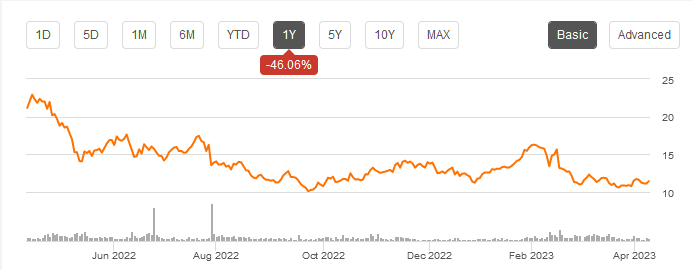
Chegg is an edtech company based in Santa Clara, California, and provides homework help, online tutoring, and other student services.  The company's value grew more than 300 percent in 2020, during the Covid pandemic, but has faced headwinds for the last two years. This includes allegations that  Chegg enables students to cheat on homework and other assignments. Derek Newton has chronicled this problem in the substack The Cheat Sheet.

[Chegg shares grew in 2020 during the Covid pandemic. Source: Seeking Alpha] 

 
Coursera is a publicly traded MOOC based in Mountain View California.  Shares started trading in April 2021.  The company has under-performed as a profit making enterprise. Massive Open Online Courses were once seen as a wave of the future in adult education but their popularity has waned. 

[Coursera has underperformed since its IPO in April 2021.  Source: Seeking Alpha]

2U (based in Lanham, MD) and Guild Education (based in Denver) and are two edtech companies based outside of Silicon Valley. 

2U is a publicly traded Online Program Manager (OPM).  The company services major universities such as the University of Southern California and University of North Carolina with support for some of their online degree programs. 2U has received an enormous amount of funding from Cathie Wood, a major Silicon Valley investor, and has continued to receive support despite a long record of financial losses.  

Some 2U investors have grown tired of persistent losses--and it has shown in the declining share price. The company also faces increased scrutiny in DC for recruiting consumers unable to recoup the cost of education for high-priced masters degrees in areas such as social work.  2U acquired edX, the Harvard-MIT MOOC in 2021 and its profitability remains to be seen.  

In 2023, 2U sued the US Department of Education for attempting to require more transparency between OPMs and their clients.  This strategy is similar to the defensive strategy that subprime colleges have used to stop gainful employment regulations, and more recently, borrower defense to repayment rules.  


 [2U shares have dropped more than 90 percent over the last 5 years. Source: Seeking Alpha]

Guild Education is a privately held corporation that grew to an estimated $4.4B evaluation in a few years. Guild serves businesses by administering online education benefits for large corporations such as Walmart, Target, and Macy's.  While its work may help companies with their bottom line, they appear to do little for their workers. 

At least ten of Guild's investors are based in Silicon Valley, including Silicon Valley Bank and venture capital firms in San Francisco, Palo Alto, and Menlo Park, California. Valuations.fyi reports Guild's estimated value at $1.3B, a 70 percent drop from its peak in June 2022. 

 
[Image above: Guild's valuation in Billions from valuations.fyi]
 
The Higher Education Inquirer will continue to observe changes in edtech as the College Meltdown advances.  


A ‘rigged’ economy and skepticism about college (Paul Fain, Open Campus)

How University of Phoenix Failed. It's a Long Story. But It's Important for the Future of Higher Education. 

The Cheat Sheet (Derek Newton)

2U Virus Expands College Meltdown to Elite Universities 

Erica Gallagher Speaks Out About 2U's Shady Practices at Department of Education Virtual Listening Meeting

Borrower Defense Claims Surpass 750,000. Consumers Empowered. Subprime Colleges and Programs Threatened.

Guild Education: Enablers of Anti-Union Corporations and Subprime College Programs 

College Meltdown 2.0 

The Growth of "RoboColleges" and "Robostudents"

The American Dream is Over (Gary Roth) 

Monday, December 30, 2024

2025 Will Be Wild!

2025 promises to be a disruptive year in higher education and society, not just in DC but across the US. While some now can see two demographic downturns, worsening climate conditions, and a Department of Education in transition, there are other less predictable and lesser-known trends and developments that we hope to cover at the Higher Education Inquirer. 

The Trump Economy

Folks are expecting a booming economy in 2025. Crypto and AI mania, along with tax cuts and deregulation, mean that corporate profits should be enormous. The Roaring 2020s will be historic for the US, just as the 1920s were, with little time and thought spent on long-range issues such as climate change and environmental destruction, economic inequality, or the potential for an economic crash.  

A Pyramid, Two Cliffs, a Wall and a Door  

HEI has been reporting about enrollment declines since 2016.  Smaller numbers of younger people and large numbers of elderly Baby Boomers and their health and disability concerns spell trouble ahead for states who may not consider higher education a priority. We'll have to see how Republican promises for mass deportations turn out, but just the threats to do so could be chaotic. There will also be controversies over the Trump/Musk plan to increase the number of H1B visas.  

The Shakeup at ED

With Linda McMahon at the helm of the Department of Education, we should expect more deregulation, more cuts, and less student loan debt relief. Mike Rounds has introduced a Senate Bill to close ED, but the Bill does not appear likely to pass. Diversity, Equity, and Inclusion (DEI) efforts may take a hit. However, online K12 education, robocolleges, and surviving online program managers could thrive in the short run.   

Student Loan Debt 

Student loan debt is expected to rise again in 2025. After a brief respite from 2020 to late 2024, and some receiving debt forgiveness, untold millions of borrowers will be expected to make payments that they may not be able to afford. How this problem affects an otherwise booming economy has not been receiving much media attention. 

Policies Against Diversity, Equity, and Inclusion

This semester at highly selective institutions, Black first-year student enrollment dropped by 16.9 percent. At MIT, the percentage of Black students decreased from 15 percent to 5 percent. At Harvard Law School, the number of Black law students has been cut by more than half.  Florida, Texas, Alabama, Iowa and Utah have banned diversity, equity and inclusion (DEI) offices at public universities. Idaho, Indiana and Kansas have prohibited colleges from requiring diversity statements in hiring and admissions. The resistance so far has been limited.

Failing Schools and Strategic Partnerships 

People should expect more colleges to fail in the coming months and years, with the possibility that the number of closures could accelerate. Small religious schools are particularly vulnerable. Colleges may further privatize their operations to save money and make money in an increasingly competitive market.

Campus Protests and Mass Surveillance

Protests may be limited out of fear of persecution, even if there are a number of legitimate issues to protest, to include human induced climate change, genocide in Palestine, mass deportations, and the resurgence of white supremacy. Things could change if conditions are so extreme that a critical mass is willing to sacrifice. Other issues, such as the growing class war, could bubble up. But mass surveillance and stricter campus policies have been emplaced at elite and name brand schools to reduce the odds of conflict and disruption.

The Legitimization of Robocollege Credentials    

Online higher education has become mainstream despite questions of its efficacy. Billions of dollars will be spent on ads for robocolleges. Religious robocolleges like Liberty University and Grand Canyon University should continue to grow and more traditional religious schools continue to shrink. University of Southern Hampshire, Purdue Global and Arizona Global will continue to enroll folks with limited federal oversight.  Adult students at this point are still willing to take on debt, especially if it leads to job promotions where an advanced credential is needed. 


Apollo Global Management is still working to unload the University of Phoenix. The sale of the school to the Idaho Board of Education or some other state organization remains in question.

AI and Cheating 

AI will continue to affect society, promising to add more jobs and threatening to take others.  One less visible way AI affects society is in academic cheating.  As long as there have been grades and competition, students have cheated.  But now it's become an industry. Even the concept of academic dishonesty has changed over the years. One could argue that cheating has been normalized, as Derek Newton of the Cheat Sheet has chronicled. Academic research can also be mass produced with AI.   

Under the Radar

A number of schools, companies, and related organizations have flown under the radar, but that could change. This includes Maximus and other Student Loan Servicers, Guild Education, EducationDynamics, South University, Ambow Education, National American University, Perdoceo, Devry University, and Adtalem. 

Related links:

Survival of the Fittest

The Coming Boom 

The Roaring 2020s and America's Move to the Right

Austerity and Disruption

Dozens of Religious Schools Under Department of Education Heightened Cash Monitoring

Shall we all pretend we didn't see it coming, again?: higher education, climate change, climate refugees, and climate denial by elites

The US Working-Class Depression: "Let's all pretend we couldn't see it coming."

Tracking Higher Ed’s Dismantling of DEI (Erin Gretzinger, Maggie Hicks, Christa Dutton, and Jasper Smith, Chronicle of Higher Education). 

Thursday, July 17, 2025

US Higher Education and the Russian Threat

In the shadow of escalating global tensions and an increasingly multipolar world, the U.S. national security apparatus is quietly reassessing risks that extend far beyond the battlefield. One such risk, largely unspoken in polite discourse, is the potential threat posed by some Russian immigrants to the United States—particularly those whose loyalties may lie with Vladimir Putin’s regime or who have deep ties to oligarchic wealth and intelligence networks.

This isn't about xenophobia or painting an entire nationality with a broad brush. Russian Americans contribute enormously to U.S. science, technology, academia, and the arts. But the geopolitical reality demands scrutiny—not silence.

A New Front in a Cold War Revival
The war in Ukraine and the subsequent deterioration of U.S.-Russia relations have reignited Cold War-era anxieties. While the most visible tensions manifest as sanctions, diplomatic expulsions, and cyberwarfare, there’s an insidious undercurrent: the possibility that Russia is using immigration channels—student visas, tech recruitment, business investments—as vehicles for influence, espionage, and destabilization.

U.S. intelligence officials have acknowledged in congressional testimony that Russian intelligence operations remain “one of the most sophisticated and aggressive in the world.” Unlike the overt threats posed by military action, these are threats wrapped in respectability—Ph.D. students at MIT, investors in Silicon Valley, and social media influencers spreading disinformation with Ivy League accents.

The Espionage Pipeline
The FBI and Department of Homeland Security have investigated numerous instances in which Russian nationals—sometimes posing as students or startup founders—were linked to intelligence-gathering operations. The 2010 spy ring that included Anna Chapman, who embedded herself in New York’s financial and academic elite, is just the tip of the iceberg.

Today, the lines between academia, tech, and national security are increasingly blurred. Universities and companies working on sensitive technologies such as AI, quantum computing, and aerospace are high-value targets for Russian and Chinese espionage. The growing presence of Russian nationals in these sectors demands vigilance—not in the form of blanket suspicion, but through rigorous security protocols and vetting.

Oligarchs in Silicon Valley and Miami
Beyond espionage, another concern is the role of Russian capital in American business and education. Since the 1990s, waves of Russian oligarchs—many with Kremlin connections—have funneled money into real estate, startups, and even philanthropic ventures in the U.S. This influx of dark money can buy influence, launder reputations, and even shape policy through think tanks, universities, and political donations.

Many Russian émigrés arrive with legitimate reasons—fleeing Putin's repression or seeking opportunity. But the U.S. must distinguish between those seeking refuge and those seeking leverage.

Universities: A Soft Target
Higher education institutions, desperate for tuition and prestige, often fail to scrutinize international applicants and donors. Some institutions, including top-tier universities, have admitted students and accepted donations without fully assessing the geopolitical implications. The Department of Education has issued warnings and begun cracking down on undisclosed foreign funding, but enforcement remains weak.

The danger is twofold: First, sensitive research and intellectual property may be accessed or exfiltrated. Second, universities can unwittingly serve as platforms for soft power, allowing adversarial states to subtly influence campus discourse, research agendas, and even media narratives.

A Call for Smart Policy, Not Scapegoating
The solution isn’t a blanket ban on Russian nationals or a new Red Scare. It’s nuanced policymaking: tougher vetting for visa applicants in sensitive fields, more transparency in university funding, and stricter rules about foreign investments in key sectors. U.S. institutions—from universities to venture capital firms—must understand that openness without discernment can be exploited.

The U.S. has always been a beacon for the world’s best minds. But in a time of hybrid warfare and information manipulation, national security must be balanced with academic freedom and immigrant inclusion. To ignore this challenge is to leave the door open—not just to students and scholars—but potentially, to spies and saboteurs.

The Higher Education Inquirer will continue to investigate the intersection of global power and American academia—where the ideals of open inquiry and democratic values are increasingly under siege from both within and without.

Thursday, March 18, 2021

Even Elite Schools Have Subprime Majors (Keil Dumsch and Dahn Shaulis)

Even elite US universities have academic majors that result in negative or low returns on investment (ROI).   The Higher Education Inquirer I looked at some of America's most elite schools and found the worst performing majors at each school.  You can find the information yourself by going to the US Department of Education's College Scorecard.  

While the College Scorecard has limitations, including incomplete and missing data, it can still be used as one tool for choosing a college and a major to study.  The College Scorecard has a section for every school called "Salary After Attending." 

If you click on "View More Details" you can see several sections, including a section titled "Salary after Completing."  If you take a look at the range and hover over the low you see the major that had the lowest performing major in terms of salaries.  

The salary ranges for some schools are enormous, and it's amazing what you will find for low salary majors at elite schools. Some may argue that the salaries are misleading if people go on to grad school or medical school, but many do not.  And of those who do continue their studies some still end up as post docs or in other less than optimum jobs while holding an even larger amount of debt.  CalTech is the only school that does not have a low-ROI major. 

Here's a sample. 

Brown, Human Biology, $27,669
Caltech, Mechanical Engineering, $83,177
Carnegie Mellon, Fine and Studio Arts, $20,140
Columbia University, Philosophy, $28,598
Cornell, Geologic and Earth Sciences/Geosciences $25,194
Dartmouth, Biology, $32,563
Duke, Area Studies, $20,262
Emory, Biology, $16,940
Georgetown, Biological and Physical Sciences, $27,476 
Harvard, Anthropology, $26,353
Johns Hopkins, Biochemistry, Biophysics, and Molecular Biology, $14,627
MIT, Biology, $35,772
New York University, Dance, $16,478
Notre Dame, Classics and Classical Languages, Literatures, and Linguistics $20,140
Princeton, Research and Experimental Psychology, $33,993
Rice, Biochemistry, Biophysics, and Molecular Biology, $24,421
Stanford University, English, $23,649
Tufts, Fine and Studio Arts, $23,538
University of California - Berkeley, Philosophy, $20,824
University of California - Los Angeles, Music, $18,498
University of Chicago, Biology, $23,649
University of Michigan - Ann Arbor, Microbiological Sciences and Immunology, $16,169
University of North Carolina - Chapel Hill, Philosophy, $18,154
University of Pennsylvania, Film, Video, and Photographic Arts, $24,035
University of Southern California, Biochemistry, Biophysics, and Molecular Biology, $10,925
University of Virginia, Drama/Theatre Arts and Stagecraft, $18,771
Vanderbilt, Biochemistry, Biophysics, and Molecular Biology, $16,663
Wake Forest University, Health and Physical Education/Fitness, $26,353
Washington University in St Louis, Biology, $16,663
Yale, Ecology, $30,771

Friday, August 1, 2025

Juiced: How HEI Uses AI—and Why Humans Still Matter

At the Higher Education Inquirer, we report on the structures that shape—and often distort—American higher education. We focus on debt, power, labor, and policy. We also use tools that help us do that work better. Artificial Intelligence is one of them. This article explains how we use AI, what concerns it raises, and why our work remains human-centered.

AI helps us review large volumes of documents, spot patterns in legal filings and government data, and summarize long reports. It helps us write more clearly and publish more regularly. It’s a tool—fast, tireless, and useful when used with care.

But we don’t trust it blindly. AI is being used in journalism and education in ways that often sidestep accountability. It generates articles, grades essays, writes marketing material, and shapes student profiles. In doing so, it introduces errors, reinforces bias, and reduces complex decisions to code. It can create false citations, misidentify sources, and spread misinformation.

AI is also replacing workers. In journalism, it’s cutting out editors and reporters. In education, it’s being sold as a cheaper alternative to faculty and staff. These changes don’t just affect paychecks. They affect trust, accuracy, and depth of understanding.

There are environmental costs too. AI requires large amounts of energy and water. Data centers draw on power grids and aquifers, often in areas already dealing with scarcity. Universities and media companies using AI at scale contribute to this footprint, even while promoting sustainability elsewhere.

There’s also the issue of psychological stress. AI-generated content is flooding screens. The volume of material, much of it shallow or repetitive, can lead to overload and distraction. Readers struggle to filter what matters. Attention suffers. The noise grows.

That’s why we still do the core of our work by hand. We write, edit, and fact-check each piece. We ask questions AI can’t: Who gains? Who loses? What’s the history? What’s being left out?

We don’t treat journalism as a technical task. It involves judgment, memory, and responsibility. AI can assist with certain parts of the process. It cannot replace what matters most.

We use AI because it helps us get more done. But we use it carefully. We know how technology can be misused in education and media. And we know the limits of what machines can do.

Sources:

American Press Institute, “How AI is Changing the Newsroom”
Columbia Journalism Review, “AI and the End of News as We Know It?”
Mozilla Foundation, “The Ethical Risks of Generative AI”
U.S. Department of Education, “Use of AI in Higher Ed: Opportunities and Concerns”
MIT Technology Review, “AI’s Carbon Footprint Is Bigger Than You Think”
Nature, “The Environmental Toll of AI”
American Psychological Association, “The Impact of Digital Overload on Mental Health”

The Higher Education Inquirer is an independent, human-run publication investigating power and inequality in U.S. higher education.

Saturday, August 10, 2024

2U Collapse Puts Sallie Mae and SLABS Back on the Radar (Glen McGhee)

The collapse of 2U and its subsidiary edX has put Sallie Mae (SLM) on the radar.  Many of those elite brand certificate programs (under the name Harvard, MIT, Cal Berkeley) were propped up by Sallie Mae private student loans. 

When the adult learners who took these certificate courses from edX did not get better jobs that they were promised, some ended up struggling to pay their loans. Some have defaulted on their loans. And a ripple occurs.  As part of a larger edtech meltdown, and with IT jobs being lost each month, the situation promises to get worse.

As a hedge for SLM, most of these loans are processed into Student Loan Asset-Backed Securities (SLABS) and sold off as assets. Large investors, including pension programs are invested directly or indirectly in this mess.

Sallie Mae Boom and Bust 

Sallie Mae (SLM) is a private lender that has had a number of problems.  Despite being bailed out by the US government and spinning off part of itself, SLM has a poor credit rating that's bad and getting worse. 

In 1972, the Nixon administration created the Student Loan Marketing Association, or “Sallie Mae” — a government-sponsored enterprise empowered by the government to use U.S. Treasury money to buy government-backed student loans from banks. 

As a publicly traded corporation Sallie Mae has benefited from decades of close government connections.

SLM was very profitable (and very predatory to consumers) when there was little oversight, and the US economy was booming. But when the Great Recession hit in 2008, SLM had to be bailed out when the US government purchased billions of dollars in government-backed student loans. After that bailout, Sallie Mae returned to maximizing profitability.  Over the last 5 years, SLM shares have gained 144 percent in value as student borrowers have suffered.   

While the economy is doing well enough for the middle class, that could change for the worse, not just for consumers, but also Sallie Mae. 

Recent Troubles, Troubles Ahead

In July 2024, Moody's changed its outlook on SLM's long-term from stable to negative, The bond ratings were already less than stellar, a Ba1 for senior unsecured notes. Ratings for some of its Student Loan Asset-Backed Securities were downgraded in 2022. 

Help for Student Debtors

For student loan debtors, we recommend joining the Debt Collective and contacting other advocates, including the Student Borrower Protection Center and the Project on Predatory Student Lending.

Related links:

2U Suspended from NASDAQ. Help for USC and UNC Student Loan Debtors.

2U Declares Chapter 11 Bankruptcy. Will Anyone Else Name All The Elite Universities That Were Complicit?

HurricaneTWOU.com: Digital Protest Exposes Syracuse, USC, Pepperdine, and University of North Carolina in 2U edX Edugrift (2024)

2U-edX crash exposes the latest wave of edugrift (2023)

2U Virus Expands College Meltdown to Elite Universities (2019)

Buyer Beware: Servicemembers, Veterans, and Families Need to Be On Guard with College and Career Choices (2021)

College Meltdown 2.1 (2022)

EdTech Meltdown (2023)  

Erica Gallagher Speaks Out About 2U's Shady Practices at Department of Education Virtual Listening Meeting (2023)

Tuesday, November 4, 2025

When Was Higher Education Truly a Public Good? (Glen McGhee)

Like staring at the Sun too long, that brief window in time, when higher ed was a public good, has left a permanent hole for nostalgia to leak in, becoming a massive black hole for trillions of dollars, and a blind-spot for misguided national policies and scholars alike. 

The notion that American higher education was ever a true public good is largely a myth. From the colonial colleges to the neoliberal university of today, higher education has functioned primarily as a mechanism of class reproduction and elite consolidation—with one brief, historically anomalous exception during the Cold War.


Colonial Roots: Elite Reproduction in the New World (1636–1787)

The first American colleges—Harvard, William and Mary, Yale, Princeton, and a handful of others—were founded not for the benefit of the public, but to serve narrow elite interests. Their stated missions were to train Protestant clergy and prepare the sons of wealthy white families for leadership. They operated under monopoly charters and drew funding from landowners, merchants, and slave traders.

Elihu Yale, namesake of Yale University, derived wealth from his commercial ties to the East India Company and the slave trade. Harvard’s early trustees owned enslaved people. These institutions functioned as “old boys’ clubs,” perpetuating privilege rather than promoting equality. Their educational mission was to cultivate “gentlemen fit to govern,” not citizens of a democracy.


Private Enterprise in the Republic (1790–1860)

After independence, the number of colleges exploded—from 19 in 1790 to more than 800 by 1880—but not because of any commitment to the public good. Colleges became tools for two private interests: religious denominations seeking influence, and land speculators eager to raise property values.

Ministers often doubled as land dealers, founding small, parochial colleges to anchor towns and boost prices. State governments played a minimal role, providing funding only in times of crisis. The Supreme Court’s 1819 Dartmouth College decision enshrined institutional autonomy, shielding private colleges from state interference. Even state universities were created mainly out of interstate competition—every state needed its own to “keep up with its neighbors.”


Gilded Age and Progressive Era: Credential Capitalism (1880–1940)

By the late 19th century, industrial capitalism had transformed higher education into a private good—something purchased for individual advancement. As family farms and small businesses disappeared, college credentials became the ticket to white-collar respectability.

Sociologist Burton Bledstein called this the “culture of professionalism.” Families invested in degrees to secure middle-class futures for their children. By the 1920s, most students attended college not to seek enlightenment, but “to get ready for a particular job.”

Elite universities such as Harvard, Yale, and Princeton solidified their dominance through exclusive networks. C. Wright Mills later observed that America’s “power elite” circulated through these same institutions and their associated clubs. Pierre Bourdieu’s concept of cultural capital helps explain this continuity: elite universities convert inherited privilege into certified merit, preserving hierarchy under the guise of meritocracy.


The Morrill Acts: Public Promise, Private Gains (1862–1890)

The Morrill Act of 1862 established land-grant colleges to promote “practical education” in agriculture and engineering. While often cited as a triumph of public-minded policy, the act’s legacy is ambivalent.

Land-grant universities were built on land expropriated from Indigenous peoples—often without compensation—and the 1890 Morrill Act entrenched segregation by mandating separate institutions for Black Americans in the Jim Crow South. Even as these colleges expanded access for white working-class men, they simultaneously reinforced racial and economic hierarchies.


Cold War Universities: The Brief Public Good (1940–1970)

For roughly thirty years, during World War II and the Cold War, American universities functioned as genuine public goods—but only because national survival seemed to depend on them.

The GI Bill opened college to millions of veterans, stabilizing the economy and expanding the middle class. Massive federal investments in research transformed universities into engines of technological and scientific innovation. The university, for a moment, was understood as a public instrument for national progress.

Yet this golden age was marred by exclusion. Black veterans were often denied GI Bill benefits, particularly in the South, where discriminatory admissions and housing policies blocked their participation. The “military-industrial-academic complex” that emerged from wartime funding created a new elite network centered on research universities like MIT, Stanford, and Berkeley.


Neoliberal Regression: Education as a Private Commodity (1980–Present)

After 1970, the system reverted to its long-standing norm: higher education as a private good. The Cold War’s end, the tax revolt, and the rise of neoliberal ideology dismantled the postwar consensus.

Ronald Reagan led the charge—first as California governor, cutting higher education funding by 20%, then as president, slashing federal support. He argued that tuition should replace public subsidies, casting education as an individual investment rather than a social right.

Since 1980, state funding per student has fallen sharply while tuition at public universities has tripled. Students are now treated as “customers,” and universities as corporations—complete with branding departments, executive pay packages, and relentless tuition hikes.


The Circuit of Elite Network Capital

Today, the benefits of higher education flow through a closed circuit of power that links elite universities, corporations, government agencies, and wealthy families.

  1. Elite Universities consolidate wealth and prestige through research funding, patents, and endowments.

  2. Corporations recruit talent and license discoveries, feeding the same institutions that produce their executives.

  3. Government and Military Agencies are staffed by alumni of elite universities, reinforcing a revolving door of privilege.

  4. Elite Professions—law, medicine, finance, consulting—use degrees as gatekeeping mechanisms, driving credential inflation.

  5. Wealthy Families invest in elite education as a means of preserving status across generations.

What the public receives are only residual benefits—technologies and medical innovations that remain inaccessible without money or insurance.


Elite Network Capital, Not Public Good

The idea of higher education as a public good has always been more myth than reality. For most of American history, colleges and universities have functioned as institutions of elite reproduction, not engines of democratic uplift.

Only during the extraordinary conditions of the mid-20th century—when global war and ideological conflict made mass education a national imperative—did higher education briefly align with the public interest.

Today’s universities continue to speak the language of “public good,” but their actions reveal a different truth. They serve as factories of credentialism and as nodes in an elite network that translates privilege into prestige. What masquerades as a public good is, in practice, elite network capital—a system designed not to democratize opportunity, but to manage and legitimize inequality.


Sources:
Labaree (2017), Bledstein (1976), Bourdieu (1984, 1986), Mills (1956), Geiger (2015), Thelin (2019), and McGhee (2025).

Tuesday, January 6, 2026

End of an Era

For now, we have suspended our three decade long run of citizen journalism and will let you know where we go from here.  Two of our other publications, American Injustice and street sociologist are also closed, but remain online for now on Blogger. 


Our Anti-SLAPP lawsuit (Chip Paucek and Pro Athlete Community v Dahn Shaulis) is pending. While the legal bill is enormous, we expect to win. In the meantime, please support independent voices like Democracy Now!, Richard Wolff, Robert A. Pape, Julie K. Brown, Roger Sollenberger, and Troy Barile. 
**********************************************
Use the search tools and click on these hashtags for more information from the College Meltdown and Higher Education Inquirer archives.  
#1stAmendment #2025 #2026 #2U #accountability #addiction #adjunct #AFT #AI #AImeltdown #alcoholism #algo #algorithm #alienation #Ambow #anomie #anti-intellectual #anxiety #Apollo #austerity #BariWeiss #Baylor
#collegemeltdown #collegetown #covid #credentialism #crypto #CTE #debtcollective #degowning #dehumanization #DEI #democracy #deportation 
#dissent #diversity #DOD #DOGE #divest #doomloop #dualenrollment #edtech #edugrift #enshittification #Epstein #epsteinfiles #FAFSA #fascism #FOXnews #freespeech #genocide #Gini #greed #Harvard  #HBCU #Hegseth #HHS #history #ICE #IDR #immigration #incel #India #inequality #Intel #Iran #jobless #kleptocracy #labor #law #lawlessness #lawschool #leadgen #LibertyUniversity #LibertyUniversityOnline #medschool #medugrift #militarization #MIT #moralcapital #Musk 
#veritas #virtue #Vistria #wikipedia #Yale

*****************************************************

   Higher Education and Class Sorting. Image by Glen McGhee

On our last full day of operation, we extend our deepest gratitude to the many courageous voices who have contributed to the Higher Education Inquirer over the years. Through research, reporting, whistleblowing, analysis, and public service, you have exposed inequities, challenged powerful interests, and helped the public understand the realities of higher education. Together, you form a resilient network of knowledge, courage, and public service, showing that collective insight can illuminate even the most entrenched systems. Your dedication has been, and continues to be, invaluable.

Special thanks to:
Bryan Alexander (Future Trends Forum), J. J. Anselmi (author), Devarian Baldwin (Trinity College),  Lisa Bannon (Wall Street Journal), Joe Berry (Higher Education Labor United), Kate Bronfenbrenner (Cornell), Stephen Burd (New America), Ann Bowers (Debt Collective), James Michael Brodie (Black and Gold Project Foundation), Patrick Campbell (Vets Ed Brief), Richard Cannon (activist), Kirk Carapezza (WGBH), Kevin L. Clay (Rutgers), Randall Collins (UPenn), Marianne Dissard (activist), Cory Doctorow, William Domhoff (UC Santa Cruz), Ruxandra Dumitriu, Keil Dumsch, Garrett Fitzgerald (College Recon), Glen Ford (with the ancestors), Richard Fossey (Condemned to Debt), Erica Gallagher (2U Whistleblower), Cliff Gibson III (Gibson & Keith), Henry Giroux (McMaster University), Terri Givens (University of British Columbia), Aaron Glantz, Luke Goldstein (The Lever),  Nathan Grawe (Carleton College), Michael Green (UNLV), Michael Hainline (Restore the GI Bill for Veterans), Debra Hale Shelton (Arkansas Times), Stephanie M. Hall (Protect Borrowers),  David Halperin (Republic Report), Bill Harrington (Croatan Institute), Phil Hill (On EdTech), Investor X (business insider), Robert Jensen (UT Austin), Seth Kahn (WCUP), Hank Kalet (Rutgers), Ben Kaufman (Protect Borrowers), Robert Kelchen (University of Tennessee), Karen Kelsky (The Professor Is In), Neil Kraus (UWRF), LACCD Whistleblower, Michelle Lee (whistleblower), Wendy Lynne Lee (Bloomsburg University of PA), Emmanuel Legeard (whistleblower), Adam Looney (University of Utah), Alec MacGillis (ProPublica), Jon Marcus (Hechinger Report), Steven Mintz (University of Texas), John D. Murphy (Mission Forsaken), Annelise Orleck (Dartmouth), Margaret Kimberly (Black Agenda Report), Austin Longhorn (UT student loan debt whistleblower), Richard Pollock (journalist), Debbi Potts (whistleblower), Jack Metzger (Roosevelt University), Derek Newton (The Cheat Sheet), Jeff Pooley (Annenberg Center), Fahmi Quadir (Safkhet Capital), Chris Quintana (USA Today), Jennifer Reed (University of Akron), Kevin Richert (Idaho Education News), Gary Roth (Rutgers-Newark), Mark Salisbury (TuitionFit), Stephanie Saul (NY Times), Christopher Serbagi (Serbagi Law), Alex Shebanow  (Fail State), Bob Shireman (TCF), Bill Skimmyhorn (William & Mary), Peter Simi (Chapman University), Jeffrey Sonnenfeld (Yale), Gary Stocker (College Viability), Strelnikov (Wikipedia Sucks), Taylor Swaak (Chronicle of Higher Education), Theresa Sweet (Sweet v Cardona), Harry Targ (Purdue University), Moe Tkacik (American Prospect),  Kim Tran (activist), Mark Twain Jr. (business insider), Michael Vasquez (The Tributary), Marina Vujnovic (Monmouth), Richard Wolff (Economic Update), David Whitman, Todd Wolfson (Rutgers, AFT), Helena Worthen (Higher Ed Labor United), DW (South American Correspondent), Heidi Weber (Whistleblower Revolution), Michael Yates (Monthly Review), government officials who have supported transparency and accountability, and the countless other educators, researchers, whistleblowers, advocates, and public servants whose work strengthens our understanding of higher education.

Dum spiro spero  (While I breathe, I hope),

Dahn Shaulis and Glen McGhee