Showing posts sorted by date for query deportation. Sort by relevance Show all posts
Showing posts sorted by date for query deportation. Sort by relevance Show all posts
Tuesday, March 11, 2025
Lawyer for Columbia University student detained by ICE for pro-Palestine protests speaks out (ABC News)
ABC News’ Linsey Davis speaks with Baher Azmy, the lawyer for Columbia University student Mahmoud Khalil, who was arrested by Immigration and Customs Enforcement (ICE) despite having a green card. Khalil is currently detained in a Department of Homeland Security (DHS) facility in Jena, Louisiana. A judge has temporarily blocked Khalil's deportation. President Trump says that this action is just the beginning of such actions by the government.

Tuesday, February 11, 2025
Indian Students getting Swept Up in Donald Trump's Deportation Drive? (Palki Sharma, Vantage)
From FirstPost:
Reports say that Indian Students in the US are becoming collateral damage amidst President Donald Trump's Mass Deportation Drive. The Indian students entered the US legally, on valid visas. But they say they are now being subjected to more frequent questioning from US immigration officials. They say uniformed officers have been questioning them more frequently, and demanding to see their student IDs and documents. Is Trump's deportation drive becoming an all out purge of migrants, irrespective of whether they're in the US legally or not?
Thursday, February 6, 2025
Trump is Using Jews, Not Protecting Us (Hank Kalet, Channel Surfing)
His Executive Order on Antisemitism is a Threat to Muslims and Palestinians on Campuses and an Attack on the First Amendment

Police in New South Wales state, which includes Sydney, said on Wednesday they had found explosives in a caravan, or trailer, that could have created a blast wave of 40 metres (130 feet).
There was some indication the explosives might be used in an antisemitic attack that could have caused mass casualties, police said.
There also was an apparently coordinated set of “graffiti attacks” on Jewish sites that have caused the Australian Jewish community to increase security. Similar security efforts are being ramped up by Jewish groups in Europe as threats of antisemitic acts and the growth of the Far Right stoke fears.
Share
There have been reports of violent and deadly incidents throughout Europe, as well, with direct attacks on synagogues and other Jewish institutions. And there are leaders like Viktor Orhan in Hungary and political parties like Alternative for Germany who use antisemitic language and tropes, though often sanitized, amid their more targeted attacks on Muslim immigrants.
Syndicate or Reuse
Books by Hank Kalet
The United States is not immune to antisemitism, of course, but American Jews seem unable to focus on the real threats. Rather than keep our eyes trained on an ascendant right wing — including many of the people in President Donald Trump’s immediate circle, including the president himself — much of the Jewish community is focused on Israel and seems intent on conflating criticism of Israel, its war on Gaza, and the occupation with actual systemic anti-Jewish action.
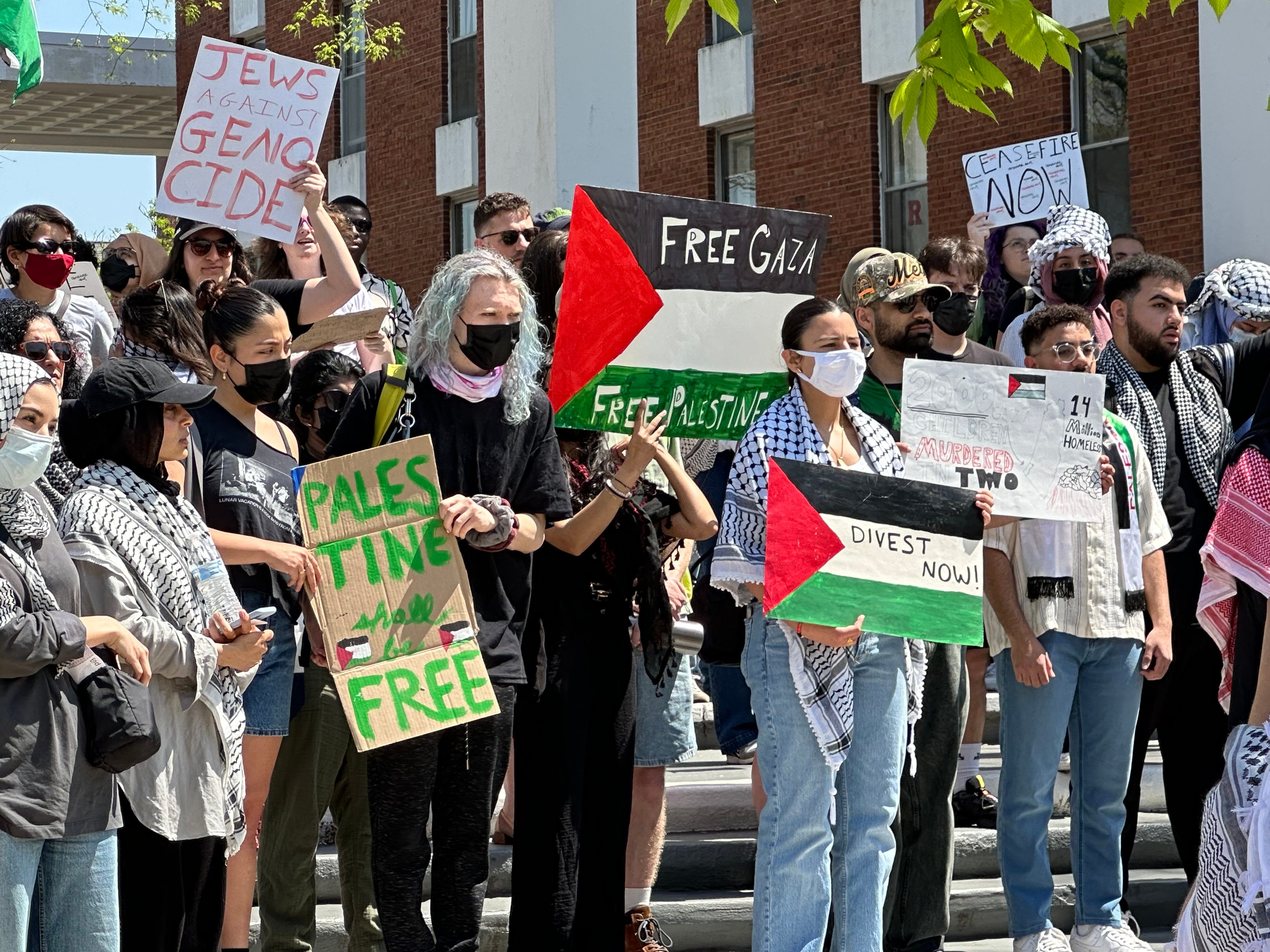
This is the context for Wednesday’s executive order on “combatting antisemitism,” which targets campus protests and continues a Conservative/Republican push to peel Jews away from teh Democratic Party.
The order, as reported by The Washington Post, “is directed at universities where pro-Palestinian protests broke out last year,” and “threatens to revoke student visas of foreign students who participated in pro-Palestinian protests.”
Supporters of the order argue that these protests were antisemitic. They point to some uncomfortable speech — the equation of Israel with the Nazis, for instance — as proof, and then conflate sloganeering and assembly with physical harassment. Jewish students and faculty, the argument goes, were made uncomfortable by the protests and encampments and felt unsafe. That sense of fear, they say, proves that the protests were designed to harass, even if there was no direct harassment. It is a circular argument, but one endorsed by much of the American political establishment and leading Jewish organizations
Marc H. Ellis addresses the underlying issues with these arguments in his 2009 book Judaism Does Not Equal Israel.1 He describes what I’ll call a “triumphalist Judaism” that mixes Holocaust victimhood with Exodus (the novel) power, constructed in “the aftermath of the great Israeli triumph in the 1967 Arab-Israeli war” (6). That narrative posits several myths: that Palestine was empty and underutilized and had to be redeemed, that the “Arabs” were hostile to Jews as Jews, and that the state that was founded and that still exists remains a democratic outpost in a hostile world. This triumphalism, however, was also tied to our very real history as a persecuted minority. “Jews had once been weak and helpless,” he writes, but that was no longer the case. Yet, “our theology was telling us we were still. The fact was just the opposite. We had become empowered” and were acting as a regional power (59).
The current power dynamics in Israel/Palestine and the actual history — the forced removal of Palestinians from what is now the state and the continued usurpation of land — are treated as though they are benign acts. Israel — Jews — has become the victimizer in the region, acting as a colonial power, an occupying force.
What was “psychological,” he writes, has become “strategic.”
“If we owned up to our newfound power, we would have to be accountable for and to it. We would have to relinquish the Holocaust as the backdrop to everything Jewish.”
So Oct. 7 and the ensuing war play out as if they were new and shocking rather than as another battle — the deadliest and most traumatic, to be sure — in a decades-long rebellion by Palestinians against suppress and control by Israel.
The argument is based on an underlying anti-Muslim/anti-Arab bias that mirrors the hate and discrimination that Jews have faced across our history. It is evident in the language we (Americans and Jews) use consistently to refer to Arabs, Muslims, Palestine, and Israel. Arabs and Muslims continued to be seen as terrorists, even as the “not all” modifier is added.
Deena R. Hurwitz and Walther H. White Jr., in an article at the American Bar Association website, cite authors Sahar Aziz and John Esposito’s May 2024 book, Global Islamophobia and the Rise of Populism, to underscore a “disturbing rise of Islamophobia worldwide.”
Blaming Muslim minorities for economic, political, and social problems is an increasingly common rhetorical strategy for politicians in countries globally. A narrative of the “threatening Muslim invader” is prevalent, regardless of whether the targets of such rhetoric are born citizens or new arrivals.
Trump, for instance, mixes Islamophobic and xenophobic language as he calls for closing the borders. At the same time, he and his conservative allies rely on both anti- and philosemitic imagery when talking with and about Jews.
“In the United States, Europe, and India, Islamophobic rhetoric is essentially normalized,” Hurwitz and White write.
The use of this rhetoric reduces the history and diversity within the Muslim and Arab communities (and within the Jewish community) to “a set of stereotyped characteristics most often reducible to themes of violence, civilizational subversion, and fundamental otherness.”
Anti-Palestinian racism silences, excludes, erases, stereotypes, defames, and dehumanizes Palestinians. This is used to deny and justify violence against Palestinians and fails to acknowledge Palestinians as Indigenous people with a collective identity while erasing their human rights and equal dignity and worth.
Trump’s executive order builds on this structure of anti-Muslim/anti-Arab thought, while also endorsing stereotypes of Jews as a model minority in need of special protection — even as he dismantles what he calls the “DEI regime.” Pitting Jewish and Muslim communities against each other creates hierarchies among aggrieved groups, which the right can then use to abrogate our rights of speech, assembly, and petition. It’s also a solution that is out of proportion to the problem.
It creates a threat to international students (mostly Muslim) based purely on their protected speech and assembly, while doing nothing to improve the actual safety of Jewish students. Remember, we already have strong protections in most jurisdictions; prohibiting speech does nothing to address this.
Alex Morey of the Foundation for Individual Rights and Expression, a group that defends speech and academic freedom on campus and that has usually been allied with more conservative groups, describes what I’ll call an existential threat. She told the Forward that the order’s language might push universities to crack down on protest, because it functions as an implied threat — to funding and to visas.
Morey said that her organization was already fielding frantic queries from international students at American universities who are worried about being caught in a legal dragnet.
“These are not students that got arrested at a protest or vandalized a building, these are students who just went out and protested,” she said. “What we don’t want to see is schools saying, ‘Hey, Students for Justice in Palestine, I’m going to need a list of everyone in that club and we’re going to comb it for foreign students.’”
What we are talking about is the loss of immigration status and potential deportation as retribution for protest. It is a direct attack on the 14th Amendment’s equal rights clause, which provides “any person within (the United States) the equal protection of the laws,” including the First Amendment’s five basic freedoms.
The order brings together several of Trump’s favorite targets — higher education, Muslims, immigrants and protesters — and is part of a broader effort to undermine the academic freedom and speech rights of faculty and students in higher education. Trump is a wannabe autocrat. He sees these groups as a threat to his control. While fighting antisemitism is the ostensible reason for the order, the larger targets are our democratic institutions.
Channel Surfing is a reader-supported publication. To receive new posts and support my work, consider becoming a free or paid subscriber.
Tuesday, February 4, 2025
Tuesday, January 21, 2025
Student Booted from PhD Program Over AI Use (Derek Newton/The Cheat Sheet)
 |
This one is going to take a hot minute to dissect. Minnesota Public Radio (MPR) has the story.
The plot contours are easy. A PhD student at the University of Minnesota was accused of using AI on a required pre-dissertation exam and removed from the program. He denies that allegation and has sued the school — and one of his professors — for due process violations and defamation respectively.
Starting the case.
The coverage reports that:
all four faculty graders of his exam expressed “significant concerns” that it was not written in his voice. They noted answers that seemed irrelevant or involved subjects not covered in coursework. Two instructors then generated their own responses in ChatGPT to compare against his and submitted those as evidence against Yang. At the resulting disciplinary hearing, Yang says those professors also shared results from AI detection software.
Personally, when I see that four members of the faculty unanimously agreed on the authenticity of his work, I am out. I trust teachers.
I know what a serious thing it is to accuse someone of cheating; I know teachers do not take such things lightly. When four go on the record to say so, I’m convinced. Barring some personal grievance or prejudice, which could happen, hard for me to believe that all four subject-matter experts were just wrong here. Also, if there was bias or petty politics at play, it probably would have shown up before the student’s third year, not just before starting his dissertation.
Moreover, at least as far as the coverage is concerned, the student does not allege bias or program politics. His complaint is based on due process and inaccuracy of the underlying accusation.
Let me also say quickly that asking ChatGPT for answers you plan to compare to suspicious work may be interesting, but it’s far from convincing — in my opinion. ChatGPT makes stuff up. I’m not saying that answer comparison is a waste, I just would not build a case on it. Here, the university didn’t. It may have added to the case, but it was not the case. Adding also that the similarities between the faculty-created answers and the student’s — both are included in the article — are more compelling than I expected.
Then you add detection software, which the article later shares showed high likelihood of AI text, and the case is pretty tight. Four professors, similar answers, AI detection flags — feels like a heavy case.
Denied it.
The article continues that Yang, the student:
denies using AI for this exam and says the professors have a flawed approach to determining whether AI was used. He said methods used to detect AI are known to be unreliable and biased, particularly against people whose first language isn’t English. Yang grew up speaking Southern Min, a Chinese dialect.
Although it’s not specified, it is likely that Yang is referring to the research from Stanford that has been — or at least ought to be — entirely discredited (see Issue 216 and Issue 251). For the love of research integrity, the paper has invented citations — sources that go to papers or news coverage that are not at all related to what the paper says they are.
Does anyone actually read those things?
Back to Minnesota, Yang says that as a result of the findings against him and being removed from the program, he lost his American study visa. Yang called it “a death penalty.”
With friends like these.
Also interesting is that, according to the coverage:
His academic advisor Bryan Dowd spoke in Yang’s defense at the November hearing, telling panelists that expulsion, effectively a deportation, was “an odd punishment for something that is as difficult to establish as a correspondence between ChatGPT and a student’s answer.”
That would be a fair point except that the next paragraph is:
Dowd is a professor in health policy and management with over 40 years of teaching at the U of M. He told MPR News he lets students in his courses use generative AI because, in his opinion, it’s impossible to prevent or detect AI use. Dowd himself has never used ChatGPT, but he relies on Microsoft Word’s auto-correction and search engines like Google Scholar and finds those comparable.
That’s ridiculous. I’m sorry, it is. The dude who lets students use AI because he thinks AI is “impossible to prevent or detect,” the guy who has never used ChatGPT himself, and thinks that Google Scholar and auto-complete are “comparable” to AI — that’s the person speaking up for the guy who says he did not use AI. Wow.
That guy says:
“I think he’s quite an excellent student. He’s certainly, I think, one of the best-read students I’ve ever encountered”
Time out. Is it not at least possible that professor Dowd thinks student Yang is an excellent student because Yang was using AI all along, and our professor doesn’t care to ascertain the difference? Also, mind you, as far as we can learn from this news story, Dowd does not even say Yang is innocent. He says the punishment is “odd,” that the case is hard to establish, and that Yang was a good student who did not need to use AI. Although, again, I’m not sure how good professor Dowd would know.
As further evidence of Yang’s scholastic ability, Dowd also points out that Yang has a paper under consideration at a top academic journal.
You know what I am going to say.
To me, that entire Dowd diversion is mostly funny.
More evidence.
Back on track, we get even more detail, such as that the exam in question was:
an eight-hour preliminary exam that Yang took online. Instructions he shared show the exam was open-book, meaning test takers could use notes, papers and textbooks, but AI was explicitly prohibited.Exam graders argued the AI use was obvious enough. Yang disagrees.Weeks after the exam, associate professor Ezra Golberstein submitted a complaint to the U of M saying the four faculty reviewers agreed that Yang’s exam was not in his voice and recommending he be dismissed from the program. Yang had been in at least one class with all of them, so they compared his responses against two other writing samples.
So, the exam expressly banned AI. And we learn that, as part of the determination of the professors, they compared his exam answers with past writing.
I say all the time, there is no substitute for knowing your students. If the initial four faculty who flagged Yang’s work had him in classes and compared suspicious work to past work, what more can we want? It does not get much better than that.
Then there’s even more evidence:
Yang also objects to professors using AI detection software to make their case at the November hearing.He shared the U of M’s presentation showing findings from running his writing through GPTZero, which purports to determine the percentage of writing done by AI. The software was highly confident a human wrote Yang’s writing sample from two years ago. It was uncertain about his exam responses from August, assigning 89 percent probability of AI having generated his answer to one question and 19 percent probability for another.“Imagine the AI detector can claim that their accuracy rate is 99%. What does it mean?” asked Yang, who argued that the error rate could unfairly tarnish a student who didn’t use AI to do the work.
First, GPTZero is junk. It’s reliably among the worst available detection systems. Even so, 89% is a high number. And most importantly, the case against Yang is not built on AI detection software alone, as no case should ever be. It’s confirmation, not conviction. Also, Yang, who the paper says already has one PhD, knows exactly what an accuracy rate of 99% means. Be serious.
A pattern.
Then we get this, buried in the news coverage:
Yang suggests the U of M may have had an unjust motive to kick him out. When prompted, he shared documentation of at least three other instances of accusations raised by others against him that did not result in disciplinary action but that he thinks may have factored in his expulsion.He does not include this concern in his lawsuits. These allegations are also not explicitly listed as factors in the complaint against him, nor letters explaining the decision to expel Yang or rejecting his appeal. But one incident was mentioned at his hearing: in October 2023, Yang had been suspected of using AI on a homework assignment for a graduate-level course.In a written statement shared with panelists, associate professor Susan Mason said Yang had turned in an assignment where he wrote “re write it, make it more casual, like a foreign student write but no ai.” She recorded the Zoom meeting where she said Yang denied using AI and told her he uses ChatGPT to check his English.She asked if he had a problem with people believing his writing was too formal and said he responded that he meant his answer was too long and he wanted ChatGPT to shorten it. “I did not find this explanation convincing,” she wrote.
I’m sorry — what now?
Yang says he was accused of using AI in academic work in “at least three other instances.” For which he was, of course, not disciplined. In one of those cases, Yang literally turned in a paper with this:
“re write it, make it more casual, like a foreign student write but no ai.”
He said he used ChatGPT to check his English and asked ChatGPT to shorten his writing. But he did not use AI. How does that work?
For that one where he left in the prompts to ChatGPT:
the Office of Community Standards sent Yang a letter warning that the case was dropped but it may be taken into consideration on any future violations.
Yang was warned, in writing.
If you’re still here, we have four professors who agree that Yang’s exam likely used AI, in violation of exam rules. All four had Yang in classes previously and compared his exam work to past hand-written work. His exam answers had similarities with ChatGPT output. An AI detector said, in at least one place, his exam was 89% likely to be generated with AI. Yang was accused of using AI in academic work at least three other times, by a fifth professor, including one case in which it appears he may have left in his instructions to the AI bot.
On the other hand, he did say he did not do it.
Findings, review.
Further:
But the range of evidence was sufficient for the U of M. In the final ruling, the panel — comprised of several professors and graduate students from other departments — said they trusted the professors’ ability to identify AI-generated papers.
Several professors and students agreed with the accusations. Yang appealed and the school upheld the decision. Yang was gone. The appeal officer wrote:
“PhD research is, by definition, exploring new ideas and often involves development of new methods. There are many opportunities for an individual to falsify data and/or analysis of data. Consequently, the academy has no tolerance for academic dishonesty in PhD programs or among faculty. A finding of dishonesty not only casts doubt on the veracity of everything that the individual has done or will do in the future, it also causes the broader community to distrust the discipline as a whole.”
Slow clap.
And slow clap for the University of Minnesota. The process is hard. Doing the review, examining the evidence, making an accusation — they are all hard. Sticking by it is hard too.
Seriously, integrity is not a statement. It is action. Integrity is making the hard choice.
MPR, spare me.
Minnesota Public Radio is a credible news organization. Which makes it difficult to understand why they chose — as so many news outlets do — to not interview one single expert on academic integrity for a story about academic integrity. It’s downright baffling.
Worse, MPR, for no specific reason whatsoever, decides to take prolonged shots at AI detection systems such as:
Computer science researchers say detection software can have significant margins of error in finding instances of AI-generated text. OpenAI, the company behind ChatGPT, shut down its own detection tool last year citing a “low rate of accuracy.” Reports suggest AI detectors have misclassified work by non-native English writers, neurodivergent students and people who use tools like Grammarly or Microsoft Editor to improve their writing.“As an educator, one has to also think about the anxiety that students might develop,” said Manjeet Rege, a University of St. Thomas professor who has studied machine learning for more than two decades.
We covered the OpenAI deception — and it was deception — in Issue 241, and in other issues. We covered the non-native English thing. And the neurodivergent thing. And the Grammarly thing. All of which MPR wraps up in the passive and deflecting “reports suggest.” No analysis. No skepticism.
That’s just bad journalism.
And, of course — anxiety. Rege, who please note has studied machine learning and not academic integrity, is predictable, but not credible here. He says, for example:
it’s important to find the balance between academic integrity and embracing AI innovation. But rather than relying on AI detection software, he advocates for evaluating students by designing assignments hard for AI to complete — like personal reflections, project-based learnings, oral presentations — or integrating AI into the instructions.
Absolute joke.
I am not sorry — if you use the word “balance” in conjunction with the word “integrity,” you should not be teaching. Especially if what you’re weighing against lying and fraud is the value of embracing innovation. And if you needed further evidence for his absurdity, we get the “personal reflections and project-based learnings” buffoonery (see Issue 323). But, again, the error here is MPR quoting a professor of machine learning about course design and integrity.
MPR also quotes a student who says:
she and many other students live in fear of AI detection software.“AI and its lack of dependability for detection of itself could be the difference between a degree and going home,” she said.
Nope. Please, please tell me I don’t need to go through all the reasons that’s absurd. Find me one single of case in which an AI detector alone sent a student home. One.
Two final bits.
The MPR story shares:
In the 2023-24 school year, the University of Minnesota found 188 students responsible of scholastic dishonesty because of AI use, reflecting about half of all confirmed cases of dishonesty on the Twin Cities campus.
Just noteworthy. Also, it is interesting that 188 were “responsible.” Considering how rare it is to be caught, and for formal processes to be initiated and upheld, 188 feels like a real number. Again, good for U of M.
The MPR article wraps up that Yang:
found his life in disarray. He said he would lose access to datasets essential for his dissertation and other projects he was working on with his U of M account, and was forced to leave research responsibilities to others at short notice. He fears how this will impact his academic career
Stating the obvious, like the University of Minnesota, I could not bring myself to trust Yang’s data. And I do actually hope that being kicked out of a university for cheating would impact his academic career.
And finally:
“Probably I should think to do something, selling potatoes on the streets or something else,” he said.
Dude has a PhD in economics from Utah State University. Selling potatoes on the streets. Come on.
(Editors note: This article first appeared at Derek Newton's The Cheat Sheet.)
Thursday, September 26, 2024
Elite Universities on Lockdown. Protestors Regroup.
[Updated 9-29-24]
Elite universities have changed their policies to significantly reduce free speech and free assembly. In response, college students and their faculty allies are having to regroup and rethink how they protest the US-Israel war against Palestine as it expands in the Middle East. On the establishment side, will universities further crack down on students and faculty, wherever peaceful protests might occur?
Campus "Crime and Punishment"
Elite universities like UCLA have dramatically reduced the areas that students can speak and assemble freely, restricting protesters to free speech zones, a common tactic used by the US government during the War on Terror. Universities have also upped surveillance measures and punished students involved in protests, with limited due process.
The visible resistance may now be limited on campuses where students have been detained, assaulted, arrested, expelled, and banned from campus. Foreign students wary of facing deportation may also be keeping quiet, publicly.
In California, Governor Gavin Newsom has signed a bill to update public university codes of conduct "and train students on how to protest
with civility, a response to pro-Palestinian demonstrations that erupted
across the state last spring." The bill was opposed by pro-Palestinian Groups and the ACLU.
Protests Off Campus
There have been a number of protests against the US-backed war that has expanded from Gaza, to the Occupied West Bank, Lebanon, Yemen, Syria, and Iran. Demonstrations have been held in New York, Chicago, Los Angeles, Washington, DC and other college towns, including Iowa City, home of the University of Iowa. Those protests will be closely observed and documented by law enforcement.
With the help of the American Legislative Exchange Council (ALEC) and the fossil fuel lobby, states have already crafted anti-protest legislation to reduce public free speech and free assembly. According to the UK Guardian, 45 states have considered new anti-protest legislation since 2017.
Protests on Campus
Over the last week, there were small protests at Penn State University and the University of Arizona. The Penn State demonstration, which had about 60 attendees, was supported by Penn State Students for Justice in Palestine (SJP), the Student Committee for Defense and Solidarity (SCDS), the Muslim Students’ Association (MSA), the United Socialists at Penn State (USPSU) and the People's Defense Front - Northern Appalachia. The impromptu Arizona protest was set up by the Party for Socialism and Liberation. At Cornell University, about 100 students protested a career fair that included defense contractors Boeing and L3 Harris. It's not surprising that these demonstrations would be small, given recent crackdowns across the country.
Collaboration Between Elite Schools and Law Enforcement
Will elite schools work with law enforcement at the local, state, federal, and international level to further restrict free speech and freedom of assembly? And university administrators try to quell dissent, will students be more harshly disciplined for planning and engaging in peaceful protests, of any type, on and off campus?
Related links:
Democratic Protests on Campus: Modeling the Better World We Seek (Annelise Orleck)
Methods of Student Nonviolent Resistance
Wikipedia Community Documents Pro-Palestinian Protests on University and College Campuses
One Fascism or Two?: The Reemergence of "Fascism(s)" in US Higher Education
A People's History of Higher Education in the USMonday, July 22, 2024
How Would Trump's Plans for Mass Deportations Affect US Higher Education?

This America First plan would expel about 11 million men, women, and children, break up millions of families and an untold number of communities, and affect not just businesses but entire industries. Deportees would include those who have crossed the borders with Mexico and Canada. But it could also include hundreds of thousands of non-white workers who have had their visas expire for a number of reasons, including temporary unemployment.
Those folks who concerned about these mass deportations should take Trump and Vance's words seriously--and vote accordingly. Struggling citizens who believe they will get better work or have a better life as a result of Trump policies should also consider whether this is true--and also consider all the other structural reasons for their plight--and vote accordingly. Before November, everyone who is voting should also know about the potential effects of these policies for their communities, counties, states, regions, and the nation.
The Heritage Foundation's 2025 Mandate for Leadership, makes this promise of mass deportations more than a pipe dream. Under a program this radical, we should also expect a backlash on and off college campuses. One that we hope would be nonviolent. Republicans such as Vance have already called professors and universities enemies of the state and of the People, and we should take them at their words.
Foreign relations under a second Trump Administration could also trigger mass surveillance and deportations of students from the People's Republic of China and other nations deemed as enemies. In 2024, Chinese students have already reported being interrogated and deported.
Plans to deport legally documented persons labeled as enemies or radicals, such as those who protest the horrors in Palestine, or call for global climate action, are also a distinct possibility.
A Trump-Vance Administration could also restrict named threats from entering and reentering the US, with help from the US Supreme Court, which they have done before. They could reinstitute the Trump "Muslim ban."
And we cannot rule out that a Trump Administration could require federal troops to use force, if necessary, to maintain order on college and university campuses.
Mass deportations of undocumented workers and foreign students would have several significant impacts on colleges and universities and the communities they serve. This includes:
1. Decreased enrollment and diversity: Many undocumented students and foreign students would be forced to leave, reducing overall enrollment numbers and campus diversity.
2. Loss of talent: Deportations would result in the loss of talented students and researchers, including those with college or graduate degrees, negatively impacting academic programs and research output.
3. Financial strain: Universities would lose tuition revenue from deported students, potentially leading to budget cuts and program reductions.
4. Workforce shortages: Higher education institutions rely on both undocumented and foreign workers in various roles. Their deportation would create staffing shortages across academic and support positions.
5. Research and innovation setbacks: The loss of foreign graduate students and researchers would hinder ongoing research projects and slow innovation in STEM fields and other areas.
6. Reduced global competitiveness: US universities may become less attractive to international students, potentially damaging their global rankings and competitiveness.
7. Economic impact on college towns: Many college towns rely on the economic contributions of international and undocumented students. Their removal would affect local businesses and housing markets.
8. Disruption of academic programs: Sudden deportations could disrupt ongoing classes, research projects, and academic collaborations.
9. Brain drain: The forced departure of educated immigrants and students could lead to a "brain drain," with talent and skills leaving the US higher education system.
10. Social and cultural impact: The loss of diverse perspectives from undocumented and international students would diminish the cultural richness and global understanding fostered on campuses.
11. Potential closure of specialized programs: Some niche academic programs that rely heavily on international student enrollment might face closure due to insufficient student numbers.
12. Increased administrative burden: Universities would face additional administrative challenges in complying with and managing the consequences of mass deportation policies.
These impacts highlight the significant role that undocumented workers and foreign students play in the US higher education system, and the potential disruptions that mass deportations could cause across academic, economic, and social dimensions.
Citations:
Sunday, November 20, 2022
University of California Academic Workers Strike For Economic Justice
This space was here to lend a voice to the 48,000 academic workers from the University of California system who started their strike on November 14th. Graduate student workers remained on the picket line for nearly six weeks before voting yes to an agreement on December 23.
This group of UC employees was not the first or the last collective of academic workers to strike, but their struggle has become a model for other academic union campaigns. The Higher Education Inquirer has been in solidarity with this effort for economic justice, where unfair labor practices are commonplace and systemic.
The outcome of the long University of California strike was a solid victory for democratic action--but not surprisingly, some of the most vulnerable workers received the least in return for their efforts.There were many takeaways--lessons learned--in this long fight--a fight that was years in the making--and that must continue. Imagine if adjuncts, students, rank-and-file workers, organized labor, and other related communities fought just as hard (and smart) to reduce homelessness, hunger, hate and violence, debt, and precarity.


 Week 3 of the strike. UC workers at UCLA, November 27, 2022


Elite Universities and the Systematic Exploitation of Labor
US mainstream media have rarely acknowledged the plight of non-tenured academic workers--who go by a number of titles. This precariat teaches undergraduate students and does much of the research at universities, including elite US universities, for modest wages and limited job security.
While elite private and public schools have gained enormous power and wealth, many contingent academic laborers often struggle just paying their bills. Grad student workers have shared stories of living in their cars, commuting long distances, and enduring other hardships while working through school.
In order to get economic justice, academic workers have struggled for union representation and equitable labor contracts--with limited results.
The original strikers consisted of four bargaining units with about 48,000 workers:
*Academic student employees (teaching assistants/readers/tutors) UAW2865
*Graduate student researchers SRU-UAW
*Postdoctoral scholars and Academic researchers UAW5810

Image from Fair UC
Workers versus Elites
At the first draft of this article (11-20-22), the union and their bosses, the University of California Regents, were far from a settlement. We expected UC officials to engage in a variety of anti-union strategies despite claims that they were bargaining in good faith. True to form, that's what happened.
Mainstream local media attention has occurred, but few sources have given much thought to the history of politics, academic power, and wealth--and their links to poor labor conditions: long and irregular hours, low-wages, and wage theft at University of California campuses.
Organized workers in the UC system have also had to fight systemic harassment and intimidation, systemic racism, and threats of deportation. In the not-too-distant past, UC workers claimed the UC system spent millions of dollars on union busting firms and employed "activist response teams" that included police officials and administrators to watch striking workers.
Governor Gavin Newsom and the 18 Regents of the UC system represent the major political and economic interests of the State of California--and the adversaries of labor. In this situation they have an enormous amount of power but were mostly invisible to the media.
California History
According to University of California Santa Barbara labor historian
Nelson Lichtenstein, about 10 percent of the UC's budget is funded by
the State of California, down from more than 50 percent in its peak year, 1963. Other elite universities have replicated this model.
Californians have also experienced growing inequality (including high rents and college tuition) for more than a half century, since the rise of Ronald Reagan (1967-1975) and the movement to reduce taxes and defund higher education.
During Reagan's second term as Governor of California, a 1973 California Supreme Court ruling opened the floodgates for landlords to charge unaffordable rents.
Proposition 13 (1978), which limited residential and commercial property taxes, added insult to injury. And Proposition 209 (1996) was a near fatal blow to equality and social justice in the Golden State.
Labor and the UC System
UAW Local 2865, the union of teaching assistants, graduate student instructors, tutors, and readers in the University of California system was formed in 2000. UAW 5810, the union of postdoctoral scholars and academic researchers, was formed in 2008.
By 2018, UAW 2865 grew
to majority membership statewide and won a new contract with new rights in
several areas.
In July 2021, the UC system boasted that it had grown to $168 Billion in assets. Four months later, 6,000 UC part-time lecturers prepared to strike for better wages and more stability. Median wages for the contingent lecturers were $19,000 a year. The settlement between the UC system and University Council-American Federation of Teachers (UC-AFT) called for a 30 percent increase in wages over 5 years with promises of more stability.
UAW 2865 has attempted to negotiate with the UC system--who for weeks offered concessions that would not even cover inflation. Worker salaries vary, but some make as little as $24,000 a year, in cities like San Francisco and Los Angeles, where housing is extremely unaffordable.

Bargaining for a Fair UC document lists worker proposals and UC's proposals.
The 2022 Strike
As the strike has developed, the system has employed a number of tactics, including divide and conquer actions and a number of appeals to the media and the public. We expect the mainstream media to side more with the system it serves rather than the people who do the hardest work but get the lowest pay.
Initially, many senior faculty and other unions serving the University of California refused to cross picket lines in solidarity with the UAW strikers.

Stanford University marching band spells out "UAW" during Stanford-Cal football game on November 19, 2022 at California Memorial Stadium. Image courtesy Rafael Jaime, President of UAW 2865.

Second week of the strike. UC workers at the University of California, San Diego, November 21, 2022

On November 29th, the UAW 5810 gained a tentative agreement and received significant wage increases for postdocs and academic researchers--12,000 of the 48,000 workers. Meanwhile, the UC system had made no additional concessions to lower status graduate student workers.
On November 30, UC officials made few concessions to the graduate students. Student Researchers United (SRU) and UAW 2865 bargaining teams made major concessions, to include:
- Dropping dependent healthcare coverage completely
- Dropping the childcare subsidy from $6,000 per quarter to $3,300
- Dropping the base wage demand from $54,000 to $43,000

Week 3 letter from UCSC4COLA to UC workers encouraging them to continue and informing them that they can expect pushback from a number of fronts.
Fox News used the UC strike as a reason to attack liberal higher education and labor power, noting the layers of administrative bloat at elite universities, the salaries of tenured professors, and the schools' reliance on foreign students--but using an ahistorial, white supremacist frame.
On December 1, strikers occupied the UC Berkeley Chancellor's Office, leaving the next morning.
On December 2, one thousand UC faculty asked Governor Gavin Newsom to support the academic workers in winning their demands.

Week 4 of the UC Strike (Finals Week). Hundreds of workers in Sacramento and sit-ins at two President's offices, December 5, 2022. That night, police arrested 17 UC protestors in Sacramento, for trespassing.
On December 5, the UK Guardian published an opinion piece by renowned labor historian and University of California, Santa Barbara professor Nelson Lichtenstein calling the UC strike "by far the largest and most important strike in the history of American higher education." That night, 17 protestors were arrested at the University of California President's Office in Sacramento, for trespassing.
On December 6, the UC strike received 6 minutes of attention from the PBS News Hour. UC strikers began planning for a "long-haul" strike and would continue to withhold their labor (grading exams) as finals weeks ends. At least 400 UC Faculty Senate members have also agreed not to break the picket line, leaving more than 30,0000 grades uncompleted.
On December 7, 10 strikers were arrested after entering the office of UC Regent & Chair of the UC Investment Committee Richard Sherman demanding fair contracts.

On Friday December 9, the UAW unions and administrators agreed to mediation. The Associated Press reported that the postdocs and researchers would not return to work until all the bargaining units had gotten an agreement. NBC News (print version) highlighted the effects of the strike on disrupting the university's operations and hurting undergraduates, with the workers struggle buried in the article. Other news outlets framed the story as a disruption causing stress to undergraduates.

In week 5, the number of strikers were reduced as 12,000 postdocs and academic researchers crossed the picket line after reaching an agreement with the Regents the previous week. Remaining strikers, who had received little attention from the Regents, vowed not to stop, preparing for a large event, the Regents Romp, at UCLA on Wednesday, December 14. Workers continued to be arrested as they spoke out about their economic hardships.
On December 16, the graduate student workers reached a Tentative Agreement (TA) with the University of California but remained on the picket line until a new contract was ratified.
On December 23, the strike ended after the agreement with graduate student workers was ratified. According to the LA Times, 68 percent of the graduate student researchers (SRU) voted yes to the agreement, with a vote of 10,057 to 4,640. UAW 2865, the union of teaching assistants, tutors and other student academic workers, approved their agreement with 61.6 voting yes, 11,386 to 7,097. For future workers, the gains were substantial, more than 50 percent over two years. Some workers, however, said the TA did not lift them out of poverty.
Related links:
Rank and File Action-UC (Facebook)
Rank and File Action-UC (Twitter)
Student Researchers United-UAW (Twitter)
Thousands of academics strike in California: how is research affected? (Max Kozlov, Nature)
Historic Strike Launched at University of California (TYT)
The University of California Strike Has Been 50 Years in the Making (Alissa Walker, Curbed)
History of Rent Protections in California (No Place Like Home)
The Power of Recognizing Higher Ed Faculty as Working-Class (Helena Worthen)
Con Job: Stories of Adjunct and Contingent Faculty
Statement by UAW Bargaining Team Members at UCSC
Student Workers on Strike at UCLA (Sarah Michelson, KNOCKLA)
Closed labs, cancelled classes: inside the largest strike to hit US higher education (Dani Anguiano, The Guardian)
UCSC academic workers focus on ‘long-haul strike’ as job action shifts to withholding grades, exams (Hillary Ojeda, Santa Cruz Lookout)
Subscribe to:
Posts (Atom)