Search This Blog

Showing posts sorted by relevance for query iran. Sort by date Show all posts

Friday, March 28, 2025

State Department Responds to Questions About Student Visa Revocations

(Higher Education Inquirer) Can you tell us more about the process that the State Department is using to decide what student visas are revoked? Should students from particular countries, like Iran and China, be concerned? Besides pro-Palestinian activists, are there any other areas of activism that may be targeted, such as those concerned about climate change?

 (US State Department) 

The United States has zero tolerance for non-citizens who violate U.S. laws. Those who break the law, including students, may face visa denial, visa revocation, and/or deportation.

All visa applicants, no matter the visa type and where they are located, are continuously vetted.  Security vetting runs from the time of each application, through adjudication of the visa, and afterwards during the validity period of every issued visa, to ensure the individual remains eligible to travel to the United States.
 
When considering revocations, the Department looks at information that arises after the visa was issued that may indicate a potential visa ineligibility under U.S. immigration laws. This can include everything from arrests, criminal convictions, and engaging in conduct that is inconsistent with the visa classification, to an overstay.
 
Given our commitment to and responsibility for national security, the Department uses all available tools to receive and review concerning information about possible ineligibilities.

Wednesday, July 2, 2025

The Dark History of Yale University: Power, Privilege, and Complicity in Genocide

Yale University, long celebrated for its intellectual prestige and political influence, has carefully cultivated an image of moral and civic leadership. But beneath the carefully constructed brand lies a history mired in racism, elitism, secrecy, and direct complicity in acts of violence—including genocide. From its early support of settler colonialism to its modern entanglements with war profiteering and imperial policy, Yale has not simply been a passive observer of atrocity, but in many cases, an active participant or enabler.

Founded in 1701 on land taken from the Quinnipiac people, Yale’s earliest benefactors enriched themselves through slavery, land theft, and violent religious expansionism. The institution was deeply tied to Puritan theology and settler colonialism, which justified the displacement and extermination of Native peoples in New England and beyond. Yale College educated generations of ministers, judges, and politicians who championed Manifest Destiny and Indian removal policies—ideologies and practices that resulted in the deaths and forced migrations of hundreds of thousands of Indigenous people across the continent. In this sense, Yale was not only born of colonialism; it helped write and preach the intellectual and religious justifications for genocide.

In the 19th and early 20th centuries, Yale’s scientific and anthropological institutions played an instrumental role in legitimizing eugenics and racial pseudoscience. Professors affiliated with Yale promoted theories of white supremacy, while the university's alumni became architects of U.S. imperialism abroad. Yale graduates were deeply involved in violent campaigns in the Philippines, Latin America, and the Caribbean—campaigns that destroyed communities, repressed national movements, and imposed economic and racial hierarchies through military and corporate force.

In the 20th century, Yale became an incubator for the Cold War security state. The university cultivated close ties with the CIA and other intelligence agencies. Skull and Bones, Yale’s secret society, became a recruitment pipeline for covert operations that supported right-wing dictatorships and death squads across the Global South. Yale men were involved in U.S.-backed coups in Iran (1953), Guatemala (1954), Chile (1973), and Indonesia (1965)—many of which led to mass killings and long-term political repression. Some of these operations resulted in genocidal violence, such as the U.S.-supported extermination of hundreds of thousands of suspected communists in Indonesia.

Yale's complicity has continued into the 21st century. The university and its alumni were instrumental in shaping the so-called War on Terror, which led to the invasion of Iraq—a war based on lies, responsible for hundreds of thousands of civilian deaths and the displacement of millions. Yale Law School graduates like John Yoo and Harold Koh wrote or defended legal justifications for torture, targeted killings, and indefinite detention. Others helped normalize drone warfare, which has devastated communities in Pakistan, Yemen, Somalia, and Afghanistan. These are not merely policy failures—they are crimes against humanity in which Yale-educated policymakers, lawyers, and think tank intellectuals have played central roles.

Yale’s investments also raise questions about complicity in structural violence. The university’s massive $40+ billion endowment is largely hidden from public scrutiny, but investigative reporting and activist pressure have revealed connections to fossil fuel companies, weapons manufacturers, and multinational corporations that profit from land dispossession, labor exploitation, and environmental degradation. Yale’s refusal to fully divest from these industries—despite sustained student and faculty protests—aligns it with forces that contribute to ecological collapse and human displacement on a global scale.

In recent years, Yale has made limited efforts to confront its dark history. These include renaming buildings previously honoring staunch defenders of slavery and colonialism, sponsoring research projects on the university’s ties to slavery, and promoting diversity initiatives. However, these gestures, while notable, are overwhelmed by the institution’s long record of harmful acts. The scale and depth of Yale’s complicity in oppression and violence far outstrip these piecemeal reforms, leaving the university’s fundamental structures of power intact and unchallenged.

This is not merely a matter of history. As the world confronts genocide in Gaza, ethnic cleansing in Myanmar, the repression of Uyghurs in China, and the persecution of Indigenous communities in the Amazon, Yale has failed to take meaningful stands. Its silence on current atrocities, particularly those committed or enabled by U.S. allies and business partners, reflects a persistent institutional cowardice masked as neutrality. The university continues to host and celebrate figures implicated in these atrocities while marginalizing the voices of those calling for justice.

Meanwhile, Yale benefits from the labor of underpaid staff and the gentrification of New Haven, all while operating as a tax-exempt institution that hoards wealth rather than redistributing it. Yale’s rhetoric of inclusion and social justice cannot obscure its structural role in global systems of domination and violence.

The dark history of Yale is not a footnote—it is central to understanding how elite education functions in a global empire. Yale has helped shape the world not only through scholarship and leadership, but through conquest, secrecy, and the normalization of genocide. To confront this truth requires more than renaming buildings or commissioning reports. It demands reparations, divestment, decolonization, and a total reimagining of what higher education can and should be.

The Higher Education Inquirer will continue to report on these institutional contradictions, shining a light on the real consequences of elite complicity. As long as Yale and its peers remain unaccountable, they will continue to reproduce the very systems they claim to critique.

Thursday, June 5, 2025

Iranian Students Face Uncertainty Amid Renewed U.S. Travel Ban

On June 4, 2025, President Donald Trump issued a sweeping travel ban, restricting entry for nationals from 19 countries—completely barring people from 12 nations and partially restricting those from seven others—citing national security concerns. This move has significant implications for Iranian students seeking education in the United States.

Impact on Iranian Students

Iranian students have historically faced challenges in obtaining U.S. visas due to stringent screening processes and political tensions between the two countries. The renewed travel ban exacerbates these difficulties, effectively halting new visa issuances for most Iranian nationals. 

Many Iranian students, even those admitted to prestigious U.S. universities, are now in limbo. Visa interviews have been suspended, and the processing of existing applications has slowed considerably. Some students have reported waiting over a year for visa approvals, with no clear timeline for resolution.

Legal Challenges and Advocacy

In response to these developments, a group of fifteen Iranian students and researchers filed a lawsuit against the Trump administration, challenging the indefinite suspension of visa interviews and the expansion of social media vetting for applicants. The plaintiffs argue that these measures are discriminatory and violate the Administrative Procedures Act.

Advocacy organizations have also raised concerns about the broader implications of the travel ban. The National Iranian American Council (NIAC) highlighted that federal law prohibits the issuance of student visas for Iranian students seeking to study in fields related to Iran's energy sector or nuclear sciences, further limiting educational opportunities.

Broader Implications for U.S. Higher Education

The travel ban's impact extends beyond individual students, affecting U.S. higher education institutions that benefit from the diversity and talent of international students. Universities may experience decreased enrollment from Iranian students, leading to potential financial and cultural losses. Moreover, the increased scrutiny and visa delays could deter prospective students from considering the U.S. as a viable destination for higher education.

Tuesday, July 1, 2025

Scientific Publishers Flooded with Fake Research: A Growing Crisis in Academia

A recent article in Het Financieele Dagblad (FD) has exposed a deepening crisis within the academic publishing world: a tidal wave of fraudulent research papers infiltrating scientific journals. These papers, often generated by so-called "paper mills," represent a form of organized academic fraud that is overwhelming the traditional safeguards of scholarly publishing. The consequences are dire, not just for publishers and researchers, but for the integrity of science itself.

Scientific publishers are increasingly struggling to detect and stop the flow of fabricated articles. In 2023 alone, more than 10,000 papers were retracted globally—a record high that signals a broken system under immense strain. At the heart of the problem are industrial-scale operations that mass-produce articles, manipulate data and images, and even sell authorship to desperate or unscrupulous academics. The incentives are clear: in countries such as China, Saudi Arabia, Russia, India, and Iran, academic advancement is frequently tied to publication metrics, with researchers pressured to publish frequently, regardless of quality. This "publish or perish" culture is not limited to these countries—it has become a global phenomenon that distorts academic priorities and undermines the values of honest scholarship.

Some of the world’s most established publishers are now being forced to act decisively. Wiley, one of the largest academic publishers, recently shut down 19 journals and retracted more than 11,000 articles—primarily from its Hindawi imprint—as part of a sweeping response to paper mill infiltration. These actions follow investigations revealing widespread manipulation of peer review, citation rings, and the use of template-based writing tools designed to mimic legitimate scientific prose. Other publishers have followed suit, quietly retracting hundreds of suspicious papers and investing in forensic software to detect plagiarism, image manipulation, and statistical anomalies.

What makes this crisis particularly alarming is the erosion of public trust in science and higher education. When fraudulent papers appear in supposedly peer-reviewed journals, the entire academic enterprise is called into question. Resources—both financial and intellectual—are wasted as real researchers chase the ghosts of fake findings, sometimes basing their own work on completely fabricated data. This undermines the credibility of entire disciplines and can have far-reaching effects, especially in areas such as biomedical research, public health, and environmental science.

In response, publishers are deploying increasingly sophisticated tools, including artificial intelligence, to flag suspicious manuscripts. Programs like the Problematic Paper Screener and Papermill Alarm are being used to scan thousands of articles for telltale signs of fraud. However, these technological solutions are playing catch-up to a rapidly evolving problem. Some journals have also established editorial task forces focused solely on fraud detection, and industry-wide collaboration is beginning to take shape. Watchdog organizations such as Retraction Watch continue to highlight egregious cases, drawing attention to a problem that still receives too little scrutiny in mainstream academia.

The FD article makes clear that the fight against paper mills is not just about bad actors; it’s about a system that rewards quantity over quality. Until institutions, funders, and governments change the metrics by which academic success is measured, the paper mill industry will continue to thrive. The push for more rigorous standards, better peer review, and a reorientation toward research integrity must become a priority, especially for university leaders and regulators.

At the Higher Education Inquirer, we’ve tracked many scandals across higher education—from student loan exploitation to for-profit college fraud—but the explosion of fake science is especially insidious. It reaches into the very foundation of higher learning and research. If we fail to address it systemically, the damage could be lasting. Scientific knowledge is built incrementally, and when falsehoods pollute the record, progress grinds to a halt—or worse, proceeds on false premises.

The academic community must confront this crisis with transparency and resolve. Anything less would be a betrayal of the public trust and of the countless researchers striving to produce knowledge that genuinely advances our understanding of the world.

Tuesday, January 6, 2026

End of an Era

For now, we have suspended our three decade long run of citizen journalism and will let you know where we go from here.  Two of our other publications, American Injustice and street sociologist are also closed, but remain online for now on Blogger. 


Our Anti-SLAPP lawsuit (Chip Paucek and Pro Athlete Community v Dahn Shaulis) is pending. While the legal bill is enormous, we expect to win. In the meantime, please support independent voices like Democracy Now!, Richard Wolff, Robert A. Pape, Julie K. Brown, Roger Sollenberger, and Troy Barile. 
**********************************************
Use the search tools and click on these hashtags for more information from the College Meltdown and Higher Education Inquirer archives.  
#1stAmendment #2025 #2026 #2U #accountability #addiction #adjunct #AFT #AI #AImeltdown #alcoholism #algo #algorithm #alienation #Ambow #anomie #anti-intellectual #anxiety #Apollo #austerity #BariWeiss #Baylor
#collegemeltdown #collegetown #covid #credentialism #crypto #CTE #debtcollective #degowning #dehumanization #DEI #democracy #deportation 
#dissent #diversity #DOD #DOGE #divest #doomloop #dualenrollment #edtech #edugrift #enshittification #Epstein #epsteinfiles #FAFSA #fascism #FOXnews #freespeech #genocide #Gini #greed #Harvard  #HBCU #Hegseth #HHS #history #ICE #IDR #immigration #incel #India #inequality #Intel #Iran #jobless #kleptocracy #labor #law #lawlessness #lawschool #leadgen #LibertyUniversity #LibertyUniversityOnline #medschool #medugrift #militarization #MIT #moralcapital #Musk 
#veritas #virtue #Vistria #wikipedia #Yale

*****************************************************

   Higher Education and Class Sorting. Image by Glen McGhee

On our last full day of operation, we extend our deepest gratitude to the many courageous voices who have contributed to the Higher Education Inquirer over the years. Through research, reporting, whistleblowing, analysis, and public service, you have exposed inequities, challenged powerful interests, and helped the public understand the realities of higher education. Together, you form a resilient network of knowledge, courage, and public service, showing that collective insight can illuminate even the most entrenched systems. Your dedication has been, and continues to be, invaluable.

Special thanks to:
Bryan Alexander (Future Trends Forum), J. J. Anselmi (author), Devarian Baldwin (Trinity College),  Lisa Bannon (Wall Street Journal), Joe Berry (Higher Education Labor United), Kate Bronfenbrenner (Cornell), Stephen Burd (New America), Ann Bowers (Debt Collective), James Michael Brodie (Black and Gold Project Foundation), Patrick Campbell (Vets Ed Brief), Richard Cannon (activist), Kirk Carapezza (WGBH), Kevin L. Clay (Rutgers), Randall Collins (UPenn), Marianne Dissard (activist), Cory Doctorow, William Domhoff (UC Santa Cruz), Ruxandra Dumitriu, Keil Dumsch, Garrett Fitzgerald (College Recon), Glen Ford (with the ancestors), Richard Fossey (Condemned to Debt), Erica Gallagher (2U Whistleblower), Cliff Gibson III (Gibson & Keith), Henry Giroux (McMaster University), Terri Givens (University of British Columbia), Aaron Glantz, Luke Goldstein (The Lever),  Nathan Grawe (Carleton College), Michael Green (UNLV), Michael Hainline (Restore the GI Bill for Veterans), Debra Hale Shelton (Arkansas Times), Stephanie M. Hall (Protect Borrowers),  David Halperin (Republic Report), Bill Harrington (Croatan Institute), Phil Hill (On EdTech), Investor X (business insider), Robert Jensen (UT Austin), Seth Kahn (WCUP), Hank Kalet (Rutgers), Ben Kaufman (Protect Borrowers), Robert Kelchen (University of Tennessee), Karen Kelsky (The Professor Is In), Neil Kraus (UWRF), LACCD Whistleblower, Michelle Lee (whistleblower), Wendy Lynne Lee (Bloomsburg University of PA), Emmanuel Legeard (whistleblower), Adam Looney (University of Utah), Alec MacGillis (ProPublica), Jon Marcus (Hechinger Report), Steven Mintz (University of Texas), John D. Murphy (Mission Forsaken), Annelise Orleck (Dartmouth), Margaret Kimberly (Black Agenda Report), Austin Longhorn (UT student loan debt whistleblower), Richard Pollock (journalist), Debbi Potts (whistleblower), Jack Metzger (Roosevelt University), Derek Newton (The Cheat Sheet), Jeff Pooley (Annenberg Center), Fahmi Quadir (Safkhet Capital), Chris Quintana (USA Today), Jennifer Reed (University of Akron), Kevin Richert (Idaho Education News), Gary Roth (Rutgers-Newark), Mark Salisbury (TuitionFit), Stephanie Saul (NY Times), Christopher Serbagi (Serbagi Law), Alex Shebanow  (Fail State), Bob Shireman (TCF), Bill Skimmyhorn (William & Mary), Peter Simi (Chapman University), Jeffrey Sonnenfeld (Yale), Gary Stocker (College Viability), Strelnikov (Wikipedia Sucks), Taylor Swaak (Chronicle of Higher Education), Theresa Sweet (Sweet v Cardona), Harry Targ (Purdue University), Moe Tkacik (American Prospect),  Kim Tran (activist), Mark Twain Jr. (business insider), Michael Vasquez (The Tributary), Marina Vujnovic (Monmouth), Richard Wolff (Economic Update), David Whitman, Todd Wolfson (Rutgers, AFT), Helena Worthen (Higher Ed Labor United), DW (South American Correspondent), Heidi Weber (Whistleblower Revolution), Michael Yates (Monthly Review), government officials who have supported transparency and accountability, and the countless other educators, researchers, whistleblowers, advocates, and public servants whose work strengthens our understanding of higher education.

Dum spiro spero  (While I breathe, I hope),

Dahn Shaulis and Glen McGhee


Monday, September 1, 2025

100 Ways the Trump Administration Has Undermined the Environment, Human Rights, World and Domestic Peace, Labor, and Knowledge

The Trump administration, since returning to power in 2025, has escalated attacks on the foundations of democracy, the environment, world peace, human rights, and intellectual inquiry. While the administration has marketed itself as “America First,” its policies have more often meant profits for the ultra-wealthy, repression for the working majority, and escalating dangers for the planet.

Below is a running list of 100 of the most dangerous actions and policies—a record of how quickly a government can dismantle hard-won protections for people, peace, and the planet.


I. Attacks on the Environment

  1. Withdrawing from the Paris Climate Agreement—again.

  2. Dismantling the EPA’s authority to regulate greenhouse gases.

  3. Opening federal lands and national parks to oil, gas, and mining leases.

  4. Gutting protections for endangered species.

  5. Allowing coal companies to dump mining waste in rivers and streams.

  6. Rolling back vehicle fuel efficiency standards.

  7. Subsidizing fossil fuel companies while defunding renewable energy programs.

  8. Suppressing climate science at federal agencies.

  9. Greenlighting pipelines that threaten Indigenous lands and water supplies.

  10. Promoting offshore drilling in fragile ecosystems.

  11. Weakening Clean Water Act enforcement.

  12. Dismantling environmental justice programs that protect poor communities.

  13. Politicizing NOAA and censoring weather/climate warnings.

  14. Undermining international climate cooperation at the UN.

  15. Allowing pesticides banned in Europe to return to U.S. farms.


II. Undermining World Peace and Global Stability

  1. Threatening military action against Iran, Venezuela, and North Korea.

  2. Expanding the nuclear arsenal instead of pursuing arms control.

  3. Cutting funding for diplomacy and the State Department.

  4. Withdrawing from the World Health Organization (WHO).

  5. Weakening NATO alliances with inflammatory rhetoric.

  6. Escalating drone strikes and loosening rules of engagement.

  7. Providing cover for authoritarian leaders worldwide.

  8. Walking away from peace negotiations in the Middle East.

  9. Blocking humanitarian aid to Gaza, Yemen, and other war-torn areas.

  10. Expanding weapons sales to Saudi Arabia despite human rights abuses.

  11. Using tariffs and sanctions as blunt instruments against allies.

  12. Politicizing intelligence briefings to justify military adventurism.

  13. Abandoning refugee protections and asylum agreements.

  14. Treating climate refugees as security threats.

  15. Reducing U.S. participation in the United Nations.


III. Attacks on Human Rights and the Rule of Law

  1. Expanding family separation policies at the border.

  2. Targeting asylum seekers for indefinite detention.

  3. Militarizing immigration enforcement with National Guard troops.

  4. Attacking reproductive rights and defunding women’s health programs.

  5. Rolling back LGBTQ+ protections in schools and workplaces.

  6. Reinstating bans on transgender service members in the military.

  7. Undermining voting rights through purges and voter ID laws.

  8. Packing the courts with extremist judges hostile to civil rights.

  9. Weaponizing the Justice Department against political opponents.

  10. Expanding surveillance powers with little oversight.

  11. Encouraging police crackdowns on protests.

  12. Expanding use of federal troops in U.S. cities.

  13. Weakening consent decrees against abusive police departments.

  14. Refusing to investigate hate crimes tied to far-right violence.

  15. Deporting long-term immigrants with no criminal record.


IV. Attacks on Domestic Peace and Tranquility

  1. Encouraging militias and extremist groups with dog whistles.

  2. Using inflammatory rhetoric that stokes racial and religious hatred.

  3. Equating journalists with “enemies of the people.”

  4. Cutting funds for community-based violence prevention.

  5. Politicizing natural disaster relief.

  6. Treating peaceful protests as national security threats.

  7. Expanding federal use of facial recognition surveillance.

  8. Undermining local control with federal overreach.

  9. Stigmatizing entire religious and ethnic groups.

  10. Promoting conspiracy theories from the presidential podium.

  11. Encouraging violent crackdowns on labor strikes.

  12. Undermining pandemic preparedness and response.

  13. Allowing corporations to sidestep workplace safety rules.

  14. Shutting down diversity and inclusion training across agencies.

  15. Promoting vigilante violence through online platforms.


V. Attacks on Labor Rights and the Working Class

  1. Weakening the Department of Labor’s enforcement of wage theft.

  2. Blocking attempts to raise the federal minimum wage.

  3. Undermining collective bargaining rights for federal workers.

  4. Supporting right-to-work laws across states.

  5. Allowing employers to misclassify gig workers as “independent contractors.”

  6. Blocking new OSHA safety standards.

  7. Expanding exemptions for overtime pay.

  8. Weakening rules on child labor in agriculture.

  9. Cutting unemployment benefits during economic downturns.

  10. Favoring union-busting corporations in federal contracts.

  11. Rolling back protections for striking workers.

  12. Encouraging outsourcing of jobs overseas.

  13. Weakening enforcement of anti-discrimination laws in workplaces.

  14. Cutting funding for worker retraining programs.

  15. Promoting unpaid internships as a “pathway” to jobs.


VI. Attacks on Intellectualism and Knowledge

  1. Defunding the Department of Education in favor of privatization.

  2. Attacking public universities as “woke indoctrination centers.”

  3. Promoting for-profit colleges with predatory practices.

  4. Restricting student loan forgiveness programs.

  5. Undermining Title IX protections for sexual harassment.

  6. Defunding libraries and public broadcasting.

  7. Politicizing scientific research grants.

  8. Firing federal scientists who contradict administration narratives.

  9. Suppressing research on gun violence.

  10. Censoring federal climate and environmental data.

  11. Promoting creationism and Christian nationalism in schools.

  12. Expanding surveillance of student activists.

  13. Encouraging book bans in schools and libraries.

  14. Undermining accreditation standards for higher education.

  15. Attacking historians who challenge nationalist myths.

  16. Cutting humanities funding in favor of military research.

  17. Encouraging political litmus tests for professors.

  18. Treating journalists as combatants in a “culture war.”

  19. Promoting AI-driven “robocolleges” with no faculty oversight.

  20. Gutting federal student aid programs.

  21. Allowing corporate donors to dictate university policy.

  22. Discouraging international students from studying in the U.S.

  23. Criminalizing whistleblowers who reveal government misconduct.

  24. Promoting conspiracy theories over peer-reviewed science.

  25. Normalizing ignorance as a political strategy.        

Sunday, June 15, 2025

A Growing Wall: International Students from Dozens of Nations Face Potential U.S. Entry Ban

Under President Donald Trump’s second term, U.S. immigration policy has taken another dramatic and punitive turn—this time targeting international students not only from historically marginalized nations but also from America’s largest educational partners. A leaked State Department memo dated June 14 warns that 36 additional countries, most of them in Africa, face imminent visa restrictions unless they meet stringent new compliance standards within 60 days. The consequences could be devastating—not just for prospective students, but for those already here, many of whom have been detained, deported, or left the country in fear.

While the list in the memo includes countries such as Nigeria, Egypt, Ghana, Ethiopia, and Cameroon—nations that send thousands of students to the United States—what is already unfolding extends beyond the African continent. Students from China and India, the top two sources of international enrollment in the U.S., have also found themselves caught in an increasingly hostile environment.

Hundreds of students from China and India have already been detained, interrogated, and in some cases deported at airports across the U.S., even when holding valid visas. Customs and Border Protection agents have reportedly cited vague “national security concerns” or accused students of being affiliated with banned organizations, including universities linked to Chinese military or surveillance activity. In some instances, students have been denied entry without access to legal representation, held overnight, and put on planes home.

In April, multiple Indian graduate students—some with full scholarships—were refused entry at U.S. airports and summarily deported. Others have chosen to abandon their programs altogether, fearing further harassment or immigration complications. The same pattern is playing out among Chinese students, especially those in STEM fields, who are now seen by some U.S. officials as potential security threats.

Meanwhile, the State Department’s June 14 memo sets its sights on a broad new swath of countries. If restrictions go into effect, they will impact not only future student visa applicants but also those currently enrolled in the U.S. who may soon find themselves unable to renew visas, travel for family emergencies, or continue their studies without disruption.

The original June 4 proclamation—Proclamation 10949—already banned entry from countries including Afghanistan, Iran, Libya, Sudan, and Yemen. But the new, expanded list includes 36 additional countries such as Angola, Benin, Cambodia, Cameroon, the Democratic Republic of Congo, Liberia, Malawi, Niger, Syria, Uganda, and Zimbabwe. Many of these nations have only a modest number of students in the U.S., but several—like Nigeria, Ghana, Egypt, and Ethiopia—have longstanding educational ties and large student populations.

Even institutions such as the University of Pennsylvania have acknowledged disruptions. More than 200 of their international students and scholars are reportedly affected by the current travel bans. Administrators have warned students from targeted countries not to leave the U.S. for fear they won't be allowed to return. Legal clinics and international offices are overwhelmed, and some campuses are quietly reassessing how much they can rely on foreign enrollment moving forward.

For many universities, the timing couldn’t be worse. Shrinking domestic enrollment, financial shortfalls, and growing political hostility toward diversity, equity, and global engagement have already strained budgets and missions. International students, who often pay full tuition, have long been seen as a financial lifeline for underfunded institutions. Now, that lifeline is fraying—if not being intentionally cut.

The Trump administration’s framing of these changes centers on alleged concerns over visa overstays, document fraud, and national security. But critics argue the administration is using fear to further a nationalist agenda—one that openly targets Black and brown-majority nations, and casts suspicion on even the most vetted international applicants.

The damage to the reputation of American higher education may be incalculable. Canada, Australia, Germany, and the UK have already begun to benefit from the perception that the U.S. is hostile to foreign students. University partnerships, research initiatives, and global talent recruitment are all at risk. So too is the decades-long project of soft diplomacy that American education once represented.

And the fear is real. Stories of students being detained or deported without warning are now common in diaspora communities. International student applications to U.S. universities are dropping. Families abroad are beginning to steer their children away from what once was the gold standard of global education.

The Higher Education Inquirer will continue to track these developments. With the stroke of a pen, thousands of academic journeys could be disrupted or ended altogether. For now, uncertainty hangs over a system that once claimed to be open to the world—and now looks increasingly closed off.

Thursday, September 26, 2024

Elite Universities on Lockdown. Protestors Regroup.

[Updated 9-29-24]

Elite universities have changed their policies to significantly reduce free speech and free assembly. In response, college students and their faculty allies are having to regroup and rethink how they protest the US-Israel war against Palestine as it expands in the Middle East. On the establishment side, will universities further crack down on students and faculty, wherever peaceful protests might occur?  

Campus "Crime and Punishment"

Elite universities like UCLA have dramatically reduced the areas that students can speak and assemble freely, restricting protesters to free speech zones, a common tactic used by the US government during the War on Terror. Universities have also upped surveillance measures and punished students involved in protests, with limited due process. 

The visible resistance may now be limited on campuses where students have been detained, assaulted, arrested, expelled, and banned from campus. Foreign students wary of facing deportation may also be keeping quiet, publicly.     

In California, Governor Gavin Newsom has signed a bill to update public university codes of conduct "and train students on how to protest with civility, a response to pro-Palestinian demonstrations that erupted across the state last spring." The bill was opposed by pro-Palestinian Groups and the ACLU.


Protests Off Campus

There have been a number of protests against the US-backed war that has expanded from Gaza, to the Occupied West Bank, Lebanon, Yemen, Syria, and Iran. Demonstrations have been held in New York, Chicago, Los Angeles, Washington, DC and other college towns, including Iowa City, home of the University of Iowa.  Those protests will be closely observed and documented by law enforcement. 

With the help of the American Legislative Exchange Council (ALEC) and the fossil fuel lobby, states have already crafted anti-protest legislation to reduce public free speech and free assembly.  According to the UK Guardian, 45 states have considered new anti-protest legislation since 2017.  

Protests on Campus

Over the last week, there were small protests at Penn State University and the University of Arizona.  The Penn State demonstration, which had about 60 attendees, was supported by Penn State Students for Justice in Palestine (SJP), the Student Committee for Defense and Solidarity (SCDS), the Muslim Students’ Association (MSA), the United Socialists at Penn State (USPSU) and the People's Defense Front - Northern Appalachia. The impromptu Arizona protest was set up by the Party for Socialism and Liberation. At Cornell University, about 100 students protested a career fair that included defense contractors Boeing and L3 Harris. It's not surprising that these demonstrations would be small, given recent crackdowns across the country. 

Collaboration Between Elite Schools and Law Enforcement

Will elite schools work with law enforcement at the local, state, federal, and international level to further restrict free speech and freedom of assembly?  And university administrators try to quell dissent, will students be more harshly disciplined for planning and engaging in peaceful protests, of any type, on and off campus? 

Related links:

Democratic Protests on Campus: Modeling the Better World We Seek (Annelise Orleck)

Methods of Student Nonviolent Resistance

Wikipedia Community Documents Pro-Palestinian Protests on University and College Campuses

One Fascism or Two?: The Reemergence of "Fascism(s)" in US Higher Education

A People's History of Higher Education in the US

Friday, June 20, 2025

Cybersecurity Threats, Fascism, and Higher Education

American higher education stands at a dangerous crossroads—caught between the encroachment of authoritarian surveillance at home and the very real cybersecurity threats from adversarial states abroad. On one side, we see the growth of data collection and domestic monitoring that risks silencing dissent and undermining academic freedom. On the other, sophisticated cyberattacks from nation-states like Russia, China, Iran, Israel, and North Korea present significant threats to intellectual property, national security, and the safety of digital infrastructure on campus.

This double-edged sword raises urgent questions about the role of higher education in a time of rising fascism, geopolitical instability, and digital vulnerability.

In recent years, colleges and universities have become sites of intensified digital monitoring. Student protesters, faculty activists, and visiting scholars find themselves increasingly under surveillance by both state agencies and private contractors. Under the guise of “safety” and “cybersecurity,” dissident voices—especially those speaking out on issues like Palestine, racial justice, climate collapse, and labor rights—are monitored, flagged, and at times disciplined.

Campus security partnerships with local police and federal agencies like the FBI, DHS, and ICE have created a new surveillance architecture that chills free speech and suppresses organizing. Social media is mined. Emails are monitored. Student groups that once flourished in the open now meet with the paranoia of being watched or labeled as threats. This chilling effect is especially acute for international students and scholars from the Global South, who face disproportionate scrutiny, travel restrictions, and visa denials. These policies don’t just protect against threats—they enforce a top-down political orthodoxy. In some cases, administrators have even turned over data to law enforcement in response to political pressure, lawsuits, or fear of reputational harm. The dream of the university as a bastion of free inquiry is fading in the fog of surveillance capitalism and political fear.

Particularly concerning is the growing role of powerful tech firms like Palantir Technologies in higher education's security infrastructure. Originally developed with backing from the CIA’s venture capital arm, In-Q-Tel, Palantir’s software is designed for mass data aggregation, predictive policing, and counterinsurgency-style surveillance. While marketed as tools for campus safety and data management, Palantir’s platforms can also be used to monitor student behavior, track political activism, and identify so-called “threats” that align more with ideological dissent than legitimate security concerns. The company has existing contracts with numerous universities and research institutions, embedding itself in the heart of higher ed’s decision-making and information systems with little public accountability.

At the same time, the threat from foreign actors is not imaginary. Russian disinformation campaigns have targeted U.S. universities, attempting to sow discord through social media and exploit political divisions on campus. Iranian state-sponsored hackers have stolen research from American institutions, targeting fields like nuclear science, engineering, and public health. Chinese entities have been accused of both cyberespionage and aggressive recruitment of U.S.-trained researchers through programs like the Thousand Talents Plan, sparking controversy and xenophobic backlash. While some fears have been overstated or politically weaponized, evidence shows that intellectual property theft and cyber intrusion are persistent issues.

Meanwhile, Israel’s cyber industry—including firms founded by former Israeli intelligence operatives—has sold spyware and surveillance tools to governments and corporations worldwide. NSO Group’s Pegasus spyware, for instance, has reportedly been used to target academics, journalists, and activists. American campuses are not exempt from these tools’ reach—particularly when it comes to Palestine advocacy and international collaborations.

The paradox is clear: The same institutions that should be defending democratic ideals and global collaboration are being co-opted into both authoritarian domestic surveillance and militarized cyberdefense. There is an alarming convergence of corporate cybersecurity contractors, intelligence agencies, and university bureaucracies—often with little transparency or oversight. Federal funding tied to defense and homeland security has made some universities complicit in this surveillance regime. Others have turned to private cybersecurity vendors like Palantir, which quietly build intrusive systems that blur the lines between threat detection and political policing. In this environment, real cybersecurity is essential—but it must not become a tool for repression.

What is needed is a dual approach that protects against foreign and criminal cyberthreats without succumbing to the authoritarian logic of mass surveillance. Universities must protect academic freedom by enforcing strict policies against political monitoring and reaffirming the rights of students and faculty to speak, organize, and dissent. They must ensure transparency and oversight over cybersecurity operations and external partnerships, particularly those involving military and intelligence-linked firms. They must support digital security for activists and marginalized groups, not just administrative systems. And they must strengthen internal cyberdefenses through open-source tools, decentralized networks, and ethical cybersecurity education—not just corporate solutions that prioritize control over community.

We cannot allow the logic of the Cold War to be reborn in the form of digital McCarthyism. Higher education must be a firewall against fascism—not a pipeline for it. As we confront 21st-century cyberconflicts and political extremism, universities must ask themselves: Are we defending truth and inquiry—or enabling the very systems that undermine them? The answer will shape the future of higher education—and democracy itself.

Wednesday, August 20, 2025

College Meltdown Fall 2025

The Fall 2025 semester begins under intensifying pressure in U.S. higher education. Institutions are responding to long-term changes in enrollment, public funding, demographics, technology, and labor markets. The result is a gradual disassembly of parts of the postsecondary system, with ongoing layoffs, program cuts, and institutional restructuring across both public and private sectors.


The Destruction of ED

In a stunning turn, the U.S. Department of Education has undergone a massive downsizing, slashing nearly half its workforce as part of the Trump administration’s push to dismantle the agency entirely. Education Secretary Linda McMahon framed the move as a “final mission” to restore state control and eliminate federal bureaucracy, but critics warn of chaos for vulnerable students and families who rely on federal programs. With responsibilities like student loans, Pell Grants, and civil rights enforcement now in limbo, Higher Education Institutions face a volatile landscape. The absence of centralized oversight has accelerated the fragmentation of standards, funding, and accountability—leaving colleges scrambling to navigate a patchwork of state policies and shrinking federal support.

AI Disruption: Academic Integrity and Graduate Employment 

Artificial Intelligence has rapidly reshaped higher education, introducing both powerful tools and profound challenges. On campus, AI-driven platforms like ChatGPT have become ubiquitous—92% of students now use them, and 88% admit to deploying AI for graded assignments. This surge has triggered a spike in academic misconduct, with detection systems struggling to keep pace and disproportionately flagging non-native English speakers Meanwhile, the job market for graduates is undergoing a seismic shift. Entry-level roles in tech, finance, and consulting are vanishing as companies automate routine tasks once reserved for junior staff. AI-driven layoffs have already claimed over 10,000 jobs in 2025 alone, and some experts predict that up to half of all white-collar entry-level positions could be eliminated within five years. For recent grads, this means navigating a landscape where degrees may hold less weight, and adaptability, AI fluency, and human-centered skills are more critical than ever.

Unsustainable Student Loan Debt and Federal Funding 

A recent report from the American Enterprise Institute (AEI) highlights the depth of the crisis: more than 1,000 colleges could lose access to federal student aid based on current student loan repayment rates—if existing rules were fully enforced. The findings expose systemic failures in accountability and student outcomes. Many of these colleges enroll high numbers of low-income students but leave them with unsustainable debt and limited job prospects.

Institutional Cuts and Layoffs Across the Country

Job losses and cost reductions are increasing across a range of universities.

Stanford University is cutting staff due to a projected $200 million budget shortfall.
University of Oregon has announced budget reductions and academic restructuring.
Michigan State University is implementing layoffs and reorganizing departments.
Vanderbilt University Medical Center is eliminating positions to manage healthcare operating costs.
Harvard Kennedy School is reducing programs and offering early retirement.
Brown University is freezing hiring and reviewing academic offerings.
Penn State University System is closing three Commonwealth Campuses.
Indiana public colleges are merging administrative functions and reviewing low-enrollment programs.

These actions affect not only employees and students but also local communities and regional labor markets.

Enrollment Decline and Demographic Change

Undergraduate enrollment has fallen 14.6% since Fall 2019, according to the National Student Clearinghouse Research Center. Community colleges have experienced the largest losses, with some regions seeing more than 20% declines.

The “demographic cliff” tied to declining birth rates is now reflected in enrollment trends. The Western Interstate Commission for Higher Education (WICHE) projects a 15% decline in high school graduates between 2025 and 2037 in parts of the Midwest and Northeast.

Aging Population and Shifts in Public Spending

The U.S. population is aging. By 2030, all baby boomers will be over 65. The number of Americans aged 80 and older is expected to rise from 13 million in 2020 to nearly 20 million by 2035. Public resources are being redirected toward Social Security, Medicare, and elder care, placing higher education in direct competition for limited federal and state funds.

State-Level Cuts to Higher Education Budgets

According to the State Higher Education Executive Officers Association (SHEEO), 28 states saw a decline in inflation-adjusted funding per student in FY2024.

The California State University system faces a $400 million structural deficit.
West Virginia has reduced academic programs in favor of workforce-focused realignment.
Indiana has ordered cost-cutting measures across public campuses.

These reductions are leading to fewer courses, increased workloads, and, in some cases, higher tuition.

Closures and Mergers Continue

Since 2020, more than 100 campuses have closed or merged, based on Education Dive and HEI data. In 2025, Penn State began closing three Commonwealth Campuses. A number of small private colleges—especially those with enrollments under 1,000 and limited endowments—are seeking mergers or shutting down entirely.

International Enrollment Faces Obstacles

The Institute of International Education (IIE) reports a 12% decline in new international student enrollment in Fall 2024. Contributing factors include visa delays and tighter immigration rules. Students from India, Nigeria, and Iran have experienced longer wait times and increased rejection rates. Graduate programs in STEM and business are particularly affected.

Increased Surveillance and Restrictions on Campus Speech

Data from FIRE and the Electronic Frontier Foundation (EFF) show increased use of surveillance tools on campuses since 2023. At least 15 public universities now use facial recognition, social media monitoring, or geofencing. State laws in Florida, Texas, and Georgia have introduced new restrictions on protests and diversity programs.

Automated Education Expands

Online Program Managers (OPMs) such as 2U, Kaplan, and Coursera are running over 500 online degree programs at more than 200 institutions, enrolling more than 1.5 million students. These programs often rely on AI-generated content and automated grading systems, with minimal instructor interaction.

Research from the Century Foundation shows that undergraduate programs operated by OPMs have completion rates below 35%, while charging tuition comparable to in-person degrees. Regulatory efforts to improve transparency and accountability remain stalled.

Oversight Gaps Remain

Accrediting agencies continue to approve closures, mergers, and new credential programs with limited transparency. Institutions are increasingly expanding short-term credential offerings and corporate partnerships with minimal external review.

Cost Shifts to Students, Faculty, and Communities

The ongoing restructuring of higher education is shifting costs and risks onto students, employees, and communities. Students face rising tuition, fewer available courses, and increased reliance on loans. Faculty and staff encounter job insecurity and heavier workloads. Outside the ivory tower, communities will lose access to educational services, cultural events, and local employment opportunities tied to campuses.

The Higher Education Inquirer will continue to report on the structural changes in U.S. higher education—grounded in data, public records, and the lived experiences of those directly affected.

Sources:
National Student Clearinghouse Research Center, Western Interstate Commission for Higher Education (WICHE), U.S. Census Bureau, State Higher Education Executive Officers Association (SHEEO), Institute of International Education (IIE), Foundation for Individual Rights and Expression (FIRE), Electronic Frontier Foundation (EFF), Government Accountability Office (GAO), The Century Foundation, Stanford University, University of Oregon, Penn State University System, Harvard Kennedy School, Vanderbilt University Medical Center, Education Dive Higher Ed Closures Tracker, American Enterprise Institute (AEI).

Saturday, July 19, 2025

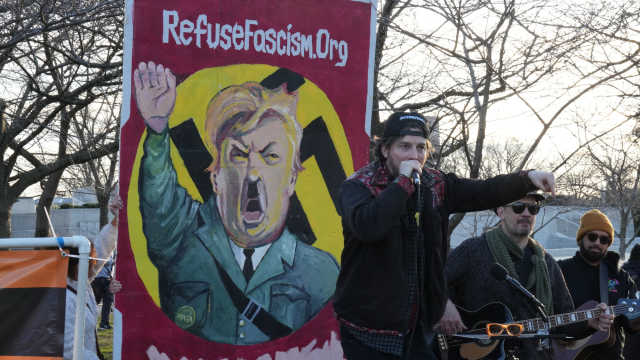
Language in the Age of Fascist Politics (Henry Giroux)

In the age of expanding fascism, the power of language is not only fragile but increasingly threatened. As Toni Morrison has noted, “language is not only an instrument through which power is exercised,” it also shapes agency and functions as an act with consequences. These consequences ripple through the very fabric of our existence. For in the words we speak, meaning, truth, and our collective future are at risk. Each syllable, phrase, and sentence becomes a battleground where truth and power collide, where silence breeds complicity, and where justice hangs in the balance.

In response, we find ourselves in desperate need of a new vocabulary, one capable of naming the fascist tide and militarized language now engulfing the United States. This is not a matter of style or rhetorical flourish; it is a matter of survival. The language required to confront and resist this unfolding catastrophe will not come from the legacy press, which remains tethered to the very institutions it ought to expose. Nor can we turn to the right-wing media machines, led by Fox News, where fascist ideals are not just defended but paraded as patriotism. 

In the face of this crisis, Toni Morrison’s insight drawn from her Nobel Lecture becomes all the more urgent and makes clear that the language of tyrants, embodied in the rhetoric, images, and modes of communication characteristic of the Trump regime, is a dead language. For her “a dead language is not simply one that is no longer spoken or written,” it is unyielding language “content to admire its own paralysis.” It is repressive language infused with power, censored and censoring. Ruthless in its policing duties and dehumanizing language, it has no desire or purpose other than maintaining the free range of its own narcotic narcissism, its own exclusivity and dominance. “Though moribund, it is not without effect” for it actively thwarts the intellect, stalls conscience, and “suppresses human potential.” Unreceptive to interrogation, it cannot form or tolerate new ideas, shape other thoughts, tell another story, or fill baffling silences. This is the language of official power whose purpose is to sanction ignorance and preserve. 

Beneath its glittering spectacle and vulgar performance, lies a language that is "dumb, predatory, sentimental." It offers mass spectacles, a moral sleepwalking state of mind, and a psychotic infatuation for those who seek refuge in unchecked power. It forges a community built on greed, corruption, and hate, steeped in a scandal of hollow fulfillment. It is a language unadorned in its cruelty and addiction to creating an architecture of violence. It is evident in Trump’s discourse of occupation, his militarizing of American politics, and in his use of an army of trolls to turn hatred into a social media spectacle of swagger and cruelty.


Despite differing tones and political effects, the discourses of the far right and the liberal mainstream converge in their complicity: both traffic in mindless spectacle, absorb lies as currency, and elevate illusion over insight. The liberal mainstream drapes the machinery of cruelty in the language of civility, masking the brutality of the Trump regime and the predatory logic of gangster capitalism, while the far right revels in it, parading its violence as virtue and its hatred as patriotism. Language, once a powerful instrument against enforced silence and institutional cruelty, now too often serves power, undermining reason, normalizing violence, and replacing justice with vengeance. 

In Trump’s oligarchic culture of authoritarianism, language becomes a spectacle of power, a theater of fear crafted, televised, and performed as a civic lesson in mass indoctrination. If language is the vessel of consciousness, then we must forge a new one--fierce, unflinching, and unafraid to rupture the fabric of falsehood that sustains domination, disposability, and terror. The late famed novelist, NgÅ©gÄ© wa Thiong’o, was right in stating that “language was a site of colonial control,” inducting people into what he called “colonies of the mind.”

The utopian visions that support the promise of a radical democracy and prevent the dystopian nightmare of a fascist politics are under siege in the United States. Increasingly produced, amplified and legitimated in a toxic language of hate, exclusion, and punishment, all aspects of the social and the democratic values central to a politics of solidarity are being targeted by right-wing extremists. In addition, the institutions that produce the formative cultures that nourishes the social imagination and democracy itself are now under attack. The signposts are on full display in a politics of racial and social cleansing that is being fed by a white nationalist and white supremacist ideology that is at the centre of power in the US—marked by fantasies of exclusion accompanied by a full-scale attack on morality, reason, and collective resistance rooted in democratic struggle. 

As more people revolt against this dystopian project, neoliberal ideology and elements of a fascist politics merge to contain, distract and misdirect the anger that has materialised out of legitimate grievances against the government, controlling privileged elites and the hardships caused by neoliberal capitalism. The current crisis of agency, representation, values and language demands a discursive shift that can call into question and defeat the formative culture and ideological scaffolding through which a savage neoliberal capitalism reproduces itself. This warped use of language directly feeds into the policies of disposability that define Trump's regime.

State Terror and Trump’s Politics of Disposability

As Trump’s regime concentrates power, he invokes a chilling convergence of law, order, and violence, a cornerstone of his politics of disposability. His acts of cruelty and lawlessness, abducting and deporting innocent people, branding immigrants as “vermin,” claiming they are “poisoning the blood” of Americans, and even proposing the legalization of murder for twelve hours, make clear that his violent metaphors are not just rhetorical flourishes. They are policy blueprints. In Trump’s hands, rhetoric becomes a weaponized prelude to atrocity, a tool of statecraft. Threats, hatred, and cruelty are transformed into instruments of governance.

This is not careless talk, it is a brutal and calculated expression of power. Trump’s threats to arrest and deport critics such as Zohran Mamdani reveal his willingness to use the machinery of the state for political extermination. His targets are predictable: immigrants, Black people, educators, journalists, LGBTQ+ individuals, and anyone who dares to challenge his white Christian nationalist, neoliberal, and white supremacist vision. His language does not merely offend, it incites harm, enacts repression, and opens the gates to state-sanctioned violence. It extends the reign of terror across the United States by labeling protesters as terrorists and deploying the military to American cities, treating them as if they were “occupied territories.” 

Trump is not alone. Many of his MAGA follower use these same hateful discourse. For instance, conservative pundit Ann Coulter wrote “in response to a speech by Melanie Yazzie, a Native artist and professor, about decolonization, “We didn’t Kill enough Indians.” This is not simply harsh rhetoric; nor is it a performative display of emboldened hatred and historical forgetting, it sets the stage for state-sanctioned repression and mass violence. What is at stake is more than civic respect. It is democracy itself. When language loses meaning and truth is blurred, tyranny thrives. Trump’s and too much of MAGA discourse is not about persuasion; it is about dehumanization and domination. It functions as statecraft, laying the groundwork for a society where suffering becomes spectacle and repression masquerades as law and order. Language is the canary in the coal mine, warning us that democracy dies without an informed citizenry.

As Eddie Glaude Jr. has powerfully argued, Americans must confront a brutal truth: the creation and expansion of Immigration and Customs Enforcement (ICE), now the largest federal law enforcement agency, is not merely a matter of policy, it is a cornerstone of white supremacy. It is a racist institution, entrenched in an immigration policy designed to uphold the values of white nationalism. In the face of shifting demographics, ICE is tasked with an urgent mission—to make America white again, a calculated attempt to turn back the clock on progress, to preserve an imagined past at the cost of justice and humanity.

We now live in a country where class and racial warfare both at home and abroad is on steroids, exposing the killing machine of gangster capitalism in its rawest, most punitive form. Trump supports the genocidal war waged by a state led by a war criminal. Children are being slaughtered in Gaza. Millions of Americans, including poor children, teeter on the edge of losing their healthcare. Funds for feeding hungry children are being slashed, sacrificed to feed the pockets of the ultra-rich. Thousands will die, not by accident, but by design. Terror, fear, and punishment have replaced the ideals of equality, freedom, and justice. Childcide is now normalized as the law of the land. The lights are dimming in America, and all that remains are the smug, ignorant smirks of fascist incompetence and bodies drained of empathy and solidarity.

Gangster Capitalism and the Death of Empathy

Gangster capitalism lays the foundation for Trump’s racist and fascist politics. As I have noted elsewhere, the United States has descended into a state of political, economic, cultural, and social psychosis, where cruel, neoliberal, democracy-hating policies have prevailed since the 1970s. At the core of this authoritarian shift lies a systemic war on workers, youth, Blacks, and immigrants, increasingly marked by mass violence and a punishing state both domestically and internationally. The U.S. has transformed into an empire dominated by a callous, greedy billionaire class that has dismantled any remnants of democracy, while embracing the fascistic ideology of white Christian nationalism and white supremacy. Fascism now parades not only beneath the flag but also under the Christian cross. 

America has shifted from celebrating unchecked individualism, as depicted in Ayn Rand’s Atlas Shrugged, to the glorification of greed championed by Gordon Gekko in Wall Street, and the psychotic avarice of Patrick Bateman in American Psycho. This descent into barbarity and psychotic infatuation with violence is further demonstrated by Justin Zhong, a right-wing preacher at Sure Foundation Baptist Church in Indianapolis, who called for the deaths of LGBTQ+ individuals during a sermon. Zhong defended his comments by citing biblical justifications and labeling LGBTQ+ people as "domestic terrorists." 

It gets worse. During a Men’s Preaching Night at Sure Foundation Baptist Church, Zhong's associate, Stephen Falco, suggested that LGBTQ+ people should "blow yourself in the back of the head," and that Christians should "pray for their deaths." Another member, Wade Rawley, advocated for violence, stating LGBTQ+ individuals should be "beaten and stomped in the mud" before being shot in the head. Fascism in America, nourished by the toxic roots of homophobia, now cloaks itself not just in the poisonous banner of the Confederate flag, but also in the sacred guise of the Christian cross.

Welcome to Trump’s America, where empathy is now viewed as a weakness and the cold rule of the market is the template for judging all social relations. One noted example can be found in the words of Trump’s on-and-off billionaire ally, Elon Musk, who dismisses empathy as a naive and detrimental force that undermines the competitive, individualistic ethos he champions. Speaking to Joe Rogan on his podcast, Musk specifically stated that “The fundamental weakness of western civilization is empathy.” As Julia Carrie Wong observes in The Guardian, the stakes extend far beyond casting empathy as a "parasitic plague." Empathy's true danger lies in its role as an enabler—granting permission to dehumanize others and constricting the very “definition of who should be included in a democratic state.” This is a recipe for barbarism, one that allows both states and individuals to turn a blind eye to the genocidal violence unfolding in Gaza and beyond.

Naming the Deep Roots of the Police State

Ruth Ben-Ghiat has warned that “America has been set on a trajectory to become a police state,” pointing to the passage of the Brutal and Bellicose Bill (BBB), which handed ICE a budget larger than the militaries of Brazil, Israel, and Italy combined. But the roots of this state violence go deeper. The foundation was laid under Bush and Cheney, whose war on terror birthed Guantanamo, Abu Ghraib, mass surveillance, and extraordinary rendition. What Trump has done is strip these earlier authoritarian practices of all pretenses, elevating them to the status of governing principles.

The police state did not begin with Trump; it evolved through him. Now, we see its terrifying maturity: racial cleansing disguised as immigration policy, hatred normalized as political speech, dissent criminalized, birthright citizenship threatened, and everyday life militarized. This is not politics as usual, it is fascism in real time.

Trump’s fascist politics grows even more dangerous when we recognize that his language of colonization and domination has helped transform American society into what NgÅ©gÄ© wa Thiong’o chillingly describes as a “war zone.” This war zone now spans the digital terrain—through the internet, podcasts, social media, and educational platforms—becoming a fertile breeding ground for fascist symbols, reactionary values, manufactured identities, and the toxic resurrection of colonial logics. In this battleground of meaning, the language of colonization does more than obscure the truth—it erodes critical thinking, silences historical memory, and disarms the very possibility of empowered agency. What remains in its wake is a nation scarred by suffering, haunted by loneliness, bound by shared fears, and anesthetized by the numbing rituals of a punishing state.

The transformation of America into a war zone finds its most visible expression in the rise of Trump’s omnipresent police state. This authoritarian machinery reveals itself through the mechanisms of state-sponsored terror, a heavily militarized ICE force operating like masked enforcers, and the rapid expansion of detention centers that will increasingly resemble a network of potential forced labor camps. As Fintan O’Toole warns, Trump’s deployment of troops onto the streets of Los Angeles is not merely symbolic—it is “a training exercise for the army, a form of reorientation.” In this reorientation, soldiers are no longer defenders of the Constitution but are being retrained as instruments of authoritarian power, bound not by democratic ideals but by obedience to a singular will.

Nevertheless, we resist or refuse to name the fascist threat and the ideological and economic architecture of its politics. Still, we recoil from calling the Trump regime what it is: a fascist state engaged in domestic terrorism. Still, we remain blind to the fact that economic inequality, global militarism, and the genocidal logics of empire are not peripheral issues, they are the center. Why is it so difficult to admit that we are living in an age of American fascism? Why do the crimes of the powerful, at home and abroad, so often pass without scrutiny, while the victims are blamed or erased?

The Collapse of Moral Imagination

What we face is not only a political crisis, partly in the collapse of conscience and civic courage-- a profound moral collapse. The war being waged at home by the Trump regime is not just against immigrants or the poor, it is a war on critical thought, on historical memory, on the courage to dissent. It is a war on every institution that upholds critical thinking, informed knowledge, and civic literacy. This is a genocidal war against the very possibility of a just future—a war not merely against, but for stupidity, for the death of morality, and for the annihilation of any robust notion of democracy. Viktor Klemperer, in his seminal work The Language of the Third Reich, offers a crucial lesson from history: "With great insistence and a high degree of precision right down to the last detail, Hitler’s Mein Kampf teaches not only that the masses are stupid, but that they need to be kept that way, intimidated into not thinking." Klemperer’s analysis reveals that Nazi politics did not arise in a vacuum; it was cultivated in a culture where language itself was the breeding ground of cruelty and control.

Trump’s rhetoric of fear, racial hatred does not emerge in a vacuum. It resonates because it taps into a long and violent history, a history soaked in blood, built on genocide, slavery, colonialism, and exclusion. His language recalls the genocidal campaigns against Indigenous peoples, Black Americans, Jews, and others deemed disposable by authoritarian regimes. It is a necrotic lexicon, resurrected in service of tyranny. It gives birth to politicians with blood in their mouths, who weaponize nostalgia and bigotry, cloaking brutality in the false promises of patriotism and “law and order.”

Language as War and the Return of Americanized Fascism

This is not merely a rhetoric of cruelty, it is a call to arms. Trump’s words do not simply shelter fascists; they summon them. They silence dissent, normalize torture, and echo the logic of death camps, internment camps, and mass incarceration. His discourse, laden with hatred and lies, is designed to turn neighbors into enemies, civic life into war, and politics into a death cult and zone of terminal exclusion. Undocumented immigrants, or those seeking to register for green cards or citizenship, are torn from their families and children, cast into prisons such as Alligator Alcatraz, a grotesque manifestation of the punishing state. As Melissa Gira Grant writes in The New Republic, it is "an American concentration camp…built to cage thousands of people rounded up by ICE," constructed in a chilling display of colonial disregard, and erected on traditional Miccosukee land without so much as consulting the Tribe.

This is the face of modern cruelty: language wielded as a tool to orchestrate a spectacle of violence, designed to degrade, divide, and erase. Culture is no longer a peripheral force in politics; it has become the central weapon in the rise of state terrorism. The language of war and complicity normalizes America’s transformation into a monstrous carceral state, a symbol of state-sponsored terror where due process is suspended, and suffering is not just an outcome but the point itself. 

A culture of cruelty now merges with state sponsored racial terror, functioning as a badge of honor. One example is noted in Trump advisor Laura Loomer, who ominously remarked that "the wild animals surrounding President Donald Trump’s new immigration detention center… will have 'at least 65 million meals." Change.org, along with others such as Pod Save America co-host Tommy Vietor, noted that her comment “is not only racist, it is a direct emotional attack and veiled threat against Hispanic communities. This kind of speech dehumanizes people of color and normalizes genocidal language.” Her racist remark not only reveals the profound contempt for human life within Trump's inner circle but also highlights how cruelty and violence are strategically used as both a policy tool and a public spectacle. Loomer’s remark is not an aberration, it is a symptom of the fascist logic animating this administration, where death itself becomes a political message. Her blood-soaked discourse if symptomatic of the criminogenic politics fundamental to the working of the Trump regime.

The parallels to history are unmistakable. Loomer’s invocation of death as the outcome of detention recalls the Nazi designation of certain camps as Vernichtungslager, extermination camps, where as Holocaust survivor Primo Levi noted, imprisonment and execution were inseparable. Likewise, the U.S. internment of Japanese Americans during World War II, though often sanitized in public memory, operated under a similar logic of racial suspicion and collective punishment. The message in each case is clear, as Judith Butler has noted in her writing: some lives are rendered invisible, deemed unworthy of legal protection, of family, of dignity, of life itself. In fascist regimes, such spaces function not only as instruments of punishment but as symbolic theaters of power, meant to instill terror, enforce obedience, and declare which bodies the state has marked for erasure.

For Trump, J.D. Vance, and their ilk, fascism is not a specter to be feared but a banner to be waved. The spirit of the Confederacy and the corpse-like doctrines of white supremacy, militarism, and neoliberal authoritarianism have returned, this time supercharged by surveillance technologies, financial capital, and social media echo chambers. In the spirit of the Trump regime, the symbols of the Confederacy are normalized. Confederate flags are now waved by neo-Nazis in public squares and parades, while Trump renames US warships and 7 military bases after Confederate officers, reinforcing a dangerous nostalgia for a past rooted in racism and rebellion against the very ideals of unity and equality that this nation claims to uphold.

Higher Education and the Fight Against Authoritarianism

Read More

It should not surprise us that the American public has grown numb with the constant echo chamber of state terrorism playing out in multiple sites of attack. Powerful disimagination machines, mainstream media, right-wing propaganda platforms, tech billionaires, have flooded public consciousness with conspiracy theories, historical amnesia, and spectacularized images of immigrants and others being deported to prisons, foreign Gulags, and modern day black holes. These are not simply entertainment outlets; they are pedagogical weapons of mass distraction, breeding civic illiteracy and moral paralysis. Under their influence, the American people have been placed in a moral and political coma.

White Nationalism and Reproductive Control

Nowhere is this more evident than in the mainstream media’s failure to address the racial and ideological foundations of Trump’s agenda. His attacks on Haitian immigrants, the travel ban on seven African countries, the shutting down of refugee programs, and his open-door policy for white Afrikaners from South Africa are not merely racist; they are explicitly white nationalist. The same ideology drives attacks on women’s reproductive rights, revealing the deep racial and gender anxieties of a movement obsessed with white demographic decline. These are not isolated skirmishes, they are interconnected strategies of domination.

These converging assaults, white nationalism, white supremacy, patriarchal control, and militarized life, manifest most vividly in the war on reproductive freedom. White nationalists encourage white women to reproduce, to hold back demographic change, while punishing women of color, LGBTQ+ people, and the poor. It is a violent calculus, animated by fantasies of purity and control.

The Systemic Assault on Democracy

This is a full-spectrum assault on democracy. Every act of cruelty, every racist law, every violent metaphor chips away at the social contract. A culture of authoritarianism is now used to demean those considered other, both citizens and non-citizens, critics and immigrants, naturalized citizens and those seeking such status. They are labeled as unworthy of citizenship now defined by the Trump regime as a privilege rather than a right. Meanwhile, a media ecosystem built on clickbait and erasure renders both such fascists as legitimate while making invisible the roots of suffering mass suffering and fear, all the while, turning oppression into spectacle and silence into complicity.

In this fog, language itself is emptied of meaning. Truth and falsehood blur. As Paulo Freire warned, the tools of the oppressor are often adopted by the oppressed. We now see that the logic of fascism has seeped into the culture, eroding civic sensibility, destroying moral imagination, and rendering resistance almost unspeakable.

The Normalization of Tyranny

Trump’s authoritarian fantasies do not alienate his base, they galvanize it. What was once unthinkable is now policy. What was once fringe has become mainstream. Cruelty is not something to be deplored and avoided at all costs, it is a central feature of power, wielded with theatrical and spectacularized brutality. Under the current acting ICE Director, Todd Lyons, this punitive logic has intensified: Lyons oversees a $4.4 billion Enforcement and Removal Operations apparatus staffed by over 8,600 agents across 200 domestic locations, using militarized tactics, surprise raids, and aggressive targeting of immigrant communities to sustain a regime of fear. ICE’s presence is at the heart of Trump’s hyper-police state, and its funding has been greatly expanded to $170 billion under Trump’s new budget bill, creating what journalist Will Bunch calls Trump’s “own gulag archipelago of detention camps across a United States that’s becoming increasingly hard to recognize.”

Meanwhile, figures like Tom Homan, who led ICE under Trump’s first term, laid the groundwork with Gestapo-style operations, midnight raids, family separations, and public declarations that undocumented immigrants “should be afraid”. As the “border tzar” under Trump, Homan has initiated deportation policies that are even more aggressively violent and cruel that those that took place in Trump’s first term as president. As Bunch notes, take the case of “the 64-year-old New Orleans woman, Donna Kashanian, who fled a tumultuous Iran 47 years ago, volunteered to rebuild her battered Louisiana community after Hurricane Katrina, never missed a check-in with U.S. immigration officials , and was snatched by ICE agents in unmarked vehicles while she was out working in her garden and sent to a notorious detention center.” These horror stories now take place daily in cities extending from Los Angeles to Providence, Rhode Island.

A central player in this current regime of state terrorism, systemic racism, mass abductions, deportations, and the criminalization of dissent is Stephen Miller, Trump’s White House Deputy Chief of Staff. During Trump’s first term, Miller was the driving force behind the Muslim ban, the family separation policy, and assaults on birthright citizenship, all rooted in an unapologetic white supremacist and eugenicist worldview. In Trump’s second term, he has emerged as the architect of even more draconian measures, pushing for mass deportations, the abolition of birthright citizenship, and the revocation of naturalized citizenship for those who fall outside his white Christian vision of who deserves to be called American.

Far-right white nationalist such as Miller, Tom Homan and Todd Lyons, do not treat cruelty as a regrettable side effect. For them, cruelty is the currency of power. Suffering becomes a spectacle, and violence a ritual of statecraft. Tyranny is not inching forward in silence; it is advancing at full speed, cheered on by those who treat fear as a governing principle and pain as public policy. At stake here is what Timothy Snyder calls the practice of fascist dehumanization.

This is not a passing storm. It is the death throes of a system that has long glorified violence, commodified everything, and fed on division. Trump’s language is not a performance, it is preparation. His words are laying the foundation for a society without empathy, without justice, without democracy.

Reclaiming the Language of Resistance, Reclaiming Democracy

In a decent society, language is the lifeblood of democracy, a vessel of solidarity, truth, and hope. But in Trump’s America, language has become a weapon, dehumanizing, excluding, and dominating. His vision is not a warning; it is a blueprint. We must resist, or we risk losing everything. The stakes are nothing less than the survival of democracy, the retrieval of truth and the refusal to live in a world where cruelty is policy and silence is complicity. 

What is needed now is not only a rupture in language but a rupture in consciousness, one that brings together the critical illumination of the present with a premonitory vision of what lies ahead if fascist dynamics remain unchecked. As Walter Benjamin insisted, we must cultivate a form of profane illumination, a language that disrupts the spectacle of lies and names the crisis in all its violent clarity. At the same time, as A.K. Thompson argues, we must grasp the future implicit in the present. His notion of premonitions urges us to read the events unfolding around us as urgent warnings, as signs of the catastrophe that awaits if we do not confront and reverse the political and cultural paths we are on. It demands that we see the connections that bind our suffering, rejecting the fragmented reality that neoliberalism forces upon us. 

The time for complacency is past. The time for a new and more vibrant language, one of critique, resistance, and militant hope, is now. A language capable not only of indicting the present but of envisioning a future rooted in justice, memory, and collective struggle.

As Antonio Gramsci remarked in his Prison Notebooks, "The crisis consists precisely in the fact that the old is dying and the new cannot be born; in this interregnum a great variety of morbid symptoms appear." What is clear is that these morbid symptoms have arrived. Yet, alongside the despair they breed, they also present new challenges and opportunities for revitalized struggles. This is where the power of language comes into play—this is the challenge and opportunity for those who believe in the transformative power of culture, language, and education to address not just the nature of the crisis but its deeper roots in politics, memory, agency, values, power, and democracy itself.

[This article first appeared in the LA Progressive.]


By Henry A. Giroux

Henry A. Giroux currently holds the McMaster University Chair for Scholarship in the Public Interest in the English and Cultural Studies Department and is the Paulo Freire Distinguished Scholar in Critical Pedagogy. His latest book is The Burden of Conscience: Educating Beyond the Veil of Silence (Bloomsbury in 2025). He is LA Progressive's Associate Editor. His website is www.henryagiroux.com