Search This Blog

Showing posts sorted by date for query peace. Sort by relevance Show all posts

Friday, November 21, 2025

Nonviolent Resistance in the Trump Era: Why Satire, Journalism, and Marches Are Not Enough

In moments of democratic crisis, societies often turn to familiar tools: satire, journalism, and public demonstrations. Today—amid intensifying authoritarian rhetoric, rising political violence, and fraying institutions—forms of dissent like South Park, The New York Times, and the No Kings marches reflect a country struggling to assert democratic values.

These efforts matter. But they are not enough.

If democracy is to endure, millions—not just artists, reporters, or marchers—must engage in coordinated, creative, nonviolent resistance. And they must do so in solidarity.


Satire as Resistance: When South Park Breaks the Spell

For decades, South Park has peeled back the layers of American political absurdity. In the Trump era, its depictions of autocratic posturing and the cult of personality have helped audiences see through the spectacle.

But satire remains commentary, not coordination. It can spark awareness, but it cannot restrain authoritarian power on its own.


Journalistic Resistance: The New York Times and the Weight of Truth

The New York Times has played a crucial role in exposing corruption, extremism, disinformation networks, and democratic backsliding. Its reporters have often faced harassment and threats simply for revealing the truth.

Yet journalism cannot mobilize the public by itself. Facts require action—and action requires organization.


Street Resistance: The No Kings Marches and Public Defiance

The No Kings marches—an umbrella for decentralized, anti-authoritarian street demonstrations—represent a powerful expression of nonviolent public resistance. Emerging across cities and campuses, these marches assert a simple moral principle: no leader, party, or faction is entitled to unchecked power.

Their message is clear:

  • Democracy requires constraints.

  • Political leaders are not royalty.

  • The people, not a single figure, hold ultimate sovereignty.

The No Kings marches reclaim public space from fear and resignation. They remind communities that resistance does not require weapons—only bodies, voices, and courage.

But marches alone cannot build the long-term structures needed to protect democracy. They ignite momentum; they do not sustain it without broader collective support.


Universities Have Failed to Defend Democratic Dissent

Historically, universities were vital sites of moral courage and mass mobilization. Today, however, university presidents have aggressively squelched campus protests—through police intervention, restrictive rules, suspensions, and pressure from wealthy donors.

This chilling effect has not recovered. Student activism remains suppressed at the very moment when democratic engagement is most essential.


The Growing Possibility of a General Strike

As institutional stability deteriorates, Americans increasingly discuss the possibility of a General Strike—a nationwide, multi-sector refusal to work until political abuses are addressed. General strikes have played decisive roles in democratic movements around the world.

A U.S. General Strike could:

  • Halt the economic machinery that enables authoritarian governance

  • Force political leaders to negotiate rather than intimidate

  • Demonstrate the nonviolent power of ordinary workers

The concept is no longer fringe. It is a rational response to a political system in crisis.


Another Government Shutdown: A Flashpoint for Resistance

The threat of another federal government shutdown exposes a political class willing to damage the public in pursuit of ideological power. Shutdowns harm millions of workers, families, and communities.

But they also clarify a crucial truth:
the government depends entirely on ordinary people showing up.

If a shutdown occurs, it could accelerate conversations about coordinated nonviolent resistance—boycotts, demonstrations, strikes—and push more Americans to see the system’s fragility and their own collective power.


Nonviolent Resistance Must Be Mass-Based and Rooted in Solidarity

Satire, journalism, and street marches each contribute to political consciousness. But democratic survival requires:

  • Coordinated labor action, including sector-wide strikes

  • Mass protests, sit-ins, and civil disobedience

  • Boycotts and divestment aimed at authoritarian enablers

  • Digital resistance against disinformation

  • Local mutual aid networks and coalition-building

  • Cross-racial, cross-class, and interfaith solidarity

Democracy is not self-sustaining. It requires collective, creative noncooperation with authoritarian drift.


Solidarity Is the Strategy

Authoritarianism thrives on isolation and fear.
Nonviolent movements thrive on courage and connection.

Satire can puncture illusions.
Journalism can expose wrongdoing.
The No Kings marches can reclaim public space.
Students can still spark moral clarity—if administrators allow it.
Workers can stop the machine entirely.

But only mass, sustained, nonviolent solidarity can protect democracy now.

And the moment to act is now.


Sources on Nonviolent Movements and Civil Resistance

Books & Academic Works

  • Gene Sharp, The Politics of Nonviolent Action

  • Erica Chenoweth & Maria J. Stephan, Why Civil Resistance Works

  • Jonathan Pinckney, From Dissent to Democracy

  • Jamila Raqib & Gene Sharp, Self-Liberation

  • Srdja Popović, Blueprint for Revolution

  • Peter Ackerman & Jack DuVall, A Force More Powerful

Research Centers & Reports

  • International Center on Nonviolent Conflict (ICNC)

  • Albert Einstein Institution

  • U.S. Institute of Peace publications on civil resistance

  • Freedom House reports on democratic erosion

Historical Case Studies

  • U.S. Civil Rights Movement

  • Solidarity Movement (Poland)

  • People Power Revolution (Philippines)

  • Anti-Apartheid Struggle (South Africa)

  • Selected Arab Spring movements

Saturday, November 15, 2025

Entangled Frontiers: Saudi Arabia, Yemen, the UAE, South Sudan, and the Israel-Palestine Arena — Implications for Higher Education, Censorship, and Global Governance

The global higher education landscape is increasingly shaped by conflicts, diplomacy, and shifting regional alliances. The relationships among Saudi Arabia, Yemen, the United Arab Emirates (UAE), South Sudan, and the Israel-Palestine conflict highlight the interconnections between geopolitics, humanitarian crises, and the responsibilities of universities as institutions of knowledge, ethics, and justice. These contexts influence not only student mobility and research collaboration but also institutional priorities, funding flows, and academic freedom. Understanding the intersection of geopolitics and higher education is essential for institutions seeking to engage globally with integrity, equity, and impact.

For scholars and administrators, these regions exemplify the challenge of balancing opportunity and risk. Research and student engagement opportunities abound in humanitarian crises, fragile states, and post-conflict zones, yet these are embedded in complex political and ethical landscapes. Additionally, the growing pressures on American universities to navigate internal censorship, legislative constraints, and donor-influenced agendas have profound implications for their global credibility and ability to engage abroad. This article explores each of these regions in depth, examines the cross-cutting implications for higher education, and discusses the domestic pressures in U.S. higher education that shape international engagement.


Saudi Arabia and Yemen

The war in Yemen has devastated the nation, creating one of the most severe humanitarian crises in recent history. Civilian infrastructure has been destroyed, millions of people have been displaced, and famine and disease threaten vast swathes of the population. Saudi Arabia, as the leading actor in the coalition intervening in Yemen, has faced both international criticism and pressure to negotiate. Recent diplomatic initiatives have suggested that Riyadh may be seeking to recalibrate its involvement, including attempts to engage Houthi representatives in peace talks. For higher education institutions, these shifts have important implications for student mobility, research opportunities, and refugee education programs. Yemen's crisis represents not only a humanitarian emergency but also a research frontier in global health, humanitarian logistics, and post-conflict educational reconstruction.

Saudi Arabia’s position on Israel adds another layer of complexity for global academic partnerships. The Kingdom continues to insist that it will not normalize relations with Israel without the establishment of a Palestinian state. This position affects regional alliances, funding priorities, and the willingness of other states to engage in collaborative academic initiatives. For universities, this reality translates into both opportunities and constraints. Scholarship programs, research funding, and institutional partnerships linked to Saudi Arabia may be influenced by the Kingdom’s foreign policy priorities. Institutions engaging with Yemen must navigate a humanitarian context that is deeply intertwined with the diplomatic posturing of a regional superpower.


The United Arab Emirates

The UAE has emerged as a significant regional actor, leveraging economic strength to expand its influence across Africa, the Red Sea corridor, and the Middle East. Its normalisation with Israel through the Abraham Accords marked a historic diplomatic shift in Arab-Israeli relations, yet the UAE has simultaneously articulated clear objections to unilateral Israeli annexation plans in the West Bank. In Africa, the UAE has deepened ties with South Sudan and other fragile states through financial agreements, including banking cooperation and long-term oil-backed loans. These interventions exemplify how foreign investment, diplomacy, and regional security concerns intersect in ways that directly affect higher education.

For universities, the UAE represents both opportunity and caution. Institutions can engage with new funding streams, branch campuses, and international partnerships facilitated by Gulf state investment. At the same time, ethical considerations are paramount. Funding sources tied to conflict zones, extractive economic deals, or contested geopolitical agendas require careful institutional scrutiny. Universities must develop frameworks that incorporate conflict sensitivity, ethical risk assessment, and transparency. The UAE’s dual role as a facilitator of academic mobility and a participant in contested geopolitical spaces underscores the complexity of engagement in regions influenced by external power.


South Sudan

South Sudan, the world’s youngest nation, has struggled to stabilize since its independence in 2011. Recurring conflict, economic dependence on oil, and weak governance structures have hindered the development of higher education infrastructure. Agreements with the UAE, including long-term oil-backed loans and financial cooperation, highlight the influence of foreign investment on the state’s trajectory and, by extension, its educational system.

For higher education, South Sudan presents both a critical research site and an urgent development need. Universities can contribute to capacity-building, curriculum development, and scholarship programs for displaced or return diaspora students. Research in post-conflict governance, peace studies, and resource management can inform broader academic understanding of fragile states. Yet these opportunities come with ethical and practical complexities. Partnerships with South Sudanese institutions must navigate the implications of resource-linked foreign investment, the risk of perpetuating inequality, and the fragility of governance structures. Universities engaging in South Sudan must balance their commitment to education with a nuanced understanding of political and economic realities.


Israel and Palestine

The Israel-Palestine conflict continues to shape the global higher education discourse, affecting student mobility, refugee education, research collaborations, and institutional partnerships. Saudi Arabia’s insistence that normalization with Israel is contingent upon Palestinian statehood and East Jerusalem as its capital remains a critical point of leverage in regional diplomacy. The UAE, despite having normalized with Israel, continues to assert that Israeli annexation of the West Bank represents a “red line” that could destabilize the region.

For universities, this context presents both opportunities and ethical challenges. Engaging with Palestinian students, hosting refugee scholars, and conducting research on human rights and humanitarian crises are vital areas of academic intervention. At the same time, institutions must navigate funding sources, regional political sensitivities, and reputational risks. Academic freedom in research on Israel and Palestine is often contested, both abroad and domestically in the United States, where political and donor pressures shape what research is feasible, safe, or fundable.


Censorship and Academic Freedom in U.S. Higher Education

Recent developments in American higher education highlight the fragility of academic freedom, which directly affects international engagement. Surveys indicate that over one-third of U.S. faculty perceive a decline in academic freedom, and approximately 70% report self-censorship on topics such as the Israel-Palestine conflict. Legislation in several states, framed under terms like “viewpoint diversity” or “campus neutrality,” imposes constraints on curriculum, speech, faculty tenure, and university governance. These pressures are compounded by donor influence, administrative oversight, and the politicization of higher education.

Censorship and self-censorship are not abstract concerns; they have tangible impacts on research agendas, global partnerships, and the capacity of universities to host refugee or international scholars. Institutions with programs in global health, humanitarian response, Middle East studies, or post-conflict development must contend with domestic pressures that may limit the scope of inquiry or public engagement. The erosion of academic freedom in the United States thus has a direct effect on the credibility and effectiveness of universities abroad, as it mirrors, in some respects, the constraints faced by institutions in fragile or authoritarian states.


Cross-Cutting Themes

Several themes cut across these regional and domestic contexts. First, conflict and displacement in Yemen, South Sudan, and Palestine create urgent educational needs for refugees and internally displaced scholars. Universities must develop programs that provide access, mentorship, and flexible pathways to education. Second, foreign investment and resource-linked funding—from the UAE in South Sudan to Saudi-backed initiatives in Yemen—underscore the ethical complexities of international partnerships. Transparency, due diligence, and conflict-sensitive frameworks are essential. Third, diplomatic realignments, including the Abraham Accords and evolving Saudi-Israel relations, create new corridors for collaboration but also introduce geopolitical risk. Fourth, domestic censorship and political pressures in the U.S. affect research capacity, ethical engagement, and the freedom to examine contentious topics, directly influencing global credibility.

Finally, structural inequality and systemic injustice are central concerns. Funding flows, research agendas, and student access are all mediated by power structures that can perpetuate inequities. Universities must be conscious of whose voices are amplified, whose perspectives are sidelined, and how partnerships with conflict-affected states influence the production of knowledge. Ethical global engagement requires institutions to address these imbalances proactively.


References & Sources

  1. PEN America, “New Report Unveils Alarming Tactics in Censorship of Higher Education,” pen.org

  2. Times of India, “Is Academic Freedom on the Decline? 35% of US College Professors Say Yes,” timesofindia.indiatimes.com

  3. Times of Israel, “Faculty Survey Reveals Fear, Self-Censorship at US Universities,” timesofisrael.com

  4. Associated Press, “Under Threat from Trump, Columbia University Agrees to Policy Changes,” apnews.com

  5. The Guardian, “US Universities’ Faculty Unite to Defend Academic Freedom After Trump’s Attacks,” theguardian.com

  6. Le Monde, “UC Berkeley, the US Capital of Free Speech, Stands Firm Against Trump,” lemonde.fr

Wednesday, September 17, 2025

Pedagogies of Repression: Ford, Trump and the War on Education (Henry A. Giroux and William Paul)

Analyses of fascism too often fixate on its most spectacular expressions: staggering inequality, systemic racism, the militarization of daily life, unbridled corruption, monopolistic control of the media, and the concentration of power in financial and political elites. Fascism thrives on a culture of fear and racial cleansing and the normalization of cruelty, lies, and state violence. Yet what is often overlooked is how culture and education now function as decisive forces in legitimating these authoritarian passions and in eroding democratic commitments. As Hannah Arendt, Jason Stanley, Richard Evans, Chris Hedges, and others remind us, the protean origins of fascism are never fully buried; they return in altered and often disguised forms, seeping into everyday life and reshaping the common sense of a society.

Under US President Donald Trump, we face a terrifying new horizon of authoritarian politics: the erosion of due process, mass abductions, vicious attacks on higher education, and the steady construction of a police state. Canada has not yet descended into such full-fledged authoritarianism, but troubling echoes are undeniable. Public spaces and public goods are under assault, book bans have appeared in Alberta, languages of hate increasingly target those deemed disposable, the mass media bends to corporate interests, labour is suppressed, and democratic values are met with disdain. These may not replicate the worst horrors of the past, but they reveal how culture and education become the terrain upon which democracy is dismantled and authoritarianism gains legitimacy. These are warning signs of a gathering darkness that must be confronted before they harden into something far more sinister.
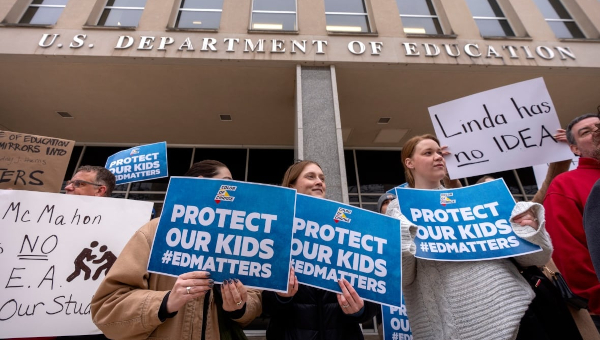
Culture and Pedagogy

Fascism thrives not only on brute police power, prisons, or economic violence but also on culture and pedagogy. Culture has increasingly become a site in the service of pedagogical tyranny. It works through erasure and repression, through memory stripped of its critical force, and through dissent silenced in the name of order. Fascism is never solely a political or economic system; it is a pedagogical project, a machinery of teaching and unlearning that narrows the horizon of what can be said, imagined, or remembered.

Today authoritarianism seeps insidiously into everyday life, embedded in seemingly obvious maneuvers that consolidate power under the guise of technical or bureaucratic necessity. Its mobilizing passions often emerge unobtrusively in maneuvers that hide in the shadows of the mundane, often at the level of everyday experience.

This creeping logic is starkly visible in Ontario, where Doug Ford’s Progressive Conservative (PC) government has moved to seize control of local school boards. What may look like routine administrative measures should be read as a warning: authoritarianism does not arrive only with grandiose spectacles or open attacks on democracy’s foundations; it gains ground quietly, through the erosion of the ordinary, the capture of the local, and above all, through the weaponization of education as a tool to dismantle democracy itself.

The Ford government’s seizure of the Toronto, Toronto Catholic, Ottawa-Carleton, and Dufferin-Peel Catholic district school boards is extraordinary, even for this democracy-averse regime. Education Minister Paul Calandra has even mused about eliminating trustees altogether before the 2026 local elections, declaring “Everything is on the table.” His justification that Ontario’s Ministry of Education (MOE) has allowed them to make too many decisions on their own is both unsupported and revealing. It exposes a deeper authoritarian project: the desire to centralize power and strip away democratic oversight from institutions closest to local communities. It curbs liberal instincts of trustees who see first-hand the vast diversity of lives and needs of the families who rely on their schools.

This is precisely how authoritarian control operates: by eroding intermediary structures that connect people to power. Just as Donald Trump sought to bend national cultural institutions like the Smithsonian Museum to his will, Ford dismantles the modest democratic functions of trusteeship. Both cases illustrate how authoritarianism works through the fine print of governance as much as through grandiose pronouncements.

Manufactured Deficits and Structural Starvation

The pretext for takeover was financial mismanagement. Yet none of the investigators found evidence of serious fiscal incompetence. The truth is that boards submitted balanced budgets year after year but only after slashing programs and services, closing outdoor education centres, selling property, cutting staff, and raising fees. What really drives their fiscal crises is a decades-old funding model – first imposed by the Mike Harris PC government in 1997 – that shifted resources from local taxes to provincial grants. This was not a move toward equitable funding; these were neoliberals of the first order who believed in central control of funding so they could squeeze school boards and education workers to contain costs.

This model, based on enrolment rather than actual need, starved boards of resources for special education, transportation, salaries, and infrastructure.1 For instance, school boards don’t get funding for actual children who need special education support but rather on the basis of a predictive model MOE devised. Boards pay for the kids MOE doesn’t fund. The Ford government hasn’t funded the full increase for statutory teacher benefits for years, leaving boards short by millions. The result is a structural deficit: chronic underfunding that leaves even well-managed boards teetering on insolvency. The Ford government, while claiming to increase spending, has in fact cut funding per student by $1,500 in real terms since 2018. This is the problem faced by with 40 percent of Ontario school boards.

It is this manufactured insolvency that led Minister Calandra to get the most out of a useful crisis and put the four school boards under supervision and maybe next eliminate all school boards in the province. Here we see neoliberal austerity converging with authoritarian ambition. Underfunding is not a policy mistake; it is a deliberate strategy to weaken public education, undermine trust in democratic institutions, and prepare the ground for privatization schemes such as vouchers and charter schools. In this instance, the policy of underfunding is a way of weakening public education and then blaming whatever problems occur on education itself. This is gangster capitalism at work, cloaked in the language of fiscal responsibility but fueled by a pedagogy of dispossession.

Eliminating Trustees, Silencing Communities

If board takeovers were simply about money, supervisors would have been told to just find savings. Instead, elected trustees were suspended, their offices shuttered, their tiny stipends cut off, and their ability to communicate with constituents forbidden. Calandra’s power grab has all the elements of Elon Musk’s DOGE assaults in the US: move fast, offer absurd excuses, and blame the victims. The supervisors replacing trustees – accountants, lawyers, and former politicians with no background in education – now wield greater power than the elected community representatives they displaced.

This substitution of technocrats for democratically accountable representatives is part of fascism’s pedagogy. It teaches the public to accept disenfranchisement as efficiency, to see obedience as order. Parents who ask why a program disappeared or why their child’s special education class has grown larger are now met with silence. In this vacuum, the lesson learned is that participation is futile and resistance meaningless – precisely the kind of civic numbing oligarchic fascism requires.

Command, Control, and the Policing of Education

Ford’s government frames these takeovers as a “broader rethink” of governance, but the real project is clear: the imposition of command and control over education. This move sends a strong message that it’s time to duck our heads and get back to basics: teaching “reading, writing, spelling, and arithmetic and the whole shebang…” as Doug Ford complained last fall after teachers and students attended a rally in support of the Grassy Narrows First Nation and its efforts to deal with generations of mercury contamination in their area. He proclaimed, with no evidence, that the field trip was “indoctrination” by teachers because activists protesting Israeli genocide were present. Community members who supported an Indigenous curriculum, modern sexual education, or even school-name changes honoring anti-colonial figures are dismissed or painted as obstacles. The message from Ford and Calandra is blunt: stick to the basics – reading, writing, arithmetic – and leave politics at the door.

Yet politics hangs over classrooms like a shroud. Despite his Captain Canada complaints about the Trump tariffs, Ford admires the President quick-marching America toward fascism. In an off-mic moment he commented recently: “Election day, was I happy this guy won? One hundred per cent I was.” It’s not the racism, the authoritarianism, the compulsive lying, the fraud, the sexual assaults that bothers the Premier; it’s that he got stiffed by his friend.
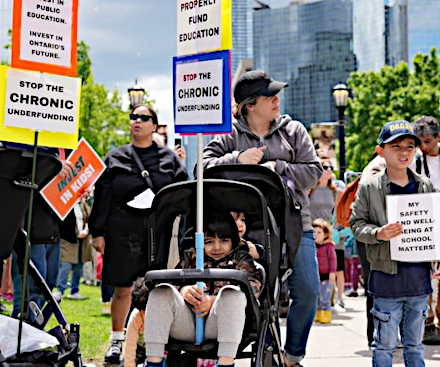
Usurping trustees according to University of Ottawa professor Sachin Maharaj is just another step toward the Progressive Conservatives’ goal to “squelch the pipeline of more progressive leaders”2 like those gaining notice and experience attending to the needs of local schools.

The banning of the Toronto Muslim Student Alliance’s screening of the film No Other Land, which documents Israeli settler violence, shows how censorship now masquerades as neutrality. This is the pedagogy of repression in action: narrowing what can be taught, remembered, or discussed until education is reduced to obedience training. What parades as a “broader rethink” is part of the authoritarian language of censorship and control. Like Trump’s attacks on “critical race theory” or his censorship of the Smithsonian, Ford’s moves are not about protecting students from politics but about protecting power from critique. The real issue here is constructing authoritarian policies that narrow critical thinking, teacher autonomy, essential funding, and knowledge that enable schools to both defend and facilitate democracy.

For Ford and his adherents, the real issue is not that schools are failing but that they are public and have a vital role to play in a democracy. The real threat to Ford is that a democracy can only exist with informed citizens. Yet that is precisely the role education should assume.

Bill 33: Codifying Authoritarianism

The perversely named Bill 33, the Supporting Children and Students Act extends this authoritarian logic. It allows the Minister to investigate boards or trustees on the mere suspicion they might act “inappropriately” or against the “public interest” – an elastic phrase that grants unchecked power. It checks much-maligned Diversity Equity and Inclusion efforts by refusing boards the right to name schools, forcing them to abandon diversity-affirming figures in favor of colonial or sanitized names. It mandates the reintroduction of police officers into schools, despite community opposition to surveillance and “unaccountable access to youth by cops.”3

At work here is the legacy of colonialism, a legacy that is terrified of diversity, of those deemed other, being able to narrate themselves. Viewed as threat, this anti-democratic language ultimately falls back on issues of control and security. This is one instance of how authoritarianism consolidates itself, not through tanks in the streets but through legislation that transforms education into an arm of the security state. Pedagogical spaces are militarized, memory is policed, and students are taught that surveillance is normal and dissent dangerous.

Trumpasitic Authoritarianism

Ford’s methods echo those of his southern counterpart. Just as Trump’s politics thrive on dispossession, erasure, and the weaponization of culture, Ford borrows from the same authoritarian playbook. The takeover of school boards not only tightens political control but also grants easy access to billions of dollars in public land, enriching developers tied to his government.4 Here, neoliberal profiteering fuses seamlessly with authoritarian centralization, an example of the merging of gangster capitalism with the pedagogy of repression.

What do you expect from a government that makes decisions reflecting the arrogance of power? The Ford government cut Toronto city council in half soon after took office in 2018 and threatened to use a constitutional override, the Notwithstanding Clause, Section 33 of Canada’s Charter of Rights and Freedoms, to overturn a Superior Court justice’s decision that the move was unconstitutional. Ford actually used the clause to push through a bill restricting election advertising in 2021 and again, pre-emptively, in 2022, buttressing back-to-work legislation against striking public workers, among the lowest paid in the province. He’s considering using it again after his decision to remove bike lanes from Toronto streets was overturned in court; power makes you petty.

Democracy in the Smallest Details

The takeover of Ontario school boards may appear less dramatic than Trump’s assaults on national institutions, but its implications are just as dire. Authoritarianism advances not only through spectacle but through the slow erosion of local democratic practices that once seemed secure.

If fascism is a pedagogy of fear, amnesia, and conformity, then resistance must be a pedagogy of memory, solidarity, and imagination. To defend education is to defend democracy itself, for schools are not simply sites of instruction but laboratories of citizenship, places where young people learn what it means to speak, to question, to remember, and to act. When trustees are silenced, when curricula are censored, when communities are stripped of their voice, what is lost is not only oversight but the very possibility of democratic life.

What is at stake, then, is far larger than budget shortfalls or bureaucratic reshuffling. It is whether the future will be governed by communities or dictated from above by those who mistake obedience for learning and silence for peace. Fascism thrives in these small erasures, in the details that seem technical until they harden into structures of domination.

The lesson could not be clearer: democracy dies in increments, but it can also be rebuilt in increments – through collective memory, through civic courage, through the refusal to allow education to become a weapon of obedience. To resist the Ford government’s authoritarian incursions is not only to protect local school boards; it is to reclaim the very ground on which democratic hope stands. •

Endnotes

  1. Dan Crow, The Consequences Of A Neoliberal Funding Formula, Canadian Centre for Policy Alternatives, Fall/Winter 2018.
  2. Sachin Maharaj, Interview August 26, 2025
  3. Andrea Vásquez Jiménez, Interview June 7, 2025.
  4. William Paul, “Riding the Gravy Train” in Against the People: How Ford Nation is Dismantling Ontario, eds: Brian Evans, Carlo Fanelli, Fernwood Publishing, 2024.

Henry A. Giroux currently is the McMaster University Professor for Scholarship in the Public Interest and The Paulo Freire Distinguished Scholar in Critical Pedagogy. His most recent books include The Violence of Organized Forgetting (City Lights, 2014), Dangerous Thinking in the Age of the New Authoritarianism (Routledge, 2015), coauthored with Brad Evans, Disposable Futures: The Seduction of Violence in the Age of Spectacle (City Lights, 2015), and America at War with Itself (City Lights, 2016). His website is henryagiroux.com.

William Paul is editor of School Magazine website.

This article first appeared at the Social Project Bullet

Wednesday, September 10, 2025

Right Wing Influencer Charlie Kirk Killed at Utah Valley University

Charlie Kirk was shot and killed at Utah Valley University today.  The killer was not immediately caught. The Higher Education Inquirer has been covering Kirk and his organization, Turning Point USA, since 2016.  Kirk has been a polarizing force in the United States, particularly on US college campuses. HEI hopes this event will not lead to further violence. Since its inception, we have urged for peace and nonviolence.   

Monday, September 8, 2025

Campus Cops, A Critical History

Campus policing in the United States has a long and complicated history, one that cannot be understood apart from the larger culture of violence in the nation. Colleges and universities, far from being sanctuaries of peace, have mirrored the broader society’s struggles with crime, inequality, and abuse of power. The development of campus police forces is both a symptom of these realities and a contributor to them.

From Watchmen to Armed Police

In the early 20th century, many colleges relied on night watchmen or unarmed security guards to keep order. Their duties were limited: locking buildings, checking IDs, and responding to minor incidents. But as campuses expanded in size and complexity—particularly after the GI Bill opened higher education to millions—colleges began to formalize security forces. By the 1960s and 1970s, during an era of political unrest and rising crime rates, many institutions established their own sworn police departments with full arrest powers.

The rationale was simple: the surrounding society was becoming more violent, and colleges were not immune. Campus shootings, from the University of Texas tower massacre in 1966 to Virginia Tech in 2007, underscored the vulnerability of universities to extreme violence. Administrators and legislators justified campus policing as a necessary protection against a culture of guns, crime, and fear.

The Expansion of Campus Policing

Today, more than 90 percent of U.S. colleges and universities with 2,500 or more students have some form of armed campus police. Many operate as fully accredited police departments, indistinguishable from municipal counterparts. They are tasked with preventing theft, responding to assaults, and increasingly, preparing for mass shootings. This expansion reflects the broader American decision to deal with social breakdown through policing and incarceration rather than through prevention, education, or healthcare.

Yet the rise of campus police also brings deep contradictions. If colleges are supposed to be places of learning and community, what does it mean that they are patrolled by officers trained in the same punitive logics as city police? What does it say about the United States that students—especially students of color—often feel surveilled rather than protected?

Campus Coverups and the Protection of Institutions

Beyond concerns about over-policing, there is another side to the story: under-policing and coverups. Colleges have long been criticized for minimizing reports of sexual assault, hazing, hate crimes, and other misconduct in order to protect their reputations. Title IX litigation, Department of Education investigations, and journalism have revealed systemic patterns of universities failing to report crimes or discouraging survivors from coming forward.

Campus police departments have sometimes been complicit in these coverups. Because they report to university administrations rather than independent city governments, their accountability is compromised. The incentive to “keep the numbers down” and maintain the appearance of a safe, prestigious campus can lead to the suppression of reports. Survivors of sexual violence often describe being dismissed, ignored, or retraumatized by campus police who appeared more concerned about institutional liability than student well-being.

The Contradictions of Campus Safety

The dual role of campus police—protecting students from external dangers while shielding institutions from internal accountability—illustrates the contradictions of higher education in a violent society. Universities are expected to provide safety in a nation awash with firearms, misogyny, racism, and economic desperation. But instead of challenging these conditions, many campuses rely on armed policing, surveillance technologies, and public relations strategies.

The result is a paradox: campuses are policed as if they are dangerous cities, yet when crimes happen within their walls, especially those involving sexual violence or elite fraternities and athletes, those same crimes are often hidden from public view.

Toward a Different Model of Safety

Critics argue that true campus safety requires moving beyond reliance on police alone. Investments in mental health services, consent education, community accountability processes, and structural reforms to address gender violence and racial inequities are essential. Some advocates push for independent oversight of campus police, ensuring they are accountable not just to administrators but to students, staff, and the broader public.

If campus policing has grown because America has normalized violence, then reimagining campus safety requires confronting the roots of that violence. As long as universities remain more committed to protecting their brands than their students, campus cops will embody the contradictions of American higher education—part shield, part coverup, and part reflection of a society unable to address its deeper wounds.


Sources

  • Sloan, John J. and Fisher, Bonnie S. The Dark Side of the Ivory Tower: Campus Crime as a Social Problem. Cambridge University Press, 2011.

  • Karjane, Heather M., Fisher, Bonnie S., and Cullen, Francis T. Campus Sexual Assault: How America’s Institutions of Higher Education Respond. National Institute of Justice, 2002.

  • U.S. Department of Education, Clery Act Reports.

  • Armstrong, Elizabeth A. and Hamilton, Laura. Paying for the Party: How College Maintains Inequality. Harvard University Press, 2013.

Sunday, September 7, 2025

Trump's War on Reality

The second Trump administration has unleashed a coordinated assault on reality itself—an effort that extends far beyond policy disagreements into the realm of deliberate gaslighting. Agency by agency, Trump’s lieutenants are reshaping facts, science, and language to consolidate power. Many of these figures, despite their populist rhetoric, come from elite universities, corporate boardrooms, or dynastic wealth. Their campaign is not just about dismantling government—it’s about erasing the ground truth that ordinary people rely on.

Department of Defense → Department of War

One of the starkest shifts has been renaming the Department of Defense the “Department of War.” This rhetorical change signals the administration’s embrace of permanent conflict as strategy. Secretary Pete Hegseth, a Princeton graduate and former hedge fund executive, embodies the contradiction: Ivy League polish combined with cable-news bravado. Under his watch, diplomacy is downgraded, alliances undermined, and propaganda elevated to policy.

The Pentagon has been retooled into a megaphone for Trump’s narrative that America is perpetually under siege. Despite the promise of “America First,” decisions consistently empower China and Russia by destabilizing traditional alliances. The irony: many of the architects of this policy cut their teeth at elite think tanks funded by the same defense contractors now profiting from chaos.

Department of Education

Trump’s appointees have doubled down on dismantling federal oversight, echoing the administration’s hostility to “woke indoctrination.” Yet the leaders spearheading this push often come from private prep schools and elite universities themselves. They know the value of credentialism for their own children, while stripping protections and opportunities from working families.

Department of Justice

Justice has been weaponized into a tool of disinformation. Elite law school alumni now run campaigns against “deep state” prosecutors, while simultaneously eroding safeguards against corruption. The result is a justice system where truth is malleable, determined not by evidence but by loyalty.

Department of Health and Human Services

Public health has been subsumed into culture war theatrics. Scientific consensus on climate, vaccines, and long-term health research is dismissed as partisan propaganda. Yet many of the leaders driving this narrative hail from institutions like Harvard and Stanford, where they once benefited from cutting-edge science, they now ridicule.

Environmental Protection Agency

The EPA has become the Environmental Pollution Agency, rolling back rules while gaslighting the public with claims of “cleaner air than ever.” Appointees often come directly from corporate law firms representing Big Oil and Big Coal, cloaking extractive capitalism in the language of freedom.

Department of Labor

Workers are told they are winning even as wages stagnate and union protections collapse. The elites orchestrating this rollback frequently hold MBAs from Wharton or Harvard Business School. They speak the language of “opportunity” while overseeing the erosion of worker rights and benefits.

Department of Homeland Security

Reality itself is policed here, where dissent is rebranded as domestic extremism. Elite operatives with ties to intelligence contractors enforce surveillance on ordinary Americans, while elite families enjoy immunity from scrutiny.


The Elite Architecture of Gaslighting

What unites these agencies is not just Trump’s directives, but the pedigree of the people carrying them out. Far from being the populist outsiders they claim to be, many hail from Ivy League schools, white-shoe law firms, or Fortune 500 boardrooms. They weaponize their privilege to convince the public that up is down, war is peace and lies are truth.

The war on reality is not a sideshow—it is the central project of this administration. For elites, it is a way to entrench their power. For the rest of us, it means living in a hall of mirrors where truth is constantly rewritten, and democracy itself hangs in the balance.


Sources

  • New York Times, Trump’s Cabinet and Their Elite Connections

  • Washington Post, How Trump Loyalists Are Reshaping Federal Agencies

  • Politico, The Ivy League Populists of Trump’s Inner Circle

  • ProPublica, Trump Administration’s Conflicts of Interest

  • Brookings Institution, Trump’s Assault on the Administrative State

  • Center for American Progress, Gaslighting the Public: Trump’s War on Facts

Monday, September 1, 2025

100 Ways the Trump Administration Has Undermined the Environment, Human Rights, World and Domestic Peace, Labor, and Knowledge

The Trump administration, since returning to power in 2025, has escalated attacks on the foundations of democracy, the environment, world peace, human rights, and intellectual inquiry. While the administration has marketed itself as “America First,” its policies have more often meant profits for the ultra-wealthy, repression for the working majority, and escalating dangers for the planet.

Below is a running list of 100 of the most dangerous actions and policies—a record of how quickly a government can dismantle hard-won protections for people, peace, and the planet.


I. Attacks on the Environment

  1. Withdrawing from the Paris Climate Agreement—again.

  2. Dismantling the EPA’s authority to regulate greenhouse gases.

  3. Opening federal lands and national parks to oil, gas, and mining leases.

  4. Gutting protections for endangered species.

  5. Allowing coal companies to dump mining waste in rivers and streams.

  6. Rolling back vehicle fuel efficiency standards.

  7. Subsidizing fossil fuel companies while defunding renewable energy programs.

  8. Suppressing climate science at federal agencies.

  9. Greenlighting pipelines that threaten Indigenous lands and water supplies.

  10. Promoting offshore drilling in fragile ecosystems.

  11. Weakening Clean Water Act enforcement.

  12. Dismantling environmental justice programs that protect poor communities.

  13. Politicizing NOAA and censoring weather/climate warnings.

  14. Undermining international climate cooperation at the UN.

  15. Allowing pesticides banned in Europe to return to U.S. farms.


II. Undermining World Peace and Global Stability

  1. Threatening military action against Iran, Venezuela, and North Korea.

  2. Expanding the nuclear arsenal instead of pursuing arms control.

  3. Cutting funding for diplomacy and the State Department.

  4. Withdrawing from the World Health Organization (WHO).

  5. Weakening NATO alliances with inflammatory rhetoric.

  6. Escalating drone strikes and loosening rules of engagement.

  7. Providing cover for authoritarian leaders worldwide.

  8. Walking away from peace negotiations in the Middle East.

  9. Blocking humanitarian aid to Gaza, Yemen, and other war-torn areas.

  10. Expanding weapons sales to Saudi Arabia despite human rights abuses.

  11. Using tariffs and sanctions as blunt instruments against allies.

  12. Politicizing intelligence briefings to justify military adventurism.

  13. Abandoning refugee protections and asylum agreements.

  14. Treating climate refugees as security threats.

  15. Reducing U.S. participation in the United Nations.


III. Attacks on Human Rights and the Rule of Law

  1. Expanding family separation policies at the border.

  2. Targeting asylum seekers for indefinite detention.

  3. Militarizing immigration enforcement with National Guard troops.

  4. Attacking reproductive rights and defunding women’s health programs.

  5. Rolling back LGBTQ+ protections in schools and workplaces.

  6. Reinstating bans on transgender service members in the military.

  7. Undermining voting rights through purges and voter ID laws.

  8. Packing the courts with extremist judges hostile to civil rights.

  9. Weaponizing the Justice Department against political opponents.

  10. Expanding surveillance powers with little oversight.

  11. Encouraging police crackdowns on protests.

  12. Expanding use of federal troops in U.S. cities.

  13. Weakening consent decrees against abusive police departments.

  14. Refusing to investigate hate crimes tied to far-right violence.

  15. Deporting long-term immigrants with no criminal record.


IV. Attacks on Domestic Peace and Tranquility

  1. Encouraging militias and extremist groups with dog whistles.

  2. Using inflammatory rhetoric that stokes racial and religious hatred.

  3. Equating journalists with “enemies of the people.”

  4. Cutting funds for community-based violence prevention.

  5. Politicizing natural disaster relief.

  6. Treating peaceful protests as national security threats.

  7. Expanding federal use of facial recognition surveillance.

  8. Undermining local control with federal overreach.

  9. Stigmatizing entire religious and ethnic groups.

  10. Promoting conspiracy theories from the presidential podium.

  11. Encouraging violent crackdowns on labor strikes.

  12. Undermining pandemic preparedness and response.

  13. Allowing corporations to sidestep workplace safety rules.

  14. Shutting down diversity and inclusion training across agencies.

  15. Promoting vigilante violence through online platforms.


V. Attacks on Labor Rights and the Working Class

  1. Weakening the Department of Labor’s enforcement of wage theft.

  2. Blocking attempts to raise the federal minimum wage.

  3. Undermining collective bargaining rights for federal workers.

  4. Supporting right-to-work laws across states.

  5. Allowing employers to misclassify gig workers as “independent contractors.”

  6. Blocking new OSHA safety standards.

  7. Expanding exemptions for overtime pay.

  8. Weakening rules on child labor in agriculture.

  9. Cutting unemployment benefits during economic downturns.

  10. Favoring union-busting corporations in federal contracts.

  11. Rolling back protections for striking workers.

  12. Encouraging outsourcing of jobs overseas.

  13. Weakening enforcement of anti-discrimination laws in workplaces.

  14. Cutting funding for worker retraining programs.

  15. Promoting unpaid internships as a “pathway” to jobs.


VI. Attacks on Intellectualism and Knowledge

  1. Defunding the Department of Education in favor of privatization.

  2. Attacking public universities as “woke indoctrination centers.”

  3. Promoting for-profit colleges with predatory practices.

  4. Restricting student loan forgiveness programs.

  5. Undermining Title IX protections for sexual harassment.

  6. Defunding libraries and public broadcasting.

  7. Politicizing scientific research grants.

  8. Firing federal scientists who contradict administration narratives.

  9. Suppressing research on gun violence.

  10. Censoring federal climate and environmental data.

  11. Promoting creationism and Christian nationalism in schools.

  12. Expanding surveillance of student activists.

  13. Encouraging book bans in schools and libraries.

  14. Undermining accreditation standards for higher education.

  15. Attacking historians who challenge nationalist myths.

  16. Cutting humanities funding in favor of military research.

  17. Encouraging political litmus tests for professors.

  18. Treating journalists as combatants in a “culture war.”

  19. Promoting AI-driven “robocolleges” with no faculty oversight.

  20. Gutting federal student aid programs.

  21. Allowing corporate donors to dictate university policy.

  22. Discouraging international students from studying in the U.S.

  23. Criminalizing whistleblowers who reveal government misconduct.

  24. Promoting conspiracy theories over peer-reviewed science.

  25. Normalizing ignorance as a political strategy.