Search This Blog

Showing posts sorted by relevance for query social media. Sort by date Show all posts

Saturday, July 20, 2019

When does a New York college become an international EB-5 visa scam?

In 2011, Sherry Li hatched the idea to create a $6 billion Chinese Disneyland in the Catskills, with a for-profit college, a casino, shopping venues, eateries, Chinese-themed rides, and a community full of wealthy Communist Chinese immigrants...just a few miles away from nearby villages of American peasants. The ideas were Trump-like, and like several of Donald Trump's business efforts, most likely to fail without political ties at all levels, and lots of money. In this case, Li needed hundreds of millions just to start, most from wealthy Chinese investors. Together with her business associate Mike Wang, Li paid out large sums of money to establish political ties, but politicians claim not to know her. In 2019, this fantastic scheme, whittled down to a school with no buildings, no students, and one person sitting at a desk, looks more like a swindle. But without victims coming forward, and most are unlikely to come forward, this relatively unknown businesswoman will continue what can now be called a scam.

(Note: I have tried communicating with Sherry Li and Mike Wang, her media director, several times via phone, email, and social media. Someone at the Thompson Education Center does answer the phone, and says "they are out of the country." But this person cannot tell me when they left or when they are returning to the US. When I mentioned that their social media was not updated or even monitored, she admitted "we're not operating anything.")

Related link: Visa Mill Promoters Drop $760K on Key Republicans and NY Governor Andrew Cuomo (2018)

China City of America is a multi-phased construction project planned for the town of Thompson, Sullivan County, in the Catskill Mountains region of the U.S. state of New York. The current project, Thompson Education Center (TEC), is a proposed college for foreign students, situated in a 573-acre parcel which borders a state-protected wetland.

In December 2011, China City LLC applied to be a USCIS recognized EB-5 visa Regional Center, but the business was never approved by US Homeland Security. The EB-5 immigrant investor program grants permanent residency to foreign investors in exchange for job-creating investments in the United States. The 880 Regional Centers sponsor capital investment projects for foreign entrepreneurs seeking green card status. Approximately 85 percent of EB-5 participants are Chinese, but there is a quota system, and waits for Chinese applicants can be as long as 15 years.

More than a year later, China City America publicly presented its idea to build a 2,200-acre Chinese theme park, hotel, and casino for an estimated $6 billion. According to The Economist, the plan "would attract 1.5 million visitors annually" and "transform the struggling economy" in upstate New York while seducing thousands of wealthy Chinese investors through the federal EB-5 visa program. The initial capital investment of $325 million would include $127.5 million from EB-5 investors, $132.5 million from equity investors, and $65 million from the U.S. government.

According to the scheme, each Chinese client would pay a small investment up front: a $65,000 non-refundable deposit. One catch was that in return, Li's business would have to quickly create at least 10 new jobs per investor. Local, national, and international media articles conveyed a variety of interests and concerns about the project while local officials and residents expressed both hope and skepticism.

[The initial presentation by Sherry Li starts at about 7:15 in this Youtube video. The comments are in some cases brutally honest, in other cases racist.]


Sherry Xue Li, an Oyster Bay, Long Island businesswoman, has been the chief executive officer and founder of China City of America. Li reported to the Associated Press that she came to the US in 1991, at the age of 19, and has a background in development and finance. Everything about her wealth seems to be a mystery that can only be gleaned from detective work by media outlets and groups like Defeat China City of America on Facebook.
According to her LinkedIn page, Sherry Li has a master's degree from NYU and was a Vice President of Hengli International Corporation (1995-1998), Executive Assistant at Money Securities (1997-1999), and President of China Financial Services (2003-2011).
SEC records show that Sherry Xue Li had been a major shareholder in BRS Group, Inc., a Delaware company dealing in scrap copper imports to China and China Electronic Holdings. Sherry Xue Li sold her stake in China Electronic in 2010 and BRS in 2011. In the video you will see in a moment, Sherry Li also mentions that she has a young child.

According to Lachlan Markay at The Daily Beast, "Li rarely, if ever, talks to the press, issuing her statements mainly through press releases in which she boasts of her meetings with Republican officeholders and Trump administration officials." The other officer of the Thompson Education Center is Mike Lianbo Wang who has appeared in a few TEC press releases.

At a 2013 town council meeting where Sherry Li first pitched the plan, she stated that "Each dynasty will have its building and will have rides go with it," China City’s website features golden dragons, and projects an initial investment of $325 million — with $10 million going to a "Temple of Heaven," $24 million on a hotel and entertainment complex, and $20 million to construct a 'Forbidden City.'" In its second meeting with the town council, Thomas J. Shepstone represented China City. Shepstone was known in the region as a defender of fracking. According to Paula Medley of the Basha Kill Area Association the project couldn't be developed on the scale proposed by China City without damaging environmentally sensitive wetlands.

In 2014, Town of Thompson supervisor Bill Rieber became frustrated with Li's constantly shifting plans and the Town of Thompson declined to approve the project, but the project was granted approval for three wells in 2016. In the same year, Sullivan county lawyer Jacob Billig sued China City of America for failing to pay him fees for service. A settlement was reached out of court for $25,000.

Thompson Education Center

While the larger China City project has stalled, the Thompson Education Center (TEC) is still being planned. The proposed for-profit college campus is on a 573 acre parcel of land near Route 17, Exit 112, which borders Wild Turnpike in Thompson, New York and extends to the town of Mamakating. The mostly undeveloped land for the project is in proximity to an environmentally protected wetland, the Harlen Swamp Wetland Complex. It is also near Monticello, New York, a village with a poverty rate of about 36 percent. TEC press releases have promised that the "high-end" project would create at least 20,000 jobs.

Thompson Education Center plans to have a school of business, a film & arts school, and programs in nursing and medical training, culinary arts, high school equivalency and executive and vocational training. The project includes four classroom buildings, student dormitories, student townhouses and a student center. TEC claims to have entered into agreements with US and Chinese high schools, colleges, education institutions and systems to provide students to the institution. TEC claims also that it has been working with several U.S. accredited colleges on undergraduate programs and ESL programs.

In a January 2017 presentation to the Monticello Rotary, Sherry Li claimed that China City had executed letters of understanding with the Catskill Regional Hospital for its nursing program, and with Phoenix, a Chinese media company that has educated 80,000 students.

According to the Wall Street Journal, in June 2017 Lianbo Wang donated $329,500 to a joint fund between President Donald Trump’s campaign and the Republican National Committee (RNC). About $86,000 was diverted to the RNC’s legal fund. Politico also reported on the large donations by Wang and Li.

In August 2017, Thompson Education Center appeared before the Town of Thompson, with a plan for a campus that would include 732 dorm rooms for 2,508 students, 276 homes for faculty members, and a college president’s house to be built in a “Founding Trustee Village.” Another source stated that the campus would also include a community center, three recreational buildings, three playgrounds, a sports stadium, a performing arts center, a library and museum, a conference center, a business center, a medical center and an inn for visitors.

In September 2017, TEC sponsored a golf tournament benefiting the Catskill Regional Medical Center (CRMC) Foundation. Ms. Li also visited Congressman Steve Stivers, Chairman of the National Republican Congressional Committee, in Washington, D.C.

In 2018, residents sought for a revocation of a permit that the Fallsburg, New York building department had granted for a 9,000-square-foot building, claiming that the building was not a residential structure. The property is adjacent to the Thompson Education Center and is owned by Sherry Li.

Epoch Times reported that Sherry Li was featured in Chinese media promoting the school "as an 'easy' way to get an American green card." The May 17, 2018 Economist issue noted that Chinese media said that "investors in the scheme will find emigrating to America 'so easy.'" But the current wait time for Chinese nationals to receive an EB-5 visa is a decade and a half, and a new regulation for EB-5 visas may substantially raise the price for obtaining a green card.

In January 2019, at the Ivy Football Association Dinner, Sherry Li's Thompson Education Center said they planned to provide application counseling, exam preparation and tutoring for students by The Butler Method. Then in February, TEC announced plans to offer the Ivy League Prep program, to give students with sports trauma treatment-related classes, noting that the courses could be "transferred to Ivy League universities for college credits." At the time, TEC also reported that the project received three well permits, and that the construction road was completed, which should not have been news--the permits had been issued in 2016. The for-profit college with no buildings and no students also reportedly signed contracts with schools in China "to deliver 2,700 nursing program students every year." On a trip to Thailand in March 2019, Ms. Li met with the president of Thonburi University and discussed educational cooperation between TEC, its partners schools and colleges, and the Bangkok school.

In the same press release, Sherry Li's organiation reported that

"College Town covers an area of 650 acres, with over 5 million square feet of the construction area for educational campus and ancillary facilities. TEC has partnered with many prestigious universities in Unites States, planned to establish courses including, business schools, media arts, medical academies, culinary, various MBAs, special license training, high schools and their affiliated facilities to create an intelligent high-end university community. In 2019, Thompson Education Center will work with International University Alliance under the Ministry of Education to open 50 Thompson Education Center Extension campuses in China."

Meanwhile the Facebook and Twitter accounts for Thompson Education Center lie dormant: a giveaway that something is very wrong with this picture.

Friday, January 3, 2025

Higher Education Must Champion Democracy, Not Surrender to Fascism (Henry Giroux)

[Editor's note: This article by Henry Giroux first appeared in Truthout.]

Critical education must become a key organizing principle to defeat the emerging authoritarianism in the US. 

For decades, neoliberalism has systematically attacked the welfare state, undermined public institutions and weakened the foundations of collective well-being. Shrouded in the alluring language of liberty, it transforms market principles into a dominant creed, insisting that every facet of life conform to the imperatives of profit and economic efficiency.

But in reality, neoliberalism consolidates wealth in the hands of a financial elite, celebrates ruthless individualism, promotes staggering levels of inequality, perpetuates systemic injustices like racism and militarism, and commodifies everything, leaving nothing sacred or untouchable. Neoliberalism operates as a relentless engine of capitalist accumulation, driven by an insatiable pursuit of unchecked growth and the ruthless concentration of wealth and power within the hands of a ruling elite. At its core, it’s a pedagogy of repression: crushing justice, solidarity and care while deriding critical education and destroying the very tools that empower citizens to resist domination and reclaim the promise of democracy.

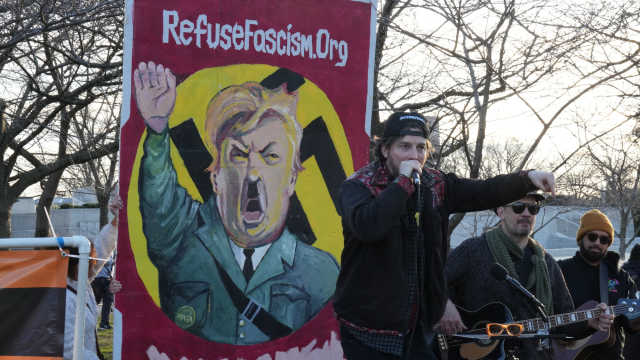
As neoliberalism collapses into authoritarianism, its machinery of repression intensifies. Dissent is silenced, social life militarized and hate normalized. This fuels a fascistic politics which is systematically dismantling democratic accountability, with higher education among its primary targets. For years, the far right has sought to undermine education, recognizing it as a powerful site of resistance. This has only accelerated, as MAGA movement adherents seek to eliminate the public education threat to their authoritarian goals.

Vice President-elect J.D. Vance openly declared “the professors are the enemy.” President-elect Donald Trump has stated that “pink-haired communists [are] teaching our kids.” In response to the Black Lives Matter protests following George Floyd’s killing, MAGA politicians like Sen. Tom Cotton openly called for deploying military force against demonstrators.  

The authoritarian spirit driving this party is crystallized in the words of right-wing activist Jack Posobiec, who, at the 2023 Conservative Political Action Conference, said: “We are here to overthrow democracy completely. We didn’t get all the way there on January 6, but we will. After we burn that swamp to the ground, we will establish the new American republic on its ashes.” This is more than anti-democratic, authoritarian rhetoric. It also shapes poisonous policies in which education is transformed into an animating space of repression and violence, and becomes weaponized as a tool of censorship, conformity and discrimination. 

As authoritarianism surges globally, democracy is being dismantled. What does this rise in illiberal regimes mean for higher education? What is the role of universities in defending democratic ideals when the very notion of democracy is under siege? In Trump’s United States, silence is complicity, and inaction a moral failing. Higher education must reassert itself as a crucial democratic public sphere that fosters critical thought, resists tyranny and nurtures the kind of informed citizens necessary to a just society.

Trump’s return to the presidency marks the endpoint of a deeply corrupt system, one that thrives on anti-intellectualism, scorn for science and contempt for reason. In this political climate, corruption, racism and hatred have transformed into a spectacle of fear, division and relentless disinformation, supplanting any notion of shared responsibility or collective purpose. In such a degraded environment, democracy becomes a hollowed-out version of itself, stripped of its legitimacy, ideals and promises. When democracy loses its moral and aspirational appeal, it opens the door for autocrats like Trump to dismantle the very institutions vital to preserving democratic life.

The failure of civic culture, education and literacy is starkly evident in the Trump administration’s success at emptying language of meaning — a flight from historical memory, ethics, justice and social responsibility. Communication has devolved into exaggerated political rhetoric and shallow public relations, replacing reason and evidence with spectacle and demagoguery. Thinking is scorned as dangerous, and news often serves as an amplifier for power rather than a check on it.

Corporate media outlets, driven by profits and ratings, align themselves with Trump’s dis-imagination machine, perpetuating a culture of celebrity worship and reality-TV sensationalism. In this climate, the institutions essential to a vibrant civil society are eroding, leaving us to ask: What kind of democracy can survive when the foundations of the social fabric are collapsing? Among these institutions, the mainstream media — a cornerstone of the fourth estate — have been particularly compromised. As Heather McGhee notes, the right-wing media has, over three decades, orchestrated “a radical takeover of our information ecosystem.”

Universities’ Neoliberal Audit Culture

As public-sector support fades, many institutions of higher education have been forced to mirror the private sector, turning knowledge into a commodity and eliminating departments and courses that don’t align with the market’s bottom line. Faculty are increasingly treated like low-wage workers, with labor relations designed to minimize costs and maximize servility. In this climate, power is concentrated in the hands of a managerial class that views education through a market-driven lens, reducing both governance and teaching to mere instruments of economic need. Democratic and creative visions, along with ethical imagination, give way to calls for efficiency, financial gain and conformity.

This neoliberal model not only undermines faculty autonomy but also views students as mere consumers, while saddling them with exorbitant tuition fees and a precarious future shaped by economic instability and ecological crisis. In abandoning its democratic mission, higher education fixates on narrow notions of job-readiness and cost-efficiency, forsaking its broader social and moral responsibilities. Stripped of any values beyond self-interest, institutions retreat from fostering critical citizenship and collective well-being.

Pedagogy, in turn, is drained of its critical content and transformative potential. This shift embodies what Cris Shore and Susan Wright term an “audit culture” — a corporate-driven ethos that depoliticizes knowledge, faculty and students by prioritizing performance metrics, measurable outputs and rigid individual accountability over genuine intellectual and social engagement.

In this process, higher education relinquishes its role as a democratic public sphere, shifting its mission from cultivating engaged citizens to molding passive consumers. This transformation fosters a generation of self-serving individuals, disconnected from the values of solidarity and justice, and indifferent to the creeping rise of authoritarianism.

The suppression of student dissent on campuses this year, particularly among those advocating for Palestinian rights and freedom, highlights this alarming trend. Universities increasingly prioritize conformity and corporate interests, punishing critical thinking and democratic engagement in the process. These developments lay the groundwork for a future shaped not by collective action and social equity, but by privatization, apathy and the encroachment of fascist politics.

Education, once the bedrock of civic engagement, has become a casualty in the age of Trump, where civic illiteracy is celebrated as both virtue and spectacle. In a culture dominated by information overload, celebrity worship and a cutthroat survival ethic, anti-intellectualism thrives as a political weapon, eroding language, meaning and critical thought. Ignorance is no longer passive — it is weaponized, fostering a false solidarity among those who reject democracy and scorn reason. This is not innocent ignorance but a calculated refusal to think critically, a deliberate rejection of language’s role in the pursuit of justice. For the ruling elite and the modern Republican Party, critical thinking is vilified as a threat to power, while willful ignorance is elevated to a badge of honor.

If we are to defeat the emerging authoritarianism in the U.S., critical education must become a key organizing principle of politics. In part, this can be done by exposing and unraveling lies, systems of oppression, and corrupt relations of power while making clear that an alternative future is possible. The language of critical pedagogy can powerfully condemn untruths and injustices.

History’s Emancipating Potential

A central goal of critical pedagogy is to cultivate historical awareness, equipping students to use history as a vital lens for understanding the present. Through the critical act of remembrance, the history of fascism can be illuminated not as a relic of the past but as a persistent threat, its dormant traces capable of reawakening even in the most robust democracies. In this sense, history must retain its subversive function — drawing on archives, historical sources, and suppressed narratives to challenge conventional wisdom and dominant ideologies.

The subversive power of history lies in its ability to challenge dominant narratives and expose uncomfortable truths — precisely why it has become a prime target for right-wing forces determined to rewrite or erase it. From banning books and whitewashing historic injustices like slavery to punishing educators who address pressing social issues, the assault on history is a calculated effort to suppress critical thinking and maintain control. Such assaults on historical memory represent a broader attempt to silence history’s emancipatory potential, rendering critical pedagogy an even more urgent and essential practice in resisting authoritarian forces. These assaults represent both a cleansing of history and what historian Timothy Snyder calls “anticipatory obedience,” which he labels as behavior individuals adopt in the service of emerging authoritarian regimes.

he fight against a growing fascist politics around the world is more than a struggle over power, it is also a struggle to reclaim historical memory. Any fight for a radical democratic socialist future is doomed if we fail to draw transformative lessons from the darkest chapters of our history, using them to forge meaningful resolutions and pathways toward a post-capitalist society. This is especially true at a time when the idea of who should be a citizen has become less inclusive, fueled by toxic religious and white supremacist ideology.

Consciousness-Shifting Pedagogy

One of the challenges facing today’s educators, students and others is the need to address the question of what education should accomplish in a historical moment when it is slipping into authoritarianism. In a world in which there is an increasing abandonment of egalitarian and democratic impulses, what will it take to educate young people and the broader polity to hold power accountable?

In part, this suggests developing educational policies and practices that not only inspire and motivate people but are also capable of challenging the growing number of anti-democratic tendencies under the global tyranny of capitalism. Such a vision of education can move the field beyond its obsession with accountability schemes, market values, and unreflective immersion in the crude empiricism of a data-obsessed, market-driven society. It can also confront the growing assault on education, where right-wing forces seek to turn universities into tools of ideological tyranny — arenas of pedagogical violence and white Christian indoctrination.

Any meaningful vision of critical pedagogy must have the power to provoke a radical shift in consciousness — a shift that helps us see the world through a lens that confronts the savage realities of genocidal violence, mass poverty, the destruction of the planet and the threat of nuclear war, among other issues. A true shift in consciousness is not possible without pedagogical interventions that speak directly to people in ways that resonate with their lives, struggles and experiences. Education must help individuals recognize themselves in the issues at hand, understanding how their personal suffering is not an isolated event, but part of a systemic crisis. In addition, activism, debate and engagement should be central to a student’s education.

n other words, there can be no authentic politics without a pedagogy of identification — an education that connects people to the broader forces shaping their lives, an education that helps them imagine and fight for a world where they are active agents of change.

The poet Jorie Graham emphasizes the importance of engaging people through experiences that resonate deeply with their everyday lives. She states that “it takes a visceral connection to experience itself to permit us to even undergo an experience.” Without this approach, pedagogy risks reinforcing a broader culture engrossed in screens and oversimplifications. In such a context, teaching can quickly transform into inaccessible jargon that alienates rather than educates.

Resisting Educational “Neutrality”

In the current historical moment, education cannot surrender to the call of academics who now claim in the age of Trump that there is no room for politics in the classroom, or the increasing claim by administrators that universities have a responsibility to remain neutral. This position is not only deeply flawed but also complicit in its silence over the current far right politicization of education.

The call for neutrality in many North American universities is a retreat from social and moral responsibility, masking the reality that these institutions are deeply embedded in power relations. As Heidi Matthews, Fatima Ahdash and Priya Gupta aptly argue, neutrality “serves to flatten politics and silence scholarly debate,” obscuring the inherently political nature of university life. From decisions about enrollment and research funding to event policies and poster placements, every administrative choice reflects a political stance. Far from apolitical, neutrality is a tool that silences dissent and shields power from accountability.

It is worth repeating that the most powerful forms of education today extend far beyond public and higher education. With the rise of new technologies, power structures and social media, culture itself has become a tool of propaganda. Right-wing media, conservative foundations, and a culture dominated by violence and reality TV created the fertile ground for the rise of Trump and his continued legitimacy. Propaganda machines like Fox News have fostered an anti-intellectual climate, normalizing Trump’s bigotry, lies, racism and history of abuse. This is not just a political failure — it is an educational crisis.

In the age of new media, platforms like Elon Musk’s X and tech giants like Facebook, Netflix and Google have become powerful teaching machines, actively serving the far right and promoting the values of gangster capitalism. These companies are reshaping education, turning it into a training ground for workers who align with their entrepreneurial vision or, even more dangerously, perpetuating a theocratic, ultra-nationalist agenda that views people of color and marginalized groups as threats. This vision of education must be rejected in the strongest terms, for it erodes both democracy and the very purpose of education itself. 

Education as Mass Mobilization

Education, in its truest sense, must be about more than training students to be workers or indoctrinating them into a white Christian nationalist view of who does and doesn’t count as American. Education should foster intellectual rigor and critical thinking, empowering students to interrogate their experiences and aspirations while equipping them with the agency to act with informed judgment. It must be a bold and supportive space where student voices are valued and engaged with pressing social and political issues, cultivating a commitment to justice, equality and freedom. In too many classrooms in the U.S., there are efforts to make students voiceless, which amounts to making them powerless. This must be challenged and avoided at all times.

Critical pedagogy must expose the false equivalence of capitalism and democracy, emphasizing that resisting fascism requires challenging capitalism. To be transformative, it should embrace anti-capitalist principles, champion radical democracy and envision political alternatives beyond conventional ideologies.

In the face of growing attacks on higher education, educators must reclaim their role in shaping futures, advancing a vision of education as integral to the struggle for democracy. This vision rejects the neoliberal framing of education as a private investment and instead embraces a critical pedagogy as a practice of freedom that disrupts complacency, fosters critical engagement, and empowers students to confront the forces shaping their lives.

In an age of resurgent fascism, education must do more than defend reason and critical judgment — it must also mobilize widespread, organized collective resistance. A number of youth movements, from Black Lives Matter and the Sunrise Movement to Fridays for Future and March for Our Lives, are mobilizing in this direction. The challenge here is to bring these movements together into one multiracial, working-class organization.

The struggle for a radical democracy must be anchored in the complexities of our time — not as a fleeting sentiment but as an active, transformative project. Democracy is not simply voting, nor is it the sum of capitalist values and market relations. It is an ideal and promise — a vision of a future that does not imitate the present; it is the lifeblood of resistance, struggle, and the ongoing merging of justice, ethics and freedom.

In a society where democracy is under siege, educators must recognize that alternative futures are not only possible but that acting on this belief is essential to achieving social change.

The global rise of fascism casts a long shadow, marked by state violence, silenced dissent and the assault on critical thought. Yet history is not a closed book — it is a call to action, a space for possibility. Now, more than ever, we must dare to think boldly, act courageously, and forge the democratic futures that justice demands and humanity deserves.

Wednesday, May 28, 2025

Corruption, Fraud and Scandal at Los Angeles Community College District (LACCD Whistleblower)

During the weekend of May 16-19, 2025, the San Francisco Bay Area Independent Media Center – IndyBay which operates as open platform news source against injustice, scrubbed two years of news articles ranging from May 2023 – May 2025.

The focus of these articles was corruption, fraud and scandal in the Los Angeles Community College District, primarily at Los Angeles Valley College’s Media Arts Department.

A few of these articles summarized.

Erika Endrijonas faces new questions in LACCD fraud | May 2, 2023 |

Pasadena City College President-Superintendent Erika Endrijonas being fired from the institution and trying to get a job at Santa Barbara City College, Mt. SAC, and Los Angeles City College. Endrijonas had been subjected to a vote of no confidence by the Pasadena Academic Senate, Pasadena Full-Time Faculty Union, protests by Part-Time Faculty, and finally the vote to reduce her contract by the newly elected board of trustees.

The article dived into Endrijonas’s tenure at her previous institution – Los Angeles Valley College. Endrijonas was announced in her new role at PCC in December 2018, the same week that a jury in Van Nuys awarded a former LAVC employee $2.9 million jury award for illegal retaliation and abuse. A few months earlier, the Los Angeles Times published a major story about the Valley Academic and Cultural Center – a project meant to be Endrijonas’s crowning achievement – being an alleged massive racketeering scheme.

Further it documented the Media Arts Department the VACC would house had a lengthy history of lawsuits and accreditation complaints against the faculty for not providing the education and training advertised – negating the need for the new building. The building’s approval vote happened in August 2016, the lawsuit happened in 2009, and the Accreditation Complaints happened in June 2016.

Dozen LAVC Cinema Students Narratives challenge Erika Endrijonas’s LACCD Success Story | May 5, 2023 |

This article covered a release of an email thread from a dozen students in 2016 that was ultimately sent to the Accreditation Commission for Junior and Community Colleges in 2016, substantiating that there was widespread fraud in the department. Classes were not scheduled by Department Chair Eric Swelstad, training was not provided, labs were not held, etc . . .

Van Nuys/Los Angeles College Screenwriting Professor Faked Writer’s Guild Membership | May 17, 2023 |

Revealed that LAVC Media Arts Department Chair Eric Swelstad faked his membership in the Writer’s Guild of America – West, and then used it in multiple professional bios.

Los Angeles Valley College perpetuated wage theft against students on Julie Su’s watch | May 19, 2023 |

Documented how Grant Director Dan Watanabe engaged in wage theft against students for two years from 2013 – 2016.

Two Los Angeles Film Professors Bilked Taxpayers Over $3.5 Million Dollars | May 21, 2023 |

Described how LAVC Media Arts Department Founder Joseph Dacursso’s retirement first as Department Chair, then as a full-time faculty in 2012, left Department Chair Eric Swelstad and Arantxa Rodriguez to engage in petty infighting and squabbling that spilled over into scheduling decisions. In short, two faculty members collected six-figure-salaries while putting students in the middle of department in-fighting.

LAVC Omsbudsman Stalked Whistleblowers | August 8, 2023 |

Described how LAVC’s Dean of Students, Annie G. Reed (Goldman) retaliated and stalked students that went to Accreditation, going as far as running a smear campaign that one of them was a potential school shooter. Worse, she began stalking him after he left school – including on social media.


[Image: Annie G. Reed Goldman, Dean of Labor and HR at LACCD]

Further articles questioned where Academic Degrees were given out to students who had not completed Academic classes and criteria, the role of Jo Ann Rivas turned YouTube Personality ‘AuditLA’ who was on the Los Angeles Valley College Citizen’s Building Oversight Committee, whether a number of students with falsified resumes received payments from a Grant as ‘Professional Experts’ etc . . .

The scrubbing of these articles coincided with the formal appointment of Alberto J. Roman as the new Chancellor of the Los Angeles Community College District, following the retirement of disgraced administrator Francisco Rodriguez.

It also came with the publication of two final articles. One about Annie G. Reed’s being named as a Defendant in a lawsuit by former faculty at Los Angeles City College, who came to her about an administrator engaging in illegal behavior – including planting drugs on employees to get them fired.

The second article, probed Los Angeles Valley College Department Chair, Eric Swelstad’s professional bio again and provided evidence that he repeatedly lied and engaged in deceptive advertising and practices for two decades. It provided students who held loans with information about student borrower defenses.

The censorship also came months after Jo Ann Rivas aka AuditLA, herself probed by the articles, launched a barrage of attacks for about a week in January about a former student who had grievance's against the school. Rivas had previously engaged in a similar barrage in July 2020.

This was not the first time that an attempt was made to censor this news stream.

In 2020, an attempt was made to hack the community news feed account on Twitter/X.com @LACCDW. Then a week before the LACCD Board of Trustees election in November 2020, Twitter suspended the community newsfeed altogether. It was only restored two years later after Twitter's sale and the re-evaluation of previous suspended accounts.

In a final update – The Valley Academic and Cultural Center, despite having a 2018 completion date, remains unfinished. According to minutes of the LAVC Work Environment Committee Minutes from 2025-05-08;

“The Valley Academic and Cultural Center (VACC) is as of Friday, May 8th, about 80% complete. They are still patching the roof. There are still some critical items like stage protection net.”

Sunday, January 4, 2026

Beyond the College Meltdown: Moral Decay, Dehumanization, and the Failure of Courage (Dahn Shaulis and Glen McGhee)

At the Higher Education Inquirer, our focus on the college meltdown has always pointed beyond collapsing enrollments, rising tuition, and institutional dysfunction. Higher education has served as a warning signal — a visible manifestation of a far deeper crisis: the moral decay and dehumanization of society, compounded by a profound failure of courage among those with the greatest power and resources.

This concern predates the current moment. Through our earlier work at American Injustice, we chronicled how American institutions steadily abandoned ethical responsibility in favor of profit, prestige, and political convenience. What is happening in higher education today is not an anomaly. It is the predictable outcome of decades of moral retreat by elites who benefit from the system while refusing to challenge its injustices.

Permanent War and the Moral Abdication of Leadership

Wars in Gaza, Ukraine, and Venezuela reveal a world in which human suffering has been normalized and strategically managed rather than confronted. Civilian lives are reduced to abstractions, filtered through geopolitical narratives and sanitized media frames. What is most striking is not only the violence itself, but the ethical cowardice of leadership.

University presidents, policymakers in Washington, and financial and technological elites rarely speak with moral clarity about war and its human costs. Institutions that claim to value human life and critical inquiry remain silent, hedging statements to avoid donor backlash or political scrutiny. The result is not neutrality, but complicity — a tacit acceptance that power matters more than people.

Climate Collapse and the Silence of Those Who Know Better

Climate change represents an existential moral challenge, yet it has been met with astonishing timidity by those most capable of leading. Universities produce the research, model the risks, and educate the future — yet many remain financially entangled with fossil fuel interests and unwilling to confront the implications of their own findings.

Student demands for divestment and climate accountability are often treated as public-relations problems rather than ethical imperatives. University presidents issue vague commitments while continuing business as usual. In Washington, legislation stalls. On Wall Street, climate risk is managed as a portfolio concern rather than a human catastrophe. In Silicon Valley, technological “solutions” are offered in place of systemic change.

This is not ignorance. It is cowardice disguised as pragmatism.

The Suppression of Student Protest and the Fear of Moral Clarity

The moral vacuum at the top becomes most visible when students attempt to fill it. Historically, student movements have pushed institutions toward justice — against segregation, apartheid, and unjust wars. Today, however, student protest is increasingly criminalized.

Peaceful encampments are dismantled. Students are arrested or suspended. Faculty are intimidated. Surveillance tools track dissent. University leaders invoke “safety” and “order” while outsourcing enforcement to police and private security. The message is unmistakable: moral engagement is welcome only when it does not challenge power.

This is not leadership. It is risk aversion elevated to institutional doctrine.

Mass Surveillance and the Bureaucratization of Fear

The expansion of mass surveillance further reflects elite moral failure. From campuses to corporations, human beings are monitored, quantified, and managed. Surveillance is justified as efficiency or security, but its deeper function is control — discouraging dissent, creativity, and ethical risk-taking.

Leaders who claim to champion innovation quietly accept systems that undermine autonomy and erode trust. In higher education, surveillance replaces mentorship; compliance replaces curiosity. A culture of fear takes root where moral courage once should have flourished.

Inequality and the Insulation of Elites from Consequence

Extreme inequality enables this cowardice. Those at the top are shielded from the consequences of their decisions. University presidents collect compensation packages while adjuncts struggle to survive. Wall Street profits from instability it helps create. Silicon Valley builds tools that reshape society without accountability. Washington dithers while communities fracture.

When elites are insulated, ethical standards erode. Moral responsibility becomes optional — something to be invoked rhetorically but avoided in practice.

Social Media, AI, and the Automation of Moral Evasion

Social media and Artificial Intelligence accelerate dehumanization while providing cover for inaction. Platforms reward outrage without responsibility. Algorithms make decisions without accountability. Leaders defer to “systems” and “processes” rather than exercising judgment.

In higher education, AI threatens to further distance leaders from the human consequences of their choices — allowing automation to replace care, metrics to replace wisdom, and efficiency to replace ethics.

The Crisis Beneath the Crisis

The college meltdown is not simply a failure of policy or finance. It is a failure of moral leadership. Those with the most power — university presidents, elected officials, financiers, and technologists — have repeatedly chosen caution over conscience, reputation over responsibility, and silence over truth.

War without moral reckoning. Climate collapse without leadership. Protest without protection. Surveillance without consent. Inequality without accountability.

These are not accidents. They are the results of decisions made — and avoided — by people who know better.

Toward Moral Courage and Rehumanization

Rehumanization begins with courage. It requires leaders willing to risk prestige, funding, and influence in defense of human dignity. Higher education should be a site of ethical leadership, not an echo of elite fear.

This means defending student protest, confronting climate responsibility honestly, rejecting dehumanizing technologies, and placing human well-being above institutional self-preservation. It means leaders speaking plainly about injustice — even when it is inconvenient.

Our concern at Higher Education Inquirer — and long before that, at American Injustice — has always been this: What happens to a society when those with the greatest power lack the courage to use it ethically?

Until that question is confronted, the college meltdown will remain only one visible fracture in a far deeper moral collapse.

Monday, June 16, 2025

PragerU and the Culture War: Manufacturing Myths in Higher Education and Beyond

In the evolving landscape of American media and education, PragerU stands out as a well-funded propaganda machine disguised as an educational institution. Despite the name, Prager University is not a university. It does not grant degrees, offer accredited courses, or submit to academic oversight. Instead, it produces short, emotionally charged videos designed to reshape young minds around a rigid conservative ideology—an ideology increasingly aligned with Christian nationalism, market fundamentalism, and historical denialism.

Founded in 2009 by talk radio host Dennis Prager, PragerU emerged during the rise of social media and deepening political polarization. The timing was ideal. With traditional civics education struggling and digital content consumption rising, PragerU began churning out five-minute videos purporting to teach the "real truth" about history, race, gender, economics, and science. These slickly produced segments claim to correct misinformation, but in reality they deliver a narrow worldview fueled by grievance, nostalgia, and moral panic.

PragerU content routinely distorts established historical and scientific knowledge. It reframes American slavery as a common global occurrence, rather than as a foundational atrocity that has shaped U.S. legal and economic systems to this day. It minimizes climate change, portraying it as exaggerated fearmongering driven by radical environmentalists, even as the scientific consensus grows increasingly dire. And it routinely dismisses systemic racism, patriarchy, and wealth inequality as myths invented by the political left to divide Americans.

This style of storytelling directly contradicts the evidence-based approaches found in the work of sociologist James Loewen and historian Howard Zinn. Loewen’s Lies My Teacher Told Me exposed how mainstream K–12 textbooks sanitize U.S. history by ignoring racism, class struggle, and colonialism. Zinn’s A People’s History of the United States took it further, reframing the American narrative through the voices of the marginalized—the enslaved, the working class, women, and the indigenous. While Loewen and Zinn sought to challenge students to think critically and question power, PragerU does the opposite. It seeks to reassure students that the status quo is righteous and that questioning it is dangerous.

PragerU’s rise also coincides with real, deeply rooted problems in American education. There are serious and measurable deficiencies in literacy, numeracy, and critical thinking among U.S. students and even adults. These educational gaps leave many people vulnerable to simplistic narratives and emotionally charged misinformation. PragerU does not aim to fill those gaps with rigorous content; it exploits them. Its materials demand little from viewers beyond ideological alignment. The videos offer no footnotes, no peer-reviewed sources, and no intellectual challenge—just certainty delivered with polish.

And yet, increasingly, these materials are being welcomed into public school classrooms. In states like Florida and Oklahoma, conservative lawmakers and school officials have approved or endorsed PragerU content as part of the curriculum. This insertion of ideologically driven material into state-sanctioned education is not just alarming—it’s part of a broader attempt to reshape how young people see their country and their place in it.

The broader culture war that PragerU is part of is not simply about liberal versus conservative. It’s about whether education should cultivate independent thinking and historical awareness—or obedient loyalty to a sanitized narrative. PragerU paints itself as a corrective to “leftist indoctrination,” but what it offers is another form of indoctrination: one that demands allegiance to a version of America that never existed, where racism was a glitch, climate change is hysteria, and capitalism is above critique.

Its media tactics are savvy. PragerU’s videos are short, colorful, and emotionally potent—perfectly crafted for young viewers raised on TikTok and YouTube. While teachers fight to hold students’ attention with limited resources, PragerU offers a packaged worldview that feels easy and affirming. But this ease comes at the cost of intellectual development. True learning requires struggle, contradiction, and evidence—not comforting stories that confirm one’s existing biases.

What’s missing from PragerU’s content is precisely what makes education meaningful: complexity, context, and the capacity to think beyond slogans. When students read Lies My Teacher Told Me or A People’s History, they may feel discomfort, but they also grow. They learn that history is not a patriotic myth but a contested and dynamic struggle over meaning and power.

To respond to PragerU’s growing reach, educators and the public must take the real problems in education seriously. Media literacy, civic education, and historical thinking should be reinforced, not removed. Students must be equipped not just with facts, but with the tools to evaluate competing narratives and sources of information. Schools and universities must resist pressure to adopt content that fails basic tests of intellectual honesty and academic rigor.

PragerU is not simply another voice in a pluralistic conversation. It is part of a movement to reduce education to ideological messaging. It thrives on a public that has been failed by underfunded schools, fractured media, and growing economic insecurity. But recognizing this reality does not mean surrendering to it.

If the goal is to prepare young people to navigate a complex world, we must choose truth over comfort, questioning over certainty, and education over indoctrination.


For more investigations into education and media, follow the Higher Education Inquirer.

Saturday, July 19, 2025

Degrees of Distraction: Clickbait Culture in Higher Education Media

A growing number of mass-market media outlets like MSN are flooding social media and news aggregators with listicle-style content that oversimplifies the complex realities of higher education. These articles—such as “These 16 College Majors Lead Straight to Debt and Disappointment,” “How Student Loan Debt Can Ruin Your Life,” and “The 10 Most Difficult College Degrees & The 10 Easiest”—traffic in anxiety and fear. They promise clarity but offer only distraction, substituting nuanced analysis with sensational headlines and shallow comparisons.

The underlying message of these articles is rarely subtle: if you pick the wrong major or underestimate the burden of student loans, you’re doomed. The reader is often shown a carousel of exaggerated personal stories, stripped of context and reduced to cautionary tales. At the same time, the articles ignore the broader, systemic forces that have made higher education more financially perilous for millions of Americans.

By presenting debt as a purely personal failure rather than a predictable outcome of policy decisions, financial deregulation, and corporate capture, these pieces shift the blame away from institutions and onto individual students. They rarely address how college costs have skyrocketed while wages have stagnated, how the Department of Education has been gutted and restructured, or how student loan servicing companies routinely mislead borrowers with little accountability. They don’t examine the role of for-profit schools, accreditors, or real estate developers profiting from campus-adjacent housing. Nor do they challenge the myth that higher education is a guaranteed path to upward mobility.

Instead, they pit majors against each other. Humanities, social sciences, and creative arts are portrayed as reckless luxuries. STEM majors are celebrated as pragmatic, even though the return on investment depends heavily on where one studies, who one knows, and whether one can persist in often toxic or exclusionary academic cultures. Even the categorization of “difficult” versus “easy” majors is misleading, based more on GPA averages than actual workload, long-term intellectual challenge, or student engagement.

This kind of journalism contributes to a growing anti-intellectualism. It discourages students from following their passions or pursuing degrees that may not yield high financial returns but are essential to a functioning democracy. It feeds a cultural narrative that sees college as a consumer transaction rather than a public good. The result is a media ecosystem where student fear becomes a revenue stream, and informed decision-making is replaced by click-through bait.

These articles also crowd out deeper investigations. Where is the coverage of ongoing borrower defense claims against predatory schools? Where is the sustained attention to the impact of private equity in education? Where is the reporting on how schools game federal regulations like Gainful Employment or misuse nonprofit status to enrich executives? Instead of informing readers about these realities, MSN and similar platforms serve up recycled headlines designed to generate outrage, not insight.

The Higher Education Inquirer calls for a higher standard of reporting—one that holds power to account and equips students with more than slogans and salary charts. Young people navigating college in 2025 are not fools or naive dreamers. They are facing an increasingly rigged game, one that demands critical thinking, not consumer shaming. They deserve journalism that investigates, not indoctrinates.

Sources
MSN: “These 16 College Majors Lead Straight to Debt and Disappointment”
MSN: “How Student Loan Debt Can Ruin Your Life”
MSN: “The 10 Most Difficult College Degrees & The 10 Easiest”
National Center for Education Statistics
The Institute for College Access and Success
The Century Foundation
Department of Education FOIA archives
Higher Education Inquirer investigations on student loan fraud and federal oversight

Language in the Age of Fascist Politics (Henry Giroux)

In the age of expanding fascism, the power of language is not only fragile but increasingly threatened. As Toni Morrison has noted, “language is not only an instrument through which power is exercised,” it also shapes agency and functions as an act with consequences. These consequences ripple through the very fabric of our existence. For in the words we speak, meaning, truth, and our collective future are at risk. Each syllable, phrase, and sentence becomes a battleground where truth and power collide, where silence breeds complicity, and where justice hangs in the balance.

In response, we find ourselves in desperate need of a new vocabulary, one capable of naming the fascist tide and militarized language now engulfing the United States. This is not a matter of style or rhetorical flourish; it is a matter of survival. The language required to confront and resist this unfolding catastrophe will not come from the legacy press, which remains tethered to the very institutions it ought to expose. Nor can we turn to the right-wing media machines, led by Fox News, where fascist ideals are not just defended but paraded as patriotism. 

In the face of this crisis, Toni Morrison’s insight drawn from her Nobel Lecture becomes all the more urgent and makes clear that the language of tyrants, embodied in the rhetoric, images, and modes of communication characteristic of the Trump regime, is a dead language. For her “a dead language is not simply one that is no longer spoken or written,” it is unyielding language “content to admire its own paralysis.” It is repressive language infused with power, censored and censoring. Ruthless in its policing duties and dehumanizing language, it has no desire or purpose other than maintaining the free range of its own narcotic narcissism, its own exclusivity and dominance. “Though moribund, it is not without effect” for it actively thwarts the intellect, stalls conscience, and “suppresses human potential.” Unreceptive to interrogation, it cannot form or tolerate new ideas, shape other thoughts, tell another story, or fill baffling silences. This is the language of official power whose purpose is to sanction ignorance and preserve. 

Beneath its glittering spectacle and vulgar performance, lies a language that is "dumb, predatory, sentimental." It offers mass spectacles, a moral sleepwalking state of mind, and a psychotic infatuation for those who seek refuge in unchecked power. It forges a community built on greed, corruption, and hate, steeped in a scandal of hollow fulfillment. It is a language unadorned in its cruelty and addiction to creating an architecture of violence. It is evident in Trump’s discourse of occupation, his militarizing of American politics, and in his use of an army of trolls to turn hatred into a social media spectacle of swagger and cruelty.


Despite differing tones and political effects, the discourses of the far right and the liberal mainstream converge in their complicity: both traffic in mindless spectacle, absorb lies as currency, and elevate illusion over insight. The liberal mainstream drapes the machinery of cruelty in the language of civility, masking the brutality of the Trump regime and the predatory logic of gangster capitalism, while the far right revels in it, parading its violence as virtue and its hatred as patriotism. Language, once a powerful instrument against enforced silence and institutional cruelty, now too often serves power, undermining reason, normalizing violence, and replacing justice with vengeance. 

In Trump’s oligarchic culture of authoritarianism, language becomes a spectacle of power, a theater of fear crafted, televised, and performed as a civic lesson in mass indoctrination. If language is the vessel of consciousness, then we must forge a new one--fierce, unflinching, and unafraid to rupture the fabric of falsehood that sustains domination, disposability, and terror. The late famed novelist, NgÅ©gÄ© wa Thiong’o, was right in stating that “language was a site of colonial control,” inducting people into what he called “colonies of the mind.”

The utopian visions that support the promise of a radical democracy and prevent the dystopian nightmare of a fascist politics are under siege in the United States. Increasingly produced, amplified and legitimated in a toxic language of hate, exclusion, and punishment, all aspects of the social and the democratic values central to a politics of solidarity are being targeted by right-wing extremists. In addition, the institutions that produce the formative cultures that nourishes the social imagination and democracy itself are now under attack. The signposts are on full display in a politics of racial and social cleansing that is being fed by a white nationalist and white supremacist ideology that is at the centre of power in the US—marked by fantasies of exclusion accompanied by a full-scale attack on morality, reason, and collective resistance rooted in democratic struggle. 

As more people revolt against this dystopian project, neoliberal ideology and elements of a fascist politics merge to contain, distract and misdirect the anger that has materialised out of legitimate grievances against the government, controlling privileged elites and the hardships caused by neoliberal capitalism. The current crisis of agency, representation, values and language demands a discursive shift that can call into question and defeat the formative culture and ideological scaffolding through which a savage neoliberal capitalism reproduces itself. This warped use of language directly feeds into the policies of disposability that define Trump's regime.

State Terror and Trump’s Politics of Disposability

As Trump’s regime concentrates power, he invokes a chilling convergence of law, order, and violence, a cornerstone of his politics of disposability. His acts of cruelty and lawlessness, abducting and deporting innocent people, branding immigrants as “vermin,” claiming they are “poisoning the blood” of Americans, and even proposing the legalization of murder for twelve hours, make clear that his violent metaphors are not just rhetorical flourishes. They are policy blueprints. In Trump’s hands, rhetoric becomes a weaponized prelude to atrocity, a tool of statecraft. Threats, hatred, and cruelty are transformed into instruments of governance.

This is not careless talk, it is a brutal and calculated expression of power. Trump’s threats to arrest and deport critics such as Zohran Mamdani reveal his willingness to use the machinery of the state for political extermination. His targets are predictable: immigrants, Black people, educators, journalists, LGBTQ+ individuals, and anyone who dares to challenge his white Christian nationalist, neoliberal, and white supremacist vision. His language does not merely offend, it incites harm, enacts repression, and opens the gates to state-sanctioned violence. It extends the reign of terror across the United States by labeling protesters as terrorists and deploying the military to American cities, treating them as if they were “occupied territories.” 

Trump is not alone. Many of his MAGA follower use these same hateful discourse. For instance, conservative pundit Ann Coulter wrote “in response to a speech by Melanie Yazzie, a Native artist and professor, about decolonization, “We didn’t Kill enough Indians.” This is not simply harsh rhetoric; nor is it a performative display of emboldened hatred and historical forgetting, it sets the stage for state-sanctioned repression and mass violence. What is at stake is more than civic respect. It is democracy itself. When language loses meaning and truth is blurred, tyranny thrives. Trump’s and too much of MAGA discourse is not about persuasion; it is about dehumanization and domination. It functions as statecraft, laying the groundwork for a society where suffering becomes spectacle and repression masquerades as law and order. Language is the canary in the coal mine, warning us that democracy dies without an informed citizenry.

As Eddie Glaude Jr. has powerfully argued, Americans must confront a brutal truth: the creation and expansion of Immigration and Customs Enforcement (ICE), now the largest federal law enforcement agency, is not merely a matter of policy, it is a cornerstone of white supremacy. It is a racist institution, entrenched in an immigration policy designed to uphold the values of white nationalism. In the face of shifting demographics, ICE is tasked with an urgent mission—to make America white again, a calculated attempt to turn back the clock on progress, to preserve an imagined past at the cost of justice and humanity.

We now live in a country where class and racial warfare both at home and abroad is on steroids, exposing the killing machine of gangster capitalism in its rawest, most punitive form. Trump supports the genocidal war waged by a state led by a war criminal. Children are being slaughtered in Gaza. Millions of Americans, including poor children, teeter on the edge of losing their healthcare. Funds for feeding hungry children are being slashed, sacrificed to feed the pockets of the ultra-rich. Thousands will die, not by accident, but by design. Terror, fear, and punishment have replaced the ideals of equality, freedom, and justice. Childcide is now normalized as the law of the land. The lights are dimming in America, and all that remains are the smug, ignorant smirks of fascist incompetence and bodies drained of empathy and solidarity.

Gangster Capitalism and the Death of Empathy

Gangster capitalism lays the foundation for Trump’s racist and fascist politics. As I have noted elsewhere, the United States has descended into a state of political, economic, cultural, and social psychosis, where cruel, neoliberal, democracy-hating policies have prevailed since the 1970s. At the core of this authoritarian shift lies a systemic war on workers, youth, Blacks, and immigrants, increasingly marked by mass violence and a punishing state both domestically and internationally. The U.S. has transformed into an empire dominated by a callous, greedy billionaire class that has dismantled any remnants of democracy, while embracing the fascistic ideology of white Christian nationalism and white supremacy. Fascism now parades not only beneath the flag but also under the Christian cross. 

America has shifted from celebrating unchecked individualism, as depicted in Ayn Rand’s Atlas Shrugged, to the glorification of greed championed by Gordon Gekko in Wall Street, and the psychotic avarice of Patrick Bateman in American Psycho. This descent into barbarity and psychotic infatuation with violence is further demonstrated by Justin Zhong, a right-wing preacher at Sure Foundation Baptist Church in Indianapolis, who called for the deaths of LGBTQ+ individuals during a sermon. Zhong defended his comments by citing biblical justifications and labeling LGBTQ+ people as "domestic terrorists." 

It gets worse. During a Men’s Preaching Night at Sure Foundation Baptist Church, Zhong's associate, Stephen Falco, suggested that LGBTQ+ people should "blow yourself in the back of the head," and that Christians should "pray for their deaths." Another member, Wade Rawley, advocated for violence, stating LGBTQ+ individuals should be "beaten and stomped in the mud" before being shot in the head. Fascism in America, nourished by the toxic roots of homophobia, now cloaks itself not just in the poisonous banner of the Confederate flag, but also in the sacred guise of the Christian cross.

Welcome to Trump’s America, where empathy is now viewed as a weakness and the cold rule of the market is the template for judging all social relations. One noted example can be found in the words of Trump’s on-and-off billionaire ally, Elon Musk, who dismisses empathy as a naive and detrimental force that undermines the competitive, individualistic ethos he champions. Speaking to Joe Rogan on his podcast, Musk specifically stated that “The fundamental weakness of western civilization is empathy.” As Julia Carrie Wong observes in The Guardian, the stakes extend far beyond casting empathy as a "parasitic plague." Empathy's true danger lies in its role as an enabler—granting permission to dehumanize others and constricting the very “definition of who should be included in a democratic state.” This is a recipe for barbarism, one that allows both states and individuals to turn a blind eye to the genocidal violence unfolding in Gaza and beyond.

Naming the Deep Roots of the Police State

Ruth Ben-Ghiat has warned that “America has been set on a trajectory to become a police state,” pointing to the passage of the Brutal and Bellicose Bill (BBB), which handed ICE a budget larger than the militaries of Brazil, Israel, and Italy combined. But the roots of this state violence go deeper. The foundation was laid under Bush and Cheney, whose war on terror birthed Guantanamo, Abu Ghraib, mass surveillance, and extraordinary rendition. What Trump has done is strip these earlier authoritarian practices of all pretenses, elevating them to the status of governing principles.

The police state did not begin with Trump; it evolved through him. Now, we see its terrifying maturity: racial cleansing disguised as immigration policy, hatred normalized as political speech, dissent criminalized, birthright citizenship threatened, and everyday life militarized. This is not politics as usual, it is fascism in real time.

Trump’s fascist politics grows even more dangerous when we recognize that his language of colonization and domination has helped transform American society into what NgÅ©gÄ© wa Thiong’o chillingly describes as a “war zone.” This war zone now spans the digital terrain—through the internet, podcasts, social media, and educational platforms—becoming a fertile breeding ground for fascist symbols, reactionary values, manufactured identities, and the toxic resurrection of colonial logics. In this battleground of meaning, the language of colonization does more than obscure the truth—it erodes critical thinking, silences historical memory, and disarms the very possibility of empowered agency. What remains in its wake is a nation scarred by suffering, haunted by loneliness, bound by shared fears, and anesthetized by the numbing rituals of a punishing state.

The transformation of America into a war zone finds its most visible expression in the rise of Trump’s omnipresent police state. This authoritarian machinery reveals itself through the mechanisms of state-sponsored terror, a heavily militarized ICE force operating like masked enforcers, and the rapid expansion of detention centers that will increasingly resemble a network of potential forced labor camps. As Fintan O’Toole warns, Trump’s deployment of troops onto the streets of Los Angeles is not merely symbolic—it is “a training exercise for the army, a form of reorientation.” In this reorientation, soldiers are no longer defenders of the Constitution but are being retrained as instruments of authoritarian power, bound not by democratic ideals but by obedience to a singular will.

Nevertheless, we resist or refuse to name the fascist threat and the ideological and economic architecture of its politics. Still, we recoil from calling the Trump regime what it is: a fascist state engaged in domestic terrorism. Still, we remain blind to the fact that economic inequality, global militarism, and the genocidal logics of empire are not peripheral issues, they are the center. Why is it so difficult to admit that we are living in an age of American fascism? Why do the crimes of the powerful, at home and abroad, so often pass without scrutiny, while the victims are blamed or erased?

The Collapse of Moral Imagination

What we face is not only a political crisis, partly in the collapse of conscience and civic courage-- a profound moral collapse. The war being waged at home by the Trump regime is not just against immigrants or the poor, it is a war on critical thought, on historical memory, on the courage to dissent. It is a war on every institution that upholds critical thinking, informed knowledge, and civic literacy. This is a genocidal war against the very possibility of a just future—a war not merely against, but for stupidity, for the death of morality, and for the annihilation of any robust notion of democracy. Viktor Klemperer, in his seminal work The Language of the Third Reich, offers a crucial lesson from history: "With great insistence and a high degree of precision right down to the last detail, Hitler’s Mein Kampf teaches not only that the masses are stupid, but that they need to be kept that way, intimidated into not thinking." Klemperer’s analysis reveals that Nazi politics did not arise in a vacuum; it was cultivated in a culture where language itself was the breeding ground of cruelty and control.

Trump’s rhetoric of fear, racial hatred does not emerge in a vacuum. It resonates because it taps into a long and violent history, a history soaked in blood, built on genocide, slavery, colonialism, and exclusion. His language recalls the genocidal campaigns against Indigenous peoples, Black Americans, Jews, and others deemed disposable by authoritarian regimes. It is a necrotic lexicon, resurrected in service of tyranny. It gives birth to politicians with blood in their mouths, who weaponize nostalgia and bigotry, cloaking brutality in the false promises of patriotism and “law and order.”

Language as War and the Return of Americanized Fascism

This is not merely a rhetoric of cruelty, it is a call to arms. Trump’s words do not simply shelter fascists; they summon them. They silence dissent, normalize torture, and echo the logic of death camps, internment camps, and mass incarceration. His discourse, laden with hatred and lies, is designed to turn neighbors into enemies, civic life into war, and politics into a death cult and zone of terminal exclusion. Undocumented immigrants, or those seeking to register for green cards or citizenship, are torn from their families and children, cast into prisons such as Alligator Alcatraz, a grotesque manifestation of the punishing state. As Melissa Gira Grant writes in The New Republic, it is "an American concentration camp…built to cage thousands of people rounded up by ICE," constructed in a chilling display of colonial disregard, and erected on traditional Miccosukee land without so much as consulting the Tribe.

This is the face of modern cruelty: language wielded as a tool to orchestrate a spectacle of violence, designed to degrade, divide, and erase. Culture is no longer a peripheral force in politics; it has become the central weapon in the rise of state terrorism. The language of war and complicity normalizes America’s transformation into a monstrous carceral state, a symbol of state-sponsored terror where due process is suspended, and suffering is not just an outcome but the point itself. 

A culture of cruelty now merges with state sponsored racial terror, functioning as a badge of honor. One example is noted in Trump advisor Laura Loomer, who ominously remarked that "the wild animals surrounding President Donald Trump’s new immigration detention center… will have 'at least 65 million meals." Change.org, along with others such as Pod Save America co-host Tommy Vietor, noted that her comment “is not only racist, it is a direct emotional attack and veiled threat against Hispanic communities. This kind of speech dehumanizes people of color and normalizes genocidal language.” Her racist remark not only reveals the profound contempt for human life within Trump's inner circle but also highlights how cruelty and violence are strategically used as both a policy tool and a public spectacle. Loomer’s remark is not an aberration, it is a symptom of the fascist logic animating this administration, where death itself becomes a political message. Her blood-soaked discourse if symptomatic of the criminogenic politics fundamental to the working of the Trump regime.

The parallels to history are unmistakable. Loomer’s invocation of death as the outcome of detention recalls the Nazi designation of certain camps as Vernichtungslager, extermination camps, where as Holocaust survivor Primo Levi noted, imprisonment and execution were inseparable. Likewise, the U.S. internment of Japanese Americans during World War II, though often sanitized in public memory, operated under a similar logic of racial suspicion and collective punishment. The message in each case is clear, as Judith Butler has noted in her writing: some lives are rendered invisible, deemed unworthy of legal protection, of family, of dignity, of life itself. In fascist regimes, such spaces function not only as instruments of punishment but as symbolic theaters of power, meant to instill terror, enforce obedience, and declare which bodies the state has marked for erasure.

For Trump, J.D. Vance, and their ilk, fascism is not a specter to be feared but a banner to be waved. The spirit of the Confederacy and the corpse-like doctrines of white supremacy, militarism, and neoliberal authoritarianism have returned, this time supercharged by surveillance technologies, financial capital, and social media echo chambers. In the spirit of the Trump regime, the symbols of the Confederacy are normalized. Confederate flags are now waved by neo-Nazis in public squares and parades, while Trump renames US warships and 7 military bases after Confederate officers, reinforcing a dangerous nostalgia for a past rooted in racism and rebellion against the very ideals of unity and equality that this nation claims to uphold.

Higher Education and the Fight Against Authoritarianism

Read More

It should not surprise us that the American public has grown numb with the constant echo chamber of state terrorism playing out in multiple sites of attack. Powerful disimagination machines, mainstream media, right-wing propaganda platforms, tech billionaires, have flooded public consciousness with conspiracy theories, historical amnesia, and spectacularized images of immigrants and others being deported to prisons, foreign Gulags, and modern day black holes. These are not simply entertainment outlets; they are pedagogical weapons of mass distraction, breeding civic illiteracy and moral paralysis. Under their influence, the American people have been placed in a moral and political coma.

White Nationalism and Reproductive Control

Nowhere is this more evident than in the mainstream media’s failure to address the racial and ideological foundations of Trump’s agenda. His attacks on Haitian immigrants, the travel ban on seven African countries, the shutting down of refugee programs, and his open-door policy for white Afrikaners from South Africa are not merely racist; they are explicitly white nationalist. The same ideology drives attacks on women’s reproductive rights, revealing the deep racial and gender anxieties of a movement obsessed with white demographic decline. These are not isolated skirmishes, they are interconnected strategies of domination.

These converging assaults, white nationalism, white supremacy, patriarchal control, and militarized life, manifest most vividly in the war on reproductive freedom. White nationalists encourage white women to reproduce, to hold back demographic change, while punishing women of color, LGBTQ+ people, and the poor. It is a violent calculus, animated by fantasies of purity and control.

The Systemic Assault on Democracy

This is a full-spectrum assault on democracy. Every act of cruelty, every racist law, every violent metaphor chips away at the social contract. A culture of authoritarianism is now used to demean those considered other, both citizens and non-citizens, critics and immigrants, naturalized citizens and those seeking such status. They are labeled as unworthy of citizenship now defined by the Trump regime as a privilege rather than a right. Meanwhile, a media ecosystem built on clickbait and erasure renders both such fascists as legitimate while making invisible the roots of suffering mass suffering and fear, all the while, turning oppression into spectacle and silence into complicity.

In this fog, language itself is emptied of meaning. Truth and falsehood blur. As Paulo Freire warned, the tools of the oppressor are often adopted by the oppressed. We now see that the logic of fascism has seeped into the culture, eroding civic sensibility, destroying moral imagination, and rendering resistance almost unspeakable.

The Normalization of Tyranny

Trump’s authoritarian fantasies do not alienate his base, they galvanize it. What was once unthinkable is now policy. What was once fringe has become mainstream. Cruelty is not something to be deplored and avoided at all costs, it is a central feature of power, wielded with theatrical and spectacularized brutality. Under the current acting ICE Director, Todd Lyons, this punitive logic has intensified: Lyons oversees a $4.4 billion Enforcement and Removal Operations apparatus staffed by over 8,600 agents across 200 domestic locations, using militarized tactics, surprise raids, and aggressive targeting of immigrant communities to sustain a regime of fear. ICE’s presence is at the heart of Trump’s hyper-police state, and its funding has been greatly expanded to $170 billion under Trump’s new budget bill, creating what journalist Will Bunch calls Trump’s “own gulag archipelago of detention camps across a United States that’s becoming increasingly hard to recognize.”

Meanwhile, figures like Tom Homan, who led ICE under Trump’s first term, laid the groundwork with Gestapo-style operations, midnight raids, family separations, and public declarations that undocumented immigrants “should be afraid”. As the “border tzar” under Trump, Homan has initiated deportation policies that are even more aggressively violent and cruel that those that took place in Trump’s first term as president. As Bunch notes, take the case of “the 64-year-old New Orleans woman, Donna Kashanian, who fled a tumultuous Iran 47 years ago, volunteered to rebuild her battered Louisiana community after Hurricane Katrina, never missed a check-in with U.S. immigration officials , and was snatched by ICE agents in unmarked vehicles while she was out working in her garden and sent to a notorious detention center.” These horror stories now take place daily in cities extending from Los Angeles to Providence, Rhode Island.

A central player in this current regime of state terrorism, systemic racism, mass abductions, deportations, and the criminalization of dissent is Stephen Miller, Trump’s White House Deputy Chief of Staff. During Trump’s first term, Miller was the driving force behind the Muslim ban, the family separation policy, and assaults on birthright citizenship, all rooted in an unapologetic white supremacist and eugenicist worldview. In Trump’s second term, he has emerged as the architect of even more draconian measures, pushing for mass deportations, the abolition of birthright citizenship, and the revocation of naturalized citizenship for those who fall outside his white Christian vision of who deserves to be called American.

Far-right white nationalist such as Miller, Tom Homan and Todd Lyons, do not treat cruelty as a regrettable side effect. For them, cruelty is the currency of power. Suffering becomes a spectacle, and violence a ritual of statecraft. Tyranny is not inching forward in silence; it is advancing at full speed, cheered on by those who treat fear as a governing principle and pain as public policy. At stake here is what Timothy Snyder calls the practice of fascist dehumanization.

This is not a passing storm. It is the death throes of a system that has long glorified violence, commodified everything, and fed on division. Trump’s language is not a performance, it is preparation. His words are laying the foundation for a society without empathy, without justice, without democracy.

Reclaiming the Language of Resistance, Reclaiming Democracy

In a decent society, language is the lifeblood of democracy, a vessel of solidarity, truth, and hope. But in Trump’s America, language has become a weapon, dehumanizing, excluding, and dominating. His vision is not a warning; it is a blueprint. We must resist, or we risk losing everything. The stakes are nothing less than the survival of democracy, the retrieval of truth and the refusal to live in a world where cruelty is policy and silence is complicity. 

What is needed now is not only a rupture in language but a rupture in consciousness, one that brings together the critical illumination of the present with a premonitory vision of what lies ahead if fascist dynamics remain unchecked. As Walter Benjamin insisted, we must cultivate a form of profane illumination, a language that disrupts the spectacle of lies and names the crisis in all its violent clarity. At the same time, as A.K. Thompson argues, we must grasp the future implicit in the present. His notion of premonitions urges us to read the events unfolding around us as urgent warnings, as signs of the catastrophe that awaits if we do not confront and reverse the political and cultural paths we are on. It demands that we see the connections that bind our suffering, rejecting the fragmented reality that neoliberalism forces upon us. 

The time for complacency is past. The time for a new and more vibrant language, one of critique, resistance, and militant hope, is now. A language capable not only of indicting the present but of envisioning a future rooted in justice, memory, and collective struggle.

As Antonio Gramsci remarked in his Prison Notebooks, "The crisis consists precisely in the fact that the old is dying and the new cannot be born; in this interregnum a great variety of morbid symptoms appear." What is clear is that these morbid symptoms have arrived. Yet, alongside the despair they breed, they also present new challenges and opportunities for revitalized struggles. This is where the power of language comes into play—this is the challenge and opportunity for those who believe in the transformative power of culture, language, and education to address not just the nature of the crisis but its deeper roots in politics, memory, agency, values, power, and democracy itself.

[This article first appeared in the LA Progressive.]


By Henry A. Giroux

Henry A. Giroux currently holds the McMaster University Chair for Scholarship in the Public Interest in the English and Cultural Studies Department and is the Paulo Freire Distinguished Scholar in Critical Pedagogy. His latest book is The Burden of Conscience: Educating Beyond the Veil of Silence (Bloomsbury in 2025). He is LA Progressive's Associate Editor. His website is www.henryagiroux.com