The U.S. Department of Education (Department) today officially released the 2025–26 Free Application for Federal Student Aid (FAFSA®), 10 days before its Dec. 1 goal. The online FAFSA form is available to all students and families at fafsa.gov, and the Department is processing submissions and sending them to schools. The paper form is also now available for students to submit.
Over the last several months, the Department has incorporated feedback from students, parents, schools, community-based organizations, and other partners into the FAFSA process and comprehensively tested the FAFSA form, system, and user supports at scale through a rigorous beta testing period. Since Oct. 1, through four rounds of testing, more than 167,000 students have submitted the online 2025–26 application; the Department has processed these forms and sent records to more than 5,200 schools across all states. The Department also tested the application with a variety of student groups—including those who faced particular challenges last year—and engaged with different colleges and universities, software vendors, state agencies, and federal partners to test FAFSA data and systems.
"I'm pleased to announce that after four successful rounds of beta testing, the 2025–26 FAFSA form is now available to all students and families,” said U.S. Secretary of Education Miguel Cardona. “After months of hard work and lots of feedback from students, schools, and other stakeholders, we can say with confidence that FAFSA is working and will serve as the gateway to college access and affordability to millions of students. Already, over 650,000 more applicants are eligible for Pell Grants, and more students are receiving Pell Grants, this school year compared to last year. We stand ready to help millions more students complete the FAFSA and get the financial aid they need to pursue their dreams of a college education.”
The Department has taken steps to modernize internal systems and processes, address issues in the FAFSA system, and put in place features that further enhance the user experience and improve functionality of the form. In addition, the Department released and updated resources and materials to help students and families better navigate the FAFSA form and process.
“We need a better FAFSA form to deliver financial aid to students going to college and other forms of education after high school,” said U.S. Under Secretary of Education James Kvaal. “Thank you to everyone who has helped the 2025–26 FAFSA launch successfully and ahead of schedule, including students and families, Department staff, and financial aid administrators and counselors across the country.”
For those who need additional assistance, the Department significantly increased staffing at the Federal Student Aid Information Center (contact center) by adding more than 700 agents since January and an additional 225 agents over the next few weeks for ongoing surge support. In anticipation of high demand as part of the official release of the FAFSA form, this week, the Department added extended FAFSA-only weeknight and Saturday contact center hours. Despite that, the Department cautions users that, during some surge periods, callers may temporarily experience longer than usual wait times. The Department will continue to add agents in the coming weeks to further support the 2025–26 FAFSA cycle.
“The 2025–26 FAFSA form that we officially released today is the same form that has been live for the past 7 weeks for the more than 140,000 students who successfully submitted applications. Our comprehensive beta testing with community-based organizations, high schools and school districts, colleges and universities, software vendors, and state agencies across the country follows industry best practices and has given us the confidence that our systems are ready,” said FAFSA Executive Advisor Jeremy Singer.
The FAFSA form and system are in a strong position, but the Department will continue working to ensure every student has the help they need to access higher education. In the coming days and weeks, the Department will carefully monitor the 2025–26 FAFSA form, as well as the contact center, and make any needed adjustments to improve the experience for students, families, and the financial aid community. The Department will begin processing paper forms by early December. In the coming months, the Department will further enhance the user experience and release additional functionality, including batch corrections and paper corrections, to facilitate a smoother process for students, families, and institutions.
The Department looks forward to continuing its work with partners to ensure that all students and their families can easily access the FAFSA form, have timely and clear information, and can quickly complete the application and access aid.
Additional Resources for Students, Families, and Partners
The Department has taken actions to significantly improve the Federal Student Aid Information Center’s contact center experience for students, families, and institutions, including to support the official release of the 2025–26 FAFSA form. These improvements include: Increasing staffing by nearly 80%. Since January, we have added more than 700 agents to the contact center.
Coordinating with the vendor team to ensure all agents, including those typically assigned to back-office processing, are trained on FAFSA to allow for an "all hands on deck" approach if needed.
Adding 225 agents over the next few weeks, in addition to the 700 agents who have already been added, for ongoing surge support, enabling extended hours of operation.
Implementing hold time announcements to inform callers of current wait times, giving them the option to hold or call back during less busy hours.
In addition to normal operating hours, found on StudentAid.gov, students and families will have access to FAFSA-only hours at the contact center that include evenings and weekends. The expanded hours begin Nov. 22, 2024 and will extend through Mar. 2, 2025. Students and families can reach agents at the contact center in English or in Spanish. Interpretation services in additional languages can be accessed here at StudentAid.gov.
Day(s) Regular Contact Center Hours FAFSA-only Support Hours
Monday 8 a.m.–9 p.m. ET Available until 10 p.m. ET
Tuesday & Wednesday 8 a.m.–8 p.m. ET Available until 10 p.m. ET
Thursday & Friday 8 a.m.–6 p.m. ET Available until 10 p.m. ET
Saturday Closed Noon–5 p.m. ET
Sunday Closed Closed
Notes: The contact center is closed on all federal holidays. On Friday, Nov. 29, 2024, the contact center will operate during regular hours and will not provide expanded FAFSA-only support hours.
The Department has recently released a suite of resources to assist students and families in completing and submitting the FAFSA form during the 2025–26 cycle, including:“Who’s the Parent on the FAFSA Form?” Wizard—A new, stand-alone tool to help students and families determine who will need to provide contributor information on the 2025–26 FAFSA form prior to starting the application.
“Creating Your StudentAid.gov Account” Page—A new resource that explains what families and partners need to know about creating a StudentAid.gov account.
Pro Tips for Completing the FAFSA Form—Updated tips for preparing to complete and submit the FAFSA form. This resource will also be linked from the StudentAid.gov Dashboard to promote easier access for students and their required contributor(s).
Federal Student Aid Estimator—The tool provides an estimate of the 2025–26 Student Aid Index and Federal Pell Grant eligibility calculation.
Federal Student Aid YouTube Channel: FAFSA Videos—Updated videos to help students and families understand the importance of the FAFSA form, who is a FAFSA contributor, and what happens after submitting the form.
Throughout the fall, the Department has released resources to assist our partners to help students and families prepare for and navigate the 2025–26 FAFSA cycle, including: 2025–26 Counselor Resource for Completing the FAFSA Form—The resource provides counselors and advisors with information and resources to help guide students and their families through the FAFSA form.
2025–26 FAFSA Roadmap—The tool highlights key dates for the FAFSA form launch, as well as timelines for the release of resources to assist our partners.
2025–26 FAFSA Preview Presentation—The resource provides financial aid administrators, advisors, and counselors with reference tools for staff trainings and financial aid nights. The presentation deck contains screenshots which highlight changes to the online 2025–26 FAFSA form.
2025–26 FAFSA Prototype—The tool provides the financial aid community an opportunity to gain a deeper understanding of the FAFSA user experience.
Updated information and outreach tools for counselors, college access professionals, and other advisors can be found in the Financial Aid Toolkit.
Showing posts sorted by relevance for query FAFSA. Sort by date Show all posts
Showing posts sorted by relevance for query FAFSA. Sort by date Show all posts
Tuesday, November 26, 2024

Tuesday, January 28, 2025
FAFSA Update (US Department of Education)

In preparation for another High School Senior 2025-26 Free Application for Federal Student Aid (FAFSA®) Week of Action (Jan. 13-17), the U.S. Department of Education (Department) is encouraging high school counselors, principals, and other school leaders; superintendents; parent and community groups; and local and state education organizations to take action raising awareness about the FAFSA, especially focusing on helping students complete the FAFSA application.
In support of critical student and family outreach, the Federal Student Aid (FSA) office is publishing a set of FAFSA guides for non-English speakers in the 10 most spoken languages in the U.S. outside of English and Spanish, as well as making interpretive services available in these languages. Users may access the guides from the FAFSA Support in Other Languages page. Some guides (in Cantonese, Mandarin, Tagalog, Vietnamese, French, Korean, and Russian) are available now, and remaining guides (in German, Arabic, and French Creole) will be published in the coming months.In addition, FSA shared updated resources, including:
Pro Tips for Completing the FAFSA Form -- information for preparing to complete and submit the FAFSA form.
Federal Student Aid YouTube Channel: FAFSA Videos -- videos to help students and families understand the importance of the FAFSA form, who is a FAFSA contributor, and what happens after submitting the form.
2025-26 Counselor Resource for Completing the FAFSA Form -- a tool for counselors and other advisors with information and resources to help guide students and families through the FAFSA form.
The Department published a new report, The Impact: Fighting for Public Education, demonstrating what can be accomplished by investing wisely in public education. If leaders at every level of government continue to embrace what works for students, we won’t just continue to raise the bar in education—we will create prosperity and lead the world for generations to come.
Thursday, December 4, 2025
HEI Investigation: ED FOIA Digging Up Suspected FAFSA Fraud at the University of Phoenix
1. All OIG investigations, reviews, case summaries, fraud-ring investigations, or closed case files (including referrals from Federal Student Aid) from January 1, 2008 to the present that involve or reference:
*the University of Phoenix (any campus or online division),
*Apollo Group, Apollo Education Group, or Phoenix Education Partners (PXED), or
*any individual or organized group that used the University of Phoenix to commit FAFSA fraud, including but not limited to identity theft, false FAFSA applications, fabricated enrollment for Title IV eligibility, Pell-runner schemes, or fraud connected to distance-education programs.
2. Any OIG audit reports, program reviews, draft findings, risk assessments, or internal memoranda from January 1, 2008 to the present that evaluate the vulnerability of the University of Phoenix to:
*FAFSA fraud
*Pell Grant fraud
*Title IV fraud rings
*identity-based financial aid fraud
*“Pell runner” activity
*online/distance-education fraud schemes linked to FAFSA misuse.
3. All institutional-level fraud-referral files, Student Aid Reports (SARs) flagged for suspected fraud, or records of suspicious-activity referrals submitted to OIG or generated internally by OIG relating to FAFSA fraud or suspected FAFSA manipulation at the University of Phoenix (January 1, 2008–present).
4. Any aggregate or institution-specific data summaries listing the number of FAFSA-related fraud referrals, confirmed FAFSA fraud cases, or Title IV fraud-ring participants associated with the University of Phoenix.
5. All communications between OIG and Federal Student Aid (FSA) from January 1, 2008 to the present that reference the University of Phoenix in connection with:
3. All institutional-level fraud-referral files, Student Aid Reports (SARs) flagged for suspected fraud, or records of suspicious-activity referrals submitted to OIG or generated internally by OIG relating to FAFSA fraud or suspected FAFSA manipulation at the University of Phoenix (January 1, 2008–present).
4. Any aggregate or institution-specific data summaries listing the number of FAFSA-related fraud referrals, confirmed FAFSA fraud cases, or Title IV fraud-ring participants associated with the University of Phoenix.
5. All communications between OIG and Federal Student Aid (FSA) from January 1, 2008 to the present that reference the University of Phoenix in connection with:
*FAFSA fraud
*Pell Grant fraud
*fraud-ring activity
*suspected manipulation of federal aid eligibility, or abnormal application-risk patterns associated with University of Phoenix applicants
This request is limited to closed investigations and final reports to avoid any interference with ongoing law-enforcement matters. If portions of any records must be withheld, please release all reasonably segregable non-exempt material. (Date Range for Record Search: From 12/31/2008 To 12/04/2025)
*suspected manipulation of federal aid eligibility, or abnormal application-risk patterns associated with University of Phoenix applicants
This request is limited to closed investigations and final reports to avoid any interference with ongoing law-enforcement matters. If portions of any records must be withheld, please release all reasonably segregable non-exempt material. (Date Range for Record Search: From 12/31/2008 To 12/04/2025)
Thursday, March 27, 2025
Potential Title IV Disruption Catastrophic (Glen McGhee)
Impact of Department of Education Dismantlement on Higher Education Act Programs
On March 20, 2025, President Trump signed an executive order to begin dismantling the Department of Education, a move that threatens to create significant upheaval across higher education's federal support system. While the order cannot immediately eliminate the department without congressional approval, it has already resulted in substantial workforce reductions and signals major changes ahead for the administration of federal education programs 1.
Title IV: The Most Vulnerable and Consequential Program
Among all eight titles of the Higher Education Act (HEA), Title IV federal student aid programs would create the most severe upheaval for the higher education sector if destabilized through the Department of Education's dismantling. Title IV represents the foundation of federal financial support for higher education, administering approximately $111.6 billion in financial assistance to 9.8 million students in FY202211. This massive program encompasses Pell Grants, federal student loans, and work-study opportunities that directly enable student access and persistence.
Financial Impact Scale
The sheer financial magnitude of Title IV makes its disruption particularly consequential. In 2021 alone, 10.5 million students received $125 billion in federal student aid through the Department of Education15. Title IV's Office of Federal Student Aid received the largest departmental budget allocation - over $68 billion, with $20 billion promised for distribution during 20254. This represents the largest financial relationship between the federal government and higher education institutions.
Enrollment Consequences Already Evident
Even small disruptions to Title IV administration have already demonstrated severe enrollment impacts. Recent problems with the Free Application for Federal Student Aid (FAFSA) system implementation led to measurable enrollment declines:
- 43% of private institutions reported smaller freshman classes
- 27% noted fewer financial aid recipients
- 18% reported decreased racial or ethnic diversity in incoming students2
These enrollment impacts disproportionately affect disadvantaged student populations. The FAFSA completion rates dropped nearly 10%, showing how administrative dysfunction can directly reduce educational access2.
Complex Regulatory Framework
Title IV administration involves an extraordinarily complex regulatory structure that would be challenging to transfer or maintain during a departmental transition. The program includes more than 300 pages of regulations, with significant compliance requirements for institutions6. Recent rule changes have created new financial responsibility, administrative capability and certification requirements applicable to institutions participating in Title IV programs7.
Presidential Assurances vs. Implementation Reality
While President Trump has indicated that essential functions like Pell Grants, Title I funding, and programs for students with disabilities would be "fully maintained and redistributed to various other agencies and departments," the implementation details remain unclear18. The executive order instructs Education Secretary Linda McMahon to "undertake all necessary actions to facilitate the dissolution" while ensuring continuous provision of services8.
However, the Department's workforce has already been reduced from over 4,000 to approximately 2,000 employees through layoffs and voluntary resignations14. This reduction in administrative capacity raises serious questions about the continuity of Title IV program implementation.
Other HEA Titles: Significant but Less Catastrophic Impact
While all HEA titles would face disruption through departmental dismantling, Title IV's combination of massive funding scale, direct impact on enrollments, and regulatory complexity makes its destabilization particularly consequential.
Other HEA titles, while important, would not create the same level of immediate financial and enrollment chaos:
- Title I: Provides general provisions and administrative requirements, but lacks direct funding mechanisms
- Title II: Supports teacher preparation programs, but with significantly smaller funding scales
- Title III: Provides institutional aid for minority-serving institutions, representing important but more targeted support
- Titles V-VIII: Offer specialized program support for specific institutional types or educational priorities
Instability Ahead
The dismantling of the Department of Education threatens all federal higher education programs, but Title IV student aid programs represent the most consequential area for potential upheaval. The scale of financial support, direct impact on enrollment and access, complexity of administration, and early evidence from FAFSA disruptions all indicate that Title IV destabilization would produce the most severe consequences for higher education institutions and students.
While the administration has promised to maintain essential functions, the mechanisms for doing so remain unclear, and the significant reduction in departmental workforce suggests potential administrative challenges ahead. The higher education community must closely monitor this transition to ensure that critical student financial support systems remain functional during this unprecedented departmental restructuring.
Citations:
- https://thehill.com/homenews/
education/5179987-trump- executive-order-department-of- education-linda-mcmahon/ - https://www.
insightintodiversity.com/ fafsa-issues-led-to-decreased- enrollment/ - https://www.everycrsreport.
com/reports/IF12780.html - https://onwardstate.com/2025/
03/20/how-the-dismantling-of- the-department-of-education- will-affect-college-students- across-the-nation/ - https://www.levyinstitute.org/
pubs/rpr_2_6.pdf - https://imprimis.hillsdale.
edu/the-crisis-and-politics- of-higher-education/ - https://www.faegredrinker.com/
en/insights/publications/2024/ 2/significant-new-financial- responsibility-administrative- capability-and-certification- requirements-loom-ahead-for- title-iv-institutions - https://www.nbcnews.com/
politics/trump-administration/ education-department-trump- what-is-next-student-loans- fafsa-rcna197302 - https://www.startribune.com/
trump-orders-a-plan-to- dismantle-the-education- department-while-keeping-some- core-functions/601240066 - https://www.nbcnews.com/news/
education/dozens-colleges-see- fafsa-turmoils-impact- freshman-classes-rcna167342 - https://sgp.fas.org/crs/misc/
R43351.pdf - https://www.asugsvsummit.com/
video/preview-of-the-great- upheaval-higher-educations- past-present-and-uncertain- future - https://www.cnn.com/2025/03/
20/politics/dismantling- department-of-education-trump/ index.html - https://www.insidehighered.
com/news/government/student- aid-policy/2024/11/04/what- abolishing-education- department-could-mean - https://campuscafesoftware.
com/title-iv-student- financial-aid-guide/ - https://www.insidehighered.
com/news/government/student- aid-policy/2025/03/13/how- education-department-layoffs- could-affect-higher - https://www.insidehighered.
com/news/government/student- aid-policy/2024/11/14/future- financial-aid-under-trump - https://www.latimes.com/world-
nation/story/2025-03-19/trump- to-order-a-plan-to-shut-down- the-us-education-department - https://www.insidehighered.
com/news/admissions/ traditional-age/2024/10/23/ after-fafsa-issues-steep-drop- first-year-enrollment - https://fsapartners.ed.gov/
knowledge-center/fsa-handbook/ 2020-2021/appendices/appx-g- higher-education-act-1965- table-contents-august-26-2020 - https://www.nasfaa.org/news-
item/35894/Trump_Signs_ Executive_Order_Seeking_to_ Dismantle_ED - https://www.nasfaa.org/news-
item/35508/ED_Title_IV_ Student_Aid_Exempt_From_White_ House_Pause_on_Federal_Grants_ and_Loans - https://www.nea.org/nea-today/
all-news-articles/how- dismantling-department- education-would-harm-students - https://www.carnegiehighered.
com/blog/fafsa-delays-impact- 2024-enrollment/ - https://fsapartners.ed.gov/
knowledge-center/library/ functional-area/Overview%20of% 20Title%20IV - https://www.insidehighered.
com/news/government/student- aid-policy/2025/02/07/five- ways-education-department- impacts-higher-ed - https://www.usatoday.com/
story/news/politics/2025/03/ 12/education-department-cuts- student-loan-fafsa-iep-impact/ 82310137007/ - https://www.cbsnews.com/news/
trump-fafsa-student-loans- what-does-the-department-of- education-do/ - https://www.foxsports.com/
stories/nfl/dallas-cowboys- free-agency-draft-2025 - https://www.washingtonpost.
com/business/2024/06/22/gen-z- millennials-debt-inflation/ - https://help.
studentclearinghouse.org/ compliancecentral/knowledge- base/gainful-employment- financial-value-transparency- faqs/ - https://19thnews.org/2025/03/
trump-executive-order- department-of-education/ - https://www.ctpost.com/news/
education/article/bridgeport- school-superintendent-search- 20230032.php - https://fsapartners.ed.gov/
knowledge-center/library/ electronic-announcements/2024- 06-20/implementation-gainful- employment-funding-metric- requirements-institutions- under-administrative- capability-and-financial- responsibility - https://crsreports.congress.
gov/product/pdf/R/R43159 - https://www.bestcolleges.com/
news/trump-wants-to-end- education-department-what- does-that-mean-for-financial- aid/
Tuesday, December 23, 2025
Federal Legal Reversal Upends Race‑Conscious Aid: What the DOJ Opinion Means for FAFSA Data Sharing and MSIs
In a dramatic reversal of long-standing federal support for minority students, the Department of Justice has declared that key programs serving historically Black and Hispanic-serving institutions are unconstitutional. The ruling targets race-conscious scholarship access and federal aid data sharing, effectively dismantling decades of policy designed to close educational gaps. For many MSIs and their students, the shift represents a Trump-era rollback of racial equity in higher education, leaving institutions scrambling to protect access and funding in a suddenly hostile legal landscape.

The U.S. Department of Justice’s Office of Legal Counsel has delivered what may be one of the most consequential legal opinions affecting federal education policy in decades: a sweeping conclusion that a suite of federal programs tied to minority‑serving institutions (MSIs) and race‑specific scholarships are unconstitutional under current equal‑protection jurisprudence.
At the center of this interpretation is a fundamental shift in how federal racial criteria are viewed post-Students for Fair Admissions v. Harvard/UNC. In that landmark affirmative‑action decision, the Supreme Court significantly tightened the permissible bounds of race‑conscious decision making. The DOJ memo applies that framework beyond admissions, asserting that programs awarding federal funds based on racial or ethnic enrollment thresholds — including MSI grant programs — “effectively employ a racial quota.”
One particularly striking aspect of the opinion is its treatment of access to Free Application for Federal Student Aid (FAFSA) data by the United Negro College Fund and the Hispanic Scholarship Fund — organizations that award scholarships targeted to students of specific racial or ethnic backgrounds. The opinion deems it unconstitutional for these groups to receive FAFSA applicant data because the statute enabling such sharing confers access only to entities that grant race‑specific awards.
Supporters of aiding historically marginalized students and institutions view this as an unprecedented restriction that could severely constrain outreach and support for those populations. Critics charge the move fits a broader administrative pattern of dismantling federal race‑conscious programs and argue that it disregards the statutory authority Congress explicitly provided — including the discretionary authority vested in the Education Secretary to administer FAFSA data sharing.
As one expert aide pointed out in private correspondence, the statutory provision that enabled FAFSA access was framed with Secretary discretion in mind — meaning it was lawful as written. But with DOJ now labeling such practices as impermissibly discriminatory, liability has been reallocated onto the administrative apparatus itself. That shift, in effect, insulates senior officials — including the Secretary — from culpability once the practice ends, leaving career bureaucrats to unwind systems built over years.
The Policy and Legal Stakes
For nearly four decades, the federal government has maintained a suite of targeted programs intended to close longstanding educational opportunity gaps. These include grants for MSIs, race‑specific scholarships, and data‑sharing mechanisms like FAFSA access that enable outreach to underrepresented students seeking financial aid.
Beginning in July 2025, the Department of Education began scaling back discretionary grants to MSIs after the U.S. Solicitor General declined to defend race‑based criteria in court, particularly the Hispanic‑Serving Institutions definition requiring at least 25% Hispanic enrollment. By September, the Department officially announced the planned termination of most MSI discretionary grant funds for FY2025 — a decision informed by the constitutional concerns later articulated in the DOJ opinion.
Until now, many observers assumed that statutory authority and congressional backing provided a stable legal foundation for such programs. But the OLC’s memo challenges that assumption, concluding that race‑based eligibility criteria — whether for institutional support or student scholarships — are no longer defensible under current constitutional interpretation.
The implications extend far beyond MSI grants. If organizations that provide targeted scholarships based on race or ethnicity can no longer receive key federal administrative data, the practical capacity of those groups to serve students could be significantly hampered.
Political and Institutional Reactions
The DOJ opinion has drawn sharply polarized responses. Administration officials frame the memo as an affirmation of equal protection and a necessary correction to federal programs that, in their view, relied on impermissible racial criteria. Congressional allies of the Administration characterize the changes as ending “racial discrimination” in federal education policy.
Conversely, Democratic legislators and MSI leaders condemn the opinion as ideologically driven and harmful to institutions that serve historically underserved populations. Critics say the analysis ignores longstanding bipartisan congressional support for such programs and portends deep cuts in educational opportunity.
Institutional leaders at a range of MSIs have expressed alarm, underlining that funding and support mechanisms now in jeopardy are “vital” to student success and campus mission. Many campuses are scrambling to assess fiscal exposure and consider contingency planning.
Looking Ahead
With federal policy in flux and several legal questions unresolved, higher education professionals face an uncertain environment. Institutions historically supported by race‑conscious federal programs may need to rethink recruitment, financial aid outreach, and partnerships with scholarship providers. Meanwhile, advocates and lawmakers may pursue legislative fixes or constitutional litigation to reshuffle the legal landscape once more.
Whatever the outcome, the DOJ opinion marks a pivotal moment in federal student aid policy — one likely to reshape how race, equity, and opportunity are legally navigated in the years to come.
HEI Reader Context: What This Means for MSIs
Historically Black Colleges and Universities (HBCUs): Loss of FAFSA data access and potential cuts to discretionary MSI grants could disrupt scholarship outreach, enrollment initiatives, and pipeline programs designed to recruit and retain underrepresented students. HBCUs may need to develop alternative channels for financial aid outreach, including direct partnerships with donors and private scholarship organizations.
Hispanic-Serving Institutions (HSIs): Many HSIs rely on federal discretionary grants to supplement state funding and support programs for first-generation and low-income students. The DOJ opinion may force HSIs to reallocate institutional resources to cover programs previously funded through race-conscious federal grants.
Scholarship Organizations: Groups like the United Negro College Fund (UNCF) and the Hispanic Scholarship Fund (HSF) may no longer receive FAFSA data, limiting their ability to identify eligible students efficiently. Expect increased reliance on outreach campaigns, social media, and partnerships with local school districts.
Institutional Planning: MSIs should assess short-term financial exposure, prioritize scholarship communications, and explore private funding alternatives. Legal and policy monitoring will be critical as legislative or judicial responses evolve.
Sources
Inside Higher Ed. “DOJ Report Declares MSIs Unconstitutional.” December 22, 2025. Link
Higher Ed Dive. “DOJ Says MSI Grant Funding Unconstitutional.” December 22, 2025. Link
ED.gov. “US Department of Education Ends Funding for Racially Discriminatory Discretionary Grant Programs, Minority-Serving Institutions.” July 2025. Link
EducationCounsel. “E-Update: September 22, 2025.” Link
Saturday, April 12, 2025
US Department of Education's Failure to Address Food Insecurity Among College Students (Government Accountability Office)
Nearly 25% of college students in 2020 reported limited or uncertain access to food. Despite being potentially eligible, most didn't receive Supplemental Nutritional Assistance Program (SNAP) benefits—formerly known as "food stamps"—which could help them pay for food.
A recent law gave the Department of Education authority to share students' Free Application for Federal Student Aid data with federal and state SNAP agencies to identify and help students who may be eligible for benefits.
But Education hasn't made a plan to start sharing this data—nor have states received guidance about this opportunity.
We recommended ways to address these issues.
What GAO Found
The U.S. Department of Agriculture (USDA) and the Department of Education have taken some steps to connect college students with Supplemental Nutrition Assistance Program (SNAP) benefits to help them pay for food, but gaps in planning and execution remain. Effective July 2024, a new law gave Education authority to share students' Free Application for Federal Student Aid (FAFSA) data with USDA and state SNAP agencies to conduct student outreach and streamline benefit administration. However, according to officials, Education had not yet developed a plan to implement these complex data-sharing arrangements. This risks delays in students getting important information that could help them access benefits they are eligible for. Following the passage of this new law, Education began providing a notification about federal benefit programs for students who may be eligible for them. However, it has not evaluated its method for identifying potentially eligible students. According to GAO analysis of 2020 Education data, Education's method could miss an estimated 40 percent of potentially SNAP-eligible students.
USDA encouraged state SNAP agencies to enhance student outreach and enrollment assistance. However, USDA has not included important information about the use of SNAP data and other student data in its guidance to state SNAP agencies. These gaps in guidance have left states with questions about how to permissibly use and share students' data to help connect them with benefits.
Student Food Assistance at a College Basic Needs Center
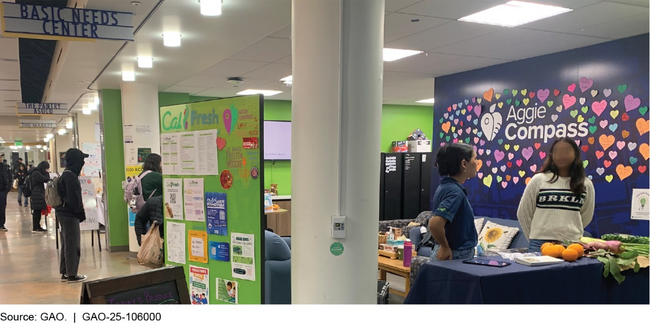
Officials from the three selected states and seven colleges GAO contacted described key strategies for communicating with students about their potential SNAP eligibility. These include using destigmatizing language, linking students directly to an application or support staff, and coordinating outreach efforts with SNAP agencies. Officials from the states and colleges GAO contacted said it is helpful to have staff available on campus to assist students with the SNAP application. Some colleges have found it helpful to partner with their respective SNAP agencies to obtain information on the status of students' applications.
Why GAO Did This Study
According to a national survey, almost one-quarter of college students were food insecure in 2020, yet GAO found many who were potentially eligible for SNAP had not received benefits. The substantial federal investment in higher education is at risk of not serving its intended purpose if students drop out because of limited or uncertain access to food. Studies have found using data to direct outreach to those potentially eligible can increase benefit uptake.
GAO was asked to review college student food insecurity. This report addresses (1) the extent to which Education and USDA have supported data use to help college students access SNAP benefits, and (2) how selected states and colleges have used student data to help connect students with SNAP benefits.
GAO reviewed relevant federal laws and agency documents. GAO also interviewed officials from Education, USDA, and national higher education and SNAP associations. GAO selected three states and interviewed officials from state SNAP and higher education agencies and seven colleges in these states. GAO visited one selected state in person and interviewed two virtually. States were selected based on actions to support food insecure students and stakeholder recommendations.
Recommendations
GAO is making five recommendations, including that Education develop a plan to implement FAFSA data-sharing and assess its benefit notification approach; and that USDA improve its SNAP agency guidance. The agencies neither agreed nor disagreed with these recommendations.
Recommendations for Executive Action
| Agency Affected | Recommendation | Status |
|---|---|---|
| Department of Education | The Secretary of Education should develop a written plan for implementing provisions in the FAFSA Simplification Act related to sharing FAFSA data with SNAP administrators, to aid in benefit outreach and enrollment assistance. (Recommendation 1) |
When we confirm what actions the agency has taken in response to this recommendation, we will provide updated information.
|
| Department of Education | The Secretary of Education should, in consultation with USDA, evaluate its approach to identifying and notifying FAFSA applicants who are potentially eligible for SNAP benefits and adjust its approach as needed. (Recommendation 2) |
When we confirm what actions the agency has taken in response to this recommendation, we will provide updated information.
|
| Department of Education | The Secretary of Education should inform colleges and state higher education agencies that FAFSA notifications are being sent to applicants who are potentially eligible for SNAP benefits. (Recommendation 3) |
When we confirm what actions the agency has taken in response to this recommendation, we will provide updated information.
|
| Department of Agriculture | The Administrator of USDA's Food and Nutrition Service should, in consultation with Education, issue guidance to state SNAP agencies—such as in its SNAP outreach priority memo—to clarify permissible uses of student data, including FAFSA data, for SNAP outreach and enrollment assistance. (Recommendation 4) |
When we confirm what actions the agency has taken in response to this recommendation, we will provide updated information.
|
| Department of Agriculture | The Administrator of USDA's Food and Nutrition Service should issue guidance to state SNAP agencies—such as in its SNAP outreach priority memo—to clarify the permissible uses and disclosure of SNAP data to support SNAP student outreach and enrollment assistance. (Recommendation 5) |
When we confirm what actions the agency has taken in response to this recommendation, we will provide updated information.
|
Thursday, December 4, 2025
HEI Investigation: FAFSA (Financial Aid) Fraud
26-00780-F
The Higher Education Inquirer (HEI) is requesting all emails, memos, and meeting notes between FSA leadership and ED leadership from January 2022–present referencing fraudulent FAFSA submissions, identity theft, synthetic identities, or the need for strengthened ID verification. (Date Range for Record Search: From 01/10/2022 To 12/02/2025)26-00779-F
The Higher Education Inquirer (HEI) is requesting from the FSA Office of the Chief Information Officer, all security assessments, vulnerability reports, or risk analyses referencing the FAFSA processing system (FPS), identity verification, or bot-driven application spikes from 2020–present. This includes reports about warnings about bots, concerns about insufficient authentication, and breaches or near-breaches that the public never hears about. (Date Range for Record Search: From 01/10/2020 To 12/02/2025)
26-00777-F
The Higher Education Inquirer (HEI) is asking for any and all FSA records, reports, data dashboards, spreadsheets, audits, or communications from January 2023–present that track or analyze fraudulent FAFSA submissions, including synthetic identities, ghost students, identity verification failures, or suspected fraud rings. This includes documents prepared for FSA leadership, ED leadership, OMB, or the OIG. (Date Range for Record Search: From 01/01/2023 To 12/02/2025)
26-00732-F
The Higher Education Inquirer (HEI) is requesting all emails from the US Department of Education regarding selling off the student loan portfolio. (Date Range for Record Search: From 01/10/2025 To 11/27/2025)
26-00023-F-IG
The Higher Education Inquirer (HEI) is requesting any and all correspondence between the ED-OIG and the University of Phoenix regarding unusual or suspicious FAFSA applications from 1/1/2020 and 11/26/2025 (Date Range for Record Search: From 01/01/2020 To 11/26/2025)
26-00709-F
The Higher Education Inquirer is requesting any and all email correspondence between the US Department of Education and the Thompson Coburn Law Firm from January 6, 2025 to November 24, 2025. We are particularly interested in the following areas related to higher education:
Gainful Employment
Bare Minimum Rule
Borrower Defense to Repayment
Student Loan Forgiveness
Title IX
False Claims Act
Federal Funding Freeze Litigation
DEI Executive Orders Litigation, the Dear Colleague Letter Litigation, and DOJ’s July 2025 Guidance on Unlawful Discrimination
Executive Order 14242 Directing the Closure of ED
Grant Termination
Rate Cap Policy Litigation
Student and Exchange Visitor Program Litigation
Legality of Nationwide Injunctions
Program Participation Agreement Signatory Litigation (Date Range for Record Search: From 01/06/2025 To 11/24/2025)
Gainful Employment
Bare Minimum Rule
Borrower Defense to Repayment
Student Loan Forgiveness
Title IX
False Claims Act
Federal Funding Freeze Litigation
DEI Executive Orders Litigation, the Dear Colleague Letter Litigation, and DOJ’s July 2025 Guidance on Unlawful Discrimination
Executive Order 14242 Directing the Closure of ED
Grant Termination
Rate Cap Policy Litigation
Student and Exchange Visitor Program Litigation
Legality of Nationwide Injunctions
Program Participation Agreement Signatory Litigation (Date Range for Record Search: From 01/06/2025 To 11/24/2025)
26-00697-F
The Higher Education Inquirer (HEI) is requesting any and all correspondence pertaining to "unusual" or "suspicious" activity regarding FAFSA applications involving the University of Phoenix. Phoenix Education Partners CEO Chris Lynne has recently acknowledged this issue. (Date Range for Record Search: From 01/01/2024 To 11/23/2025)
| 26-00697-F |
| 26-00697-F |
Monday, December 29, 2025
Higher Education Without Illusions
In 2025, the landscape of higher education is dominated by contradictions, crises, and the relentless churn of what might be called “collegemania.” Underneath the polished veneer of university marketing—the glossy brochures, viral TikToks, and celebrity endorsements—lurks a network of systemic pressures that students, faculty, and society at large must navigate. The hashtags trending below the masthead of Higher Education Without Illusions capture the full spectrum of these pressures: #accountability, #adjunct, #AI, #AImeltdown, #algo, #alienation, #anomie, #anxiety, #austerity, #BDR, #bot, #boycott, #BRICS, #climate, #collegemania, #collegemeltdown, #crypto, #divest, #doomloop, #edugrift, #enshittification, #FAFSA, #greed, #incel, #jobless, #kleptocracy, #medugrift, #moralcapital, #nokings, #nonviolence, #PSLF, #QOL, #rehumanization, #resistance, #robocollege, #robostudent, #roboworker, #solidarity, #strikedebt, #surveillance, #temperance, #TPUSA, #transparency, #Trump, #veritas.

Taken together, these words map the terrain of higher education as it exists today: a fragile ecosystem strained by debt, automation, political polarization, and climate urgency. Students are increasingly treated as commodities (#robostudent, #strikedebt), faculty are underpaid and precarious (#adjunct, #medugrift), and universities themselves are subjected to the whims of markets and algorithms (#algo, #AImeltdown, #robocollege).
Financial pressures are unrelenting. The FAFSA system, once intended as a bridge to opportunity, now functions as a tool of surveillance and debt management (#FAFSA, #BDR). Public service loan forgiveness (#PSLF) continues to be delayed or denied, leaving graduates to navigate the twin anxieties of indebtedness and joblessness (#jobless, #doomloop). Meanwhile, austerity measures squeeze institutional budgets, often at the expense of research, mental health support, and academic freedom (#austerity, #anomie, #anxiety).
Automation and artificial intelligence are now central to the higher education ecosystem. AI grading tools, predictive enrollment algorithms, and administrative bots promise efficiency but often produce alienation and ethical dilemmas (#AI, #AImeltdown, #roboworker, #bot). In this context, “robocollege” is not a metaphor but a lived reality for many students navigating hyper-digitized classrooms where human mentorship is increasingly rare.
Political and cultural currents further complicate the picture. From the influence of conservative campus organizations (#TPUSA, #Trump) to global shifts in power (#BRICS), universities are battlegrounds for ideological and material stakes. Moral capital—the credibility and legitimacy of an institution—is increasingly intertwined with corporate sponsorships, divestment movements, and climate commitments (#moralcapital, #divest, #climate). At the same time, greed and kleptocracy (#greed, #kleptocracy) permeate administration and policy decisions, eroding trust in higher education’s social mission.
Yet amid this bleakness, there are threads of resistance and rehumanization. Student debt strikes, faculty solidarity networks, and advocacy for transparency (#strikedebt, #solidarity, #transparency, #rehumanization) reveal a persistent desire to reclaim the university as a space of collective flourishing rather than pure financial extraction. Nonviolence (#nonviolence), temperance (#temperance), and boycotts (#boycott) reflect strategic, principled responses to systemic crises, even as anxiety and alienation persist.
Ultimately, higher education without illusions demands that we confront both the structural and human dimensions of its crises. Universities are not just engines of credentialing and profit—they are social institutions embedded in broader networks of power, ideology, and technology. A recognition of #veritas and #QOL (quality of life) alongside the demands of #collegemania and #enshittification is essential for any hope of reform.
The hashtags are more than social media markers—they are diagnostics. They chart a system in flux, exposing the frictions between automation and humanity, austerity and access, greed and moral responsibility. They call on all of us—students, educators, policymakers, and citizens—to act with accountability, solidarity, and courage.
Higher education without illusions is not pessimism; it is clarity. Only by naming the pressures and contradictions can we begin to imagine institutions that serve human flourishing rather than perpetuate cycles of debt, alienation, and social inequality.
Sources & Further Reading:
-
An American Sickness, Elisabeth Rosenthal
-
Medical Apartheid, Harriet Washington
-
Body and Soul, Alondra Nelson
-
HEI coverage of student debt, adjunct labor, and AI in higher education
Sunday, November 23, 2025
PXED Throws US Department of Education Under the Bus Regarding Enrollment Fraud
[Editor's note: The Higher Education Inquirer has requested all Department of Education correspondence related to "unusual" or "suspicious" enrollment regarding the University of Phoenix.]
Phoenix Education Partners (PXED), parent company of the University of Phoenix, used its latest earnings call to advance a familiar narrative: when things go wrong, blame the U.S. Department of Education. This time, CEO Chris Lynne positioned ED as the primary culprit behind the suspicious-enrollment surge that distorted PXED’s numbers over the past year.
The exchange began when Goldman Sachs analyst George Tong asked the question PXED tried to sidestep throughout its IPO process: How much of PXED’s slowing FY2026 enrollment growth is due to fraud controls, and how much of it is due to friction created for legitimate students? And, crucially, what prevents these distortions from resurfacing in the next cycle?
Lynne offered no numbers. Instead, he pivoted to a sweeping explanation of PXED’s “advanced algorithms” and internal control systems—systems so forceful that they immediately block applicants once certain thresholds are hit, even when PXED cannot determine whether they’ve flagged a real student or a bad actor.
But once the CEO finished describing these internal measures, he returned to the real point he wanted to deliver to Wall Street: this is the Department of Education’s fault, not PXED’s.
According to Lynne, the “root” cause was a breakdown in ED’s identity-verification controls tied to the troubled rollout of the new FAFSA. The Department “publicly acknowledged” the failure, Lynne said, and PXED executives met with ED in September to confirm that the government finally has “a good handle on this.” In Lynne’s telling, PXED is the responsible party cleaning up a federal mess.
What this framing ignores is everything that came before. PXED and its predecessor, the University of Phoenix, have long histories of enrollment-integrity problems that predate the FAFSA meltdown by more than a decade. When Lynne says his algorithms “cleaned up” the funnel after being moved to the top of the application process, what he really means is that PXED used its own filters—its own black-box controls—to decide which students were worth staff time and which were not.
And PXED quietly admitted the cost. The verification loops and algorithmic filters caught many real students, blocking or delaying their enrollment and layering additional obstacles onto people who already face the steepest barriers in higher education. Lynne dismissed this as mere “friction”—a small price to pay for cleaner numbers.
But the larger problem is structural. For-profit systems built on volume rely on conversions, throughput, and funnel efficiency. When that model is threatened, the instinct is not to repair student-facing systems—it's to blame the government, tighten internal controls, and preserve the revenue pipeline. PXED’s decision to throw ED under the bus fits that pattern exactly.
The real story isn’t that the Department of Education made serious mistakes in rolling out the new FAFSA—mistakes it has acknowledged. The real story is how quickly companies like PXED use those failures as a shield, deflecting accountability for their own long-standing recruitment practices and quietly punishing the very students they claim to serve.
Subscribe to:
Posts (Atom)