In 2006, Washington state adjunct advocate Keith Hoeller described a higher education labor system already in deep trouble—adjuncts were underpaid, lacked job security, and served as a buffer protecting tenured faculty from cuts. Nearly two decades later, those warnings seem less like early alarms and more like an obituary for the tenure system. By 2025, the crisis has metastasized.
Pay and Financial Security: Poverty Wages Become the Norm
In 2006, Hoeller reported that Washington community college adjuncts earned just 57 cents for every dollar paid to their full-time colleagues. The disparity persists—and in some ways, it has widened. Today, more than a quarter of adjuncts report earning under $26,500 a year, below the federal poverty line for a family of four.
Course pay in 2025 still averages between $2,500 and $5,000, with some positions offering as little as $1,500 per course. Melissa Olson-Petrie’s 2025 account captures the reality vividly: adjuncts can be “required in teaching five or more classes a semester, with occasional overload schedules depleting your very marrow,” yet still earn tens of thousands less annually than full-time peers.
Job Security and Contract Precarity: From Insecure to Systematically Disposable
Adjuncts in 2006 faced last-minute class cancellations and almost no job security. In 2025, the instability is institutionalized. Seventy-six percent of part-time contingent faculty are on short-term, nonrenewable contracts. Olson-Petrie notes that adjuncts can lose all scheduled work with only seven days’ notice before a semester begins.
The Scale of Adjunctification: Contingency Becomes the Default
In 1987, 47 percent of U.S. faculty held contingent appointments; by 2006, there were about half a million adjunct professors. In 2025, 68 percent of all faculty are contingent, and 49 percent are part-time. This is no longer a marginal or temporary workforce—it is the dominant teaching corps in American higher education.
Union Representation: Gains, Losses, and Legislative Blows
Unionization of academic workers has expanded since 2006, with graduate student organizing seeing a 133 percent increase between 2012 and 2024. Yet the structural imbalance Hoeller warned of remains: full-time faculty often dominate mixed bargaining units, leaving adjunct priorities underrepresented.
The 2025 landscape also includes outright reversals. In Florida, where adjunct organizing had surged, all eight adjunct faculty unions—representing more than 8,000 professors—were dissolved in 2024 under state law requiring 60 percent dues-paying membership.
Academic Freedom: Now an Explicit Target
In both 2006 and 2025, adjuncts lacked tenure protections. But in the current political climate, academic freedom is under direct attack. The Foundation for Individual Rights in Education warns that when three out of four professors lack tenure, political retaliation becomes easier. Recent non-reappointments at CUNY of adjuncts advocating for Palestinian rights show how swiftly dissenting voices can be silenced.
Federal and Institutional Pressures: The Trump Freeze and Funding Cuts
New forces compound old problems. Under the Trump administration, federal funding cuts, research grant threats, and hiring freezes have hit even the wealthiest universities. Institutions from Harvard to state schools are eliminating positions, further constricting opportunities for full-time, stable faculty roles.
Structural Deterioration: A Fully Entrenched Two-Tier System
Hoeller’s 2006 call for adjuncts to form independent bargaining units largely went unheeded. Full-time faculty continue to benefit from adjunct labor as a flexible shield against cuts, while adjuncts themselves are treated—per Olson-Petrie—as “little more than a high-quality paper towel within the academy.”
From Labor Problem to Institutional Crisis
Nearly every issue identified in 2006 has worsened. Today’s 68 percent contingent faculty rate represents not just a failure to protect academic labor but a transformation of the profession itself. The adjunct of 2025 faces economic exploitation, permanent precarity, and political vulnerability in an environment where structural reform has stalled, and in many cases, reversed.
Without systemic change—separately empowered unions, funding reinvestment, and real job security—the profession risks losing its foundation: the ability of educators to teach freely, securely, and sustainably.
Sources: Inside Higher Ed, AAUP, NEA, SEIU Faculty Forward, FIRE, ACE, Higher Ed Dive, U.S. News, AFT.
The Chronicle of Higher Education recently published Erik Ofgang’s piece, “How to Thrive as an Adjunct Professor.” The article is framed as practical guidance from one contingent faculty member to others — a survival manual for the academe’s most disposable workers. But the framing itself is the problem. The Chronicle is not a neutral outlet dispensing helpful tips. It is an institution firmly embedded in the higher-ed Establishment, and its editorial choices reflect the interests of those who run that Establishment.
The suggestion that adjuncts can “thrive” is not merely optimistic; it is ideological. It normalizes a labor system built on underpayment, instability, and silent suffering. It helps institutions maintain a two-tier caste system in which tenure-line faculty enjoy stability, voice, and benefits, while adjuncts scramble semester-to-semester without a guarantee of renewed employment or even basic respect.
The Chronicle’s article treats precarity as a lifestyle challenge rather than a structural failure. That framing deflects attention away from institutional responsibility. The reason adjuncts have to piece together multiple jobs, endure last-minute course assignments, and live without healthcare is not that they lack good strategies. It is because universities — including the ones that proudly subscribe to the Chronicle — have chosen to replace stable academic jobs with contingent, low-paid labor.
Turning exploitation into a self-help genre is a subtle form of gaslighting. Instead of pressuring institutions to create full-time positions, support collective bargaining, or reduce administrative bloat, the Chronicle encourages adjuncts to “adapt” and “manage” their conditions. Resilience becomes a substitute for rights. Coping becomes a substitute for reform. The system remains untouched.
The omissions in the Chronicle’s piece are revealing. There is no mention of organizing, even as adjuncts across the country unionize in record numbers. There is no scrutiny of universities’ vast expenditures on athletics, luxury facilities, and administrative expansion. There is no questioning of the billion-dollar endowments that coexist with poverty-level adjunct wages. Instead, the Chronicle defaults to the safest possible narrative: individuals should adjust; institutions should not.
This is not accidental. The Chronicle’s core readership includes the provosts, deans, trustees, and HR architects who built the adjunct system. It is financially and culturally aligned with the sector’s leadership. Its survival depends on not alienating them. That alignment shapes what it chooses to publish — and what it chooses not to. Pieces that counsel adjuncts to quietly endure their exploitation are palatable to the Establishment. Pieces that call out structural injustice are not.
Adjunctification is not an unfortunate side effect of financial pressures. It is a deliberate strategy to reduce labor costs and weaken faculty power. It is part of a decades-long reorganization of higher education around managerial priorities and corporate values. Any article that ignores these realities in favor of “tips” is engaging in misdirection.
In truth, adjuncts don’t need advice on how to “thrive.” They need living wages, multiyear contracts, healthcare, respect, and a seat at the table. They need a labor system that recognizes teaching as the core mission of higher education rather than a cost center to be minimized. They need the kind of systemic change that the Chronicle rarely demands — because demanding it would mean criticizing the very institutions that sustain the Chronicle’s prestige and its business model.
The Chronicle’s soft-pedaled advice is not harmless. It is part of the ideological infrastructure that protects the higher-education status quo. If the sector is ever to become less exploitative, those who report on it must stop reassuring adjuncts that survival is a form of success and start holding institutions accountable for creating the conditions adjuncts are forced to endure.
HEI exists precisely because the mainstream higher-ed press will not.
Sources
Erik Ofgang, “How to Thrive as an Adjunct Professor,” Chronicle of Higher Education, Nov. 6, 2025.
American Association of University Professors (AAUP). Data Snapshot: Contingent Faculty in US Higher Ed.
Marc Bousquet, How the University Works: Higher Education and the Low-Wage Nation (NYU Press, 2008).
Tressie McMillan Cottom, Lower Ed: The Troubling Rise of For-Profit Colleges (2017).
Gary Rhoades, “Managed Professionals: Unionized Faculty and Restructuring Academic Labor” (SUNY Press, 1998).
Claire Goldstene, The Struggle for the Soul of Higher Education (2015).
Devarian Baldwin, In the Shadow of the Ivory Tower (2021).
First published in November 2005 by Monthly Review Press, Reclaiming the Ivory Tower quickly became a breakthrough organizing handbook for contingent, often adjunct, faculty in U.S. higher education. Authored by Joe Berry, a labor educator with the Chicago Coalition of Contingent Academic Labor, the book combined structural analysis with practical organizing tools and remains widely influential.
Author’s Ongoing Influence
Joe Berry’s longstanding work—as a historian and labor educator affiliated with institutions like the University of Illinois’s Chicago Labor Education Program and Roosevelt University—has helped shape adjunct organizing both in Chicago and beyond. Berry's most recent focus is with a new project, Higher Ed Labor United (HELU), and with Democratic Socialists of America.
Two Decades On: The Struggle Persists
Though adjunct faculty now make up the majority of instructors at many colleges, the precarious conditions Berry described—marked by low pay, limited benefits, and job insecurity—endure. His organizing models, featuring campus committees and community alliances, have borne fruit in isolated victories. Yet, systemic inequities remain.
Reclaiming the Ivory Tower remains a foundational resource for grassroots organizing in academia. Its emphasis on coalition-building and collective action continues to inspire adjuncts, labor activists, and academic allies.
Power Despite Precarity
Just at the time of HELU’s birth, and as COVID was still raging, Berry and his colleague, partner and fellow contingent faculty Helena Worthen, published a follow up book, Power Despite Precarity: Strategies for the contingent faculty movement in higher education (2021, Pluto Press). Using one of the most successful local unions in higher education, the CA Faculty Association (SEIU, AAUP) for contingents, the book tells the story of their limited, but very real, successes, and suggests some strategic visions for the movement and our goals for higher education.
A New Wave of National Coordination
In March 2024, Inside Higher Ed reported that Higher Ed Labor United—a developing national coalition—was emerging to bridge divisions between higher education workers, regardless of union affiliation or job title. Joe Berry serves on its interim steering committee, signaling his continued leadership in academic labor unity.
HELU’s vision is threefold: to serve as a political voice, a think tank for higher education labor, and a supporting infrastructure for organizing across campuses. The coalition thus builds on Berry’s grassroots foundations by adding a national dimension to the effort.
Timeline of Adjunct Organizing: 2005–2025
2005–2009: Organizing spreads through AFT and NEA-affiliated adjunct campaigns, adopting Berry’s strategies of solidarity with tenure-track faculty and students. 2010–2014: Digital movements like #AdjunctNation increase visibility. Labor drives gain traction at private and niche institutions. 2015–2019: The SEIU’s Faculty Forward initiative secures pay gains and multi-year contracts in cities like Boston and LA. 2020–2022: COVID-19 exacerbates adjunct precarity. Virtual organizing leads to some wins, but layoffs and instability rise. 2023–2025: Broader solidarity emerges—adjuncts band with student and staff labor movements. Union campaigns increasingly connect to critiques of austerity and corporatization.
Looking Ahead
With its 20th anniversary slated for November 2025, Reclaiming the Ivory Tower stands as much more than a historical landmark—it’s a blueprint for current and future organizing. While awareness of adjunct labor issues has grown, sustainable and structural transformation requires persistent organizing, cross-campus solidarity, and the sort of national coalition-building that HELU represents.
Sources
Berry, Joe. Reclaiming the Ivory Tower: Organizing Adjuncts to Change Higher Education. Monthly Review Press, 2005. [monthlyreview.org reference; meet the author site]
“Higher Ed Workers Seek to Coordinate Nationally.” Inside Higher Ed, March 26, 2024. Includes details on HELU and Joe Berry’s role
National Center for the Study of Collective Bargaining in Higher Education and the Professions data trends
Inside Higher Ed reporting on adjunct unionization, strikes, and SEIU campaigns
For decades, critics and policymakers have argued that American higher education could be “fixed” through better management, new credentials, accountability systems, or market competition. But the evidence now points to a sobering reality: the time for meaningful reform has passed. What remains is a structurally inert system staggering toward collapse, incapable of adapting in ways that would meaningfully serve students, faculty, or the broader society.
Too Late: The System Has Already Crystallized
Sociologists Michael Hannan and John Freeman warned in 1984 that organizations often fall prey to “structural inertia,” creating a form of lock-in that makes real transformation virtually impossible. Today’s higher education sector exemplifies their theory.
Since 2010, undergraduate enrollment has declined by more than 15%, representing 2.7 million fewer students nationwide. The FAFSA fiasco of 2024–25 alone is expected to result in hundreds of thousands fewer freshmen, according to Brookings. This is not gradual adjustment but systemic breakdown occurring within institutions whose structures are too rigid to respond.
The so-called “demographic cliff” beginning in 2025 will accelerate these failures. The Philadelphia Federal Reserve predicts that 1 in 10 U.S. colleges faces “significant financial distress” in the next decade. Closures are already mounting: Birmingham-Southern College in Alabama shut its doors in 2024 after 168 years, despite political lobbying and emergency funding attempts. In Vermont, the Vermont State Colleges System closed three campuses in 2020, citing declining enrollment and unsustainable costs. In Massachusetts, Mount Ida College collapsed in 2018, leaving students stranded. These are not isolated cases—they are signs of a broader unraveling.
No Power, No Resources: Reform Advocates Lack Institutional Leverage
Those demanding reform—students burdened by debt, adjuncts trapped in precarity, or concerned citizens—lack meaningful power within entrenched governance structures. Administrative hierarchies create what organizational theorists call “hierarchical inertia”: resistance to bottom-up change.
Between 2010 and 2018, spending on administrative services grew by 25%, compared with only 16% growth in instructional spending. Administrative salaries rose faster than faculty pay, and presidents of elite private universities now routinely earn over $1 million annually, while the median adjunct pay per course hovers around $3,500.
Meanwhile, the faculty workforce has stratified into a rigid caste system: 48% of all faculty are adjuncts, compared with only 33% who are tenure-track. Nearly one in four adjuncts qualifies for some form of public assistance, according to the American Federation of Teachers.
Higher Education as a Caste System
The metaphor of higher education as a caste system is not rhetorical exaggeration—it is sociological description.
Academic labor: Adjuncts teach 60–70% of all undergraduate courses at some public universities, yet lack benefits, job security, or office space.
Institutional prestige: The top 20 U.S. universities control nearly $400 billion in endowment wealth, while the median endowment across all institutions is less than $200 million—a disparity that drives inequality in faculty hiring, research opportunities, and student aid.
Student access: Federal data show that students from the top income quartile are five times more likely to attend a selective university than students from the bottom quartile.
As one adjunct professor bitterly described it: “I guess I am in the Sudra—servant—class.”
Path Dependence and the Logic of Lock-In
American higher education is path dependent: historical decisions have created self-reinforcing mechanisms that are now nearly impossible to undo.
The feedback loops are obvious. Average tuition has tripled (in real dollars) since 1980, while total student loan debt now exceeds $1.7 trillion, owed by more than 43 million borrowers. Tuition hikes fuel administrative growth, which requires even higher tuition. Federal student loans underwrite rising costs, which then justify further loan expansion.
Even when institutions attempt reform, history traps them. Consider New College of Florida, a small public liberal arts institution: under political pressure in 2023, its governance was remade to align with a conservative ideological agenda. The result has been turmoil, plummeting enrollment, and national headlines—but no structural fix to the deeper financial instability.
The sector has reached what economists call “quasi-irreversibility”: a point beyond which reform cannot meaningfully occur without collapse.
The Futility of Cosmetic Solutions
The reforms most commonly floated today—cost containment, program elimination, or alternative credentials—misunderstand structural inertia.
In 2025, West Virginia University cut 28 academic programs, including its entire foreign language department, as part of an effort to address a projected $45 million deficit. Dozens of other universities, from regional publics to small privates, have announced similar cuts. These moves balance budgets temporarily but hollow out educational missions.
Calls for universities to spend more of their endowments overlook the fact that even elite institutions already average spending rates around 4.5%, which is close to what financial managers consider sustainable. Meanwhile, 90% of U.S. colleges have endowments under $100 million, meaning they cannot rely on them for meaningful financial rescue.
Alternative credentials face similar structural limits. A 2022 SHRM survey found that while 48% of employers expressed interest in microcredentials, only 20% actually considered them in hiring decisions. Applicant tracking systems are built to screen for traditional degrees, not experimental certificates.
The Iron Law of Institutional Preservation
Sociologists describe “institutional isomorphism”—the tendency for organizations to mimic each other in ways that resist innovation. In higher education, this has created an “iron law” of institutional preservation.
When faced with crisis, universities respond with defensive maneuvers: hiring freezes, program eliminations, and lobbying for more federal support. In 2025 alone, more than 100 institutions announced cuts to majors, from classics to physics, while maintaining administrative and athletic spending.
The overriding purpose of universities is no longer the pursuit of knowledge or the education of students, but the preservation of their own bureaucratic forms.
Collapse Before Reform
The conclusion is stark but unavoidable: American higher education has passed the point of meaningful reform. Its rigid hierarchies, path dependence, and preservation instincts make internal change impossible. Demographic decline and financial pressures will likely force widespread collapse before adaptation occurs.
Hannan and Freeman’s theory predicted this outcome: organizational change is rarely the product of internal reform. Instead, it comes through environmental selection—the replacement of existing institutions by new ones better suited to survive.
The American university may not disappear entirely, but the form it has taken since the mid-20th century is unsustainable. Collapse is not only likely—it may already be underway.
Sources:
Hannan & Freeman (1984); BestColleges (2025); Brookings (2025); Philadelphia Fed (2024); Forbes (2025); Inside Higher Ed (2023); Academe Blog (2013); Governing (2023); AFT (2020); SHRM (2022); Al Jazeera (2025); ERIC (2020); Birmingham-Southern (2024); WVU (2025); Mount Ida (2018); Vermont State Colleges (2020).
“It is difficult to get a man to understand something, when his salary depends upon his not understanding it.”
—Upton Sinclair
Purpose
This proposal seeks modest support to research and write a new book in the spirit of Upton Sinclair’s 1923 exposé The Goose-Step: A Study of American Education, a biting critique of higher education’s corruption and corporate control. The revised and updated work—tentatively titled The Goose-Step Revisited: The College Meltdown and the Future of American Higher Ed—will document the present crisis of U.S. higher education from the ground up: on campuses, in classrooms, in communities, and in conversations with students, workers, adjuncts, administrators, and those left behind.
This is not a detached academic exercise. It is a journalistic and moral investigation into a failing system. Like Sinclair, we will name names. But we will also listen carefully to those who are rarely heard—especially debtors, dropouts, whistleblowers, and exploited faculty.
Scope
The project will include:
Travel across the U.S. to visit a diverse array of colleges: from collapsing for-profits and underfunded regional publics to elite private institutions and community colleges on the brink.
Field interviews with stakeholders in higher education, including:
Adjuncts and contingent faculty
Debt-burdened students and recent grads
College workers and unions
Policy experts and whistleblowers
Administrators, where access is permitted
Archival research and use of public data (IPEDS, College Scorecard, OPE, etc.)
Photographs and dispatches for the Higher Education Inquirer along the way
A final book manuscript, synthesizing travel writing, investigative reporting, data analysis, and historical reflection.
Questions the Book Will Explore
How does the current College Meltdown resemble or diverge from the problems Sinclair exposed in 1923?
What does higher education actually provide today—for whom, and at what cost?
How have corporatization, finance capital, and political ideology reshaped American colleges?
Is reform still possible—or are we watching the managed decline of an unsustainable system?
Budget and Support Needed
This is a modest request, commensurate with the ethos of the Higher Education Inquirer. A stripped-down, independent operation. Key needs:
Travel and lodging across the U.S. (preferably via Amtrak, bus, or car)
Minimal tech support (phone, laptop, data storage)
Small editorial stipend for fact-checking, manuscript preparation
Crowdfunding, foundation support, or collaboration with independent media outlets may supplement this request.
Why Now?
The signs are everywhere.
Colleges closing.
Debt rising.
Adjuncts starving.
Truth distorted.
Labor crushed.
Meanwhile, the gatekeepers of knowledge—like those in Sinclair’s time—are too often complicit, compromised, or silent.
This book is not intended to speak for anyone. It aims to amplify those whose stories have been buried beneath bureaucracy and branding. It's A Modest Proposal for a not-so-modest truth: American higher education is in a manufactured crisis. But from this so-called collapse, a more just and democratic vision might emerge—if we’re willing to listen, document, and act.
This is a proposal to walk the ruins, record the voices, and revive the fierce spirit of Upton Sinclair.
Editors note: The Higher Education Inquirer thanks Hank Kalet for allowing us to reprint his substack Channel Surfing as a record of the Rutgers strike. Hank is a lecturer at the Rutgers University School of Communication and Information. We encourage you to subscribe to his substack and visit the Rutgers AAUP-AFT and Rutgers Adjunct Faculty Union twitter pages.
Post-Strike Diary: A Step Back and Some History The Fight Here at Rutgers Is Not Over, Nor Is It an Isolated Battle
I want to get back to first principles. Put the strike at Rutgers into the broader context of higher ed and contingent worker right. Connect it to the larger currents in the labor movement.
The 40 years starting with Ronald Reagan’s election were awful ones for labor unions. Union activity had already peaked when Reagan fired striking air-traffic controllers and signaled to business that the era of labor peace on the employer side was over.
I worked in a factory in Trenton that summer. There were whispers that union organizing was taking place, but it wasn’t gaining much traction. Factory jobs were leaving the state and the Northeast and there was fear that management would close shop and move to Georgia, Alabama, or another anti-union state. Reagan’s action was the final straw, dooming the efforts, and setting in motion a frenzy of union busting we are still struggling to understand. (I’m working on a play about this moment.)
The 40 years that followed were mostly dark for the union movement, with some victories. Some of this darkness was brought on by the unions themselves, many of which had calcified and were either corrupt or overly cozy with management and politicians. Grassroots energy was dismissed and reform efforts short-lived.
The Covid pandemic shifted the terrain. Donna Murch, a union colleague and associate professor of history at Rutgers, has been making the case that Covid laid bare the vulnerabilities of all faculty members and all workers at Rutgers. Covid forced classes online with little assistance and no compensation for the work needed to make that happen. It put clinicians and lab workers in peril, requiring them to work through the pandemic often without proper PPE. It disrupted grad students’ research, even as their funding clock continued to tick.
This precarity was evident throughout society, a realization that led to union drives at Amazon, Starbucks, and other companies that relied on short-term and/or low-paid workers. Warehouse workers — many immigrants, some undocumented— often faced the worst conditions.
Those of us with a level of economic privilege were able to pay folks in the gig economy to do our grocery shopping and provide needed services, allowing Im us to stay home.
Unemployment shot up, wages stagnated with the economy, and the fascistic wing of the Republican Party — those most aligned with then-President Trump and opposed to vaccines, masks, and those who violently responded to the Black Lives Matter protests that spread after the state murder of George Floyd — cracked down and continue to crackdown on efforts to expand opportunity and inclusion.
This is the backdrop against which we have to judge the current wave of organizing and strikes — a movement that is gaining traction in ways we have not seen in a long time.
Seventy-one percent of Americans now approve of labor unions. Although statistically similar to last year's 68%, it is up from 64% before the pandemic and is the highest Gallup has recorded on this measure since 1965.
Union density remains an issue, though this is likely because of the legal impediments erected over 40-plus years of aggressive anti-union activity from both parties, abetted by a media infrastructure that has lost its connections to workers.
News coverage of labor is lagging badly behind this surge of organizing. The loss of labor as a beat has created a structural coverage deficit that, in practical terms, means reporters are reporting and writing stories with at best a limited background on labor issues and dynamics, including how labor law works and just how much power the bosses have accumulated over the years. The upshot is a series of stories throughout the press that boils nearly every labor dispute down to money, or that filters these disputes through an earlier lens in which each dispute is a singular event unrelated to the larger American economy.
The reality, as we discussed in my class today, is that the current wave of organizing is about more than money. It is about life conditions, workplace conditions, about safety and scheduling, and long-term job security. Starbucks workers want more control of their schedules, more regularity, so they can plan their lives. Amazon workers and others working in the new mostly unregulated warehouse industry want safety rules, regular breaks, sick time. The rail workers, who were thrown onto the tracks by President Joe Biden, want an end to the kind of scheduling that results in exhaustion and dangerous conditions — one of the many factors that resulted in the deadly East Palestine crash.
Adjuncts and grads at Rutgers and other institutions of higher education want raises. But we also want respect. We want job security — big raises mean little if we can be fired or laid off easily. We want a shift in values in higher ed away from the current model, which is more focused on creating a profit (big reserve accounts and endowments that can be invested to generate bigger reserves and endowments), on building sports empires, on turning faculty into grant chasers or replaceable cogs.
The framework in place at Rutgers is a start, but this contract fight is far from over. And even when this one ends, we know there will be more work to be done. This is the beginning of the transformation of higher ed, not the conclusion.
Post-Strike Diary: Rutgers Unions Fight On Historic Gains But Work To Be Done.
The strike is off, for now. But the efforts to remake Rutgers continues.
As I wrote Saturday, the unions representing striking workers voted to accept a contract framework in exchange for pausing the strike before it entered its second week. We paused to let students get back to classes. To let them finish their semester, their careers at Rutgers.
The framework includes a 14% raise over four years for full-time faculty, a 33% pay increase for grads over four years, a 25.5% bump for post-docs, and a 48% increase for adjuncts; multi-semester contracts for adjuncts, presumptive renewal of contracts, recognition of graduate fellows as grad workers, changes in grievance and evaluations procedures, and five-year funding for grads. The framework also includes elements of the “Bargaining for the Common Good” agenda: a $600,000 recurring Community Fund and the end of the university policy that prevents students from registering for classes or getting transcripts or diplomas due to unpaid fines and fees, and a Union-University-Community table.
Much of this is historic, but it’s still a work in progress. The clinicians, researchers, and professors represented by BHSNJ-AAUP have nothing from administration, and more needs to be done for grads, for students and the community, and for adjuncts.
That was the message Monday afternoon as about 100 picketers gathered and chanted, reminding the community and the press that the battle to end the corporatization on higher ed continues — both here in New Jersey and nationally — continues.
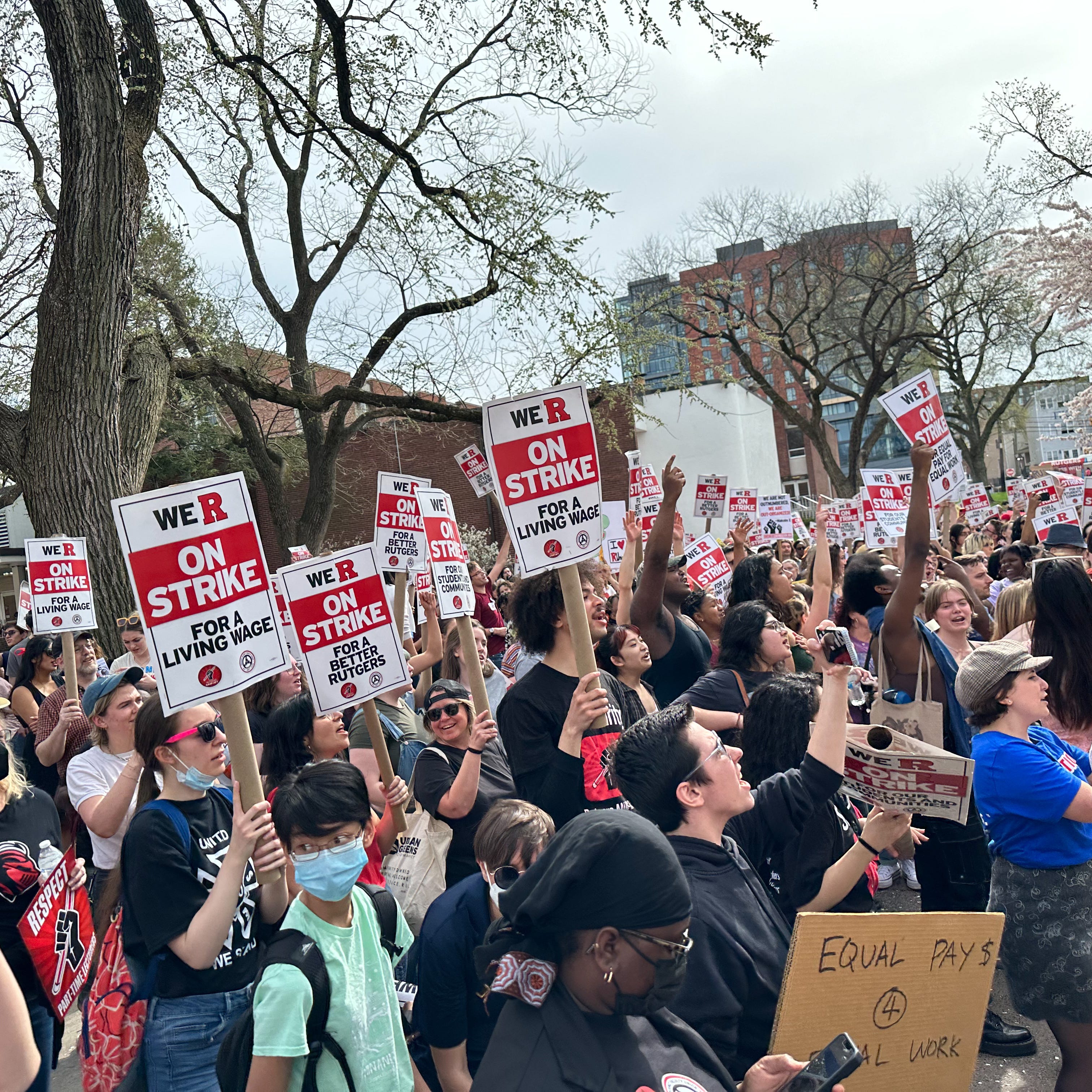
Picketers carried strike signs with the word “suspended” stapled above “On Strike.” We marched intro of Scott Hall on College Avenue chanting, “The strike may be suspended. The struggle hasn’t ended.” We did his despite the cold win blowing own College Avenue as students looked on. We have more actions planned this week, part of a rolling set of protests designed to keep our issues in front of the public and to maintain pressure on an administration that failed to take us seriously until we walked and the governor got involved.
I told NBC New York that we could reinstate the strike if management fails to play ball. A threat? Idle talk? I’ll leave it at that. But we’re not going away. We’re not backing down.
RU Strike Diary, Day 5 Ends With a 'Framework'
We have a framework for a deal and are pausing the strike that has shut down Rutgers University for the last five days. I’m being careful of the language. We don’t have a deal and we have not ended the strike. We have a framework. There remain a lot issues to address, but most of the big ones are settled. The framework takes us a long way toward our demands of equal pay, job security, better pay for grads, and making Rutgers a better neighbor. It is not a perfect deal. We wanted more. But I think we moved the ball far down the field. This is not the final battle, but part of a larger movement.
Cliches. Platitudes. Bromides.
But still accurate.
I think the deal is good for the workers and students involved, but I can’t say much about the details. The journalist in me bristles at this, but my role as a member of the adjunct faculty union executive board prohibits me from saying much more. This is in line with the week for me, a week in which I found myself on the other side of the reporter’s notebook. I’ve talked with more reporters this week than in my entire adult life.
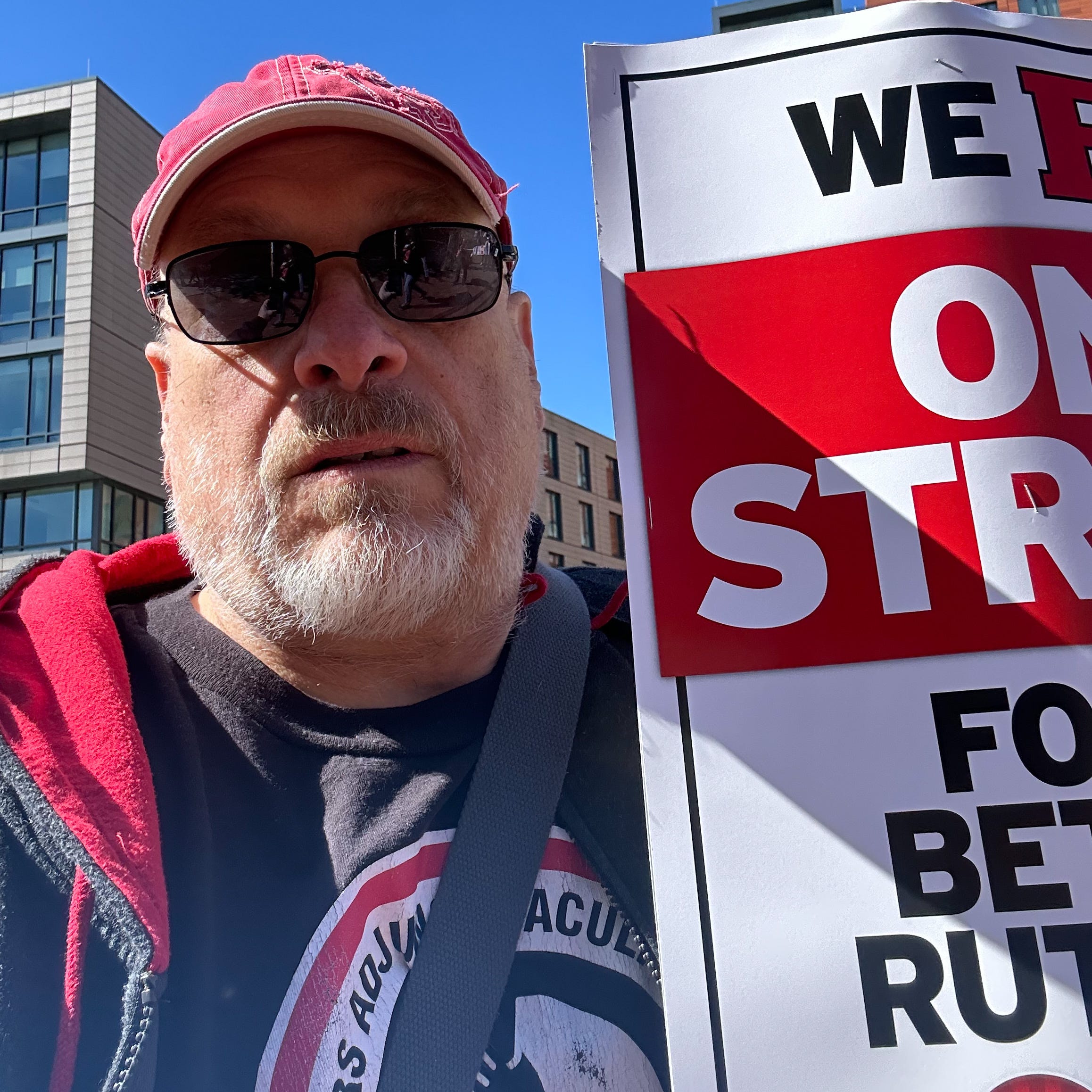
I teach journalism at Rutgers as an adjunct. I became involved in the union effort in 2021 and have become more and more active. The more active I became, the more I learned about the inequities of higher ed. The more I learned about these inequities, the more I became involved.
This was the same for just about everyone I talked with all week. I spent five days on the lines in New Brunswick. It was hot. It was exhausting. It was thrilling. Turnout fluctuated and the size of the pickets on College Avenue varied from day to day. We probably hit 1,000 picketers on Tuesday afternoon, when the folks from Cook/Douglass and Livingston and Busch joined in a march up George Street to the administration building on the Old Queens campus (a small subsection of the College Avenue campus) and joined the College Avenue contingent in an emotional and forceful show of solidarity. Wednesday featured a wake-up tour of campus, while Friday offered a festive feel, even as talks were heating up in Trenton.
The larger experience was one of joy and unity. That does not mean everyone is happy, but we made massive gains and I think we need to acknowledge that.
The message I would offer to the public at this point is that academic workers are tired of being pushed around. We are tired of the corporate bent of higher ed, angry that universities have been coopted by big-time athletics, corporate-style governance and funding models, and that what should be their primary missions — education and research — have been sold off to funders who only care about how they can monetize their scientific discoveries.
We have watched as more and more teaching and research jobs have been remade as contingent, easily replaceable labor. We have watched as the humanities are decimated in favor of incredibly important STEM courses and programs, not because of academic need, but because STEM generates grant revenue.
Rutgers, like most American universities, operates as a corporation. Senior administrators, who often have a Master of Business Administration degree (MBA) with little or no experience in higher education, along with sports coaches who have the potential to earn the university money, are highly compensated while thousands of poorly paid educators and staff are denied job security and benefits. Adjunct faculty and graduate workers are often forced to apply for Medicaid. They frequently take second jobs teaching at other colleges, driving for Uber or Lyft, working as cashiers, delivering food for Grubhub or DoorDash, walking dogs, house sitting, waiting on tables, bartending and living four or six to an apartment or camping out on a friend’s sofa. This inversion of values is destroying the nation’s educational system.
This is why we have seen academic workers strike across the country, from California to Illinois to New York. The strike at Rutgers is part of this movement and, because of the university’s size and the fact that all three of its faculty unions walked out of class, might be the most important of these efforts. The University of California strike was larger, but as with all other walkouts it only featured mainly graduate students. The strike at The New School was about adjunct wages. At Temple, it was just grads. At Rutgers, I walked along side non-tenure-track professors, full professors, graduate students, undergraduates and allies from the area.
The framework — again, not a tentative agreement or a contract — goes some of the way toward addressing these issues at Rutgers and, if it is ratified, could stand as a model and the largest victory so far in the battle for the soul of the American university system.
RU Strike Diary, Day 4
Day four was a tougher haul. The heat had a draining effect on many of us, but we were out on the lines and we are committed to remaining out for as long as it takes to win the transformation we are demanding.
There are three unions on strike — AAUP-AFT, the Rutgers Adjunct Faculty Union, and BHSNJ-AFT. We are negotiating together. Fighting together.
Our demands:
*Equal pay for equal work and job security for adjuncts like me; *A living wage and longer guaranteed funding for grad workers; *Recognition of grad fellows as workers who should be part of the union; *Job security for non-tenure-track professors; *Protections for academic freedom; *Control of schedules; *Wages that keep up with inflation; *An end to onerous fines on students and the practices of withholding class registration and transcripts and the sale of student debt to collection agencies; *A rent freeze on Rutgers-owned properties; *A community hardship fund; *Health care for all workers; *And numerous other changes in the way Rutgers operates.
Thursday featured numerous targeted pickets, which may have left the impression on College Ave that there were fewer people out. But we made joyful noise on Voorhees Mall and in front of Scott Hall, marched through the streets of the city to show solidarity with the community, marched on President Jonathan Holloway’s mansion in Piscataway, and on the homes of several members of the university Board of Governors.
Our pressure has had an effect. As our bargaining team has reported, the administration has been pushed significantly — by us and because of pressure for Gov. Phil Murphy. I’ve been critical of his public statements, but it’s clear he has contributed to at least some of the progress.
Make no mistake, however. We are winning this because we’ve out organized management, showed our commitment, and made the public case that we are engaged in a moral cause to bring equity to high ed, a message that is resonating beyond our campuses.
Day
3 went much like Day 2, with massive pickets and a powerful rally in
front of Winants Hall — home to Rutgers President Jonathan Holloway
offices. There were drag queens, music, and a festive atmosphere — but
hanging over it all was the specter of negotiations.
On Sunday
night, Gov. Phil Murphy summoned both sides to Trenton, using his office
to try to avert the strike — didn’t happened — and possibly get the
dispute settled quickly. We walked, knowing this was the backdrop and
brought hundreds upon hundreds of people into the streets — faculty,
staff, community members, and students.
The rest of this post will be
filled with photos, which should remind everyone how much energy and
unity there is and to help keep our spirits high as this stretches into
the fourth day.
A Good Exhaustion Prevented Me From Getting This Out Yesterday
The
word from the table is progress. It’s slow, but it’s happening, driven
by the power we’ve assembled on the streets of New Brunswick,
Piscataway, Camden, and Newark.
More than a thousand strikers
across the campuses is not something you ignore. And we’re planning to
grow our already robust pickets every day until this strike ends.
Several images stood out for me from Day 2:
The
massive picket that marched up College Avenue and circled the campus,
led by students and faculty carrying a banner declaring “Equal Pay for
Equal Work” — which has been the central fight of the adjunct union. Our
demands were centered in this amazing march, as was a push for equity —
for adjuncts, grad workers, students, and the community.
Rutgers
functions like a corporation in too many ways, chewing up and spitting
out vulnerable workers and the community in which it’s situated. It’s
real estate practices — buying up properties across the city and either
raising rents or gentrifying— are making New Brunswick unaffordable.
It’s why we’re calling for a rent freeze on Rutgers’ properties, an end
to predatory student fees and punitive actions when those fees and fines
go unpaid, and a community fund to help our neighbors.
We’ve been saying that this strike is about faculty and students and the university’s largely poor and immigrant neighbors, and we mean it.
Later
in the day came the mass convergence, when all of the New Brunswick
picketing marched to the entrance gates of Old Queens, the origin point
of Rutgers. Picketers from Cook and Douglass were joined by their
colleagues from Busch and Livingston and marched down George Street
through the center of town. They were joined by the Mason Gross School
of the Arts and Edward Bloustein school and marched to meet the College
Ave crew, creating a sea of picketers as we marched to Voorhees Mall and
a not-quite impromptu party/rally.
I’m not one for hyperbole or sentimentality, so when I say it gave me chills the reader should understand I mean it.
More
important, though, was the impact on the bargaining table. Our
colleagues there were buoyed by our show of strength, our joy, outer
commitment. And they are using it to their advantage. Management appears
to be buckling, and we plan to keep this up until we win a better
Rutgers, a kinder less corporate Rutgers.
RU Strike Diary, Day 1: The Inevitable Happens
This
is where it’s been leading since the beginning. A historic strike at my
alma mater. A school where I’ve taught journalism for 10 years. That I
think is one of the best and most underrated institutions of higher
learning in the country. From the beginning.
This is not what
anyone wanted, but it’s what had to happen. Higher ed is in crisis.
Rutgers is in crisis. We’ve been taken over by the corporate power
structure. Had a change in mission crammed down our throats. Higher ed
has become just another cog in the American oligarchy and Rutgers,
despite its proclamations to the contrary, has been doing its part.
Channel
Surfing is a reader-supported publication. To receive new posts and
support my work, consider becoming a free or paid subscriber.
I
was at UBS Arena last night watching Bruce Springsteen when we — our
union’s executive boards — voted. I voted by proxy. It was unanimous. I
listened and shouted and sang as the man known as The Boss tore through a
catalogue of songs about working people. And the irony was not lost on
me. Springsteen singing of working class dreams as he allowed
Ticketmaster to drive up prices and BMW to offer exclusive parking.
Still,
as my phone was blowing up with texts about the now very real strike,
he broke into “Wrecking Ball” and the lines “So hold tight on your
anger, you hold tight on your anger / Hold tight to your anger, don't
fall to your fears” hit me like a truck.
We are angry. Tired of being disrespected. Tired of the neoliberal model of higher ed reducing everything to profit.
We’ll hold tight and fight. We’re going to win this.
Alexander, Bryan (2020). Academia Next: The Futures of Higher Education. Johns Hopkins Press.
Alexander, Bryan (2023). Universities on Fire. Johns Hopkins Press.
Angulo,
A. (2016). Diploma Mills: How For-profit Colleges Stiffed Students,
Taxpayers, and the American Dream. Johns Hopkins University Press.
Archibald, R. and Feldman, D. (2017). The Road Ahead for America's Colleges & Universities. Oxford University Press.
Armstrong, E. and Hamilton, L. (2015). Paying for the Party: How College Maintains Inequality. Harvard University Press.
Arum, R. and Roksa, J. (2011). Academically Adrift: Limited Learning on College Campuses. University of Chicago Press.
Baldwin, Davarian (2021). In the Shadow of the Ivory Tower: How Universities Are Plundering Our Cities. Bold Type Books.
Bennett, W. and Wilezol, D. (2013). Is
College Worth It?: A Former United States Secretary of Education and a
Liberal Arts Graduate Expose the Broken Promise of Higher Education.
Thomas Nelson.
Berg, I. (1970). "The Great Training Robbery: Education and Jobs." Praeger.
Berman, Elizabeth P. (2012). Creating the Market University. Princeton University Press.
Berry, J. (2005). Reclaiming the Ivory Tower: Organizing Adjuncts to Change Higher Education. Monthly Review Press.
Best, J. and Best, E. (2014) The Student Loan Mess: How Good
Intentions Created a Trillion-Dollar Problem. Atkinson Family
Foundation.
Bogue, E. Grady and Aper, Jeffrey. (2000). Exploring the Heritage
of American Higher Education: The Evolution of Philosophy and Policy.
Bok, D. (2003). Universities in the Marketplace : The Commercialization of Higher Education. Princeton University Press.
Bousquet, M. (2008). How the University Works: Higher Education and the Low Wage Nation. NYU Press.
Brennan, J & Magness, P. (2019). Cracks in the Ivory Tower. Oxford University Press.
Brint, S., & Karabel, J. The Diverted Dream: Community colleges
and the promise of educational opportunity in America, 1900–1985. Oxford
University Press. (1989).
Caplan, B. (2018). The Case Against Education: Why the Education
System Is a Waste of Time and Money. Princeton University Press.
Cappelli, P. (2015). Will College Pay Off?: A Guide to the Most Important Financial Decision You'll Ever Make. Public Affairs.
Carney, Cary Michael (1999). Native American Higher Education in the United States. Transaction.
Childress, H. (2019). The Adjunct Underclass: How America's Colleges
Betrayed Their Faculty, Their Students, and Their Mission University of
Chicago Press.
Cohen, Arthur M. (1998). The Shaping of American Higher Education:
Emergence and Growth of the Contemporary System. San Francisco:
Jossey-Bass.
Collins, Randall. (1979/2019) The Credential Society. Academic Press. Columbia University Press.
Cottom, T. (2016). Lower Ed: How For-profit Colleges Deepen Inequality in America
Domhoff, G. William (2021). Who Rules America? 8th Edition. Routledge.
Donoghue, F. (2008). The Last Professors: The Corporate University and the Fate of the Humanities.
Dorn, Charles. (2017) For the Common Good: A New History of Higher Education in America Cornell University Press.
Eaton,
Charlie. (2022) Bankers in the Ivory Tower: The Troubling Rise of
Financiers in US Higher Education. University of Chicago Press.
Eisenmann, Linda. (2006) Higher Education for Women in Postwar America, 1945–1965. Johns Hopkins U. Press.
Espenshade, T., Walton Radford, A.(2009). No Longer Separate, Not
Yet Equal: Race and Class in Elite College Admission and Campus Life.
Princeton University Press.
Faragher, John Mack and Howe, Florence, ed. (1988). Women and Higher Education in American History. Norton.
Farber, Jerry (1972). The University of Tomorrowland. Pocket Books.
Freeman, Richard B. (1976). The Overeducated American. Academic Press.
Gaston, P. (2014). Higher Education Accreditation. Stylus.
Ginsberg, B. (2013). The Fall of the Faculty: The Rise of the All Administrative University and Why It Matters
Gleason, Philip. Contending with Modernity: Catholic Higher Education in the Twentieth Century. Oxford U. Press, 1995.
Golden, D. (2006). The Price of Admission: How America's Ruling
Class Buys its Way into Elite Colleges — and Who Gets Left Outside the
Gates.
Goldrick-Rab, S. (2016). Paying the Price: College Costs, Financial Aid, and the Betrayal of the American Dream.
Graeber, David (2018) Bullshit Jobs: A Theory. Simon and Schuster.
Hamilton, Laura T. and Kelly Nielson (2021) Broke: The Racial Consequences of Underfunding Public Universities
Johnson, B. et al. (2003). Steal This University: The Rise of the Corporate University and the Academic Labor Movement
Keats, John (1965) The Sheepskin Psychosis. Lippincott.
Kelchen, R. (2018). Higher Education Accountability. Johns Hopkins University Press.
Kezar, A., DePaola, T, and Scott, D. The Gig Academy: Mapping Labor in the Neoliberal University. Johns Hopkins Press.
Kinser, K. (2006). From Main Street to Wall Street: The Transformation of For-profit Higher Education
Kozol, Jonathan (2006). The Shame of the Nation: The Restoration of Apartheid Schooling in America. Crown.
Kozol, Jonathan (1992). Savage Inequalities: Children in America's Schools. Harper Perennial.
Labaree,
David F. (2017). A Perfect Mess: The Unlikely Ascendancy of American Higher
Education. Chicago: University of Chicago Press.
Labaree,
David (1997) How to Succeed in School without Really Learning: The
Credentials Race in American Education, Yale University Press.
Lafer, Gordon (2004). The Job Training Charade. Cornell University Press.
Lohse, Andrew (2014). Confessions of an Ivy League Frat Boy: A Memoir. Thomas Dunne Books.
Lucas, C.J. American higher education: A history. (1994).
Lukianoff,
Greg and Jonathan Haidt (2018). The Coddling of the American Mind: How
Good Intentions and Bad Ideas Are Setting Up a Generation for Failure.
Penguin Press.
Reynolds, G. (2012). The Higher Education Bubble. Encounter Books.
Roth, G. (2019) The Educated Underclass: Students and the Promise of Social Mobility. Pluto Press
Ruben,
Julie. The Making of the Modern University: Intellectual Transformation
and the Marginalization of Morality. University Of Chicago Press.
(1996).
Rudolph, F. (1991) The American College and University: A History.
Rushdoony, R. (1972). The Messianic Character of American Education. The Craig Press.
Selingo, J. (2013). College Unbound: The Future of Higher Education and What It Means for Students.
Shelton, Jon (2023). The Education Myth: How Human Capital Trumped Social Democracy. Cornell University Press.
Sinclair, U. (1923). The Goose-Step: A Study of American Education.
Stevens, Mitchell L. (2009). Creating a Class: College Admissions and the Education of Elites. Harvard University Press.
Stodghill, R. (2015). Where Everybody Looks Like Me: At the Crossroads of America's Black Colleges and Culture.
Tamanaha, B. (2012). Failing Law Schools. The University of Chicago Press.
Taylor,
Barret J. and Brendan Cantwell (2019). Unequal Higher Education:
Wealth, Status and Student Opportunity. Rutgers University Press.
Thelin, John R. (2019) A History of American Higher Education. Johns Hopkins U. Press.
Tolley, K. (2018). Professors in the Gig Economy: Unionizing Adjunct Faculty in America. Johns Hopkins University Press.
Twitchell, James B. (2005). Branded Nation: The Marketing of Megachurch, College Inc., and Museumworld. Simon and Schuster.
Vedder, R. (2004). Going Broke By Degree: Why College Costs Too Much.
Veysey Lawrence R. (1965).The emergence of the American university.
Washburn, J. (2006). University Inc.: The Corporate Corruption of Higher Education
Washington,
Harriet A. (2008). Medical Apartheid: The Dark History of Medical
Experimentation on Black Americans from Colonial Times to the Present.
Anchor.
Whitman, David (2021). The Profits of Failure: For-Profit Colleges and the Closing of the Conservative Mind. Cypress House.
Wilder, C.D. (2013). Ebony and Ivy: Race, Slavery, and the Troubled History of America's Universities.
Woodson, Carter D. (1933). The Mis-Education of the Negro.
Zemsky, Robert, Susan Shaman, and Susan Campbell Baldridge (2020). The College Stress Test:Tracking Institutional Futures across a Crowded Market. Johns Hopkins University Press.
Activists, Coalitions, Innovators, and Alternative Voices