Search This Blog

Showing posts sorted by relevance for query trustees. Sort by date Show all posts

Thursday, July 24, 2025

Presidents, Trustees, Donors, and the Machinery of Genocide: Higher Education’s Complicity in War and Fossil Capital

In a time of global climate catastrophe, endless war, and mounting social unrest, the American higher education system—ostensibly a sanctuary of ethics and enlightenment—has shown its allegiance not to peace or justice, but to power. The presidents of elite universities, their boards of trustees, and their wealthiest donors now stand exposed as key cogs in a machinery that profits from genocide, fossil fuel destruction, and war profiteering. They are not simply bystanders to global injustice; they are its enablers and its beneficiaries.

The Role of University Presidents

University presidents, many with backgrounds in business or law rather than academia, have become institutional CEOs rather than moral stewards. Their silence—or worse, their euphemistic statements—in the face of war crimes and environmental devastation reveals not neutrality but complicity. As students protest U.S.-backed wars and apartheid policies abroad, these leaders respond not with dialogue, but with surveillance, mass arrests, and the suppression of speech.

The university president today is less a defender of academic freedom and more a manager of reputational risk. In the face of genocide in Gaza or mass civilian deaths in Yemen, many presidents remain silent or offer carefully crafted non-statements that betray the moral bankruptcy at the heart of neoliberal academia. Their true constituents are not students or faculty—but the donors and trustees who demand institutional alignment with corporate and political interests.

Trustees as Enforcers of the Status Quo

University trustees are often drawn from the ruling class: hedge fund managers, defense contractors, fossil fuel executives, and venture capitalists. These are not individuals selected for their commitment to education or the common good. They are chosen precisely because of their wealth and their proximity to power.

Their presence on governing boards ensures that universities continue to invest in private equity, fossil fuels, and weapons manufacturers. They help enforce austerity for faculty and students while protecting multi-million-dollar endowments from divestment campaigns. When students call for cutting ties with Israeli defense contractors or fossil fuel companies, it is trustees who push back the hardest.

Donors as Puppeteers

Donors exert a quiet but overwhelming influence on policy, curriculum, and campus climate. Mega-donors like Stephen Schwarzman, Kenneth Griffin, and Leonard Lauder have given hundreds of millions to name buildings, shape public discourse, and suppress dissent. Often, these donations come with invisible strings—ideological conditions that shift the priorities of entire departments or shut down lines of critical inquiry.

In the case of fossil fuels, large gifts from oil and gas interests help sustain "energy centers" at top institutions, which in turn push pro-industry research and obstruct climate activism. In terms of war, donations from defense industry executives or foreign governments with poor human rights records ensure a steady normalization of militarism on campus.

Even genocide, once a line that no institution dared cross, is now rendered a matter of "complex geopolitics" by the same donors who pour money into think tanks and academic centers that sanitize ethnic cleansing and apartheid.

Genocide and the Academy

It is no longer possible to ignore the role of elite institutions in justifying or supporting genocidal policies. When universities accept grants and partnerships with governments or corporations involved in mass displacement, ethnic cleansing, or indiscriminate bombing, they become accomplices in atrocity.

During the ongoing Israeli siege of Gaza, for example, several major U.S. universities have contracts or investments tied to Israeli defense firms or U.S. arms manufacturers whose weapons are used against civilians. Students calling for divestment face violent repression, police brutality, and academic retaliation. The pursuit of justice is punished. The preservation of power is prioritized.

Fossil Fuels and the Death Economy

Despite decades of research proving the existential threat of fossil fuels, many university endowments remain deeply invested in oil, gas, and coal. The divestment movement, led primarily by students, has scored some victories—but these are often cosmetic. Institutions may pull direct holdings while maintaining exposure through private equity or index funds.

Fossil fuel interests also shape research agendas, sponsor misleading "carbon capture" or "clean energy" projects, and silence environmental whistleblowers. Professors who speak out risk losing funding. Departments that challenge fossil capital are marginalized. The truth, as always, is inconvenient.

War as a University Business Model

Finally, the war economy permeates American higher education at every level. Defense contracts support engineering departments. ROTC programs and military recruiting are embedded in campus life. Universities run weapons labs, receive funding from DARPA, and participate in Department of Defense research initiatives. The "military-academic-industrial complex" is not an abstraction—it is the everyday reality of higher ed.

Many of these contracts directly support weapons development used in current conflicts. And as with fossil fuels, the system is built to insulate the university from moral scrutiny. War is framed as "security research." Genocide is called "a contested political issue." Exploitation is rendered invisible through language.

Toward a Reckoning

The American university must decide: Will it continue to serve as a laundering machine for violence, fossil capital, and authoritarian control? Or can it reimagine itself as a truly democratic institution—answerable not to trustees and donors, but to the communities it serves?

That transformation will not come from the top. It will come from students occupying campus lawns, adjuncts organizing for fair wages, and the public demanding transparency and divestment. The reckoning is long overdue.

Until then, university presidents, trustees, and donors will remain what they have become: polished stewards of empire, cloaked in Ivy and moral evasion.

The Higher Education Inquirer continues to investigate the political economy of higher ed, exposing how institutions prioritize power and profit over people and planet.

Saturday, November 29, 2025

Medugrift and the price makers in higher education

In the United States, the cost of higher education is not a natural phenomenon. It is deliberately constructed by a network of institutional actors who function as price makers: university presidents, chief financial officers, boards of trustees, governors, and state legislators. They determine what students pay, how institutions are structured, and whose interests higher education ultimately serves. Their decisions shape tuition, labor conditions, program priorities, and the balance between education and the expanding world of medugrift—the hybrid system where medicine, education, debt, and corporate extraction intersect.


For decades, the American public has been told that tuition rises because education is inherently expensive. But as Richard Wolff argues in his critiques of the “War on the Working Class,” the economic decisions shaping tuition, labor costs, athletics, administrative growth, and capital projects reflect class priorities. The price makers choose which costs are fundamental and which are negotiable. They choose what gets built, who gets hired, and how much debt institutions take on. They choose who pays.

University presidents now act more like corporate executives than academic leaders. They negotiate seven-figure salaries, travel globally for fundraising, and preside over campuses where luxury construction often outruns academic needs. They approve budgets that elevate branding and athletics while pressuring academic departments to justify their existence through profit metrics. Tuition increases rarely slow presidential compensation; instead, they are framed as regrettable necessities dictated by “the market” or “competitive realities.”

CFOs enforce a financial logic that prioritizes credit ratings, cash reserves, and debt-financed expansion. They present budgets as neutral, but each line reflects a hierarchy of value. Instruction is cast as a cost center. Staff health care, faculty benefits, and student services become “inefficiencies.” Meanwhile, massive expenditures on consultants, real estate, information systems, and administration are justified as essential to “modernization.” The result is predictable: the people who teach and learn bear the burden while those who administer expand.

Trustees represent another layer of price making. Often drawn from banking, private equity, real estate, biotech, and corporate medicine, trustees bring a worldview shaped by capital accumulation rather than public service. They authorize tuition hikes, approve investment strategies, and greenlight partnerships that blend public education with private profit. Many trustees sit simultaneously on hospital boards or medical investment firms, allowing medugrift to flourish in the shadows of institutional legitimacy. Their decisions shape which programs expand, which shrink, and which students are offered genuine opportunity.

State governors and legislators are external architects of scarcity. Since the 1980s, state governments have systematically defunded public higher education while channeling resources to mass incarceration, gambling revenue schemes, corporate tax breaks, and subsidies to companies like Amazon. These choices undermine the ability of public institutions to remain affordable and force them to operate increasingly like private universities. The shift from public funding to tuition revenue is not inevitable; it is a political strategy. HBCUs and tribal colleges have lived with this manufactured scarcity for generations. Their chronic underfunding—documented in numerous state audits and federal investigations—illustrates what happens when government treats education for marginalized communities as optional.

The emergence of medugrift reveals a deeper structural problem. At the intersection of higher education and corporate medicine sits an engine of extraction. University medical systems leverage public funding, student tuition, and philanthropic contributions to build financial empires that often serve administrators first and communities last. Medical schools charge extreme tuition while placing students into debt-heavy paths. University hospitals consolidate regional health systems, increasing costs while reducing access. Research produced through public dollars is routinely captured by private pharmaceutical or biotech companies. Meanwhile, residents and faculty in these health systems often endure poor working conditions and stagnant pay. Medugrift conceals itself behind the prestige of medicine, but its logic mirrors that of predatory education: privatize gains, socialize losses, and extract from those with the least bargaining power.

Who determines the costs to students? The answer lies in the aggregated decisions of these actors. When a university raises tuition to protect its bond rating, that is a decision. When trustees invest in athletics while cutting humanities programs, that is a decision. When governors choose prisons over scholarships, that is a decision. When state legislatures allow gambling revenue to substitute for stable taxation, that is a decision. Each choice shifts the financial burden downward while consolidating power upward.

This is not simply mismanagement; it is a class project. The people who determine prices do not feel them. Students, families, adjunct instructors, and underfunded communities do. For working-class students, particularly those from historically excluded backgrounds, the price makers have built a system defined by debt, precarity, and limited mobility.

Nothing about this system is inevitable. There was a time when public universities were affordable, when trustees included community members and labor leaders, when presidents were educators, and when medical centers served the public rather than corporate conglomerates. If the price makers can build this system, a more democratic and humane system can be built to replace it.

The question for the coming decade is not whether higher education is too expensive. The public has already reached its verdict. The question is whether students, workers, and communities will continue to let the price makers—and the medugrift machinery attached to them—define who gets educated, who gets indebted, and who gets left behind.

Sources
Richard D. Wolff, Understanding Socialism; Capitalism Hits the Fan
Elisabeth Rosenthal, An American Sickness
Harriet A. Washington, Medical Apartheid
Rebecca Skloot, The Immortal Life of Henrietta Lacks
Alondra Nelson, Body and Soul
State Higher Education Finance (SHEF) Reports
U.S. Department of Education, Office for Civil Rights, HBCU Funding Analyses

Wednesday, September 17, 2025

Pedagogies of Repression: Ford, Trump and the War on Education (Henry A. Giroux and William Paul)

Analyses of fascism too often fixate on its most spectacular expressions: staggering inequality, systemic racism, the militarization of daily life, unbridled corruption, monopolistic control of the media, and the concentration of power in financial and political elites. Fascism thrives on a culture of fear and racial cleansing and the normalization of cruelty, lies, and state violence. Yet what is often overlooked is how culture and education now function as decisive forces in legitimating these authoritarian passions and in eroding democratic commitments. As Hannah Arendt, Jason Stanley, Richard Evans, Chris Hedges, and others remind us, the protean origins of fascism are never fully buried; they return in altered and often disguised forms, seeping into everyday life and reshaping the common sense of a society.

Under US President Donald Trump, we face a terrifying new horizon of authoritarian politics: the erosion of due process, mass abductions, vicious attacks on higher education, and the steady construction of a police state. Canada has not yet descended into such full-fledged authoritarianism, but troubling echoes are undeniable. Public spaces and public goods are under assault, book bans have appeared in Alberta, languages of hate increasingly target those deemed disposable, the mass media bends to corporate interests, labour is suppressed, and democratic values are met with disdain. These may not replicate the worst horrors of the past, but they reveal how culture and education become the terrain upon which democracy is dismantled and authoritarianism gains legitimacy. These are warning signs of a gathering darkness that must be confronted before they harden into something far more sinister.

Culture and Pedagogy

Fascism thrives not only on brute police power, prisons, or economic violence but also on culture and pedagogy. Culture has increasingly become a site in the service of pedagogical tyranny. It works through erasure and repression, through memory stripped of its critical force, and through dissent silenced in the name of order. Fascism is never solely a political or economic system; it is a pedagogical project, a machinery of teaching and unlearning that narrows the horizon of what can be said, imagined, or remembered.

Today authoritarianism seeps insidiously into everyday life, embedded in seemingly obvious maneuvers that consolidate power under the guise of technical or bureaucratic necessity. Its mobilizing passions often emerge unobtrusively in maneuvers that hide in the shadows of the mundane, often at the level of everyday experience.

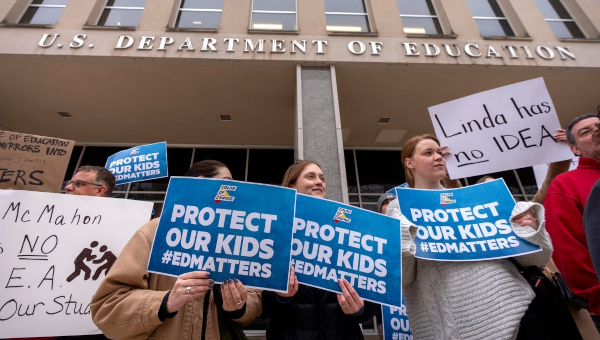
This creeping logic is starkly visible in Ontario, where Doug Ford’s Progressive Conservative (PC) government has moved to seize control of local school boards. What may look like routine administrative measures should be read as a warning: authoritarianism does not arrive only with grandiose spectacles or open attacks on democracy’s foundations; it gains ground quietly, through the erosion of the ordinary, the capture of the local, and above all, through the weaponization of education as a tool to dismantle democracy itself.

The Ford government’s seizure of the Toronto, Toronto Catholic, Ottawa-Carleton, and Dufferin-Peel Catholic district school boards is extraordinary, even for this democracy-averse regime. Education Minister Paul Calandra has even mused about eliminating trustees altogether before the 2026 local elections, declaring “Everything is on the table.” His justification that Ontario’s Ministry of Education (MOE) has allowed them to make too many decisions on their own is both unsupported and revealing. It exposes a deeper authoritarian project: the desire to centralize power and strip away democratic oversight from institutions closest to local communities. It curbs liberal instincts of trustees who see first-hand the vast diversity of lives and needs of the families who rely on their schools.

This is precisely how authoritarian control operates: by eroding intermediary structures that connect people to power. Just as Donald Trump sought to bend national cultural institutions like the Smithsonian Museum to his will, Ford dismantles the modest democratic functions of trusteeship. Both cases illustrate how authoritarianism works through the fine print of governance as much as through grandiose pronouncements.

Manufactured Deficits and Structural Starvation

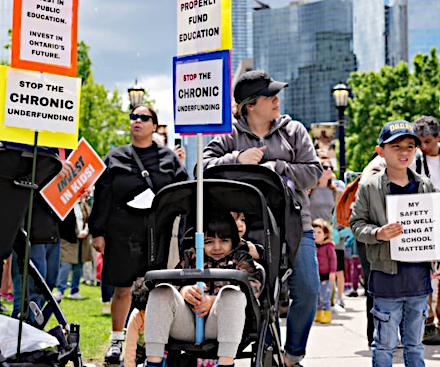
The pretext for takeover was financial mismanagement. Yet none of the investigators found evidence of serious fiscal incompetence. The truth is that boards submitted balanced budgets year after year but only after slashing programs and services, closing outdoor education centres, selling property, cutting staff, and raising fees. What really drives their fiscal crises is a decades-old funding model – first imposed by the Mike Harris PC government in 1997 – that shifted resources from local taxes to provincial grants. This was not a move toward equitable funding; these were neoliberals of the first order who believed in central control of funding so they could squeeze school boards and education workers to contain costs.

This model, based on enrolment rather than actual need, starved boards of resources for special education, transportation, salaries, and infrastructure.1 For instance, school boards don’t get funding for actual children who need special education support but rather on the basis of a predictive model MOE devised. Boards pay for the kids MOE doesn’t fund. The Ford government hasn’t funded the full increase for statutory teacher benefits for years, leaving boards short by millions. The result is a structural deficit: chronic underfunding that leaves even well-managed boards teetering on insolvency. The Ford government, while claiming to increase spending, has in fact cut funding per student by $1,500 in real terms since 2018. This is the problem faced by with 40 percent of Ontario school boards.

It is this manufactured insolvency that led Minister Calandra to get the most out of a useful crisis and put the four school boards under supervision and maybe next eliminate all school boards in the province. Here we see neoliberal austerity converging with authoritarian ambition. Underfunding is not a policy mistake; it is a deliberate strategy to weaken public education, undermine trust in democratic institutions, and prepare the ground for privatization schemes such as vouchers and charter schools. In this instance, the policy of underfunding is a way of weakening public education and then blaming whatever problems occur on education itself. This is gangster capitalism at work, cloaked in the language of fiscal responsibility but fueled by a pedagogy of dispossession.

Eliminating Trustees, Silencing Communities

If board takeovers were simply about money, supervisors would have been told to just find savings. Instead, elected trustees were suspended, their offices shuttered, their tiny stipends cut off, and their ability to communicate with constituents forbidden. Calandra’s power grab has all the elements of Elon Musk’s DOGE assaults in the US: move fast, offer absurd excuses, and blame the victims. The supervisors replacing trustees – accountants, lawyers, and former politicians with no background in education – now wield greater power than the elected community representatives they displaced.

This substitution of technocrats for democratically accountable representatives is part of fascism’s pedagogy. It teaches the public to accept disenfranchisement as efficiency, to see obedience as order. Parents who ask why a program disappeared or why their child’s special education class has grown larger are now met with silence. In this vacuum, the lesson learned is that participation is futile and resistance meaningless – precisely the kind of civic numbing oligarchic fascism requires.

Command, Control, and the Policing of Education

Ford’s government frames these takeovers as a “broader rethink” of governance, but the real project is clear: the imposition of command and control over education. This move sends a strong message that it’s time to duck our heads and get back to basics: teaching “reading, writing, spelling, and arithmetic and the whole shebang…” as Doug Ford complained last fall after teachers and students attended a rally in support of the Grassy Narrows First Nation and its efforts to deal with generations of mercury contamination in their area. He proclaimed, with no evidence, that the field trip was “indoctrination” by teachers because activists protesting Israeli genocide were present. Community members who supported an Indigenous curriculum, modern sexual education, or even school-name changes honoring anti-colonial figures are dismissed or painted as obstacles. The message from Ford and Calandra is blunt: stick to the basics – reading, writing, arithmetic – and leave politics at the door.

Yet politics hangs over classrooms like a shroud. Despite his Captain Canada complaints about the Trump tariffs, Ford admires the President quick-marching America toward fascism. In an off-mic moment he commented recently: “Election day, was I happy this guy won? One hundred per cent I was.” It’s not the racism, the authoritarianism, the compulsive lying, the fraud, the sexual assaults that bothers the Premier; it’s that he got stiffed by his friend.

Usurping trustees according to University of Ottawa professor Sachin Maharaj is just another step toward the Progressive Conservatives’ goal to “squelch the pipeline of more progressive leaders”2 like those gaining notice and experience attending to the needs of local schools.

The banning of the Toronto Muslim Student Alliance’s screening of the film No Other Land, which documents Israeli settler violence, shows how censorship now masquerades as neutrality. This is the pedagogy of repression in action: narrowing what can be taught, remembered, or discussed until education is reduced to obedience training. What parades as a “broader rethink” is part of the authoritarian language of censorship and control. Like Trump’s attacks on “critical race theory” or his censorship of the Smithsonian, Ford’s moves are not about protecting students from politics but about protecting power from critique. The real issue here is constructing authoritarian policies that narrow critical thinking, teacher autonomy, essential funding, and knowledge that enable schools to both defend and facilitate democracy.

For Ford and his adherents, the real issue is not that schools are failing but that they are public and have a vital role to play in a democracy. The real threat to Ford is that a democracy can only exist with informed citizens. Yet that is precisely the role education should assume.

Bill 33: Codifying Authoritarianism

The perversely named Bill 33, the Supporting Children and Students Act extends this authoritarian logic. It allows the Minister to investigate boards or trustees on the mere suspicion they might act “inappropriately” or against the “public interest” – an elastic phrase that grants unchecked power. It checks much-maligned Diversity Equity and Inclusion efforts by refusing boards the right to name schools, forcing them to abandon diversity-affirming figures in favor of colonial or sanitized names. It mandates the reintroduction of police officers into schools, despite community opposition to surveillance and “unaccountable access to youth by cops.”3

At work here is the legacy of colonialism, a legacy that is terrified of diversity, of those deemed other, being able to narrate themselves. Viewed as threat, this anti-democratic language ultimately falls back on issues of control and security. This is one instance of how authoritarianism consolidates itself, not through tanks in the streets but through legislation that transforms education into an arm of the security state. Pedagogical spaces are militarized, memory is policed, and students are taught that surveillance is normal and dissent dangerous.

Trumpasitic Authoritarianism

Ford’s methods echo those of his southern counterpart. Just as Trump’s politics thrive on dispossession, erasure, and the weaponization of culture, Ford borrows from the same authoritarian playbook. The takeover of school boards not only tightens political control but also grants easy access to billions of dollars in public land, enriching developers tied to his government.4 Here, neoliberal profiteering fuses seamlessly with authoritarian centralization, an example of the merging of gangster capitalism with the pedagogy of repression.

What do you expect from a government that makes decisions reflecting the arrogance of power? The Ford government cut Toronto city council in half soon after took office in 2018 and threatened to use a constitutional override, the Notwithstanding Clause, Section 33 of Canada’s Charter of Rights and Freedoms, to overturn a Superior Court justice’s decision that the move was unconstitutional. Ford actually used the clause to push through a bill restricting election advertising in 2021 and again, pre-emptively, in 2022, buttressing back-to-work legislation against striking public workers, among the lowest paid in the province. He’s considering using it again after his decision to remove bike lanes from Toronto streets was overturned in court; power makes you petty.

Democracy in the Smallest Details

The takeover of Ontario school boards may appear less dramatic than Trump’s assaults on national institutions, but its implications are just as dire. Authoritarianism advances not only through spectacle but through the slow erosion of local democratic practices that once seemed secure.

If fascism is a pedagogy of fear, amnesia, and conformity, then resistance must be a pedagogy of memory, solidarity, and imagination. To defend education is to defend democracy itself, for schools are not simply sites of instruction but laboratories of citizenship, places where young people learn what it means to speak, to question, to remember, and to act. When trustees are silenced, when curricula are censored, when communities are stripped of their voice, what is lost is not only oversight but the very possibility of democratic life.

What is at stake, then, is far larger than budget shortfalls or bureaucratic reshuffling. It is whether the future will be governed by communities or dictated from above by those who mistake obedience for learning and silence for peace. Fascism thrives in these small erasures, in the details that seem technical until they harden into structures of domination.

The lesson could not be clearer: democracy dies in increments, but it can also be rebuilt in increments – through collective memory, through civic courage, through the refusal to allow education to become a weapon of obedience. To resist the Ford government’s authoritarian incursions is not only to protect local school boards; it is to reclaim the very ground on which democratic hope stands. •

Endnotes

  1. Dan Crow, The Consequences Of A Neoliberal Funding Formula, Canadian Centre for Policy Alternatives, Fall/Winter 2018.
  2. Sachin Maharaj, Interview August 26, 2025
  3. Andrea Vásquez Jiménez, Interview June 7, 2025.
  4. William Paul, “Riding the Gravy Train” in Against the People: How Ford Nation is Dismantling Ontario, eds: Brian Evans, Carlo Fanelli, Fernwood Publishing, 2024.

Henry A. Giroux currently is the McMaster University Professor for Scholarship in the Public Interest and The Paulo Freire Distinguished Scholar in Critical Pedagogy. His most recent books include The Violence of Organized Forgetting (City Lights, 2014), Dangerous Thinking in the Age of the New Authoritarianism (Routledge, 2015), coauthored with Brad Evans, Disposable Futures: The Seduction of Violence in the Age of Spectacle (City Lights, 2015), and America at War with Itself (City Lights, 2016). His website is henryagiroux.com.

William Paul is editor of School Magazine website.

This article first appeared at the Social Project Bullet

Thursday, February 20, 2025

University Presidents Called to Action

Elite universities, long considered the pinnacle of higher education, have become increasingly entwined in a broader conversation about privilege, access, and power. From their controversial legacy admissions practices to their outsized political influence, these institutions are not merely places of learning—they are gatekeepers of social and economic power, shaping the future through both exclusion and influence. Beyond their academic roles, these universities have extended their reach into local communities, using their enormous wealth and influence to take control of land, shape urban landscapes, and solidify their power within regional politics.

The legacy admissions system, which provides preferential treatment to the children and grandchildren of alumni, is a glaring example of how these universities perpetuate privilege. Institutions such as Harvard, Yale, Princeton, and Stanford—universities that consistently rank among the top in the nation—have long utilized this practice to ensure that the doors to elite education remain open to those already within the circles of power. By admitting students with lesser academic qualifications solely because of their family connections, these schools continue a long tradition of insularity, effectively reserving spaces for the wealthy and well-connected. Despite growing opposition, including recent moves by California’s private colleges to ban legacy admissions, the practice remains a powerful force, locking out more qualified, diverse applicants and ensuring that the privileged maintain access to elite institutions.

In addition to these admissions practices, elite universities exert considerable influence on the political landscape. The recent revelations about their political spending—millions funneled into federal campaigns, overwhelmingly favoring Democratic candidates—highlight a disturbing trend. Universities like Harvard, Stanford, and Johns Hopkins are not neutral players in the policy arena; they are active participants in shaping the very policies that benefit their interests. Whether it’s lobbying for federal funding, securing advantageous tax policies, or influencing regulations related to higher education, these universities use their wealth to protect and expand their power. These schools are not just centers of academic pursuit—they are political players in their own right, using their financial clout to shape the policies that govern education, tax law, and more.

Beyond their influence in academia and politics, elite universities increasingly exert power over the very land on which they sit. In many cities, top-tier universities like Harvard, Stanford, Columbia, and the University of Chicago are not just educational institutions—they are economic and political powerhouses. With multi-billion-dollar endowments, these institutions often wield more financial clout than entire cities. They routinely expand their campuses, purchasing properties, and in some cases, entire neighborhoods, often displacing long-standing communities in the process. This process, commonly known as "university-led gentrification," transforms urban spaces, driving up property values and rents while pushing out lower-income residents.

Universities often justify their land acquisitions as part of their mission to expand their campuses, build new research centers, and offer more housing for students and faculty. However, the impact on local communities can be severe. In many cases, universities use their tax-exempt status to avoid paying property taxes on the land they acquire, depriving local governments of revenue while also claiming a disproportionate share of urban space. This allows them to grow their influence without contributing fully to the neighborhoods in which they are embedded.

This land-grabbing behavior has sparked resistance in cities across the country. In Boston, for example, Harvard and MIT have been critiqued for taking over large swaths of land in the Allston and Kendall Square neighborhoods, displacing low-income residents and local businesses. In New York, Columbia’s expansion into Harlem sparked protests from community members who felt their homes and livelihoods were being sacrificed to the university’s growth. In many cases, these universities lobby local governments to secure favorable zoning laws, tax breaks, and exemptions that allow them to build at will and maintain their growing empire.

Both legacy admissions and political donations underscore a fundamental truth: elite universities are not just educational institutions—they are institutions of power. They maintain an oligarchic structure that privileges those already in positions of wealth and influence, while shaping local economies and political systems to ensure their continued dominance. By hoarding access to elite education, they perpetuate a system in which the children of the wealthy have a head start in both education and society, while simultaneously lobbying for policies that further cement their own influence. Through their land acquisitions, gentrification, political donations, and admissions practices, these universities continue to consolidate their power, reinforcing an elitist status quo that leaves many outside looking in.

In all of this, university presidents have increasingly positioned themselves as moral arbiters, asserting their institutions’ commitment to social justice, inclusion, and equality. Yet this moral high ground becomes precarious when their administrations take extreme measures to suppress resistance. Protests against their policies—whether regarding gentrification, climate change, or labor rights—are often met with heavy-handed tactics. University leaders, eager to preserve their public image, have been known to deploy security forces, call in the police, or even collaborate with local governments to disband protests. In some cases, these universities have resorted to legal action against student and faculty activists, silencing dissent through threats of discipline, expulsion, or other punitive measures.

This duplicity becomes even more apparent when considering the moral stands many university leaders take in public, promoting inclusivity, diversity, and progressive values, while simultaneously suppressing those who challenge their institution’s power dynamics. In the face of mounting resistance from marginalized communities or student groups, these leaders prefer to maintain control over their campuses and public narratives, often using administrative power to quash any movements that may disrupt the status quo.

Yet, history has shown that even the most entrenched systems can change, and university presidents are not beyond the possibility of transformation. Just as some figures in the Bible experienced profound revelations that led them to change course and right their wrongs, university leaders, too, can have moments of reckoning. Consider the example of King David, whose heart was changed after his confrontation with the prophet Nathan over his sin (2 Samuel 12). David, once blinded by his own power, repented and chose a path of humility and righteousness. In the same way, university presidents, confronted by the voices of resistance, public outcry, or moral awakening, could choose to lead their institutions toward a more just and equitable future. In the New Testament, Saul’s conversion on the road to Damascus (Acts 9) serves as another powerful reminder that no one is beyond redemption. Saul, who once persecuted early Christians, was transformed into Paul, one of the most influential apostles in Christian history. Similarly, a university president could choose to recognize the harm their institution has caused and decide to enact transformative policies that benefit marginalized communities and dismantle the systems of privilege they have helped sustain.

Moses is another figure whose story exemplifies the power of divine revelation to shift course. As a prince of Egypt, Moses had everything at his disposal, yet he chose to stand up to Pharaoh when he recognized the injustice of the Hebrew people’s oppression. His moment of conviction led him to free his people from slavery, even though it required courage to defy a powerful ruler (Exodus 3-4). In the same way, a university president must stand up to the powerful trustees and donors who expect to maintain the status quo. To act in the face of such resistance requires profound moral courage—a willingness to lead against entrenched interests that protect wealth and privilege.

Another key figure in the Old Testament is Esther, who displayed extraordinary courage in a moment of great moral clarity. She risked her life by standing up to King Xerxes to save the Jewish people from annihilation (Esther 4). As the queen, she was in a powerful position, but it was only when she realized the enormity of the injustice at hand that she chose to act. Similarly, university presidents with the power to challenge the status quo can, like Esther, use their positions to advocate for justice and equality, even if it means confronting powerful forces that wish to preserve an unjust order.

As university presidents come face to face with the overwhelming issues of racism, injustice, and climate chaos, there exists the possibility of moral revelation—a turning point where they confront the gravity of their actions and their institutions’ role in perpetuating harm. The growing calls for racial justice, fueled by movements like Black Lives Matter, demand an acknowledgment of the systemic racism embedded in these universities. Whether through the disproportionate representation of wealthy white students or the stark inequities in faculty and leadership diversity, these institutions must reckon with their participation in racial oppression. Similarly, as the climate crisis deepens, universities’ investments in fossil fuels and their ongoing complicity in the destruction of the environment have become focal points for student activists and global environmental movements. Universities, often perceived as beacons of progress, have a responsibility to divest from industries contributing to ecological collapse and instead use their vast resources for environmental justice.

And yet, one of the greatest challenges these university leaders will face lies not only in the resistance of external forces like protestors, activists, and the general public, but also in the powerful trustees and donors who hold significant sway over the institutions’ direction. Many universities are closely tied to wealthy benefactors and influential trustees whose interests often align with maintaining the status quo—whether through preserving investment strategies, political stances, or traditional admissions processes. These figures are not simply investors in the university's future; they are powerful stakeholders with the resources to shape institutional policies and procedures, often with little regard for social justice or environmental responsibility.

For a university president to truly lead with courage and integrity, they must be willing to go against these powerful forces. This would require challenging the entrenched interests of those who have long benefited from an elite, exclusionary system and are reluctant to embrace the radical changes needed to address systemic injustice. It takes immense fortitude to stand up to trustees and donors who view universities as tools for preserving their wealth and influence, rather than forces for good in the world.

But university presidents who choose to go against these forces can become true moral leaders. They can take inspiration from figures like Moses, who boldly defied Pharaoh’s power to liberate the oppressed, or Esther, whose bravery in standing up to the king saved her people (Esther 4). In doing so, they would not only transform their institutions but also serve as examples of ethical leadership in a time when such leadership is sorely needed.

The courage to defy powerful donors and trustees would mark a dramatic shift in how elite universities operate. Presidents could, if they choose, champion a new vision—one where social justice, racial equality, and environmental sustainability are at the forefront of institutional priorities. Just as Moses led the Israelites out of Egypt toward a promised land of freedom, so too could university presidents lead their institutions out of the grip of elitism and corporate influence, steering them toward a more equitable and just future.

Both legacy admissions, political donations, land control, and the suppression of protest point to a deeper issue: elite universities have built themselves into institutions of unparalleled power. These universities operate not only as educational establishments but also as political and economic entities, constantly reinforcing a structure of privilege, wealth, and exclusion. The dissonance between their public declarations of moral authority and their actions to protect entrenched power reveals the true nature of these institutions. They are not the bastions of free inquiry and social good they often claim to be—they are powerful, self-interested players in a system that serves to preserve the very inequalities they profess to challenge.

However, the possibility remains that these institutions—guided by transformative leadership—could embrace a new path. University presidents could heed the call for justice, as many leaders in history have, and change the trajectory of their institutions, opting to lead in ways that promote true equity, racial justice, and environmental stewardship. These universities—once seen as places of learning and opportunity—could become what they claim to be: inclusive, just, and truly committed to the betterment of society. They are the architects of the future they seek to create: one where the privileged no longer remain firmly entrenched at the top, and where political, economic, and educational structures are reshaped for the common good. Whether through legacy admissions, political spending, land control, or suppressing protest, these institutions continue to consolidate their power, but with the right leadership, they can still pivot toward a more just future—one that embodies the values they espouse.

[Editor's note: This essay, written for elite university presidents, is intended as a rhetorical device rather than a statement of facts. We find that everyone has their own "mythology" or set of mythologies they follow. As with all our work, we value your feedback.]

Wednesday, June 11, 2025

Corruption, Fraud and Scandal at Los Angeles Community College District, Part 2 (LACCD Whistleblower)

[Editor's note: The first installment of Corruption, Fraud and Scandal at Los Angeles Community College District is here.]

“HR has been weaponized against our faculty for speaking out and complaining about discrimination.” This was a public comment made by Los Angeles Community College District Academic Senate President Angela Echeverri at the March 2025 Meeting of the LACCD Board of Trustees.

Echeverri’s remarks were not isolated either and were echoed by Deborah Harrington (California Community Colleges’ Success Network Executive Director), “Our HR leadership is not living up to the standards that we deserve. Our members remain quite frustrated.” More reporting can be read in Pierce College student newspaper ‘The RoundUp’ and LACCD Youtube Live-Streamed meetings.

These accusations come three years after longtime administrator Annie G. Reed (Annie Goldman Reed) left her position as Omsbudsman/Associate Dean of Students at Los Angeles Valley College was promoted to Interim Dean of Employee and Labor Relations collecting an annual salary of $284,935.00 in pay and benefits in 2022 according to Transparent California last year of reporting.

A survey of public records including news articles, lawsuits, accreditation complaints, and emails to show that Annie G. Reed has a long history of this sort of behavior across multiple LACCD campuses – going back to the 2000s. 

In an October 27, 2010 article ‘Grade Grievances Give Students Voice’ by Lucas Thompson in ‘The Los Angeles Valley Star’ Annie G. Reed is quoted as cautioning students against using their rights to challenge unfair grades stating, “It’s worthwhile if a student really thinks they have the proof to forward with the process . . . It’s their right to, [but] we don’t encourage frivolous [cases], because that’s a waste of college resources.” 

The article further quoted disgraced ex-College President Sue Carleo who left the institution in 2013, with the College finances in the red and on Warning Status with the Accreditation Commission of Junior and Community Colleges. Carleo warned that students should simply view mis-grading as “Human Error.” (https://archive.org/details/cavgchm_002210/mode/2up? q=Annie+Reed+LAVC)

When the ACJCC placed Los Angeles Valley College on Accreditation Warning it cited multiple standards violations and specifically;

College Recommendation 5:

To fully meet the Standards, the college should ensure that records of complaints are routinely maintained as required by the Policy on Student and Public Complaints Against Institutions (Standards II.B.2, II.B.2.c, II.B.3.a, II.B.4)

This came after Annie G. Reed failed to have student records or complaints available for inspection to the visiting Accreditation Team.

 Three years later Reed was again in hot water when a student filed an Accreditation Complaint in June 2016, specifically documenting multiple faculty members in the Los Angeles Valley College Media Arts Department engaging in fraud and deceptive practices – supported by sixty pages of documentation.

The complaint further stated that Reed refused to facilitate student complaints as was her role and threatened action for ‘disrupting the peace of the campus’ by making complaints. This was followed by a second accreditation complaint by another student regarding the same issues and a student Facebook Group discussing issues.

Reed’s response was to suspend the first student running a smear campaign that he was potential active shooter citing the complaints he brought, suspend a thirty-year old single mother in the Facebook Group for Academic dishonesty after she forgot to have a college transcript from when she was eighteen-years old sent to LAVC, and then threatened the second student who brought an Accreditation Complaint for vandalizing school property.

[Below: Text exchange between LACCD students alleging that administrator Annie Reed created a smear campaign against them.]

Student 1 was suspended for a year (though not expelled by the Board of Trustees after investigation) a semester short of graduating. Student 1 would have earned six associate degrees and eight occupational certificates. Student 2, was ordered to pay a substantial amount of financial aid back to the college as “restitution.” Several months later, she was subjected to a reversal of hours by LAVC Grant Director Dan Watanabe in the Media Arts Department, for a campus job she worked and ordered to pay back several thousand dollars. Student 3 ended up going to Los Angeles City College to take final classes needed to graduate and was nearly refused graduation by Department Chair Eric Swelstad.

These actions also happened right before and after LAVC Media Arts Faculty Eric Swelstad, Chad Sustin, Adrian Castillo, Dan Watanabe, and LAVC President Erika Endrijonas lobbied the LACCD Board of Trustees to approve construction of a new Media Arts Building that was later reported by The Los Angeles Times to be a massive racketeering scheme – Aug 4, 2022, Teresa Watanabe, ‘Corruption and fraud beset long-delayed L.A. Valley college theater project, lawsuit alleges.’ (https://www.latimes.com/california/story/2022-08-04/corruption-alleged-in-long delayed-la-valley-college-theater-project) 

These actions mirrored the treatment of a student who sued LAVC’s Media Arts Department in 2009, alleging the same type of fraud and misconduct by nearly all the same Department Faculty.

Enrique Caraveo vs Los Angeles Valley College, Eric Swelstad, Joseph D’Accurso, Arantxia Rodriguez, Dennis J. Reed among others. Filing Date: 05/18/2009 (https://unicourt.com/case/ca la2-enrique-caraveo-vs-los-angeles-valley-college-et-al-621337)

In that case, Caraveo stated:

46. When plaintiff complained about the above referenced matters, Swelstad and other Valley College officials retaliated against plaintiff by refusing to grant him a Certificate and creating a hostile learning environment for him in class.

47. On or around June 2007 plaintiff satisfied the requirements to get a Cinema Arts Production Certificate (“Certificate”) at Valley College.

54. On or about October 2008, Swelstad denied plaintiff the certificate via a letter even though plaintiff has fulfilled the requirements to get the Certificate.

55. On or about October 13, 2008, plaintiff notified Delahoussaye and Reed that plaintiff had fulfilled all requirements for the Certificate and that they should take care of the matter as soon as possible. On or about October 13, 2008, Yasmin Delahoussaye and Dennis Reed denied request.”

Dennis Reed, was at the time the Dean over the Media Arts Department and the husband of Annie G. Reed. Dennis Reed was later profiled in LAist Magazine on April 27, 2016 article ‘Jerk Driver Who Ran Cyclists Off Glendale Road Charged With Assault, Lying To Police’ (https:// laist.com/news/justice-delivered-almost)

 More to the point – Dennis Reed also oversaw a grant program at Los Angeles Valley College Media Arts Department known as IDEAS – Institute for Developing Entertainment Arts and Studies at LAVC. The Grant was run by Dan Watanabe. (https://archive.org/details/ cavgchm_002241/mode/2up?q=Annie+Reed+LAVC)

 Watanabe was also named in the Accreditation Complaint for Wage Theft, Improper use of funds and fraud in the successor grant ICT Doing What Matters, due to the college receiving Grant Money but immediately eliminating the curriculum the grant application said they would provide and like Caraveo’s complaint not providing in class training or labs. The complaints to Accreditation and the LACCD Personnel Commission by students also questioned the legitimacy of a number of professional experts, including Robert Reber – who was listed as both a ‘student worker’ and ‘professional expert’ in 2008. Student 1 further provided evidence to both that Dan Watanabe had asked him to falsify his resume claiming fictitious jobs and cited an employee in the LAVC Payroll office as being behind it (that employee immediately denied it and Student 1 refused).

Dennis Reed had also spent years lobbying for the approval of the VACC building – unsuccessfully.

In short, Annie G. Reed’s retaliation and cover-up in 2016, may have been to help realize her husband’s failed building project as well as preemptively shutdown any investigations or audits that might trigger further scrutiny regarding how the IDEAS Grant was administered under his time as area Dean.

Reed’s behavior of covering up abusive behavior towards members of the LACCD Community was also not limited to retaliation against students.

In 2017, then LACCD Board President Andra Hoffman accused former Board President Scott Svonkin of abusive behavior and demanded sanctions. According to an article in the Los Angeles Daily News, ‘LA Community College board postpones sanction hearing vote against former 4 president’ August 28, 2017, Annie G. Reed again inserted herself into the matter to cover-up for Svonkin.

“The allegations do not strike me as related to governing and seem best suited for mediation,” said Annie Reed, a district employee for 22 years and a representative of Teamsters Local 911. “I don’t ever recall a time, or a place, where he has treated his colleagues poorly.”

Others disagreed, including two former women board members who did not speak at the downtown meeting.

They said Hoffman’s critics — who they said weren’t present during the abuse — had a tendency to blame the victim, while ignoring Svonkin’s allegedly brusque treatment of employees.” (https://www.dailynews.com/2017/07/13/la-community-college-board-postpones-sanction hearing-vote-against-former-president/)

Her behavior is further documented in a series of lawsuits against the LACCD District. 

Filed October 03, 2024 Dr. Christiana Baskaran (Plaintiff), Linda Silva; Dr. Ruth Dela Cruz, Dr. Adriana Portugal, vs LACCD (including defendant Annie Reed). (https://trellis.law/doc/ 219882998/complaint-filed-by-dr-christiana-baskaran-plaintiff-linda-silva-plaintiff-dr-ruth-dela cruz-plaintiff-et-al-as-to-los-angeles-community-college-district-defendant-board-trustees-los angeles-community-college-district-defendant-los-angeles-c)

“[other defendants] Annie Reed to discriminate against female faculty and staff, refused to investigate immediately or to take preventative action. Then Defendants and EMPLOYER DEFENDANTS retaliated against PLAINTIFFS and others to try and prevent them from complaining to authorities. When PLAINTIFFS opposed these illegal practices, they continued to retaliate against them.”

24. As set forth herein, ALL Defendants were officers, agents. Defendants and directly or indirectly used or attempt to use their official authority or influence for the purpose of intimidating, threatening, coercing, commanding, or attempting to intimidate, threaten, coerce, or command PLAINTIFF and others for the purpose of interfering with the right of that person to disclose to an official agent matters within the scope of this article. EMPLOYER DEFENDANTS aided and abetted MARY GALLAGHER, ARMANDO RIVERA-FIGUEROA, ANN HAMILTON, JAMES LANCASTER, JOCELYN SIMPSON, JIM LANCASTER, ANNIE REED and Victoria Friedman District Complaince Officer, Genie-Sarceda-Magruder Interim Director Office for Diversity, Equity and Inclusion, Rick Von Kolen to violate this statute.

28. . . .Dr Hamilton admitted to other illegal activity such as planting drugs on employees to destroy their reputation and get them fired. Dr Silva filed a grievance against Dean Hamilton to try and get her to stop the illegal activity, the union did nothing. 

32. Ms. Silva complained to Human Resources filed a title IX complaint, made a report to the police and was retaliated against.

Filed October 19, 2023 Sara Adams, An Individual VS California Institute of Technology, California Corporation. (https://trellis.law/case/23stcv25556/sara-adams-an-individual-vs california-institute-technology-california-corporation)

“21. On April 7, 2023, Mr. Wu continued to report the pay disparity to Annie Reed, Upon information and belief, Annie Reed is Caltech’s Employee and Organizational Development Consultant (Human Resources Department). 

22. Annie Reed spoke about the report of pay disparity to Ofelia Velazquez-Perez, Caltech’s Senior Director, Total Rewards and Director of Employee and Organizational Development (Employee Relations).”

Filed March 08, 2021, Mitra Hoshiar, an individual, Plaintiff, v. Los Angeles Community College District, (https://trellis.law/case/21stcv08950/mitra-hoshiar-vs-los-angeles-community college-district-an-unknown-entity)

“28. On December 3, 2015, PLAINTIFF then filed a discrimination complaint against Sheri Berger (“Berger”), VP of Academic Affairs, and Fernando Oleas (“Oleas”), Pierce Union President. During PLAINTIFF meeting with Dean Barbara Anderson (“Anderson”) at Anderson’s office on June 10, 2015, Berger and Oleas stopped by and started making remarks of PLAINTIFF’s accent for reading the graduates’ names on the ceremony with a non-American accent.

29. Thereafter, On December 11, 2015, in meeting with Dean Annie Reed in conjunction with the non-collegiality investigation Walsh, Union Grievance Rep and Oleas stopped by at PLAINTIFF’s office in order to prevent PLAINTIFF from Union Representation. They made PLAINTIFF to Barbara Anderson, whom was PLANTIFF’s chosen union rep and request for Anderson to not join the meeting because Walsh and Oleas had to choose who could be the union representation in the meeting.

30. Based on what had transpired on December 11, 2015, on December 14, 2015, Plaintiff filed a Whistleblower/Retaliation Complaint at the District’s Complaint at the District’s Compliance Office against Walsh, Oleas, and McKeever (department and union delegate), and other members of her department. No action was taken by the Compliance Office.

Annie G. Reed’s, current interim Dean of Labor and Employee Relations, has been involved in covering up wrongdoing in the Los Angeles Community College District for decades. Her targets have involved employees, students, faculty, and even a trustee. And so far has never been held accountable.

Multiple stories were published on newswire IndyBay, the news outlet branch of the San Francisco Bay Area Independent Media Center between 2023 and 2024. They were then scrubbed (along with other stories) over the weekend of May 18, 2025.

Recently, newly appointed Chancellor, Dr. Alberto J. Roman has been alerted to Ms. Reed’s disturbing history – it remains to be seen whether he will take corrective action, or continue to 6 keep around the same problematic individuals that resulted in his predecessor’s resignation after a vote of no-confidence by the LACCD Academic Senate.

(To be continued...)