Search This Blog

Thursday, December 12, 2024

Maximus AidVantage Contracts with the US Department of Education Publicly Available

The Higher Education Inquirer has received all the current contracts between the US Department of Education and Maximus/AidVantage through a Freedom of Information Act (FOIA) request. Maximus serves millions of student loan debtors and has faced increased scrutiny (and loss of revenues) for not fulfilling their duties on time. 

The FOIA response (23-01436-F) consists of a zip file of 998 pages in 5 separate files. HEI is sharing this information with any news outlet or organization for free, however we would appreciate an acknowledgement of the source. 

We have already reached out to a number of organizations, including the Student Borrower Protection Center, the Debt Collective, the Project on Predatory Lending, the NY Times, ProPublica, and Democracy Now!  We have also posted this article at the r/BorrowerDefense subreddit

Wednesday, December 11, 2024

Owners of Shuttered For-Profit Hussian College Sue ex-CEO, Charging Embezzlement (David Halperin)

The owners of shuttered for-profit Hussian College have sued the school’s former president and CEO, Jeremiah Staropoli, seeking $162 million in damages and penalties and claiming that Staropoli and close associates in the company embezzled funds and then conspired to cover up the alleged misdeeds.

On September 5, father-and-son Hussian owners David and Joshua Figuli sued Staropoli, other former Hussian employees, and two lending companies in Pennsylvania state court, alleging a racketeering conspiracy, fraud, embezzlement, and other abuses. The lending companies, contending there was a basis for federal court jurisdiction, removed the case from the state court to the U.S. District Court in Philadelphia.

While the companies and some of the former employees have filed answers to the complaint or moved to dismiss the case, Staropoli has not responded. In a recent court filing, the Figulis say they have tried to serve Staropoli with the complaint seven times and that Staropoli “appears to be evading service.”

Staropoli did not respond to a request for comment from Republic Report. The Figuli’s attorney also did not respond.

The Hussian closure

Hussian College, founded in Philadelphia in 1946, closed in summer 2023. At the time it shut down, Hussian had hundreds of students at campuses in Pennsylvania, Ohio, Tennessee, and California, plus online offerings, and taught programs in business, information technology, criminal justice, health sciences, and the arts. Hussian, in 2018, had expanded by taking over Tennessee-based for-profit Daymar College, a school that had in 2015 agreed to a $12.4 million settlement to end a lawsuit, alleging deceptive practices, brought by Kentucky’s attorney general.

For academic year 2021-22, the last year for which the U.S. Department of Education published data on the school, Hussian received $14.8 million in federal student aid dollars from the Department — about 74 percent of the school’s revenue.

In June 2022, accrediting agency ACCSC, the gatekeeper for the schools’ eligibility for federal student grants and loans, had put all the Hussian and Daymar campuses on system-wide warning, citing concerns about student achievement at the schools. But ACCSC removed the warning and renewed Hussian’s accreditation in December 2022.

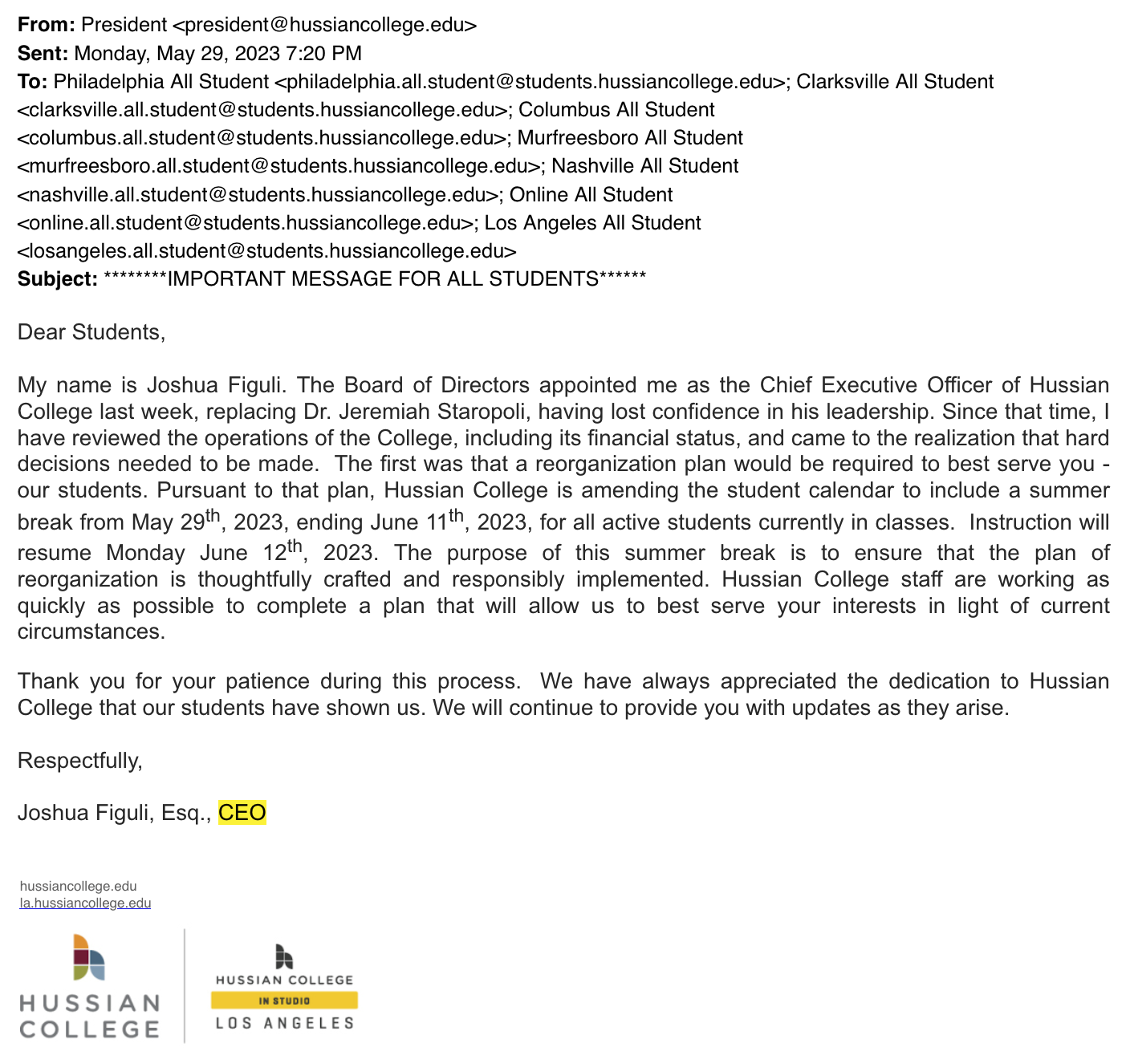
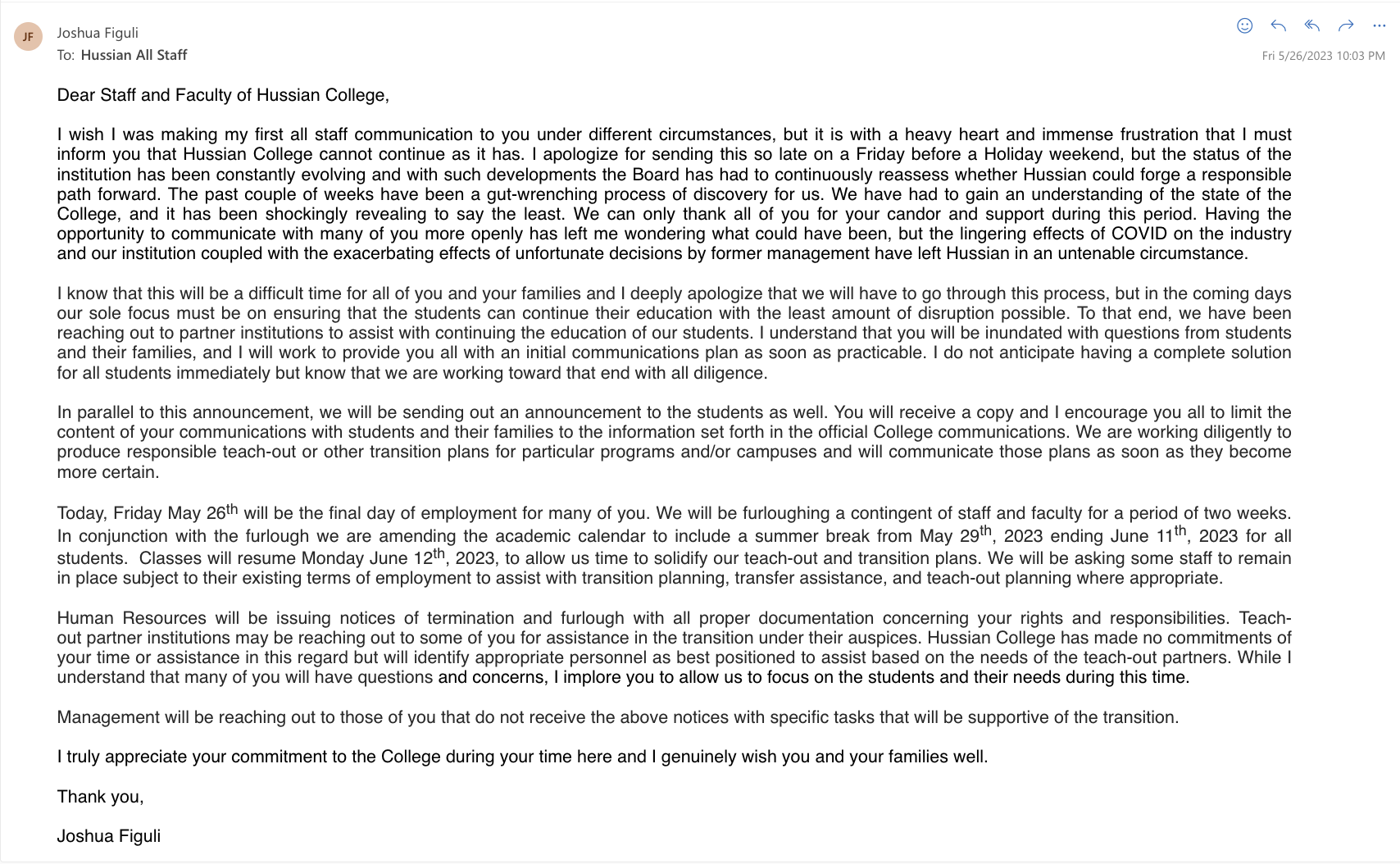
The Figulis announced the closure in June 2023, two weeks after Joshua Figuli informed Hussian students by email that the school’s board of directors had replaced Staropoli because it had “lost confidence in his leadership.” Figuli wrote in a separate email to faculty and staff that a “gut-wrenching process of discovery” had produced “shockingly revealing” information about the state of the school under Staropoli.

Around the time of the announced closure, more than 15 Hussian faculty, staff, students, and parents spoke with Republic Report. They told me that Hussian repeatedly had been pressed by vendors for extended and blatant failures to pay its bills, that students had not been receiving federal aid disbursements in a timely manner, that Hussian owed money to many students, and that Hussian was enrolling new students even as it was about to close.

One Hussian employee at the time reported to me evidence of financial misconduct, improper expenses, and computer access manipulation by Staropoli. The employee also said that Joshua Figuli, who stepped in as CEO when Staropoli was dismissed, was failing to respond to calls and emails from students and staff who were trying to find out what was going on.


The lawsuit’s allegations


The lawsuit filed in September by the Figulis places the blame for Hussian’s collapse squarely on Staropoli, who joined Hussian as CEO in 2017, and a group of employees he brought in. The Figulis admit to knowing that Staropoli had past ties to some of these employees, but they claim the ties turned out to be much deeper than Staropoli told them, including, they allege, one employee engaged, before and after being hired, in an apparent romantic relationship with Staropoli. The Figulis allege that Staropoli caused Hussian to pay large and unwarranted bonuses to these favored employees, and even allowed one of them to work for Hussian while remaining on the payroll of a competitor school.

The Figulis also allege that Staropoli conspired with the two lending companies to make deals behind their backs and that Staropoli created fake email addresses for the Figulis so that he, not they, would receive confirmation of the deals.

The Figulis say that under Staropoli’s leadership, Hussian was failing to return to the government millions in unearned federal and state student aid, as required by law, and that Staropoli was concealing from them the schools’ “dire state of cash flow” and its failure, also, to transmit hundreds of thousands owed to students.

And they allege that school money was used to pay for Staropoli’s family and friends to vacation in Orlando and Nashville; for charges from Staropoli’s country club in Delaware; for tuition payments to Drexel University for one of the favored employees, despite that same employee ending Hussian’s tuition reimbursement policy; for “nondescript transfers to VENMO”; and more.

The Figulis claim that the alleged improper actions of Staropoli and other defendants induced them “to provide loans, advance costs, provide capital infusions, forego collections, and execute guarantees that summed to total direct losses in excess of $6,948,110.93.”

The two lending companies have moved to dismiss the case, one former employee has done the same, and another former employee filed an answer to the complaint. But former employee Steven Wojslaw, according to a filing by the Figulis, was served but has not filed any response.

Wojslaw filed his own lawsuit against Hussian in 2022, after he apparently put his own money into the company. When he was terminated, he sued to get the money back. That case was settled. Meanwhile, Velocity Capital Group, one of the lenders the Figulis have now sued, filed last year its own lawsuit in New York against Hussian and the Figulis, seeking its investment back. The Figulis have filed a counterclaim in that lawsuit.

In their new case against Starapoli, Velocity, and the others, the Figulis filed a motion on December 2 seeking permission to amend their original complaint to clarify, add, and withdraw certain claims, in part to respond to the motions to dismiss.

Who is Jeremiah Staropoli?

A former employee says information that the company learned around the time the Figulis forced out Staropoli came as “a giant shock” to the company. “It was insane,” this ex-employee says. “There were multiple victims: the Figulis, but also the staff, the students, and the government.” The ex-employee asks, “Why don’t people go to prison” when they “destroy so many lives?” This employee says that, as the school struggled, many employees believed the Figulis were the enemy, who wouldn’t invest enough money and time “to help Staropoli save the company,” but that the facts in the new lawsuit tell a different story.

Jeremiah Staropoli is a former president of the Towson, Maryland, campus of Brightwood College, a for-profit chain owned by now-collapsed Education Corporation of America. He also previously worked for the for-profit college operations Kaplan and DeVry. According to his LinkedIn page, he also was previously president of the Kentucky-based The Keeling Group, an IT consulting firm “specializing in custom software development, cloud consulting, network integration and higher education regulatory compliance solutions.”

Staropoli also was once listed as part of the management team of a fledgling coding bootcamp operation owned by the Figulis called AcademicIQ, but that business apparently never took off. Hussian College and AcademicIQ shared an address on Spring Garden Street in Philadelphia, along with a campus of non-profit Harrisburg University. David Figuli until recently served on the Harrisburg University board of trustees.

Hussian also has a connection to Colbeck Capital Management, slippery operators of campuses of the Art Institutes (now closed) and South University (still open) that were acquired in the wake of the collapse of Dream Center Education Holdings. Hussian acquired the Los Angeles-based Studio School, in which Colbeck had been an investor, and renamed the school Hussian College Los Angeles; Staropoli told me in 2019 that Colbeck-backed Studio Enterprise remained “a service provider” to the school.

The mess at Hussian seems to be just the latest example of how the federal investment in for-profit colleges often ends up as waste, fraud, and abuse — with taxpayers ripped off, students locked out in the cold, and some for-profit executives walking away with cash and fancy perqs. The for-profit college industry, recalling the lax enforcement in the first Trump term under Secretary of Education Betsy Devos, is salivating at the impending restoration of the leader of scam Trump University as leader of the United States. But, if it has any integrity at all, the new department that Elon Musk is supposedly setting up for Trump — committed to rooting out federal government waste, fraud, and abuse — should investigate this industry promptly.

[Editor's note: This article originally appeared on Republic Report.] 

Tuesday, December 10, 2024

Viral Video Shows Franklin Fire Raging Outside Pepperdine University Library Doors (Weather Channel)

Pepperdine University issued a shelter-in-place order just after 1 a.m. local time on Tuesday, Dec. 10, ordering those on campus to seek shelter at either the Tyler Campus Center or Payson Library as the Franklin Fire raged nearby.

Footage shared by the user @ew_its_kat on X appears to show the students’ perspective "from inside the library" of firefighters battling the blaze.

Sunday, December 8, 2024

Climate Change and The Kleptocene: On the Commodification of Sentience (Wendy Lynne Lee)

Dear friends and colleagues, I am delighted to be able to tell you that my new book, Climate Change and The Kleptocene: On the Commodification of Sentience is available for pre-order at Bookshop.org

It's also available at Amazon--but let's support local bookstores, shall we? It will be ready to ship December 15th, 2024. I am very excited and hopeful that my work will be useful to my fellows, and I look forward to your feedback, criticism, and even some positive observations. Let me know what you think!

Wendy Lynne Lee

University of Phoenix: An Albatross for Idaho?

The University of Phoenix will be back in Idaho District Court in 2025 unless Apollo Global Management can find another buyer for the school. Apollo Group, the primary owner of the University of Phoenix, has been trying to unload the school for years.  

Although the University of Phoenix appears to be a profitable institution, it has potential liabilities, including hundreds of millions of dollars in Borrower Defense to Repayment (fraud) claims that the US Department of Education could claw back from the parent owner. While this risk may be seriously reduced over the next four years, that danger could rise again under a progressive administration. 

As of 2023, there were approximately 73,000 Borrower Defense claims against the school. More than 19,000 Borrower Defense claims were approved for student debtors who attended the University of Phoenix and were part of the Sweet v Cardona settlement. Many of the remaining claims are still awaiting a decision from the Department of Education.  

University of Phoenix debtors are saddled with an estimated $21.6 Billion in student loan debt. 

The University of Phoenix has been involved in a number of lawsuits over the last decade. In 2019, the Federal Trade Commission and the University of Phoenix settled a claim for $191M for deceptive employment claims, but the school denied any wrongdoing.


Friday, December 6, 2024

Student Stories: Understanding the Human Impact of For-profit Colleges (Project on Predatory Student Lending)

For decades, the predatory for-profit college industry has exploited the promise of higher education, at the expense of students who are trying to build a better life.  

These are their stories. Read a letter from 5,721 student borrowers who were the victims of fraud and misconduct here sent to members of Congress, the Department of Education, and White House officials on November 22, 2024.

Read all of the stories here


Related link:

List of Schools with Strong Indicators of Misconduct, Evidence for Borrower Defense Claims


Get Wise, Guys: The Perils of the Sports Betting Culture

The NCAA Calls it a Nightmare 

It's easy to get caught up in the excitement of betting on college sports, the potential for quick money, and the social aspect of it all. But let's peel back the curtain and examine the real dangers that lurk beneath the surface of the sports betting culture.  

The Illusion of Easy Money
While it may seem like a simple way to make extra cash, the reality is much more complex. The odds are stacked against you, and the house always has an edge. Chasing losses can lead to a dangerous cycle of debt and despair.

The Mental Toll
The emotional rollercoaster of sports betting can take a significant toll on your mental health. The highs of winning can be fleeting, while the lows of losing can be devastating. The constant stress, anxiety, and disappointment can lead to serious mental health issues.

The Social Impact
Gambling addiction can strain relationships with friends and family. It can lead to isolation, secrecy, and a breakdown of trust. Your academic performance may suffer as you prioritize betting over your studies.

Get Wise, Stay Wise
While it's tempting to indulge in the thrill of sports betting, it's important to approach it with a level head. If you are underage, don't do it.  If you are over 25 and don't have an addiction, stick to a few small bets and a small budget, and know when to walk away. Don't drink or do drugs before, during, or after wagering. If you find yourself struggling with a gambling addiction, seek help immediately.  And if someone notices problems before you do, consider them an ally, and listen. 

Remember, the true joy of sports lies in the game itself, not in the financial outcome.


The National Problem Gambling Helpline (1-800-GAMBLER) is operated by the National Council on Problem Gambling. The helpline serves as a one-stop hub connecting people looking for assistance with a gambling problem to local resources. This network includes 28 contact centers which cover all 50 states and the U.S. territories. The National Problem Gambling Helpline offers call, text and chat services 24/7/365.

This Week in IPEDS - Winter 2023-24 Data Released; Update on Race/Ethnicity Collection and Reporting

1. Winter 2023-24 Data Released

NCES has released provisional data from the Winter 2023-24 collection. The Winter 2023-24 collection includes the following survey data: Graduation Rates for selected cohorts; Outcome Measures for cohort year 2015-16; Student Financial Aid, academic year 2022-23; and Admissions, Fall 2023. The data are currently available through the IPEDS Use the Data Page: https://nces.ed.gov/ipeds/use-the-data

2. Update on Statistical Policy Directive No. 15 Regarding Race/Ethnicity Collection and Reporting

As previously noted, all Departments within the Federal Government are in the process of implementing Statistical Policy Directive No. 15 (SPD 15): Standards for Maintaining, Collecting, and Presenting Federal Data on Race and Ethnicity. At this time, IPEDS has not yet announced any specific plans regarding changes to race/ethnicity reporting. However, Title IV-participating institutions should prepare for upcoming changes, which may as require updates to information systems.

An IPEDS Technical Review Panel meeting was recently held to discuss SPD 15, and the summary of that meeting will be available in the near future. Additionally, the Chief Statistician of the United States has shared more information about SPD 15 on this blog. Institutions are urged to begin or continue internal discussions to prepare for the forthcoming changes related to race/ethnicity data collection and reporting. These changes include the addition of a Middle Eastern or North African (MENA) race category and the introduction of a combined race/ethnicity question, which will replace the existing two-part question.

IPEDS Help Desk
1-877-225-2568
ipedshelp@rti.org

Thursday, December 5, 2024

How much will global economic and political forces affect international enrollment in 2025?

Elite and brand name universities serve the world's elite. But how much will global economic and political forces affect US higher education in 2025? More than one million foreign students attend higher education institutions in the US, but those numbers could change. 

There are several ongoing developments that could affect the influx of international students in 2025. This includes problems with the political economy in Asia (China, South Korea) and in Europe (the UK, Germany, and France). 

Trade wars, which incoming President Trump has threatened, could also affect enrollment. And deportations of Muslim students, including those who have protested the war in the Middle East, could create a chilling effect on student in-migration. 

Indian students are already the largest group coming into the US and they serve as a major pipeline for the tech industry and medicine, and that is unlikely to change in the near future. 
 
(KTLA Video) International students at the University of Southern California are being urged to return to the US before the Trump Administration gains power. 

Why the Ivy League Class Controls America (Nick Pardini)