Search This Blog

Showing posts sorted by relevance for query PSLF. Sort by date Show all posts

Monday, June 30, 2025

Trump’s Neg Reg to Weaponize Debt Is Here - Key Takeaways from Day 1 (Student Borrower Protection Center)

Back in March, President Trump announced an executive order to revoke Public Service Loan Forgiveness (PSLF) eligibility from public service workers employed at organizations engaged in work opposed by his administration—a blatantly illegal attempt to use public service workers as pawns in his right-wing political project to destroy civil society.


Shortly after, the U.S. Department of Education (ED) announced its plans for a Negotiated Rulemaking (Neg Reg) process to put these dangerous policies into the PSLF regulations. Today marked Day 1 of the only 3-day committee session for this Neg Reg—and ED has already doubled down on this campaign to weaponize debt to silence speech that does not align with President Trump’s MAGA playbook:


  • ED’s first draft of regulatory language, to put it bluntly, serves Trump’s fascist agenda. It empowers Secretary McMahon to block all government workers with student debt, including first responders, social workers, and teachers, from receiving PSLF in retaliation if she decides that a local or state government policy conflicts with her extreme, right-wing views on immigration, civil rights, or free speech. More on that here.
  • ED excluded borrowers and key experts from the rulemaking committee.
  • Despite overwhelming public demand for stronger borrower protections, discussions focused on weaponizing and restricting critical relief programs like PSLF.


Session Summary:


  • The day started off on a bad foot. Abby Shafroth, alternate negotiator for the Consumers, Legal Aid, and Civil Rights seat, requested to add a seat dedicated to civil rights because the proposed changes to PSLF directly affect the ability of marginalized communities to access higher education. Civil rights advocates Chavis Jones and Jaylon Herbin were present and ready to join the table—but ED denied the request.
  • After this inaugural miscarriage of justice, most of the day was spent running through definitions outlined in ED’s proposed language. Does ED actually have the authority to exclude certain groups from PSLF when Congress has already specially outlined some but not others? Hint: they don’t. Who would be excluded from PSLF based on “illegal activities”? Would military members be excluded if the military were found in violation of state tort laws? If a city’s Health Department were specifically found guilty of substantial illegal activity, would all workers employed by that entire city be disqualified?
  • Put plainly: ED did not have sufficient answers for these questions. At times, ED chastised negotiators for asking questions at inappropriate times.” Other times, ED assured folks that everything would become clear once the Notice of Proposed Rulemaking language was issued. ED also refused to provide any examples of application of, or answer any “hypothetical” questions about their proposal. In our opinion, if you’re going to put forth a prospective rulemaking to decide the fate of millions of people, you should at the very least be able to explain how it would work.


Missing From the Table:

ED refused to seat Satra D. Taylor, a student loan borrower, Black woman, and SBPC fellow, who wants to know:


“Why didn’t ED include anyone who would be most affected by these policy changes to negotiate—not a single public service worker, civil rights advocate, first responder, social worker, or teacher? Also, what is ED’s legal authority to propose these regulations in the first place? Congress defined in law that government and 501(c)(3) non-profit employers are categorically eligible for PSLF, and yet ED’s current proposal would exclude government and non-profit employers that it determines no longer engage in public service. This is a foundational issue for the Neg Reg, and ED refused to provide a clear answer.”


Public Comment Mic ðŸŽ¤ Drops:

Our legal director, Winston Berkman-Breen (also excluded from the committee), called out ED during the public comment period:


“Although this is not a serious proposal, it is a dangerous one. If the Administration has true concerns about whether employers across the country are engaged in unlawful activity, its law enforcement offices could conduct thorough investigations and then allow courts to determine the merits of those allegations. Instead, it has proposed letting the Secretary of Education police American society.”

Watch Winston's Full Comment

Thanks for following along. We’ll be back again tomorrow with Day 2 updates.


In solidarity,


Brandon Herrera

Communications and Digital Strategist

Student Borrower Protection Center

Tuesday, July 1, 2025

Neg Reg Day 2: Still Turning Borrowers into Political Pawns (Student Borrower Protection Center)


Day 2 of the U.S. Department of Education (ED)'s Neg Reg aimed at weaponizing Public Service Loan Forgiveness (PSLF) was… just as damning as Day 1. Here’s the recap:


Session Summary:

The session got SPICY right off the bat. ED began the day by presenting their newly revised language. Here are some key moments:


  • Abby Shafroth, legal aid negotiator, stated CLEARLY for the record that this Neg Reg is not about protecting PSLF; it’s about the Department of Education (ED) using it as a tool to coerce nonprofits and universities to further the Trump Administration’s own goals. The government’s response was not convincing. Watch her remarks here.
  • Betsy Mayotte, the negotiator representing consumers, brought more fire: “When reading the statute of PSLF, I don’t see where the Education Secretary has the authority to remove employer eligibility definition from a 501(c)(3) or government organization…but my understanding of the regulations and executive order is that they cannot be contrary to the statute. There are no ifs, ands, or buts under government or 501(c)(3).” Watch the exchange here.
  • In a heated discussion on ED’s proposal to exclude public service workers who provide gender-affirming care to transgender minors, Abby further flagged that no one in the room had any medical expertise, so no one had qualifications to weigh in on medical definitions like “chemical and surgical castration.”
  • The non-federal negotiators held a caucus to talk about large employers that fall under a single federal Employer Identification Number. They are CONCERNED that the extreme breadth of this rule could potentially cut out thousands of workers only because a subset of people work on issues disfavored by this Administration—all without any right to appeal. Negotiators plan to submit language that would allow employers to appeal a decision to revoke PSLF eligibility by ED.
  • Borrowers and other experts and advocates came in HOT with public comment today—calling out ED for using this rulemaking to unlawfully engage in viewpoint discrimination and leave borrowers drowning in debt, unable to keep food on their tables, or provide for their families.


Missing From the Table:

Today, our legal director, Winston Berkman-Breen, who was excluded from the committee (but still gave powerful public comment yesterday!) has some thoughts on what was missing from the conversation:


For two days now, negotiators have raised legitimate questions and important concerns about the Secretary of Education’s authority to disqualify certain government and 501(c)(3) employers from PSLF. And for two days now, ED’s neg reg staff—inlcuding the moderator!—have engaged in bad faith negotiations.


Jacob, ED’s attorney, asserted that the Secretary has broad authority in its administration of the PSLF program—true, but only to an extent. The Secretary cannot narrow the program beyond the basic requirements set by Congress. When pushed for specific authority, Tamy—the federal negotiator—simply declined.


It doesn’t stop there—ED representatives sidestepped, dismissed, or outright ignored negotiators’ questions and concerns. That’s because this isn’t a negotiation—it’s an exercise in gaslighting. ED is proposing action that exceeds the Secretary’s statutory authority and likely violates the U.S. Constitution—all the while telling negotiators to fall in line.


The kicker? By pushing this proposal, ED itself is engaged in an activity with “substantial illegal purpose.” Let that sink in.


Public Comment Mic ðŸŽ¤ Drops:

And Satra D. Taylor, a student loan borrower, Black woman, and SBPC fellow, who was also not selected by ED to negotiate, shared more thoughts during public comment:


“I am disheartened and frustrated by what I have witnessed over the last few days… It has become clear that this Administration is intent on… making college once again exclusive to white, male, and wealthy individuals. These political attacks, disguised as rulemaking, are inequitable and target communities from historically marginalized backgrounds. The PSLF program has provided a vital incentive for Americans interested in serving our country and local communities, regardless of their political affiliation. The Department’s efforts to engage in rulemaking and to change PSLF eligibility are directly related to the goal of Trump’s Executive Order and exceed the Administration’s authority…”

Watch Satra's Public Comment

That’s it for Day 2, we’ll be back again tomorrow for the LAST DAY of this Neg Reg charade.


In solidarity,


Brandon Herrera

Communications and Digital Strategist

Student Borrower Protection Center

Friday, February 28, 2025

States are stepping up to protect and deliver for borrowers. (Student Borrower Protection Center)


I know all that’s happening at the federal level is frustrating right now, but I’m here to report on some real progress happening at the state level. We’ve been working with amazing partners across the country as they advance critical bills in state legislatures, some of which have been heard in various committees over the past few weeks. I’d like to highlight our recent work in Maryland and New Mexico in particular:


Maryland


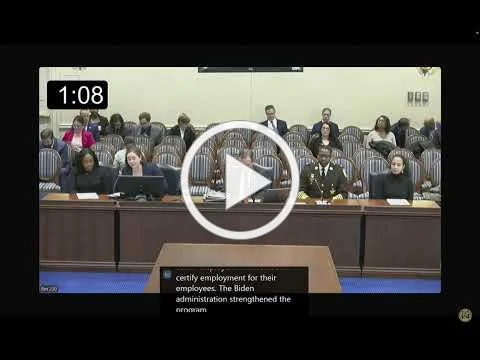
  • Public Service Loan Forgiveness Employment Certification and Awareness (House Bill 795)
  • Introduced by Delegates SpiegelKaiserKaufmanLehmanR. LewisLopezPalakovich CarrTerrasa, and Toles, this bill will make Public Service Loan Forgiveness (PSLF) more accessible to Maryland public service workers. It mandates that a multiplier be used to calculate hours worked for adjunct and contingent faculty, qualifying employers certify employment in a timely fashion, and employers and the Maryland ombuds regularly share information on the PSLF program.
  • On February 13th, SBPC, along with the CASH Campaign of Maryland and the Maryland Center for Collegiate Financial Wellness, testified before the Economic Matters Committee with the sponsor, Delegate Spiegel. The bill received a favorable report from the Committee!


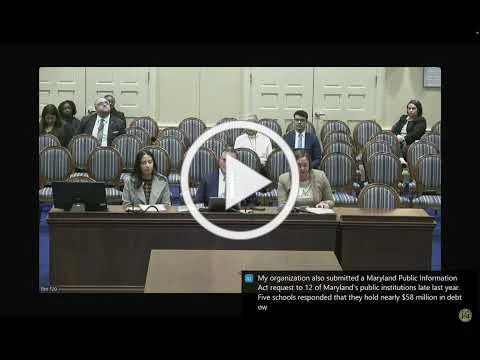
  • Institutional Debt Reporting (House Bill 920)
  • Last week, SBPC testified alongside Maryland Center for Collegiate Financial Wellness and bill sponsor, Delegate Spiegel, on the critical issue of institutional debt. HB 920 would require higher education institutions to report on the institutional debt they hold for things like students’ parking tickets, tuition, and library fees. SBPC released a Maryland-based fact sheet analyzing the results of public information requests sent to 12 schools. Their responses—or lack thereof—were troubling. Records provided by Allegany College of Maryland show that the debt is disproportionately owed by women, Black students, and low-income students. No other school responded to SBPC’s request for data on debt by demographic. Clearly, this bill is needed to protect students!

House Bill 795 Testimony

House Bill 920 Testimony

New Mexico


  • New Mexico Student Loan Borrower Bill of Rights (House Bill 224)
  • The New Mexico Borrower Bill of Rights, introduced by Representatives ChandlerCaballero, and Hochman-Vigil, would create a licensing structure for student loan servicers in New Mexico, provide consumer protections for borrowers with private student loans, and establish an ombuds who can help borrowers and investigate issues at the state level. If enacted, New Mexico would be the 20th state to pass a Borrower Bill of Rights! We are proud to have partnered with New Mexico AFT to keep this bill front and center!


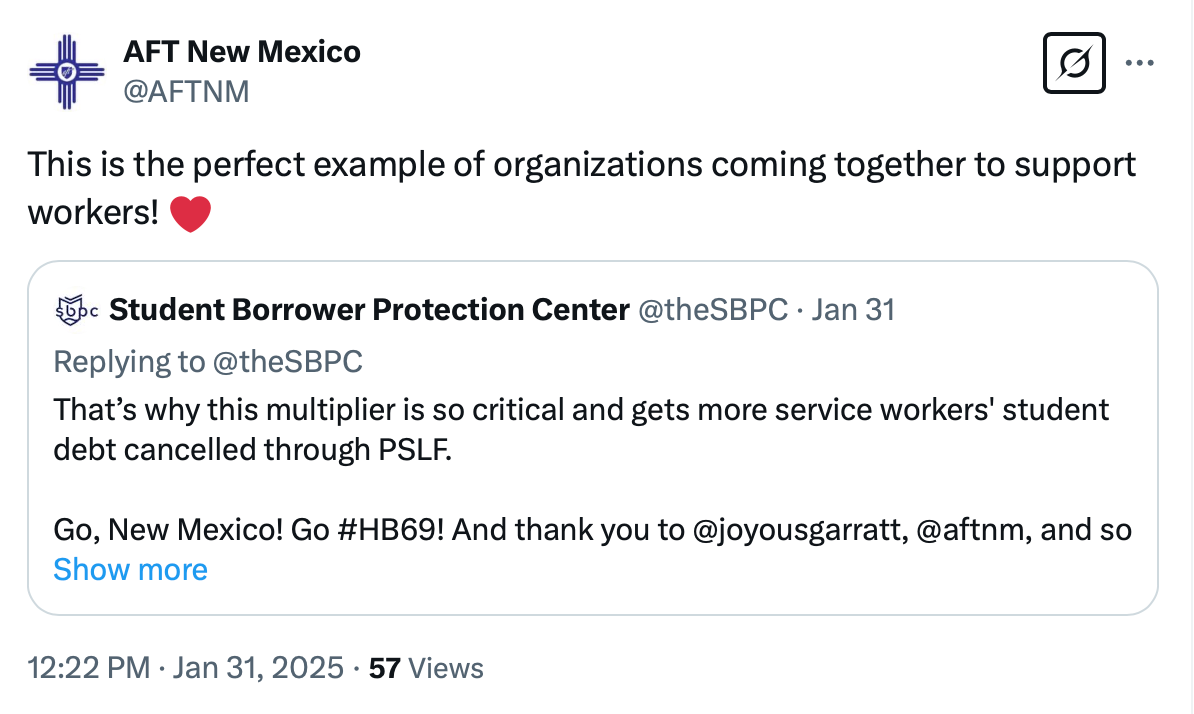
  • Public Service Loan Forgiveness Employment Certification and Awareness (House Bill 69)
  • Like the Maryland bill, HB 69 will make PSLF more accessible to public service workers across New Mexico. Introduced by Representative Garratt and Senator Jaramillo, it requires higher education institutions to use a multiplier when calculating the number of hours of adjunct and contingent faculty work, and it requires that qualifying employers certify employment in a timely fashion and regularly share information on the PSLF program with their employees.
  • This bill passed through the House Government, Elections, and Indian Affairs Committee on January 31st, and passed the House Education Committee last week on February 18th!! We look forward to continuing to work with partners like New Mexico AFT to advance protections for borrowers!

Attacks at the federal level on working families make state and local work like this all the more necessary. States can and must step up to create more protections for borrowers!


Keep calm and TAKE ACTION, 


Amy Czulada

Outreach & Advocacy Manager

Student Borrower Protection Center