Search This Blog

Showing posts sorted by relevance for query militarization. Sort by date Show all posts

Tuesday, August 12, 2025

From Campus to Command: Charlie Kirk’s Push for Martial Law in U.S. Cities

Conservative commentator Charlie Kirk recently made headlines by calling for a full military occupation of American cities following what he terms the “liberation” of Washington, D.C. Speaking on a national platform, Kirk advocated deploying U.S. military forces to urban centers such as Chicago, New York, Boston, Philadelphia, Portland, and San Francisco to restore order amid rising crime and social unrest. He emphasized that a sustained military presence was necessary until these cities were “safe,” drawing comparisons to the low-crime, tightly controlled environments of Tokyo and Singapore.

Kirk’s call is not merely rhetorical; it reflects a growing faction within right-wing politics that endorses the federalization of local law enforcement issues, invoking military force as a tool for domestic order. He also proposed federalizing Washington, D.C., with military oversight — a step he deems essential to restoring law and order in the nation’s capital.

This stance has sparked significant debate over the balance between public safety and civil liberties. Critics warn that deploying military forces in civilian settings risks authoritarian overreach and undermines democratic norms. Supporters, meanwhile, argue that urgent and decisive action is needed in cities they see as suffering from governance failures. The implications of such a military occupation extend beyond crime statistics to the very fabric of American democracy, raising concerns about militarization, racial justice, and the erosion of local governance.

Background on Charlie Kirk and Turning Point USA

Charlie Kirk is the founder and president of Turning Point USA (TPUSA), a conservative nonprofit organization established in 2012. Founded when Kirk was just 18, TPUSA has grown into a powerful network dedicated to promoting free markets, limited government, and conservative values among youth. Financially backed by donors including the late Foster Friess and Home Depot co-founder Bernie Marcus, TPUSA reported revenues exceeding $55 million in 2022.

The organization’s stated mission is to "identify, educate, train, and organize students to promote freedom." However, its campus activities have drawn criticism for compiling “watchlists” targeting left-leaning faculty and spreading misinformation. The Higher Education Inquirer has closely documented TPUSA’s growth, spotlighting its alliances with conservative student chapters, the appearances of controversial figures on its platforms, and its alignment with Trump administration policies. Beyond campuses, TPUSA has expanded through initiatives like TPUSA Faith, TPUSA Live, and the AmericaFest conference series, which have featured speakers such as Donald Trump Jr., Candace Owens, Tucker Carlson, and Marjorie Taylor Greene.

Fox News and the Epstein Fallout: Kirk’s Rising Media Profile

Amid Fox News’ ongoing tensions with Rupert Murdoch’s Wall Street Journal over the Jeffrey Epstein investigative files, Charlie Kirk has been tapped to guest host Fox & Friends Weekend. His appearances on July 27–28, 2025, alongside Rachel Campos-Duffy and Charlie Hurt, signaled a strategic move by Fox News to bolster its conservative youth appeal and MAGA alignment amid internal pressures.

This development follows the Wall Street Journal’s July 2025 investigative report detailing Donald Trump’s past ties with Jeffrey Epstein, including allegations about a hand-drawn birthday card sent to Epstein. Trump has vehemently denied the claims and sued the Journal and Rupert Murdoch for $10 billion, labeling the report defamatory. Fox News, however, has noticeably limited its coverage of the Epstein files and the lawsuit, unlike other right-leaning outlets such as Newsmax and Real America’s Voice.

Kirk has vocally attacked the Journal’s reporting, calling it “fake” and “a hit job” on Trump. He praised Trump’s lawsuit on his podcast and social media platforms, framing the allegations as baseless attempts to tarnish the former president’s reputation. Despite initial criticism of Attorney General Pam Bondi over a DOJ memo regarding the Epstein investigation, Kirk later shifted his position, urging trust in government officials — a reversal that drew attention to the strategic recalibrations within MAGA circles.

Institutional Expansion and Political Influence

TPUSA’s influence extends well beyond college campuses. Through Turning Point Academy, it reaches high schools, while TPUSA Faith engages religious communities. Its political arm, Turning Point Action, spent over $7 million in the 2022 midterms, reflecting significant investment in electoral politics. TPUSA’s 2023 annual report highlights its presence in more than 2,500 schools and training of over 12,000 student activists.

Kirk’s upcoming role on Fox News underscores the merging of youth-oriented conservative political branding with legacy cable television platforms. This integration comes as Fox News attempts to balance the demands of its MAGA base against legal and reputational challenges linked to its corporate ownership. Kirk’s rising profile represents the normalization and institutionalization of organizations like TPUSA within mainstream conservative media.

Charlie Kirk’s calls for military occupation of American cities, coupled with his increasing prominence within conservative media, highlight the evolving landscape of political influence, youth activism, and media power in the United States. As debates intensify over public safety, civil liberties, and the militarization of law enforcement, it is crucial to scrutinize the intersection of political ideology and institutional authority. The implications extend far beyond partisan disputes — touching the core of democratic governance and social cohesion in a deeply divided nation.


Sources:

Axios (July 2025): “Charlie Kirk to co-host Fox & Friends Weekend”
Wall Street Journal (July 2025): “Trump’s Epstein Birthday Card”
IRS Form 990 Filings (TPUSA 2021–2023)
Media Matters: “Fox News Epstein Coverage Analysis”
FEC.gov: Turning Point Action Political Expenditures
Rolling Stone, Puck News (July 2025): Trump’s calls to allies over Epstein story
TPUSA 2023 Annual Report
Higher Education Inquirer Archive (2016–2025): Reports on TPUSA campus activity
Original Article on Charlie Kirk's Military Occupation Call

Tuesday, July 29, 2025

Netanyahu Denies Starvation as Civilians Die at Gaza Food Sites, While U.S. Campuses Suppress Dissent

Israeli Prime Minister Benjamin Netanyahu stated this week that “there is no starvation in Palestine,” contradicting extensive reporting from international aid organizations documenting famine conditions and lethal attacks on civilians at food distribution sites in Gaza.

A May 2025 report by the Integrated Food Security Phase Classification (IPC), a United Nations-supported initiative, found that over 70 percent of Gaza’s population was experiencing catastrophic food insecurity. Nearly 30 percent of children under the age of five were acutely malnourished. The World Food Programme has labeled the crisis a "man-made famine."

On July 20, Doctors Without Borders reported that a drone strike hit near its food and medical site in Khan Younis, killing nine civilians, including three children.

On July 24, the Palestinian Red Crescent Society reported that at least 15 civilians were killed when Israeli forces opened fire near an aid distribution point in Gaza City. The United Nations Relief and Works Agency (UNRWA) confirmed the death of one of its staff members in the incident. 

Despite these conditions, Netanyahu has denied the existence of starvation, and the U.S. government has continued its military and diplomatic support. The United States provides approximately $3.8 billion annually in military aid to Israel, and U.S.-manufactured weapons have been linked to attacks on aid sites. The U.S. has also vetoed or blocked three United Nations Security Council resolutions since October 2023 aimed at enforcing ceasefires or expanding humanitarian access.

Meanwhile, suppression of speech and surveillance on U.S. campuses has escalated. Across dozens of universities, students and faculty who have spoken out against the war in Gaza or criticized U.S. and Israeli policies have faced disciplinary action, police monitoring, and digital surveillance. Peaceful protests and teach-ins have been met with administrative crackdowns, restrictions on student group activities, and, in some cases, expulsions.

At several campuses, private security firms with ties to law enforcement and intelligence agencies have been contracted to monitor student activism. Surveillance tools, including facial recognition and social media tracking software, have been used to identify and target protesters. In many cases, these efforts have been carried out with little or no oversight.

Faculty members who have criticized U.S. foreign policy or supported Palestinian rights have reported threats to job security and tenure, especially in public institutions receiving defense-related research funding. Some have been the targets of smear campaigns and blacklists promoted by outside organizations.

At least 24 U.S. universities maintain partnerships or research contracts with defense contractors such as Lockheed Martin, Raytheon, and General Dynamics—companies whose weapons systems are deployed in Gaza. This financial entanglement has made many administrations unwilling to permit open debate, let alone challenge the broader militarization of U.S. higher education.

These repressive measures raise fundamental questions about the role of the university in a democratic society. When criticism of state violence is policed, and protest against war is surveilled, the campus ceases to function as a space of inquiry and dissent. It becomes, instead, an extension of the national security state.

As civilians are killed while waiting for food and as children die of hunger and infection, the U.S. government and its educational institutions remain enmeshed in systems of silence, denial, and complicity. The suppression of free speech on campus is not peripheral to this crisis—it is part of it.

Sources:
UNRWA Situation Reports, July 2025
World Food Programme Emergency Updates
Integrated Food Security Phase Classification (IPC), May 2025
Palestinian Red Crescent Society, July 2025
Médecins Sans Frontières Field Reports
World Health Organization, Gaza Emergency Briefings
UNICEF Gaza Nutrition Data, July 2025
U.S. State Department Foreign Military Financing Budget, 2024–2025
UN Security Council Voting Records, 2023–2025
Coalition for Civil Freedoms Campus Speech Tracker
Higher Education Inquirer archives on university-defense contractor ties

Monday, July 28, 2025

Empire in Decline: What the Fall of Rome Tells Us About the American Oligarchy

There are tax farmers squeezing a province dry. There are soldiers fighting for the emperor's baton. And then there are a few who dread the empire's fall and dream of the old republic.

This is not just the story of ancient Rome. It's also an apt metaphor for the state of contemporary America—a late-stage empire defined by extreme inequality, militarization, and a governing class that clings to power while the social fabric unravels.

In Rome, the Senate once stood as the heart of the Republic, composed of elite Patrician families who wielded enormous religious, political, and economic influence. But as historian and economist Michael Hudson writes in The Collapse of Antiquity, these elites became entrenched creditors and landlords, a rentier class unwilling to compromise or adapt. They refused debt cancellation, land redistribution, or any reforms that might curb their power—transforming what was once a dynamic, if imperfect, republic into a brittle and parasitic empire.

This refusal to evolve created an unsustainable system. Wealth concentrated in fewer hands. Small farmers and urban workers were crushed under debts. The rural economy collapsed as latifundia (large estates) displaced independent farmers. Military commanders, frustrated with elite gridlock, seized power for themselves. And the Senate, once a genuine force of governance, became a ceremonial shell. What followed was a long descent: civil wars, authoritarianism, economic stagnation, and eventually the re-feudalization of the West.

Hudson’s view is clear: the Roman Senate and elite, by prioritizing their creditor rights over the common good, destroyed the economic base that sustained the Empire. In their greed and rigidity, they ensured the fall they feared.

Now consider the United States. Like Rome, America has become dominated by a professional ruling class: oligarchs, financiers, tenured politicians, credentialed technocrats, and think-tank warriors. Institutions of higher education, once engines of democratic possibility, have increasingly become training grounds for this elite. And like the Roman Senate, they are largely unaccountable—privatizing gains, socializing losses, and suppressing reform.

Just as Roman tax farmers drained the provinces, today’s student loan servicers, for-profit colleges, and hedge fund–backed housing firms squeeze the public to fund private empires. Just as Roman generals became emperors, today’s billionaires and media moguls wield near-sovereign power over public discourse, elections, and foreign policy. And just as the Roman elite clung to legal fictions while society crumbled, our ruling class insists the republic is healthy—even as inequality soars, infrastructure decays, and democratic norms erode.

There are still those who long for a return to the "old republic"—to a time when education was a public good, when civic virtue mattered, and when government sought the common welfare. But those voices are increasingly drowned out in a landscape of imperial spectacle, culture wars, and managed decline.

Hudson reminds us that ancient societies that survived economic collapse—like those in Mesopotamia—did so by recognizing the need for periodic resets. They canceled debts. They redistributed land. They prioritized stability over elite entrenchment. Rome—and perhaps America—refused to learn those lessons.

In this moment of crisis, the choice is stark: will we continue down the path of empire, ruled by debt and extraction? Or will we recover some measure of republic, with institutions that serve people, not just capital?

One thing is certain: empires fall. But their people don’t have to fall with them—if they choose to resist.

Sources:

  • Michael Hudson, The Collapse of Antiquity: Greece and Rome as Civilization's Oligarchic Turning Point, 2023

  • Mary Beard, SPQR: A History of Ancient Rome, 2015

  • Edward Gibbon, The Decline and Fall of the Roman Empire, 1776–1789

  • Kyle Harper, The Fate of Rome: Climate, Disease, and the End of an Empire, 2017

  • Higher Education Inquirer, ongoing coverage on student debt and elite university structures

  • U.S. Department of Education, data on student debt and institutional concentration of resources

Tuesday, December 30, 2025

Higher Education Inquirer nears 2 million views, with more than 1.5 million in 2025

As 2025 draws to a close, Higher Education Inquirer (HEI) is approaching a bittersweet milestone: nearly 2 million total page views since its founding, with more than 1.5 million of those views occurring in 2025 alone. At the same time, HEI will cease operations on January 6, 2026, bringing an end to one of the most independent and critical voices covering higher education in the United States.

The extraordinary growth in readership during 2025 came amid historic disruption across higher education. HEI documented the unraveling of federal oversight, the rise of hyper-deregulation, the expanding reach of for-profit colleges and private equity, and the worsening student debt crisis. These developments drove unprecedented interest from readers seeking analysis that challenged official narratives and corporate messaging.

HEI’s growing audience was fueled not only by comprehensive reporting, but by early warnings that were often ignored by institutions and policymakers. In August 2025, Higher Education Inquirer published a warning about escalating campus violence and political radicalization exactly one month before the Charlie Kirk investigation became public, underscoring the publication’s role as an early-warning system rather than a reactive outlet. That article was part of a broader series examining how extremist politics, lax security, and institutional denial were converging on U.S. campuses.

This foresight extended back further. In early 2024, HEI analyzed Project 2025, highlighting its implications for higher education, civil liberties, and democratic governance. At a time when much of the higher education press treated Project 2025 as speculative, HEI examined its explicit calls for mass deportations, the targeting of immigrants and international students, and the restructuring of federal agencies affecting education, labor, and research. Those warnings now read less like commentary and more like documentation.

HEI’s investigative work extended beyond reporting and analysis. Over the years, the publication submitted dozens of Freedom of Information Act (FOIA) requests to federal and state agencies, uncovering critical data about institutional misconduct, federal oversight failures, and the financialization of higher education. These FOIAs often revealed information that universities and regulators preferred to keep hidden, from financial irregularities to internal policy deliberations affecting students and staff.

Labor reporting was another cornerstone of HEI’s mission. The publication highlighted the struggles of underpaid and overworked faculty, staff, and healthcare workers connected to colleges, drawing attention to systemic exploitation across public and private institutions. Similarly, HEI closely tracked borrower defense to repayment claims, scrutinizing how the Department of Education and loan servicers handled student complaints, debt relief applications, and policy reversals—often exposing bureaucratic dysfunction that had direct consequences for tens of thousands of students.

HEI’s editorial record reflects a consistent effort to connect policy blueprints to real-world consequences before those consequences became headline news. Coverage spanned a vast array of topics, including predatory institutions like the University of Phoenix, Trump-era housing policies, climate change, militarization of campuses, labor exploitation, and the privatization of public institutions. Notable published articles from 2025 include:

Despite its growing influence, HEI’s independence came at a cost. The publication has never been backed by universities, education corporations, or major foundations. A lawsuit involving Chip Paucek became the final breaking point, imposing substantial legal fees that HEI could not absorb. While the publication stood by its reporting, the emotional toll of prolonged legal conflict made continued operations impossible.

Reaching nearly 2 million views—most of them in a single year—is not merely a metric of success; it is evidence that HEI’s work mattered to a wide and engaged audience. As Higher Education Inquirer prepares to shut down, its legacy remains in the thousands of articles that documented institutional abuse, policy failure, and human cost within higher education.

HEI ends not because its mission was fulfilled, but because the structural forces it scrutinized proved difficult to survive. The readership growth of 2025 suggests that the need for independent, adversarial higher education journalism is greater than ever—even as one of its most persistent voices is forced to fall silent.


Sunday, August 24, 2025

The Death of Education Is the Death of Democracy (Henry A. Giroux)

Trump’s War on Memory and Education

Fascism does not only occupy institutions; it occupies memory and views education as a battleground. It dictates what is remembered and what is silenced, ensuring that alternative visions of history and democracy cannot take root.  What must be grasped, if fascism is to be resisted, is that it is not merely a political order but as Ergin Yildizoglu notes is a pedagogical regime, a machinery of teaching and unlearning, of shaping consciousness itself through aesthetics, media, and the algorithmic reach of artificial intelligence. Its pedagogy is one of domination: it scripts emotions, dictates values, and implants narratives that define who must be hated, who must be forgotten, and who must remain invisible.

Fascism does more than capture the state; it colonizes language, memory, and identity. It erases the past by silencing historical memory, narrows the horizons of imagination, and drains public life of critical vitality. It produces subjects who are loyal not to truth but to power, obedient not to conscience but to command. This is the ultimate aim of pedagogical terrorism: not only to militarize the state, knowledge, and values, but to also militarize the mind. By narrowing what can be said, remembered, or imagined, it criminalizes dissent and turns language itself into an arsenal of cruelty. Under Trump, fascism is not only a militarized spectacle, it is a model of war. If fascism is not only a government, a form of gangster capitalism, but also a culture, the fight against it must not only be economic, ideological, but also pedagogical space where education becomes central to politics and culture speaks to individuals in a language in which they can both recognize themselves and organize into a mass movement.

As Antonio Gramsci, in the Prison Notebooks, reminded us, “all politics is pedagogical.” If fascism teaches fear, cruelty, and obedience, then resistance must teach solidarity, critical memory, and the courage to imagine a different future. Against fascism’s pedagogy of dispossession, we must cultivate a pedagogy of liberation—one that expands the field of the possible, restores the dignity of memory, and reclaims language as a weapon for democracy rather than domination.

Democracy cannot survive without memory or it runs the risk of turning itself into an authoritarian state. It requires citizens to confront injustice, to learn from the crimes of the past, and to imagine futures that do not repeat them. William Faulkner’s warning still resonates: “The past is never dead. It’s not even past.”  In America today, history itself has become a battleground. The ghosts of slavery, Jim Crow, and white supremacy remain with us, shaping institutions and social life. As Angela Davis reminds us, we live with these ghosts every day. The real question is whether we choose to acknowledge them, or to erase them. For when a society turns away from its own horrors and promotes forms of historical amnesia, what kind of culture is normalized? What political order emerges from the silence of forgetting? Under Trump, we have already been given a terrifying answer: a society organized around violence: against immigrants, Black people, youth, students, dissidents, women, the unhoused, and all those who fail the regime’s loyalty test to white Christian nationalism.

As sociologist Zygmunt Bauman observed, our times are not marked simply by the fading of collective memory, but by “the aggressive assault on whatever memory remains.” That assault takes the form of book bans, censorship, intimidation of educators, and the replacement of critical history with patriotic myth. Kimberlé Crenshaw has noted that the panic over “critical race theory” was never about pedagogy, it was an attempt to whitewash slavery and racism from the national narrative. The suppression of historical memory produces not only ignorance but moral paralysis. As Robert Jay Lifton warned, erasure of the past creates a psychic numbing, a diminished capacity to feel and act against injustice. Forgetting is never neutral. It is a political strategy. Under the Trump regime it has become a central element in a war against democracy, informed citizens, the truth, and rationality. Put bluntly, it has become a central tool in the weaponization against literacy, knowledge, consciousness, and critical agency.

This is domestic terrorism, rooted not only in incendiary words but in their violent translation into state policy. It is the organized weaponization of fear, the calculated deployment of intimidation and cruelty to hollow out democratic life and silence dissent. It is a deliberate assault on citizens, on institutions, and on every idea that refuses to bow before authoritarian power. As John Ganz observes, under Trump, citizenship ceases to be an inalienable right; it becomes a conditional prize, a privilege dispensed at will. In Trump’s hands, it is both gift and bludgeon, “a transferable and revocable commodity,” bestowed on the loyal and withheld or revoked from the condemned. Wielded as a threat, it enables the regime to deport, to banish, to resurrect the ancient horror of statelessness, expelling individuals not only from the nation but from humanity itself. In this sense, Ganz is right: Trump’s assault on citizenship is not merely reactionary; it bears the unmistakable mark of fascism, the totalitarian logic that decides who counts as human and who may be erased. 

Appropriating Achille Mbembe’s notion of  necropolitics, domestic terrorism is where political power thrives by reducing human life to disposable, expendable objects. Under the Trump regime, this takes the form of a violent, racialized project that merges capital accumulation with the subjugation of marginalized groups. His policies—driven by a toxic mix of racial hierarchy, xenophobia, and the celebration of violent histories—create a society where certain lives are deemed unworthy of protection or consideration. This regime operates on a death drive, relentlessly attempting to eliminate both the lives and futures of those who resist or defy its vision. In this environment, the space for dissent shrinks, historical amnesia thrives, leaving only room for those willing to submit to the dominance of a fascist, authoritarian regime.

This war on memory is not just theoretical; it takes concrete form in the attacks on institutions that hold our collective history. Under Donald Trump and the MAGA movement, memory, let alone history itself, is under siege. What we face is not neglect but an orchestrated assault fueled by a systemic violence of forgetting, and the whitewashing of the past that echoes the darkest traditions of fascism. For Trump, any reckoning with slavery, Jim Crow, or the long arc of racial violence is treated as an unforgivable stain on America’s story. Equally intolerable are the histories of resistance, by workers, Black communities, women, immigrants, and LGBTQ people, all of which he and his allies disparage as “woke” ideology. As journalist Dean Blundell recently observed, “In recent days, he has attacked the Smithsonian Institution as ‘out of control,’ insisting its museums focus too much on ‘how bad slavery was.’ His administration has ordered a 120-day review of eight Smithsonian museums and hinted that funding could be used as leverage to ‘get the woke out.’ The message lands with the subtlety of a hammer: make the story brighter, or else. This is not a debate about one label or a curatorial tone. It’s an attempt to police memory.” The policing of history is not incidental; it is central to Trump’s authoritarian project and nowhere is this clearer than in his attack on the Smithsonian.

Censoring the Smithsonian

In March 2025, Trump signed an executive order targeting the Smithsonian Institution, declaring its exhibits were corrupted by “improper ideology.” Trump argued that the “Smithsonian museums were ‘out of control’ and “painted the country in a negative light, including about slavery.” The language of the order feigned neutrality, but the intent was unmistakably authoritarian: to sanitize the nation’s cultural memory. For Trump, As the White House “focused on seven museums for their exhibits and messaging,” the chilling effect was immediate. References to Trump’s two impeachments quietly vanished from an exhibit on the “Limits of Presidential Power.” What had been a straightforward record of checks on executive abuse was erased in real time, as though history itself could be made to serve the whims of power.

This was no isolated act of censorship. Trump has repeatedly sought to bend the past to his will, recasting the violent January 6th insurrectionists as “hostages,” stripping diversity and equity programs of content that celebrated Black history, and encouraging allies to push bills that would defund schools for teaching that the nation’s founding documents were entangled with slavery. The thread binding these assaults together is clear: the authoritarian logic of erasure. Memory is to be disciplined, history domesticated, truth is subordinated  to the spectacle of Trump’s political theater. What is at stake is not simply the content of museum exhibits or school curricula, it is whether democracy itself can survive without an honest reckoning with its past. As history warns us, fascist regimes--from Hitler’s book burnings to Franco’s cultural purges--have always begun their reign of terror by waging war on memory. The thread uniting these efforts is the logic of erasure: history must serve power, never truth.

From Nazi Germany to Trump’s America

The Trump era’s assault on memory recalls, in chilling ways, the memory politics of Nazi Germany. In 1933, Nazi officials staged massive book burnings, consigning to the flames the works of Jewish authors, feminists, Marxists, and anyone deemed “un-German.” These were not just acts of censorship, they were spectacles of purification. Fire was the ritual through which dissent was eradicated and mythic unity forged. Schools and universities were purged of Jewish and oppositional voices, textbooks rewritten, and history recast as propaganda for the racial state.

The United States has not replicated those bonfires, but the spirit is unmistakable. Books by Toni Morrison, James Baldwin, and Margaret Atwood are being pulled from libraries. Governors stage press events around banned books, turning censorship into political theater. Viral videos of parents denouncing “divisive concepts” in classrooms circulate widely, feeding the illusion that banning history is an act of protection.

The attack on the Smithsonian, the banning of books, the silencing of universities, and the stigmatization of “woke” as a code word for racial justice and historical truth all make visible how white supremacy fuels the cleansing project of authoritarianism. The assault on memory and historical consciousness connects strongly with a wider pedagogy of repression and the attempts on the part of MAGA ideologues to turn public and higher education into crude laboratories of indoctrination. In one particular instance, this  project takes a  particularly grotesque form, as with Oklahoma’s Ryan Walters requiring applicants from “liberal states” to pass an anti-woke test before teaching. These assaults on memory are also an assault on critical thinking, critical pedagogy, and civic literacy. It is crucial to view them as anything but isolated. They are part of a systematic effort to weaponize education, culture, and memory to manufacture a fascist subject, passive, obedient, and stripped of critical thought. Primo Levi warned that “wherever you begin by denying the fundamental liberties of mankind and equality among people, you move towards the concentration camp system.” Forgetting, he argued, is the first step toward barbarism. The lesson of Nazi Germany is that erasing memory is not collateral to authoritarianism, it is central to it.

Conclusion:  The burden of memory and the centrality of education to politics

At the heart of Trump’s war on memory lies an act of pedagogical terror, a poisoning of history and the transformation of culture into a blunt instrument of indoctrination. To resist this death of memory is to recognize that the fight for democracy cannot be separated from the fight over history, over culture, and over the economic forces that shackle both under gangster capitalism. To defend truth is to defend freedom; to erase history is to pave the road to authoritarianism. Trump’s censorship of the Smithsonian, his bans on books, and his whitewashing of slavery are not mere cultural disputes. They are weapons aimed at the very life of democracy. Culture is never simply a mirror of society; it is a battlefield that shapes how we imagine the world and our place within it. In a time when neoliberalism and fascism bleed into each other, culture becomes the decisive ground where narratives of domination collide with possibilities of resistance. Authoritarians seek to turn it into a machinery of obedience, silencing dissent and numbing consciousness. Yet culture also holds the fragile, indispensable power to ignite memory, nourish critical thought, and keep alive the hope of resistance.

At the heart of this project lies a war over culture and consciousness.  Antonio Gramsci, in the Prison Notebooks, warned that every political struggle is also a struggle over pedagogy, over who shapes the common sense of a society. Paulo Freire reminded us that education is never neutral--it either nurtures liberation or reinforces domination. Trump’s pedagogy of repression seeks nothing less than a populace severed from memory, stripped of critical thought, and rendered compliant to authoritarian power. What is at stake is not simply the narcotic of censorship and erasure, but the calculated use of state terrorism to fashion a fascist subject, anti-intellectual, morally hollow, obedient to authority, and emptied of democratic agency. The United States has become a warfare state, where the instruments of militarization and the machinery of control no longer remain at the edges of empire but are turned inward, disciplining culture, stifling memory, and colonizing everyday life under the banner of “law and order.” What once was unleashed abroad in the name of empire now circulates within, producing citizens as enemies and culture itself as a battlefield. War should be a warning; under Trump it has become theater, a grotesque spectacle where cruelty parades as civic virtue.

If democracy is to endure, memory must be defended with the same ferocity as freedom itself. Yet remembrance alone is not enough. What is required is a critical culture that binds past and present, a pedagogy that transforms historical consciousness into collective action. The ghosts of Auschwitz, of Jim Crow, of January 6th, remain with us, not as abstractions but as urgent reminders of the abyss that awaits when memory is erased. Our responsibility is to teach, to narrate, and to reimagine, so that memory itself becomes an act of resistance. Only by turning remembrance into struggle can we block the return of barbarism and reclaim democracy as a living, unfinished experiment in freedom. Only through mass movements of organized resistance can we dismantle the machinery of ignorance, disposability, and death that now threatens the remnants of American democracy.

In the end, culture remains the decisive ground where radical democracy either withers under authoritarian rule or is reborn as the terrain of resistance and hope. What is clear is that the Trump regime does not merely flirt with fascism, it embodies it, hurling the United States over the abyss. And that abyss stretches far beyond American borders. Trump arms Netanyahu, an indicted war criminal who wages genocide against the Palestinian people with impunity; he aligns himself with dictators like Russia’s Vladimir Putin, India’s Narendra Modi, Argentina’s Javier Gerardo Milei, El Salvador’s Nayib Bukele, and others who traffic in repression, violence, and cruelty. The warfare state is drenched in blood. Resistance is no longer a choice; it is a necessity that sears the conscience, demanding action.

Charlotte Delbo, an Auschwitz survivor, pleaded in A Prayer to the Living to Forgive Them for Being Alive: “You who are passing by, I beg you, do something…to justify your existence…because it would be too senseless after all for so many to have died while you live doing nothing with your life.” Her words reverberate through time, transcending the horrors of a specific moment in history, and call us to a moral reckoning we cannot ignore. The choice before us is unambiguous: silence or resistance, complicity or memory, barbarism or democracy. The weight of this decision cannot be overstated. The time to act is now, for what is at stake is not just our collective humanity, but the very survival of democracy itself.

Tuesday, December 16, 2025

Violence, Safety, and the Limits of Campus Security: From MIT to Brown and Beyond

The Monday killing of MIT professor Nuno F.G. Loureiro at his home in Brookline, Massachusetts has shaken the academic community and reinforced a troubling reality already examined in Higher Education Inquirer’s recent reporting on campus safety and mental health: violence affecting higher education in the United States is neither isolated nor confined to campus boundaries.

Loureiro, a Portuguese-born physicist and internationally respected scholar in plasma science and fusion research, was a senior leader at MIT and director of its Plasma Science and Fusion Center. His death occurred off campus, yet it reverberated powerfully within higher education because it underscores how scholars, students, and staff exist within a broader national environment shaped by widespread gun violence, strained mental-health systems, and limited preventive safeguards.

Authorities have confirmed the incident as a homicide. At the time of writing, no suspect has been publicly identified, and investigators have released few details about motive. The uncertainty has compounded the shock felt by colleagues, students, and international collaborators who viewed Loureiro as both a scientific leader and a deeply committed mentor.


A Pattern, Not an Anomaly

Loureiro’s killing followed a series of violent incidents tied to U.S. college campuses throughout 2025, reinforcing that these events are not aberrations but part of a broader pattern.

Just days earlier, a deadly shooting at Brown University left two students dead and several others wounded when a gunman opened fire in an academic building during final exams. The attack disrupted campus life, forced lockdowns, and exposed vulnerabilities in building access and emergency response procedures.

Earlier in the year, Florida State University experienced a mass shooting in a heavily trafficked campus area, resulting in multiple fatalities and injuries. The suspect, a student, was taken into custody, but the psychological impact on students and faculty persisted long after classes resumed.

At Kentucky State University, a shooting inside a residence hall claimed the life of a student and critically injured another. The alleged shooter was not a student but a parent, underscoring how campus violence increasingly involves individuals with indirect or external connections to institutions.

In September 2025, violence took an explicitly political turn when Charlie Kirk, founder of Turning Point USA, was assassinated during a public speaking event at Utah Valley University. Kirk was shot during a large outdoor gathering attended by thousands. The killing, widely described as a political assassination, was unprecedented in recent U.S. campus history and raised urgent questions about security at high-profile events, free expression, and political polarization within academic spaces.

Together, these incidents — spanning elite private universities, public flagship institutions, regional campuses, and HBCUs — illustrate how violence in higher education now crosses institutional type, geography, and purpose, from classrooms and residence halls to public forums and nearby neighborhoods.


The Limits of Traditional Campus Safety Models

HEI’s recent analysis of U.S. campus safety emphasized a central tension: colleges and universities rely heavily on reactive security measures — armed campus police, surveillance infrastructure, emergency alerts — while underinvesting in prevention, mental-health care, and community-based risk reduction.

The events of 2025 highlight the limitations of these approaches. Even well-resourced institutions cannot fully secure campus perimeters or prevent violence originating beyond institutional control. Nor can security infrastructure alone address the social isolation, untreated mental illness, ideological extremism, and easy access to firearms that underlie many of these incidents.

Federal compliance frameworks such as the Clery Act prioritize disclosure and reporting rather than prevention. Meanwhile, the expansion of campus policing has often mirrored broader trends in U.S. law enforcement, raising concerns about militarization without clear evidence of improved safety outcomes.


Violence Beyond Active Shooters

While mass shootings and assassinations draw national attention, they represent only one part of a wider landscape of harm in higher education. HEI has documented other persistent threats, including hazing deaths, sexual violence, domestic abuse, stalking, false threats that provoke armed responses, and institutional failures to protect vulnerable populations.

Mental health remains a critical and often neglected dimension. Many acts of campus-related violence intersect with untreated mental illness, financial stress, academic pressure, and inadequate access to care — conditions exacerbated by rising tuition, housing insecurity, and uneven campus support systems.

For international students in particular, exposure to U.S. gun violence and emergency lockdowns can be deeply destabilizing, challenging assumptions about safety that differ sharply from conditions in other countries.


An Urgent Moment for Higher Education

The deaths of individuals such as Professor Loureiro and Charlie Kirk, alongside students at Brown, Florida State, and Kentucky State, underscore a central truth: American campuses do not exist apart from the society around them. No amount of prestige, branding, or technology can fully insulate higher education from national patterns of violence.

For administrators and policymakers, the lesson is not simply to harden security, but to rethink safety holistically — integrating physical protection with mental-health infrastructure, transparent accountability, community engagement, and policies that address deeper cultural and structural drivers of violence.

As Higher Education Inquirer has argued, campus safety is inseparable from broader questions of public health, social policy, and institutional responsibility. Without sustained attention to these connections, tragedies across U.S. campuses will continue to be framed as shocking exceptions rather than symptoms of a deeper and ongoing crisis.


Sources

Associated Press reporting on the MIT professor killing
Reuters coverage of campus shootings in 2025
Reporting on the Brown University shooting
Coverage of the Florida State University shooting
Reporting on the Kentucky State University residence hall shooting
PBS NewsHour and national reporting on the Charlie Kirk assassination at Utah Valley University
Higher Education Inquirer – Understanding U.S. Campus Safety and Mental Health: Guidance for International Students

Sunday, June 8, 2025

Trump deploys National Guard amid Los Angeles immigration protests (CNN)

In a stunning escalation that has drawn comparisons to authoritarian crackdowns, former President Donald Trump has ordered 2,000 California National Guard troops into Los Angeles to quell protests sparked by ICE raids across the region. Despite opposition from California Governor Gavin Newsom and local officials, Trump bypassed state authority by invoking federal powers under Title 10 of the U.S. Code—stopping short of the more drastic Insurrection Act but still raising serious constitutional questions.

The protests began after ICE agents detained dozens of individuals in workplace raids across South L.A. County. The response from the public was immediate and fierce, with large demonstrations erupting near ICE facilities and federal buildings. As tensions grew, federal officers deployed tear gas and non-lethal weapons against demonstrators, while arrests mounted and reports of detainee mistreatment surfaced.

What makes this moment particularly alarming is the way Trump has redefined protest as “rebellion,” authorizing military support for federal law enforcement without a state request. Defense Secretary Pete Hegseth has even threatened to deploy active-duty Marines from Camp Pendleton—a move unseen since the 1992 Rodney King unrest. Legal experts and civil rights advocates have sounded the alarm, calling the federal takeover of California's National Guard unprecedented and chilling.

The implications for higher education, especially for undocumented and mixed-status students, are profound. Campuses in Southern California are already on edge, with many students fearing ICE presence and military escalation. Faculty and staff in sanctuary campuses and immigrant advocacy networks warn that the militarization of civil immigration enforcement could further chill free speech, academic freedom, and student organizing.

Law professors like Erwin Chemerinsky have warned that Trump’s actions bypass both precedent and constitutional norms: “It is using the military domestically to stop dissent.” Georgetown’s Steve Vladeck noted that the National Guard’s role may technically be limited to support functions, but the symbolism and real-world consequences of armed troops on city streets are undeniable.

Trump’s invocation of rebellion in response to protest mirrors earlier moments of U.S. history where power was used to silence dissent. But this time, it is playing out amid a polarized political landscape, weakened democratic institutions, and a rising authoritarian movement—with the academy, once again, caught in the crossfire.

As protests continue, California’s colleges and universities—long sites of political activism—face renewed pressure. The presence of federal troops, surveillance, and threats of repression may signal a dangerous new phase in the government’s approach to dissent. What was once unthinkable is becoming reality: a nation where protesting immigration raids can be construed as rebellion, and soldiers patrol streets not in a time of war, but in a time of political theater.


Wednesday, September 17, 2025

Pedagogies of Repression: Ford, Trump and the War on Education (Henry A. Giroux and William Paul)

Analyses of fascism too often fixate on its most spectacular expressions: staggering inequality, systemic racism, the militarization of daily life, unbridled corruption, monopolistic control of the media, and the concentration of power in financial and political elites. Fascism thrives on a culture of fear and racial cleansing and the normalization of cruelty, lies, and state violence. Yet what is often overlooked is how culture and education now function as decisive forces in legitimating these authoritarian passions and in eroding democratic commitments. As Hannah Arendt, Jason Stanley, Richard Evans, Chris Hedges, and others remind us, the protean origins of fascism are never fully buried; they return in altered and often disguised forms, seeping into everyday life and reshaping the common sense of a society.

Under US President Donald Trump, we face a terrifying new horizon of authoritarian politics: the erosion of due process, mass abductions, vicious attacks on higher education, and the steady construction of a police state. Canada has not yet descended into such full-fledged authoritarianism, but troubling echoes are undeniable. Public spaces and public goods are under assault, book bans have appeared in Alberta, languages of hate increasingly target those deemed disposable, the mass media bends to corporate interests, labour is suppressed, and democratic values are met with disdain. These may not replicate the worst horrors of the past, but they reveal how culture and education become the terrain upon which democracy is dismantled and authoritarianism gains legitimacy. These are warning signs of a gathering darkness that must be confronted before they harden into something far more sinister.
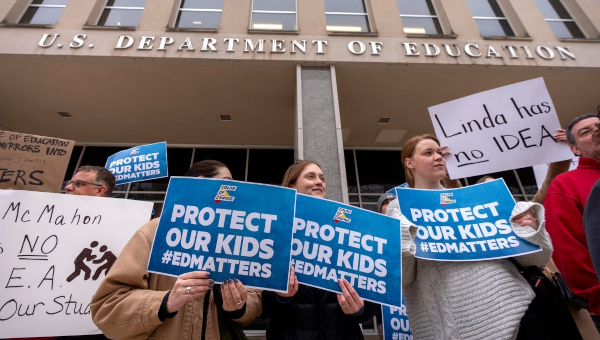
Culture and Pedagogy

Fascism thrives not only on brute police power, prisons, or economic violence but also on culture and pedagogy. Culture has increasingly become a site in the service of pedagogical tyranny. It works through erasure and repression, through memory stripped of its critical force, and through dissent silenced in the name of order. Fascism is never solely a political or economic system; it is a pedagogical project, a machinery of teaching and unlearning that narrows the horizon of what can be said, imagined, or remembered.

Today authoritarianism seeps insidiously into everyday life, embedded in seemingly obvious maneuvers that consolidate power under the guise of technical or bureaucratic necessity. Its mobilizing passions often emerge unobtrusively in maneuvers that hide in the shadows of the mundane, often at the level of everyday experience.

This creeping logic is starkly visible in Ontario, where Doug Ford’s Progressive Conservative (PC) government has moved to seize control of local school boards. What may look like routine administrative measures should be read as a warning: authoritarianism does not arrive only with grandiose spectacles or open attacks on democracy’s foundations; it gains ground quietly, through the erosion of the ordinary, the capture of the local, and above all, through the weaponization of education as a tool to dismantle democracy itself.

The Ford government’s seizure of the Toronto, Toronto Catholic, Ottawa-Carleton, and Dufferin-Peel Catholic district school boards is extraordinary, even for this democracy-averse regime. Education Minister Paul Calandra has even mused about eliminating trustees altogether before the 2026 local elections, declaring “Everything is on the table.” His justification that Ontario’s Ministry of Education (MOE) has allowed them to make too many decisions on their own is both unsupported and revealing. It exposes a deeper authoritarian project: the desire to centralize power and strip away democratic oversight from institutions closest to local communities. It curbs liberal instincts of trustees who see first-hand the vast diversity of lives and needs of the families who rely on their schools.

This is precisely how authoritarian control operates: by eroding intermediary structures that connect people to power. Just as Donald Trump sought to bend national cultural institutions like the Smithsonian Museum to his will, Ford dismantles the modest democratic functions of trusteeship. Both cases illustrate how authoritarianism works through the fine print of governance as much as through grandiose pronouncements.

Manufactured Deficits and Structural Starvation

The pretext for takeover was financial mismanagement. Yet none of the investigators found evidence of serious fiscal incompetence. The truth is that boards submitted balanced budgets year after year but only after slashing programs and services, closing outdoor education centres, selling property, cutting staff, and raising fees. What really drives their fiscal crises is a decades-old funding model – first imposed by the Mike Harris PC government in 1997 – that shifted resources from local taxes to provincial grants. This was not a move toward equitable funding; these were neoliberals of the first order who believed in central control of funding so they could squeeze school boards and education workers to contain costs.

This model, based on enrolment rather than actual need, starved boards of resources for special education, transportation, salaries, and infrastructure.1 For instance, school boards don’t get funding for actual children who need special education support but rather on the basis of a predictive model MOE devised. Boards pay for the kids MOE doesn’t fund. The Ford government hasn’t funded the full increase for statutory teacher benefits for years, leaving boards short by millions. The result is a structural deficit: chronic underfunding that leaves even well-managed boards teetering on insolvency. The Ford government, while claiming to increase spending, has in fact cut funding per student by $1,500 in real terms since 2018. This is the problem faced by with 40 percent of Ontario school boards.

It is this manufactured insolvency that led Minister Calandra to get the most out of a useful crisis and put the four school boards under supervision and maybe next eliminate all school boards in the province. Here we see neoliberal austerity converging with authoritarian ambition. Underfunding is not a policy mistake; it is a deliberate strategy to weaken public education, undermine trust in democratic institutions, and prepare the ground for privatization schemes such as vouchers and charter schools. In this instance, the policy of underfunding is a way of weakening public education and then blaming whatever problems occur on education itself. This is gangster capitalism at work, cloaked in the language of fiscal responsibility but fueled by a pedagogy of dispossession.

Eliminating Trustees, Silencing Communities

If board takeovers were simply about money, supervisors would have been told to just find savings. Instead, elected trustees were suspended, their offices shuttered, their tiny stipends cut off, and their ability to communicate with constituents forbidden. Calandra’s power grab has all the elements of Elon Musk’s DOGE assaults in the US: move fast, offer absurd excuses, and blame the victims. The supervisors replacing trustees – accountants, lawyers, and former politicians with no background in education – now wield greater power than the elected community representatives they displaced.

This substitution of technocrats for democratically accountable representatives is part of fascism’s pedagogy. It teaches the public to accept disenfranchisement as efficiency, to see obedience as order. Parents who ask why a program disappeared or why their child’s special education class has grown larger are now met with silence. In this vacuum, the lesson learned is that participation is futile and resistance meaningless – precisely the kind of civic numbing oligarchic fascism requires.

Command, Control, and the Policing of Education

Ford’s government frames these takeovers as a “broader rethink” of governance, but the real project is clear: the imposition of command and control over education. This move sends a strong message that it’s time to duck our heads and get back to basics: teaching “reading, writing, spelling, and arithmetic and the whole shebang…” as Doug Ford complained last fall after teachers and students attended a rally in support of the Grassy Narrows First Nation and its efforts to deal with generations of mercury contamination in their area. He proclaimed, with no evidence, that the field trip was “indoctrination” by teachers because activists protesting Israeli genocide were present. Community members who supported an Indigenous curriculum, modern sexual education, or even school-name changes honoring anti-colonial figures are dismissed or painted as obstacles. The message from Ford and Calandra is blunt: stick to the basics – reading, writing, arithmetic – and leave politics at the door.

Yet politics hangs over classrooms like a shroud. Despite his Captain Canada complaints about the Trump tariffs, Ford admires the President quick-marching America toward fascism. In an off-mic moment he commented recently: “Election day, was I happy this guy won? One hundred per cent I was.” It’s not the racism, the authoritarianism, the compulsive lying, the fraud, the sexual assaults that bothers the Premier; it’s that he got stiffed by his friend.
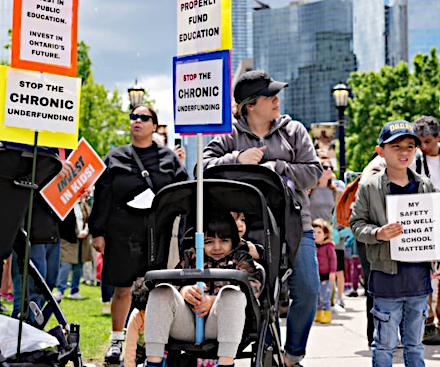
Usurping trustees according to University of Ottawa professor Sachin Maharaj is just another step toward the Progressive Conservatives’ goal to “squelch the pipeline of more progressive leaders”2 like those gaining notice and experience attending to the needs of local schools.

The banning of the Toronto Muslim Student Alliance’s screening of the film No Other Land, which documents Israeli settler violence, shows how censorship now masquerades as neutrality. This is the pedagogy of repression in action: narrowing what can be taught, remembered, or discussed until education is reduced to obedience training. What parades as a “broader rethink” is part of the authoritarian language of censorship and control. Like Trump’s attacks on “critical race theory” or his censorship of the Smithsonian, Ford’s moves are not about protecting students from politics but about protecting power from critique. The real issue here is constructing authoritarian policies that narrow critical thinking, teacher autonomy, essential funding, and knowledge that enable schools to both defend and facilitate democracy.

For Ford and his adherents, the real issue is not that schools are failing but that they are public and have a vital role to play in a democracy. The real threat to Ford is that a democracy can only exist with informed citizens. Yet that is precisely the role education should assume.

Bill 33: Codifying Authoritarianism

The perversely named Bill 33, the Supporting Children and Students Act extends this authoritarian logic. It allows the Minister to investigate boards or trustees on the mere suspicion they might act “inappropriately” or against the “public interest” – an elastic phrase that grants unchecked power. It checks much-maligned Diversity Equity and Inclusion efforts by refusing boards the right to name schools, forcing them to abandon diversity-affirming figures in favor of colonial or sanitized names. It mandates the reintroduction of police officers into schools, despite community opposition to surveillance and “unaccountable access to youth by cops.”3

At work here is the legacy of colonialism, a legacy that is terrified of diversity, of those deemed other, being able to narrate themselves. Viewed as threat, this anti-democratic language ultimately falls back on issues of control and security. This is one instance of how authoritarianism consolidates itself, not through tanks in the streets but through legislation that transforms education into an arm of the security state. Pedagogical spaces are militarized, memory is policed, and students are taught that surveillance is normal and dissent dangerous.

Trumpasitic Authoritarianism

Ford’s methods echo those of his southern counterpart. Just as Trump’s politics thrive on dispossession, erasure, and the weaponization of culture, Ford borrows from the same authoritarian playbook. The takeover of school boards not only tightens political control but also grants easy access to billions of dollars in public land, enriching developers tied to his government.4 Here, neoliberal profiteering fuses seamlessly with authoritarian centralization, an example of the merging of gangster capitalism with the pedagogy of repression.

What do you expect from a government that makes decisions reflecting the arrogance of power? The Ford government cut Toronto city council in half soon after took office in 2018 and threatened to use a constitutional override, the Notwithstanding Clause, Section 33 of Canada’s Charter of Rights and Freedoms, to overturn a Superior Court justice’s decision that the move was unconstitutional. Ford actually used the clause to push through a bill restricting election advertising in 2021 and again, pre-emptively, in 2022, buttressing back-to-work legislation against striking public workers, among the lowest paid in the province. He’s considering using it again after his decision to remove bike lanes from Toronto streets was overturned in court; power makes you petty.

Democracy in the Smallest Details

The takeover of Ontario school boards may appear less dramatic than Trump’s assaults on national institutions, but its implications are just as dire. Authoritarianism advances not only through spectacle but through the slow erosion of local democratic practices that once seemed secure.

If fascism is a pedagogy of fear, amnesia, and conformity, then resistance must be a pedagogy of memory, solidarity, and imagination. To defend education is to defend democracy itself, for schools are not simply sites of instruction but laboratories of citizenship, places where young people learn what it means to speak, to question, to remember, and to act. When trustees are silenced, when curricula are censored, when communities are stripped of their voice, what is lost is not only oversight but the very possibility of democratic life.

What is at stake, then, is far larger than budget shortfalls or bureaucratic reshuffling. It is whether the future will be governed by communities or dictated from above by those who mistake obedience for learning and silence for peace. Fascism thrives in these small erasures, in the details that seem technical until they harden into structures of domination.

The lesson could not be clearer: democracy dies in increments, but it can also be rebuilt in increments – through collective memory, through civic courage, through the refusal to allow education to become a weapon of obedience. To resist the Ford government’s authoritarian incursions is not only to protect local school boards; it is to reclaim the very ground on which democratic hope stands. •

Endnotes

  1. Dan Crow, The Consequences Of A Neoliberal Funding Formula, Canadian Centre for Policy Alternatives, Fall/Winter 2018.
  2. Sachin Maharaj, Interview August 26, 2025
  3. Andrea Vásquez Jiménez, Interview June 7, 2025.
  4. William Paul, “Riding the Gravy Train” in Against the People: How Ford Nation is Dismantling Ontario, eds: Brian Evans, Carlo Fanelli, Fernwood Publishing, 2024.

Henry A. Giroux currently is the McMaster University Professor for Scholarship in the Public Interest and The Paulo Freire Distinguished Scholar in Critical Pedagogy. His most recent books include The Violence of Organized Forgetting (City Lights, 2014), Dangerous Thinking in the Age of the New Authoritarianism (Routledge, 2015), coauthored with Brad Evans, Disposable Futures: The Seduction of Violence in the Age of Spectacle (City Lights, 2015), and America at War with Itself (City Lights, 2016). His website is henryagiroux.com.

William Paul is editor of School Magazine website.

This article first appeared at the Social Project Bullet