Search This Blog

Showing posts sorted by relevance for query neoliberal. Sort by date Show all posts

Monday, November 17, 2025

Neoliberalism and the Global College Meltdown

Over the past four decades, neoliberalism has reshaped higher education into a market-driven enterprise, producing what can only be described as a global College Meltdown. Once envisioned as a public good—a tool for civic empowerment, social mobility, and national progress—higher education in the United States, the United Kingdom, and China has been transformed into a competitive market system defined by privatization, debt, and disillusionment.

The United States: From Public Good to Profit Engine

Nowhere has neoliberal ideology had a more devastating effect on higher education than in the United States. Beginning in the 1980s, with the Reagan administration’s cuts to federal grants and the expansion of student loans, higher education funding shifted from public investment to individual burden. Universities adopted corporate governance models, hired armies of administrators, and marketed education as a private commodity promising personal enrichment rather than collective advancement.

The results are visible everywhere: tuition inflation, student debt exceeding $1.7 trillion, and the proliferation of predatory for-profit colleges. Elite universities transformed into financial behemoths, hoarding endowments while relying on contingent faculty. Meanwhile, working-class and minority students were lured into debt traps by institutions that promised upward mobility but delivered unemployment and despair.

The U.S. College Meltdown—a term that describes the system’s moral and financial collapse—is a direct consequence of neoliberal policies: deregulation, privatization, and austerity disguised as efficiency. The profit motive replaced the public mission, and the casualties include students, adjuncts, and the ideal of education as a democratic right.

The United Kingdom: Marketization and Managerialism

The United Kingdom followed a similar trajectory under Margaret Thatcher and her successors. The introduction of tuition fees in 1998 and their tripling in 2012 marked the formal triumph of neoliberal logic over public investment. British universities became quasi-corporate entities, obsessed with league tables, branding, and global rankings.

The result has been mounting student debt, declining staff morale, and a hollowing out of intellectual life. Faculty strikes over pensions and pay disparities underscore a deeper crisis of purpose. Universities now function as rent-seeking landlords—building luxury dorms for international students while cutting humanities departments. The logic of “student-as-customer” has reduced education to a transaction, and accountability has been redefined to mean profit margin rather than social contribution.

The UK’s College Meltdown mirrors that of the U.S.—a story of financialization, precarious labor, and the erosion of public trust.

China: Neoliberalism with Authoritarian Characteristics

At first glance, China seems to defy the Western College Meltdown. Its universities have expanded rapidly, producing millions of graduates and investing heavily in research. But beneath this apparent success lies a deeply neoliberal structure embedded in an authoritarian framework.

Since the 1990s, China’s higher education system has embraced competition, rankings, and market incentives. Universities compete for prestige and funding; families invest heavily in private tutoring and overseas degrees; and graduates face a saturated labor market. The result is mounting anxiety and unemployment among young people—known online as the “lying flat” generation, disillusioned with promises of meritocratic success.

The Chinese model fuses state control with neoliberal marketization. Education serves as both an instrument of national power and a mechanism of social stratification. In this sense, China’s version of the College Meltdown reflects a global truth: the commodification of education leads to alienation, regardless of political system.

A Global System in Crisis

Whether in Washington, London, or Beijing, the pattern is strikingly similar. Neoliberalism treats education as an investment in human capital, reducing learning to a financial calculation. Universities compete like corporations; students borrow like consumers; and knowledge becomes a tool of capital accumulation rather than liberation.

This convergence of economic and ideological forces has created an unsustainable higher education bubble—overpriced, overcredentialized, and underdelivering. Across continents, graduates face debt, underemployment, and despair, while universities chase rankings and revenue streams instead of justice and truth.

Toward a Post-Neoliberal Education

Reversing the College Meltdown requires more than reform; it demands a new philosophy. Public universities must reclaim their civic mission. Education must once again be understood as a human right, not a private investment. Debt forgiveness, reinvestment in teaching, and democratic governance are essential first steps.

Neoliberalism’s greatest illusion was that markets could produce wisdom. The College Meltdown proves the opposite: when education serves profit instead of people, it consumes itself from within.


Sources:

  • Wendy Brown, Undoing the Demos (2015)

  • David Harvey, A Brief History of Neoliberalism (2005)

  • Tressie McMillan Cottom, Lower Ed (2017)

  • The Higher Education Inquirer archives on the U.S. College Meltdown

  • BBC, “University staff strikes and student debt crisis,” 2024

  • Caixin, “China’s youth unemployment and education anxiety,” 2023

Monday, July 21, 2025

How Neoliberalism Haunts Our Lives: 24/7/365

Neoliberalism isn’t just an economic theory or a dry policy framework. It’s a lived reality that operates around the clock, shaping our lives in ways many people don’t fully see. Neoliberalism tells us that markets solve everything, that individual responsibility trumps social solidarity, and that human worth is best measured by productivity, consumption, and credentialing. Its presence is constant—at work, in education, in healthcare, in housing, even in our relationships.

This is not a new critique. But as the 21st century drags on and late capitalism becomes more extractive, predatory, and digitally surveilled, the impacts of neoliberal ideology have intensified. For the working class, for students, for adjuncts, for debtors, for renters, and for the chronically ill, neoliberalism is not an abstraction—it is a system of permanent exhaustion.


The Day Begins: Sleep-Deprived and Algorithmically Watched

The neoliberal day begins before the alarm rings. If you’re poor, you may be sleeping in your car or waking up in a crowded home. If you’re middle-class, the first thing you see is likely your phone, already feeding you metrics about your body (sleep scores, heart rate, missed messages). Neoliberal logic tells us our time must be optimized, even our rest must be productive.

Gig workers check their apps to see if they’ll get enough rides or orders to survive. Others log into remote jobs monitored by keystroke trackers, digital timesheets, or AI productivity tools. Control is constant, and surveillance is internalized: we discipline ourselves with planners, metrics, reminders, shame.


Education: Credentials Over Knowledge

For students, neoliberal education is a high-cost simulation of opportunity. Degrees are sold as investments in "human capital," with ever-rising tuition and debt. Public funding is replaced by predatory loans, branding consultants, and privatized ed-tech platforms. The curriculum is shaped by market demand, not civic responsibility. Liberal arts are gutted, and adjuncts are paid poverty wages while administrators balloon in number.

The university, once imagined as a space for critical thinking and collective inquiry, is now a debt-fueled credential mill—an HR pipeline for corporations, a subscription model of social mobility that rarely delivers.


Healthcare: A Business of Despair

Neoliberalism doesn’t take a break when you get sick. In fact, your illness becomes a profit center. In the U.S., the healthcare system is a financial trap. Insurance is often tied to employment; losing your job means losing your access to care. Big Pharma, hospital chains, and insurance conglomerates operate under the logic of maximizing shareholder value—not public health.

Even mental health is commodified. Wellness apps, “self-care” products, and Instagram therapy push the idea that individual solutions will fix systemic problems. Suffering is reframed as personal failure.


Housing: A Market, Not a Human Right

Housing insecurity is one of neoliberalism’s clearest failures. Real estate speculation, gentrification, and the financialization of housing have made shelter a luxury good. Renters face skyrocketing costs and eviction threats, while homes sit vacant as investment vehicles.

Public housing is stigmatized and underfunded. Homelessness becomes a criminal issue instead of a humanitarian one. You’re told to “pull yourself up” while the ladder is systematically removed.


Work and Labor: You're Always On

The 9-to-5 is no longer the norm. Neoliberal work is either hyper-precarious or all-consuming. The gig economy pretends to offer flexibility, but in practice it strips away rights, benefits, and security. Professional workers face unpaid overtime, side hustles, and an expectation of constant availability. Labor laws lag decades behind. Union-busting is normalized.

At the same time, those without work are treated with suspicion. Unemployment, disability, and even retirement are framed as moral failings or burdens on the system.


Nightfall: No Rest for the Weary

At night, the apps don’t sleep. Your data is still harvested. Your bank is still charging fees. Your landlord’s algorithm is still adjusting rent. Your student loan is still accruing interest. Your body, overstressed and under-cared-for, begins to break down.

Even dreams aren’t free: entertainment has been colonized by neoliberal culture, feeding you aspirational lifestyles and endless content to dull your exhaustion. Everything is monetized. Everything is a subscription.


Resistance in the Cracks

Despite its pervasiveness, neoliberalism is not invincible. People are resisting in small and large ways—through union organizing, mutual aid, alternative media, degrowth activism, and radical pedagogy. These aren’t just political choices; they are survival strategies.

But for resistance to grow, we must name the problem clearly. Neoliberalism is not just a phase of capitalism—it’s an ideology embedded in every institution and mediated by every platform. It isolates us, overworks us, and extracts from us while pretending to offer freedom and choice.


The 24/7/365 Trap

We live in neoliberalism’s world, but we don’t have to live by its rules. That starts with refusing its myths: that poverty is personal failure, that education is a private good, that health must be earned, that the market is sacred.

As long as neoliberalism governs our lives without challenge, inequality will deepen and democracy will continue to erode. The question isn’t whether we can afford to abandon neoliberalism—the question is whether we can survive if we don’t.


Sources:

  • Wendy Brown, Undoing the Demos

  • David Harvey, A Brief History of Neoliberalism

  • Sarah Jaffe, Work Won’t Love You Back

  • Marion Fourcade and Kieran Healy, “Seeing Like a Market”

  • Astra Taylor, The Age of Insecurity

  • Michael Hudson, The Destiny of Civilization

  • Maurizio Lazzarato, The Making of the Indebted Man

Wednesday, December 10, 2025

Nonprofits and Nothingness: Follow the Money

In the world of higher education and its orbiting industries—veteran-serving nonprofits, student-debt advocacy groups, educational charities, “policy” organizations, and campus-focused foundations—there is a great deal of motion but not always much movement. Press releases bloom, awards are distributed, partnerships are announced, and donors beam from stages and annual reports. Yet too often, the people who most need substantive support—servicemembers, student-loan borrowers, contingent faculty, low-income students, and other working-class communities—receive only fragments of what the glossy brochures promise.

To understand why, you need only follow the money.

The Neoliberal Philanthropy Trap

Over the last four decades, American nonprofit culture has been reshaped and disciplined by neoliberal capital. So-called “impact philanthropy” and “venture philanthropy” introduced a corporate mindset: donors expect brand alignment, flattering metrics, and ideological safety. The result is a nonprofit sector that frequently mimics the institutions it claims to critique.

Organizations become risk-averse. They avoid structural analysis. They sidestep direct confrontation with the powerful. They produce white papers instead of organizing. They praise the very elite funders who limit their scope.

The most severe problems facing servicemembers and veterans—predatory for-profit schools, Pentagon-to-college corruption pipelines, GI Bill waste, chronic under-support—rarely get the oxygen they deserve. Advocacy groups that rely on neoliberal donors often focus on “financial literacy” workshops rather than taking on the multi-billion-dollar scams that actually trap servicemembers in debt.

Student-debt nonprofits, similarly, lean into “awareness campaigns” and technocratic fixes that avoid challenging lenders, profiteering institutions, or federal policy failures. Many will deliver testimonials and infographics, but few will call out the philanthropic class whose own investments are entangled in servicing and securitizing student debt.

And when it comes to helping working-class people more broadly—those navigating food insecurity, unstable housing, wage stagnation, and the crushing costs of education—the nonprofit sector too often does what neoliberal donors prefer: it performs compassion rather than redistributing power. It focuses on individual resilience rather than collective remedy.
Appearance Over Impact

This creates a strange ecosystem in which organizations are rewarded for looking productive rather than for being productive.

• Events over empowerment.
• Reports over results.
• Branding over coalition-building.
• Strategy sessions over structural change.

The donor’s name gets its plaque, its press release, its tax receipt. The nonprofit gets to survive another cycle. But the problems—deep, persistent, systemic—remain unchallenged.

Nonprofits that speak too directly about exploitation in higher education risk alienating the very people who write the checks. Some are nudged away from naming predatory universities. Others are steered toward “innovation,” “entrepreneurship,” or “student success” frameworks that sanitize the underlying issues. Many are encouraged to “partner” with the same institutions harming the people they were formed to help.

In the end, we get a sector filled with earnest staff but hollowed-out missions—organizations doing just enough to appear active but rarely enough to threaten the arrangement that keeps donors comfortable and inequality intact.
 
What Could Be—If Nonprofits Were Free


Imagine a nonprofit sector liberated from neoliberal constraints:
Organizations could openly challenge predatory colleges instead of courting them as sponsors.
Veteran-serving groups could expose fraud rather than “collaborate” with federal contractors.
Debt-advocacy groups could organize mass borrower actions rather than hold polite policy forums.
Working-class students could find allies who fight for public investment, not piecemeal philanthropy.

We could have watchdogs instead of window dressing.
We could have mobilization instead of marketing.
We could have justice instead of jargon.

But as long as donor-driven nonprofits prioritize appearance over impact, we’re left with what might be called “nonprofits and nothingness”: organizations whose glossy public-facing work obscures the emptiness underneath.
 
The Way Forward: Independent, Ground-Up Power

Real change in higher education—on affordability, accountability, labor rights, and fairness—will not come from donor-managed nonprofits. It will come from independent journalism, grassroots organizing, debt-resistance movements, student-worker coalitions, and communities willing to challenge elite decision-makers directly.

Those efforts don’t fit neatly into annual reports. They don’t flatter philanthropists. They don’t offer easy wins. But they build the kind of power that higher education, and the country, desperately needs.

Until more nonprofits break free from the neoliberal donor leash, we should continue to follow the money—and then look beyond it, to the people whose work actually changes lives.

Sources
— Eikenberry, Angela. The Nonprofit Sector in an Age of Marketization.
— Giridharadas, Anand. Winners Take All.
— Reich, Rob. Just Giving: Why Philanthropy Is Failing Democracy.

Tuesday, August 19, 2025

Trump’s “Manhattan Project” for AI Chips: U.S. Scrambles as China Reaps Neoliberal Legacy

The Trump administration is reportedly considering an extraordinary intervention in the private sector: partially nationalizing Intel Corp., one of America’s leading semiconductor manufacturers. Sources say the government is exploring a stake in the company—a move experts liken to the Manhattan Project or the early space race.

MIT AI computer scientist Dave Blundin described the effort on a podcast with MIT engineer Peter Diamandis as “every bit as important as the space race was, as the nuclear arms race was. Actually, it’s more important.” Intel’s advanced semiconductor capabilities could reduce U.S. dependence on foreign fabrication plants, particularly in Taiwan, which controls more than 60 percent of global chip production.

Decades of Missteps

Yet the urgency behind the move is rooted not in technological inevitability, but in decades of strategic missteps. Neoliberal policies pursued by U.S. administrations and corporate elites deliberately outsourced manufacturing and critical technology to China to cut labor costs. Over time, this strategy handed Beijing a decisive advantage in semiconductors, AI, and advanced technology, leaving the United States reactive and vulnerable.

The potential nationalization of Intel—a step usually reserved for wartime or extreme crises—signals a dramatic departure from free-market principles. By directly involving the federal government in a major private firm, the administration privileges corporate elites, bypassing both market competition and public accountability. Intel declined to comment on the discussions but emphasized its commitment to supporting the administration’s technology and manufacturing priorities.

China and Taiwan

Blundin warned the move puts the industry on a “war footing,” likening it to a mobilization for conflict, with supply chains and fabs as the battlefield. Analysts stress urgency: China may attempt to take over Taiwan sooner rather than later. Unlike the United States, China operates under a coordinated, authoritarian system that fuses government strategy and industrial capacity to dominate global technology—a stark structural advantage over the fragmented, elite-driven U.S. approach.

Recent deals highlight the U.S.’s reactive posture. Last week, Nvidia and Advanced Micro Devices (AMD) agreed to hand over 15 percent of their chip sales revenue in China to the U.S. government in exchange for export licenses. Experts warn that while these arrangements provide short-term financial gains, they also strengthen China’s AI and military capabilities. Liza Tobin, former China director at the National Security Council, called the deal “an own goal” likely to incentivize Beijing to escalate its technology development and demand further concessions.

Trump has also threatened a 100 percent tariff on imports unless chips are manufactured domestically. If Intel is partially nationalized, it would mark one of the most significant government interventions in U.S. industry in decades—demonstrating both a departure from free-market capitalism and a concentration of power in the hands of elites.

The U.S.’s current scramble illustrates a deeper crisis. Decades of neoliberal policies, elite capture, and weakening democratic institutions have left the nation ill-prepared to compete against a strategically unified authoritarian China. Semiconductor leadership is no longer just an economic or technological matter—it is a test of whether the United States can reclaim strategic sovereignty while defending democracy and free-market principles, or whether it will continue to lose ground to authoritarian advantage.

Sources: Bloomberg, Financial Times, The New York Times, MIT Podcast with Dave Blundin & Peter Diamandis

Wednesday, May 28, 2025

The Harvard Business School Paradox: Ethics, Elites, and the Theatre of Honesty

For the first time in nearly 80 years, Harvard University has taken the extraordinary step of revoking the tenure of a faculty member—Francesca Gino, a former professor at Harvard Business School (HBS) known for her widely publicized research on ethics, decision-making, and organizational behavior. The irony of her downfall—accused of academic dishonesty while researching honesty—has been noted by nearly every outlet covering the story. But a deeper question lingers: What does Gino’s story tell us about Harvard Business School and the neoliberal system it both serves and symbolizes?

Ethics as Performance in a Neoliberal Order

Gino, once celebrated for championing ethical behavior and "rebel talent," now stands accused of falsifying data in multiple academic papers. But HBS’s brand of ethics—delivered through expensive executive programs and best-selling books—is part of a larger performance in which corporate elites are taught to appear virtuous while perpetuating systems that concentrate wealth, exploit labor, and externalize harm.

In this context, ethics becomes less about justice or truth and more about managing perceptions. The fall of Francesca Gino is dramatic, but the real ethical crisis lies not in her alleged misconduct alone—it lies in the institutional contradictions embedded within HBS itself. Harvard Business School doesn’t just teach capitalism; it molds the gatekeepers of global capital. Its mission is not merely to educate but to replicate and legitimize a system that increasingly rewards the few at the expense of the many.

HBS: The Training Ground for Economic Power

From Wall Street executives to Silicon Valley disruptors, the alumni of Harvard Business School include some of the most powerful figures in global finance and industry—many of whom have presided over layoffs, environmental degradation, and financial schemes with far more damaging consequences than academic fraud.

The school’s ethos is rooted in neoliberal values: deregulation, privatization, shareholder primacy, and labor "flexibility." These principles have driven inequality to historic levels, eroded public trust in institutions, and created a permanent underclass of precarious workers—including the adjuncts and support staff who toil in the shadows of Harvard's gilded brand.

That Gino was one of Harvard’s highest paid employees, earning over $1 million a year, underscores the commercialization of academia. Her high-profile persona, media presence, and prolific publication record made her not just a scholar but a product—one the institution proudly marketed until it became inconvenient.

The Politics of Academic Accountability

The revocation of Gino’s tenure has been portrayed as a triumph of academic accountability. But it also reveals the selective nature of institutional justice. While Harvard moved swiftly to investigate and sanction Gino, other faculty members in elite institutions—some with clear ties to ethically questionable industries or discriminatory practices—remain unscathed, protected by the very power structures they serve.

Moreover, this case unfolds against a broader political backdrop in which Harvard, like other elite universities, is entangled in legal and ideological battles with the federal government. From fights over DEI initiatives and student visas to federal funding for research, the university’s moral posturing often masks a pragmatic calculus: preserving its endowment, its influence, and its brand.

A System that Rewards Deception

That Harvard Business School fostered—and then disowned—a figure like Francesca Gino should surprise no one. The institution’s most infamous alumni include architects of the 2008 financial crisis and leaders of corporations known for tax evasion, union busting, and regulatory capture. In such a system, the real problem isn’t dishonesty—it’s getting caught.

Gino’s downfall may satisfy the university’s need for a scapegoat, but it doesn't address the deeper malaise at the heart of elite business education. Harvard Business School produces managers, not moral leaders. It shapes ideologies, not communities. And in doing so, it offers up a sanitized vision of capitalism in which individual ethics can redeem systemic violence.

The Theatre of Respectability

Francesca Gino’s tenure revocation is a symbolic gesture—one that reinforces the illusion that elite institutions police themselves rigorously. But the real fraud is more abstract and far more consequential: it is the fraud of presenting institutions like Harvard Business School as guardians of ethical capitalism, while they actively reinforce the economic logic of exploitation.

In a just world, the moral bankruptcy of neoliberalism would be exposed not by a professor’s faked data, but by the suffering of workers laid off for shareholder gains, the communities displaced for private equity ventures, and the global inequities entrenched by the very graduates these schools send into the world.

Until then, we are left with what Gino herself once studied: the subtle science of dishonesty. Only now, the lab is Harvard—and the experiment is ongoing.


The Higher Education Inquirer continues to investigate the contradictions and inequalities embedded in American higher education, especially as they relate to labor, class, and power. Follow us for more independent, critical analysis.

Wednesday, June 18, 2025

Young Graduates Face Rising Unemployment Amidst Neoliberal Pressures and Elite Narratives

A recent Fortune article by Eleanor Pringle, highlighting the alarming rise in unemployment among recent college graduates, underscores a growing crisis that institutions of higher education can no longer afford to ignore. With the jobless rate for bachelor’s degree holders spiking to 6.1%—and even higher for those with advanced degrees or some college but no degree—this trend is more than a post-pandemic ripple. It’s a signal that the college-to-career pipeline is faltering, especially for Gen Z.

But while the numbers tell one story, the public narrative is increasingly shaped by powerful voices in American business—voices like JPMorgan Chase CEO Jamie Dimon, Home Depot’s Ted Decker, and Walmart U.S. CEO John Furner. These executives have become some of the most visible champions of “skills over degrees,” calling for a shift in focus from academic credentials to job readiness and alternative career paths.

We would do well, however, to approach their arguments with caution.

Elite Narratives in a Neoliberal Economy

Dimon, Decker, and Furner are not wrong to critique a higher education system that too often overpromises and underdelivers. They are correct to point out that the U.S. has neglected non-degree pathways and vocational training. But their critiques also reflect a broader neoliberal ideology—one that places the burden of employability on the individual while absolving employers and policymakers of structural responsibility.

In this framework, it's not the economy that fails young graduates—it's graduates who fail to align themselves with market demands. It's not corporations underinvesting in training or offering substandard wages—it's colleges miseducating and students mischoosing. These narratives, while seductive in their simplicity, risk obscuring deeper systemic issues: wage stagnation, job precarity, labor casualization, and the erosion of worker protections.

Dimon’s call to “measure schools by whether students get jobs” is emblematic of this thinking. It reduces education to a transaction and a worker pipeline—ignoring the broader civic, intellectual, and ethical missions of higher learning. Meanwhile, companies like JPMorgan, Home Depot, and Walmart have long histories of low-wage employment and union resistance. Their newfound concern for youth opportunity must be understood in the context of maintaining control over the terms of labor.

A System Out of Sync

Still, the data is troubling. Young graduates are struggling, and even those who find work are often underemployed—working jobs that do not require their degrees and offer limited upward mobility. The system, as it currently functions, is out of sync with both the labor market and student expectations.

But if college is failing to deliver secure employment, it’s not because education has too many ideals. It’s because the broader economy has too few guarantees. Young workers are increasingly caught in a no-win situation: Take on crushing student debt to chase credentials that may not yield career security—or forgo college and risk being excluded from many white-collar opportunities altogether.

A Different Conversation

The calls from corporate elites to “rethink” college are not entirely misplaced—but they are incomplete and self-serving. We must instead ask: What kind of economy do we want for young people? One where education is a public good and decent work is a right? Or one where economic survival hinges on which company-approved credential a person has managed to obtain?

Policymakers, educators, and advocates must seize this moment to widen the conversation. We need expanded public investment in both college and non-college pathways. We need labor reforms that strengthen worker protections and bargaining power. And we need to challenge the idea that economic justice can be achieved solely through personal skill acquisition.


Stay with the Higher Education Inquirer for ongoing analysis of higher education, labor, and the evolving American economy.

Thursday, November 6, 2025

Hyper Credentialism and the Neoliberal College Meltdown (Glen McGhee and Dahn Shaulis)

In the neoliberal era, higher education has become less a public good and more a marketplace of promises. The ideology of “lifelong learning” has been weaponized into an endless treadmill of hyper-credentialism — a cycle in which students, workers, and institutions are trapped in perpetual pursuit of new degrees, certificates, and micro-badges.


From Education to Signaling


Once, a college degree was seen as a path to citizenship and critical thought. Today, it’s a market signal — and an increasingly weak one. The bachelor’s degree no longer guarantees stable employment, so the system produces ever-more credentials: master’s programs, micro-certificates, “badges,” and other digital tokens of employability.

This shift doesn’t solve economic precarity — it monetizes it. Workers internalize the blame for their own stagnating wages, believing that the next credential will finally make them “market ready.” Employers, meanwhile, use credential inflation to justify low pay and increased screening, outsourcing the costs of training onto individuals.

A Perfect Fit for Neoliberalism

Hyper-credentialism is not a side effect; it’s a feature of the neoliberal education economy. It supports four pillars of the model:

Privatization and Profit Extraction – Public funding declines while students pay more. Each new credential creates a new revenue stream for universities, online program managers (OPMs), and ed-tech corporations.

Individual Responsibility – The structural causes of unemployment or underemployment are reframed as personal failures. “You just need to upskill.”

Debt Dependency – Students and workers finance their “reskilling” through federal loans and employer-linked programs, feeding the student-debt industry and its servicers.

Market Saturation and Collapse – As more credentials flood the market, each becomes less valuable. Institutions respond by creating even more credentials, accelerating the meltdown.

The Education-Finance Complex

The rise of hyper-credentialism is inseparable from the growth of the education-finance complex — a web of universities, private lenders, servicers, and Wall Street investors.
Firms like 2U, Coursera, and Guild Education sell the illusion of “access” while extracting rents from students and institutions alike. University administrators, pressured by enrollment declines, partner with these firms to chase new markets — often by spinning up online master’s programs with poor outcomes.

The result is a debt-driven ecosystem that thrives even as public confidence collapses. The fewer good jobs there are, the more desperate people become to buy new credentials. The meltdown feeds itself.

Winners and Losers

Winners: Ed-tech executives, university administrators, debt servicers, and the politicians who promote “lifelong learning” as a substitute for wage growth or labor rights.

Losers: Students, adjunct faculty, working-class families, and the public universities hollowed out by austerity and privatization.

The rhetoric of “upskilling” and “personal growth” masks a grim reality: a transfer of wealth from individuals to financialized institutions under the guise of opportunity.

A System That Can’t Redeem Itself

As enrollment declines and public trust erodes, the industry doubles down on micro-credentials and “stackable” pathways — small fixes to a structural crisis. Each badge, each certificate, is sold as a ticket back into the middle class. Yet every new credential devalues the old, producing diminishing returns for everyone except those selling the product.

Hyper-credentialism thus becomes both the symptom and the accelerant of the college meltdown. It sustains the illusion of mobility in a collapsing system, ensuring that the blame never reaches the architects of austerity, privatization, and financialization.

Sources and Further Reading

Brown, Wendy. Undoing the Demos: Neoliberalism’s Stealth Revolution.

Giroux, Henry. Neoliberalism’s War on Higher Education.

Cottom, Tressie McMillan. Lower Ed: The Troubling Rise of For-Profit Colleges in the New Economy.

The Higher Education Inquirer archives on the college meltdown, OPMs, and the debt economy.

Thursday, October 30, 2025

When Parenthood Feels Like a Trap: Regret, Trumpism, and the Educated Underclass

The recent MSN article “I Regret Having Children — It Has Stripped My Life of Meaning” is not just a private confession. It is a mirror reflecting a collapsing social order — one where parenting, education, and labor are all defined by debt, exhaustion, and disillusionment.

In today’s America, the family, the school, and the workplace no longer promise progress; they reproduce precarity. The personal regret of parents becomes a collective symptom of a society that demands self-sacrifice but offers little reciprocity.


The Privatization of Care and the Myth of the “Good Parent”

Since the Reagan era, neoliberal ideology has reduced social problems to personal failures. Families are told to work harder, plan better, and be grateful — while the state retreats from childcare, healthcare, and education.

Parenting, once understood as a shared civic project, is now a private ordeal. The “good parent” myth demands endless self-denial while ignoring the structural forces that make family life unsustainable: stagnant wages, unaffordable housing, unaffordable education, and the erosion of community networks.

The parent who whispers, “I regret having children,” isn’t rejecting love — they are acknowledging betrayal. They were promised fulfillment through family, but abandoned by a system that commodifies care and isolates suffering.


The Dobbs Decision and the Politics of Coerced Parenthood

The 2022 Dobbs v. Jackson Women’s Health Organization ruling — which overturned Roe v. Wade — deepened this betrayal. By stripping away the constitutional right to abortion, the Supreme Court forced millions into unwanted pregnancies under conditions of economic and emotional strain.

This was no accident of jurisprudence. It was the political offspring of neoliberal neglect and Trump-era authoritarianism — a regime that exalts “family values” while defunding the social infrastructure that makes family life possible.

Dobbs represents coerced parenthood in a nation without paid leave, affordable childcare, or universal healthcare. It is the culmination of a system that insists on reproduction but refuses responsibility — transforming bodily autonomy into a political battleground while leaving families to fend for themselves.


Trumpism, Despair, and Manufactured Nostalgia

Trumpism feeds on the despair that neoliberalism creates. It promises to restore “traditional America” — stable jobs, strong families, obedient children — but it offers only resentment as consolation.

When exhausted parents or debt-ridden graduates look for meaning, Trumpian populism channels their frustration toward scapegoats: immigrants, educators, feminists, the poor. It converts structural despair into cultural war.

Trump’s America is a paradox: it glorifies the family while destroying the material base that sustains it. It preaches “Make America Great Again” while keeping its base desperate, indebted, and emotionally dependent on rage.


The Rise of the Educated Underclass

Nowhere is this contradiction clearer than in the making of the educated underclass — the millions of Americans who did everything “right” but found the social contract shredded beneath them.

They earned degrees, followed career advice, and invested in the myth of meritocracy. Yet decades of wage stagnation, precarious employment, and student debt have left them economically fragile and politically disoriented.

Many are parents who believed education would secure their children’s futures. Instead, they see their own children inheriting instability — locked out of homeownership, burdened with loans, and facing a world where credentials no longer guarantee dignity.

This educated underclass, spanning teachers, social workers, adjunct professors, nurses, and mid-level professionals, represents the human fallout of the neoliberal university and the marketized economy it feeds. Their disillusionment — like parental regret — is both personal and systemic.


Higher Education as a Debt Factory

Colleges once promised upward mobility; now they manufacture anxiety and debt. The family that sacrifices for tuition does so on faith that a degree still matters. But as corporate consolidation and automation erode stable work, that faith collapses.

Parents, particularly those from the working and lower-middle class, internalize this collapse as failure — not recognizing that the problem lies in a system that sells hope on credit. Their children, emerging into a gig economy with record debt, form the next generation of the educated underclass: credentialed, precarious, and politically volatile.


Regret as a Rational Response

In this context, parental regret is not deviance — it is rational. It reflects the exhaustion of trying to raise children, pay loans, and sustain meaning in a society where everything, including love, has been commodified.

It reflects the psychic cost of neoliberalism’s lie: that education, work, and family can still deliver self-realization without collective solidarity or public investment.

And it warns of what happens when a nation loses faith not only in its institutions but in the very act of reproduction itself.


Toward a Politics of Care and Repair

To break this cycle, we must confront the intertwined crises of reproduction, education, and inequality. A humane alternative would demand:

  • Universal reproductive freedom — protecting the right not to bear children, and the resources to raise them with dignity.

  • Tuition-free higher education and student debt relief — dismantling the educated underclass.

  • Guaranteed childcare, healthcare, and paid leave — treating parenting as collective labor, not private suffering.

  • Living wages and housing justice — reestablishing the economic base of real family life.

  • Democratized higher education — ending the capture of universities by finance and corporate boards.

Only by restoring care as a public good — not a private burden — can we move beyond regret toward renewal.


From Regret to Resistance

The parent who says, “I regret having children,” and the graduate who says, “My degree ruined my life,” are not failures. They are witnesses. Their grief exposes the moral bankruptcy of a system that exploits care, education, and aspiration for profit.

Trumpism thrives on that despair, offering nostalgia instead of justice. Neoliberalism rationalizes it, calling it “personal responsibility.”

But the truth is collective: meaning cannot survive where solidarity has been destroyed. The antidote to regret is not silence — it is organizing. It is rebuilding a society where care, education, and dignity are shared, not sold.


Sources

  • MSN News, “I Regret Having Children — It Has Stripped My Life of Meaning,” 2025.

  • Dobbs v. Jackson Women’s Health Organization, 597 U.S. ___ (2022).

  • Donath, Orna. Regretting Motherhood: A Sociopolitical Analysis. North Atlantic Books, 2017.

  • Fraser, Nancy. Cannibal Capitalism. Verso, 2022.

  • Brown, Wendy. Undoing the Demos. Zone Books, 2015.

  • Giroux, Henry. Neoliberalism’s War on Higher Education. Haymarket, 2014.

  • Hochschild, Arlie. Strangers in Their Own Land. The New Press, 2016.

  • Shaulis, Dahn. The College Meltdown (Higher Education Inquirer archives).

Friday, November 28, 2025

The New Cold War in the Americas: Power, Proxy, and the People Caught in Between

The Western Hemisphere is entering a new and dangerous phase of global rivalry—one shaped by old imperial habits, new economic pressures, and resurgent great-power maneuvering. From Washington to Beijing to Caracas, political leaders are escalating tensions over Venezuela’s future, reviving a familiar script in which Latin America becomes the proving ground for foreign powers and a pressure cooker for working-class people who have no say in the geopolitical games unfolding above them.

What looks like a confrontation over oil, governance, or regional security is better understood as a collision of neoliberal extraction, colonial legacies, and competing empires, each claiming moral authority while pursuing strategic advantage. In this moment, it is essential to remember what history shows again and again: ordinary people—soldiers, students, workers—pay the highest price for elite ambitions.


A Long Shadow: U.S. Intervention in Latin America Since the 1890s

The U.S. role in Latin America cannot be separated from its imperial foundations. Over more than a century, Washington has repeatedly intervened—militarily, covertly, and financially—to shape political outcomes in the region:

  • 1898–1934: The “Banana Wars.” U.S. Marines were deployed throughout the Caribbean and Central America to secure plantations, protect U.S. investors, and maintain favorable governments in Cuba, Puerto Rico, Nicaragua, Haiti, the Dominican Republic, Panama, and Honduras.

  • 1954: Guatemala. The CIA overthrew democratically elected President Jacobo Árbenz after he challenged United Fruit Company landholdings.

  • 1961: Bay of Pigs Invasion. A failed U.S.-backed attempt to overthrow Fidel Castro.

  • 1973: Chile. U.S. support for the coup against Salvador Allende ushered in the Pinochet dictatorship and a laboratory for neoliberal economics.

  • 1980s: Nicaragua, El Salvador, Guatemala. Funding death squads, supporting Contra rebels, and fueling civil wars that killed hundreds of thousands.

  • 1989: Panama. A full-scale U.S. invasion to remove Manuel Noriega, with civilian casualties in the thousands.

  • 2002: Venezuela. U.S. officials supported the brief coup against Hugo Chávez.

  • 2020s: Economic warfare continues. Sanctions, diplomatic isolation, and support for factions opposing Nicolás Maduro all sustain a long-running pressure campaign.

This is not ancient history. It is the operating system of U.S. hemispheric influence.


China’s Expanding Soft Power and Strategic Positioning

While the U.S. escalates military signaling toward Venezuela, China is expanding soft power, economic influence, and political relationships throughout Latin America—including with Venezuela. Beijing’s strategy is centered not on direct military confrontation but on long-term infrastructure, trade, and diplomatic partnerships designed to reduce U.S. dominance.

Recent statements from Beijing underscore this shift. Chinese President Xi Jinping publicly backed Venezuelan President Nicolás Maduro, describing China and Venezuela as “intimate friends” as the U.S. intensifies military pressure in the region. China’s role extends beyond rhetoric: loans, technology transfers, energy investments, and political support form a web of influence that counters U.S. objectives.

This is the new terrain: the U.S. leaning on sanctions and military posture, China leveraging soft power and strategic alliances.


Russia as a Third Power in the Hemisphere

Any honest assessment of the current geopolitical climate must include Russia, which has expanded its presence in Latin America as part of its broader campaign to counter U.S. power globally. Moscow has supplied Venezuela with military equipment, intelligence support, cybersecurity assistance, and diplomatic cover at the United Nations. It has strengthened ties with Nicaragua, Cuba, and other governments willing to challenge U.S. regional dominance.

Russia’s involvement is not ideological; it is strategic. It seeks to weaken Washington’s influence, create leverage in distant theaters, and embed itself in the Western Hemisphere without deploying large-scale military forces. Where China builds infrastructure and invests billions, Russia plays the spoiler: complicating U.S. policy, reinforcing embattled leaders when convenient, and offering an alternative to nations seeking to escape U.S. hegemony.

The result is a crowded geopolitical arena in which Venezuela becomes not just a domestic crisis but a theater for multipolar contention, shaped by three major powers with very different tools and interests.


Neoliberalism, Colonialism, and the Repeating Pattern

Viewed in historical context, today’s crisis is simply the newest iteration of a long-standing pattern:

  1. Colonial logics justify intervention. The idea that Washington must “manage” or “stabilize” Latin America recycles the paternalism of earlier eras.

  2. Neoliberal extraction drives policy. Control over energy resources, access to markets, and geopolitical leverage matter more than democracy or human well-being.

  3. Foreign powers treat the region as a chessboard. The U.S., China, and Russia approach Latin America not as sovereign equals but as terrain for influence.

  4. People—not governments—bear the cost. Sanctions devastate civilians. Military escalations breed proxy conflicts. Migration pressures rise. And working-class youth are recruited to fight battles that are not theirs.

This is why today’s developments must be understood as part of a wider global system that treats nations in the Global South as resources to exploit and battlegrounds to dominate.


A Warning for Those Considering Enlistment or ROTC

In moments like this, the pressure on young people—especially working-class youth—to join the military increases. Recruiters frame conflict as opportunity: tuition money, job training, patriotism, adventure, or stability. But the truth is starker and more political.

Muhammad Ali’s stance during the Vietnam War remains profoundly relevant today. He refused the draft, famously stating that the Vietnamese “never called me [a slur]” and declaring that he would not fight a war of conquest against people who had done him no harm.

The same logic applies to today’s geopolitical brinkmanship. Young Americans are asked to risk their lives in conflicts that protect corporate interests, reinforce imperial ambitions, and escalate global tensions. Venezuelan workers, Chinese workers, Russian workers, and U.S. workers are not enemies. They are casualties-in-waiting of decisions made by governments and corporations insulated from the consequences of their actions.

Before enlisting—or joining ROTC—young people deserve to understand the historical cycle they may be pulled into. Wars in Latin America, proxy or direct, have never served the interests of everyday people. They serve empires.


Sources

  • Firstpost. “Xi Backs Maduro, Calls China and Venezuela ‘Intimate Friends’ as Trump Steps Up Military Pressure.”

  • Greg Grandin, Empire’s Workshop: Latin America, the United States, and the Rise of the New Imperialism

  • Naomi Klein, The Shock Doctrine

  • Stephen Kinzer, Overthrow: America’s Century of Regime Change

  • U.S. Congressional Research Service reports on U.S. policy in Venezuela and China-Latin America relations

  • UN Human Rights Council documentation on sanctions and civilian impact


Tuesday, November 4, 2025

When Was Higher Education Truly a Public Good? (Glen McGhee)

Like staring at the Sun too long, that brief window in time, when higher ed was a public good, has left a permanent hole for nostalgia to leak in, becoming a massive black hole for trillions of dollars, and a blind-spot for misguided national policies and scholars alike. 

The notion that American higher education was ever a true public good is largely a myth. From the colonial colleges to the neoliberal university of today, higher education has functioned primarily as a mechanism of class reproduction and elite consolidation—with one brief, historically anomalous exception during the Cold War.


Colonial Roots: Elite Reproduction in the New World (1636–1787)

The first American colleges—Harvard, William and Mary, Yale, Princeton, and a handful of others—were founded not for the benefit of the public, but to serve narrow elite interests. Their stated missions were to train Protestant clergy and prepare the sons of wealthy white families for leadership. They operated under monopoly charters and drew funding from landowners, merchants, and slave traders.

Elihu Yale, namesake of Yale University, derived wealth from his commercial ties to the East India Company and the slave trade. Harvard’s early trustees owned enslaved people. These institutions functioned as “old boys’ clubs,” perpetuating privilege rather than promoting equality. Their educational mission was to cultivate “gentlemen fit to govern,” not citizens of a democracy.


Private Enterprise in the Republic (1790–1860)

After independence, the number of colleges exploded—from 19 in 1790 to more than 800 by 1880—but not because of any commitment to the public good. Colleges became tools for two private interests: religious denominations seeking influence, and land speculators eager to raise property values.

Ministers often doubled as land dealers, founding small, parochial colleges to anchor towns and boost prices. State governments played a minimal role, providing funding only in times of crisis. The Supreme Court’s 1819 Dartmouth College decision enshrined institutional autonomy, shielding private colleges from state interference. Even state universities were created mainly out of interstate competition—every state needed its own to “keep up with its neighbors.”


Gilded Age and Progressive Era: Credential Capitalism (1880–1940)

By the late 19th century, industrial capitalism had transformed higher education into a private good—something purchased for individual advancement. As family farms and small businesses disappeared, college credentials became the ticket to white-collar respectability.

Sociologist Burton Bledstein called this the “culture of professionalism.” Families invested in degrees to secure middle-class futures for their children. By the 1920s, most students attended college not to seek enlightenment, but “to get ready for a particular job.”

Elite universities such as Harvard, Yale, and Princeton solidified their dominance through exclusive networks. C. Wright Mills later observed that America’s “power elite” circulated through these same institutions and their associated clubs. Pierre Bourdieu’s concept of cultural capital helps explain this continuity: elite universities convert inherited privilege into certified merit, preserving hierarchy under the guise of meritocracy.


The Morrill Acts: Public Promise, Private Gains (1862–1890)

The Morrill Act of 1862 established land-grant colleges to promote “practical education” in agriculture and engineering. While often cited as a triumph of public-minded policy, the act’s legacy is ambivalent.

Land-grant universities were built on land expropriated from Indigenous peoples—often without compensation—and the 1890 Morrill Act entrenched segregation by mandating separate institutions for Black Americans in the Jim Crow South. Even as these colleges expanded access for white working-class men, they simultaneously reinforced racial and economic hierarchies.


Cold War Universities: The Brief Public Good (1940–1970)

For roughly thirty years, during World War II and the Cold War, American universities functioned as genuine public goods—but only because national survival seemed to depend on them.

The GI Bill opened college to millions of veterans, stabilizing the economy and expanding the middle class. Massive federal investments in research transformed universities into engines of technological and scientific innovation. The university, for a moment, was understood as a public instrument for national progress.

Yet this golden age was marred by exclusion. Black veterans were often denied GI Bill benefits, particularly in the South, where discriminatory admissions and housing policies blocked their participation. The “military-industrial-academic complex” that emerged from wartime funding created a new elite network centered on research universities like MIT, Stanford, and Berkeley.


Neoliberal Regression: Education as a Private Commodity (1980–Present)

After 1970, the system reverted to its long-standing norm: higher education as a private good. The Cold War’s end, the tax revolt, and the rise of neoliberal ideology dismantled the postwar consensus.

Ronald Reagan led the charge—first as California governor, cutting higher education funding by 20%, then as president, slashing federal support. He argued that tuition should replace public subsidies, casting education as an individual investment rather than a social right.

Since 1980, state funding per student has fallen sharply while tuition at public universities has tripled. Students are now treated as “customers,” and universities as corporations—complete with branding departments, executive pay packages, and relentless tuition hikes.


The Circuit of Elite Network Capital

Today, the benefits of higher education flow through a closed circuit of power that links elite universities, corporations, government agencies, and wealthy families.

  1. Elite Universities consolidate wealth and prestige through research funding, patents, and endowments.

  2. Corporations recruit talent and license discoveries, feeding the same institutions that produce their executives.

  3. Government and Military Agencies are staffed by alumni of elite universities, reinforcing a revolving door of privilege.

  4. Elite Professions—law, medicine, finance, consulting—use degrees as gatekeeping mechanisms, driving credential inflation.

  5. Wealthy Families invest in elite education as a means of preserving status across generations.

What the public receives are only residual benefits—technologies and medical innovations that remain inaccessible without money or insurance.


Elite Network Capital, Not Public Good

The idea of higher education as a public good has always been more myth than reality. For most of American history, colleges and universities have functioned as institutions of elite reproduction, not engines of democratic uplift.

Only during the extraordinary conditions of the mid-20th century—when global war and ideological conflict made mass education a national imperative—did higher education briefly align with the public interest.

Today’s universities continue to speak the language of “public good,” but their actions reveal a different truth. They serve as factories of credentialism and as nodes in an elite network that translates privilege into prestige. What masquerades as a public good is, in practice, elite network capital—a system designed not to democratize opportunity, but to manage and legitimize inequality.


Sources:
Labaree (2017), Bledstein (1976), Bourdieu (1984, 1986), Mills (1956), Geiger (2015), Thelin (2019), and McGhee (2025).

Thursday, July 24, 2025

Release All the Epstein Files

More than five years after Jeffrey Epstein’s suspicious death in federal custody, the full truth about his vast network of sexual abuse, elite privilege, and systemic protection remains locked behind closed doors. Despite high-profile arrests, mainstream media coverage, and multiple court battles, the U.S. government and key institutions—including major universities—have still not released the complete set of Epstein-related documents. The Higher Education Inquirer joins growing public calls: release all the Epstein files now.

This is not just about one man or even a circle of powerful friends. It is an indictment of a broader system—a grotesque synergy of patriarchy and neoliberalism—that enables elite impunity while systematically devaluing the lives of the vulnerable.

The Web of Secrecy

The known facts are damning enough. Jeffrey Epstein, a convicted sex offender with deep ties to academia, finance, royalty, and intelligence services, was allowed to operate with virtual impunity for decades. He funded elite universities like Harvard and MIT. He gained legitimacy through connections to figures like Bill Clinton, Donald Trump, Prince Andrew, and tech moguls. He was gifted a sweetheart plea deal in Florida in 2008, allowing him to avoid serious jail time despite credible allegations from dozens of underage survivors.

Even after his re-arrest in 2019, the system again failed: Epstein died in custody under circumstances that have never been credibly explained. Key surveillance footage went missing. Guards fell asleep. No high-ranking accomplices were charged—only Ghislaine Maxwell, who remains silent behind bars.

Court documents have trickled out—most recently in January 2024, when hundreds of pages from a defamation suit involving Virginia Giuffre were unsealed. But these documents were heavily redacted and incomplete. Names were obscured. The network remains only partially visible. The Department of Justice, the FBI, and several universities still withhold key information under claims of “privacy” and “national security.”

Whose privacy? Whose security? Certainly not that of the survivors.

An Indictment of Patriarchy

At its core, this is a story about the exploitation of women and girls, enabled by a patriarchal power structure that routinely protects the powerful at the expense of the powerless. Epstein's crimes were not hidden in a shadowy underworld—they were committed in mansions, on private islands, in Ivy League offices, and aboard private jets.

Many of his victims were teenage girls from economically precarious families. Some were Black, Latina, or Eastern European. They were groomed, trafficked, silenced, and disbelieved. Their trauma was commodified while their abuser was shielded by lawyers, donors, and university administrators.

To treat this merely as a “sex scandal” is to ignore the structural forces at work. Epstein's operation was not a fluke; it was a feature of a society that commodifies women's bodies, deifies the ultra-wealthy, and demands obedience from institutions that should serve the public interest.

A Neoliberal Failure

Epstein’s reach into higher education and finance is a symptom of neoliberalism’s rot: where ethics are subordinated to endowments, where philanthropy buys silence, and where universities compete for the favor of billionaires rather than serve truth or justice.

How did a man with no college degree and no scientific credentials end up with offices at Harvard and deep ties to MIT’s Media Lab? Why did major figures—Bill Gates, Alan Dershowitz, Larry Summers, Marvin Minsky, and others—accept meetings, flights, and funding without asking harder questions? And why have most of these institutions still not released full internal reviews?

Neoliberal higher education sold its soul for prestige and funding. By chasing Epstein’s money, it became complicit.

This is also true of elite media and political networks. Many journalists, editors, and executives knew about Epstein years before 2019. ABC News reportedly squashed a story in 2015. Powerful names pressured platforms and prosecutors. A “free press” operating under corporate control often becomes an accomplice to coverup.

What’s at Stake

By continuing to withhold the Epstein files, U.S. institutions deepen public distrust and prolong injustice. Survivors deserve full accountability. The public deserves to know who participated, who enabled, and who covered it up.

This is not about voyeurism or scandal-chasing. It is about transparency, justice, and systemic reform. We cannot begin to dismantle the structures that enabled Epstein without exposing them fully.

There is no legitimate reason for the government, law enforcement, or publicly funded universities to sit on thousands of sealed documents—especially when they may implicate individuals who still hold influence over public policy, education, and media.

Release Everything

We call for:

  • The Department of Justice to release all non-classified documents related to Epstein, including client lists, flight logs, financial records, and communications.

  • Universities like Harvard, MIT, and Arizona State to disclose all funding sources, correspondence, and internal reviews involving Epstein and his associates.

  • All sealed court filings involving Epstein and Maxwell—unless doing so would endanger survivors—to be made public.

  • An independent, survivor-led truth and reconciliation commission to oversee disclosure and redress.

The Fight Is Bigger Than Epstein

Jeffrey Epstein is dead, but the system that protected him is very much alive. It is a system built on patriarchal control, neoliberal corruption, and elite impunity. Releasing the files is a first step toward dismantling that system.

Until then, every redaction is an act of complicity. Every delay is a betrayal of justice.

Release all the Epstein files. Now.


If you are a survivor of sexual violence or abuse and need support, call the National Sexual Assault Hotline at 800.656.HOPE (4673). Confidential help is available 24/7.

Monday, April 14, 2025

Neoliberal Elites Win One Against Trump — And Now, Labor Is Under Siege

In a dramatic policy shift that took just hours, the Trump administration reversed its position on reciprocal tariffs, caving to pressure from corporate America. In an unexpected retreat, President Donald Trump, Commerce Secretary Howard Lutnick, and Trade Advisor Peter Navarro reversed course on their “non-negotiable” tariffs, opting for a 90-day pause after facing a chorus of condemnation from CEOs and Wall Street titans. Despite the administration’s spin on the decision as a “win,” the retreat highlighted the deep sway that neoliberal elites hold over U.S. economic policy, even when faced with populist rhetoric.

While the immediate concern was the stock market plunge—$6.5 trillion lost in just two days—the larger narrative was the growing influence of corporate America in shaping trade policy. Business leaders from Jamie Dimon of JP Morgan to Larry Fink of BlackRock spoke out against the tariffs, urging the President to change course. In an organized show of power, corporate CEOs, including those from tech giants like Tesla and Ford, sided with the broader economic establishment over the administration’s protectionist policies.

However, what is not often discussed in these corporate circles is the broader attack on workers' rights and labor organizing taking place across the country—particularly in higher education, where private universities are increasingly using the courts and political arguments to undermine labor organizing efforts.

In a striking example of this trend, the University of Southern California (USC) has launched a direct challenge to the National Labor Relations Board (NLRB), an independent federal agency that has long protected workers’ rights to organize and bargain collectively. The university is attempting to block a unionization effort by its non-tenure-track faculty members, echoing the anti-union rhetoric pushed by corporations like SpaceX, Amazon, and Trader Joe’s, which have previously argued that the NLRB is unconstitutional.

In December, over 2,500 non-tenure-track faculty members at USC filed a petition to form a union with the United Faculty-United Auto Workers (UFW-UAW). This move came after a majority of faculty members expressed support for unionization. But ten days after the petition was filed, USC took the unprecedented step of arguing that the NLRB itself is unconstitutional. This argument hinges on claims that the NLRB’s structure—specifically, its independence and the protection of its members from presidential dismissal—violates constitutional principles.

This tactic mirrors the legal arguments advanced by corporations like SpaceX, which in 2020 challenged the NLRB’s constitutionality in court, claiming that the board's authority to issue decisions in labor disputes violated the separation of powers. Amazon, too, has tried to undermine the NLRB’s authority, arguing that the board’s structure infringes upon its rights as an employer.

While corporate interests have long resisted unionization—fearing the erosion of their unchecked power—USC’s stance is particularly noteworthy because it highlights how elite institutions, even those within academia, are increasingly willing to side with corporate interests to suppress workers’ rights. The university’s argument that non-tenure-track faculty cannot unionize because they are “managers” or “supervisors” is a familiar refrain in the corporate world, where businesses often claim that certain employees lack the right to unionize due to their purported managerial roles. This is despite the fact that faculty members have little to no influence over university policy.

Jennifer Abruzzo, former general counsel for the NLRB, emphasized that the university could voluntarily recognize the faculty union without needing to rely on the NLRB’s authority. She argued that USC’s challenge is a direct attempt to subvert workers' rights to organize, asserting, “Whether the NLRB is unconstitutional or not does not preclude USC from recognizing and bargaining with their workers’ chosen representative.”

The significance of USC’s challenge extends beyond the university itself. If successful, this legal strategy could have wide-reaching implications for labor rights in the U.S. In a climate where conservative forces are already pushing to dismantle federal regulatory agencies, a ruling against the NLRB’s constitutionality could decimate the labor rights of nearly 170 million American workers.

For faculty members at USC, the stakes are personal and immediate. Sanjay Madhav, an associate professor and union activist at USC, pointed out that the push for unionization is especially critical as the university faces budget cuts and hiring freezes in response to financial uncertainty. Faculty members like Madhav are advocating for greater bargaining power, particularly around merit pay and benefits—issues that have become more pressing as the economic landscape becomes increasingly volatile.

Ironically, the pushback from USC against unionization underscores the very corporate mindset that has driven much of the resistance to Trump’s trade policies. Just as CEOs have leveraged their financial and political influence to halt tariffs that threatened their profits, private universities like USC are wielding legal arguments and political influence to protect their control over faculty and suppress the possibility of meaningful labor negotiations.

This broader context of corporate resistance to workers’ rights—both in trade policy and labor organizing—raises critical questions for higher education. It signals a growing trend where powerful interests are not only challenging the rights of workers but are also attempting to reframe the debate around collective bargaining and labor rights as unconstitutional or undesirable. This echoes a deeper, neoliberal agenda that seeks to hollow out democratic mechanisms of worker representation, whether in trade, the workplace, or the classroom.

As faculty at USC and other institutions wait to hear whether they will be allowed to proceed with their union election, the broader question remains: What happens when the very institutions that are meant to foster critical thinking and social mobility also align themselves with forces that seek to dismantle workers’ rights? And what does it mean for the future of labor and democracy when both corporate America and elite universities are so aggressively working to undermine the rights of those who power their institutions?


Saturday, July 19, 2025

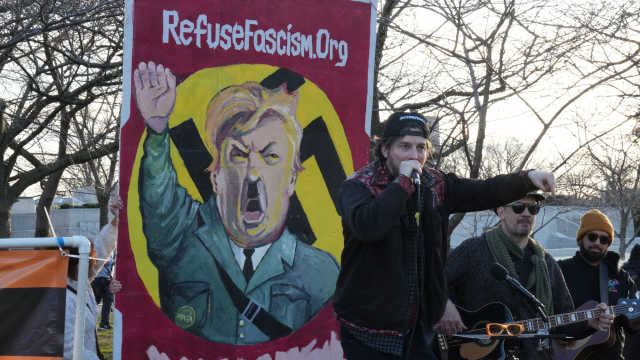
Language in the Age of Fascist Politics (Henry Giroux)

In the age of expanding fascism, the power of language is not only fragile but increasingly threatened. As Toni Morrison has noted, “language is not only an instrument through which power is exercised,” it also shapes agency and functions as an act with consequences. These consequences ripple through the very fabric of our existence. For in the words we speak, meaning, truth, and our collective future are at risk. Each syllable, phrase, and sentence becomes a battleground where truth and power collide, where silence breeds complicity, and where justice hangs in the balance.

In response, we find ourselves in desperate need of a new vocabulary, one capable of naming the fascist tide and militarized language now engulfing the United States. This is not a matter of style or rhetorical flourish; it is a matter of survival. The language required to confront and resist this unfolding catastrophe will not come from the legacy press, which remains tethered to the very institutions it ought to expose. Nor can we turn to the right-wing media machines, led by Fox News, where fascist ideals are not just defended but paraded as patriotism. 

In the face of this crisis, Toni Morrison’s insight drawn from her Nobel Lecture becomes all the more urgent and makes clear that the language of tyrants, embodied in the rhetoric, images, and modes of communication characteristic of the Trump regime, is a dead language. For her “a dead language is not simply one that is no longer spoken or written,” it is unyielding language “content to admire its own paralysis.” It is repressive language infused with power, censored and censoring. Ruthless in its policing duties and dehumanizing language, it has no desire or purpose other than maintaining the free range of its own narcotic narcissism, its own exclusivity and dominance. “Though moribund, it is not without effect” for it actively thwarts the intellect, stalls conscience, and “suppresses human potential.” Unreceptive to interrogation, it cannot form or tolerate new ideas, shape other thoughts, tell another story, or fill baffling silences. This is the language of official power whose purpose is to sanction ignorance and preserve. 

Beneath its glittering spectacle and vulgar performance, lies a language that is "dumb, predatory, sentimental." It offers mass spectacles, a moral sleepwalking state of mind, and a psychotic infatuation for those who seek refuge in unchecked power. It forges a community built on greed, corruption, and hate, steeped in a scandal of hollow fulfillment. It is a language unadorned in its cruelty and addiction to creating an architecture of violence. It is evident in Trump’s discourse of occupation, his militarizing of American politics, and in his use of an army of trolls to turn hatred into a social media spectacle of swagger and cruelty.


Despite differing tones and political effects, the discourses of the far right and the liberal mainstream converge in their complicity: both traffic in mindless spectacle, absorb lies as currency, and elevate illusion over insight. The liberal mainstream drapes the machinery of cruelty in the language of civility, masking the brutality of the Trump regime and the predatory logic of gangster capitalism, while the far right revels in it, parading its violence as virtue and its hatred as patriotism. Language, once a powerful instrument against enforced silence and institutional cruelty, now too often serves power, undermining reason, normalizing violence, and replacing justice with vengeance. 

In Trump’s oligarchic culture of authoritarianism, language becomes a spectacle of power, a theater of fear crafted, televised, and performed as a civic lesson in mass indoctrination. If language is the vessel of consciousness, then we must forge a new one--fierce, unflinching, and unafraid to rupture the fabric of falsehood that sustains domination, disposability, and terror. The late famed novelist, Ngũgĩ wa Thiong’o, was right in stating that “language was a site of colonial control,” inducting people into what he called “colonies of the mind.”

The utopian visions that support the promise of a radical democracy and prevent the dystopian nightmare of a fascist politics are under siege in the United States. Increasingly produced, amplified and legitimated in a toxic language of hate, exclusion, and punishment, all aspects of the social and the democratic values central to a politics of solidarity are being targeted by right-wing extremists. In addition, the institutions that produce the formative cultures that nourishes the social imagination and democracy itself are now under attack. The signposts are on full display in a politics of racial and social cleansing that is being fed by a white nationalist and white supremacist ideology that is at the centre of power in the US—marked by fantasies of exclusion accompanied by a full-scale attack on morality, reason, and collective resistance rooted in democratic struggle. 

As more people revolt against this dystopian project, neoliberal ideology and elements of a fascist politics merge to contain, distract and misdirect the anger that has materialised out of legitimate grievances against the government, controlling privileged elites and the hardships caused by neoliberal capitalism. The current crisis of agency, representation, values and language demands a discursive shift that can call into question and defeat the formative culture and ideological scaffolding through which a savage neoliberal capitalism reproduces itself. This warped use of language directly feeds into the policies of disposability that define Trump's regime.

State Terror and Trump’s Politics of Disposability

As Trump’s regime concentrates power, he invokes a chilling convergence of law, order, and violence, a cornerstone of his politics of disposability. His acts of cruelty and lawlessness, abducting and deporting innocent people, branding immigrants as “vermin,” claiming they are “poisoning the blood” of Americans, and even proposing the legalization of murder for twelve hours, make clear that his violent metaphors are not just rhetorical flourishes. They are policy blueprints. In Trump’s hands, rhetoric becomes a weaponized prelude to atrocity, a tool of statecraft. Threats, hatred, and cruelty are transformed into instruments of governance.

This is not careless talk, it is a brutal and calculated expression of power. Trump’s threats to arrest and deport critics such as Zohran Mamdani reveal his willingness to use the machinery of the state for political extermination. His targets are predictable: immigrants, Black people, educators, journalists, LGBTQ+ individuals, and anyone who dares to challenge his white Christian nationalist, neoliberal, and white supremacist vision. His language does not merely offend, it incites harm, enacts repression, and opens the gates to state-sanctioned violence. It extends the reign of terror across the United States by labeling protesters as terrorists and deploying the military to American cities, treating them as if they were “occupied territories.” 

Trump is not alone. Many of his MAGA follower use these same hateful discourse. For instance, conservative pundit Ann Coulter wrote “in response to a speech by Melanie Yazzie, a Native artist and professor, about decolonization, “We didn’t Kill enough Indians.” This is not simply harsh rhetoric; nor is it a performative display of emboldened hatred and historical forgetting, it sets the stage for state-sanctioned repression and mass violence. What is at stake is more than civic respect. It is democracy itself. When language loses meaning and truth is blurred, tyranny thrives. Trump’s and too much of MAGA discourse is not about persuasion; it is about dehumanization and domination. It functions as statecraft, laying the groundwork for a society where suffering becomes spectacle and repression masquerades as law and order. Language is the canary in the coal mine, warning us that democracy dies without an informed citizenry.

As Eddie Glaude Jr. has powerfully argued, Americans must confront a brutal truth: the creation and expansion of Immigration and Customs Enforcement (ICE), now the largest federal law enforcement agency, is not merely a matter of policy, it is a cornerstone of white supremacy. It is a racist institution, entrenched in an immigration policy designed to uphold the values of white nationalism. In the face of shifting demographics, ICE is tasked with an urgent mission—to make America white again, a calculated attempt to turn back the clock on progress, to preserve an imagined past at the cost of justice and humanity.

We now live in a country where class and racial warfare both at home and abroad is on steroids, exposing the killing machine of gangster capitalism in its rawest, most punitive form. Trump supports the genocidal war waged by a state led by a war criminal. Children are being slaughtered in Gaza. Millions of Americans, including poor children, teeter on the edge of losing their healthcare. Funds for feeding hungry children are being slashed, sacrificed to feed the pockets of the ultra-rich. Thousands will die, not by accident, but by design. Terror, fear, and punishment have replaced the ideals of equality, freedom, and justice. Childcide is now normalized as the law of the land. The lights are dimming in America, and all that remains are the smug, ignorant smirks of fascist incompetence and bodies drained of empathy and solidarity.

Gangster Capitalism and the Death of Empathy

Gangster capitalism lays the foundation for Trump’s racist and fascist politics. As I have noted elsewhere, the United States has descended into a state of political, economic, cultural, and social psychosis, where cruel, neoliberal, democracy-hating policies have prevailed since the 1970s. At the core of this authoritarian shift lies a systemic war on workers, youth, Blacks, and immigrants, increasingly marked by mass violence and a punishing state both domestically and internationally. The U.S. has transformed into an empire dominated by a callous, greedy billionaire class that has dismantled any remnants of democracy, while embracing the fascistic ideology of white Christian nationalism and white supremacy. Fascism now parades not only beneath the flag but also under the Christian cross. 

America has shifted from celebrating unchecked individualism, as depicted in Ayn Rand’s Atlas Shrugged, to the glorification of greed championed by Gordon Gekko in Wall Street, and the psychotic avarice of Patrick Bateman in American Psycho. This descent into barbarity and psychotic infatuation with violence is further demonstrated by Justin Zhong, a right-wing preacher at Sure Foundation Baptist Church in Indianapolis, who called for the deaths of LGBTQ+ individuals during a sermon. Zhong defended his comments by citing biblical justifications and labeling LGBTQ+ people as "domestic terrorists." 

It gets worse. During a Men’s Preaching Night at Sure Foundation Baptist Church, Zhong's associate, Stephen Falco, suggested that LGBTQ+ people should "blow yourself in the back of the head," and that Christians should "pray for their deaths." Another member, Wade Rawley, advocated for violence, stating LGBTQ+ individuals should be "beaten and stomped in the mud" before being shot in the head. Fascism in America, nourished by the toxic roots of homophobia, now cloaks itself not just in the poisonous banner of the Confederate flag, but also in the sacred guise of the Christian cross.

Welcome to Trump’s America, where empathy is now viewed as a weakness and the cold rule of the market is the template for judging all social relations. One noted example can be found in the words of Trump’s on-and-off billionaire ally, Elon Musk, who dismisses empathy as a naive and detrimental force that undermines the competitive, individualistic ethos he champions. Speaking to Joe Rogan on his podcast, Musk specifically stated that “The fundamental weakness of western civilization is empathy.” As Julia Carrie Wong observes in The Guardian, the stakes extend far beyond casting empathy as a "parasitic plague." Empathy's true danger lies in its role as an enabler—granting permission to dehumanize others and constricting the very “definition of who should be included in a democratic state.” This is a recipe for barbarism, one that allows both states and individuals to turn a blind eye to the genocidal violence unfolding in Gaza and beyond.

Naming the Deep Roots of the Police State

Ruth Ben-Ghiat has warned that “America has been set on a trajectory to become a police state,” pointing to the passage of the Brutal and Bellicose Bill (BBB), which handed ICE a budget larger than the militaries of Brazil, Israel, and Italy combined. But the roots of this state violence go deeper. The foundation was laid under Bush and Cheney, whose war on terror birthed Guantanamo, Abu Ghraib, mass surveillance, and extraordinary rendition. What Trump has done is strip these earlier authoritarian practices of all pretenses, elevating them to the status of governing principles.

The police state did not begin with Trump; it evolved through him. Now, we see its terrifying maturity: racial cleansing disguised as immigration policy, hatred normalized as political speech, dissent criminalized, birthright citizenship threatened, and everyday life militarized. This is not politics as usual, it is fascism in real time.

Trump’s fascist politics grows even more dangerous when we recognize that his language of colonization and domination has helped transform American society into what Ngũgĩ wa Thiong’o chillingly describes as a “war zone.” This war zone now spans the digital terrain—through the internet, podcasts, social media, and educational platforms—becoming a fertile breeding ground for fascist symbols, reactionary values, manufactured identities, and the toxic resurrection of colonial logics. In this battleground of meaning, the language of colonization does more than obscure the truth—it erodes critical thinking, silences historical memory, and disarms the very possibility of empowered agency. What remains in its wake is a nation scarred by suffering, haunted by loneliness, bound by shared fears, and anesthetized by the numbing rituals of a punishing state.

The transformation of America into a war zone finds its most visible expression in the rise of Trump’s omnipresent police state. This authoritarian machinery reveals itself through the mechanisms of state-sponsored terror, a heavily militarized ICE force operating like masked enforcers, and the rapid expansion of detention centers that will increasingly resemble a network of potential forced labor camps. As Fintan O’Toole warns, Trump’s deployment of troops onto the streets of Los Angeles is not merely symbolic—it is “a training exercise for the army, a form of reorientation.” In this reorientation, soldiers are no longer defenders of the Constitution but are being retrained as instruments of authoritarian power, bound not by democratic ideals but by obedience to a singular will.

Nevertheless, we resist or refuse to name the fascist threat and the ideological and economic architecture of its politics. Still, we recoil from calling the Trump regime what it is: a fascist state engaged in domestic terrorism. Still, we remain blind to the fact that economic inequality, global militarism, and the genocidal logics of empire are not peripheral issues, they are the center. Why is it so difficult to admit that we are living in an age of American fascism? Why do the crimes of the powerful, at home and abroad, so often pass without scrutiny, while the victims are blamed or erased?

The Collapse of Moral Imagination

What we face is not only a political crisis, partly in the collapse of conscience and civic courage-- a profound moral collapse. The war being waged at home by the Trump regime is not just against immigrants or the poor, it is a war on critical thought, on historical memory, on the courage to dissent. It is a war on every institution that upholds critical thinking, informed knowledge, and civic literacy. This is a genocidal war against the very possibility of a just future—a war not merely against, but for stupidity, for the death of morality, and for the annihilation of any robust notion of democracy. Viktor Klemperer, in his seminal work The Language of the Third Reich, offers a crucial lesson from history: "With great insistence and a high degree of precision right down to the last detail, Hitler’s Mein Kampf teaches not only that the masses are stupid, but that they need to be kept that way, intimidated into not thinking." Klemperer’s analysis reveals that Nazi politics did not arise in a vacuum; it was cultivated in a culture where language itself was the breeding ground of cruelty and control.

Trump’s rhetoric of fear, racial hatred does not emerge in a vacuum. It resonates because it taps into a long and violent history, a history soaked in blood, built on genocide, slavery, colonialism, and exclusion. His language recalls the genocidal campaigns against Indigenous peoples, Black Americans, Jews, and others deemed disposable by authoritarian regimes. It is a necrotic lexicon, resurrected in service of tyranny. It gives birth to politicians with blood in their mouths, who weaponize nostalgia and bigotry, cloaking brutality in the false promises of patriotism and “law and order.”

Language as War and the Return of Americanized Fascism

This is not merely a rhetoric of cruelty, it is a call to arms. Trump’s words do not simply shelter fascists; they summon them. They silence dissent, normalize torture, and echo the logic of death camps, internment camps, and mass incarceration. His discourse, laden with hatred and lies, is designed to turn neighbors into enemies, civic life into war, and politics into a death cult and zone of terminal exclusion. Undocumented immigrants, or those seeking to register for green cards or citizenship, are torn from their families and children, cast into prisons such as Alligator Alcatraz, a grotesque manifestation of the punishing state. As Melissa Gira Grant writes in The New Republic, it is "an American concentration camp…built to cage thousands of people rounded up by ICE," constructed in a chilling display of colonial disregard, and erected on traditional Miccosukee land without so much as consulting the Tribe.

This is the face of modern cruelty: language wielded as a tool to orchestrate a spectacle of violence, designed to degrade, divide, and erase. Culture is no longer a peripheral force in politics; it has become the central weapon in the rise of state terrorism. The language of war and complicity normalizes America’s transformation into a monstrous carceral state, a symbol of state-sponsored terror where due process is suspended, and suffering is not just an outcome but the point itself. 

A culture of cruelty now merges with state sponsored racial terror, functioning as a badge of honor. One example is noted in Trump advisor Laura Loomer, who ominously remarked that "the wild animals surrounding President Donald Trump’s new immigration detention center… will have 'at least 65 million meals." Change.org, along with others such as Pod Save America co-host Tommy Vietor, noted that her comment “is not only racist, it is a direct emotional attack and veiled threat against Hispanic communities. This kind of speech dehumanizes people of color and normalizes genocidal language.” Her racist remark not only reveals the profound contempt for human life within Trump's inner circle but also highlights how cruelty and violence are strategically used as both a policy tool and a public spectacle. Loomer’s remark is not an aberration, it is a symptom of the fascist logic animating this administration, where death itself becomes a political message. Her blood-soaked discourse if symptomatic of the criminogenic politics fundamental to the working of the Trump regime.

The parallels to history are unmistakable. Loomer’s invocation of death as the outcome of detention recalls the Nazi designation of certain camps as Vernichtungslager, extermination camps, where as Holocaust survivor Primo Levi noted, imprisonment and execution were inseparable. Likewise, the U.S. internment of Japanese Americans during World War II, though often sanitized in public memory, operated under a similar logic of racial suspicion and collective punishment. The message in each case is clear, as Judith Butler has noted in her writing: some lives are rendered invisible, deemed unworthy of legal protection, of family, of dignity, of life itself. In fascist regimes, such spaces function not only as instruments of punishment but as symbolic theaters of power, meant to instill terror, enforce obedience, and declare which bodies the state has marked for erasure.

For Trump, J.D. Vance, and their ilk, fascism is not a specter to be feared but a banner to be waved. The spirit of the Confederacy and the corpse-like doctrines of white supremacy, militarism, and neoliberal authoritarianism have returned, this time supercharged by surveillance technologies, financial capital, and social media echo chambers. In the spirit of the Trump regime, the symbols of the Confederacy are normalized. Confederate flags are now waved by neo-Nazis in public squares and parades, while Trump renames US warships and 7 military bases after Confederate officers, reinforcing a dangerous nostalgia for a past rooted in racism and rebellion against the very ideals of unity and equality that this nation claims to uphold.

Higher Education and the Fight Against Authoritarianism

Read More

It should not surprise us that the American public has grown numb with the constant echo chamber of state terrorism playing out in multiple sites of attack. Powerful disimagination machines, mainstream media, right-wing propaganda platforms, tech billionaires, have flooded public consciousness with conspiracy theories, historical amnesia, and spectacularized images of immigrants and others being deported to prisons, foreign Gulags, and modern day black holes. These are not simply entertainment outlets; they are pedagogical weapons of mass distraction, breeding civic illiteracy and moral paralysis. Under their influence, the American people have been placed in a moral and political coma.

White Nationalism and Reproductive Control

Nowhere is this more evident than in the mainstream media’s failure to address the racial and ideological foundations of Trump’s agenda. His attacks on Haitian immigrants, the travel ban on seven African countries, the shutting down of refugee programs, and his open-door policy for white Afrikaners from South Africa are not merely racist; they are explicitly white nationalist. The same ideology drives attacks on women’s reproductive rights, revealing the deep racial and gender anxieties of a movement obsessed with white demographic decline. These are not isolated skirmishes, they are interconnected strategies of domination.

These converging assaults, white nationalism, white supremacy, patriarchal control, and militarized life, manifest most vividly in the war on reproductive freedom. White nationalists encourage white women to reproduce, to hold back demographic change, while punishing women of color, LGBTQ+ people, and the poor. It is a violent calculus, animated by fantasies of purity and control.

The Systemic Assault on Democracy

This is a full-spectrum assault on democracy. Every act of cruelty, every racist law, every violent metaphor chips away at the social contract. A culture of authoritarianism is now used to demean those considered other, both citizens and non-citizens, critics and immigrants, naturalized citizens and those seeking such status. They are labeled as unworthy of citizenship now defined by the Trump regime as a privilege rather than a right. Meanwhile, a media ecosystem built on clickbait and erasure renders both such fascists as legitimate while making invisible the roots of suffering mass suffering and fear, all the while, turning oppression into spectacle and silence into complicity.

In this fog, language itself is emptied of meaning. Truth and falsehood blur. As Paulo Freire warned, the tools of the oppressor are often adopted by the oppressed. We now see that the logic of fascism has seeped into the culture, eroding civic sensibility, destroying moral imagination, and rendering resistance almost unspeakable.

The Normalization of Tyranny

Trump’s authoritarian fantasies do not alienate his base, they galvanize it. What was once unthinkable is now policy. What was once fringe has become mainstream. Cruelty is not something to be deplored and avoided at all costs, it is a central feature of power, wielded with theatrical and spectacularized brutality. Under the current acting ICE Director, Todd Lyons, this punitive logic has intensified: Lyons oversees a $4.4 billion Enforcement and Removal Operations apparatus staffed by over 8,600 agents across 200 domestic locations, using militarized tactics, surprise raids, and aggressive targeting of immigrant communities to sustain a regime of fear. ICE’s presence is at the heart of Trump’s hyper-police state, and its funding has been greatly expanded to $170 billion under Trump’s new budget bill, creating what journalist Will Bunch calls Trump’s “own gulag archipelago of detention camps across a United States that’s becoming increasingly hard to recognize.”

Meanwhile, figures like Tom Homan, who led ICE under Trump’s first term, laid the groundwork with Gestapo-style operations, midnight raids, family separations, and public declarations that undocumented immigrants “should be afraid”. As the “border tzar” under Trump, Homan has initiated deportation policies that are even more aggressively violent and cruel that those that took place in Trump’s first term as president. As Bunch notes, take the case of “the 64-year-old New Orleans woman, Donna Kashanian, who fled a tumultuous Iran 47 years ago, volunteered to rebuild her battered Louisiana community after Hurricane Katrina, never missed a check-in with U.S. immigration officials , and was snatched by ICE agents in unmarked vehicles while she was out working in her garden and sent to a notorious detention center.” These horror stories now take place daily in cities extending from Los Angeles to Providence, Rhode Island.

A central player in this current regime of state terrorism, systemic racism, mass abductions, deportations, and the criminalization of dissent is Stephen Miller, Trump’s White House Deputy Chief of Staff. During Trump’s first term, Miller was the driving force behind the Muslim ban, the family separation policy, and assaults on birthright citizenship, all rooted in an unapologetic white supremacist and eugenicist worldview. In Trump’s second term, he has emerged as the architect of even more draconian measures, pushing for mass deportations, the abolition of birthright citizenship, and the revocation of naturalized citizenship for those who fall outside his white Christian vision of who deserves to be called American.

Far-right white nationalist such as Miller, Tom Homan and Todd Lyons, do not treat cruelty as a regrettable side effect. For them, cruelty is the currency of power. Suffering becomes a spectacle, and violence a ritual of statecraft. Tyranny is not inching forward in silence; it is advancing at full speed, cheered on by those who treat fear as a governing principle and pain as public policy. At stake here is what Timothy Snyder calls the practice of fascist dehumanization.

This is not a passing storm. It is the death throes of a system that has long glorified violence, commodified everything, and fed on division. Trump’s language is not a performance, it is preparation. His words are laying the foundation for a society without empathy, without justice, without democracy.

Reclaiming the Language of Resistance, Reclaiming Democracy

In a decent society, language is the lifeblood of democracy, a vessel of solidarity, truth, and hope. But in Trump’s America, language has become a weapon, dehumanizing, excluding, and dominating. His vision is not a warning; it is a blueprint. We must resist, or we risk losing everything. The stakes are nothing less than the survival of democracy, the retrieval of truth and the refusal to live in a world where cruelty is policy and silence is complicity. 

What is needed now is not only a rupture in language but a rupture in consciousness, one that brings together the critical illumination of the present with a premonitory vision of what lies ahead if fascist dynamics remain unchecked. As Walter Benjamin insisted, we must cultivate a form of profane illumination, a language that disrupts the spectacle of lies and names the crisis in all its violent clarity. At the same time, as A.K. Thompson argues, we must grasp the future implicit in the present. His notion of premonitions urges us to read the events unfolding around us as urgent warnings, as signs of the catastrophe that awaits if we do not confront and reverse the political and cultural paths we are on. It demands that we see the connections that bind our suffering, rejecting the fragmented reality that neoliberalism forces upon us. 

The time for complacency is past. The time for a new and more vibrant language, one of critique, resistance, and militant hope, is now. A language capable not only of indicting the present but of envisioning a future rooted in justice, memory, and collective struggle.

As Antonio Gramsci remarked in his Prison Notebooks, "The crisis consists precisely in the fact that the old is dying and the new cannot be born; in this interregnum a great variety of morbid symptoms appear." What is clear is that these morbid symptoms have arrived. Yet, alongside the despair they breed, they also present new challenges and opportunities for revitalized struggles. This is where the power of language comes into play—this is the challenge and opportunity for those who believe in the transformative power of culture, language, and education to address not just the nature of the crisis but its deeper roots in politics, memory, agency, values, power, and democracy itself.

[This article first appeared in the LA Progressive.]


By Henry A. Giroux

Henry A. Giroux currently holds the McMaster University Chair for Scholarship in the Public Interest in the English and Cultural Studies Department and is the Paulo Freire Distinguished Scholar in Critical Pedagogy. His latest book is The Burden of Conscience: Educating Beyond the Veil of Silence (Bloomsbury in 2025). He is LA Progressive's Associate Editor. His website is www.henryagiroux.com