Search This Blog

Showing posts sorted by relevance for query IDR. Sort by date Show all posts

Friday, October 24, 2025

A HUGE legal win for MILLIONS of borrowers (Protect Borrowers)

Borrowers just secured a MAJOR victory! In AFT v. U.S. Department of Education (ED), the Trump Administration agreed to protect borrowers enrolled in Income-Driven Repayment (IDR) plans and deliver student debt relief to borrowers making payments under those plans for decades.

This is a huge milestone. At the time AFT originally filed the lawsuit in March 2025—represented by Protect Borrowers and Berger Montague—the Trump Administration had removed the application to enroll in IDR from government websites and had issued a secret order to student loan contractors to halt all IDR enrollment and processing. After we filed, the government quickly resumed accepting applications and, months later, began processing those applications again. ED’s recent agreement is the first time the Trump Administration has publicly committed its intent to follow the law, after representations it made that it wouldn’t cancel debt under certain—and at times, any—IDR plan.


The Administration has now agreed to:


  • Cancel student debt for all eligible borrowers enrolled in Income-Based Repayment (IBR), Income-Contingent Repayment, and Pay As You Earn payment plans and the Public Service Loan Forgiveness (PSLF) program;


  • Refund any borrower who makes additional payments beyond the date of eligibility for IDR cancellation;


  • Process IDR applications and PSLF Buyback applications—including applications for the IBR plan from borrowers without a partial financial hardship.


  • Recognize the date a borrower becomes eligible for cancellation as the effective date of discharge and not issue IRS forms suggesting that cancelled debt is taxable for borrowers whose effective date is on or before December 31, 2025; and


  • File six monthly status reports with the court on the status of its IDR and PSLF application and loan cancellation processing—increasing transparency and accountability.


This relief will extend to all borrowers.


Borrowers urgently needed this agreement. Prior to it, borrowers eligible to have their loans cancelled in 2025 were at risk of getting stuck with a large tax bill due to the Administration’s processing delays. This is because Trump and Congressional Republicans’ “One Big Beautiful Bill Act” (OBBBA) permanently extended Congress’s 2018 action to exclude cancelled debts for death or disability from federal taxable income—but not all cancelled student loan debt. As a result, millions of borrowers who earn debt relief under an IDR plan after January 1, 2026, could see their taxes skyrocket. Working families can’t shoulder thousands of dollars in additional taxes—they’re already stretched thin by rising costs of living, a weak job market, mounting levels of debt, and OBBBA’s historic cuts to public benefits.

Saturday, March 29, 2025

CBO's Revised Student Loan Projections and FSA Operational Costs (Glen McGhee)

The Congressional Budget Office (CBO) has dramatically revised its projections for the federal student loan program, transforming what was once expected to be a profitable government investment into a significant fiscal liability. This report examines the details of these projection changes and analyzes the operational costs of the Federal Student Aid (FSA) program.

The CBO's updated budget projections released in 2024 reveal a stark shift in the expected financial performance of the federal student loan program. These projections represent a significant revision from earlier expectations and highlight growing concerns about the sustainability of current student lending policies.
According to the Committee for a Responsible Federal Budget (CRFB), the estimated federal cost of student loans issued between 2015 and 2024 has increased by $340 billion – transforming from a projected gain of $135 billion in the 2014 baseline to an expected loss of $205 billion in the 2024 baseline15. This represents a complete reversal in the financial outlook for the program over the past decade.
This dramatic shift is particularly evident when examining the changing projections for specific loan cohorts. In 2014, the CBO projected that taxpayers would generate an 11-cent profit for every dollar of student loans issued by the federal government in fiscal year 2024. However, the most recent projections indicate that taxpayers will instead incur a 20-cent loss per dollar of loans issued this fiscal year6.
Looking ahead, the situation appears even more concerning. Over the 2024-2034 budget window, the CBO expects federal student loans to cost taxpayers $393 billion1. This amount exceeds the $355 billion CBO expects to be spent on Pell Grants, the flagship college aid program for low-income students, over the same time period1.
The projected $393 billion cost includes several components:
  • $221 billion in losses on the $1.1 trillion in student loans the federal government will issue during this period
  • $140 billion in re-estimates of the losses taxpayers will bear on outstanding loans
  • $34 billion toward administering the student loan programs6
One particularly concerning aspect of the CBO projections is the growing cost of graduate student loans. These loans are expected to make up around half of new student loans originated in the current fiscal year11. The CBO projects that taxpayers will lose $102 billion on lending to graduate students over the coming decade11. According to the CRFB, graduate school loans are now nearly as subsidized as undergraduate loans and make up half of the cost of newly issued student loans15.
The dramatic increase in projected costs has several primary causes, as identified in the CBO reports and analyses by financial experts.
The primary catalyst for the growing losses is the expansion and increased utilization of income-driven repayment (IDR) plans6. While a borrower repaying loans under a traditional fixed-term repayment plan typically repays more than the initial amount borrowed, a typical borrower using an IDR plan will repay significantly less than the original loan amount6.
The CBO projects that taxpayers will lose between 30 and 48 cents for every dollar in federal student loans issued in fiscal year 2024 and repaid on an IDR plan1. Preston Cooper notes in his LinkedIn post that "the role of IDR plans in driving these costs can't be overstated. CBO generally expects taxpayers to profit on loans repaid through traditional fixed-term repayment plans. But loans repaid on IDR plans will incur losses ranging from 30 to 48 cents on the dollar"1.
The Biden administration's student loan forgiveness initiatives are cited as significant contributors to the growing cost of the program. The House Budget Committee press release states that "$140 billion or over a third of this cost directly stems from President Biden's student loan forgiveness schemes"7. These initiatives include changes to income-driven repayment plans to make them more generous1.
Beyond the projected losses on the loans themselves, the Federal Student Aid (FSA) program incurs significant operational costs to administer federal student aid programs.
According to FSA's 2024 annual report, the agency operated on an annual administrative budget of approximately $2.1 billion during FY 20244. As of September 30, 2024, FSA was staffed by 1,444 full-time employees who are primarily based in FSA's headquarters in Washington, DC, with additional staff in 10 regional offices throughout the country4.
The Department of Education's Salaries and Expenses Overview provides additional insight into how these administrative funds are allocated. The Student Aid Administration account consists of two primary components:
  1. Salaries and Expenses
  2. Servicing Activities
In the fiscal year 2020 budget request, for example, the Student Aid Administration account totaled $1,812,000,000, with $1,281,281,000 allocated for Salaries and Expenses and $530,719,000 for Servicing Activities5.
The latest CBO projections highlight a dramatic shift in the financial outlook for the federal student loan program. What was once projected to be a profitable government investment has transformed into a significant fiscal liability, with taxpayers expected to lose hundreds of billions of dollars over the next decade.
This transformation raises important questions about the sustainability of current policies and the potential need for reforms to address growing costs. The substantial operational budget of FSA ($2.1 billion annually) adds to the overall fiscal impact of federal student aid programs.
As policymakers consider the future of federal student aid, they will need to grapple with balancing access to higher education with fiscal responsibility and ensuring that federal resources are allocated efficiently and effectively.
Citations:
  1. https://www.linkedin.com/posts/preston-cooper-479331a4_the-congressional-budget-office-cbo-released-activity-7209166019871809536-8vM2
  2. https://www.farmers.gov/sites/default/files/2021-10/usda-farmloans-factsheet-10-20-2021.pdf
  3. https://www.cbo.gov/publication/59499
  4. https://studentaid.gov/sites/default/files/fy2024-fsa-annual-report.pdf
  5. https://www.ed.gov/media/document/w-seoverviewpdf-39165.pdf
  6. https://www.forbes.com/sites/prestoncooper2/2024/06/19/cbo-cost-of-federal-student-loans-nears-400-billion/
  7. https://budget.house.gov/press-release/via-forbes-cbo-cost-of-federal-student-loans-nears-400-billion
  8. https://www.fsa.usda.gov/resources/programs/farm-operating-loans
  9. https://www.opm.gov/healthcare-insurance/flexible-spending-accounts/
  10. https://crsreports.congress.gov/product/pdf/R/R46143
  11. https://edworkforce.house.gov/uploadedfiles/2.5.25_cooper_testimony_house_ed_and_workforce_final.pdf
  12. https://studentaid.gov/data-center/student/portfolio
  13. https://www.agcredit.net/loans/beginning-farmer-loans/fsa-loans
  14. https://www.oklahomafarmreport.com/okfr/2025/01/07/usda-increases-funding-for-new-specialty-crop-program-reminds-producers-of-upcoming-deadlines/
  15. https://www.crfb.org/blogs/student-loans-cost-340-billion-more-expected
  16. https://farmdoc.illinois.edu/wp-content/uploads/2022/09/USDA-FSA-Your-Guide-to-Farm-Loans.pdf
  17. https://www.cbo.gov/publication/59946
  18. https://gaswcc.georgia.gov/document/document/microloans-fact-sheet-aug-2019/download
  19. https://www.cbo.gov/publication/60682
  20. https://www.farmraise.com/blog/fsa-loan-types
  21. https://www.cbo.gov/publication/60713
  22. https://www.fsa.usda.gov/programs-and-services/farm-loan-programs/farm-operating-loans
  23. https://www.cato.org/briefing-paper/ending-federal-student-loans
  24. https://fsapartners.ed.gov/knowledge-center/fsa-handbook/2022-2023/vol3/ch2-cost-attendance-budget
  25. https://www.congress.gov/crs-product/R43571
  26. https://fsapartners.ed.gov/knowledge-center/fsa-handbook/2023-2024/vol3/ch2-cost-attendance-budget
  27. https://sustainableagriculture.net/publications/grassrootsguide/credit-crop-insurance/direct-and-guaranteed-farm-loans/
  28. https://www.ed.gov/sites/ed/files/about/overview/budget/budget24/summary/24summary.pdf
  29. https://studentaid.gov/sites/default/files/fy2023-fsa-annual-report.pdf
  30. https://bipartisanpolicy.org/explainer/federal-student-aid-an-overview/
  31. https://www.ed.gov/about/ed-organization/functional-statements/fsa-functional-statements/finance
  32. https://www.pgpf.org/our-national-debt/
  33. https://www.cbo.gov/publication/60419
  34. https://www.mercatus.org/research/data-visualizations/cbo-export-import-bank-fha-mortgage-guarantees-and-doed-student-loan
  35. https://www.crfb.org/papers/analysis-cbos-march-2024-long-term-budget-outlook

Friday, January 17, 2025

Biden-Harris Administration Announces Final Student Loan Forgiveness and Borrower Assistance Actions (US Department of Education)

Total Approved Student Debt Relief Reached Almost $189 Billion for 5.3 Million Borrowers

The Biden-Harris Administration today announced its final round of student loan forgiveness, approving more than $600 million for 4,550 borrowers through the Income-Based Repayment (IBR) Plan and 4,100 individual borrower defense approvals. The Administration leaves office having approved a cumulative $188.8 billion in forgiveness for 5.3 million borrowers across 33 executive actions. The U.S. Department of Education (Department) today also announced that it has completed the income-driven repayment payment count adjustment and that borrowers will now be able to see their income-driven repayment counters when they log into their accounts on StudentAid.gov. Finally, the Department took additional actions that will allow students who attended certain schools that have since closed to qualify for student loan discharges. 

“Four years ago, President Biden made a promise to fix a broken student loan system. We rolled up our sleeves and, together, we fixed existing programs that had failed to deliver the relief they promised, took bold action on behalf of borrowers who had been cheated by their institutions, and brought financial breathing room to hardworking Americans—including public servants and borrowers with disabilities. Thanks to our relentless, unapologetic efforts, millions of Americans are approved for student loan forgiveness,” said U.S. Secretary of Education Miguel Cardona. “I’m incredibly proud of the Biden-Harris Administration’s historic achievements in making the life-changing potential of higher education more affordable and accessible for more people.” 

From Day One the Biden-Harris Administration took steps to rethink, restore, and revitalize targeted relief programs that entitle borrowers to relief under the Higher Education Act but that failed to live up to their promises. Through a combination of executive actions and regulatory improvements, the Biden-Harris Administration produced the following results for borrowers: 

Fixed longstanding problems with Income-Driven Repayment (IDR). The Administration has approved 1.45 million borrowers for $57.1 billion in loan relief, including $600 million for 4,550 borrowers announced today for IBR forgiveness. 

IDR plans help keep payments manageable for borrowers and have provided a path to forgiveness after an extended period. These plans started in the early 1990s, but prior to the Biden-Harris Administration taking office, just 50 borrowers had ever had their loans forgiven. The Administration corrected longstanding failures to accurately track borrower progress toward forgiveness and addressed past instances of forbearance steering whereby servicers inappropriately advised borrowers to postpone payments for extended periods of time. These totals also include borrowers who received forgiveness under the Saving on a Valuable Education (SAVE) plan prior to court orders halting forgiveness under the SAVE plan. 

Today, the Department also announced the completion of the IDR payment count adjustment, correcting eligible payment counts. While the payment count adjustment is now complete, borrowers who were affected by certain servicer transitions in 2024 may see one or two additional months credited in the coming weeks. The Department is also launching the ability for borrowers to track their IDR progress on StudentAid.gov. Borrowers can now log in to their accounts and see their total IDR payment count and a month-by-month breakdown of progress.   

Restored the promise of Public Service Loan Forgiveness (PSLF). The Administration has approved 1,069,000 borrowers for $78.5 billion in forgiveness.  

The PSLF Program provides critical support to teachers, service members, social workers, and others engaged in public service. But prior to this Administration taking office, just 7,000 borrowers had received forgiveness and the overwhelming majority of borrowers who applied had their applications denied. The Biden-Harris Administration fixed this program by pursuing regulatory improvements, correcting long-standing issues with tracking progress toward forgiveness and misuse of forbearances, and implementing the limited PSLF waiver to avoid harm from the pandemic. 

Automated discharges and simplified eligibility criteria for borrowers with a total and permanent disability. The Administration has approved 633,000 borrowers for $18.7 billion in loan relief. 

Borrowers who are totally and permanently disabled may be eligible for a total and permanent disability (TPD) discharge. The Biden-Harris Administration changed regulations to automatically forgive loans for eligible borrowers based upon a data match with the Social Security Administration (SSA). This helped hundreds of thousands of borrowers who were eligible for relief but hadn’t managed to navigate paperwork requirements. The Department also made it easier for borrowers to qualify for relief based upon SSA determinations, made it easier to complete the TPD application, and eliminated provisions that had caused many borrowers to have their loans reinstated. 

Delivered long-awaited help to borrowers ripped off by their institutions, whose schools closed, or through related court settlements. The Administration has approved just under 2 million borrowers for $34.5 billion in loan relief.  

For years, students had sought relief from the Department through borrower defense to repayment—a provision that allows borrowers to have their loans forgiven if their college engaged in misconduct related to the borrowers’ loans. The Department delivered long-awaited relief to borrowers who attended some of the most notoriously predatory institutions to ever participate in the federal financial aid programs. This included approving for discharge all remaining outstanding loans from Corinthian Colleges, as well as group discharges for ITT Technical Institute, the Art Institutes, Westwood College, Ashford University, and others. The Department also settled a long-running class action lawsuit stemming from allegations of inaction and the issuance of form denials, allowing it to begin the first sustained denials of non-meritorious claims. 

Today, the Department also approved 4,100 additional individual borrower defense applications for borrowers who attended DeVry University, based upon findings announced in February 2022.  

“For decades, the federal government promised to help people who couldn’t afford their student loans because they were in public service, had disabilities, were cheated by their college, or who had completed decades of payments. But it rarely kept those promises until now,” said U.S. Under Secretary of Education James Kvaal. “These permanent reforms have already helped more 5 million borrowers, and many more borrowers will continue to benefit.” 

The table below compares the progress made by the Biden-Harris Administration in these key discharge areas compared to other administrations. 

 Borrowers approved for forgiveness 
 Prior Administrations Biden-Harris Administration 
Borrower Defense (Since 2015) 53,500 1,767,000* 
Public Service Loan Forgiveness (Since 2017) 7,000 1,069,000 
Income-Driven Repayment (all-time) 50 1,454,000 
Total and Permanent Disability (Since 2017) 604,000 633,000 

* Includes 107,000 borrowers and $1.25 billion captured by an extension of the closed-school lookback window at ITT Technical Institute.  

Additional actions related to closed school discharges 

The Department today also announced additional actions that will make more borrowers eligible for a closed school loan discharge. Generally, a borrower qualifies for a closed school discharge if they did not complete their program and were either still enrolled when the school closed or left without graduating within 120 days before it closed. . However, the Department has determined that several schools closed under exceptional circumstances that merit allowing borrowers who did complete and were enrolled in the school more than 120 days prior to the closure to qualify for a closed school discharge. justify extending the look-back window beyond the applicable 120 or 180 days--allowing additional borrowers to qualify for a closed school discharge. Generally, eligible borrowers will have to apply for these discharges, but the Secretary has directed Federal Student Aid to make borrowers aware of their eligibility, and to pursue automatic discharges for those affected by closures that took place between 2013 and 2020 and who did not enroll elsewhere within three years of their school closing. 

These adjusted look-back windows are: 

  • To May 6, 2015, for all campuses owned at the time by the Career Education Corporation (CEC), which have since closed. That is the day CEC announced it would close or sell all campuses except for two brands. This affected the Art Institutes, Le Cordon Bleu, Brooks Institute, Missouri College, Briarcliffe College, and Sanford-Brown. 
  • To December 16, 2016, for campuses owned by the Education Corporation of America (ECA) on that date that closed. ECA operated Virginia College, Brightwood College, EcoTech, and Golf Academies and started on the path to closure after its accreditation agency lost federal recognition and ECA could not obtain accreditation elsewhere. 
  • To October 17, 2017 for all campuses owned or sold on that date by the Education Management Corporation (EDMC) and that later closed. That is the day EDMC sold substantially all of its assets to Dream Center Educational Holdings. The decision affects borrowers who attended the Art Institutes, including the Miami International University of Art & Design and Argosy University.  
  • To April 23, 2021, for Bay State College. That is the day this Massachusetts-based college began to face significant accreditation challenges, which eventually led to the school losing accreditation and closing in August 2023. 

Borrowers who want more information about closed school discharge, including how to apply, can visit StudentAid.gov/closedschool

A state-by-state breakdown of various forms of student debt relief approved by the Biden-Harris Administration is available here.

Monday, January 20, 2025

Major updates: student debt relief progress and new fact sheets (SBPC)

The fight for student loan borrowers continues! In the last remaining days of the Biden-Harris Administration, the U.S. Department of Education (ED) is pushing some final relief through for student loan borrowers, new Income-Driven Repayment (IDR) Account Adjustment payment counts are live, and we have new fact sheets shedding light on the impact of the student debt crisis on borrowers.


Here’s a roundup of the latest:


Over 5 million borrowers have been freed from student debt.

In a major win for borrowers, ED announced that the Biden-Harris Administration has now approved $183.6 billion in student debt discharges via various student debt relief fixes and programs. This relief has now reached over 5 million borrowers and includes new approvals for Public Service Loan Forgiveness (PSLF) relief, borrower defense relief, and Total and Permanent Disability Discharge relief.


This relief is life-changing for millions of families, proving the power of bold, decisive action on student debt. Yet, there is much more work to do. Every step toward relief underscores the need to continue fighting for policies that reduce the burden of student debt and ensure affordable access to higher education.


Final phase of the IDR Account Adjustment is underway—take screenshots!

In tandem with the latest cancellation efforts, ED has also finally started updating borrower payment counts on the Federal Student Aid dashboard. Providing official payment counts will help borrowers receive the credit they have earned towards cancellation under IDR, and ensure that all borrowers who have been forced to pay for 20 years or longer are automatically able to benefit from relief they are entitled to under federal law. ***If you are a borrower with federal student loans, we recommend that you check your dashboard on studentaid.gov, screenshot your new count, and save it in your records.


Previously, many borrowers—including those who work in public service jobs and low-income borrowers struggling to afford payments—were steered into costly deferments and forbearance, preventing them from reaching the 20 years or longer for IDR relief or the 120 payments necessary for PSLF cancellation. Under the IDR Account Adjustment, these periods are now counted, even if borrowers were mistakenly placed in the wrong repayment plan or faced servicing errors. 

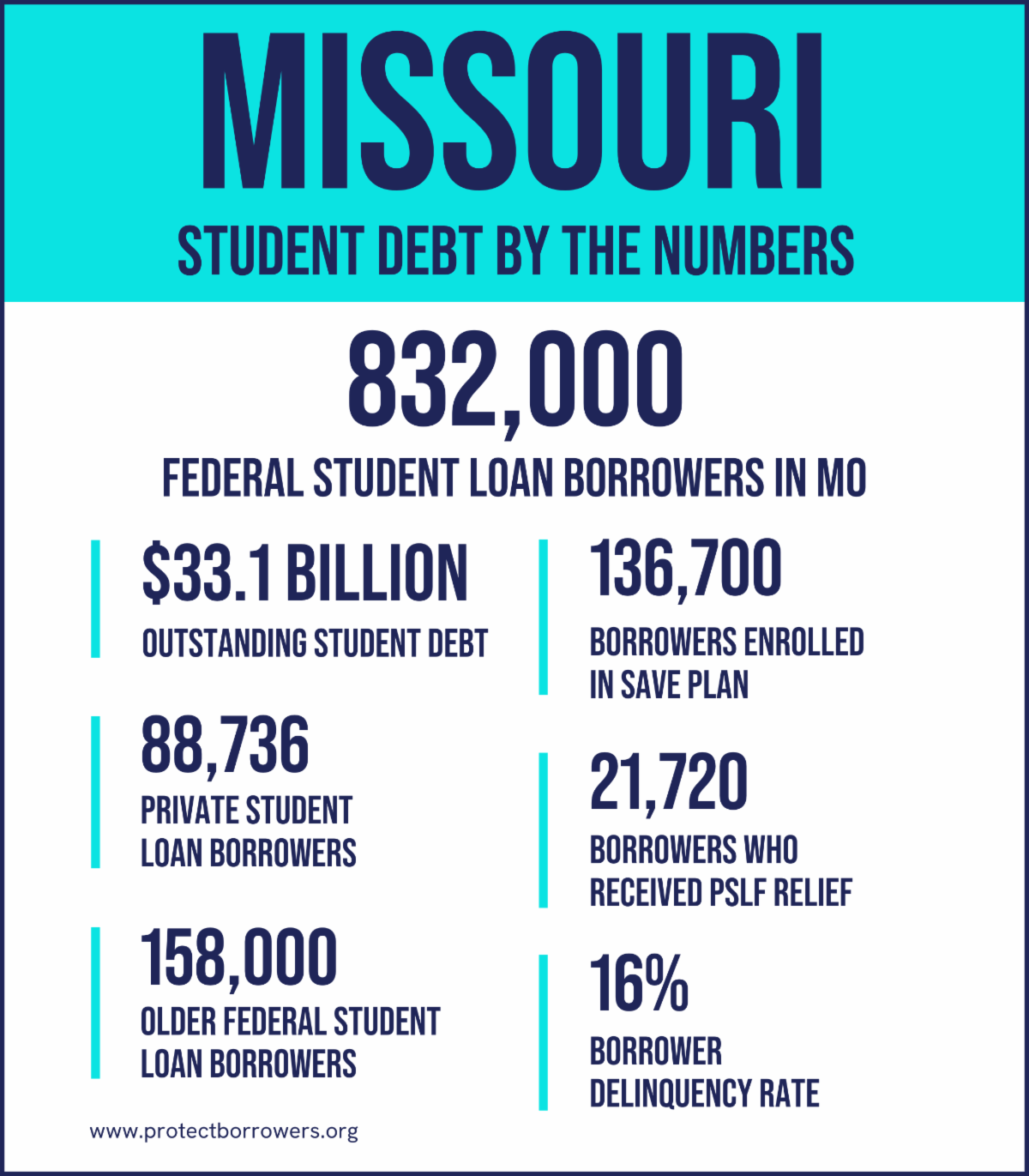
New SBPC fact sheets on the student debt crisis are live.

As the new administration and conservative congressional majority considers proposals that would roll back critical protections for student loan borrowers and make student loan debt even more expensive, we’re committed to protecting borrowers. We’ve released statewide and congressional-level snapshots of the student debt crisis to shine a light on the impact of student debt across the country.

These fact sheets provide granular data on:

  • The number of borrowers and total student debt in each area
  • Constituents benefiting from affordable repayment plans
  • The life-changing impact of debt relief over the past four years


We hope these snapshots offer critical context to help ensure new and returning policymakers understand the toll of student debt on their communities—and the urgent need for bold action to alleviate this crisis.

The fight to protect student loan borrowers continues.

The new political dynamics of the 119th Congress raise the stakes for borrowers. Proposals to roll back protections, gut affordable repayment plans like the Saving on a Valuable Education Plan, and shift costs onto working families, threaten the progress we’ve made. But our coalition and community of borrowers and advocates are ready to stand strong together and continue protecting our wins while fighting for more.

Standing together,


Persis Yu

Deputy Executive Director & Managing Counsel

Student Borrower Protection Center

Friday, July 18, 2025

Interest charges will restart for borrowers in SAVE forbearance (Student Borrower Protection Center)


Student Borrower Protection Center’s research partners are conducting a groundbreaking research study that aims to understand how Income-Driven Repayment (IDR) and Public Service Loan Forgiveness (PSLF) programs impact borrowers’ well-being. If you are currently in an IDR plan, working towards PSLF, or your loans have been cancelled through PSLF, please consider participating below (Password: REPAYE).

Participate in Survey

Dahn,


The Biden Administration’s Saving on a Valuable Education (SAVE) repayment plan promised to lower monthly student loan payments for millions of Americans. But legal attacks by the same conservative state attorneys general who exploited the courts to block President Biden’s original student debt relief plan resulted in a court injunction that has blocked borrowers from enrolling. Thus, borrowers have been trapped in a year-long, interest-free forbearance while their unprocessed Income-Driven Repayment (IDR) applications wait in limbo.


But now, Trump and Education Secretary McMahon are saddling these borrowers with interest. Last week, the U.S. Department of Education (ED) announced that it will begin restarting student loan interest charges on August 1, 2025, for the nearly 8 MILLION borrowers stuck in this forbearance.


McMahon voluntarily chose to do this—there was no state or federal court order forcing her hand. Read our Executive Director Mike Pierce’s statement on this below:

“Instead of fixing the broken student loan system, Secretary McMahon is choosing to drown millions of people in unnecessary interest charges and blaming unrelated court cases for her own mismanagement. Every day, we hear from borrowers waiting on hold with their servicer for hours, begging the government to let them out of this forbearance, and help them get back on track—instead, McMahon is choosing to jack up the cost of their student debt without giving them a way out. These are teachers, nurses, and retail workers who trusted the government’s word, only to get sucker-punched by bills that will now cost them hundreds more every month. McMahon is turning a lifeline into a trap and fueling one of the biggest wealth grabs from working families in modern history. It’s a betrayal.”

Read the Full Statement

In response to this announcement, we released a new analysis of this policy change, projecting that the typical SAVE borrower will be forced to pay more than $3,500 per year—or $300 per month—in unnecessary interest charges. In total, we found that affected borrowers will be charged more than $27 BILLION in interest over the next 12 months.

Read Our Analysis

Borrowers have suffered long enough because of the broken student loan system. Despite promises to lower costs for working families, Trump and his allies have only raised them more. Eliminating SAVE and replacing it with the Repayment Assistance Plan (RAP) created by Congressional Republicans means the typical student loan borrower will see their annual student loan costs skyrocket by $2,900—and millions of other borrowers will see their monthly loan bills increase by 50 percent. In fact, they will pay more for longer. RAP forces borrowers to pay for 30 years instead of the 20-25 year timelines of current IDR plans. And now, the Trump Administration wants to pile $27 billion dollars of interest charges over the next 12 months onto struggling borrowers.


But McMahon can’t hide from her decision to drown borrowers in interest charges. We’ve been busy sounding the alarm of her policy choice in widespread coverage:


The attacks on borrowers and working families must end. Borrowers deserve justice—not retaliation to the tune of billions of dollars in unnecessary, harmful debt.


In solidarity,


Brandon Herrera

Communications and Digital Strategist

Student Borrower Protection Center