Search This Blog

Showing posts sorted by relevance for query virtue. Sort by date Show all posts

Monday, June 9, 2025

The War on Education: Reclaiming Critical Thought in an Age of Fascism (Henry Giroux)

As Steven Levitsky and Daniel Ziblatt note in How Democracies Die, authoritarianism no longer announces itself with marching boots or military coups. It now emerges through culture, through the seductive rhythms of social media, viral spectacles, and the normalization of cruelty. Today, culture is not just a backdrop to politics and historical amnesia; it is politics embedded in the erasure of historical memory. It teaches us how to see, what to remember, whom to fear, and what to forget. In this age of resurgent authoritarianism, culture functions as a powerful pedagogy of domination.

We are living through a dismal age, one where anti-intellectualism is no longer masked, but paraded as a form of virtue. A fascist monoculture thrives, dull and mechanized, overrun by wooden stuntmen, empathy-hating billionaires, and artists like Kanye West who unashamedly praise Hitler. Meanwhile, podcast ventriloquists spew algorithmic bile into the void. In the ruins of the university, too many so-called leaders and their bureaucratic accountants now lend legitimacy to what Herbert Marcuse once called “scholarshit,” a travesty of thought, dressed in the empty rituals of managerial reason, budget-cutting cruelty, and unapologetic brutality. “Scholarshit'” masquerades as intellectual discourse while stripping it of genuine engagement with critical inquiry. It thrives on jargon and pretension, prioritizing form over substance, and favoring self-congratulatory cleverness over meaningful argument. In its hollow rhetoric, the complexities of society are reduced to buzzwords and superficial analyses, its practitioners more concerned with appearing intellectually sophisticated than engaging in any real critique. This approach to scholarship fosters intellectual laziness, encouraging an atmosphere where complexity is simplified, nuance is erased, and true critical thought is marginalized in favor of what passes for cleverness but lacks depth or insight. Never has the need for critical education and a shift in mass consciousness been more urgent. Never has it been more crucial to recognize education as both a force for empowerment and a powerful mode of colonization.

In an age when instrumentalism and techno-fascism dominates the culture, reducing education to mere training and suffocating pedagogy under the weight of indoctrination, it becomes more urgent than ever to reclaim the university as a space for reflection, critique, and ethical imagination. Instrumentalism erases social responsibility, dismisses matters of justice, and detaches learning from the deeper relations of power. It exchanges depth for compliance and, in the process, robs education of its emancipatory promise.

We have witnessed this logic unfold in so-called liberal movements like "teaching to the test" and in the ongoing proliferation of Teaching and Learning Centers, which often reduce education to a toolbox of technical skills. As Ariella Aïsha Azoulay warns, these practices resemble the workings of "imperial technologies", systems designed to manage learning without nurturing an awareness of injustice, to flatten thought, and to detach education from the struggle for democratic agency and pedagogical citizenship.

Consider Elon Musk, hailed by some as a visionary for creating Tesla and fueling fantasies of colonizing Mars. Beneath this gleaming myth, however, lies a far more disturbing reality. Musk has made Nazi salutes, trafficked in dangerous conspiracy theories, and, as Michelle Goldberg noted in The New York Times, exhibits a chilling disdain for empathy, paired with "breathless cruelty." This cruelty is not abstract; it manifests in the real world, where the policies Musk champions have contributed to the deaths of hundreds of thousands of children in Africa. His power is not merely technological; it is ideological, shaping a culture that confuses megalomania with genius and elevates indifference to suffering as a mark of strength. This is more than a collapse of civic literacy, it is a toxic poison, destroying any vestige of civic consciousness, solidarity, and social responsibility.

Cruelty has become the currency of power, the measure by which dominance is asserted and human worth discarded. Bill Gates, in a moment of moral clarity, acknowledged the gravity of shuttering USAID, conceding that he “bore the responsibility of risking a resurgence of diseases such as measles, HIV, and polio.” But his warning grew even more damning when, in The Financial Times, he described Elon Musk—once heralded as a symbol of techno-utopian promise—as “the world’s richest man killing the world’s poorest children.” Yet even Gates understates the larger architecture of violence at work. Trump’s so-called “beautiful budget bill” is not merely a policy document—it is a blueprint for social abandonment, a death sentence rendered in the language of austerity. It slashes funding for child nutrition programs, strips health care from millions, and eviscerates what remains of the social state. In its wake rises a machinery of disposability—a punishing state that targets the poor, the vulnerable, and people of color, turning the politics of governance into a war zone where compassion is silenced and suffering normalized. This is gangster capitalism on steroids--unleashed, utterly devoid of any social responsibility and drunk on its own greed, power, corruption, and fascist principles.

This silence speaks to a deeper void in higher education, one that raises crucial questions about the burden of conscience in education. It is no longer enough to champion STEM disciplines while starving the liberal arts and humanities. It is not enough for humanities students to dwell only in critique, disconnected from the technological world around them. What we need is a fusion of literacies, a pedagogy that teaches technical competence without sacrificing moral imagination; a pedagogy that nurtures civic literacy, historical awareness, the capacity to think beyond disciplines, and the courage to cross borders of culture, identity, and thought.

The attacks facing higher education today are more than a political or economic crisis, they also speak to a cultural catastrophe, a struggle over civic consciousness, critical literacy, and the promise of higher education as a democratic public good. Higher education has become prime target because it offers the promise to students of pedagogical citizenship—a pedagogy that enables young people to attentive, critical, knowledgeable, and able to hold power accountable. That is why higher education is viewed as dangerous to the authoritarian neanderthals attacking higher education. At the core of the crackdown on higher education is a project that successfully enables society to forget how to think, to feel, and to remember, practices that provide a fertile ground for creating fascist subjects.  Under such conditions, grotesque acts become normalized,  children are starved in Gaza, immigrant families are torn apart, and the horror of state terrorism fades into the background noise of spectacle and distraction.

And yet, culture remains a vital site of possibility. José Mujica, former president of Uruguay, reminded us that real change does not begin with laws or institutions, but with the values that shape how people see the world. You cannot build a society rooted in justice with individuals trained to prize greed, selfishness, and domination. As he put it, “You can’t construct a new kind of future with people whose hearts still belong to the old one.” The struggle for radical democracy must begin in the realm of culture, where imagination is nurtured, public conscience awakened, and the seeds of transformation take root.

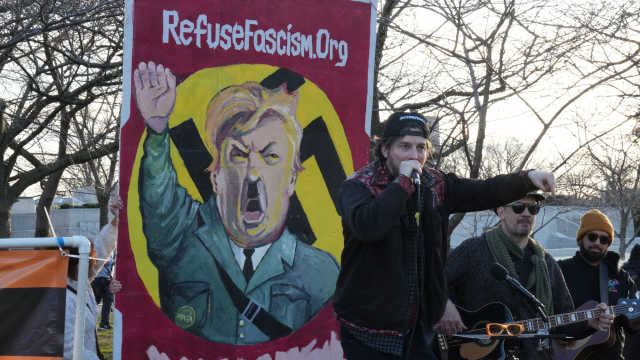
Language itself has been hijacked, bent to the will of a colonizing legacy steeped in hatred, disposability, genocide, and a culture of unapologetic cruelty. Neo-Nazis march without shame, white supremacists shape the conservative cultural machinery, and racist policies are no longer whispered but codified. Nazi salutes are back in fashion. Universities are increasingly transformed into sites of indoctrination and surveillance, more attuned to the logic of police precincts than places of critical learning. Students who dare to protest the genocidal assault on Palestinians in Gaza are abducted, vilified, and silenced. The most powerful white nationalist on the planet parades corruption as a political virtue and deploys state terror as a primary tool of governance. Solidarity is reconfigured into communities of hate, while resistance to fascism is rebranded as terrorism. Beneath these crimes against humanity lies a culture hollowed out by the absence of reason, moral clarity, and the capacity to hold power accountable. The ghost of fascism has not merely returned; it has taken up residence and been made ordinary.

The age of lofty visions has been cast aside, discarded like ideological refuse. Yet without such visions, rooted in the hard labor and hopeful promise of democracy and the critical function of education, we are left adrift. In their place stand administrators who act as high-powered accountants, students shaped by a culture of commodification and conformity, and a precarious academic labor force paid less than Wall-Mart greeters and clerks. Meanwhile, racism, white nationalism, and Christian fundamentalism gather momentum, extinguishing the flickering lights that once illuminated the path toward a radical democracy. When higher education no longer serves as a vessel for ethical imagination and collective hope, it becomes complicit in its own undoing, and with it, democracy itself teeters on the edge.

As educators, we must fight for a vision of higher education as both sanctuary and catalyst, a place where democracy is not only studied but enacted, where students are not trained to be efficient machines, but cultivated into thinking, feeling, and acting human beings. We need an education in which a culture of questioning is not punished but nurtured, where talking back is a civic virtue, and where the pursuit of equity and justice is central to the very purpose of teaching and learning. Such an education must be grounded in the principles of civic literacy, historical consciousness, and a systemic understanding of power—one that connects private troubles to public issues and expands the possibilities for individual and collective agency.

This is the foundation upon which a radical democracy must be built, and it is the defining pedagogical task of our time. If we fail in this responsibility, higher education will surrender its role as a vital civic sphere—one essential to producing the narratives, knowledge, and capacities that sustain the promise of equality, justice, freedom, and compassion. In abandoning that mission, it will not merely falter; it will aid in its own unraveling. And with it, democracy will edge ever closer to collapse.

Donald Trump understands this. That is why he fears critical education. That is why he wages war on it.

Wednesday, July 30, 2025

When American Greed is the Norm

Greed is no longer a sin in America—it’s a system. It’s a curriculum. It’s a badge of success. In the American higher education marketplace, greed is not the exception. It’s the norm.

We see it in the bloated salaries of university presidents who deliver austerity to everyone but themselves. We see it in billion-dollar endowments hoarded like dragon’s gold while students drown in debt. We see it in the metastasizing ranks of middlemen—consultants, online program managers, enrollment optimization firms—who profit off the dreams and desperation of working-class families.

But greed in American higher education is more than a few bad actors or golden parachutes. It is institutionalized, normalized, and weaponized.

The Student as Customer, the Campus as Marketplace

It began with the rebranding of education as a “return on investment,” a transaction rather than a transformation. The purpose of college was no longer to liberate the mind but to monetize the degree.

By the 1990s, under bipartisan neoliberal consensus, public colleges were defunded and forced to adopt the private sector’s logic: cut costs, raise prices, sell more. Tuition rose. Debt exploded. The ranks of administrators swelled while faculty were downsized and adjunctified. The market had spoken.

But even that wasn’t enough. A generation of edu-preneurs emerged—Silicon Valley-funded disruptors, for-profit college chains, and online program managers—who turned learning into a scalable commodity. Robocolleges like Southern New Hampshire University, Purdue Global, and the University of Phoenix began operating more like tech platforms than institutions of thought.

The result? Diploma mills at the front end and collection agencies at the back.

Greed in the Name of God and Country

Greed doesn’t always look like Wall Street. Sometimes it wears the face of morality. Religious colleges, some of them under the protection of nonprofit status, have become breeding grounds for political operatives and ideological grooming—while raking in millions through taxpayer-funded financial aid.

Liberty University, Grand Canyon University, and a host of lesser-known Bible colleges operate under a warped theology of prosperity, turning salvation into a subscription plan. Meanwhile, they push anti-democratic ideologies and funnel money toward political causes far removed from the mission of education.

Accreditation as a Shell Game

The accreditors—the supposed watchdogs of educational quality—have been largely asleep at the wheel or complicit. When greed is the norm, accountability is an inconvenience. For-profit schools regularly reinvent themselves as nonprofits. Online program managers operate in regulatory gray zones. Mergers and acquisitions disguise collapse as growth.

Accreditation agencies rubber-stamp it all, as long as the paperwork is tidy and the lobbyists are well-compensated.

Debt as Discipline

More than 43 million Americans carry federal student loan debt. Many will never escape it. This debt is not just financial—it’s ideological. It keeps the workforce compliant. It disciplines dissent. It renders critical thought a luxury.

And those who push for debt relief? They are met with moral lectures about personal responsibility—from the same lawmakers who handed trillions to banks, defense contractors, and fossil fuel companies.

Silicon Valley's Hungry Mouth

The new frontier of greed is AI. Tech giants like Google, Amazon Web Services, and Meta are embedding themselves deeper into education—not to empower learning, but to extract data, monetize behavior, and deepen surveillance. Every click, every quiz, every attendance record is a monetizable moment.

Universities, starved for funding and afraid of obsolescence, are selling access to students in exchange for access to cloud infrastructure and algorithmic tools they barely understand.

Greed Isn’t Broken—It’s Working as Designed

In this system, who wins? Not students. Not faculty. Not society.

The winners are those who turn knowledge into a commodity, compliance into virtue, and inequality into inevitability. Those who build castles from the bones of public education, then retreat behind walls of donor-backed endowments and think tanks. The winners are few. But they write the rules.

A Different Future Is Possible

If American greed is the norm, then what remains of education’s soul must be found in the margins—in the community college professor working three jobs. In the librarian defending open access. In the adjunct organizing a union. In the students refusing to be pawns in someone else’s game.

The antidote to greed is not charity—it’s solidarity.

Until justice is funded as well as football. Until learning is valued more than branding. Until access is more than a talking point on a donor brochure—then greed will remain not just a sin, but a system.


Sources

  • U.S. Department of Education, National Center for Education Statistics

  • The Century Foundation, “The OPM Industry: Profits Over Students” (2023)

  • Chronicle of Higher Education, “Administrative Bloat and the Adjunct Crisis”

  • IRS Nonprofit Filings, Liberty University and Grand Canyon University

  • Debt Collective, “The State of Student Debt” (2025)

  • Public records and audits of Title IV institutions, 2022–2024

  • Higher Education Inquirer archives

Saturday, July 19, 2025

Language in the Age of Fascist Politics (Henry Giroux)

In the age of expanding fascism, the power of language is not only fragile but increasingly threatened. As Toni Morrison has noted, “language is not only an instrument through which power is exercised,” it also shapes agency and functions as an act with consequences. These consequences ripple through the very fabric of our existence. For in the words we speak, meaning, truth, and our collective future are at risk. Each syllable, phrase, and sentence becomes a battleground where truth and power collide, where silence breeds complicity, and where justice hangs in the balance.

In response, we find ourselves in desperate need of a new vocabulary, one capable of naming the fascist tide and militarized language now engulfing the United States. This is not a matter of style or rhetorical flourish; it is a matter of survival. The language required to confront and resist this unfolding catastrophe will not come from the legacy press, which remains tethered to the very institutions it ought to expose. Nor can we turn to the right-wing media machines, led by Fox News, where fascist ideals are not just defended but paraded as patriotism. 

In the face of this crisis, Toni Morrison’s insight drawn from her Nobel Lecture becomes all the more urgent and makes clear that the language of tyrants, embodied in the rhetoric, images, and modes of communication characteristic of the Trump regime, is a dead language. For her “a dead language is not simply one that is no longer spoken or written,” it is unyielding language “content to admire its own paralysis.” It is repressive language infused with power, censored and censoring. Ruthless in its policing duties and dehumanizing language, it has no desire or purpose other than maintaining the free range of its own narcotic narcissism, its own exclusivity and dominance. “Though moribund, it is not without effect” for it actively thwarts the intellect, stalls conscience, and “suppresses human potential.” Unreceptive to interrogation, it cannot form or tolerate new ideas, shape other thoughts, tell another story, or fill baffling silences. This is the language of official power whose purpose is to sanction ignorance and preserve. 

Beneath its glittering spectacle and vulgar performance, lies a language that is "dumb, predatory, sentimental." It offers mass spectacles, a moral sleepwalking state of mind, and a psychotic infatuation for those who seek refuge in unchecked power. It forges a community built on greed, corruption, and hate, steeped in a scandal of hollow fulfillment. It is a language unadorned in its cruelty and addiction to creating an architecture of violence. It is evident in Trump’s discourse of occupation, his militarizing of American politics, and in his use of an army of trolls to turn hatred into a social media spectacle of swagger and cruelty.


Despite differing tones and political effects, the discourses of the far right and the liberal mainstream converge in their complicity: both traffic in mindless spectacle, absorb lies as currency, and elevate illusion over insight. The liberal mainstream drapes the machinery of cruelty in the language of civility, masking the brutality of the Trump regime and the predatory logic of gangster capitalism, while the far right revels in it, parading its violence as virtue and its hatred as patriotism. Language, once a powerful instrument against enforced silence and institutional cruelty, now too often serves power, undermining reason, normalizing violence, and replacing justice with vengeance. 

In Trump’s oligarchic culture of authoritarianism, language becomes a spectacle of power, a theater of fear crafted, televised, and performed as a civic lesson in mass indoctrination. If language is the vessel of consciousness, then we must forge a new one--fierce, unflinching, and unafraid to rupture the fabric of falsehood that sustains domination, disposability, and terror. The late famed novelist, Ngũgĩ wa Thiong’o, was right in stating that “language was a site of colonial control,” inducting people into what he called “colonies of the mind.”

The utopian visions that support the promise of a radical democracy and prevent the dystopian nightmare of a fascist politics are under siege in the United States. Increasingly produced, amplified and legitimated in a toxic language of hate, exclusion, and punishment, all aspects of the social and the democratic values central to a politics of solidarity are being targeted by right-wing extremists. In addition, the institutions that produce the formative cultures that nourishes the social imagination and democracy itself are now under attack. The signposts are on full display in a politics of racial and social cleansing that is being fed by a white nationalist and white supremacist ideology that is at the centre of power in the US—marked by fantasies of exclusion accompanied by a full-scale attack on morality, reason, and collective resistance rooted in democratic struggle. 

As more people revolt against this dystopian project, neoliberal ideology and elements of a fascist politics merge to contain, distract and misdirect the anger that has materialised out of legitimate grievances against the government, controlling privileged elites and the hardships caused by neoliberal capitalism. The current crisis of agency, representation, values and language demands a discursive shift that can call into question and defeat the formative culture and ideological scaffolding through which a savage neoliberal capitalism reproduces itself. This warped use of language directly feeds into the policies of disposability that define Trump's regime.

State Terror and Trump’s Politics of Disposability

As Trump’s regime concentrates power, he invokes a chilling convergence of law, order, and violence, a cornerstone of his politics of disposability. His acts of cruelty and lawlessness, abducting and deporting innocent people, branding immigrants as “vermin,” claiming they are “poisoning the blood” of Americans, and even proposing the legalization of murder for twelve hours, make clear that his violent metaphors are not just rhetorical flourishes. They are policy blueprints. In Trump’s hands, rhetoric becomes a weaponized prelude to atrocity, a tool of statecraft. Threats, hatred, and cruelty are transformed into instruments of governance.

This is not careless talk, it is a brutal and calculated expression of power. Trump’s threats to arrest and deport critics such as Zohran Mamdani reveal his willingness to use the machinery of the state for political extermination. His targets are predictable: immigrants, Black people, educators, journalists, LGBTQ+ individuals, and anyone who dares to challenge his white Christian nationalist, neoliberal, and white supremacist vision. His language does not merely offend, it incites harm, enacts repression, and opens the gates to state-sanctioned violence. It extends the reign of terror across the United States by labeling protesters as terrorists and deploying the military to American cities, treating them as if they were “occupied territories.” 

Trump is not alone. Many of his MAGA follower use these same hateful discourse. For instance, conservative pundit Ann Coulter wrote “in response to a speech by Melanie Yazzie, a Native artist and professor, about decolonization, “We didn’t Kill enough Indians.” This is not simply harsh rhetoric; nor is it a performative display of emboldened hatred and historical forgetting, it sets the stage for state-sanctioned repression and mass violence. What is at stake is more than civic respect. It is democracy itself. When language loses meaning and truth is blurred, tyranny thrives. Trump’s and too much of MAGA discourse is not about persuasion; it is about dehumanization and domination. It functions as statecraft, laying the groundwork for a society where suffering becomes spectacle and repression masquerades as law and order. Language is the canary in the coal mine, warning us that democracy dies without an informed citizenry.

As Eddie Glaude Jr. has powerfully argued, Americans must confront a brutal truth: the creation and expansion of Immigration and Customs Enforcement (ICE), now the largest federal law enforcement agency, is not merely a matter of policy, it is a cornerstone of white supremacy. It is a racist institution, entrenched in an immigration policy designed to uphold the values of white nationalism. In the face of shifting demographics, ICE is tasked with an urgent mission—to make America white again, a calculated attempt to turn back the clock on progress, to preserve an imagined past at the cost of justice and humanity.

We now live in a country where class and racial warfare both at home and abroad is on steroids, exposing the killing machine of gangster capitalism in its rawest, most punitive form. Trump supports the genocidal war waged by a state led by a war criminal. Children are being slaughtered in Gaza. Millions of Americans, including poor children, teeter on the edge of losing their healthcare. Funds for feeding hungry children are being slashed, sacrificed to feed the pockets of the ultra-rich. Thousands will die, not by accident, but by design. Terror, fear, and punishment have replaced the ideals of equality, freedom, and justice. Childcide is now normalized as the law of the land. The lights are dimming in America, and all that remains are the smug, ignorant smirks of fascist incompetence and bodies drained of empathy and solidarity.

Gangster Capitalism and the Death of Empathy

Gangster capitalism lays the foundation for Trump’s racist and fascist politics. As I have noted elsewhere, the United States has descended into a state of political, economic, cultural, and social psychosis, where cruel, neoliberal, democracy-hating policies have prevailed since the 1970s. At the core of this authoritarian shift lies a systemic war on workers, youth, Blacks, and immigrants, increasingly marked by mass violence and a punishing state both domestically and internationally. The U.S. has transformed into an empire dominated by a callous, greedy billionaire class that has dismantled any remnants of democracy, while embracing the fascistic ideology of white Christian nationalism and white supremacy. Fascism now parades not only beneath the flag but also under the Christian cross. 

America has shifted from celebrating unchecked individualism, as depicted in Ayn Rand’s Atlas Shrugged, to the glorification of greed championed by Gordon Gekko in Wall Street, and the psychotic avarice of Patrick Bateman in American Psycho. This descent into barbarity and psychotic infatuation with violence is further demonstrated by Justin Zhong, a right-wing preacher at Sure Foundation Baptist Church in Indianapolis, who called for the deaths of LGBTQ+ individuals during a sermon. Zhong defended his comments by citing biblical justifications and labeling LGBTQ+ people as "domestic terrorists." 

It gets worse. During a Men’s Preaching Night at Sure Foundation Baptist Church, Zhong's associate, Stephen Falco, suggested that LGBTQ+ people should "blow yourself in the back of the head," and that Christians should "pray for their deaths." Another member, Wade Rawley, advocated for violence, stating LGBTQ+ individuals should be "beaten and stomped in the mud" before being shot in the head. Fascism in America, nourished by the toxic roots of homophobia, now cloaks itself not just in the poisonous banner of the Confederate flag, but also in the sacred guise of the Christian cross.

Welcome to Trump’s America, where empathy is now viewed as a weakness and the cold rule of the market is the template for judging all social relations. One noted example can be found in the words of Trump’s on-and-off billionaire ally, Elon Musk, who dismisses empathy as a naive and detrimental force that undermines the competitive, individualistic ethos he champions. Speaking to Joe Rogan on his podcast, Musk specifically stated that “The fundamental weakness of western civilization is empathy.” As Julia Carrie Wong observes in The Guardian, the stakes extend far beyond casting empathy as a "parasitic plague." Empathy's true danger lies in its role as an enabler—granting permission to dehumanize others and constricting the very “definition of who should be included in a democratic state.” This is a recipe for barbarism, one that allows both states and individuals to turn a blind eye to the genocidal violence unfolding in Gaza and beyond.

Naming the Deep Roots of the Police State

Ruth Ben-Ghiat has warned that “America has been set on a trajectory to become a police state,” pointing to the passage of the Brutal and Bellicose Bill (BBB), which handed ICE a budget larger than the militaries of Brazil, Israel, and Italy combined. But the roots of this state violence go deeper. The foundation was laid under Bush and Cheney, whose war on terror birthed Guantanamo, Abu Ghraib, mass surveillance, and extraordinary rendition. What Trump has done is strip these earlier authoritarian practices of all pretenses, elevating them to the status of governing principles.

The police state did not begin with Trump; it evolved through him. Now, we see its terrifying maturity: racial cleansing disguised as immigration policy, hatred normalized as political speech, dissent criminalized, birthright citizenship threatened, and everyday life militarized. This is not politics as usual, it is fascism in real time.

Trump’s fascist politics grows even more dangerous when we recognize that his language of colonization and domination has helped transform American society into what Ngũgĩ wa Thiong’o chillingly describes as a “war zone.” This war zone now spans the digital terrain—through the internet, podcasts, social media, and educational platforms—becoming a fertile breeding ground for fascist symbols, reactionary values, manufactured identities, and the toxic resurrection of colonial logics. In this battleground of meaning, the language of colonization does more than obscure the truth—it erodes critical thinking, silences historical memory, and disarms the very possibility of empowered agency. What remains in its wake is a nation scarred by suffering, haunted by loneliness, bound by shared fears, and anesthetized by the numbing rituals of a punishing state.

The transformation of America into a war zone finds its most visible expression in the rise of Trump’s omnipresent police state. This authoritarian machinery reveals itself through the mechanisms of state-sponsored terror, a heavily militarized ICE force operating like masked enforcers, and the rapid expansion of detention centers that will increasingly resemble a network of potential forced labor camps. As Fintan O’Toole warns, Trump’s deployment of troops onto the streets of Los Angeles is not merely symbolic—it is “a training exercise for the army, a form of reorientation.” In this reorientation, soldiers are no longer defenders of the Constitution but are being retrained as instruments of authoritarian power, bound not by democratic ideals but by obedience to a singular will.

Nevertheless, we resist or refuse to name the fascist threat and the ideological and economic architecture of its politics. Still, we recoil from calling the Trump regime what it is: a fascist state engaged in domestic terrorism. Still, we remain blind to the fact that economic inequality, global militarism, and the genocidal logics of empire are not peripheral issues, they are the center. Why is it so difficult to admit that we are living in an age of American fascism? Why do the crimes of the powerful, at home and abroad, so often pass without scrutiny, while the victims are blamed or erased?

The Collapse of Moral Imagination

What we face is not only a political crisis, partly in the collapse of conscience and civic courage-- a profound moral collapse. The war being waged at home by the Trump regime is not just against immigrants or the poor, it is a war on critical thought, on historical memory, on the courage to dissent. It is a war on every institution that upholds critical thinking, informed knowledge, and civic literacy. This is a genocidal war against the very possibility of a just future—a war not merely against, but for stupidity, for the death of morality, and for the annihilation of any robust notion of democracy. Viktor Klemperer, in his seminal work The Language of the Third Reich, offers a crucial lesson from history: "With great insistence and a high degree of precision right down to the last detail, Hitler’s Mein Kampf teaches not only that the masses are stupid, but that they need to be kept that way, intimidated into not thinking." Klemperer’s analysis reveals that Nazi politics did not arise in a vacuum; it was cultivated in a culture where language itself was the breeding ground of cruelty and control.

Trump’s rhetoric of fear, racial hatred does not emerge in a vacuum. It resonates because it taps into a long and violent history, a history soaked in blood, built on genocide, slavery, colonialism, and exclusion. His language recalls the genocidal campaigns against Indigenous peoples, Black Americans, Jews, and others deemed disposable by authoritarian regimes. It is a necrotic lexicon, resurrected in service of tyranny. It gives birth to politicians with blood in their mouths, who weaponize nostalgia and bigotry, cloaking brutality in the false promises of patriotism and “law and order.”

Language as War and the Return of Americanized Fascism

This is not merely a rhetoric of cruelty, it is a call to arms. Trump’s words do not simply shelter fascists; they summon them. They silence dissent, normalize torture, and echo the logic of death camps, internment camps, and mass incarceration. His discourse, laden with hatred and lies, is designed to turn neighbors into enemies, civic life into war, and politics into a death cult and zone of terminal exclusion. Undocumented immigrants, or those seeking to register for green cards or citizenship, are torn from their families and children, cast into prisons such as Alligator Alcatraz, a grotesque manifestation of the punishing state. As Melissa Gira Grant writes in The New Republic, it is "an American concentration camp…built to cage thousands of people rounded up by ICE," constructed in a chilling display of colonial disregard, and erected on traditional Miccosukee land without so much as consulting the Tribe.

This is the face of modern cruelty: language wielded as a tool to orchestrate a spectacle of violence, designed to degrade, divide, and erase. Culture is no longer a peripheral force in politics; it has become the central weapon in the rise of state terrorism. The language of war and complicity normalizes America’s transformation into a monstrous carceral state, a symbol of state-sponsored terror where due process is suspended, and suffering is not just an outcome but the point itself. 

A culture of cruelty now merges with state sponsored racial terror, functioning as a badge of honor. One example is noted in Trump advisor Laura Loomer, who ominously remarked that "the wild animals surrounding President Donald Trump’s new immigration detention center… will have 'at least 65 million meals." Change.org, along with others such as Pod Save America co-host Tommy Vietor, noted that her comment “is not only racist, it is a direct emotional attack and veiled threat against Hispanic communities. This kind of speech dehumanizes people of color and normalizes genocidal language.” Her racist remark not only reveals the profound contempt for human life within Trump's inner circle but also highlights how cruelty and violence are strategically used as both a policy tool and a public spectacle. Loomer’s remark is not an aberration, it is a symptom of the fascist logic animating this administration, where death itself becomes a political message. Her blood-soaked discourse if symptomatic of the criminogenic politics fundamental to the working of the Trump regime.

The parallels to history are unmistakable. Loomer’s invocation of death as the outcome of detention recalls the Nazi designation of certain camps as Vernichtungslager, extermination camps, where as Holocaust survivor Primo Levi noted, imprisonment and execution were inseparable. Likewise, the U.S. internment of Japanese Americans during World War II, though often sanitized in public memory, operated under a similar logic of racial suspicion and collective punishment. The message in each case is clear, as Judith Butler has noted in her writing: some lives are rendered invisible, deemed unworthy of legal protection, of family, of dignity, of life itself. In fascist regimes, such spaces function not only as instruments of punishment but as symbolic theaters of power, meant to instill terror, enforce obedience, and declare which bodies the state has marked for erasure.

For Trump, J.D. Vance, and their ilk, fascism is not a specter to be feared but a banner to be waved. The spirit of the Confederacy and the corpse-like doctrines of white supremacy, militarism, and neoliberal authoritarianism have returned, this time supercharged by surveillance technologies, financial capital, and social media echo chambers. In the spirit of the Trump regime, the symbols of the Confederacy are normalized. Confederate flags are now waved by neo-Nazis in public squares and parades, while Trump renames US warships and 7 military bases after Confederate officers, reinforcing a dangerous nostalgia for a past rooted in racism and rebellion against the very ideals of unity and equality that this nation claims to uphold.

Higher Education and the Fight Against Authoritarianism

Read More

It should not surprise us that the American public has grown numb with the constant echo chamber of state terrorism playing out in multiple sites of attack. Powerful disimagination machines, mainstream media, right-wing propaganda platforms, tech billionaires, have flooded public consciousness with conspiracy theories, historical amnesia, and spectacularized images of immigrants and others being deported to prisons, foreign Gulags, and modern day black holes. These are not simply entertainment outlets; they are pedagogical weapons of mass distraction, breeding civic illiteracy and moral paralysis. Under their influence, the American people have been placed in a moral and political coma.

White Nationalism and Reproductive Control

Nowhere is this more evident than in the mainstream media’s failure to address the racial and ideological foundations of Trump’s agenda. His attacks on Haitian immigrants, the travel ban on seven African countries, the shutting down of refugee programs, and his open-door policy for white Afrikaners from South Africa are not merely racist; they are explicitly white nationalist. The same ideology drives attacks on women’s reproductive rights, revealing the deep racial and gender anxieties of a movement obsessed with white demographic decline. These are not isolated skirmishes, they are interconnected strategies of domination.

These converging assaults, white nationalism, white supremacy, patriarchal control, and militarized life, manifest most vividly in the war on reproductive freedom. White nationalists encourage white women to reproduce, to hold back demographic change, while punishing women of color, LGBTQ+ people, and the poor. It is a violent calculus, animated by fantasies of purity and control.

The Systemic Assault on Democracy

This is a full-spectrum assault on democracy. Every act of cruelty, every racist law, every violent metaphor chips away at the social contract. A culture of authoritarianism is now used to demean those considered other, both citizens and non-citizens, critics and immigrants, naturalized citizens and those seeking such status. They are labeled as unworthy of citizenship now defined by the Trump regime as a privilege rather than a right. Meanwhile, a media ecosystem built on clickbait and erasure renders both such fascists as legitimate while making invisible the roots of suffering mass suffering and fear, all the while, turning oppression into spectacle and silence into complicity.

In this fog, language itself is emptied of meaning. Truth and falsehood blur. As Paulo Freire warned, the tools of the oppressor are often adopted by the oppressed. We now see that the logic of fascism has seeped into the culture, eroding civic sensibility, destroying moral imagination, and rendering resistance almost unspeakable.

The Normalization of Tyranny

Trump’s authoritarian fantasies do not alienate his base, they galvanize it. What was once unthinkable is now policy. What was once fringe has become mainstream. Cruelty is not something to be deplored and avoided at all costs, it is a central feature of power, wielded with theatrical and spectacularized brutality. Under the current acting ICE Director, Todd Lyons, this punitive logic has intensified: Lyons oversees a $4.4 billion Enforcement and Removal Operations apparatus staffed by over 8,600 agents across 200 domestic locations, using militarized tactics, surprise raids, and aggressive targeting of immigrant communities to sustain a regime of fear. ICE’s presence is at the heart of Trump’s hyper-police state, and its funding has been greatly expanded to $170 billion under Trump’s new budget bill, creating what journalist Will Bunch calls Trump’s “own gulag archipelago of detention camps across a United States that’s becoming increasingly hard to recognize.”

Meanwhile, figures like Tom Homan, who led ICE under Trump’s first term, laid the groundwork with Gestapo-style operations, midnight raids, family separations, and public declarations that undocumented immigrants “should be afraid”. As the “border tzar” under Trump, Homan has initiated deportation policies that are even more aggressively violent and cruel that those that took place in Trump’s first term as president. As Bunch notes, take the case of “the 64-year-old New Orleans woman, Donna Kashanian, who fled a tumultuous Iran 47 years ago, volunteered to rebuild her battered Louisiana community after Hurricane Katrina, never missed a check-in with U.S. immigration officials , and was snatched by ICE agents in unmarked vehicles while she was out working in her garden and sent to a notorious detention center.” These horror stories now take place daily in cities extending from Los Angeles to Providence, Rhode Island.

A central player in this current regime of state terrorism, systemic racism, mass abductions, deportations, and the criminalization of dissent is Stephen Miller, Trump’s White House Deputy Chief of Staff. During Trump’s first term, Miller was the driving force behind the Muslim ban, the family separation policy, and assaults on birthright citizenship, all rooted in an unapologetic white supremacist and eugenicist worldview. In Trump’s second term, he has emerged as the architect of even more draconian measures, pushing for mass deportations, the abolition of birthright citizenship, and the revocation of naturalized citizenship for those who fall outside his white Christian vision of who deserves to be called American.

Far-right white nationalist such as Miller, Tom Homan and Todd Lyons, do not treat cruelty as a regrettable side effect. For them, cruelty is the currency of power. Suffering becomes a spectacle, and violence a ritual of statecraft. Tyranny is not inching forward in silence; it is advancing at full speed, cheered on by those who treat fear as a governing principle and pain as public policy. At stake here is what Timothy Snyder calls the practice of fascist dehumanization.

This is not a passing storm. It is the death throes of a system that has long glorified violence, commodified everything, and fed on division. Trump’s language is not a performance, it is preparation. His words are laying the foundation for a society without empathy, without justice, without democracy.

Reclaiming the Language of Resistance, Reclaiming Democracy

In a decent society, language is the lifeblood of democracy, a vessel of solidarity, truth, and hope. But in Trump’s America, language has become a weapon, dehumanizing, excluding, and dominating. His vision is not a warning; it is a blueprint. We must resist, or we risk losing everything. The stakes are nothing less than the survival of democracy, the retrieval of truth and the refusal to live in a world where cruelty is policy and silence is complicity. 

What is needed now is not only a rupture in language but a rupture in consciousness, one that brings together the critical illumination of the present with a premonitory vision of what lies ahead if fascist dynamics remain unchecked. As Walter Benjamin insisted, we must cultivate a form of profane illumination, a language that disrupts the spectacle of lies and names the crisis in all its violent clarity. At the same time, as A.K. Thompson argues, we must grasp the future implicit in the present. His notion of premonitions urges us to read the events unfolding around us as urgent warnings, as signs of the catastrophe that awaits if we do not confront and reverse the political and cultural paths we are on. It demands that we see the connections that bind our suffering, rejecting the fragmented reality that neoliberalism forces upon us. 

The time for complacency is past. The time for a new and more vibrant language, one of critique, resistance, and militant hope, is now. A language capable not only of indicting the present but of envisioning a future rooted in justice, memory, and collective struggle.

As Antonio Gramsci remarked in his Prison Notebooks, "The crisis consists precisely in the fact that the old is dying and the new cannot be born; in this interregnum a great variety of morbid symptoms appear." What is clear is that these morbid symptoms have arrived. Yet, alongside the despair they breed, they also present new challenges and opportunities for revitalized struggles. This is where the power of language comes into play—this is the challenge and opportunity for those who believe in the transformative power of culture, language, and education to address not just the nature of the crisis but its deeper roots in politics, memory, agency, values, power, and democracy itself.

[This article first appeared in the LA Progressive.]


By Henry A. Giroux

Henry A. Giroux currently holds the McMaster University Chair for Scholarship in the Public Interest in the English and Cultural Studies Department and is the Paulo Freire Distinguished Scholar in Critical Pedagogy. His latest book is The Burden of Conscience: Educating Beyond the Veil of Silence (Bloomsbury in 2025). He is LA Progressive's Associate Editor. His website is www.henryagiroux.com

Monday, July 28, 2025

Empire in Decline: What the Fall of Rome Tells Us About the American Oligarchy

There are tax farmers squeezing a province dry. There are soldiers fighting for the emperor's baton. And then there are a few who dread the empire's fall and dream of the old republic.

This is not just the story of ancient Rome. It's also an apt metaphor for the state of contemporary America—a late-stage empire defined by extreme inequality, militarization, and a governing class that clings to power while the social fabric unravels.

In Rome, the Senate once stood as the heart of the Republic, composed of elite Patrician families who wielded enormous religious, political, and economic influence. But as historian and economist Michael Hudson writes in The Collapse of Antiquity, these elites became entrenched creditors and landlords, a rentier class unwilling to compromise or adapt. They refused debt cancellation, land redistribution, or any reforms that might curb their power—transforming what was once a dynamic, if imperfect, republic into a brittle and parasitic empire.

This refusal to evolve created an unsustainable system. Wealth concentrated in fewer hands. Small farmers and urban workers were crushed under debts. The rural economy collapsed as latifundia (large estates) displaced independent farmers. Military commanders, frustrated with elite gridlock, seized power for themselves. And the Senate, once a genuine force of governance, became a ceremonial shell. What followed was a long descent: civil wars, authoritarianism, economic stagnation, and eventually the re-feudalization of the West.

Hudson’s view is clear: the Roman Senate and elite, by prioritizing their creditor rights over the common good, destroyed the economic base that sustained the Empire. In their greed and rigidity, they ensured the fall they feared.

Now consider the United States. Like Rome, America has become dominated by a professional ruling class: oligarchs, financiers, tenured politicians, credentialed technocrats, and think-tank warriors. Institutions of higher education, once engines of democratic possibility, have increasingly become training grounds for this elite. And like the Roman Senate, they are largely unaccountable—privatizing gains, socializing losses, and suppressing reform.

Just as Roman tax farmers drained the provinces, today’s student loan servicers, for-profit colleges, and hedge fund–backed housing firms squeeze the public to fund private empires. Just as Roman generals became emperors, today’s billionaires and media moguls wield near-sovereign power over public discourse, elections, and foreign policy. And just as the Roman elite clung to legal fictions while society crumbled, our ruling class insists the republic is healthy—even as inequality soars, infrastructure decays, and democratic norms erode.

There are still those who long for a return to the "old republic"—to a time when education was a public good, when civic virtue mattered, and when government sought the common welfare. But those voices are increasingly drowned out in a landscape of imperial spectacle, culture wars, and managed decline.

Hudson reminds us that ancient societies that survived economic collapse—like those in Mesopotamia—did so by recognizing the need for periodic resets. They canceled debts. They redistributed land. They prioritized stability over elite entrenchment. Rome—and perhaps America—refused to learn those lessons.

In this moment of crisis, the choice is stark: will we continue down the path of empire, ruled by debt and extraction? Or will we recover some measure of republic, with institutions that serve people, not just capital?

One thing is certain: empires fall. But their people don’t have to fall with them—if they choose to resist.

Sources:

  • Michael Hudson, The Collapse of Antiquity: Greece and Rome as Civilization's Oligarchic Turning Point, 2023

  • Mary Beard, SPQR: A History of Ancient Rome, 2015

  • Edward Gibbon, The Decline and Fall of the Roman Empire, 1776–1789

  • Kyle Harper, The Fate of Rome: Climate, Disease, and the End of an Empire, 2017

  • Higher Education Inquirer, ongoing coverage on student debt and elite university structures

  • U.S. Department of Education, data on student debt and institutional concentration of resources

Wednesday, June 18, 2025

Fintech’s Student Loan Empire in the Age of Trump

As the second Trump administration wages war on the Department of Education, disbands regulatory protections, and openly courts billionaires over borrowers, another machine continues humming in the background—one that rarely makes headlines but stands to profit from the coming deluge of student loan defaults.

Enter Credible, LendKey, Purefy, and Splash Financial—a quartet of fintech firms with shiny websites, soothing interfaces, and predatory precision. Together, they represent a new face of student debt capitalism, where algorithms replace accountability and refinancing replaces relief.

With federal repayment programs in disarray and income-driven repayment options under political attack, these platforms are poised to scoop up disoriented borrowers, offering them lower rates in exchange for their last shred of protection. In this era, fintech isn’t just a workaround to broken federal systems. It’s a weaponized mechanism of privatization, hiding in plain sight.


Credible: Fox News Meets Finance

Credible, a loan comparison site launched in 2012 and bought by Fox Corporation for $265 million, exemplifies the corporate convergence of media, politics, and predatory finance. Its business model is simple: steer borrowers to private lenders and collect a fee.

What makes Credible especially dangerous now is its backing by Rupert Murdoch’s empire, giving it privileged placement across conservative media. In the Trump era, where truth and financial ethics are negotiable, Credible becomes part of the machinery: a platform peddling student loan refinancing under the banner of “freedom” and “individual responsibility.”

Its prequalified offers may seem consumer-friendly, but the reality is more sinister: borrowers lose access to Public Service Loan Forgiveness (PSLF), income-driven repayment, and federal deferment rights—often without full disclosure. And there’s no federal watchdog left with the teeth to stop it.


LendKey: Privatization via Local Lending

Once hailed as a democratizing force in student lending, LendKey now serves as the gateway for credit unions and small banks to enter the refinancing market. By providing digital infrastructure and loan servicing, LendKey enables even the smallest financial institution to compete in the debt arms race.

But it’s no populist hero. In a Trumpian economy where regulatory oversight is gutted, LendKey helps funnel borrowers from federal protections into private debt with fewer rights and more risk. Its loans are marketed with community-friendly language, but behind the scenes they’re just another piece in a growing puzzle of financialization.

As the default rate ticks up—and it will, with millions unprepared for repayment—LendKey's partner institutions may face waves of delinquency. But LendKey still profits, regardless of whether its borrowers sink.


Purefy: Elite Refinancing in an Age of Collapse

Purefy, partnered closely with Pentagon Federal Credit Union (PenFed), continues to focus on white-collar borrowers and high-income households. With its niche offerings—like spousal loan refinancing and Parent PLUS buyouts—Purefy doesn’t hide its demographic targets. It’s a platform for the haves—not the have-nots.

Now, in a Trump-led America where debt relief is dead on arrival, Purefy serves as a lifeboat for select borrowers, mostly those with six-figure incomes and perfect credit. For everyone else, there’s no rescue—just rising interest, frozen wages, and default letters.

What’s worse: Purefy’s slick interface masks its private lending alliances, and borrowers often don’t know whether their servicer is PenFed, ELFI, or someone else entirely. Transparency, once a fintech virtue, has eroded into strategic ambiguity.


Splash Financial: A Fintech Platform for the 1%

Initially built to refinance medical school debt, Splash Financial has expanded into a broader fintech infrastructure role, helping banks and credit unions deploy private loan products under white-label brands. Recently acquired by Nymbus, Splash is less about helping borrowers and more about selling digital weaponry to lenders.

Its target demographic—doctors, dentists, tech professionals—is largely insulated from the coming crash. But as student loan interest rates climb and defaults spike, Splash stands to gain by filtering the "creditworthy" from the desperate, feeding clean data to lenders while offloading risk onto consumers.

In the new political regime, where borrowers are told to “pay what they owe” and compassion is framed as weakness, Splash’s business model looks less like innovation and more like extraction by design.


The Coming Storm: Defaults and Deregulation

Federal student loan payments have resumed, but millions are behind or confused. The SAVE plan is under legal attack. Forbearance options are shrinking. Servicers are overwhelmed or deliberately opaque. The Biden-era reforms are being dismantled, and debt relief promises are evaporating under Trump’s budget cuts and executive orders.

This is a perfect storm for fintech lenders. As traditional repayment plans implode, desperate borrowers will turn to refinancing offers—many not realizing that by switching to private loans, they’re permanently shutting the door on cancellation, forgiveness, or manageable repayment plans.

In this new default economy, the winners are not educators or students—but platforms like Credible, Purefy, LendKey, and Splash. They won’t bear the burden of broken promises or economic ruin. They’ll take their cut, rinse, and repeat.


An Engine of Extraction

This is not innovation. It is not disruption. It is digital debt peonage, dressed in Silicon Valley branding and sold as financial freedom.

In the second Trump administration, student loan fintech is flourishing, not in spite of the chaos—but because of it. These companies are the beneficiaries of policy neglect, privatization, and regulatory retreat. They are the corporate middlemen of misery, accelerating the financial collapse of an entire generation.

If there’s a future reckoning for student debt in America, it won’t begin on a campaign trail or in a press conference. It will begin with the simple question: Who profits when borrowers fail?

Sunday, August 24, 2025

The Death of Education Is the Death of Democracy (Henry A. Giroux)

Trump’s War on Memory and Education

Fascism does not only occupy institutions; it occupies memory and views education as a battleground. It dictates what is remembered and what is silenced, ensuring that alternative visions of history and democracy cannot take root.  What must be grasped, if fascism is to be resisted, is that it is not merely a political order but as Ergin Yildizoglu notes is a pedagogical regime, a machinery of teaching and unlearning, of shaping consciousness itself through aesthetics, media, and the algorithmic reach of artificial intelligence. Its pedagogy is one of domination: it scripts emotions, dictates values, and implants narratives that define who must be hated, who must be forgotten, and who must remain invisible.

Fascism does more than capture the state; it colonizes language, memory, and identity. It erases the past by silencing historical memory, narrows the horizons of imagination, and drains public life of critical vitality. It produces subjects who are loyal not to truth but to power, obedient not to conscience but to command. This is the ultimate aim of pedagogical terrorism: not only to militarize the state, knowledge, and values, but to also militarize the mind. By narrowing what can be said, remembered, or imagined, it criminalizes dissent and turns language itself into an arsenal of cruelty. Under Trump, fascism is not only a militarized spectacle, it is a model of war. If fascism is not only a government, a form of gangster capitalism, but also a culture, the fight against it must not only be economic, ideological, but also pedagogical space where education becomes central to politics and culture speaks to individuals in a language in which they can both recognize themselves and organize into a mass movement.

As Antonio Gramsci, in the Prison Notebooks, reminded us, “all politics is pedagogical.” If fascism teaches fear, cruelty, and obedience, then resistance must teach solidarity, critical memory, and the courage to imagine a different future. Against fascism’s pedagogy of dispossession, we must cultivate a pedagogy of liberation—one that expands the field of the possible, restores the dignity of memory, and reclaims language as a weapon for democracy rather than domination.

Democracy cannot survive without memory or it runs the risk of turning itself into an authoritarian state. It requires citizens to confront injustice, to learn from the crimes of the past, and to imagine futures that do not repeat them. William Faulkner’s warning still resonates: “The past is never dead. It’s not even past.”  In America today, history itself has become a battleground. The ghosts of slavery, Jim Crow, and white supremacy remain with us, shaping institutions and social life. As Angela Davis reminds us, we live with these ghosts every day. The real question is whether we choose to acknowledge them, or to erase them. For when a society turns away from its own horrors and promotes forms of historical amnesia, what kind of culture is normalized? What political order emerges from the silence of forgetting? Under Trump, we have already been given a terrifying answer: a society organized around violence: against immigrants, Black people, youth, students, dissidents, women, the unhoused, and all those who fail the regime’s loyalty test to white Christian nationalism.

As sociologist Zygmunt Bauman observed, our times are not marked simply by the fading of collective memory, but by “the aggressive assault on whatever memory remains.” That assault takes the form of book bans, censorship, intimidation of educators, and the replacement of critical history with patriotic myth. Kimberlé Crenshaw has noted that the panic over “critical race theory” was never about pedagogy, it was an attempt to whitewash slavery and racism from the national narrative. The suppression of historical memory produces not only ignorance but moral paralysis. As Robert Jay Lifton warned, erasure of the past creates a psychic numbing, a diminished capacity to feel and act against injustice. Forgetting is never neutral. It is a political strategy. Under the Trump regime it has become a central element in a war against democracy, informed citizens, the truth, and rationality. Put bluntly, it has become a central tool in the weaponization against literacy, knowledge, consciousness, and critical agency.

This is domestic terrorism, rooted not only in incendiary words but in their violent translation into state policy. It is the organized weaponization of fear, the calculated deployment of intimidation and cruelty to hollow out democratic life and silence dissent. It is a deliberate assault on citizens, on institutions, and on every idea that refuses to bow before authoritarian power. As John Ganz observes, under Trump, citizenship ceases to be an inalienable right; it becomes a conditional prize, a privilege dispensed at will. In Trump’s hands, it is both gift and bludgeon, “a transferable and revocable commodity,” bestowed on the loyal and withheld or revoked from the condemned. Wielded as a threat, it enables the regime to deport, to banish, to resurrect the ancient horror of statelessness, expelling individuals not only from the nation but from humanity itself. In this sense, Ganz is right: Trump’s assault on citizenship is not merely reactionary; it bears the unmistakable mark of fascism, the totalitarian logic that decides who counts as human and who may be erased. 

Appropriating Achille Mbembe’s notion of  necropolitics, domestic terrorism is where political power thrives by reducing human life to disposable, expendable objects. Under the Trump regime, this takes the form of a violent, racialized project that merges capital accumulation with the subjugation of marginalized groups. His policies—driven by a toxic mix of racial hierarchy, xenophobia, and the celebration of violent histories—create a society where certain lives are deemed unworthy of protection or consideration. This regime operates on a death drive, relentlessly attempting to eliminate both the lives and futures of those who resist or defy its vision. In this environment, the space for dissent shrinks, historical amnesia thrives, leaving only room for those willing to submit to the dominance of a fascist, authoritarian regime.

This war on memory is not just theoretical; it takes concrete form in the attacks on institutions that hold our collective history. Under Donald Trump and the MAGA movement, memory, let alone history itself, is under siege. What we face is not neglect but an orchestrated assault fueled by a systemic violence of forgetting, and the whitewashing of the past that echoes the darkest traditions of fascism. For Trump, any reckoning with slavery, Jim Crow, or the long arc of racial violence is treated as an unforgivable stain on America’s story. Equally intolerable are the histories of resistance, by workers, Black communities, women, immigrants, and LGBTQ people, all of which he and his allies disparage as “woke” ideology. As journalist Dean Blundell recently observed, “In recent days, he has attacked the Smithsonian Institution as ‘out of control,’ insisting its museums focus too much on ‘how bad slavery was.’ His administration has ordered a 120-day review of eight Smithsonian museums and hinted that funding could be used as leverage to ‘get the woke out.’ The message lands with the subtlety of a hammer: make the story brighter, or else. This is not a debate about one label or a curatorial tone. It’s an attempt to police memory.” The policing of history is not incidental; it is central to Trump’s authoritarian project and nowhere is this clearer than in his attack on the Smithsonian.

Censoring the Smithsonian

In March 2025, Trump signed an executive order targeting the Smithsonian Institution, declaring its exhibits were corrupted by “improper ideology.” Trump argued that the “Smithsonian museums were ‘out of control’ and “painted the country in a negative light, including about slavery.” The language of the order feigned neutrality, but the intent was unmistakably authoritarian: to sanitize the nation’s cultural memory. For Trump, As the White House “focused on seven museums for their exhibits and messaging,” the chilling effect was immediate. References to Trump’s two impeachments quietly vanished from an exhibit on the “Limits of Presidential Power.” What had been a straightforward record of checks on executive abuse was erased in real time, as though history itself could be made to serve the whims of power.

This was no isolated act of censorship. Trump has repeatedly sought to bend the past to his will, recasting the violent January 6th insurrectionists as “hostages,” stripping diversity and equity programs of content that celebrated Black history, and encouraging allies to push bills that would defund schools for teaching that the nation’s founding documents were entangled with slavery. The thread binding these assaults together is clear: the authoritarian logic of erasure. Memory is to be disciplined, history domesticated, truth is subordinated  to the spectacle of Trump’s political theater. What is at stake is not simply the content of museum exhibits or school curricula, it is whether democracy itself can survive without an honest reckoning with its past. As history warns us, fascist regimes--from Hitler’s book burnings to Franco’s cultural purges--have always begun their reign of terror by waging war on memory. The thread uniting these efforts is the logic of erasure: history must serve power, never truth.

From Nazi Germany to Trump’s America

The Trump era’s assault on memory recalls, in chilling ways, the memory politics of Nazi Germany. In 1933, Nazi officials staged massive book burnings, consigning to the flames the works of Jewish authors, feminists, Marxists, and anyone deemed “un-German.” These were not just acts of censorship, they were spectacles of purification. Fire was the ritual through which dissent was eradicated and mythic unity forged. Schools and universities were purged of Jewish and oppositional voices, textbooks rewritten, and history recast as propaganda for the racial state.

The United States has not replicated those bonfires, but the spirit is unmistakable. Books by Toni Morrison, James Baldwin, and Margaret Atwood are being pulled from libraries. Governors stage press events around banned books, turning censorship into political theater. Viral videos of parents denouncing “divisive concepts” in classrooms circulate widely, feeding the illusion that banning history is an act of protection.

The attack on the Smithsonian, the banning of books, the silencing of universities, and the stigmatization of “woke” as a code word for racial justice and historical truth all make visible how white supremacy fuels the cleansing project of authoritarianism. The assault on memory and historical consciousness connects strongly with a wider pedagogy of repression and the attempts on the part of MAGA ideologues to turn public and higher education into crude laboratories of indoctrination. In one particular instance, this  project takes a  particularly grotesque form, as with Oklahoma’s Ryan Walters requiring applicants from “liberal states” to pass an anti-woke test before teaching. These assaults on memory are also an assault on critical thinking, critical pedagogy, and civic literacy. It is crucial to view them as anything but isolated. They are part of a systematic effort to weaponize education, culture, and memory to manufacture a fascist subject, passive, obedient, and stripped of critical thought. Primo Levi warned that “wherever you begin by denying the fundamental liberties of mankind and equality among people, you move towards the concentration camp system.” Forgetting, he argued, is the first step toward barbarism. The lesson of Nazi Germany is that erasing memory is not collateral to authoritarianism, it is central to it.

Conclusion:  The burden of memory and the centrality of education to politics

At the heart of Trump’s war on memory lies an act of pedagogical terror, a poisoning of history and the transformation of culture into a blunt instrument of indoctrination. To resist this death of memory is to recognize that the fight for democracy cannot be separated from the fight over history, over culture, and over the economic forces that shackle both under gangster capitalism. To defend truth is to defend freedom; to erase history is to pave the road to authoritarianism. Trump’s censorship of the Smithsonian, his bans on books, and his whitewashing of slavery are not mere cultural disputes. They are weapons aimed at the very life of democracy. Culture is never simply a mirror of society; it is a battlefield that shapes how we imagine the world and our place within it. In a time when neoliberalism and fascism bleed into each other, culture becomes the decisive ground where narratives of domination collide with possibilities of resistance. Authoritarians seek to turn it into a machinery of obedience, silencing dissent and numbing consciousness. Yet culture also holds the fragile, indispensable power to ignite memory, nourish critical thought, and keep alive the hope of resistance.

At the heart of this project lies a war over culture and consciousness.  Antonio Gramsci, in the Prison Notebooks, warned that every political struggle is also a struggle over pedagogy, over who shapes the common sense of a society. Paulo Freire reminded us that education is never neutral--it either nurtures liberation or reinforces domination. Trump’s pedagogy of repression seeks nothing less than a populace severed from memory, stripped of critical thought, and rendered compliant to authoritarian power. What is at stake is not simply the narcotic of censorship and erasure, but the calculated use of state terrorism to fashion a fascist subject, anti-intellectual, morally hollow, obedient to authority, and emptied of democratic agency. The United States has become a warfare state, where the instruments of militarization and the machinery of control no longer remain at the edges of empire but are turned inward, disciplining culture, stifling memory, and colonizing everyday life under the banner of “law and order.” What once was unleashed abroad in the name of empire now circulates within, producing citizens as enemies and culture itself as a battlefield. War should be a warning; under Trump it has become theater, a grotesque spectacle where cruelty parades as civic virtue.

If democracy is to endure, memory must be defended with the same ferocity as freedom itself. Yet remembrance alone is not enough. What is required is a critical culture that binds past and present, a pedagogy that transforms historical consciousness into collective action. The ghosts of Auschwitz, of Jim Crow, of January 6th, remain with us, not as abstractions but as urgent reminders of the abyss that awaits when memory is erased. Our responsibility is to teach, to narrate, and to reimagine, so that memory itself becomes an act of resistance. Only by turning remembrance into struggle can we block the return of barbarism and reclaim democracy as a living, unfinished experiment in freedom. Only through mass movements of organized resistance can we dismantle the machinery of ignorance, disposability, and death that now threatens the remnants of American democracy.

In the end, culture remains the decisive ground where radical democracy either withers under authoritarian rule or is reborn as the terrain of resistance and hope. What is clear is that the Trump regime does not merely flirt with fascism, it embodies it, hurling the United States over the abyss. And that abyss stretches far beyond American borders. Trump arms Netanyahu, an indicted war criminal who wages genocide against the Palestinian people with impunity; he aligns himself with dictators like Russia’s Vladimir Putin, India’s Narendra Modi, Argentina’s Javier Gerardo Milei, El Salvador’s Nayib Bukele, and others who traffic in repression, violence, and cruelty. The warfare state is drenched in blood. Resistance is no longer a choice; it is a necessity that sears the conscience, demanding action.

Charlotte Delbo, an Auschwitz survivor, pleaded in A Prayer to the Living to Forgive Them for Being Alive: “You who are passing by, I beg you, do something…to justify your existence…because it would be too senseless after all for so many to have died while you live doing nothing with your life.” Her words reverberate through time, transcending the horrors of a specific moment in history, and call us to a moral reckoning we cannot ignore. The choice before us is unambiguous: silence or resistance, complicity or memory, barbarism or democracy. The weight of this decision cannot be overstated. The time to act is now, for what is at stake is not just our collective humanity, but the very survival of democracy itself.

Friday, December 19, 2025

The University of Austin’s Ideological Overreach: A Critical Look at the “Higher Education” Alternative

The University of Austin (UATX) markets itself as the cure for the alleged decay of American universities—a “fearless pursuit of truth” dedicated to restoring rigor, patriotism, and civic virtue. In a recent fundraising appeal, UATX’s president Carlos Carvalho argued that America’s youth have been “miseducated, unwise, and confused” by elite institutions and that only UATX’s model can reverse these trends.

But beneath the rhetoric lies a deeply ideological project that raises serious questions about educational substance, inclusivity, and the influence of wealthy backers. Rather than addressing the structural challenges facing higher education, UATX simplifies complex societal shifts into a moral blame game, offering solutions grounded in a narrow set of political and cultural assumptions.

A Narrow Diagnosis for a Complex Problem

UATX highlights surveys showing declining patriotism among young Americans and growing interest in alternative economic systems such as socialism. The university concludes that mainstream universities are to blame for this generational malaise—a claim both simplistic and selective. Attitudes toward identity, governance, and civic life are shaped by economics, media, community, and lived experience, not solely by seminar-room pedagogy. Reducing broad societal trends to grading policies or curriculum choices obscures complexity and risks promoting moral panic over reasoned analysis.

UATX’s Prescriptions: Tradition Over Inquiry

The university champions meritocratic admissions emphasizing test scores, small seminars, and strict grading as antidotes to the so-called “gutting of academic standards.” While rigorous study has value, these proposals reflect a particular vision of education: one centered on classical Western texts, narrow definitions of excellence, and pedagogical models that prioritize conformity over intellectual exploration. Rather than fostering openness, this approach risks reinforcing orthodoxy.

Donors, Ideology, and Influence

UATX rejects tuition and government support in favor of private philanthropy, a choice that amplifies questions of ideological influence. The university’s early and major backers are heavily aligned with conservative and libertarian priorities, raising doubts about whether the institution can serve as a genuinely neutral forum for intellectual inquiry. Notable supporters include Jeff Yass, billionaire co-founder of Susquehanna International Group and major Republican donor, who pledged $100 million to UATX, launching a $300 million campaign; Harlan Crow, real estate developer and GOP donor, reported as an early backer; Len Blavatnik, investor whose family foundation has donated to UATX; and Bill Ackman, hedge fund manager supporting UATX’s free-speech mission.

Founders and trustees include Bari Weiss, journalist and co-founder who remains a trustee, framing UATX as a response to “censoriousness” in higher education; Joe Lonsdale, venture capitalist and founding trustee linked to UATX’s fiscal sponsor; and Niall Ferguson, Pano Kanelos, and others who played founding leadership roles. The concentration of wealth and ideological alignment among donors raises pressing questions: can a university built on such a foundation truly function as a neutral intellectual space?

Alarmism, Ideology, and Academic Freedom

UATX portrays mainstream universities as ideologically monolithic and hostile to free speech. Critics note that such framing conflates disagreement with censorship, overlooking the robust debates already occurring on campuses nationwide. Moreover, by marketing itself as an alternative to “woke indoctrination,” UATX signals a particular cultural orientation rather than offering a neutral platform for diverse perspectives.

Ideological Branding—not Educational Transformation

UATX presents itself as an education revolution. Yet its model appears more rooted in ideological branding than in addressing real structural and pedagogical challenges: affordability, accessibility, genuine academic freedom, and engagement with both classical and contemporary ideas. True reform demands more than a privately funded bubble of aligned donors and like-minded students; it requires grappling with complexity rather than caricaturing crisis.

Sources 

Green, Erica L. At the U. of Austin, a Raft of Departures Leaves More Questions Than Answers. Chronicle of Higher Education.
Zaleski, Olivia. Austin’s Anti‑Woke University Is Living in Dreamland. The New Republic.
Smith, Helen. Is the University of Austin Betraying Its Founding Principles? Quillette.
CBS News. UATX Launches, Touting Ideological Openness and Debate.
Austin Monthly. How the So‑Called University of Austin Is Faring Nearly Two Years After Conception.
Chron.com. University of Austin Staff Exodus.
Reformaustin.org. GOP Donors Pour Millions Into Anti‑Woke University in Texas.
Salon.com. Bari Weiss’ Field of Right‑Wing Dreams: Will the University of Austin Ever Actually Exist?