Search This Blog

Showing posts sorted by relevance for query tech. Sort by date Show all posts

Monday, December 8, 2025

Higher Education and the Culture of Silence

American higher education presents itself as a beacon of truth, courage, and critical inquiry. Yet behind the marketing gloss lies a pervasive culture of silence—one that extends far beyond colleges and universities themselves. The same forces that suppress dissent on campus operate through a larger ecosystem of nonprofits, contractors, ed-tech companies, and “public-private partnerships” that orbit higher ed. Together, they form a network of institutional interests that reward secrecy, punish whistleblowers, and prioritize reputation and revenue over honesty and accountability.

At the center of this system are nondisclosure agreements. NDAs are now standard tools not only in universities, but in the foundations that support them, the think tanks that shape education policy, and the ed-tech corporations that extract profit from student data and public subsidies. Whether a case involves workplace retaliation, fraudulent recruitment, financial misconduct, algorithmic harm, or student exploitation, NDAs are used to hide patterns of abuse and protect organizations from scrutiny. What gets buried is not just information—it is the possibility of reform.

The threat of litigation is part of the same architecture. Universities, nonprofits, and ed-tech companies routinely rely on aggressive legal strategies to silence critics. Workers attempting to expose unethical contracts, deceptive marketing, or discrimination face cease-and-desist letters. Researchers who publish unflattering findings are pressured to retract or soften their conclusions. Students raising alarms about data privacy or predatory practices encounter legal intimidation disguised as “professional communication.” These organizations—flush with donor money, investor capital, or public funds—use lawsuits and threats of lawsuits as shields and weapons.

Leadership across this broader ecosystem is often weak, conflicted, or corrupt. University presidents beholden to trustees are mirrored by nonprofit executives beholden to major donors, and by ed-tech CEOs beholden to venture capital. Many leaders prioritize political favor, philanthropic relationships, and corporate growth over the public interest. They outsource accountability to law firms, PR agencies, and consulting outfits whose job is not to fix problems but to bury them.

And circulating through this system is the same cast of characters: politicians chasing influence, lawyers crafting airtight silence, consultants selling risk-mitigation strategies, bean counters manipulating data, and conmen repackaging failed ideas as “innovation.” The lines between nonprofit, corporate, and educational interests have blurred to the point of erasure. Trustees who shape campus policy sit on nonprofit boards. Ed-tech companies hire former university officials and then market themselves back to campuses. Donors direct funds through philanthropic intermediaries that simultaneously pressure institutions for access and silence.

The victims of this system—faculty, staff, gig workers in tech and nonprofit roles, graduate students, undergraduates, and even the communities surrounding campuses—are pressured to comply. They face retaliation in the form of job loss, non-renewal, demotion, academic penalties, professional blacklisting, or immigration vulnerabilities. Whistleblowers are isolated. Critics are surveilled. And when the fallout becomes too public to contain, institutions rely on payouts—quiet settlements, buyouts, and confidential agreements that allow perpetrators to move seamlessly to their next institution or company.

This culture of silence is not a collection of isolated incidents. It is a structural feature of modern higher education and the industries built around it.

But it is not unbreakable.

If you have experienced or witnessed this culture—whether in a university, a higher-ed nonprofit, or the ed-tech world—the Higher Education Inquirer invites you to share your story. You may do so publicly or anonymously. We understand the risks. We know many people cannot speak openly without jeopardizing their jobs, degrees, or health. Anonymous accounts are welcome, valued, and protected.

Your story, no matter how brief, can help illuminate the patterns that institutions spend billions to obscure. Silence is what sustains the system. Truth—shared safely and collectively—is what can dismantle it.


Sources

  • Elisabeth Rosenthal, An American Sickness

  • Alondra Nelson, Body and Soul

  • Harriet A. Washington, Medical Apartheid

  • Rebecca Skloot, The Immortal Life of Henrietta Lacks

  • Reporting from the Higher Education Inquirer on university corruption, NDAs, donor influence, and ed-tech abuses

  • Investigations into nonprofit and ed-tech misconduct published in public records, court filings, and independent journalism

Thursday, July 3, 2025

How the Trump Spending Bill Undermines U.S. National Security—and Strengthens China and Russia

The Trump-backed spending bill, now back in the U.S. House after passing the Senate, is a masterclass in short-term thinking and long-term self-destruction. Framed as a “Big, Beautiful” plan to restore fiscal discipline and American greatness, the legislation guts the very pillars of U.S. national power: public education, scientific research, clean energy innovation, and social stability. While it throws billions at the Pentagon and fossil fuel subsidies, it slashes the public investments that actually determine whether a country can compete in the 21st century.

By hollowing out education, defunding clean energy programs, and dismantling the civilian R&D infrastructure, the bill hands strategic advantages to authoritarian competitors like China and Russia. It weakens America not through direct confrontation—but through willful neglect of the systems that make a nation resilient, adaptable, and globally influential.

Gutted: America's Brainpower and Knowledge Economy

The spending bill imposes major cuts to federal funding for public colleges, student aid programs, and agencies like the National Science Foundation (NSF), National Institutes of Health (NIH), and Department of Energy’s Office of Science. These institutions are not bureaucratic waste—they are engines of innovation that fuel entire sectors of the U.S. economy and form the intellectual backbone of national security.

China knows this. Its government has expanded investment in top-tier universities, AI, green tech, biotech, and quantum computing. In contrast, the U.S.—once the global leader in research and discovery—is now flirting with intellectual disarmament. Russia, though economically weaker, has also retained strong state control over critical research in energy and defense.

Clean Energy Sidelined—A Strategic Blunder

Perhaps the most dangerous provision in the bill is its rollback of clean energy investments. In a global race to dominate the energy systems of the future, this bill puts the U.S. in reverse. Key provisions from the Inflation Reduction Act (IRA)—including tax incentives for solar, wind, battery manufacturing, and electric vehicle production—are defunded or delayed. Climate-related research and Department of Energy grants are also on the chopping block.

This isn’t just bad environmental policy—it’s a geopolitical gift to Beijing and Moscow. China is already the world leader in solar panel manufacturing, electric vehicle production, and battery supply chains. Russia, meanwhile, depends on continued fossil fuel dominance. By kneecapping its own clean tech industry, the U.S. effectively cedes both economic and strategic terrain to its rivals.

Social Fragmentation: A National Security Threat

National security isn’t only about military power—it’s also about internal cohesion. By making college less accessible, eliminating student loan forgiveness, and worsening inequality, the Trump spending bill undermines the social contract. Millions of Americans, particularly young people, will see fewer paths to stability, upward mobility, or meaningful civic participation. That growing sense of abandonment is exactly the kind of vulnerability that foreign disinformation campaigns exploit.

Adversaries don't need to defeat the U.S. militarily if it’s already imploding internally. The seeds of unrest, division, and despair are sown by domestic policy—especially when it prioritizes tax cuts for the rich and weapons systems over education, climate resilience, and economic fairness.

Civilian Tech and Cybersecurity Left Exposed

The bill fails to support civilian cybersecurity, privacy infrastructure, and next-generation technologies outside of military procurement. Yet most cyber vulnerabilities and technological innovations originate in the civilian sector, much of it publicly funded. Cutting university research, technology transfer programs, and broadband expansion weakens America's ability to counter cyberattacks and AI-driven threats from China and Russia.

Meanwhile, China’s “Military-Civil Fusion” ensures that academic research, industrial policy, and military planning operate in lockstep. The U.S. is doing the opposite—undermining the very institutions that can build democratic resilience in the face of hybrid warfare.

A Blueprint for Decline

This legislation is not just a spending plan. It’s a strategic realignment—one that favors corporate profits, fossil fuels, and elite donors while undercutting the nation’s human and technological foundations. In the long run, no number of tanks or tax cuts can make up for a collapsed education system, a dead-end economy, and a planet on fire.

If passed in the House and signed into law, the Trump-backed spending bill will accelerate America's decline and embolden its adversaries. It is a self-inflicted wound dressed up as patriotism—and China and Russia are watching, patiently and profitably.


Sources:

  • The Hill: “Student Loans Become Flashpoint in Trump-Backed Senate Spending Bill” (July 1, 2025)

  • Politico: “Inside the GOP's 'Big, Beautiful' Spending Reconciliation Plan” (June 30, 2025)

  • DOE FY2025 Budget Summary (retrieved from House Committee on Appropriations)

  • National Science Board: The State of U.S. Science and Engineering 2024

  • Center for Strategic and International Studies (CSIS): “China’s Tech Rise and Civil-Military Fusion”

  • Rhodium Group: Clean Energy Investment Trends, 2025

  • BloombergNEF: Global Race for Clean Tech: U.S. vs China

For more investigative journalism on education, inequality, and public power, visit Higher Education Inquirer.

Friday, January 24, 2025

Coalition for Mutual Liberation at Cornell University

WHO WE ARE

The Coalition for Mutual Liberation (CML) is a broad-based coalition of over 40 organizations on Cornell University's Ithaca Campus and in the surrounding community. Many of these orgnizations are publicly members of CML; the others wish to remain anonymous.
 

COALITION MEMBERS

The Arab Graduate Student Association
Asian Pacific Americans for Action
The Basic Needs Coalition
Black Students United
The Buddhist Sangha
The Cadre Journal
Climate Justice Cornell
Cornell Progressives
Ithaca Ceasefire Now
Jewish Voice for Peace at Cornell
The Mass Education Campaign
The Muslim Educational and Cultural Association
El Movimiento Estudiantil Chicanx at de Aztlán
Native American and Indigenous Students at Cornell
The People’s Organizing Collective Cornell, United Students Against Sweatshops Local 3
The South Asian Council
Students for Justice in Palestine
Young Democratic Socialists of America

OUR MISSION

Our mission is to educate, empower, and organize our community to take action against imperialism, settler colonialism, and all other forms of oppression. Our struggles are deeply interconnected, and it is only through our collective resistance that we will achieve mutual liberation.

OUR FOCUS

Today, we join international humanitarian organizations, political leaders, scholars, activists, and most recently the state of South Africa incondemning Israel's genocide of the Palestinian people. We come together in solidarity with the people of Palestine in particular because Palestine is among the clearest manifestations of American economic and military hegemony—the force that perpetuates imperialism, racism, white supremacy, transphobia, homophobia, as well as religious- and gender-based violence across the world's historically exploited nations and populations.

DIVESTMENT DEMANDS

We find Cornell University complicit in the genocide of the Palestinian people through its endowment investments in weapons manufacturers and military technology developers, its corporate and institutional partnerships with the producers of these technologies, and its lack of screening procedures and transparency around these ties. Cornell must take immediate action to sever its ties with the US-backed Israeli siege on Palestine which has already left more than 30,000 Palestinians dead. We demand:

1. Divestment from any company complicit in genocide, apartheid, or systematic cruelty against children perpetrated against Palestinians in Gaza and the West Bank, in accordance with Cornell's 2016 Standard to Guide Divestment Consideration. As outlined in Cornell's 2016 Standard to Guide Divestment Consideration, the Board of Trustees must consider divestment from companies whose actions constitute "genocide, apartheid, or systemic cruelty to children." By doing business with Israel as it conducts its genocide, responsibility for these three morally reprehensible actions fall on the shoulders of the following weapons companies: BAE Systems, Boeing, Elbit Systems, General Dynamics, L3Harris Technologies, Leonardo, Lockheed Martin, Northrop Grumman, RTX, and ThyssenKrupp. In order for Cornell to abide by its own divestment standards and precedents for divestment (in the cases of the Sudanese genocide and the fossil fuels industry), the university must immediately liquidate all of its holdings in the companies listed above and enact a moratorium on all investments in arms manufacturers that supply weapons, munitions, and other military supplies to Israel.

2. The termination of all corporate partnerships with companies complicit in the genocide, apartheid, or systematic cruelty towards children perpetrated against Palestinians in Gaza and the West Bank. Cornell currently maintains corporate partnerships with a number of weapons companies whose products have been used against civilians in Gaza. These companies include BAE Systems, Boeing, and Lockheed Martin. Cornell Systems Engineering also partners with RTX (Raytheon), which is described as being “an extended part of the Cornell Systems Engineering community.” Cornell’s partnerships with these weapons companies amounts to complicity in the genocide of the Palestinian people. We are therefore calling on Cornell University to sever their corporate partnerships with these companies as soon as possible. We call on Cornell University to begin this process immediately and to have fully dissolved these partnerships by the end of the 2024 calendar year.

3. A comprehensive ban on the research and development of any technologies used by the Israeli Offensive Forces at the Jacobs Cornell-Technion Institute in New York City. The Jacobs Technion-Cornell Institute, a partnership between Cornell University and the Israel Institute of Technology (Technion), is part of Cornell Tech, a campus for graduate research in New York City. Independently of Cornell Tech, Technion researches and develops geospatial, intelligence, and weapons technologies used by the Israeli Ministry of Defense. Cornell Tech’s publicly stated founding purpose is “to advance technology as a means to a better quality of life for all communities [...] around the world.” Its “Diversity and Inclusion” mission includes “[engaging] in research that promotes justice, equity, diversity, and inclusion” and “[educating and training] ethical technology leaders of the future.” In light of Technion’s numerous connections to Israel’s occupation and genocide in Palestine, Cornell Tech’s supposed commitment to ethical and just technological development rings hollow. We demand a comprehensive ban on the research and development of any technologies used by the Israel Offensive Forces at the Cornell Tech/Technion Campus in New York City.

As Israel continues its relentless genocide in Gaza and further militarizes its occupation of the West Bank, the world watches as Palestinians are displaced, starved, and killed every day. The horrors of Israel’s siege on Gaza are broadcast in full display across multiple news outlets and social media platforms, and yet, the American institutions that fuel this violence refuse to act.

Thirty years ago, when over fifty other universities across the country divested from South African apartheid, Cornell faltered in its commitment to humanity and never severed its ties with a state dependent on the perpetuation of horrific racial violence. Today, the global community once again stands at a crossroad—Cornell University has the opportunity to do what it couldn’t three decades ago.

Cornell University must make a choice: to toe the line drawn by a foreign nation and remain complicit in the genocide of the Palestinian people, or to establish itself as a leader among elite educational institutions by being the first to materially recognize the Palestinian right to life and dignity.

We envision a future for Cornell University that does not fund and partner with the corporate entities responsible for the decimation of an entire people, their cultural artifacts, and the land they inhabit. The Board of Trustees must have the courage and moral fortitude to cut ties with Israel’s unrelenting campaign of violence against Palestine so that Cornell may truly do the greatest good.

For more information about our divestment demands, the companies listed as divestment targets, Cornell's complicity in Israel's genocide against the Palestinian people, and Cornell's violation of its own standards, procedures, and values, see CML's full Divestment Report

DEMANDS FROM LIBERATED ZONE

Cornell students, staff, faculty, and community members join the cross-campus wave of organizers establishing liberated zones in solidarity with Gaza. The campers' ongoing act of nonviolent resistance will include teach-ins, art builds, and other activities to highlight the urgency with which Cornell must act in response to the Israeli government's genocide of Palestinians in Gaza. Students from across the globe have joined together to protest the genocide in Gaza during which the Israeli Offensive Forces have murdered over 34,000 Indigenous Palestinians in under seven months. Students are organizing in outrage that Palestinian universities have been obliterated with weapons funded and developed through Cornell University's partnerships and investments. Distinctly, the Cornell University Board of Trustees adopted a commitment in 2016 to divest from companies engaged in "genocide, apartheid, and systematic cruelty against children.” Cornell's failure to divest is not only a violation of the university's stated policies, but also an act of genocide denialism.

Cornell’s refusal to cut ties to Palestinian genocide reflects its history of profiteering from the violent dispossession of Indigenous Peoples across North America. Cornell is the largest beneficiary of the Morrill Act of 1862, which redistributed Indigenous land as public domain to states to establish and endow land-grant institutions. Through the dispossession, Cornell accrued nearly 1 million acres of land, some of which it sold for profit, and some to which it currently retains the rights. Today, Cornell showcases its land-grant status—its status as an institution supposedly dedicated to the promotion of practical disciplines such as agriculture, mining, and engineering—to signal its commitment to accessible higher education and mask its refusal to provide reparations or restitution to the 251 tribal nations affected by land-grant dispossession. Cornell's settler colonial project in the United States is the foundation for its settler colonial interests in Palestine. Through this encampment, students highlight Cornell's role in dispossession and genocide across the globe.

The encampment on the oldest commons on Cornell's campus invites all members of the community to support the students' demands that Cornell University:

1. Acknowledge its role in the national genocide of Indigenous Peoples through the Morrill Act and its sale of 977,909 acres of Indigenous land; return all mineral interests to Tribal Nations dispossessed by the Morrill Act; provide restitution for the dispossessed nations; provide restitution for the Cayuga Nation; establish an Indigenous Studies department; and return surplus land in New York state to the Haudenosaunee Confederacy, the Lenni Lenape, and their descendants who have been forced out of New York.

2. Annually disclose a comprehensive account of its endowment and land holdings, and divest from entities involved in “morally reprehensible activities,” in accordance with Cornell’s 2016 Standard to Guide Divestment Consideration.

3. End profit-generating partnerships, volunteer arrangements, and other significant corporate and academic affiliations with institutions involved in “morally reprehensible activities,” including but not limited to the dissolution of the Jacobs-Technion Cornell Institute and all other partnerships with the Technion Israel Institute of Technology.

4. Call for an unconditional, permanent ceasefire in Gaza.

5. Establish a Palestinian Studies program housed in the College of Arts and Sciences, along with an accredited minor that is available to all undergraduate and graduate students. Representatives from Cornell’s chapter of “Students for Justice in Palestine” and “Cornell Collective for Justice in Palestine” must serve on the committees that oversee the hiring of the program’s faculty.

6. Publicly acknowledge and protect anti-Zionist speech, viewpoints, and histories in both religious and academic contexts. Recognize the legitimate and historical claim that anti-Zionism is not anti-Semitism.

7. Remove all police from campus, beginning with the elimination of police presence at demonstrations. Replace police with an emergency response team composed of healthcare workers and first responders trained in de-escalation. A majority of team members must be providers who share lived experiences and identities with Cornell’s diverse student body.

8. Ensure total legal and academic amnesty for all individuals involved with the Liberated Zone and related demonstrations.
 

POINTS OF UNITY

1. The principal contradiction of our world is that between the exploited nations and the exploiters in the imperial core: imperialism.

2. The underdevelopment of the exploited nations was and is the dialectical necessity for the development of the exploiters.

3. Capitalism has always been a global, racialized system—primitive accumulation could not have occurred without genocide, enslavement, and ecocide.

4.Imperialism creates a stratification that rewards some proletarians as settlers and/or citizens, thus forming a labor aristocracy.

5. The labor aristocracy’s wages and incorporation into the nation-state allow them to benefit from the exploitation of the low-waged labor of the exploited nations, intensifying imperialism in the form of unequal exchange.

6. Unequal exchange precludes the universality and internationalism of the proletariat, and hinders the solidarity of the “workers of the world”.

7. Imperialism manifests itself in a variety of other ways today, in sanctions regimes, indebtedness, military intervention, nuclear aggression, extractivism, and other forms.

8. Capitalism cannot be defeated globally while imperialism persists—without anti-imperialism, efforts at socialism in the exploiting nations can only produce social imperialism.

9. The obligation of revolutionaries today is to challenge imperialism by any means necessary. In the exploiting nations, that primarily means acting in solidarity with anti-imperialist movements in the exploited nations.

10. Solidarity cannot be simply symbolic—it must be material; it must be something we can hold in our hands.
 

CONTACT US
Information address: cml.information@proton.me
Press address: cml.press@proton.me

Thursday, June 26, 2025

Murky Waters 2: Ambow Education, Chinese Influence, and US Edtech, 2013-2025

In Chinese culture, there’s an old proverb: “混水摸鱼” — “In murky waters, it is easier to catch fish.” The lesson is clear: confusion and opacity benefit those looking to manipulate outcomes for personal gain. In politics, finance, and international affairs, it is a warning. In the case of Ambow Education Holding Ltd., it may be a roadmap.

On June 26, 2025, Ambow announced a partnership with the tiny University of the West (UWest), a Buddhist college in Rosemead, California, enrolling just 153 students. The deal will implement Ambow’s HybriU platform—a so-called “phygital” learning solution combining digital and physical education delivery—positioning the technology as a tool for expanding U.S. academic access to international students. But a closer look reveals a story less about educational innovation than about power, soft influence, and the financialization of struggling institutions.

Ambow, a Cayman Islands–registered and formerly Beijing-based EdTech firm, has quietly entrenched itself in U.S. higher education. While other sectors of the U.S. economy—especially semiconductors and AI—have become more cautious of Chinese-linked investment due to national security concerns, American higher education remains notably exposed. The Ambow-UWest partnership exemplifies that vulnerability.

This is not Ambow’s first foray into U.S. academia. In 2013, the company was delisted from the New York Stock Exchange and liquidated after accusations of accounting irregularities. Rebranded and restructured offshore, Ambow re-entered the market, acquiring distressed for-profit colleges. In 2017, it bought Bay State College in Boston. Three years later, Massachusetts fined the school $1.1 million for fraudulent advertising, inflated placement rates, and illegal telemarketing. The school shuttered in 2023 after eliminating key services, including its library, and squandering pandemic-era federal aid.

In 2020, Ambow acquired the NewSchool of Architecture and Design in San Diego. Since then, NewSchool has appeared on the U.S. Department of Education’s Heightened Cash Monitoring 2 list, signifying severe financial instability. Lawsuits followed, including one for unpaid rent and another over compensation disputes involving the school’s former president.

Still, Ambow continues to market itself as a leader in “AI-driven” phygital innovation. HybriU, its flagship platform, has been promoted at edtech and investor conferences like CES and ASU-GSV, with lofty promises about immersive education and intelligent classrooms. But the evidence is thin. The platform’s website contains vague marketing language, no peer-reviewed validation, no public client list, and stock images masquerading as real users. Its core technology, OOOK (One-on-One Knowledge), was piloted in China in 2021 but shows no signs of adoption by credible U.S. institutions.

Why, then, would a college like University of the West—or potentially a major public institution like Colorado State University (CSU), reportedly exploring a partnership with Ambow—risk associating with such an entity?

To understand the stakes, we must follow the money and the power behind the brand.

Ambow’s largest shareholder bloc is controlled by Jian-Yue Pan (aka Pan Jianyue), a Chinese executive with deep ties to the country’s tech and investment elite. Pan is general partner of CEIHL Partners I and II, two Cayman Islands entities that control roughly 26.7 percent of Ambow’s publicly floated Class A shares. He also chairs Uphill Investment Co., which is active in the semiconductor and electronics sectors, and holds board positions in tech firms with connections to Tsinghua University—one of China’s premier talent pipelines for its national strategic industries.

Pan’s voting control over Ambow gives him sweeping influence over its corporate decisions, executive appointments, and strategic direction. His role raises critical concerns about the use of U.S. higher education infrastructure as a potential channel for data access, market expansion, and soft geopolitical influence.

To further legitimize its U.S. operations, Ambow recently appointed James Bartholomew as company president. Bartholomew’s resume includes controversial stints at DeVry University and Adtalem Global Education. While at DeVry, the institution was fined $100 million by the FTC for deceptive marketing. At Adtalem, he oversaw operations criticized for offshore medical schools and active resistance to gainful employment regulations.

Even Ambow’s financial underpinnings are suspect. Its R&D spending hovers around $100,000 per quarter—trivial for a firm purporting to lead in AI and immersive tech. Its audits are performed by Prouden CPA, a virtually unknown Chinese firm, not one of the major global accounting networks. These red flags suggest not a dynamic tech company, but a shell operation kept afloat by hype, misdirection, and strategic ambiguity.

That makes its ambitions in U.S. public education all the more dangerous.

Reports that Colorado State University—a land-grant institution managing sensitive federal research—may be considering a partnership with Ambow should prompt urgent scrutiny. Has CSU conducted a full cybersecurity and national security risk assessment? Have university stakeholders—faculty, students, and the public—been involved in the review process? Or is the university racing blindly into an agreement driven by budget pressures and buzzwords?

American higher education has long been susceptible to bad actors promising solutions to enrollment declines and funding shortfalls. But in recent years, the cost of these decisions has grown. With campuses increasingly dependent on international student tuition and digital platforms, the door has opened to exploitative operators and geopolitical influence.

Ambow has already shuttered one U.S. college. Its remaining campus is on shaky footing. Its technology lacks serious vetting. Its leadership is tethered to past scandals. And its largest shareholder has interests far beyond education.

This is not just about Ambow. It is about the structural vulnerabilities in American higher education—an industry ripe for manipulation by financial speculators, tech opportunists, and foreign actors operating with impunity. The murky waters of privatized, digitized education reward those who operate without transparency.

Public universities must remember who they serve: students, faculty, and the public—not offshore shareholders or unproven platforms.

If Colorado State or any other institution moves forward with Ambow, they owe the public clear answers: What protections are in place? What risks are being considered? Who really controls the platforms delivering instruction? And most importantly, why are public institutions turning to unstable, opaque companies for core educational delivery?

As the proverb reminds us, murky waters are fertile ground for hidden agendas. But education, above all, demands clarity, integrity, and public accountability.


Sources:

  • SEC filings and 20-F reports: sec.gov

  • Massachusetts Attorney General settlement with Bay State College, March 2020

  • Federal Trade Commission settlement with DeVry University, December 2016

  • U.S. Department of Education Heightened Cash Monitoring List

  • NYSE delisting notices, 2013

  • CES and ASU-GSV conference archives, 2023–2024

  • Corporate data from MarketScreener and CEIHL Partners

  • Ambow’s 2023 Annual Report and quarterly 6-K filings


Saturday, August 16, 2025

Investor Frenzy and Higher Education: Why a P/E Ratio of 30 Matters Beyond Wall Street

The U.S. stock market is approaching a price-to-earnings (P/E) ratio of 30, a threshold that has historically signaled overvaluation and preceded major downturns, including the dot-com crash. For investors, this is cause for caution. For higher education, the implications are far more immediate and tangible.

Howard Marks, co-chairman of Oaktree Capital Management, warns that while the “Magnificent Seven” tech giants—Apple, Microsoft, Alphabet, Amazon, Meta Platforms, Nvidia, and Tesla—remain grounded in strong fundamentals, the broader market is overextended. The remaining S&P 500 companies average a P/E ratio of 22, well above historical norms and potentially driven more by speculative enthusiasm than solid economic performance. Similarly, Erik Gordon, a professor of financial markets and technology, cautions that the financial fallout from the current AI boom could exceed the damage of the early 2000s dot-com crash. He points to dramatic stock drops in firms like CoreWeave, which lost $24 billion in valuation in just two days, as evidence of the speculative excesses pervading the market.

These market dynamics have profound consequences for higher education. Many universities, particularly elite institutions, rely on endowment returns to fund scholarships, research programs, and faculty salaries. A sudden market correction could sharply reduce these funds, forcing universities to cut programs, delay research, or freeze hiring—decisions that directly affect students, faculty, and staff. Economic instability also threatens student loan repayment and could pressure universities to raise tuition, placing additional burdens on graduates already navigating high debt.

Furthermore, corporate influence on campus—through research funding, partnerships, and internship pipelines—becomes more precarious when heavily invested tech and AI companies are overvalued and vulnerable to downturns. Cuts in this funding can reduce research opportunities and career pathways for students. Beyond the campus, economic shocks disproportionately impact lower-income and marginalized students, adjunct faculty, and other contingent workers, revealing how speculative market bubbles ripple through higher education, shaping access, equity, and the future of an educated workforce.

As the market approaches the 30 P/E ratio mark, reminiscent of levels that preceded the dot-com crash, HEI readers must understand that this is more than a finance story. It is a warning that economic speculation, institutional priorities, and the fragility of endowment-dependent universities are deeply interconnected, affecting both the opportunities available to students and the stability of higher education itself.

Sources:

Saturday, October 12, 2024

Rehumanization in Higher Education: An Alternative to Maximizing Panic and Profit

It's questionable whether the Earth's tech bros (e.g. Gates, Musk, Bezos, Thiel, Zuckerberg) really believe in democracy, but they do believe in enriching themselves, like the robber barons of the 19th century, or going back even further, to myths of flawed rulers and gods of ancient times. A few of these bros, believing mostly in themselves, have suggested that democracy is incompatible with progress. There are probably more of these elites (and their backers) who agree, but on the back stage. 

Today, there are apps for just about everything, and there are some good ones. But there are few signs that the most recent technological innovations have improved the overall existence of humans, the planet we live on, or the many other species with share the planet with. Life is great for some, good for many, and not as happy for many more. Folks feel anxious, alienated, and dehumanized and for good reason.

Rehumanization: An Alternative to Maximizing Panic and Profit 

Despite all this new technology, climate change is an existential threat and its consequences are looming. Wars and conflicts are raging around the world and there are threats of more war. Stock prices have risen, but American Quality of Life (QOL) has not improved significantly. Information for the masses is laced with toxic propaganda. Mental illness is rising. US life expectancy has plateaued. Debt is a normal part of middle class life. People are more sedentary and obese. 

For many in this new tech world, sh*t jobs are plentiful and good jobs are hard to find. Bitcoin is an alternative (and speculative) currency used for illegal and predatory activity. Online teachers and content creators are throwaway items. You can have prepared food, of varying quality, delivered to your door. Pornography is omnipresent. Mass surveillance is accepted and normalized. Brutality and genocide can be watched like entertainment, to be played over and over or swept away at the touch of a finger. Online robocollege education is available 24/7/365 and cheating is rampant, but for many a degree is just a ticket to be punched in a world of hypercredentialism.   

Some of us are half-conscious of the algorithms of oppression and those who dictate the code, but we have enough faith in technology and the tech bros that it will be ok if we accept certain social realities--and don't fight it or challenge it. If we just go along. However sick, pathological, or evil it is, no matter how greedy these tech bros and their enablers are, "it is what it is." 

How is this progress? And does it have to be this way? We don't think so. There are even models to bring light into the approaching darkness.

That's why we want to highlight the bright spots in higher education in a series called the Rehumanization of Higher Ed. Stay tuned. 

Monday, April 10, 2023

EdTech Meltdown

The Silicon Valley tech downturn has been creating reverberations in other parts of the economy and in other areas of the US.

Edtech, a small subset of the tech industry that overlaps with higher education, is facing major headwinds as skepticism about higher education and the economy grows.  Even two industry insiders, Noodle CEO John Katzman and Kaplan executive Brandon Busteed have been critical of the short-term thinking and questionable outcomes of edtech. Katzman has called some companies in the space "more adtech than edtech," implying that some do little more than marketing and advertising for colleges and universities.     

Ultimately, it's US consumers who are feeling the greatest pain as participants in online education--a mode of instruction that for millions of people may have more risks than benefits--within an increasingly dysfunctional economy that produces expensive education and fewer good jobs.   

Significant problems that were observed in large subprime colleges like University of Phoenix, Corinthian Colleges, ITT Tech, DeVry University, Colorado Tech, and the Art Institutes more than a dozen years ago have resurfaced in edtech.  And other problems unique to edtech have emerged. 

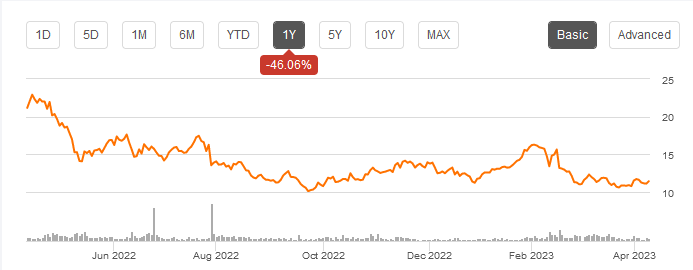
Chegg is an edtech company based in Santa Clara, California, and provides homework help, online tutoring, and other student services.  The company's value grew more than 300 percent in 2020, during the Covid pandemic, but has faced headwinds for the last two years. This includes allegations that  Chegg enables students to cheat on homework and other assignments. Derek Newton has chronicled this problem in the substack The Cheat Sheet.

[Chegg shares grew in 2020 during the Covid pandemic. Source: Seeking Alpha] 

 
Coursera is a publicly traded MOOC based in Mountain View California.  Shares started trading in April 2021.  The company has under-performed as a profit making enterprise. Massive Open Online Courses were once seen as a wave of the future in adult education but their popularity has waned. 

[Coursera has underperformed since its IPO in April 2021.  Source: Seeking Alpha]

2U (based in Lanham, MD) and Guild Education (based in Denver) and are two edtech companies based outside of Silicon Valley. 

2U is a publicly traded Online Program Manager (OPM).  The company services major universities such as the University of Southern California and University of North Carolina with support for some of their online degree programs. 2U has received an enormous amount of funding from Cathie Wood, a major Silicon Valley investor, and has continued to receive support despite a long record of financial losses.  

Some 2U investors have grown tired of persistent losses--and it has shown in the declining share price. The company also faces increased scrutiny in DC for recruiting consumers unable to recoup the cost of education for high-priced masters degrees in areas such as social work.  2U acquired edX, the Harvard-MIT MOOC in 2021 and its profitability remains to be seen.  

In 2023, 2U sued the US Department of Education for attempting to require more transparency between OPMs and their clients.  This strategy is similar to the defensive strategy that subprime colleges have used to stop gainful employment regulations, and more recently, borrower defense to repayment rules.  


 [2U shares have dropped more than 90 percent over the last 5 years. Source: Seeking Alpha]

Guild Education is a privately held corporation that grew to an estimated $4.4B evaluation in a few years. Guild serves businesses by administering online education benefits for large corporations such as Walmart, Target, and Macy's.  While its work may help companies with their bottom line, they appear to do little for their workers. 

At least ten of Guild's investors are based in Silicon Valley, including Silicon Valley Bank and venture capital firms in San Francisco, Palo Alto, and Menlo Park, California. Valuations.fyi reports Guild's estimated value at $1.3B, a 70 percent drop from its peak in June 2022. 

 
[Image above: Guild's valuation in Billions from valuations.fyi]
 
The Higher Education Inquirer will continue to observe changes in edtech as the College Meltdown advances.  


A ‘rigged’ economy and skepticism about college (Paul Fain, Open Campus)

How University of Phoenix Failed. It's a Long Story. But It's Important for the Future of Higher Education. 

The Cheat Sheet (Derek Newton)

2U Virus Expands College Meltdown to Elite Universities 

Erica Gallagher Speaks Out About 2U's Shady Practices at Department of Education Virtual Listening Meeting

Borrower Defense Claims Surpass 750,000. Consumers Empowered. Subprime Colleges and Programs Threatened.

Guild Education: Enablers of Anti-Union Corporations and Subprime College Programs 

College Meltdown 2.0 

The Growth of "RoboColleges" and "Robostudents"

The American Dream is Over (Gary Roth) 

Monday, July 7, 2025

Google, Amazon Web Services, and the Robocollege Gold Rush

The rise of robocolleges—massive, data-driven online universities like Southern New Hampshire University (SNHU), Liberty University Online, and the University of Phoenix—has not only reshaped the American higher education landscape but also become a lucrative revenue stream for Big Tech giants like Google and Amazon Web Services (AWS). These corporations, often thought of in the context of search engines or online retail, are quietly cashing in on the transformation of higher education into a sprawling digital enterprise.

Google profits primarily through its dominant advertising platform. Robocolleges spend tens of millions of dollars annually on Google Ads, targeting prospective students through highly refined search engine marketing. When a person types “online college” or “fastest bachelor’s degree,” Google’s algorithms serve up ads from SNHU, Liberty, University of Phoenix, and similar institutions, often above organic search results. These schools bid aggressively on search terms, particularly those that resonate with working adults, single parents, and veterans—populations that are more vulnerable to misleading advertising and frequently take on large student loans with low completion rates. A 2018 New York Times report revealed that the University of Phoenix spent $27 million on Google ads in a single year. SNHU and Liberty have since increased their digital marketing budgets dramatically, much of it funneled into the Google ecosystem.

But Google’s relationship with robocolleges goes far beyond advertising. Through its YouTube platform, also part of Alphabet Inc., the company monetizes education-related content and ads aimed at vulnerable populations. Whether viewers are watching videos about job interviews or financial survival, they’re often served high-pressure ads from online universities offering "flexible" degrees with "no SAT required." These targeted promotions generate both direct revenue and valuable behavioral data, which is used to optimize future advertising and extract more profit from the education market.

Amazon Web Services (AWS), the dominant player in cloud computing, profits from robocolleges in a different but equally impactful way. The University of Phoenix, for instance, migrated its entire infrastructure to AWS, entrusting Amazon with the storage and management of its student data, financial systems, and learning platforms. This move was framed as a way to increase efficiency and reduce costs, but it also locked a major for-profit university into the AWS ecosystem, with recurring fees that scale with student enrollment and data usage. Liberty University and other online-heavy institutions have also entered cloud partnerships with AWS and its competitors, making Amazon a key stakeholder in the delivery and surveillance of digital education.

The integration of Big Tech with robocolleges isn't just about services—it's about power. These tech platforms shape who gets seen and who remains invisible. Google's search and ad algorithms essentially control the public-facing narrative of higher education, prioritizing those who pay the most, not those who offer the best outcomes. Meanwhile, Amazon’s infrastructure ensures that these institutions can operate at scale with minimal human oversight, using cloud tools to automate enrollment, course delivery, and even student monitoring.

This alliance between Big Tech and robocolleges has significant implications for students, many of whom take on large debts in pursuit of degrees that may have limited labor market value. The same students who are recruited through Google ads often end up attending classes hosted on AWS servers, their tuition dollars indirectly supporting some of the richest corporations on the planet. As regulators begin to scrutinize student outcomes and loan defaults, the role of Google and Amazon in propping up this system remains largely invisible—and unaccountable.

What we are witnessing is not just the digitization of higher education, but its full-scale commercialization, driven by two of the most powerful technology firms in the world. In this new regime, education becomes a pipeline for data extraction, ad revenue, and cloud profits—where the student is no longer the customer, but the product.

Sources:
The New York Times, “How Google Took Over the Classroom” (2017)
The Chronicle of Higher Education, “Online Education’s Marketing Machine” (2020)
The Markup, “Google Is Earning Big From Predatory For-Profit Colleges” (2020)
University of Phoenix Newsroom, “University of Phoenix Moves to AWS” (2019)
SNHU Financial Statements (2020-2023)
Liberty University Marketing Disclosures (Various)
Alphabet Inc. and Amazon.com Inc. Annual Reports (2023-2024)

Wednesday, June 18, 2025

Tech Titans, Ideologues, and the Future of American Higher Education

American higher education is under pressure from within and without—squeezed by financial strain, declining enrollment, political hostility, and technological disruption. But the greatest challenge may be coming from a group of powerful outsiders—figures with deep influence in politics, technology, and media—who are actively reshaping how education is perceived, delivered, and valued. Among them: Donald Trump, Elon Musk, Peter Thiel, Sam Altman, Alex Karp, and Charlie Kirk. Each brings a different ideology and strategy, but their combined influence represents an existential threat to traditional colleges and universities.

Donald Trump’s second rise to power has included a full-spectrum attack on elite and public institutions of higher learning. From threats to strip funding from schools that promote diversity, equity, and inclusion, to freezing billions in research grants at elite institutions like Harvard, Trump has positioned universities as enemies in a broader cultural and political war. His proposed education policy emphasizes trade schools and short-term credentials over liberal arts and research, while his administration has floated revoking accreditation from institutions that resist his agenda. Rather than investing in public education, the Trump agenda calls for punishment, privatization, and obedience. And for institutions that don’t comply, there are growing threats of taxation, defunding, and public humiliation.

Elon Musk is undermining higher education in a different way. Musk has openly mocked the need for college degrees, suggesting that “you can learn anything online for free.” While that’s partly rhetoric, it’s also a blueprint for disruption. His experimental school Astra Nova already offers a glimpse into a post-institutional future—one that favors creative, independent thinking over traditional credentialing. Now, with plans to launch the Texas Institute of Technology & Science, Musk is betting that elite training can happen outside the bounds of accreditation and federal oversight. Musk’s future is technocratic and libertarian, with universities seen as bloated, slow-moving, and culturally out of touch.

Peter Thiel’s vision is even more radical. Thiel has compared American higher education to the Catholic Church before the Reformation—rich, corrupt, and intellectually bankrupt. His Thiel Fellowship pays young people to skip college entirely, offering $100,000 to start companies instead of accumulating debt. He argues that universities reward conformity and delay adulthood. For Thiel, colleges don’t just fail to prepare students—they actively mislead them. His endgame is a decentralized, market-driven system in which talent rises through initiative and capital, not credentials.

Sam Altman, CEO of OpenAI, presents yet another threat—this time from artificial intelligence. Altman doesn’t reject learning, but he does question the institutions that monopolize it. With tools like ChatGPT and future AI tutors, Altman envisions personalized, real-time learning for everyone, everywhere. In this model, universities risk becoming obsolete—not because they are wrong, but because they are too slow and too expensive. Altman has also pushed universities to take a more active role in shaping AI policy; if they don’t, the tech industry will do it for them. The message is clear: adapt or be replaced.

Alex Karp, CEO of Palantir, is building a new kind of corporate university. Through programs like the Palantir Meritocracy Fellowship and “Semester at Palantir,” Karp is recruiting students directly out of elite schools—particularly those disillusioned by what he sees as anti-Israel sentiment or campus censorship. These programs offer practical, high-paid experience that bypasses traditional academic pathways. Karp’s vision doesn’t require the elimination of universities—it just renders them unnecessary for the most competitive jobs in tech and intelligence. His model suggests a future in which corporations, not universities, decide who is qualified.

Charlie Kirk, founder of Turning Point USA, has weaponized the culture war to delegitimize higher education entirely. Kirk’s brand of activism portrays universities as corrupt, anti-American indoctrination centers. Through social media campaigns, donor networks, and student chapters, he has built an infrastructure of resistance against academic institutions. His goal isn’t reform—it’s replacement. Through efforts like the Freedom College Alliance, Kirk is helping to build a parallel educational system rooted in conservative Christian values, classical curricula, and ideological purity. In Kirk’s world, higher education isn’t broken—it’s the enemy.

Together, these six men are shaping a new, fragmented future for American education. Some want to burn it down. Some want to replace it. Some want to privatize it or profit from its collapse. What they share is a conviction that traditional universities no longer serve their intended purpose—and that a new model, rooted in tech, politics, or religion, must take its place.

This isn’t a theoretical debate. Universities are already responding—cutting liberal arts programs, racing to implement AI tools, rebranding themselves as career accelerators, and seeking favor with donors who increasingly resemble these disruptive outsiders. For those who resist, the future may include not just funding cuts, but political investigations, lawsuits, and public smear campaigns.

Higher education faces a stark choice. It can double down on its public mission—defending critical thinking, civic engagement, and social mobility—or it can retreat into elite credentialing and survival mode. What it cannot do is ignore the forces gathering at its gates. These forces are rich, powerful, ideologically driven—and they are not waiting for permission to remake the system.

Monday, July 21, 2025

Digital Dope: How Internet Addiction Mirrors the Great Crises of Gin, Opium, Meth, and Fentanyl

In the 18th century, gin swept through the working-class neighborhoods of London, offering brief euphoria and long-term devastation. In the 19th century, opium dulled the pain of colonialism and industrial collapse. The 20th century brought methamphetamine and its promise of energy and escape, followed by fentanyl—cheap, potent, and deadly.

Now, in the 21st century, we face a new form of mass addiction: not chemical but digital. The most addictive substances of our time are not smoked, snorted, or injected—they are streamed, swiped, and scrolled.

The internet, once hailed as a revolution in knowledge and communication, has been weaponized into an empire of distraction and dependency. Social media, pornography, and online gambling—backed by surveillance capitalism and unchecked corporate power—are engineered for compulsive use. And like the addictive epidemics of the past, they are eroding individual agency, family life, and the very foundations of civic society.

The Gin Craze and the Algorithmic Binge

In 18th-century Britain, the Gin Craze turned city streets into open-air taverns. Cheap, potent alcohol flooded the market, leading to widespread addiction, crime, and social decay. The state profited from taxes while the poor drowned in despair.

Today’s equivalent is the infinite scroll. Social media platforms like TikTok, Instagram, and Facebook—like gin—are engineered to be consumed endlessly. The user is reduced to a set of engagement metrics. Like the gin drinker numbing pain, the social media user seeks validation, escape, or identity in a flood of curated images and outrage. Depression, anxiety, and loneliness have exploded, especially among teens and young adults. Suicides, particularly among girls, have surged in tandem with social media usage.

Opium Dens and the Porn Empire

The opium den offered oblivion. It soothed pain but eroded will. Victorian elites warned of its moral decay while quietly indulging themselves.

Today, online pornography is the new opium—widely available, hyper-stimulating, and often degrading. Once confined to private spaces, it is now accessible to children, monetized by multi-billion-dollar platforms, and normalized by mainstream culture. The effects—especially on young people—include desensitization, unrealistic expectations, isolation, and difficulty forming real-life relationships.

Research has shown that excessive porn consumption alters brain chemistry similarly to addictive drugs. It hijacks the reward system, rewires sexual expectations, and in many cases, contributes to erectile dysfunction, compulsive behavior, and emotional detachment.

Meth, Fentanyl, and the Speed of the Feed

Meth promised productivity; fentanyl promises relief. Both deliver destruction.

Digital addiction today mimics the frenetic highs of meth and the numbing power of fentanyl. The constant rush of notifications, likes, and headlines overstimulates the brain and crushes attention spans. Apps and games are engineered like slot machines, delivering intermittent reinforcement that keeps users hooked. The average smartphone user touches their phone over 2,500 times a day.

University students struggle to read long texts or concentrate for extended periods. Professors battle declining classroom attention and rising rates of anxiety and burnout. Like meth, the digital feed gives the illusion of efficiency while grinding the mind into dust.

Online Gambling: Casino in Your Pocket

The rise of online sports betting and casino apps has brought Vegas to every dorm room and bedroom. Targeted ads on Instagram and YouTube lure young people into betting with "free" money. Many students—especially young men—develop compulsive behaviors, losing thousands before they graduate. Some turn to credit cards, payday loans, or family bailouts.

States, like governments in the gin and opium eras, have embraced online gambling for its tax revenues. Universities, meanwhile, remain largely silent—even as students destroy their finances and futures through legalized digital addiction.

Higher Education: From Ivory Tower to Digital Trap

Colleges were once sanctuaries of thought and reflection. Today, they are nodes in the digital economy—where learning management systems monitor clicks, and students are nudged toward screens at every turn. Social interaction is filtered through group chats and Reddit threads. Pornography, gambling, and endless scrolling are a click away on the same device used to write term papers and attend virtual lectures.

Even counseling services are digitized. The solution to tech addiction, students are told, is often more tech—apps that monitor screen time, AI chatbots for mental health, or video therapy that feels detached and impersonal.

The Profiteers and the Pushers

In every addiction crisis, there are profiteers: distillers, opium traders, pharmaceutical companies, and cartels. Today, Big Tech plays the same role. Meta, TikTok, YouTube, Pornhub, DraftKings, FanDuel, and hundreds of smaller apps compete for attention with algorithms that exploit human weakness.

Their business model depends on addiction. They study neuroscience, behavioral psychology, and micro-targeted advertising with military-grade precision. Like the drug lords of the past, they deny responsibility while reaping billions.

And just as the poor suffered most in the gin and opioid crises, it is the working class, the unemployed, the chronically ill, and the disconnected who fall hardest into the digital pit.

The Need for Radical Intervention

Digital addiction is not a moral failing—it’s a public health emergency. Like past addiction epidemics, the solution requires:

  • Public awareness campaigns

  • Stricter age and content regulation

  • Taxation on digital vice industries

  • Digital literacy education at all levels

  • Offline spaces and activities that foster real connection and attention

Higher education must lead. Not by digitizing every service, but by teaching students to reclaim their minds, their time, and their agency. Faculty must model mindful engagement and challenge the corporatization of the university by tech companies. Administrators must reconsider their reliance on LMS systems, data harvesting, and digital surveillance.

Will We Wake Up in Time?

In the past, addiction crises forced society to reflect on what was lost: family cohesion, civic virtue, mental clarity, and freedom itself. We stand again at such a crossroads. The digital drug is in every hand, and the overdose is slow—but devastating.

Like gin, opium, meth, and fentanyl, the internet addiction crisis is about more than chemicals—it’s about despair, disconnection, and exploitation. And like those earlier epidemics, it is not an individual failing, but a systemic one. The good news? As with past crises, awareness is the first step toward recovery. The question is: Will we act before another generation is lost?


The Higher Education Inquirer continues to investigate the intersection of capitalism, addiction, and the commodification of human attention. Reach out if you have a story to share.

Monday, January 27, 2025

Essays in the Transformation of Higher Education (Dan Morris and Harry Targ)


From Upton Sinclair's 'Goose Step' to the Neoliberal University (lulu.com)

Table of Contents
Introduction
Chapter One: Macro and Micro Analyses of Higher Education
Chapter Two: Discourses On Ideology
Chapter Three: Branding
Chapter Four: What Do Universities Do?
Chapter Five: Universities and War:
Conclusion
Appendix

Introduction

In the following pages, you are going to find a lot of specific information about what is happening at one major public research university, but we believe what is happening at Purdue is analogous to a canary in a coal mine. We believe that Purdue under Mitch Daniels, a former George Walker Bush administrator and Governor of Indiana, is becoming a high profile and influential spokesperson for the transformation of public higher education in the 21st century in directions that we find dangerous and that go against how we value higher education. We realize that, while we address extensively institutional changes and policies at Purdue, Indiana’s Land Grant University, our interest is in using this case study to illustrate larger patterns and issues that should be of concern to readers who care about the future of higher education in a broader sense.

Harry Targ's pieces do tend towards a wider-angle perspective than do those by Dan Morris, although both of us rely on our "boots on the ground" level understanding of Purdue to counteract and contest official media versions of what is happening at Purdue. We write at a moment when there is something of a "media desert" in terms of local news coverage of higher education in small markets such as Lafayette, Indiana. We have both tried to work to rectify the "media desert" landscape in our community by contributing to the Lafayette Independent, an electronic newsletter. We appreciate efforts by local journalists such as Dave Bangert and the student staff of the Purdue Exponent to offer coverage of the university in ways that are more substantial, and, often, more critical, than what one finds in the area's only mainstream newspaper, the Journal and Courier, and main local TV news source, and the Purdue NPR radio station, whose ownership in the last year has been mysteriously transferred to an Indianapolis corporation. Paradoxically the richest data for many of the essays below come from the official daily public relations newsletter from Purdue called Purdue Today. This public relations source celebrates Purdue’s latest connections with multinational corporations, the military, and state politics, and provides links to editorials published by Purdue’s President and other officials in the national press. Ironically, oftentimes what Purdue celebrates becomes the data for our more analytical and discursive writings.

Like alternative media sources, we see this book as another intervention in offering an alternative view of what is happening at our campus, but we also write with the hope that readers can apply the readings we bring to Purdue to begin conversations about the promise and problems of contemporary higher education on campuses. The authors wish to praise and encourage further research and activism around the transformations of higher education in general. We identify with what some scholars have referred to as Critical University Studies (CUS). The essays below, we believe, are part of this emerging tradition of critical and self-reflective scholarship.

The authors also wish to identify at least three major elements of the transformation of higher education. First, Purdue, like many other universities, is once again pursuing research contracts with huge corporations, and perhaps most importantly, the Department of Defense. As essays below suggest, Purdue research is increasingly justified as serving the interests of United States “national security.” Often this is conceptualized as helping the United States respond to “the Chinese threat,” rarely identifying what exactly is the threat, or considering the possibility that contributing to a new arms race with a perceived adversary may increase, rather than reduce, the possibility for conflict between nations.

Second, the work below and other writings in CUS, highlight the purposive transformation of the content of higher education. Universities are moving resources away from the liberal arts, creating new programs in “artificial intelligence” and “data science,” and in response to political pressures are diminishing programs that emphasize interdisciplinarity, intersectionality, and the structural problems of race, class, gender, and sexual preference in history and contemporary society. Essays below on “civics literacy” suggest that leading administrators at Purdue, while refusing to defend its universally praised Writing Lab after it was ridiculed on Fox News for its recommendation that student writers select gender-neutral terms such as postal worker when writing about occupations, seek to avoid the controversaries around Critical Race Theory by requiring all students to study in some fashion “civics literacy.” President Daniels has made it clear that the study of civics literacy will illustrate the “vitality” of US political institutions (as opposed to over-emphasizing the slaughter of the original inhabitants of the North American continent or the history of slavery and white supremacy).

Third, the essays below do not dwell enough on the transformation of the university as a workplace. While there have been attacks for years on the tenure system, a system of job security which was initially designed to protect faculty from external political pressures, recent additions to the transformations of the university as a work site should be noted.

Adjunctification is a term that refers to the qualitative increase in the hiring of various forms of part time instructors: full-time instructors for a set time period, instructors to teach less than a full complement of courses, and instructors with various arrangements that limit their work life, their ability to do research and prepare for their class time, and their time to serve the many needs of students. The fundamental trend in higher education is to “cheapen” and make insecure instructors, ultimately to destroy the job security that comes with academic tenure. In many cases this impacts negatively on the quality of the educational experience. (In colleges and universities in general about 70 percent of classes now are taught by instructors who are not tenure-line faculty).

And finally, every effort is made by universities to limit and derail the workplace concerns of non-teaching staff, particularly opposing their right to form unions.

One positive development from all of this-destroying the tenure system and job security, adjunctification, increased exploitation of graduate students, and finally restricting the rights and the wages and benefits of staff has been the rise of labor militancy. The American Association of University Professors (AAUP), the American Federation of Teachers (AFT), and various unions such as the United Auto Workers (UAW) and the United Electrical Workers (UE) with a history of militancy have been organizing graduate students and staff.

Finally, the authors acknowledge that in the months after we completed our manuscript, Purdue administrators and trustees have announced a series of initiatives without an appropriate level of input from university stakeholders and the wider Lafayette area community:

1. Purdue is building a housing complex near the Discovery Park part of campus to attract higher income earning technologists to relocate in West Lafayette. To encourage new high-income residents, the West Lafayette city government has authorized $5,000 cash incentives for any purchasers of these new housing units adjacent to Purdue. Such offers are not available to lower income earners or students.

2. To deal with record enrollments, Purdue has purchased a privately constructed apartment complex across from campus at a price well more than the cost of its construction.

3. Purdue officials have expanded partnerships with Saab, Rolls Royce, the Raytheon Corporation, one of the world’s five largest military contractors, and undertaken a controversial business mission with the Indiana governor to Taiwan to pursue research and production of semi-conductors, in part to respond to what Purdue officials have described as a ”Chinese threat” to national security in the United States.

4.The College of Liberal Arts has announced it will be partnering with the College of Science to develop a new interdisciplinary degree program in artificial intelligence. CLA calls its “new field” of interest, “sociogenomics.”

5. Purdue received an award recognizing its “excellence in counterintelligence,” one of only four such award recipients in 2022. Purdue joins those few universities which protect “sensitive national information from foreign adversaries.” The award announced in Purdue Today, August 24, 2022, noted that the university continues to work with the Defense Counterintelligence and Security Agency (DCSA) and the FBI.

In short, the transformation of Indiana’s Land Grant university continues at a rapid pace. And while the essays below concentrate on the developments and forces leading to these changes, the broader point of this collection of essays is to suggest that higher education in the twenty-first century is changing in a rapid and largely deleterious way. The appended essay by Carl Davidson reflects a similar critique of the university during the height of the Cold War. What we are witnessing today is a revitalization of that trend.

For those who value the university as a site for informing students about the world and debating the value of changes occurring in it, the developments highlighted in these essays are a warning. And for faculty and students alike the antidote to the militarization of the university, the transformation of the curricula, and the disempowering of those who work in universities is organizing against those elements of change that are antithetical to the educational process.

And More:

“The Krach Institute for Tech Diplomacy at Purdue has created a category of its own. As part of the nation’s leading national security university, it is rapidly becoming the world’s premier institution focused on Tech Statecraft, a new model of diplomacy bridging the gap between technology experts, government officials and policymakers, and business leaders to ensure tomorrow’s tech secures our freedoms,” said (Daniel) Kurtenbach. ‘I’m excited to contribute to the Krach Institute’s already-impressive momentum by enhancing and building its innovative partnerships and relationships to achieve our shared vision of a future that prizes individual freedom through trusted technology.’ ”

https://www.citybiz.co/article/378157/krach-institute-for-tech-diplomacy-at-purdue-names-daniel-kurtenbach-as-chief-growth-officer/

Homepage - Tech Statecraft (techdiplomacy.org)

Saturday, January 3, 2026

The Poisoning of the American Mind

For more than a decade, Americans have been told that polarization, mistrust, and civic fragmentation are organic byproducts of cultural change. But the scale, speed, and persistence of the damage suggest something more deliberate: a sustained poisoning of the American mind—one that exploits structural weaknesses in education, media, technology, and governance.

This poisoning is not the work of a single actor. It is the cumulative result of foreign influence campaigns, profit-driven global technology platforms, and domestic institutions that have failed to defend democratic literacy. Higher education, once imagined as a firewall against mass manipulation, has proven porous, compromised, and in many cases complicit.

Foreign Influence as Cognitive Warfare

Chinese and Russian influence operations differ in style but converge in purpose: weakening American social cohesion, degrading trust in institutions, and normalizing cynicism.

Russian efforts have focused on chaos. Through state-linked troll farms, bot networks, and disinformation pipelines, Russian actors have amplified racial grievances, cultural resentments, and political extremism on all sides. The objective has not been persuasion so much as exhaustion—flooding the information environment until truth becomes indistinguishable from propaganda and democratic participation feels futile.

Chinese influence efforts, by contrast, have emphasized discipline and control. Through economic leverage, academic partnerships, Confucius Institutes, and pressure campaigns targeting universities and publishers, the Chinese Communist Party has sought to shape what can be discussed, researched, or criticized. While less visibly inflammatory than Russian disinformation, these efforts quietly narrow the boundaries of acceptable discourse—especially within elite institutions that prize funding and global prestige.

Both strategies treat cognition itself as a battlefield. The target is not simply voters, but students, scholars, journalists, and future professionals—anyone involved in shaping narratives or knowledge.

The Role of Global Tech Elites

Foreign influence campaigns would be far less effective without the infrastructure built and defended by global technology elites.

Social media platforms were designed to monetize attention, not to preserve truth. Algorithms reward outrage, tribalism, and repetition. Misinformation is not an accidental byproduct of these systems; it is a predictable outcome of engagement-driven design.

What is often overlooked is how insulated tech leadership has become from the social consequences of its products. Executives who speak fluently about “free expression” and “innovation” operate within gated communities, private schools, and curated information environments. The cognitive pollution affecting the public rarely touches them directly.

At the same time, these platforms have shown inconsistent willingness to confront state-sponsored manipulation. Decisions about content moderation, data access, and platform governance are routinely shaped by geopolitical calculations and market access—particularly when China is involved. The result is a global information ecosystem optimized for profit, vulnerable to manipulation, and hostile to slow, evidence-based thinking.

Higher Education’s Failure of Defense

Universities were supposed to be inoculation centers against mass manipulation. Instead, they have become transmission vectors.

Decades of underfunding public higher education, adjunctification of faculty labor, and administrative bloat have weakened academic independence. Meanwhile, elite institutions increasingly depend on foreign students, donors, and partnerships, creating subtle but powerful incentives to avoid controversy.

Critical thinking is often reduced to branding rather than practice. Students are encouraged to adopt identities and positions rather than interrogate evidence. Media literacy programs, where they exist at all, are thin, optional, and disconnected from the realities of algorithmic persuasion.

Even worse, student debt has turned higher education into a high-stakes compliance system. Indebted graduates are less likely to challenge employers, institutions, or dominant narratives. Economic precarity becomes cognitive precarity.

A Domestic Willingness to Be Deceived

Foreign adversaries and tech elites exploit vulnerabilities, but they did not create them alone. The poisoning of the American mind has been enabled by domestic actors who benefit from confusion, resentment, and distraction.

Political consultants, partisan media ecosystems, and privatized education interests profit from outrage and ignorance. Complex structural problems—healthcare, housing, inequality, climate—are reframed as cultural battles, keeping attention away from systems of power and extraction.

In this environment, truth becomes negotiable, expertise becomes suspect, and education becomes a consumer product rather than a public good.

The Long-Term Consequences

The danger is not simply misinformation. It is the erosion of shared reality.

A society that cannot agree on basic facts cannot govern itself. A population trained to react rather than reflect is easy to manipulate—by foreign states, domestic demagogues, or algorithmic systems optimized for profit.

Higher education sits at the center of this crisis. If universities cannot reclaim their role as defenders of intellectual rigor and civic responsibility, they risk becoming credential factories feeding a cognitively compromised workforce.

Toward Intellectual Self-Defense

Reversing the poisoning of the American mind will require more than fact-checking or content moderation. It demands structural change:

A recommitment to public higher education as a democratic institution, not a revenue stream.
Robust media literacy embedded across curricula, not siloed in electives.
Transparency and accountability for technology platforms that shape public cognition.
Protection of academic freedom from both foreign pressure and domestic political interference.
Relief from student debt as a prerequisite for intellectual independence.

Cognitive sovereignty is national security. Without it, no amount of military or economic power can sustain a democratic society.

The question is not whether the American mind has been poisoned. The question is whether the institutions charged with educating it are willing to admit their failure—and do the hard work of recovery.


Sources

U.S. Senate Select Committee on Intelligence, reports on Russian active measures
National Intelligence Council, foreign influence assessments
Department of Justice investigations into Confucius Institutes
Shoshana Zuboff, The Age of Surveillance Capitalism
Renée DiResta et al., research on computational propaganda
Higher Education Inquirer reporting on student debt, academic labor, and institutional capture