Search This Blog

Tuesday, January 21, 2025

Student Booted from PhD Program Over AI Use (Derek Newton/The Cheat Sheet)


This one is going to take a hot minute to dissect. Minnesota Public Radio (MPR) has the story.

The plot contours are easy. A PhD student at the University of Minnesota was accused of using AI on a required pre-dissertation exam and removed from the program. He denies that allegation and has sued the school — and one of his professors — for due process violations and defamation respectively.
Starting the case.
The coverage reports that:
all four faculty graders of his exam expressed “significant concerns” that it was not written in his voice. They noted answers that seemed irrelevant or involved subjects not covered in coursework. Two instructors then generated their own responses in ChatGPT to compare against his and submitted those as evidence against Yang. At the resulting disciplinary hearing, Yang says those professors also shared results from AI detection software. 
Personally, when I see that four members of the faculty unanimously agreed on the authenticity of his work, I am out. I trust teachers.
I know what a serious thing it is to accuse someone of cheating; I know teachers do not take such things lightly. When four go on the record to say so, I’m convinced. Barring some personal grievance or prejudice, which could happen, hard for me to believe that all four subject-matter experts were just wrong here. Also, if there was bias or petty politics at play, it probably would have shown up before the student’s third year, not just before starting his dissertation.
Moreover, at least as far as the coverage is concerned, the student does not allege bias or program politics. His complaint is based on due process and inaccuracy of the underlying accusation.
Let me also say quickly that asking ChatGPT for answers you plan to compare to suspicious work may be interesting, but it’s far from convincing — in my opinion. ChatGPT makes stuff up. I’m not saying that answer comparison is a waste, I just would not build a case on it. Here, the university didn’t. It may have added to the case, but it was not the case. Adding also that the similarities between the faculty-created answers and the student’s — both are included in the article — are more compelling than I expected.
Then you add detection software, which the article later shares showed high likelihood of AI text, and the case is pretty tight. Four professors, similar answers, AI detection flags — feels like a heavy case.
Denied it.
The article continues that Yang, the student:
denies using AI for this exam and says the professors have a flawed approach to determining whether AI was used. He said methods used to detect AI are known to be unreliable and biased, particularly against people whose first language isn’t English. Yang grew up speaking Southern Min, a Chinese dialect. 
Although it’s not specified, it is likely that Yang is referring to the research from Stanford that has been — or at least ought to be — entirely discredited (see Issue 216 and Issue 251). For the love of research integrity, the paper has invented citations — sources that go to papers or news coverage that are not at all related to what the paper says they are.
Does anyone actually read those things?
Back to Minnesota, Yang says that as a result of the findings against him and being removed from the program, he lost his American study visa. Yang called it “a death penalty.”
With friends like these.
Also interesting is that, according to the coverage:
His academic advisor Bryan Dowd spoke in Yang’s defense at the November hearing, telling panelists that expulsion, effectively a deportation, was “an odd punishment for something that is as difficult to establish as a correspondence between ChatGPT and a student’s answer.” 
That would be a fair point except that the next paragraph is:
Dowd is a professor in health policy and management with over 40 years of teaching at the U of M. He told MPR News he lets students in his courses use generative AI because, in his opinion, it’s impossible to prevent or detect AI use. Dowd himself has never used ChatGPT, but he relies on Microsoft Word’s auto-correction and search engines like Google Scholar and finds those comparable. 
That’s ridiculous. I’m sorry, it is. The dude who lets students use AI because he thinks AI is “impossible to prevent or detect,” the guy who has never used ChatGPT himself, and thinks that Google Scholar and auto-complete are “comparable” to AI — that’s the person speaking up for the guy who says he did not use AI. Wow.
That guy says:
“I think he’s quite an excellent student. He’s certainly, I think, one of the best-read students I’ve ever encountered”
Time out. Is it not at least possible that professor Dowd thinks student Yang is an excellent student because Yang was using AI all along, and our professor doesn’t care to ascertain the difference? Also, mind you, as far as we can learn from this news story, Dowd does not even say Yang is innocent. He says the punishment is “odd,” that the case is hard to establish, and that Yang was a good student who did not need to use AI. Although, again, I’m not sure how good professor Dowd would know.
As further evidence of Yang’s scholastic ability, Dowd also points out that Yang has a paper under consideration at a top academic journal.
You know what I am going to say.
To me, that entire Dowd diversion is mostly funny.
More evidence.
Back on track, we get even more detail, such as that the exam in question was:
an eight-hour preliminary exam that Yang took online. Instructions he shared show the exam was open-book, meaning test takers could use notes, papers and textbooks, but AI was explicitly prohibited. 
Exam graders argued the AI use was obvious enough. Yang disagrees. 
Weeks after the exam, associate professor Ezra Golberstein submitted a complaint to the U of M saying the four faculty reviewers agreed that Yang’s exam was not in his voice and recommending he be dismissed from the program. Yang had been in at least one class with all of them, so they compared his responses against two other writing samples. 
So, the exam expressly banned AI. And we learn that, as part of the determination of the professors, they compared his exam answers with past writing.
I say all the time, there is no substitute for knowing your students. If the initial four faculty who flagged Yang’s work had him in classes and compared suspicious work to past work, what more can we want? It does not get much better than that.
Then there’s even more evidence:
Yang also objects to professors using AI detection software to make their case at the November hearing.  
He shared the U of M’s presentation showing findings from running his writing through GPTZero, which purports to determine the percentage of writing done by AI. The software was highly confident a human wrote Yang’s writing sample from two years ago. It was uncertain about his exam responses from August, assigning 89 percent probability of AI having generated his answer to one question and 19 percent probability for another. 
“Imagine the AI detector can claim that their accuracy rate is 99%. What does it mean?” asked Yang, who argued that the error rate could unfairly tarnish a student who didn’t use AI to do the work.  
First, GPTZero is junk. It’s reliably among the worst available detection systems. Even so, 89% is a high number. And most importantly, the case against Yang is not built on AI detection software alone, as no case should ever be. It’s confirmation, not conviction. Also, Yang, who the paper says already has one PhD, knows exactly what an accuracy rate of 99% means. Be serious.
A pattern.
Then we get this, buried in the news coverage:
Yang suggests the U of M may have had an unjust motive to kick him out. When prompted, he shared documentation of at least three other instances of accusations raised by others against him that did not result in disciplinary action but that he thinks may have factored in his expulsion.  
He does not include this concern in his lawsuits. These allegations are also not explicitly listed as factors in the complaint against him, nor letters explaining the decision to expel Yang or rejecting his appeal. But one incident was mentioned at his hearing: in October 2023, Yang had been suspected of using AI on a homework assignment for a graduate-level course. 
In a written statement shared with panelists, associate professor Susan Mason said Yang had turned in an assignment where he wrote “re write it, make it more casual, like a foreign student write but no ai.”  She recorded the Zoom meeting where she said Yang denied using AI and told her he uses ChatGPT to check his English.
She asked if he had a problem with people believing his writing was too formal and said he responded that he meant his answer was too long and he wanted ChatGPT to shorten it. “I did not find this explanation convincing,” she wrote. 
I’m sorry — what now?
Yang says he was accused of using AI in academic work in “at least three other instances.” For which he was, of course, not disciplined. In one of those cases, Yang literally turned in a paper with this:
“re write it, make it more casual, like a foreign student write but no ai.” 
He said he used ChatGPT to check his English and asked ChatGPT to shorten his writing. But he did not use AI. How does that work?
For that one where he left in the prompts to ChatGPT:
the Office of Community Standards sent Yang a letter warning that the case was dropped but it may be taken into consideration on any future violations. 
Yang was warned, in writing.
If you’re still here, we have four professors who agree that Yang’s exam likely used AI, in violation of exam rules. All four had Yang in classes previously and compared his exam work to past hand-written work. His exam answers had similarities with ChatGPT output. An AI detector said, in at least one place, his exam was 89% likely to be generated with AI. Yang was accused of using AI in academic work at least three other times, by a fifth professor, including one case in which it appears he may have left in his instructions to the AI bot.
On the other hand, he did say he did not do it.
Findings, review.
Further:
But the range of evidence was sufficient for the U of M. In the final ruling, the panel — comprised of several professors and graduate students from other departments — said they trusted the professors’ ability to identify AI-generated papers.
Several professors and students agreed with the accusations. Yang appealed and the school upheld the decision. Yang was gone. The appeal officer wrote:
“PhD research is, by definition, exploring new ideas and often involves development of new methods. There are many opportunities for an individual to falsify data and/or analysis of data. Consequently, the academy has no tolerance for academic dishonesty in PhD programs or among faculty. A finding of dishonesty not only casts doubt on the veracity of everything that the individual has done or will do in the future, it also causes the broader community to distrust the discipline as a whole.” 
Slow clap.
And slow clap for the University of Minnesota. The process is hard. Doing the review, examining the evidence, making an accusation — they are all hard. Sticking by it is hard too.
Seriously, integrity is not a statement. It is action. Integrity is making the hard choice.
MPR, spare me.
Minnesota Public Radio is a credible news organization. Which makes it difficult to understand why they chose — as so many news outlets do — to not interview one single expert on academic integrity for a story about academic integrity. It’s downright baffling.
Worse, MPR, for no specific reason whatsoever, decides to take prolonged shots at AI detection systems such as:
Computer science researchers say detection software can have significant margins of error in finding instances of AI-generated text. OpenAI, the company behind ChatGPT, shut down its own detection tool last year citing a “low rate of accuracy.” Reports suggest AI detectors have misclassified work by non-native English writers, neurodivergent students and people who use tools like Grammarly or Microsoft Editor to improve their writing. 
“As an educator, one has to also think about the anxiety that students might develop,” said Manjeet Rege, a University of St. Thomas professor who has studied machine learning for more than two decades. 
We covered the OpenAI deception — and it was deception — in Issue 241, and in other issues. We covered the non-native English thing. And the neurodivergent thing. And the Grammarly thing. All of which MPR wraps up in the passive and deflecting “reports suggest.” No analysis. No skepticism.
That’s just bad journalism.
And, of course — anxiety. Rege, who please note has studied machine learning and not academic integrity, is predictable, but not credible here. He says, for example:
it’s important to find the balance between academic integrity and embracing AI innovation. But rather than relying on AI detection software, he advocates for evaluating students by designing assignments hard for AI to complete — like personal reflections, project-based learnings, oral presentations — or integrating AI into the instructions. 
Absolute joke.
I am not sorry — if you use the word “balance” in conjunction with the word “integrity,” you should not be teaching. Especially if what you’re weighing against lying and fraud is the value of embracing innovation. And if you needed further evidence for his absurdity, we get the “personal reflections and project-based learnings” buffoonery (see Issue 323). But, again, the error here is MPR quoting a professor of machine learning about course design and integrity.
MPR also quotes a student who says:
she and many other students live in fear of AI detection software.  
“AI and its lack of dependability for detection of itself could be the difference between a degree and going home,” she said. 
Nope. Please, please tell me I don’t need to go through all the reasons that’s absurd. Find me one single of case in which an AI detector alone sent a student home. One.
Two final bits.
The MPR story shares:
In the 2023-24 school year, the University of Minnesota found 188 students responsible of scholastic dishonesty because of AI use, reflecting about half of all confirmed cases of dishonesty on the Twin Cities campus. 
Just noteworthy. Also, it is interesting that 188 were “responsible.” Considering how rare it is to be caught, and for formal processes to be initiated and upheld, 188 feels like a real number. Again, good for U of M.
The MPR article wraps up that Yang:
found his life in disarray. He said he would lose access to datasets essential for his dissertation and other projects he was working on with his U of M account, and was forced to leave research responsibilities to others at short notice. He fears how this will impact his academic career
Stating the obvious, like the University of Minnesota, I could not bring myself to trust Yang’s data. And I do actually hope that being kicked out of a university for cheating would impact his academic career.
And finally:
“Probably I should think to do something, selling potatoes on the streets or something else,” he said. 
Dude has a PhD in economics from Utah State University. Selling potatoes on the streets. Come on.
(Editors note: This article first appeared at Derek Newton's The Cheat Sheet.)

Monday, January 20, 2025

Ambow Education Continues to Fish in Murky Waters

In May 2022, The Higher Education Inquirer began investigating Ambow Education after we received credible tips about the company as a bad actor in US higher education, particularly with its failure to adequately maintain and operate Bay State College in Boston. The Massachusetts Attorney General had already stepped in and fined the school in 2020 for misleading students. 

As HEI dug deeper, we found that Ambow failed years before under questionable circumstances. And we worked with a number of news outlets and staffers in the offices of Senator Elizabeth Warren and Representative Ayanna Pressley to get justice for the students at Bay State College. 

Murky Waters

Since that 2022 story we continued to investigate Ambow Education, its CEO/CFO/Board Chair Jin Huang, and Ambow's opaque business practices. Not only were we concerned about the company's finances, we were wary of any undue influence the People's Republic of China (PRC) had on Ambow, which the company had previously acknowledged in SEC documents. 

A Chinese proverb says it's easier to fish in murky waters. And that's what it seemed like for us to investigate Ambow, a company that used the murky waters in American business as well as anyone. But not everything can remain hidden to US authorities, even if the company was based out of the Cayman Islands, with a corporate headquarters in Beijing. 

In November 2022, Ambow sold all of its assets in the People's Republic of China, and in August 2023 Bay State College closed abruptly. We reported some strange behaviors in the markets to the Securities and Exchange Commission, but they had nothing to tell us. Ambow moved its headquarters to a small rental space in Cupertino, where it still operates. 

HybriU

In 2024, Ambow began spinning its yarns about a new learning platform, HybriU, using Norm Algood of Synergis Education as its huckster. HybriU appeared at the Consumer Electronics Show in Las Vegas and at the ASU-GSV conference in San Diego and used their presence as signs of legitimacy. It later reported a $1.3 million contract with a small company out of Singapore. Doing a reverse image search, we found that some of the images on the HybriU website were stock photos.

There is no indication that HybriU's OOOK technology, first promoted in the PRC in 2021, is groundbreaking, although glowing press releases counter that. HybriU says that its technology is being used in classrooms, but no clients (schools or businesses)  have been mentioned.  If Ambow Education can prove the HybriU technology is promising and valuable to consumers, we will publicy acknowledge it.  

Continued PRC Interests 

Besides having an auditor from the People's Republic of China, Ambow has apparently shown an interest in working with Chinese interests in Morocco and Tunisia.

Ambow Education's Financial Health

In 2025, Ambow Education remains alive but with fewer assets and only the promise of doing something of value with those assets. Its remaining US college, the NewSchool of Architecture and Design in San Diego has seen its enrollment dip to 280 students. And there are at least three cases in San Diego Superior Court pending (for failure to pay rent and failing to pay the school's former President).  The US Department of Education has the school under Heightened Cash Monitoring (HCM2) for administrative issues. Despite these problems, NewSchool has been given a cleaner bill of health by its regional accreditor, WSCUC, changing the school's Warning status to a Notice of Concern.

A report by Argus Research, which Ambow commissioned, also described Ambow in a generally positive light, despite the fact that Ambow was only spending $100,000 per quarter on Research and Development. That report notes that Prouden, a small accounting firm based in the People's Republic of China is just seeing Ambow Education's books for the first time. In April 2025 we wonder if we'll get adequate information when Ambow reports its 2024 annual earnings, or whether we find just another layer of sludge. 

Joe Biden Commutes Life Sentence of Indigenous Activist Leonard Peltier (APTN News)

From Minnesota Public Radio News

In one of his last official acts before leaving the White House, President Joe Biden released Leonard Peltier from prison. The action is an extraordinary move that ends a decades-long push by Indigenous activists, international religious leaders, human rights organizations who argued that the 80-year-old Native American activist was wrongly convicted.


Major updates: student debt relief progress and new fact sheets (SBPC)

The fight for student loan borrowers continues! In the last remaining days of the Biden-Harris Administration, the U.S. Department of Education (ED) is pushing some final relief through for student loan borrowers, new Income-Driven Repayment (IDR) Account Adjustment payment counts are live, and we have new fact sheets shedding light on the impact of the student debt crisis on borrowers.


Here’s a roundup of the latest:


Over 5 million borrowers have been freed from student debt.

In a major win for borrowers, ED announced that the Biden-Harris Administration has now approved $183.6 billion in student debt discharges via various student debt relief fixes and programs. This relief has now reached over 5 million borrowers and includes new approvals for Public Service Loan Forgiveness (PSLF) relief, borrower defense relief, and Total and Permanent Disability Discharge relief.


This relief is life-changing for millions of families, proving the power of bold, decisive action on student debt. Yet, there is much more work to do. Every step toward relief underscores the need to continue fighting for policies that reduce the burden of student debt and ensure affordable access to higher education.


Final phase of the IDR Account Adjustment is underway—take screenshots!

In tandem with the latest cancellation efforts, ED has also finally started updating borrower payment counts on the Federal Student Aid dashboard. Providing official payment counts will help borrowers receive the credit they have earned towards cancellation under IDR, and ensure that all borrowers who have been forced to pay for 20 years or longer are automatically able to benefit from relief they are entitled to under federal law. ***If you are a borrower with federal student loans, we recommend that you check your dashboard on studentaid.gov, screenshot your new count, and save it in your records.


Previously, many borrowers—including those who work in public service jobs and low-income borrowers struggling to afford payments—were steered into costly deferments and forbearance, preventing them from reaching the 20 years or longer for IDR relief or the 120 payments necessary for PSLF cancellation. Under the IDR Account Adjustment, these periods are now counted, even if borrowers were mistakenly placed in the wrong repayment plan or faced servicing errors. 

New SBPC fact sheets on the student debt crisis are live.

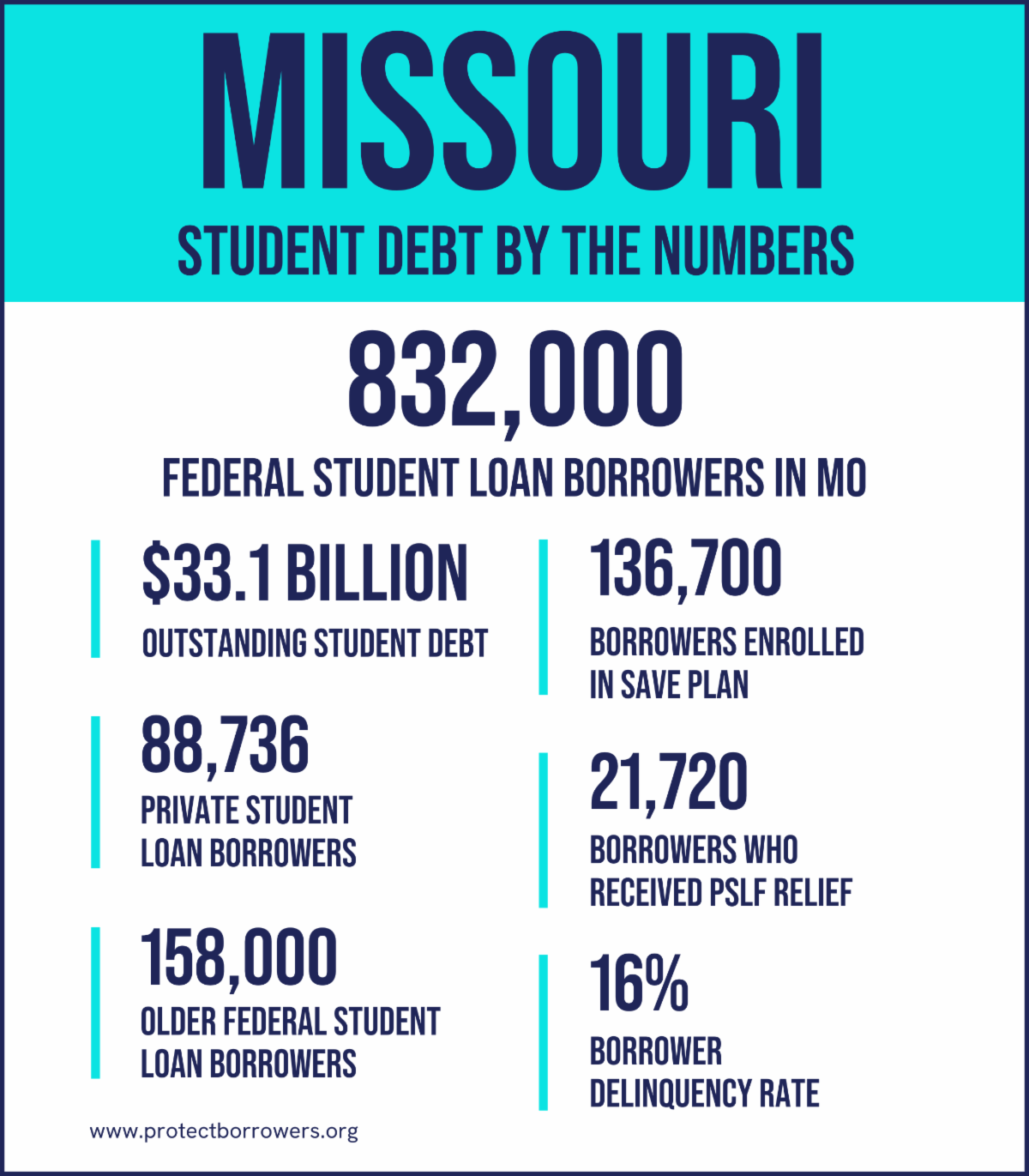
As the new administration and conservative congressional majority considers proposals that would roll back critical protections for student loan borrowers and make student loan debt even more expensive, we’re committed to protecting borrowers. We’ve released statewide and congressional-level snapshots of the student debt crisis to shine a light on the impact of student debt across the country.

These fact sheets provide granular data on:

  • The number of borrowers and total student debt in each area
  • Constituents benefiting from affordable repayment plans
  • The life-changing impact of debt relief over the past four years


We hope these snapshots offer critical context to help ensure new and returning policymakers understand the toll of student debt on their communities—and the urgent need for bold action to alleviate this crisis.

The fight to protect student loan borrowers continues.

The new political dynamics of the 119th Congress raise the stakes for borrowers. Proposals to roll back protections, gut affordable repayment plans like the Saving on a Valuable Education Plan, and shift costs onto working families, threaten the progress we’ve made. But our coalition and community of borrowers and advocates are ready to stand strong together and continue protecting our wins while fighting for more.

Standing together,


Persis Yu

Deputy Executive Director & Managing Counsel

Student Borrower Protection Center

Let America Be America Again (Langston Hughes)


Sunday, January 19, 2025

The Business Plots, Then and Now

In 1933, a group of American businessman planned a coup to take down the new President, Franklin Roosevelt. In this scheme, General Smedley Butler would be tasked with orchestrating the overthrow. This attempted coup was called the Business Plot.  

College students today may ask, so what's so important about this moment in history?  The point is that we have entered an era again where big business has a dominating influence over American politics. In the case of the 1933 moment, the coup was reactive. American business had failed, a Great Depression was in progress, and businessmen were fighting to maintain control, a control that they were used to having under Harding, Coolidge, and Hoover. The man tasked to lead the plot, General Butler, squashed it before it happened. And the story largely faded away. 

Eight years later, in 1941, the US would be fighting a world war against global fascism and imperialism.  In the aftermath of the war, a stronger nation would arise. Today, we are also a nation facing intense competition and conflict, this time against China, Russia, India and other nations, with global climate change being a factor that wasn't apparent back then. 

In 2024, US business people, some of the richest people in the world, did something similar, but more proactive and less controversial. Today, folks, in general are OK with American businessmen pulling the strings. The most wealthy man have succeeded where big banks and big business failed before. And they have elected a friend. Today, cryptocurrency is booming. The stock market is booming for now. Unemployment is at record lows--for now. Big business has managed to gain greater control of the US government with little or no uproar. 


Higher Ed Unbridled (And Muzzled)

In early 2025, we will slowly begin to see what US higher education looks like with less oversight and accountability, something that many business leaders and administrators secretly hope for. At the same time, we can imagine higher education and its media wary of talking out of turn.

In the past, the Higher Education Inquirer (HEI) focused on exposing bad actors in a few areas of the higher education business: online program managers, large robocolleges, student loan servicers, lead generators, SLAB makers, and university endowments. 

We followed the plight of student loan debtors and their families, working-class adjuncts, and striking academic labor. Together, they represented tens of millions of Americans. And we covered funding cuts, layoffs, and universities in financial peril. 

We promoted people, in higher education and the higher education business, who fight for more transparency and accountability--those who provided value to consumers. 

And HEI highlighted the work of important scholars who discussed the role of higher education in larger matters of politics and economics, climate change and global conflicts.

Despite all of this work, we believe there will be a need to expand our focus over the next four years. We expect fraud and corruption to widen across the higher ed sector and for media coverage of this malfeasance to be minimal--maybe even less than the past.  

While higher ed may be unbridled, the higher ed media may be muzzled.  We hope to do the opposite despite the costs.  

Please support the Higher Education Inquirer by consistently reading and sharing our work with allies, and by letting us know what you all see. Your comments are always welcome and your participation does matter. Let's work and struggle together--in solidarity.

Saturday, January 18, 2025

The US is leading us closer to nuclear war (Jeffrey Sachs)

Columbia University Professor Jeffrey Sachs says that the United States is steering the world toward disaster. Sachs served as the Director of the Earth Institute at Columbia University from 2002 to 2016 and is considered one of the world’s leading experts on economic development, global macroeconomics, and the fight against poverty.


Friday, January 17, 2025

Bernie Sanders Proposes 20,000 Fellowships for American Students to take STEM Jobs from H1B Foreign Workers


Social Security Offsets and Defaulted Student Loans (CFPB)

Executive Summary

When borrowers default on their federal student loans, the U.S. Department of Education (“Department of Education”) can collect the outstanding balance through forced collections, including the offset of tax refunds and Social Security benefits and the garnishment of wages. At the beginning of the COVID-19 pandemic, the Department of Education paused collections on defaulted federal student loans.1 This year, collections are set to resume and almost 6 million student loan borrowers with loans in default will again be subject to the Department of Education’s forced collection of their tax refunds, wages, and Social Security benefits.2 Among the borrowers who are likely to experience forced collections are an estimated 452,000 borrowers ages 62 and older with defaulted loans who are likely receiving Social Security benefits.3

This spotlight describes the circumstances and experiences of student loan borrowers affected by the forced collection of Social Security benefits.4 It also describes how forced collections can push older borrowers into poverty, undermining the purpose of the Social Security program.5

Key findings

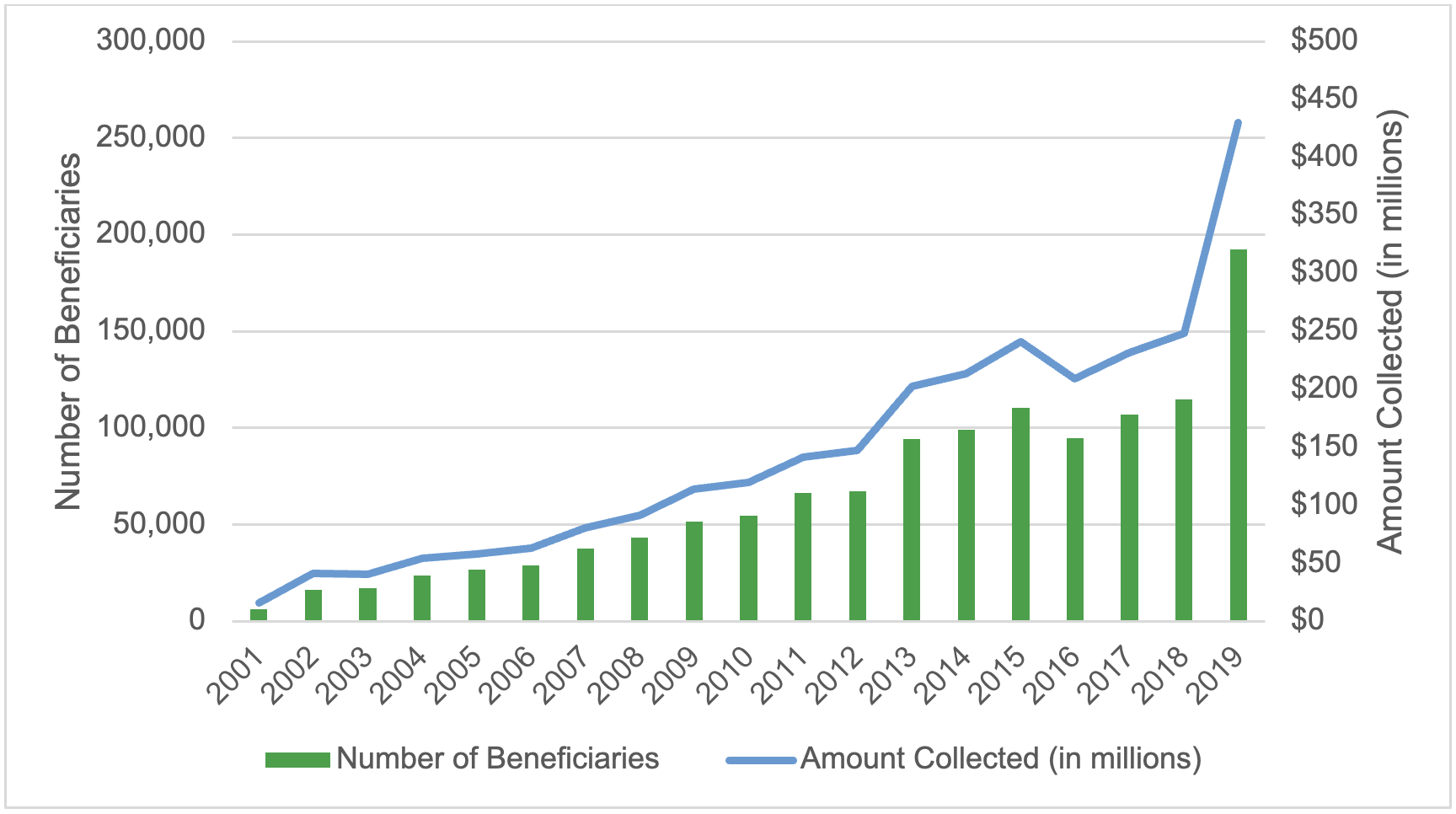
  • The number of Social Security beneficiaries experiencing forced collection grew by more than 3,000 percent in fewer than 20 years; the count is likely to grow as the age of student loan borrowers trends older. Between 2001 and 2019, the number of Social Security beneficiaries experiencing reduced benefits due to forced collection increased from approximately 6,200 to 192,300. This exponential growth is likely driven by older borrowers who make up an increasingly large share of the federal student loan portfolio. The number of student loan borrowers ages 62 and older increased by 59 percent from 1.7 million in 2017 to 2.7 million in 2023, compared to a 1 percent decline among borrowers under the age of 62.
  • The total amount of Social Security benefits the Department of Education collected between 2001 and 2019 through the offset program increased from $16.2 million to $429.7 million. Despite the exponential increase in collections from Social Security, the majority of money the Department of Education has collected has been applied to interest and fees and has not affected borrowers’ principal amount owed. Furthermore, between 2016 and 2019, the Department of the Treasury’s fees alone accounted for nearly 10 percent of the average borrower’s lost Social Security benefits.
  • More than one in three Social Security recipients with student loans are reliant on Social Security payments, meaning forced collections could significantly imperil their financial well-being. Approximately 37 percent of the 1.3 million Social Security beneficiaries with student loans rely on modest payments, an average monthly benefit of $1,523, for 90 percent of their income. This population is particularly vulnerable to reduction in their benefits especially if benefits are offset year-round. In 2019, the average annual amount collected from individual beneficiaries was $2,232 ($186 per month).
  • The physical well-being of half of Social Security beneficiaries with student loans in default may be at risk. Half of Social Security beneficiaries with student loans in default and collections skipped a doctor’s visit or did not obtain prescription medication due to cost.
  • Existing minimum income protections fail to protect student loan borrowers with Social Security against financial hardship. Currently, only $750 per month of Social Security income—an amount that is $400 below the monthly poverty threshold for an individual and has not been adjusted for inflation since 1996—is protected from forced collections by statute. Even if the minimum protected income was adjusted for inflation, beneficiaries would likely still experience hardship, such as food insecurity and problems paying utility bills. A higher threshold could protect borrowers against hardship more effectively. The CFPB found that for 87 percent of student loan borrowers who receive Social Security, their benefit amount is below 225 percent of the federal poverty level (FPL), an income level at which people are as likely to experience material hardship as those with incomes below the federal poverty level.
  • Large shares of Social Security beneficiaries affected by forced collections may be eligible for relief or outright loan cancellation, yet they are unable to access these benefits, possibly due to insufficient automation or borrowers’ cognitive and physical decline. As many as eight in ten Social Security beneficiaries with loans in default may be eligible to suspend or reduce forced collections due to financial hardship. Moreover, one in five Social Security beneficiaries may be eligible for discharge of their loans due to a disability. Yet these individuals are not accessing such relief because the Department of Education’s data matching process insufficiently identifies those who may be eligible.

Taken together, these findings suggest that the Department of Education’s forced collections of Social Security benefits increasingly interfere with Social Security’s longstanding purpose of protecting its beneficiaries from poverty and financial instability.

Introduction

When borrowers default on their federal student loans, the Department of Education can collect the outstanding balance through forced collections, including the offset of tax refunds and Social Security benefits, and the garnishment of wages. At the beginning of the COVID-19 pandemic, the Department of Education paused collections on defaulted federal student loans. This year, collections are set to resume and almost 6 million student loan borrowers with loans in default will again be subject to the Department of Education’s forced collection of their tax refunds, wages, and Social Security benefits.6

Among the borrowers who are likely to experience the Department of Education’s renewed forced collections are an estimated 452,000 borrowers with defaulted loans who are ages 62 and older and who are likely receiving Social Security benefits.7 Congress created the Social Security program in 1935 to provide a basic level of income that protects insured workers and their families from poverty due to situations including old age, widowhood, or disability.8 The Social Security Administration calls the program “one of the most successful anti-poverty programs in our nation's history.”9 In 2022, Social Security lifted over 29 million Americans from poverty, including retirees, disabled adults, and their spouses and dependents.10 Congress has recognized the importance of securing the value of Social Security benefits and on several occasions has intervened to protect them.11

This spotlight describes the circumstances and experiences of student loan borrowers affected by the forced collection of their Social Security benefits.12 It also describes how the purpose of Social Security is being increasingly undermined by the limited and deficient options the Department of Education has to protect Social Security beneficiaries from poverty and hardship.

The forced collection of Social Security benefits has increased exponentially.

Federal student loans enter default after 270 days of missed payments and transfer to the Department of Education’s default collections program after 360 days. Borrowers with a loan in default face several consequences: (1) their credit is negatively affected; (2) they lose eligibility to receive federal student aid while their loans are in default; (3) they are unable to change repayment plans and request deferment and forbearance;13 and (4) they face forced collections of tax refunds, Social Security benefits, and wages among other payments.14 To conduct its forced collections of federal payments like tax refunds and Social Security benefits, the Department of Education relies on a collection service run by the U.S. Department of the Treasury called the Treasury Offset Program.15

Between 2001 and 2019, the number of student loan borrowers facing forced collection of their Social Security benefits increased from at least 6,200 to 192,300.16 That is a more than 3,000 percent increase in fewer than 20 years. By comparison, the number of borrowers facing forced collections of their tax refunds increased by about 90 percent from 1.17 million to 2.22 million during the same period.17

This exponential growth of Social Security offsets between 2001 and 2019 is likely driven by multiple factors including:

  • Older borrowers accounted for an increasingly large share of the federal student loan portfolio due to increasing average age of enrollment and length of time in repayment. Data from the Department of Education (which is only available since 2017), show that the number of student loan borrowers ages 62 and older, increased 24 percent from 1.7 million in 2017 to 2.1 million in 2019, compared to less than 1 percent among borrowers under the age of 62.18
  • A larger number of borrowers, especially older borrowers, had loans in default. Data from the Department of Education show that the number of student loan borrowers with a defaulted loan increased by 230 percent from 3.8 million in 2006 to 8.8 million in 2019.19 Compounding these trends is the fact that older borrowers are twice as likely to have a loan in default than younger borrowers.20

Due to these factors, the total amount of Social Security benefits the Department of Education collected between 2001 and 2019 through the offset program increased annually from $16.2 million to $429.7 million (when adjusted for inflation).21 This increase occurred even though the average monthly amount the Department of Education collected from individual beneficiaries was the same for most years, at approximately $180 per month.22

Figure 1: Number of Social Security beneficiaries and total amount collected for student loans (2001-2019)

A combination of a line graph showing the growth in total amount of Social Security collected for defaulted student loans between 2001 and 2019, and a bar graph showing the number of Social Security beneficiaries affected during the same period.

Source: CFPB analysis of public data from U.S. Treasury’s Fiscal Data portal. Amounts are presented in 2024 dollars.

While the total collected from Social Security benefits has increased exponentially, the majority of money the Department of Education collected has not been applied to borrowers’ principal amount owed. Specifically, nearly three-quarters of the monies the Department of Education collects through offsets is applied to interest and fees, and not towards paying down principal balances.23 Between 2016 and 2019, the U.S. Department of the Treasury charged the Department of Education between $13.12 and $15.00 per Social Security offset, or approximately between $157.44 and $180 for 12 months of Social Security offsets per beneficiary with defaulted federal student loans.24 As a matter of practice, the Department of Education often passes these fees on directly to borrowers.25 Furthermore, these fees accounted for nearly 10 percent of the average monthly borrower’s lost Social Security benefits which was $183 during this time.26 Interest and fees not only reduce beneficiaries’ monthly benefits, but also prolong the period that beneficiaries are likely subject to forced collections.

Forced collections are compromising Social Security beneficiaries’ financial well-being.

Forced collection of Social Security benefits affects the financial well-being of the most vulnerable borrowers and can exacerbate any financial and health challenges they may already be experiencing. The CFPB’s analysis of the Survey of Income and Program Participation (SIPP) pooled data for 2018 to 2021 finds that Social Security beneficiaries with student loans receive an average monthly benefit of $1,524.27 The analysis also indicates that approximately 480,000 (37 percent) of the 1.3 million beneficiaries with student loans rely on these modest payments for 90 percent or more of their income,28 thereby making them particularly vulnerable to reduction in their benefits especially if benefits are offset year-round. In 2019, the average annual amount collected from individual beneficiaries was $2,232 ($186 per month).29

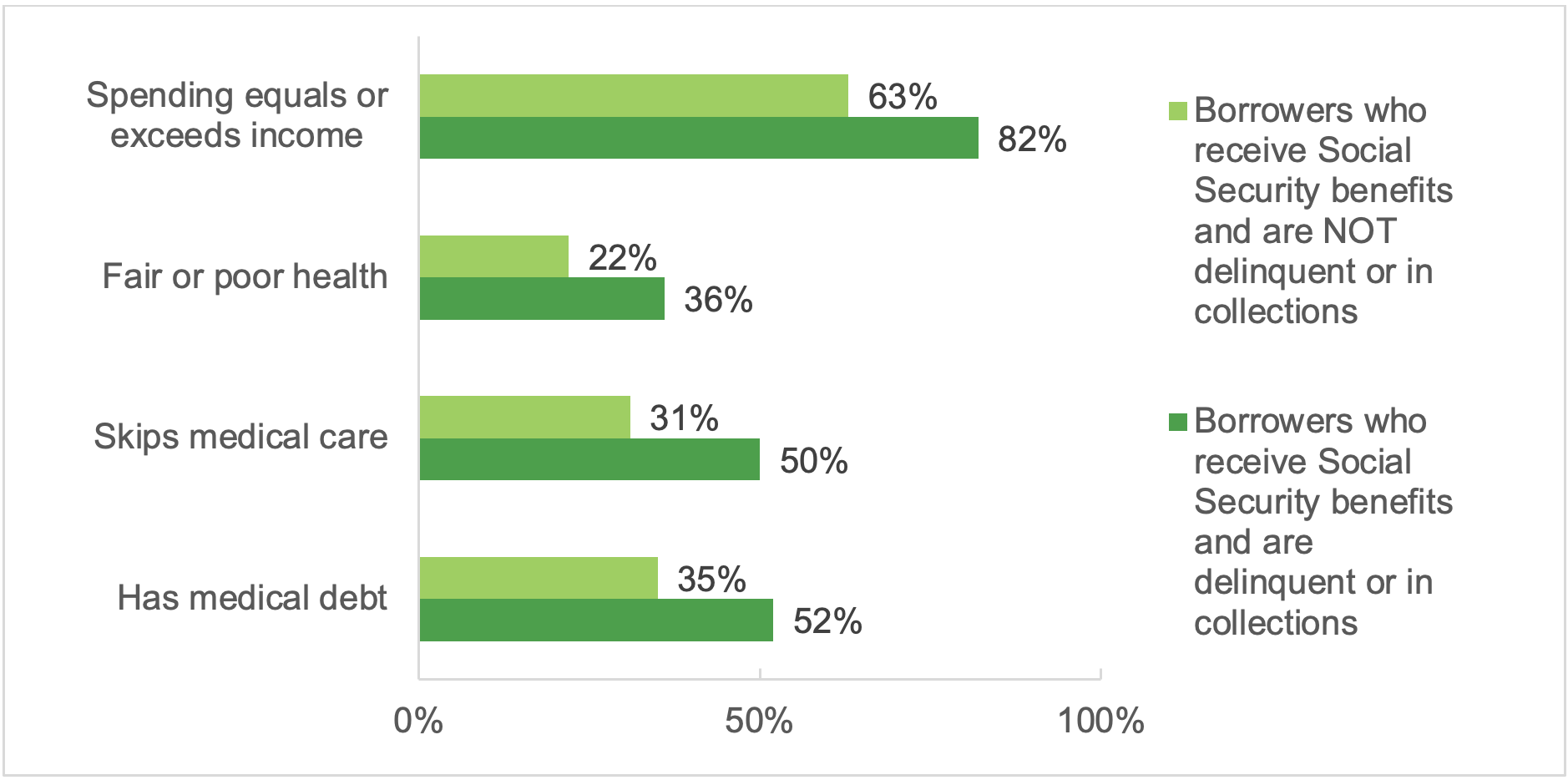
A recent survey from The Pew Charitable Trusts found that more than nine in ten borrowers who reported experiencing wage garnishment or Social Security payment offsets said that these penalties caused them financial hardship.30 Consequently, for many, their ability to meet their basic needs, including access to healthcare, became more difficult. According to our analysis of the Federal Reserve’s Survey of Household Economic and Decision-making (SHED), half of Social Security beneficiaries with defaulted student loans skipped a doctor’s visit and/or did not obtain prescription medication due to cost.31 Moreover, 36 percent of Social Security beneficiaries with loans in delinquency or in collections report fair or poor health. Over half of them have medical debt.32

Figure 2: Selected financial experiences and hardships among subgroups of loan borrowers

Bar graph showing that borrowers who receive Social Security benefits and are delinquent or in collections are more likely to report that their spending is same or higher than their income, they are unable to pay some bills, have fair or poor health, and skip medical care than borrowers who receive Social Security benefits and are not delinquent or in collections.

Source: CFPB analysis of the Federal Reserve Board Survey of Household Economic and Decision-making (2019-2023).

Social Security recipients subject to forced collection may not be able to access key public benefits that could help them mitigate the loss of income. This is because Social Security beneficiaries must list the unreduced amount of their benefits prior to collections when applying for other means-tested benefits programs such as Social Security Insurance (SSI), Supplemental Nutrition Assistance Program (SNAP), and the Medicare Savings Programs.33 Consequently, beneficiaries subject to forced collections must report an inflated income relative to what they are actually receiving. As a result, these beneficiaries may be denied public benefits that provide food, medical care, prescription drugs, and assistance with paying for other daily living costs.34

Consumers’ complaints submitted to the CFPB describe the hardship caused by forced collections on borrowers reliant on Social Security benefits to pay for essential expenses.35 Consumers often explain their difficulty paying for such expenses as rent and medical bills. In one complaint, a consumer noted that they were having difficulty paying their rent since their Social Security benefit usually went to paying that expense.36 In another complaint, a caregiver described that the money was being withheld from their mother’s Social Security, which was the only source of income used to pay for their mother’s care at an assisted living facility.37 As forced collections threaten the housing security and health of Social Security beneficiaries, they also create a financial burden on non-borrowers who help address these hardships, including family members and caregivers.

Existing minimum income protections fail to protect student loan borrowers with Social Security against financial hardship.

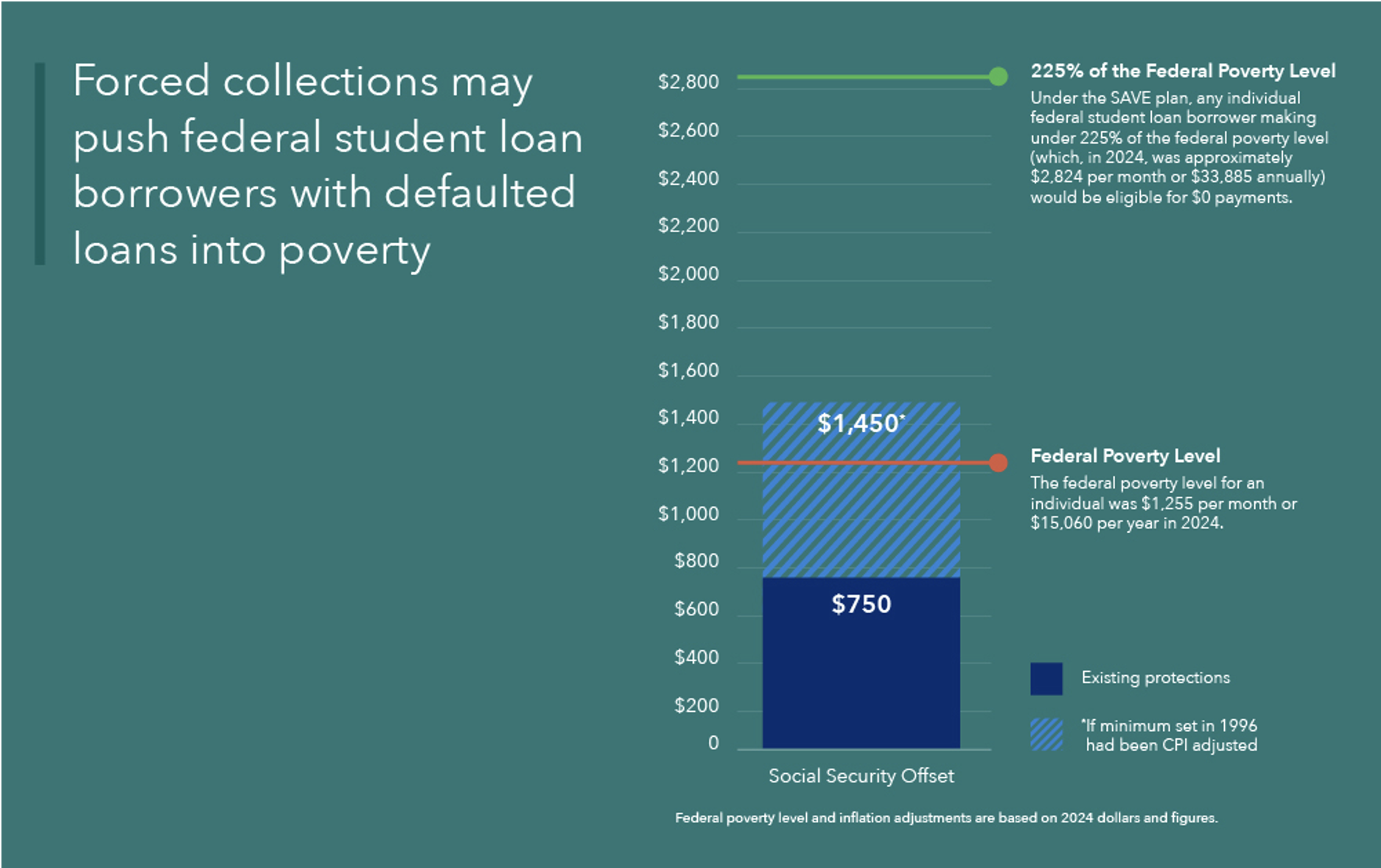
The Debt Collection Improvement Act set a minimum floor of income below which the federal government cannot offset Social Security benefits and subsequent Treasury regulations established a cap on the percentage of income above that floor.38 Specifically, these statutory guardrails limit collections to 15 percent of Social Security benefits above $750. The minimum threshold was established in 1996 and has not been updated since. As a result, the amount protected by law alone does not adequately protect beneficiaries from financial hardship and in fact no longer protects them from falling below the federal poverty level (FPL). In 1996, $750 was nearly $100 above the monthly poverty threshold for an individual.39 Today that same protection is $400 below the threshold. If the protected amount of $750 per month ($9,000 per year) set in 1996 was adjusted for inflation, in 2024 dollars, it would total $1,450 per month ($17,400 per year).40

Figure 3: Comparison of monthly FPL threshold with the current protected amount established in 1996 and the amount that would be protected with inflation adjustment

Image with a bar graph showing the difference in monthly amounts for different thresholds and protections, from lowest to highest: (a) existing protections ($750), (b) the federal poverty level in 2024 ($1,255), (c) the amount set in 1996 if it had been CPI adjusted ($1,450), and (e) 225% of the FPL under the SAVE Plan ($2,824).

Source: Calculations by the CFPB. Notes: Inflation adjustments based on the consumer price index (CPI).

Even if the minimum protected income of $750 is adjusted for inflation, beneficiaries will likely still experience hardship as a result of their reduced benefits. Consumers with incomes above the poverty line also commonly experience material hardship.41 This suggests that a threshold that is higher than the poverty level will more effectively protect against hardship.42 Indeed, in determining an income threshold for $0 payments under the SAVE plan, the Department of Education researchers used material hardship (defined as being unable to pay utility bills and reporting food insecurity) as their primary metric, and found similar levels of material hardship among those with incomes below the poverty line and those with incomes up to 225 percent of the FPL.43 Similarly, the CFPB’s analysis of a pooled sample of SIPP respondents finds the same levels of material hardship for Social Security beneficiaries with student loans with incomes below 100 percent of the FPL and those with incomes up to 225 percent of the FPL.44 The CFPB found that for 87 percent of student loan borrowers who receive Social Security, their benefit amount is below 225 percent of the FPL.45 Accordingly, all of those borrowers would be removed from forced collections if the Department of Education applied the same income metrics it established under the SAVE program to an automatic hardship exemption program.

Existing options for relief from forced collections fail to reach older borrowers.

Borrowers with loans in default remain eligible for certain types of loan cancellation and relief from forced collections. However, our analysis suggests that these programs may not be reaching many eligible consumers. When borrowers do not benefit from these programs, their hardship includes, but is not limited to, unnecessary losses to their Social Security benefits and negative credit reporting.

Borrowers who become disabled after reaching full retirement age may miss out on Total and Permanent Disability

The Total and Permanent Disability (TPD) discharge program cancels federal student loans and effectively stops all forced collections for disabled borrowers who meet certain requirements. After recent revisions to the program, this form of cancelation has become common for those borrowers with Social Security who became disabled prior to full retirement age.46 In 2016, a GAO study documented the significant barriers to TPD that Social Security beneficiaries faced.47 To address GAO’s concerns, the Department of Education in 2021 took a series of mitigating actions, including entering into a data-matching agreement with the Social Security Administration (SSA) to automate the TPD eligibility determination and discharge process.48 This process was expanded further with new final rules being implemented July 1, 2023 that expanded the categories of borrowers eligible for automatic TPD cancellation.49 In total, these changes successfully resulted in loan cancelations for approximately 570,000 borrowers.50

However, the automation and other regulatory changes did not significantly change the application process for consumers who become disabled after they reach full retirement age or who have already claimed the Social Security retirement benefits. For these beneficiaries, because they are already receiving retirement benefits, SSA does not need to determine disability status. Likewise, SSA does not track disability status for those individuals who become disabled after they start collecting their Social Security retirement benefits.51

Consequently, SSA does not transfer information on disability to the Department of Education once the beneficiary begins collecting Social Security retirement.52 These individuals therefore will not automatically get a TPD discharge of their student loans, and they must be aware and physically and mentally able to proactively apply for the discharge.53

The CFPB’s analysis of the Census survey data suggests that the population that is excluded from the TPD automation process could be substantial. More than one in five (22 percent) Social Security beneficiaries with student loans are receiving retirement benefits and report a disability such as a limitation with vision, hearing, mobility, or cognition.54 People with dementia and other cognitive disabilities are among those with the greatest risk of being excluded, since they are more likely to be diagnosed after the age 70, which is the maximum age for claiming retirement benefits.55

These limitations may also help explain why older borrowers are less likely to rehabilitate their defaulted student loans. Specifically, 11 percent of student loan borrowers ages 50 to 59 facing forced collections successfully rehabilitated their loans,56 while only five percent of borrowers over the age of 75 do so.57

Figure 4: Number of student loan borrowers ages 50 and older in forced collection, borrowers who signed a rehabilitation agreement, and borrowers who successfully rehabilitated a loan by selected age groups

Age Group Number of Borrowers in Offset Number of Borrowers Who Signed a Rehabilitation Agreement Percent of Borrowers Who Signed a Rehabilitation Agreement Number of Borrowers Successfully Rehabilitated Percent of Borrowers who Successfully Rehabilitated
50 to 59 265,200 50,800 14% 38,400 11%
60 to 74 184,900 24,100 11% 18,500 8%
75 and older 15,800 1,000 6% 800 5%

Source: CFPB analysis of data provided by the Department of Education.

Shifting demographics of student loan borrowers suggest that the current automation process may become less effective to protect Social Security benefits from forced collections as more and more older adults have student loan debt. The fastest growing segment of student loan borrowers are adults ages 62 and older. These individuals are generally eligible for retirement benefits, not disability benefits, because they cannot receive both classifications at the same time. Data from the Department of Education reflect that the number of student loan borrowers ages 62 and older increased by 59 percent from 1.7 million in 2017 to 2.7 million in 2023. In comparison, the number of borrowers under the age of 62 remained unchanged at 43 million in both years.58 Furthermore, additional data provided to the CFPB by the Department of Education show that nearly 90,000 borrowers ages 81 and older hold an average amount of $29,000 in federal student loan debt, a substantial amount despite facing an estimated average life expectancy of less than nine years.59

Existing exceptions to forced collections fail to protect many Social Security beneficiaries

In addition to TPD discharge, the Department of Education offers reduction or suspension of Social Security offset where borrowers demonstrate financial hardship.60 To show hardship, borrowers must provide documentation of their income and expenses, which the Department of Education then uses to make its determination.61 Unlike the Debt Collection Improvement Act’s minimum protections, the eligibility for hardship is based on a comparison of an individual’s documented income and qualified expenses. If the borrower has eligible monthly expenses that exceed or match their income, the Department of Education then grants a financial hardship exemption.62

The CFPB’s analysis suggests that the vast majority of Social Security beneficiaries with student loans would qualify for a hardship protection. According to CFPB’s analysis of the Federal Reserve Board’s SHED, eight in ten (82 percent) of Social Security beneficiaries with student loans in default report that their expenses equal or exceed their income.63 Accordingly, these individuals would likely qualify for a full suspension of forced collections. Yet the GAO found that in 2015 (when the last data was available) less than ten percent of Social Security beneficiaries with forced collections applied for a hardship exemption or reduction of their offset.64 A possible reason for the low uptake rate is that many beneficiaries or their caregivers never learn about the hardship exemption or the possibility of a reduction in the offset amount.65 For those that do apply, only a fraction get relief. The GAO study found that at the time of their initial offset, only about 20 percent of Social Security beneficiaries ages 50 and older with forced collections were approved for a financial hardship exemption or a reduction of the offset amount if they applied.66

Conclusion

As hundreds of thousands of student loan borrowers with loans in default face the resumption of forced collection of their Social Security benefits, this spotlight shows that the forced collection of Social Security benefits causes significant hardship among affected borrowers. The spotlight also shows that the basic income protections aimed at preventing poverty and hardship among affected borrowers have become increasingly ineffective over time. While the Department of Education has made some improvements to expand access to relief options, especially for those who initially receive Social Security due to a disability, these improvements are insufficient to protect older adults from the forced collection of their Social Security benefits.

Taken together, these findings suggest that forced collections of Social Security benefits increasingly interfere with Social Security’s longstanding purpose of protecting its beneficiaries from poverty and financial instability. These findings also suggest that alternative approaches are needed to address the harm that forced collections cause on beneficiaries and to compensate for the declining effectiveness of existing remedies. One potential solution may be found in the Debt Collection Improvement Act, which provides that when forced collections “interfere substantially with or defeat the purposes of the payment certifying agency’s program” the head of an agency may request from the Secretary of the Treasury an exemption from forced collections.67 Given the data findings above, such a request for relief from the Commissioner of the Social Security Administration on behalf of Social Security beneficiaries who have defaulted student loans could be justified. Unless the toll of forced collections on Social Security beneficiaries is considered alongside the program’s stated goals, the number of older adults facing these challenges is only set to grow.

Data and Methodology

To develop this report, the CFPB relied primarily upon original analysis of public-use data from the U.S. Census Bureau Survey of Income and Program Participation (SIPP), the Federal Reserve Board Board’s Survey of Household Economics and Decision-making (SHED), U.S. Department of the Treasury, Fiscal Data portal, consumer complaints received by the Bureau, and administrative data on borrowers in default provided by the Department of Education. The report also leverages data and findings from other reports, studies, and sources, and cites to these sources accordingly. Readers should note that estimates drawn from survey data are subject to measurement error resulting, among other things, from reporting biases and question wording.

Survey of Income and Program Participation

The Survey of Income and Program Participation (SIPP) is a nationally representative survey of U.S. households conducted by the U.S. Census Bureau. The SIPP collects data from about 20,000 households (40,000 people) per wave. The survey captures a wide range of characteristics and information about these households and their members. The CFPB relied on a pooled sample of responses from 2018, 2019, 2020, and 2021 waves for a total number of 17,607 responses from student loan borrowers across all waves, including 920 respondents with student loans receiving Social Security benefits. The CFPB’s analysis relied on the public use data. To capture student loan debt, the survey asked to all respondents (variable EOEDDEBT): Owed any money for student loans or educational expenses in own name only during the reference period. To capture receipt of Social Security benefits, the survey asked to all respondents (variable ESSSANY): “Did ... receive Social Security benefits for himself/herself at any time during the reference period?” To capture amount of Social Security benefits, the survey asked to all respondents (variable TSSSAMT): “How much did ... receive in Social Security benefit payment in this month (1-12), prior to any deductions for Medicare premiums?”

The public-use version of the survey dataset, and the survey documentation can be found at: https://www.census.gov/programs-surveys/sipp.html

Survey of Household Economics and Decision-making

The Federal Reserve Board’s Survey of Household Economics and Decision-making (SHED) is an annual web-based survey of households. The survey captures information about respondents’ financial situations. The CFPB relied on a pooled sample of responses from 2019 through 2023 waves for a total number of 1,376 responses from student loan borrowers in collection across all waves. The CFPB analysis relied on the public use data. To capture default and collection, the survey asked all respondents with student loans (variable SL6): “Are you behind on payments or in collections for one or more of the student loans from your own education?” To capture receipt of Social Security benefits, the survey asked to all respondents (variable I0_c): “In the past 12 months, did you (and/or your spouse or partner) receive any income from the following sources: Social Security (including old age and DI)?”

The public-use version of the survey dataset, and the survey documentation can be found at https://www.federalreserve.gov/consumerscommunities/shed_data.htm  

Appendix A: Number of student loan borrowers ages 60 and older, total outstanding balance, and average balance by age group, August 2024

Age Group Borrower Count (in thousands) Balance (in billions) Average balance

60 to 65

1,951.4

$87.49

$44,834

66 to 70

909.8

$39.47

$43,383

71 to 75

457.5

$18.95

$41,421

76 to 80

179.0

$6.80

$37,989

81 to 85

59.9

$1.90

$31,720

86 to 90

20.1

$0.51

$25,373

91 to 95

7.0

$0.14

$20,000

96+

2.8

$0.05

$17,857

Source: Data provided by the Department of Education.

The endnotes for this report are available here