Search This Blog

Monday, July 7, 2025

Counselor Recommendation Letters: A Double-Edged Sword in Selective College Admissions (Research in Higher Education)

A new peer-reviewed study published in Research in Higher Education (July 2025) by Andrew S. Belasco, Katherine W. S. Lee, Su Yeong Song, and Michael N. Bastedo offers the most comprehensive analysis to date of how counselor recommendation letters contribute to inequality in U.S. college admissions. Analyzing more than 615,000 counselor letters submitted through the Common Application between 2018 and 2020, the authors applied natural language processing (NLP) techniques to uncover disturbing disparities in both letter length and thematic content based on students’ race, income level, school type, and test performance.

The study’s central finding is that counselor letters are far from neutral documents. Students from private schools and high-income families consistently received longer, more detailed letters, filled with praise across academic, extracurricular, and personal domains. These letters often emphasized qualities that align with the expectations of elite college admissions readers, such as leadership, initiative, and intellectual promise. In contrast, students from low-income backgrounds, especially those who received application fee waivers, frequently received letters that emphasized personal character or resilience over academic achievement. While these letters were sometimes longer in length, they were less likely to describe students' performance in key areas like academics or extracurricular activities. First-generation college students were particularly disadvantaged, receiving the shortest letters across all measured categories—even among top scorers.

The racial disparities revealed in the study were also striking. Black and Latinx students received significantly shorter letters than their white and Asian American peers, even when controlling for school and counselor characteristics. Their letters were less likely to highlight academic strengths, artistic or athletic talents, and extracurricular leadership. These inequities were still evident among students scoring in the 95th percentile or higher on standardized tests. Asian American students, while receiving longer letters on academic ability, were frequently described in narrower terms, with fewer references to personal qualities or well-roundedness. These findings point to entrenched patterns of racial bias, even when counselors intend to advocate for their students.

The authors of the study—Belasco, Lee, Song, and Bastedo—argue that these disparities are not solely the result of individual counselor prejudice. Instead, they are structural, tied to the unequal distribution of resources and caseloads across public and private schools. Private school counselors typically serve far fewer students and often have deeper relationships with them, enabling more comprehensive and personalized letters. Public school counselors, particularly in underfunded districts, may be responsible for hundreds of students and lack the time or information to write in-depth recommendations.

These inequities matter because counselor letters continue to play a major role in holistic admissions, especially at highly selective colleges and universities. Although some admissions officers make efforts to read letters within the context of a student's environment, there is little consistency across institutions. When letters are interpreted without such context, the gaps in length and substance can serve to amplify the advantages already enjoyed by privileged students.

In response to these findings, the authors recommend a series of policy changes. They advocate for better training for admissions readers to evaluate counselor letters with an understanding of school context and structural inequality. They also suggest that schools and districts develop more standardized approaches to writing letters to minimize variation. Furthermore, the study raises serious questions about whether counselor recommendations should be required at all—particularly in public university systems. Institutions such as the University of California and the University of Illinois Urbana-Champaign have already made counselor letters optional or eliminated them entirely, citing equity concerns.

The research adds to a growing body of literature that challenges the fairness of so-called holistic review processes. In the wake of the U.S. Supreme Court’s 2023 decision banning race-conscious admissions policies, colleges and universities are under increased scrutiny to ensure that alternative measures, such as essays and recommendation letters, do not serve as covert pathways to replicate systemic bias. This study indicates that without intentional reform, recommendation letters may continue to function as gatekeeping devices that privilege whiteness, wealth, and access to elite educational institutions.

As U.S. higher education grapples with questions of access and equity, this study from Belasco, Lee, Song, and Bastedo provides a data-driven reminder that well-meaning admissions tools can still reproduce injustice. Colleges that are serious about fair admissions practices must confront not only who writes these letters—but what they contain, what they omit, and how they are interpreted.


Sources
Belasco, A. S., Lee, K. W. S., Song, S., & Bastedo, M. N. (2025). School Counselors, Structural Inequality, and Recommendation Letters in College Admissions. Research in Higher Education. https://doi.org/10.1007/s11162-025-09847-5
Stevens, M. L. (2009). Creating a Class: College Admissions and the Education of Elites. Harvard University Press.
Jack, A. A. (2019). The Privileged Poor: How Elite Colleges Are Failing Disadvantaged Students. Harvard University Press.
Bastedo, M. N., Bowman, N. A., Glasener, K. M., & Kelly, J. L. (2018). What Are We Talking About When We Talk About Holistic Review? Journal of Higher Education.
Carnevale, A. P., Rose, S. J., & Cheah, B. (2011). The College Payoff: Education, Occupations, Lifetime Earnings. Georgetown University Center on Education and the Workforce.
National Association for College Admission Counseling (NACAC). (2019). State of College Admission.

Science-Based Climate Change Denial: Manufacturing Doubt in the Age of Collapse

Despite overwhelming scientific consensus that human activity—especially the burning of fossil fuels—is the primary driver of climate change, a sophisticated form of climate change denial persists, often cloaked in the language and authority of science itself. This “science-based” climate change denial does not simply reject climate science outright but instead cherry-picks data, emphasizes uncertainties, and amplifies marginal scientific viewpoints to cast doubt on established facts. At the center of this strategy are credentialed scientists, industry-funded think tanks, and academic institutions that provide intellectual cover for the continued exploitation of fossil fuels.

This form of denialism has proved highly effective in delaying climate action, muddying public understanding, and influencing policy—especially in the United States, where partisan politics, neoliberal economic ideology, and extractive capitalism intersect.

The Evolution of Denialism

In the 1990s, outright climate change denial was more common, with prominent voices denying that the Earth was warming or that human activity played any role. But as evidence mounted—through rising global temperatures, melting ice caps, and increasingly destructive weather events—climate denial evolved. Rather than deny global warming altogether, many so-called skeptics now argue that climate models are unreliable, that warming is not necessarily dangerous, or that adaptation is more cost-effective than mitigation.

This shift gave rise to a subtler, more insidious strategy: science-based denial. Unlike conspiracy theories or fringe pseudoscience, this form of denial often involves credentialed experts, peer-reviewed articles (sometimes in low-quality or ideologically driven journals), and selective interpretation of data to mislead the public and stall regulatory action.

Scientists for Hire

Think tanks like the Heartland Institute, Cato Institute, and George C. Marshall Institute have employed scientists with impressive resumes to lend credibility to denialist arguments. Figures like Willie Soon, an astrophysicist at the Harvard-Smithsonian Center for Astrophysics, have received funding from fossil fuel interests like ExxonMobil and Southern Company while publishing papers that downplay human contributions to climate change. These financial ties are often undisclosed or downplayed, even though they present a clear conflict of interest.

In some cases, these scientists present themselves as heroic dissenters—mavericks standing up against a corrupt, alarmist scientific establishment. Their arguments are rarely about disproving the reality of climate change, but instead about inflating uncertainties, misrepresenting data, or offering misleading counter-examples that are unrepresentative of broader trends.

The Role of Higher Education

Elite universities and academic journals have sometimes unwittingly enabled science-based denial by embracing a culture of both-sides-ism and neutrality in the face of coordinated disinformation campaigns. In the name of academic freedom, universities have tolerated or even elevated voices that promote denialist rhetoric under the guise of “healthy skepticism.”

Institutions like George Mason University’s Mercatus Center and Stanford University’s Hoover Institution have provided intellectual homes for scholars funded by fossil fuel interests. These institutions maintain the veneer of academic legitimacy while promoting deregulatory, pro-fossil fuel policy agendas.

Furthermore, federal and state funding for climate research has become increasingly politicized, especially under Republican administrations. Under the Trump administration (2017–2021), federal agencies were directed to scrub climate change from reports and suppress scientific findings. Even now, with the potential return of Trump-style governance, science-based denialists are preparing for a resurgence.

Strategic Misinformation

Climate denial campaigns use sophisticated media strategies to manipulate public opinion. Through platforms like Fox News, right-wing podcasts, and social media channels, science-based denial is disseminated to millions. The denialists often invoke “Climategate”—a 2009 scandal involving hacked emails from climate scientists—as proof of corruption in climate science, despite multiple investigations clearing the scientists of wrongdoing.

The playbook is familiar: exaggerate uncertainty, cherry-pick cold weather events, blame solar activity, and discredit prominent climate scientists like Michael Mann or James Hansen. The public, already overwhelmed with crises, becomes confused, disoriented, or apathetic.

Consequences and Countermeasures

The consequences of science-based climate denial are devastating. Delayed action has led to rising sea levels, record heatwaves, agricultural disruption, and biodiversity collapse. Vulnerable communities, particularly in the Global South and marginalized communities in the U.S., bear the brunt of the damage.

To counter this, scholars and educators must move beyond “debating” denialists and instead expose the ideological and financial underpinnings of their arguments. As Naomi Oreskes and Erik Conway showed in Merchants of Doubt, denialism is not a scientific disagreement—it is a political and economic strategy designed to protect powerful interests.

The Higher Education Inquirer supports open scientific inquiry, but not at the expense of truth or the planet. Universities, journalists, and the public must hold denialists accountable and challenge the structures that enable them—especially those in academic robes who lend their credentials to oil-funded propaganda.


Reliable Sources and Further Reading:

  • Oreskes, Naomi, and Erik M. Conway. Merchants of Doubt. Bloomsbury Press, 2010.

  • Brulle, Robert J. “Institutionalizing delay: foundation funding and the creation of U.S. climate change counter-movement organizations.” Climatic Change, vol. 122, no. 4, 2014, pp. 681–694.

  • Dunlap, Riley E., and Aaron M. McCright. “Organized climate change denial.” The Oxford Handbook of Climate Change and Society, Oxford University Press, 2011.

  • Mann, Michael E. The New Climate War: The Fight to Take Back Our Planet. PublicAffairs, 2021.

  • Union of Concerned Scientists. "The Climate Deception Dossiers." 2015. https://www.ucsusa.org/resources/climate-deception-dossiers

  • Inside Climate News. “Exxon: The Road Not Taken.” https://insideclimatenews.org/news/15092015/exxon-the-road-not-taken/

  • Climate Investigations Center. “Tracking the Climate Denial Machine.” https://climateinvestigations.org


For inquiries, reprint permissions, or to contribute your own investigations, contact The Higher Education Inquirer at gmcghee@aya.yale.edu.

Trump Team Weakens Bipartisan Law That Protects Students and Veterans From Predatory Colleges (David Halperin)

On the eve of the 4th of July holiday, when they probably hoped no one was paying attention, the Trump Department of Education issued an Interpretive Rule that will make it easier for for-profit colleges to evade regulations aimed at protecting students, and especially student veterans and military service members, from low-quality schools.

The Department’s 90-10 rule, created by Congress, requires for-profit colleges to obtain at least ten percent of their revenue from sources other than taxpayer-funded federal student grants and loans, or else — if they flunk two years in a row — lose eligibility for federal aid. The purpose is to remove from federal aid those schools of such poor quality that few students, employers, or scholarship programs would put their own money into them.

For decades, low quality schools have been able to avoid accountability through a giant loophole: only Department of Education funding counted on the federal side of the 90-10 ledger, while other government funding, including GI Bill money from the VA, and tuition assistance for active duty troops and their families from the Pentagon, counted as non-federal. That situation was particularly bad because it motivated low-quality predatory schools, worried about their 90-10 ratios, to aggressively target U.S. veterans and service members for recruitment.

After years of efforts by veterans organizations and other advocates to close the loophole, Congress in 2021 passed, on a bipartisan basis, and President Biden signed, legislation that appropriately put all federal education aid, including VA and Defense Department money, on the federal side of the ledger.

The Department was required by the new law to issue regulations specifying in detail how this realignment would work, and the Department under the Biden administration did so in 2022, after engaging in a legally-mandated negotiated rulemaking that brought together representatives of relevant stakeholders. In an unusual development, that rulemaking actually achieved consensus among the groups at the table, from veterans organizations to the for-profit schools themselves, on what the final revised 90-10 rule should be.

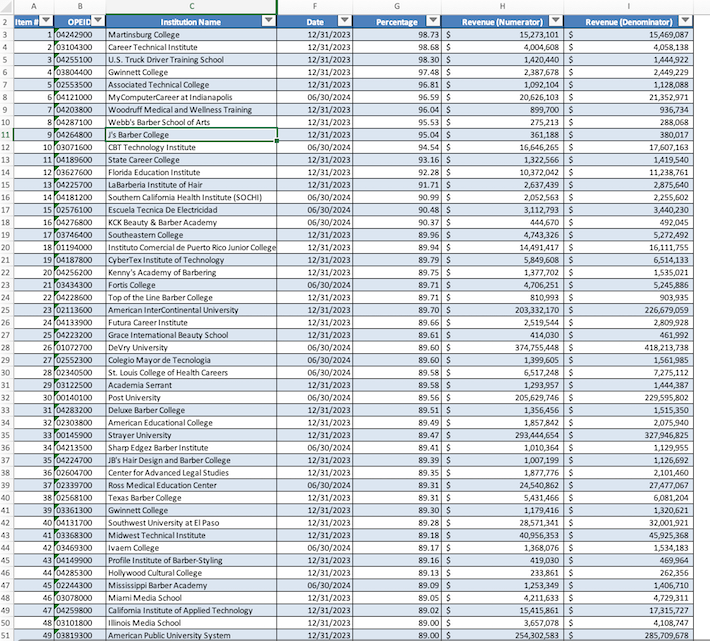
The new rule took effect in 2023, and when the Department released the latest 90-10 calculations, for the 2023-24 academic year, sixteen for-profit colleges had flunked, compared with just five the previous year. These were mostly smaller schools, led by West Virginia’s Martinsburg College, which got 98.73 percent of its revenue from federal taxpayer dollars, and Washington DC’s Career Technical Institute, which reported 98.68 percent. Another 36 schools, including major institutions such as DeVry University, Strayer University, and American Public University, came perilously close to the line, at 89 percent or higher.

The education department last week altered the calculation by effectively restoring an old loophole that allowed for-profit colleges to use revenue from programs that are ineligible for federal aid to count on the non-federal side. That loophole was expressly addressed, via a compromise agreement, after Department officials discussed the details with representatives of for-profit colleges, during the 2022 negotiated rulemaking meetings.

All the flunking or near-flunking schools can now get a new, potentially more favorable, calculation of their 90-10 ratio under the Trump administration’s re-interpretation of the rule.

In the lawless fashion of the Trump regime, the Department has now undermined a provision of its own regulation without going through the required negotiated rulemaking process. (The Department’s notice last week included a labored argument about why its action was lawful.)

As it has done multiple times over its first six months, the Trump Department of Education, under Secretary Linda McMahon, has again taken a step that allows poor-quality predatory for-profit colleges to rip off students and taxpayers.

[Editor's note: This article originally appeared on Republic Report.]

Future Scenarios: A Post-College America (Glen McGhee)

By 2035, the traditional American college system may be a relic of the past. A variety of forces—economic, technological, demographic, and cultural—are converging to transform the landscape of higher learning. Grounded in Papenhausen's cyclical model of institutional change, current data and trends suggest a plausible future in which college campuses no longer serve as the central hubs of postsecondary education. Instead, a more fragmented, skills-based, and economically integrated system may rise in its place.

Since 2010, college enrollment in the U.S. has declined by 8.5%, with more than a million fewer students than before the COVID-19 pandemic. Over 80 colleges have closed or merged since 2020, and many experts forecast a sharp acceleration in closures, especially as the so-called “demographic cliff” reduces the pool of traditional-age college students. The Federal Reserve Bank of Philadelphia projects a potential 142% increase in annual college closures by the end of the decade.

This institutional unraveling is not solely demographic. Federal disinvestment in research and financial aid, rising tuition (up more than 1,500% since the late 1970s), and increasing underemployment among recent graduates are undermining the perceived and actual value of a college degree. Emerging technologies, particularly AI, are rapidly changing the ways people learn and the skills employers seek. Meanwhile, the proliferation of fake degrees and credential fraud further erodes trust in conventional academic institutions.

In response to these destabilizing trends, four future scenarios offer possible replacements for the traditional college system. Each reflects different combinations of technological advancement, labor market shifts, and institutional evolution.

The Corporate Academy Landscape envisions a future in which large companies like Google, Amazon, and IBM take the lead in educating the workforce. Building on existing certificate programs, these corporations establish their own academies, offering industry-aligned training and credentials. Apprenticeships and on-the-job learning become the primary paths to employment, with digital badges and blockchain-secured micro-credentials replacing degrees. Corporate campuses cluster in major urban centers, while rural areas develop niche training programs related to local industries such as agriculture and renewable energy.

In The Distributed Learning Networks scenario, education becomes fully decentralized. Instead of enrolling in a single institution, learners access personalized instruction through AI-powered platforms, community-based workshops, and online mentorships. Local libraries, maker spaces, and co-working hubs evolve into core educational environments. Learning is assessed through portfolios and real-world projects rather than grades or standardized exams. Regional expertise clusters develop organically, especially in smaller cities and towns with existing community infrastructure.

The Guild Renaissance looks to the past to shape the future. Modeled on pre-industrial apprenticeship systems, professional guilds re-emerge as gatekeepers of career development. These organizations handle training, credentialing, and job placement in sectors such as healthcare, construction, technology, and the arts. Hierarchical systems guide individuals from novice to expert, and regional economies specialize around guild-supported industries. Employment becomes tightly integrated with ongoing learning, minimizing the traditional gap between school and work.

Finally, The Hybrid Workplace University scenario grows out of the shift to remote and hybrid work. With more than one-third of workers expected to remain partially remote, workplaces themselves become learning environments. Education is embedded in professional workflows through VR training, modular courses, and flexible scheduling. As access to learning becomes geographically unrestricted, rural and underpopulated areas may see renewed vitality as remote workers seek lower-cost, higher-quality living environments.

Despite their differences, these scenarios share several transformational themes. Economically, resources formerly directed toward campus infrastructure are redirected toward skills training, research hubs, and community development. Culturally, the notion of lifelong learning becomes normalized, and credentials become more transparent, practical, and verifiable. Socially, traditional notions of campus life give way to professional and civic identity tied to industry specialization or community engagement.

The evolution of quality assurance is also noteworthy. Traditional accreditation may give way to employer-driven standards, market-based performance indicators, and digital verification technologies. Blockchain and competency-based evaluations offer more direct and trustworthy assessments of ability and readiness for employment.

Geographically, these changes will reshape communities in different ways. Former college towns must navigate economic transitions, potentially reinventing themselves as hubs for innovation or remote work. Urban areas may thrive as centers of corporate education and research. Rural regions may find new purpose through specialized training programs aligned with local resources and culture.

If these trends continue, the benefits could be substantial: reduced student debt, more direct paths to employment, faster innovation, and greater regional economic diversity. But challenges remain. The loss of traditional university research infrastructure may hinder long-term scientific progress. Access to elite training may increasingly depend on corporate affiliation, potentially limiting social mobility and excluding those without early access to professional networks. The liberal arts and humanities—once central to American higher education—may struggle to find footing in this new paradigm.

In the broad view, these emerging models reflect a shift away from institutional prestige and toward demonstrable competence. The change is not only educational but societal, redefining what it means to learn, to work, and to belong. Whether this transformation leads to a more inclusive and efficient system or deepens existing inequities will depend on how these new models are regulated, supported, and adapted to public needs.

By 2035, the American educational system may no longer be anchored to age-segregated campuses and debt-financed degrees. Instead, it may revolve around pragmatic, lifelong pathways—deeply integrated with the labor market, shaped by regional strengths, and responsive to continuous technological change.

Sources:

  1. National Student Clearinghouse Research Center

  2. U.S. Department of Education

  3. Federal Reserve Bank of Philadelphia
    4–5. National Center for Education Statistics
    6–9. Bureau of Labor Statistics, Consumer Price Index
    10–11. Federal Reserve Bank of New York
    12–13. McKinsey & Co., World Economic Forum
    14–16. U.S. Department of Justice, Accrediting Agencies
    17–19. Company Reports (Google, IBM, Amazon, Apple)
    20–21. U.S. Department of Labor
    22–24. Credential Engine, World Bank, Blockchain in Education Conference

  4. Burning Glass Institute
    26–29. EdTech Reports, OECD, Pew Research Center
    30–31. National Apprenticeship Survey
    32–34. Gallup, Stanford Remote Work Project

  5. UNESCO Blockchain for Education Report

Harvard Faculty Union Threatens Resistance to Any Deal with Trump Administration

Faculty at Harvard University are warning that they will "strongly oppose" any agreement the university might strike with the Trump administration regarding ongoing threats to federal funding and alleged civil rights violations. The Harvard chapter of the American Association of University Professors (AAUP), representing more than 300 faculty members, issued the warning amid secretive negotiations between Harvard leadership and federal officials.

In recent months, the Trump administration has escalated efforts to discipline elite universities, accusing Harvard of failing to protect Jewish students and violating Title VI of the Civil Rights Act. The Department of Education has threatened to withhold all federal funding from the university, a move that could disrupt billions of dollars in research and student aid. While Harvard has filed suit to block the funding cuts, concerns have emerged that university leaders may quietly negotiate a settlement to avoid further political retaliation.

Harvard faculty say they were not consulted about the negotiations and reject any deal that would compromise academic freedom, institutional autonomy, or faculty governance. Kirsten Weld, president of the AAUP chapter, told the Boston Globe that “the red line of academic freedom… has already been crossed” if administrators are making decisions without full faculty participation. Professor of Classics Richard Thomas emphasized that any arrangement that gives the government influence over curriculum, hiring, or research is unacceptable, stating, “I expect that the AAUP and the faculty will react very strongly against any sort of deal.”

The AAUP’s position is backed by a recent survey reported by The Harvard Crimson, showing that 71 percent of responding faculty oppose any agreement with the Trump administration, while 98 percent support Harvard’s legal efforts to block the federal funding freeze. The faculty response reflects not only opposition to political interference, but also frustration with what they see as a lack of transparency from Harvard’s top leadership.

The university's conflict with the federal government began after the administration accused Harvard and other elite schools of fostering environments hostile to Jewish students, citing demonstrations and social media posts in the wake of the Israel-Gaza conflict. Critics argue that these investigations are politically motivated and designed to suppress speech critical of U.S. foreign policy or Israeli actions. By threatening to cut off Title IV funds and research grants, the administration is leveraging unprecedented financial pressure on higher education institutions.

Harvard’s AAUP chapter, like others formed in recent years, lacks formal collective bargaining rights under U.S. labor law. But its members are prepared to organize using petitions, public pressure, and other means of faculty protest. As universities become central targets in broader culture wars, the line between political influence and academic control continues to blur. Faculty organizers view this moment as a test case not only for Harvard’s values, but for the future of academic freedom across the country.

For the Higher Education Inquirer, which has long stood in support of labor rights and academic self-governance, this case highlights the growing need for faculty and student workers to assert their roles in shaping institutional responses to political coercion. Whether Harvard’s leadership will listen to its faculty remains to be seen. But the message from the AAUP is clear: any backroom deal with the federal government that sacrifices core academic principles will face fierce and public opposition.

Sources
The Boston Globe, July 6, 2025: “Harvard professor union will ‘strongly’ oppose any deal between school and Trump, members say”
The Harvard Crimson, July 2025: “Faculty Oppose Deal With Trump Administration, Survey Finds”
The Washington Post, April 21, 2025: “Harvard sues the Trump administration in escalating confrontation”
Politico, April 17, 2025: “The Ivy League resistance is just getting started”

The LinkedIn Illusion: A Harsh Reality for Job Seekers (Glen McGhee)

 LinkedIn, long marketed as the premier platform for professional networking and career advancement, is failing the vast majority of its users. Far from being a ladder to opportunity, academic research and hard statistics reveal that LinkedIn is more illusion than solution—a social media platform powered by professional anxiety, built on fake engagement, and designed to serve corporate interests rather than individual users.

A peer-reviewed study in the Journal of Applied Psychology cuts through the hype. It found that the more job seekers use LinkedIn, the worse their outcomes. Increased usage leads to depleted confidence, greater frustration, and poorer job search results. LinkedIn encourages toxic upward social comparisons, making people feel inadequate rather than empowered. The platform is not just unhelpful—it is psychologically harmful.

The data is damning. InMail response rates, once a tool of recruiters, have dropped from 30 percent to just 15–18 percent. Connection success rates among sales teams are abysmal, with over 80 percent unable to achieve even a 50 percent success rate. Most job applications submitted through LinkedIn go unanswered—96 percent receive no response, compared to a 20 percent response rate on Indeed. Meanwhile, 76 percent of users report receiving spam or unsolicited sales pitches, often within minutes of accepting new connections.

LinkedIn consumes users’ time without delivering results. Critics have called it a “time-suck,” with users spending an estimated 4 to 6 hours a week on job search and networking activities across social media—yet LinkedIn’s own data shows average engagement is only 17 minutes per user per month. That gap between effort and return is a red flag. People are putting in time, but the system is stacked against them.

The platform’s core issues run deep. Fake accounts, bot-driven connections, and plagiarized influencer content dominate the space. Automated “growth hackers” admit to engineering virality through dishonest tactics, while personal branding influencers peddle fantasy success stories. Nearly 25 percent of influencers on social media, including LinkedIn, have been involved in deceptive engagement practices.

Networking itself has been corrupted. LinkedIn promotes a view of professional relationships as purely transactional—connections are often followed immediately by sales pitches. Metrics that track profile views, endorsements, and connection counts gamify relationships, turning human interactions into status signals. Instead of meaningful collaboration or mentorship, users are trained to see every interaction as a career move.

And then there’s the money. LinkedIn is not a free public service—it is a $15 billion-a-year business model that monetizes professional desperation. Individual users pay between $30 and $120 per month for premium subscriptions that promise visibility and competitive advantage. Companies shell out hundreds or thousands per month for recruiting tools. And advertisers pay LinkedIn over $3 billion a year to access a user base that’s 44 percent composed of professionals earning more than $75,000 annually. Behind the networking façade is a finely tuned engine of data extraction and lead generation.

Microsoft’s $26.2 billion acquisition of LinkedIn in 2016 paid off handsomely. Today, the platform is one of Microsoft’s most profitable divisions. But its profits come not from helping most people find meaningful work—they come from convincing them to keep trying, to keep paying, and to keep feeding the system with their data and their hope.

At its core, LinkedIn is built on a fundamental contradiction. It sells itself as an equalizing tool of professional empowerment while reinforcing elite advantages and monetizing user anxiety. It claims to democratize opportunity while allowing bots, spam, and exaggeration to dominate. It encourages users to “be authentic” while rewarding those who fabricate experience and inflate achievements. It hosts an “influencer economy” where marketing, not merit, is the coin of the realm.

What LinkedIn truly excels at is data collection. Its real value lies in selling access to that data to corporations—recruiters, advertisers, and sales teams. While millions of users struggle to get noticed, LinkedIn is delivering premium insights and leads to those who can pay. It is a social media site masquerading as a merit-based marketplace, a platform where unpaid users supply the content and data that fuel a multi-billion-dollar operation.

The hard truth is that LinkedIn isn’t broken. It’s working exactly as designed. It generates massive profit by promising professional uplift but delivering little more than noise, distraction, and emotional drain for most users. Its real customers are not job seekers or aspiring professionals. They are the corporations paying for recruiting tools, advertising access, and professional intelligence.

For those caught in the churn of LinkedIn’s false promises, it’s time to recognize the platform for what it is: not a community, not a meritocracy, but a highly sophisticated mechanism for monetizing ambition.

Unaffordable Housing in the Trump Era: Beyond the Dream, Into the Crisis

In today’s America, the promise of safe, stable, and affordable housing is slipping further out of reach. Despite the Trump administration’s claims of economic revival and prosperity, millions of Americans are being priced out, boxed in, or forced into precarious living arrangements. The root causes are not mysterious. They are systemic, policy-driven, and deeply intertwined with speculative greed and political neglect.

The median home sale price in the United States now stands at $440,892, according to Redfin’s May 2025 data. That number alone should alarm anyone who remembers when homeownership was a realistic goal for middle-class families. Mortgage rates remain elevated at nearly 7 percent, driving up average monthly housing payments to more than $2,800. Meanwhile, wages have stagnated, and inflation has eaten away at what little purchasing power remains for working families. The math no longer works. The dream no longer adds up.

Redfin’s analysis also reveals that a household now needs to earn more than $116,000 per year to afford a typical home. In contrast, the income required to rent is around $64,000—creating the widest gap between buying and renting in modern history. But renting is hardly a reprieve. Rents remain high in many cities and towns, often rivaling mortgage payments without offering the long-term security or equity of homeownership.

For those who do manage to purchase homes, the costs don’t stop with the mortgage. Homeowners Association (HOA) fees, once a modest cost to maintain shared spaces, have ballooned into a significant monthly burden. Across the country, homeowners are now paying between $250 and $700 each month in HOA fees, with some communities—especially in urban and luxury markets—charging over $1,000. These fees are often non-negotiable and tied to strict, sometimes punitive rules enforced by private management firms. What was meant to foster community has become a system of control and financial extraction.

And while the affluent buy and sell property as investment vehicles, everyday Americans are packing into shared housing out of necessity, not preference. The sitcom Friends portrayed roommate life as quirky and fun, but today’s version is starkly different. Living with roommates in 2025 is less about friendship and more about survival. According to Pew Research, more than one in four adults under 35 live with roommates or extended family. Redfin reports a 25 percent increase in roommate listings over the past year, as professionals—including teachers, nurses, and adjunct professors—struggle to afford rent on their own.

In university towns and major metro areas alike, it’s not uncommon to see five or six adults sharing a two-bedroom apartment. Living rooms are converted into bedrooms. People rent bunkbeds in “pod living” arrangements. Privacy, safety, and basic dignity are sacrificed. This is the new normal for the working class in the United States.

Trump-era policies have only deepened the crisis. Federal tax incentives and deregulation under his administration overwhelmingly favored developers, landlords, and Wall Street investors. Tenant protections were weakened. HUD’s enforcement of fair housing laws was gutted. Tariffs on construction materials, sold to the public as nationalist economics, raised costs for builders and drove up home prices. Public housing projects were sold off or left to rot. Section 8 funding was cut, and anti-homeless ordinances—backed by federal grants—spread through red-state legislatures like wildfire.

Meanwhile, colleges and universities have played their part in exacerbating the problem. Institutions continue to expand enrollment without building sufficient affordable housing. For-profit developers are often brought in to build high-end dorms or apartments that price out low-income students and local residents. Adjunct faculty and grad students are among the most severely impacted, often earning poverty wages while paying market-rate rents near the schools they serve.

The Trump administration’s broader approach to housing can best be described as a landlord’s paradise. Investors and private equity firms have been allowed to buy up entire neighborhoods, displacing long-time residents and raising rents. Redfin data shows a massive influx of investor-owned properties, which are often rented at inflated rates or flipped for profit. The result is a housing market dominated by speculation and scarcity—where homes are treated as assets, not shelter.

The solutions are not out of reach, but they require political courage and a rejection of market fundamentalism. Rent control and HOA fee caps could immediately ease the burden on millions of families. Public and cooperative housing models could provide long-term stability. Policies that remove private equity and speculators from the housing ecosystem would free up units and cool down prices. Universities should be mandated to provide nonprofit, affordable housing for their students and staff. And a serious investment in housing as infrastructure—not just private development—would be a step toward reversing the damage.

The unaffordable housing crisis in the Trump era is not just a matter of bad luck or poor planning. It’s the product of deliberate choices that prioritize wealth accumulation over human needs. For the working class, students, and even many professionals, housing is no longer a right—it’s a battleground. And until we reclaim it, the dream of stability and security will remain just that: a dream.

Sources
Redfin Housing Market Data (May 2025): www.redfin.com/news/data-center
Redfin News: "The Income Needed to Buy a Home in 2025"
Pew Research Center: “Who Lives With Whom in 2025”
National Low Income Housing Coalition: Out of Reach 2025
Center for Budget and Policy Priorities: HUD Budget Trends
AP News: “Sellers Outnumber Buyers as Market Slows”
Business Insider: “First-Time Buyers Are Getting Squeezed Out of the Market”
HOA-USA: National HOA Fee Trends and Survey Data

If you’re a student, educator, or tenant affected by the housing crisis, the Higher Education Inquirer invites you to share your story. 

Harvard Removes 800 Graduate Students From Union, Citing Employment Status

Harvard University has removed roughly 800 graduate students from the Harvard Graduate Students Union–United Auto Workers (HGSU-UAW), asserting that they are not employees and therefore not entitled to union representation. The move has drawn criticism from labor advocates and student organizers and raises broader questions about the future of graduate labor rights in U.S. higher education.

According to The Harvard Crimson, the affected students receive research-based stipends but do not hold formal teaching or administrative appointments. In recent communications to faculty and the union, Harvard administrators stated that these students “are not employees under the National Labor Relations Act and do not have the right to unionize.” The university said that its position is based on recent rulings by the National Labor Relations Board (NLRB), including decisions involving similar cases at MIT and Brown University.

Harvard’s message to the union and faculty further claimed that “Harvard has never agreed that non-employees should be included in the unit.” This interpretation removes a substantial portion—approximately 15 percent—of the union’s former membership, weakening its bargaining position just as the union’s initial contract expired at the end of the 2025 fiscal year.

Union leaders have pushed back. Sara V. Speller, president of the HGSU-UAW, told The Crimson that the union is “working closely with the UAW and exploring our options.” The union has previously challenged Harvard’s stance in arbitration and won a favorable ruling related to the inclusion of research-focused psychology graduate students, though that case is now under federal review.

Harvard’s reclassification is not occurring in isolation. It comes in the context of ongoing efforts by elite universities to limit the reach of graduate student unions by drawing a line between academic training and paid labor. While the 2016 Columbia decision by the NLRB affirmed that graduate students at private universities could be classified as employees, recent decisions under a changing board composition have opened the door for reinterpretation. Harvard's legal strategy appears aligned with these more conservative rulings.

The Higher Education Inquirer has long supported the labor rights of contingent faculty, staff, and student workers, including graduate students whose research and teaching responsibilities serve as critical infrastructure in the academic enterprise. The removal of 800 graduate students from union protections reflects a broader pattern of university administrations attempting to limit collective bargaining power and redefine the boundaries of academic labor.

The implications of Harvard’s decision go beyond Cambridge. As other universities monitor the fallout, they may follow suit, especially as labor board interpretations shift with the political winds in Washington. In this climate, labor unions representing graduate students, adjunct faculty, and staff will need to navigate an increasingly complex terrain—one where administrative classification may determine who gets a voice at the bargaining table.

Graduate students affected by the reclassification may continue receiving stipends and conducting research, but they will no longer have access to grievance procedures, union-led negotiations, or other protections afforded to employees. Those who also serve as teaching fellows or hold research assistantships tied to grants will retain their union eligibility—for now.

For many observers, this case underscores the fragility of labor rights in higher education. It also reveals the persistent tension between the educational missions universities claim to uphold and the employment realities that sustain their operations. As Harvard redefines its labor boundaries, the national debate about who counts as a worker in academia grows sharper—and more urgent.

Google, Amazon Web Services, and the Robocollege Gold Rush

The rise of robocolleges—massive, data-driven online universities like Southern New Hampshire University (SNHU), Liberty University Online, and the University of Phoenix—has not only reshaped the American higher education landscape but also become a lucrative revenue stream for Big Tech giants like Google and Amazon Web Services (AWS). These corporations, often thought of in the context of search engines or online retail, are quietly cashing in on the transformation of higher education into a sprawling digital enterprise.

Google profits primarily through its dominant advertising platform. Robocolleges spend tens of millions of dollars annually on Google Ads, targeting prospective students through highly refined search engine marketing. When a person types “online college” or “fastest bachelor’s degree,” Google’s algorithms serve up ads from SNHU, Liberty, University of Phoenix, and similar institutions, often above organic search results. These schools bid aggressively on search terms, particularly those that resonate with working adults, single parents, and veterans—populations that are more vulnerable to misleading advertising and frequently take on large student loans with low completion rates. A 2018 New York Times report revealed that the University of Phoenix spent $27 million on Google ads in a single year. SNHU and Liberty have since increased their digital marketing budgets dramatically, much of it funneled into the Google ecosystem.

But Google’s relationship with robocolleges goes far beyond advertising. Through its YouTube platform, also part of Alphabet Inc., the company monetizes education-related content and ads aimed at vulnerable populations. Whether viewers are watching videos about job interviews or financial survival, they’re often served high-pressure ads from online universities offering "flexible" degrees with "no SAT required." These targeted promotions generate both direct revenue and valuable behavioral data, which is used to optimize future advertising and extract more profit from the education market.

Amazon Web Services (AWS), the dominant player in cloud computing, profits from robocolleges in a different but equally impactful way. The University of Phoenix, for instance, migrated its entire infrastructure to AWS, entrusting Amazon with the storage and management of its student data, financial systems, and learning platforms. This move was framed as a way to increase efficiency and reduce costs, but it also locked a major for-profit university into the AWS ecosystem, with recurring fees that scale with student enrollment and data usage. Liberty University and other online-heavy institutions have also entered cloud partnerships with AWS and its competitors, making Amazon a key stakeholder in the delivery and surveillance of digital education.

The integration of Big Tech with robocolleges isn't just about services—it's about power. These tech platforms shape who gets seen and who remains invisible. Google's search and ad algorithms essentially control the public-facing narrative of higher education, prioritizing those who pay the most, not those who offer the best outcomes. Meanwhile, Amazon’s infrastructure ensures that these institutions can operate at scale with minimal human oversight, using cloud tools to automate enrollment, course delivery, and even student monitoring.

This alliance between Big Tech and robocolleges has significant implications for students, many of whom take on large debts in pursuit of degrees that may have limited labor market value. The same students who are recruited through Google ads often end up attending classes hosted on AWS servers, their tuition dollars indirectly supporting some of the richest corporations on the planet. As regulators begin to scrutinize student outcomes and loan defaults, the role of Google and Amazon in propping up this system remains largely invisible—and unaccountable.

What we are witnessing is not just the digitization of higher education, but its full-scale commercialization, driven by two of the most powerful technology firms in the world. In this new regime, education becomes a pipeline for data extraction, ad revenue, and cloud profits—where the student is no longer the customer, but the product.

Sources:
The New York Times, “How Google Took Over the Classroom” (2017)
The Chronicle of Higher Education, “Online Education’s Marketing Machine” (2020)
The Markup, “Google Is Earning Big From Predatory For-Profit Colleges” (2020)
University of Phoenix Newsroom, “University of Phoenix Moves to AWS” (2019)
SNHU Financial Statements (2020-2023)
Liberty University Marketing Disclosures (Various)
Alphabet Inc. and Amazon.com Inc. Annual Reports (2023-2024)

Sunday, July 6, 2025

College grad unemployment surges as employers replace new hires with AI (CBS News)

The unemployment rate for new college graduates has recently surged. Economists say businesses are now replacing entry-level jobs with artificial intelligence.


The Real Sin Behind the Texas Floods

Last week a catastrophic flood swept through Central Texas, killing at least 50 people, including at least two dozen girls at a Christian summer camp located near the Guadalupe River.  The water reportedly rose 25 feet in 40 minutes, something of almost Biblical proportions.    

In similar horrifying events, 9-11 and Hurricane Katrina for example, conservative religious voices framed disasters as divine punishment for the sins of modern society. These interpretations, often shared in churches, social media posts, and talk radio segments, portray tragedies like these as acts of God triggered by moral decay: homosexuality, abortion, secularism, or a failure to adhere to traditional values.

This time politicians blamed these deaths on the National Weather Service and NOAA and its antiquated warning system. Part of that is true. And it's mind-boggling that conservative politicians like Homeland Security Chief Christy Noem, who make these assertions, are those who have worked so hard to shortchange federal agencies like this.    

The biggest sin in this case, though, is the refusal by those in power, to confront the mounting crisis of human-caused climate change. What we are witnessing in Texas, and in countless other climate disasters around the globe. It is the direct and measurable result of a planet warming due to greenhouse gas emissions and the systems that sustain them.

Scientific evidence has been clear for decades. As the Earth’s atmosphere warms, it holds more moisture, leading to heavier and more intense rainfall events. A warmer climate also disrupts traditional weather patterns, increasing the likelihood of sudden and extreme downpours. The National Climate Assessment and peer-reviewed studies in journals like Nature Climate Change and Geophysical Research Letters confirm the link between climate change and flash flooding, especially in the U.S. South and Midwest. In Texas specifically, the frequency and intensity of extreme precipitation events have risen markedly over the past few decades, driven in large part by human activity.

In the case of this month’s flood, nearly a foot of rain fell in just a few hours over the Guadalupe River basin. The river surged more than 26 feet in 45 minutes, submerging campsites, RV parks, and a Christian girls’ summer camp. This level of devastation is not random. It is part of a trend—a predictable, deadly trend that scientists have warned us about repeatedly.

And yet, the political response to climate change, especially among many conservative lawmakers and right-wing institutions, has been one of denial, deflection, and delay. Texas remains heavily dependent on fossil fuels, both economically and politically. Industry-backed campaigns have spread climate misinformation for years, weakening public understanding and blocking meaningful policy reforms. Some Texas leaders continue to cast doubt on climate science even as their constituents drown in record-breaking floods and fry in record-breaking heat.

But if we are to talk about sin, we should do so honestly. The sin is in the silence and inaction. The sin is in ignoring the suffering of the vulnerable—children at summer camps, workers without flood insurance, renters with no way to evacuate—while protecting the profits of polluters. The sin is in cutting funding for emergency management and scientific research while quoting scripture to justify the status quo.

True moral clarity lies in demanding justice from systems that degrade the planet and sacrifice human life for political gain. Repentance, in this sense, means changing course: ending fossil fuel subsidies, embracing climate adaptation, strengthening infrastructure, and respecting the knowledge of scientists and Indigenous communities.

Texas is drowning not because of God's wrath but because of human arrogance. To call it anything else is not only dishonest—it is a grave disservice to the dead, the missing, and the millions still at risk.

Sources

  • US Global Change Research Program. Fourth National Climate Assessment, Volume II (2018). https://nca2018.globalchange.gov

  • Prein, A. F., Rasmussen, R. M., Ikeda, K., et al. "Increased rainfall volume from future convective storms in the US." Nature Climate Change, 7, 880–884 (2017). https://doi.org/10.1038/s41558-017-0007-7

  • Trenberth, K. E. "Changes in precipitation with climate change." Climate Research, 47(1–2), 123–138 (2011). https://doi.org/10.3354/cr00953

  • Hoerling, M., Eischeid, J., Perlwitz, J., et al. "Explaining Extreme Events of 2013 from a Climate Perspective." Bulletin of the American Meteorological Society (2014). https://doi.org/10.1175/BAMS-D-14-00021.1

  • Zhang, W., Villarini, G., Scoccimarro, E., & Vecchi, G. A. "Impacts of the Pacific Meridional Mode on U.S. Springtime Tornado Activity." Geophysical Research Letters, 43(3), 1096–1104 (2016). https://doi.org/10.1002/2015GL067193

Graduate Education is Broken

Graduate education in the United States—especially doctoral education—is fundamentally broken. Sold as a noble pursuit of truth and a gateway to the ivory tower, the Ph.D. has become, for many, a pipeline into debt, precarious employment, and psychological distress. Despite the lofty ideals marketed by universities and celebrated in faculty speeches, the numbers and lived experiences of graduates tell a darker, more sobering story.

According to Leaving Academia by Christopher L. Caterine, only 7 percent of all doctoral students will become tenure-track professors. That statistic, quietly acknowledged in graduate lounges and whispered among disillusioned postdocs, is not an anomaly. It is the grim baseline. The academic system continues to lure thousands into graduate programs every year, fully aware that 93 percent of them will not land the career they were explicitly or implicitly promised.

In his 2015 book The Graduate School Mess, Columbia University professor Leonard Cassuto calls out the structural failures of the Ph.D. pipeline—citing inadequate career preparation, mentorship dysfunction, and the willful neglect of graduate outcomes. Graduate programs serve the needs of faculty and institutions far more than they serve the students themselves. The labor of graduate students powers undergraduate education and research output, but their futures are sacrificed to the prestige economy of the university.

Karen Kelsky, in her influential guide The Professor Is In, goes even further. Drawing on years of advising graduate students and job seekers, she pulls no punches: the academic job market is brutal, and the culture within graduate school is often toxic—especially for women, people of color, and those without financial safety nets. Kelsky's consulting business exists because so many Ph.D.s are desperate to claw their way out of a system that promised them intellectual fulfillment and delivered exploitation instead.

Making matters worse is the massive oversupply of labor, which has been quietly sustained by an influx of international students. Many of the remaining full-time academic positions—not to mention a growing number of graduate student slots—are held by international labor. These students and scholars often enter the system under the false assumption that hard work and merit will lead to a stable career in academia. In reality, their presence—exploited under the banner of "global academic exchange"—exacerbates the labor surplus, keeping wages low and competition high. It’s not their fault—it’s the system’s design.

Enter Cheeky Scientist, a consulting service built to help Ph.D.s pivot into industry. What was once called "alt-ac" (alternative academic) is now, for most, the main road out. If academia won’t hire you, the logic goes, rebrand yourself for tech, pharma, or finance. Entire cottage industries now exist to rescue doctoral graduates from the wreckage of their academic dreams.

Beyond job prospects lies another ignored reality: financial instability. Emily Roberts, through her platform Personal Finance for Ph.D.s, has helped shine a light on the dire economic situation many doctoral students face. Stipends often fail to meet basic living expenses, especially in cities like New York, Boston, or San Francisco. Few programs offer retirement contributions or basic financial literacy. The result? Many Ph.D.s graduate not just without a job, but with significant debt—especially those who funded earlier education with loans or had to self-finance part of their graduate training.

Roberts’ work underscores that financial precarity begins in the first year of grad school. Her interviews with graduate students reveal the systemic neglect: many rely on food pantries, delay medical care, or take on secret gig work to survive—while their advisors remain oblivious or indifferent.

What we have, then, is a system that overproduces credentials, underprepares people for life outside the academy, and clings to a 20th-century fantasy of academic meritocracy. Doctoral education is not just out of step with the job market—it is actively harmful in many cases.

Meanwhile, universities continue to benefit. The intellectual labor of graduate students and international scholars props up research labs, lecture halls, and college rankings. They are essential, yet disposable. Institutions show little incentive to reduce Ph.D. admissions or offer honest appraisals of job prospects. Why would they? The system works—for them.

Graduate education isn’t merely broken. It’s functioning exactly as designed—for the benefit of the few, at the expense of the many.

It is time for a reckoning.

Fiction: The Pines Still Whisper

Cass McBride pulled into the parking lot of Atlantic Cape Community College just as the morning fog was lifting. The campus was quieter than she remembered—fewer cars, fewer conversations, fewer reasons to linger. The culinary arts building stood at the edge, windows clouded with dust, the café shuttered and dark.

Javi Sandoval sat beside her, scrolling through an email on his cracked phone screen. The college had just announced what everyone already knew: Atlantic Cape’s culinary program would be consolidated with Rowan College at Burlington County by the fall. The words were clean and administrative—“efficiency,” “realignment,” “cost savings”—but everyone understood the message. This place was being downsized, absorbed, and eventually erased.

“They’re moving all the classes to Mt. Holly,” Javi said. “That’s over an hour away. No shuttle, no support. Just go if you can. Or don’t.”

Cass nodded, her hands resting on a worn-out canvas bag filled with cookbooks and a half-used chef’s coat. “They say it’s about opportunity. But it feels like they’re just trimming away everything that made this place ours.”

Inside the student center, the old café was locked, its chalkboard menu still faintly showing specials from months ago—creamy risotto, grilled seasonal vegetables, apple tart. Meals once made by students, for staff and faculty, as part of their hands-on learning.

They walked around to the back hallway near the faculty offices, hoping to find someone who could give them real answers. That’s where they found Professor Reilly, sitting on a bench with a cardboard box beside him—books, a stained apron, and a union button that read: EDUCATION IS NOT A BUSINESS.

Reilly had taught part-time in the culinary program for over a decade—early morning sections, night classes, summer workshops. He was known for lecturing about labor history in the middle of baking demonstrations, quoting Eugene V. Debs while folding dough.

“They gave me fifteen minutes,” he said when Cass asked what had happened. “No severance. Just a letter. Said my ‘contract wasn’t renewed due to program restructuring.’ They didn’t even spell my name right.”

Javi sat down next to him. “I thought you were protected. Weren’t you in the union?”

Reilly chuckled. “We tried. We organized. But it’s hard when most of us are part-time and disposable. Admin smiles during bargaining, then turns around and guts your job through ‘curricular updates.’ They always find a way.”

Cass asked him if he’d stay in the area.

“I’ll stay,” he said. “Because this is where the students are. Because someone needs to remind them they’re not crazy for wanting more than just job training and debt. They deserve an education that feeds the soul, not just the economy.”

That night, Cass and Javi drove out past Pleasantville, where empty storefronts now stood beside a few remaining restaurants, barbershops, and bodegas. They passed through Margate and Ventnor, where beach homes glowed in early evening light, and the golf courses were still lush and quiet. In Somers Point, they saw the “Help Wanted” signs outside the waterfront restaurants—jobs with no benefits and long hours, perfect for students who no longer had classes to attend.

The casinos in Atlantic City still blinked and buzzed, but the crowds were thinner, and most of the profits came from online betting now—clicks from phones, not chips on tables.

They camped that evening just off Route 542, in a small clearing where the Pines bent gently in the wind. The stars came out slowly.

“I miss the kitchen,” Javi said. “The way Reilly used to talk about food—like it was a kind of justice.”

Cass pulled out her copy of The Grapes of Wrath, the one Reilly had recommended. She turned to a page he had dog-eared for her. “‘And the little screaming fact that sounds through all history: repression works only to strengthen and knit the repressed.’”

Javi looked up at the trees. “I keep thinking about people like Bernie Sanders and AOC. The way they talk about socialism, unions, public schools—for them, it’s not just politics. It’s survival. Dignity. Like what Reilly was trying to teach.”

Cass smiled, the firelight flickering on her face. “Yeah. It makes you think maybe this isn’t the end. Maybe it’s the start of something different.”

The wind moved through the Pines, steady and low, like an old voice telling stories to those who still cared to listen.

And for now, that was enough.

Robocolleges vs. Public Universities: Debt, Dropouts, and a Fraying Future

As the landscape of American higher education continues to shift, the divide between public universities and tech-heavy “robocolleges” has grown increasingly apparent. Once promoted as affordable and innovative, robocolleges are now under scrutiny for fostering high student debt and low graduation rates.

These institutions prioritize automation, outsourcing, and marketing over traditional teaching models, often sidelining academic integrity in favor of scalability.

Comparing Outcomes: Public Universities vs. Robocolleges

FeaturePublic UniversitiesRobocolleges (e.g., for-profit/online-heavy)
Average Student Debt~$18,350 at graduation~$29,000 or higher
Graduation Rates~60% for full-time studentsOften below 30%
Support ServicesAcademic advising, tutoring, career centersOften outsourced or minimal
Faculty InteractionIn-person, tenured professorsAutomated systems or adjuncts
Cost EfficiencyLower tuition, especially in-stateHigher cost per credit hour
OutcomesBetter job placement and earnings potentialMixed results, often lower ROI

Sources: National Center for Education Statistics; Higher Education Inquirer research

Who Are the Robocolleges?

The following institutions have been identified by the Higher Education Inquirer as leading examples of the robocollege model:

  • Liberty University Online: A nonprofit institution with massive online enrollment and over $8 billion in federal student loan debt, especially at the graduate level.

  • Southern New Hampshire University (SNHU): With more than 160,000 online students, SNHU has become a leader in automation and AI-driven instruction.

  • University of Phoenix: Once the largest for-profit college, now operating as a nonprofit affiliate of the University of Idaho. It has reduced instruction and services by $100 million annually while maintaining high profits.

  • Colorado Technical University (CTU): Known for its use of machine learning and data analytics to manage student advising and engagement.

  • Purdue University Global: A public university operating a former for-profit model, with deep ties to Kaplan Education and significant outsourcing.

  • University of Arizona Global Campus (UAGC): Formerly Ashford University, now part of the University of Arizona system. It offers accelerated online degrees with limited faculty interaction.

The Robocollege Model

These schools rely on automated learning platforms, outsourced services, and aggressive marketing to attract students—often working adults, veterans, and low-income learners. While they promise flexibility and access, critics argue they deliver shallow curricula, minimal support, and poor job placement.

The Consequences

Many students leave robocolleges with significant debt and no degree to show for it. Partnerships with Online Program Managers (OPMs) like 2U and EducationDynamics have drawn criticism for deceptive recruitment practices and inflated costs. Public confidence in higher ed is eroding, and students are increasingly seeking alternative routes to meaningful work.

What’s Next?

As tuition costs rise and outcomes falter, the Higher Education Inquirer will continue investigating whether robocolleges represent a legitimate future for learning—or a cautionary tale of commercialized education gone awry.

Saturday, July 5, 2025

U‑6 Unemployment Rate Inching Up: A Broader Look at Labor Market Strain

The U‑6 unemployment rate, the broadest measure of labor underutilization reported by the Bureau of Labor Statistics (BLS), is showing signs of upward pressure. Unlike the headline U‑3 rate, which only includes those actively seeking work, the U‑6 figure captures a more complete picture of employment. It includes discouraged workers, marginally attached individuals, and those working part-time for economic reasons.

According to the most recent data from the BLS and the Federal Reserve Bank of St. Louis, the U‑6 rate inched up from 7.7 percent in June 2024 to a recent peak of 8.0 percent in February 2025. Since then, it has remained elevated, recording 7.9 percent in March and 7.8 percent in both April and May. The June 2025 figure dropped slightly to 7.7 percent but remains among the highest levels seen since 2023.

The U‑6 rate tends to rise when more people are involuntarily working part-time or when marginally attached workers reenter the job search but fail to secure full-time employment. These dynamics suggest that while headline unemployment may appear stable—hovering around 4.1 percent in June—the underlying labor market may be more fragile than it seems.

This persistence in underemployment raises concerns about the quality of jobs available, wage stagnation, and economic resilience, particularly for lower-income workers and those in precarious positions. A growing number of Americans want full-time employment but are unable to find it. Others are technically outside the labor force but remain discouraged or marginally attached to it.

In the broader context, the U‑6 rate serves as a counterbalance to optimistic economic narratives. The apparent stability in the U‑3 rate masks lingering vulnerabilities, especially as sectors like retail, hospitality, and education continue to rely heavily on part-time labor or are facing budgetary constraints. For those watching the post-pandemic economy, particularly in relation to student debt, workforce readiness, and higher education policy, these indicators suggest a structural weakness in job creation and labor absorption.

The gradual rise of U‑6 is not just a statistical footnote. It signals that the labor market is not fully healed and that a portion of the population remains economically sidelined. It is a metric worth monitoring as debates around economic recovery, fiscal policy, and employment strategies continue.

For readers of the Higher Education Inquirer, this trend reinforces the need to consider broader employment conditions when evaluating the health of the U.S. economy, particularly for recent graduates, contingent faculty, and other workers navigating a precarious job landscape.

Sources
Bureau of Labor Statistics, Table A-15. Alternative measures of labor underutilization: https://www.bls.gov/news.release/empsit.t15.htm
Federal Reserve Bank of St. Louis (FRED), U‑6 Unemployment Rate: https://fred.stlouisfed.org/series/U6RATE
TradingEconomics, U‑6 Unemployment Rate: https://tradingeconomics.com/united-states/u6-unemployment-rate

The Professor is In, 2nd Edition (Karen Kelsky)


Help The Second Edition Come Out This Fall!

PLEASE READ: 2nd Edition Book News and Promotion

I just got word that the second edition of The Professor Is In book – orig. planned for September – might be *delayed*!

It can’t ship out until we sell the extra inventory of the 1st edition that is still on hand at Amazon, Random House, and other sellers (about 2000 copies).

I REALLY want the second edition to come out Fall 2025 in time for its 10th anniversary, so I’m running a special promotion!

If you buy 100 (new) copies of the first edition (ie, the one that’s on sale now at Amazon, Random House, etc.) I will do a FREE 1 hour virtual talk for your department or program on any aspect of the academic or post-academic job search, grant writing, book proposals, or any other topic in my repertoire.

If you buy 200 new copies, I’ll do a full 1.5 hour virtual talk!

//Rest assured, the actual job search advice content is virtually unchanged between the two editions! So the first edition remains 100% effective for anyone seeking an academic job in 2025. (For reference, the big difference in the second ed., is in the wider contextualization of this advice – deteriorating conditions of academic labor, attacks on tenure and DEI, considerations for marginalized job seekers around issues of disability, gay and trans identity, BIPOC identity, and mental illness and neurodivergency, making the decision to leave, and above all, prioritizing your personal health and well-being). The one chapter of advice that has been entirely rewritten is the one on “What to Wear”, and I’m happy to send along pdfs of that chapter to anyone who participates in this promotion and wants the updated fashion advice!//

But wait, there’s more! 🙂

If you buy 50 books, I will do a 30 minute Q & A with your class or program.

If you buy 25, I’ll give you a discounted rate for a virtual or in person talk.

And if you buy 1 to 10 copies, send me the receipt (at gettenure@gmail.com) and I’ll put you in a drawing for a free suite of services – editing your job or grant documents, doing a zoom consultation with me, etc. – worth $500! You will get as many entries as copies you buy, up to 10.

Of course, if you’re a Dean or Provost and want to buy 1000+ copies for all the grad students in your college … well, DM me and let’s talk! I’d be glad to reciprocate in some big way that benefits your program.

Thanks, and please share widely! I hope together we can get this done!

Older (Desperate) Folks Targeted for Online Robocolleges

In recent years, the profile of student loan borrowers in the United States has shifted dramatically. While student debt is often associated with young adults entering the workforce, a rapidly growing number of older Americans—those aged 50 and above—are carrying significant student loan balances, revealing a troubling new dimension of the nation’s student debt crisis.

As of mid-2025, approximately 7.8 million Americans aged 50 and older hold federal student loan debt, representing about 6% of adults in this age group. Many have borrowed not only for their own education but also to finance their children’s or grandchildren’s schooling. Others have returned to college later in life, seeking new skills or credentials to remain competitive. Yet, these borrowers often face unique challenges that have been exacerbated by the rise of so-called “robocolleges.”

Robocolleges are online institutions that aggressively market to older adults, promising flexible schedules and quick credentials that can lead to better job prospects. However, many of these institutions have come under scrutiny for their low graduation rates, high tuition costs, and poor outcomes for students. Unlike traditional colleges, robocolleges often rely heavily on automated systems and minimal personal support, leaving vulnerable older learners with little guidance about loan obligations or realistic career prospects.

These institutions have played a significant role in trapping many older Americans in unsustainable debt. Borrowers are lured by the promise of upward mobility but frequently end up with degrees that hold limited value in the labor market. The high cost of attendance combined with aggressive recruitment tactics has led many to accumulate tens of thousands of dollars in student loan debt with few prospects for repayment.

Among older borrowers—6.2 million between 50 and 61 years old, and 2.8 million aged 62 or older—the average federal student loan balance for the 50–61 cohort is around $47,000, the highest among all age groups. Around 8% are delinquent on their loans, with median delinquent balances near $11,500. For those over 62, approximately 452,000 are in default and face the threat of Social Security benefit garnishment, though recent government actions have temporarily paused such garnishments.

The debt explosion among older Americans has been dramatic: over the past two decades, the number of borrowers aged 60 and above has increased sixfold, with total debt rising nearly twentyfold. Robocolleges, with their predatory recruitment and inadequate educational outcomes, are a central piece of this puzzle, helping to drive up borrowing without delivering commensurate value.

This growing crisis underscores the urgent need for policy reforms tailored to the realities faced by older borrowers. There must be greater transparency and accountability from robocolleges, stronger consumer protections, and expanded debt relief options that reflect the challenges of late-in-life borrowing. Additionally, educational counseling and financial literacy support designed specifically for older students are crucial.

The student debt crisis in America is no longer only about young adults trying to start their careers—it increasingly jeopardizes the financial security and dignity of older generations. As robocolleges continue to trap vulnerable older learners in cycles of debt, the urgency for reform becomes even clearer.

The Higher Education Inquirer will continue to investigate and report on this evolving crisis, amplifying the voices of those caught in the crosshairs of an expanding student debt epidemic.

Caring for the Planet: Walk More, Buy Less

In a world of climate crisis, student debt, and endless consumption, there’s a quiet revolution available to young people: walk more, buy less. It sounds simple—because it is—but the impact can be profound.

Most college students and recent grads don’t need to be reminded about environmental collapse. You've grown up amid wildfires, extreme weather, and warnings about rising seas. But while corporations and billionaires pump out pollution and plastic, you’re often told that the burden to fix things falls on your shoulders. You recycle. You switch off lights. You carry a tote bag. Still, it doesn’t feel like enough.

That’s because systemic change is slow and hard. But two actions—walking and not shopping—have the power to disrupt entire systems of waste and exploitation.


Walking Is a Radical Act

In car-dominated societies like the U.S., walking is often dismissed as inconvenient or inefficient. But for those who can safely walk, it is an act of environmental resistance. Cars consume fossil fuels, require destructive mining for materials, and spew emissions into the air. Even electric vehicles rely on rare earth metals, large batteries, and energy grids that still burn coal and gas.

Every mile you walk instead of drive avoids carbon pollution. Every pair of shoes worn out instead of tires is a win. Walking also builds local awareness. You notice what’s happening on your streets—who’s struggling, who’s thriving, which spaces are neglected, and where nature is still hanging on. You become part of your community rather than just passing through it.

Walking saves money, improves health, and takes power away from oil companies and car-dependent infrastructure. That’s not just healthy—it’s revolutionary.


Buying Less: Anti-Consumerism as Climate Action

You’ve probably heard the phrase “vote with your wallet.” But what if not spending is the more powerful vote?

Our entire economy is built around constant consumption. Fast fashion, tech upgrades, cheap furniture, endless online shopping—this isn’t just bad for your bank account. It’s bad for the planet. Every product you buy took raw materials, labor (often exploited), and energy to produce, ship, and store. The less we consume, the less destruction we support.

Here’s the thing: corporations want you to feel like you’re missing out if you don’t buy the newest thing. Social media and marketing are built to trigger that FOMO. But refusing to participate—living simply, creatively, and consciously—is one of the boldest stands you can take.

You don’t have to live like a monk. But delaying gratification, fixing what you already own, swapping clothes with friends, using the library, and just sitting with your discomfort instead of numbing it with shopping—these are environmental acts. They’re also acts of freedom.


Why This Matters for Students and Grads

As a young person, you’re probably juggling rent, school loans, gig jobs, and anxiety about the future. You may feel powerless. But walking and cutting back on shopping are low-cost, high-impact moves. They don’t require wealth. They don’t require perfection. They’re daily choices that build awareness and build community.

By walking and refusing overconsumption, you model an alternative future—one not built on endless growth, but on balance, care, and intentional living.

These small acts won’t fix everything. But they will help you live in closer alignment with your values. And they send a clear message: We’re not buying the lies anymore.


Final Thought

Caring for the environment isn’t about being perfect. It’s about shifting culture. It’s about resisting a system that treats the Earth—and our lives—as disposable.

So walk when you can. Buy less than you think you need. Look around. Notice what matters. And know that in these small acts, you’re part of something bigger.

Your steps count. Your refusal counts. Your care counts.


Higher Education Inquirer is committed to radical truth-telling and student advocacy in an era of climate chaos and corporate capture.