Search This Blog

Showing posts sorted by relevance for query palestine. Sort by date Show all posts

Tuesday, August 19, 2025

Applauding a Brave Stand for Academic Freedom at the Harvard Crimson

In a moment when academic institutions often yield to external pressure, The Harvard Crimson recently delivered a vital reminder of what true scholarly integrity looks like. Its coverage of the open letter signed by more than 360 academics worldwide—demanding accountability from the Harvard Education Publishing Group (HEPG) for its abrupt cancellation of a special issue on Palestine and education—deserves high praise.

A Stand Against Scholasticide

The canceled issue, initially slated for release following a full editorial process, was pulled two months prior to publication under the pretext of “copy-editing issues” and editorial misalignment. Yet scholars and editors viewed this as censorship—what some have called “scholasticide”—undermining both academic freedom and HEPG’s mission. The Harvard Educational Review (HER) student editorial board publicly denounced the move, describing it as inconsistent with the journal’s nearly century-long legacy.

Global Solidarity and Moral Clarity

The open letter drew signatures from professors across more than 55 institutions worldwide—an extraordinary act of scholarly solidarity. Signatories demanded HEPG acknowledge its decision as discriminatory, reverse the cancellation, and safeguard editorial independence from political interference. In doing so, they upheld academic freedom not simply as institutional rhetoric, but as a moral imperative.

Why The Harvard Crimson Coverage Matters

The Crimson’s reporting illuminated an issue too often buried in bureaucratic opacity. It traced the timeline of a late-stage “legal risk assessment” that derailed the issue and documented the dismay of editors and authors. More importantly, it framed the cancellation as a threat not only to scholarship on Palestine, but to academic freedom more broadly.

By bringing this story to light, The Crimson demonstrated what real student journalism can achieve: holding power to account, amplifying marginalized voices, and ensuring that critical debates remain visible.

In Defense of Ideas, Especially Contested Ones

In polarized times, academic freedom can feel precarious—especially when certain topics trigger political sensitivities. The cancellation of a Palestine-focused issue raises alarms that should not be ignored. What The Crimson provided was more than reporting; it was a rallying moment, a reminder that student journalists and scholars worldwide can resist institutional silence.

Academic Freedom Must Be Defended

The Harvard Crimson’s coverage is a model for higher education journalism—courageous, unflinching, and morally clear. By spotlighting both the injustice of the cancellation and the global academic response, The Crimson affirmed that when institutions retreat, journalism can still advance the cause of truth.

May this moment remind us: academic freedom is never guaranteed. It must be defended—and applauded—when it is under threat.


Sources

  • The Harvard Crimson, “Over 360 Academics Sign Letter Condemning Harvard Education Publishing Group’s Cancellation of Palestine Issue” (Aug. 15, 2025)

  • The Harvard Crimson, “Harvard Educational Review Cancels Special Issue on Palestine” (July 24, 2025)

  • Wikipedia, Harvard Educational Review entry

  • Open letter from international scholars to HEPG (2025)

  • American Association of University Professors (AAUP), 1940 Statement of Principles on Academic Freedom and Tenure

  • Joan Wallach Scott, Knowledge, Power, and Academic Freedom (2019)

  • Matthew Hedges, Repression and Academic Freedom in the Middle East (2021)

  • Steven Salaita, Uncivil Rites: Palestine and the Limits of Academic Freedom (2015)

Friday, January 24, 2025

Coalition for Mutual Liberation at Cornell University

WHO WE ARE

The Coalition for Mutual Liberation (CML) is a broad-based coalition of over 40 organizations on Cornell University's Ithaca Campus and in the surrounding community. Many of these orgnizations are publicly members of CML; the others wish to remain anonymous.
 

COALITION MEMBERS

The Arab Graduate Student Association
Asian Pacific Americans for Action
The Basic Needs Coalition
Black Students United
The Buddhist Sangha
The Cadre Journal
Climate Justice Cornell
Cornell Progressives
Ithaca Ceasefire Now
Jewish Voice for Peace at Cornell
The Mass Education Campaign
The Muslim Educational and Cultural Association
El Movimiento Estudiantil Chicanx at de Aztlán
Native American and Indigenous Students at Cornell
The People’s Organizing Collective Cornell, United Students Against Sweatshops Local 3
The South Asian Council
Students for Justice in Palestine
Young Democratic Socialists of America

OUR MISSION

Our mission is to educate, empower, and organize our community to take action against imperialism, settler colonialism, and all other forms of oppression. Our struggles are deeply interconnected, and it is only through our collective resistance that we will achieve mutual liberation.

OUR FOCUS

Today, we join international humanitarian organizations, political leaders, scholars, activists, and most recently the state of South Africa incondemning Israel's genocide of the Palestinian people. We come together in solidarity with the people of Palestine in particular because Palestine is among the clearest manifestations of American economic and military hegemony—the force that perpetuates imperialism, racism, white supremacy, transphobia, homophobia, as well as religious- and gender-based violence across the world's historically exploited nations and populations.

DIVESTMENT DEMANDS

We find Cornell University complicit in the genocide of the Palestinian people through its endowment investments in weapons manufacturers and military technology developers, its corporate and institutional partnerships with the producers of these technologies, and its lack of screening procedures and transparency around these ties. Cornell must take immediate action to sever its ties with the US-backed Israeli siege on Palestine which has already left more than 30,000 Palestinians dead. We demand:

1. Divestment from any company complicit in genocide, apartheid, or systematic cruelty against children perpetrated against Palestinians in Gaza and the West Bank, in accordance with Cornell's 2016 Standard to Guide Divestment Consideration. As outlined in Cornell's 2016 Standard to Guide Divestment Consideration, the Board of Trustees must consider divestment from companies whose actions constitute "genocide, apartheid, or systemic cruelty to children." By doing business with Israel as it conducts its genocide, responsibility for these three morally reprehensible actions fall on the shoulders of the following weapons companies: BAE Systems, Boeing, Elbit Systems, General Dynamics, L3Harris Technologies, Leonardo, Lockheed Martin, Northrop Grumman, RTX, and ThyssenKrupp. In order for Cornell to abide by its own divestment standards and precedents for divestment (in the cases of the Sudanese genocide and the fossil fuels industry), the university must immediately liquidate all of its holdings in the companies listed above and enact a moratorium on all investments in arms manufacturers that supply weapons, munitions, and other military supplies to Israel.

2. The termination of all corporate partnerships with companies complicit in the genocide, apartheid, or systematic cruelty towards children perpetrated against Palestinians in Gaza and the West Bank. Cornell currently maintains corporate partnerships with a number of weapons companies whose products have been used against civilians in Gaza. These companies include BAE Systems, Boeing, and Lockheed Martin. Cornell Systems Engineering also partners with RTX (Raytheon), which is described as being “an extended part of the Cornell Systems Engineering community.” Cornell’s partnerships with these weapons companies amounts to complicity in the genocide of the Palestinian people. We are therefore calling on Cornell University to sever their corporate partnerships with these companies as soon as possible. We call on Cornell University to begin this process immediately and to have fully dissolved these partnerships by the end of the 2024 calendar year.

3. A comprehensive ban on the research and development of any technologies used by the Israeli Offensive Forces at the Jacobs Cornell-Technion Institute in New York City. The Jacobs Technion-Cornell Institute, a partnership between Cornell University and the Israel Institute of Technology (Technion), is part of Cornell Tech, a campus for graduate research in New York City. Independently of Cornell Tech, Technion researches and develops geospatial, intelligence, and weapons technologies used by the Israeli Ministry of Defense. Cornell Tech’s publicly stated founding purpose is “to advance technology as a means to a better quality of life for all communities [...] around the world.” Its “Diversity and Inclusion” mission includes “[engaging] in research that promotes justice, equity, diversity, and inclusion” and “[educating and training] ethical technology leaders of the future.” In light of Technion’s numerous connections to Israel’s occupation and genocide in Palestine, Cornell Tech’s supposed commitment to ethical and just technological development rings hollow. We demand a comprehensive ban on the research and development of any technologies used by the Israel Offensive Forces at the Cornell Tech/Technion Campus in New York City.

As Israel continues its relentless genocide in Gaza and further militarizes its occupation of the West Bank, the world watches as Palestinians are displaced, starved, and killed every day. The horrors of Israel’s siege on Gaza are broadcast in full display across multiple news outlets and social media platforms, and yet, the American institutions that fuel this violence refuse to act.

Thirty years ago, when over fifty other universities across the country divested from South African apartheid, Cornell faltered in its commitment to humanity and never severed its ties with a state dependent on the perpetuation of horrific racial violence. Today, the global community once again stands at a crossroad—Cornell University has the opportunity to do what it couldn’t three decades ago.

Cornell University must make a choice: to toe the line drawn by a foreign nation and remain complicit in the genocide of the Palestinian people, or to establish itself as a leader among elite educational institutions by being the first to materially recognize the Palestinian right to life and dignity.

We envision a future for Cornell University that does not fund and partner with the corporate entities responsible for the decimation of an entire people, their cultural artifacts, and the land they inhabit. The Board of Trustees must have the courage and moral fortitude to cut ties with Israel’s unrelenting campaign of violence against Palestine so that Cornell may truly do the greatest good.

For more information about our divestment demands, the companies listed as divestment targets, Cornell's complicity in Israel's genocide against the Palestinian people, and Cornell's violation of its own standards, procedures, and values, see CML's full Divestment Report

DEMANDS FROM LIBERATED ZONE

Cornell students, staff, faculty, and community members join the cross-campus wave of organizers establishing liberated zones in solidarity with Gaza. The campers' ongoing act of nonviolent resistance will include teach-ins, art builds, and other activities to highlight the urgency with which Cornell must act in response to the Israeli government's genocide of Palestinians in Gaza. Students from across the globe have joined together to protest the genocide in Gaza during which the Israeli Offensive Forces have murdered over 34,000 Indigenous Palestinians in under seven months. Students are organizing in outrage that Palestinian universities have been obliterated with weapons funded and developed through Cornell University's partnerships and investments. Distinctly, the Cornell University Board of Trustees adopted a commitment in 2016 to divest from companies engaged in "genocide, apartheid, and systematic cruelty against children.” Cornell's failure to divest is not only a violation of the university's stated policies, but also an act of genocide denialism.

Cornell’s refusal to cut ties to Palestinian genocide reflects its history of profiteering from the violent dispossession of Indigenous Peoples across North America. Cornell is the largest beneficiary of the Morrill Act of 1862, which redistributed Indigenous land as public domain to states to establish and endow land-grant institutions. Through the dispossession, Cornell accrued nearly 1 million acres of land, some of which it sold for profit, and some to which it currently retains the rights. Today, Cornell showcases its land-grant status—its status as an institution supposedly dedicated to the promotion of practical disciplines such as agriculture, mining, and engineering—to signal its commitment to accessible higher education and mask its refusal to provide reparations or restitution to the 251 tribal nations affected by land-grant dispossession. Cornell's settler colonial project in the United States is the foundation for its settler colonial interests in Palestine. Through this encampment, students highlight Cornell's role in dispossession and genocide across the globe.

The encampment on the oldest commons on Cornell's campus invites all members of the community to support the students' demands that Cornell University:

1. Acknowledge its role in the national genocide of Indigenous Peoples through the Morrill Act and its sale of 977,909 acres of Indigenous land; return all mineral interests to Tribal Nations dispossessed by the Morrill Act; provide restitution for the dispossessed nations; provide restitution for the Cayuga Nation; establish an Indigenous Studies department; and return surplus land in New York state to the Haudenosaunee Confederacy, the Lenni Lenape, and their descendants who have been forced out of New York.

2. Annually disclose a comprehensive account of its endowment and land holdings, and divest from entities involved in “morally reprehensible activities,” in accordance with Cornell’s 2016 Standard to Guide Divestment Consideration.

3. End profit-generating partnerships, volunteer arrangements, and other significant corporate and academic affiliations with institutions involved in “morally reprehensible activities,” including but not limited to the dissolution of the Jacobs-Technion Cornell Institute and all other partnerships with the Technion Israel Institute of Technology.

4. Call for an unconditional, permanent ceasefire in Gaza.

5. Establish a Palestinian Studies program housed in the College of Arts and Sciences, along with an accredited minor that is available to all undergraduate and graduate students. Representatives from Cornell’s chapter of “Students for Justice in Palestine” and “Cornell Collective for Justice in Palestine” must serve on the committees that oversee the hiring of the program’s faculty.

6. Publicly acknowledge and protect anti-Zionist speech, viewpoints, and histories in both religious and academic contexts. Recognize the legitimate and historical claim that anti-Zionism is not anti-Semitism.

7. Remove all police from campus, beginning with the elimination of police presence at demonstrations. Replace police with an emergency response team composed of healthcare workers and first responders trained in de-escalation. A majority of team members must be providers who share lived experiences and identities with Cornell’s diverse student body.

8. Ensure total legal and academic amnesty for all individuals involved with the Liberated Zone and related demonstrations.
 

POINTS OF UNITY

1. The principal contradiction of our world is that between the exploited nations and the exploiters in the imperial core: imperialism.

2. The underdevelopment of the exploited nations was and is the dialectical necessity for the development of the exploiters.

3. Capitalism has always been a global, racialized system—primitive accumulation could not have occurred without genocide, enslavement, and ecocide.

4.Imperialism creates a stratification that rewards some proletarians as settlers and/or citizens, thus forming a labor aristocracy.

5. The labor aristocracy’s wages and incorporation into the nation-state allow them to benefit from the exploitation of the low-waged labor of the exploited nations, intensifying imperialism in the form of unequal exchange.

6. Unequal exchange precludes the universality and internationalism of the proletariat, and hinders the solidarity of the “workers of the world”.

7. Imperialism manifests itself in a variety of other ways today, in sanctions regimes, indebtedness, military intervention, nuclear aggression, extractivism, and other forms.

8. Capitalism cannot be defeated globally while imperialism persists—without anti-imperialism, efforts at socialism in the exploiting nations can only produce social imperialism.

9. The obligation of revolutionaries today is to challenge imperialism by any means necessary. In the exploiting nations, that primarily means acting in solidarity with anti-imperialist movements in the exploited nations.

10. Solidarity cannot be simply symbolic—it must be material; it must be something we can hold in our hands.
 

CONTACT US
Information address: cml.information@proton.me
Press address: cml.press@proton.me

Saturday, November 15, 2025

Entangled Frontiers: Saudi Arabia, Yemen, the UAE, South Sudan, and the Israel-Palestine Arena — Implications for Higher Education, Censorship, and Global Governance

The global higher education landscape is increasingly shaped by conflicts, diplomacy, and shifting regional alliances. The relationships among Saudi Arabia, Yemen, the United Arab Emirates (UAE), South Sudan, and the Israel-Palestine conflict highlight the interconnections between geopolitics, humanitarian crises, and the responsibilities of universities as institutions of knowledge, ethics, and justice. These contexts influence not only student mobility and research collaboration but also institutional priorities, funding flows, and academic freedom. Understanding the intersection of geopolitics and higher education is essential for institutions seeking to engage globally with integrity, equity, and impact.

For scholars and administrators, these regions exemplify the challenge of balancing opportunity and risk. Research and student engagement opportunities abound in humanitarian crises, fragile states, and post-conflict zones, yet these are embedded in complex political and ethical landscapes. Additionally, the growing pressures on American universities to navigate internal censorship, legislative constraints, and donor-influenced agendas have profound implications for their global credibility and ability to engage abroad. This article explores each of these regions in depth, examines the cross-cutting implications for higher education, and discusses the domestic pressures in U.S. higher education that shape international engagement.


Saudi Arabia and Yemen

The war in Yemen has devastated the nation, creating one of the most severe humanitarian crises in recent history. Civilian infrastructure has been destroyed, millions of people have been displaced, and famine and disease threaten vast swathes of the population. Saudi Arabia, as the leading actor in the coalition intervening in Yemen, has faced both international criticism and pressure to negotiate. Recent diplomatic initiatives have suggested that Riyadh may be seeking to recalibrate its involvement, including attempts to engage Houthi representatives in peace talks. For higher education institutions, these shifts have important implications for student mobility, research opportunities, and refugee education programs. Yemen's crisis represents not only a humanitarian emergency but also a research frontier in global health, humanitarian logistics, and post-conflict educational reconstruction.

Saudi Arabia’s position on Israel adds another layer of complexity for global academic partnerships. The Kingdom continues to insist that it will not normalize relations with Israel without the establishment of a Palestinian state. This position affects regional alliances, funding priorities, and the willingness of other states to engage in collaborative academic initiatives. For universities, this reality translates into both opportunities and constraints. Scholarship programs, research funding, and institutional partnerships linked to Saudi Arabia may be influenced by the Kingdom’s foreign policy priorities. Institutions engaging with Yemen must navigate a humanitarian context that is deeply intertwined with the diplomatic posturing of a regional superpower.


The United Arab Emirates

The UAE has emerged as a significant regional actor, leveraging economic strength to expand its influence across Africa, the Red Sea corridor, and the Middle East. Its normalisation with Israel through the Abraham Accords marked a historic diplomatic shift in Arab-Israeli relations, yet the UAE has simultaneously articulated clear objections to unilateral Israeli annexation plans in the West Bank. In Africa, the UAE has deepened ties with South Sudan and other fragile states through financial agreements, including banking cooperation and long-term oil-backed loans. These interventions exemplify how foreign investment, diplomacy, and regional security concerns intersect in ways that directly affect higher education.

For universities, the UAE represents both opportunity and caution. Institutions can engage with new funding streams, branch campuses, and international partnerships facilitated by Gulf state investment. At the same time, ethical considerations are paramount. Funding sources tied to conflict zones, extractive economic deals, or contested geopolitical agendas require careful institutional scrutiny. Universities must develop frameworks that incorporate conflict sensitivity, ethical risk assessment, and transparency. The UAE’s dual role as a facilitator of academic mobility and a participant in contested geopolitical spaces underscores the complexity of engagement in regions influenced by external power.


South Sudan

South Sudan, the world’s youngest nation, has struggled to stabilize since its independence in 2011. Recurring conflict, economic dependence on oil, and weak governance structures have hindered the development of higher education infrastructure. Agreements with the UAE, including long-term oil-backed loans and financial cooperation, highlight the influence of foreign investment on the state’s trajectory and, by extension, its educational system.

For higher education, South Sudan presents both a critical research site and an urgent development need. Universities can contribute to capacity-building, curriculum development, and scholarship programs for displaced or return diaspora students. Research in post-conflict governance, peace studies, and resource management can inform broader academic understanding of fragile states. Yet these opportunities come with ethical and practical complexities. Partnerships with South Sudanese institutions must navigate the implications of resource-linked foreign investment, the risk of perpetuating inequality, and the fragility of governance structures. Universities engaging in South Sudan must balance their commitment to education with a nuanced understanding of political and economic realities.


Israel and Palestine

The Israel-Palestine conflict continues to shape the global higher education discourse, affecting student mobility, refugee education, research collaborations, and institutional partnerships. Saudi Arabia’s insistence that normalization with Israel is contingent upon Palestinian statehood and East Jerusalem as its capital remains a critical point of leverage in regional diplomacy. The UAE, despite having normalized with Israel, continues to assert that Israeli annexation of the West Bank represents a “red line” that could destabilize the region.

For universities, this context presents both opportunities and ethical challenges. Engaging with Palestinian students, hosting refugee scholars, and conducting research on human rights and humanitarian crises are vital areas of academic intervention. At the same time, institutions must navigate funding sources, regional political sensitivities, and reputational risks. Academic freedom in research on Israel and Palestine is often contested, both abroad and domestically in the United States, where political and donor pressures shape what research is feasible, safe, or fundable.


Censorship and Academic Freedom in U.S. Higher Education

Recent developments in American higher education highlight the fragility of academic freedom, which directly affects international engagement. Surveys indicate that over one-third of U.S. faculty perceive a decline in academic freedom, and approximately 70% report self-censorship on topics such as the Israel-Palestine conflict. Legislation in several states, framed under terms like “viewpoint diversity” or “campus neutrality,” imposes constraints on curriculum, speech, faculty tenure, and university governance. These pressures are compounded by donor influence, administrative oversight, and the politicization of higher education.

Censorship and self-censorship are not abstract concerns; they have tangible impacts on research agendas, global partnerships, and the capacity of universities to host refugee or international scholars. Institutions with programs in global health, humanitarian response, Middle East studies, or post-conflict development must contend with domestic pressures that may limit the scope of inquiry or public engagement. The erosion of academic freedom in the United States thus has a direct effect on the credibility and effectiveness of universities abroad, as it mirrors, in some respects, the constraints faced by institutions in fragile or authoritarian states.


Cross-Cutting Themes

Several themes cut across these regional and domestic contexts. First, conflict and displacement in Yemen, South Sudan, and Palestine create urgent educational needs for refugees and internally displaced scholars. Universities must develop programs that provide access, mentorship, and flexible pathways to education. Second, foreign investment and resource-linked funding—from the UAE in South Sudan to Saudi-backed initiatives in Yemen—underscore the ethical complexities of international partnerships. Transparency, due diligence, and conflict-sensitive frameworks are essential. Third, diplomatic realignments, including the Abraham Accords and evolving Saudi-Israel relations, create new corridors for collaboration but also introduce geopolitical risk. Fourth, domestic censorship and political pressures in the U.S. affect research capacity, ethical engagement, and the freedom to examine contentious topics, directly influencing global credibility.

Finally, structural inequality and systemic injustice are central concerns. Funding flows, research agendas, and student access are all mediated by power structures that can perpetuate inequities. Universities must be conscious of whose voices are amplified, whose perspectives are sidelined, and how partnerships with conflict-affected states influence the production of knowledge. Ethical global engagement requires institutions to address these imbalances proactively.


References & Sources

  1. PEN America, “New Report Unveils Alarming Tactics in Censorship of Higher Education,” pen.org

  2. Times of India, “Is Academic Freedom on the Decline? 35% of US College Professors Say Yes,” timesofindia.indiatimes.com

  3. Times of Israel, “Faculty Survey Reveals Fear, Self-Censorship at US Universities,” timesofisrael.com

  4. Associated Press, “Under Threat from Trump, Columbia University Agrees to Policy Changes,” apnews.com

  5. The Guardian, “US Universities’ Faculty Unite to Defend Academic Freedom After Trump’s Attacks,” theguardian.com

  6. Le Monde, “UC Berkeley, the US Capital of Free Speech, Stands Firm Against Trump,” lemonde.fr

Friday, August 22, 2025

Call for Authors: Writing on the Genocide in Palestine

The Higher Education Inquirer is calling on student journalists, college students, faculty, and independent writers to speak truth to power about the ongoing genocide in Palestine. At a time when universities, governments, and media outlets are complicit through silence, distortion, or outright propaganda, it is urgent that we create space for honest accounts, rigorous investigations, and unapologetic solidarity.

We are seeking pieces that uncover how campuses are responding—or refusing to respond—to the atrocities, that expose academic and financial ties between U.S. higher education and Israel, that highlight student and faculty resistance, and that reflect on the risks of teaching and speaking openly in an environment of censorship and fear. We are especially interested in writing that challenges media narratives, including the BBC’s deeply biased coverage of Gaza, which research shows privileges Israeli voices and humanizes Israeli deaths while erasing Palestinian suffering.

This is not a moment for neutrality. Higher education is entangled in global systems of power, and its students and workers bear both the weight of silence and the responsibility to resist. We welcome investigative reporting, personal testimony, analytical essays, and critical reflections. Because safety is a real concern, we will publish pieces anonymously if needed.

If you are ready to contribute, send a 2–3 sentence pitch to gmcghee@aya.yale.edu. The Higher Education Inquirer stands in the muckraking tradition: fearless, uncompromising, and committed to amplifying voices that others try to silence.

Sources:
Centre for Media Monitoring, “BBC on Gaza-Israel: One Story, Double Standards” (2024) https://cfmm.org.uk/bbc-on-gaza-israel-one-story-double-standards

Novara Media, “BBC Systematically Biased Against Palestinians in Gaza Coverage” (2025) https://novaramedia.com/2025/06/16/bbc-systematically-biased-against-palestinians-in-gaza-coverage

BRICUP, “Meticulous Analysis of BBC’s Systemic Bias on Israel-Palestine” (2025) https://www.bricup.org.uk/news-2/meticulous-analysis-of-bbcs-systemic-bias-on-israeli-palestine-confirms-its-link-to-the-deep-state

The Guardian, “The BBC Pulled My Gaza Documentary After It Was Approved” (2025) https://www.theguardian.com/commentisfree/2025/jul/02/bbc-gaza-doctors-under-attack-documentary-israel-war

The Guardian, “The BBC Has Alienated Everyone on Gaza Bias” (2025) https://www.theguardian.com/commentisfree/2025/jul/15/bbc-alienated-everyone-gaza-bias
Wikipedia, “Media Coverage of the Gaza War” https://en.wikipedia.org/wiki/Media_coverage_of_the_Gaza_war
Wikipedia, “South Africa’s Genocide Case Against Israel” https://en.wikipedia.org/wiki/South_Africa%27s_genocide_case_against_Israel
Wikipedia, “International Criminal Court Arrest Warrants for Israeli Leaders” https://en.wikipedia.org/wiki/International_Criminal_Court_arrest_warrants_for_Israeli_leaders

Thursday, February 6, 2025

Trump is Using Jews, Not Protecting Us (Hank Kalet, Channel Surfing)

His Executive Order on Antisemitism is a Threat to Muslims and Palestinians on Campuses and an Attack on the First Amendment

Antisemitism exists. It has a long and painful history that has embedded fear in our DNA as Jews, a fear that grows when incidents occur, like the one in Australia recently.

Police in New South Wales state, which includes Sydney, said on Wednesday they had found explosives in a caravan, or trailer, that could have created a blast wave of 40 metres (130 feet).

There was some indication the explosives might be used in an antisemitic attack that could have caused mass casualties, police said.

There also was an apparently coordinated set of “graffiti attacks” on Jewish sites that have caused the Australian Jewish community to increase security. Similar security efforts are being ramped up by Jewish groups in Europe as threats of antisemitic acts and the growth of the Far Right stoke fears.

Share

There have been reports of violent and deadly incidents throughout Europe, as well, with direct attacks on synagogues and other Jewish institutions. And there are leaders like Viktor Orhan in Hungary and political parties like Alternative for Germany who use antisemitic language and tropes, though often sanitized, amid their more targeted attacks on Muslim immigrants.

Syndicate or Reuse

Books by Hank Kalet

The United States is not immune to antisemitism, of course, but American Jews seem unable to focus on the real threats. Rather than keep our eyes trained on an ascendant right wing — including many of the people in President Donald Trump’s immediate circle, including the president himself — much of the Jewish community is focused on Israel and seems intent on conflating criticism of Israel, its war on Gaza, and the occupation with actual systemic anti-Jewish action.

This is the context for Wednesday’s executive order on “combatting antisemitism,” which targets campus protests and continues a Conservative/Republican push to peel Jews away from teh Democratic Party.

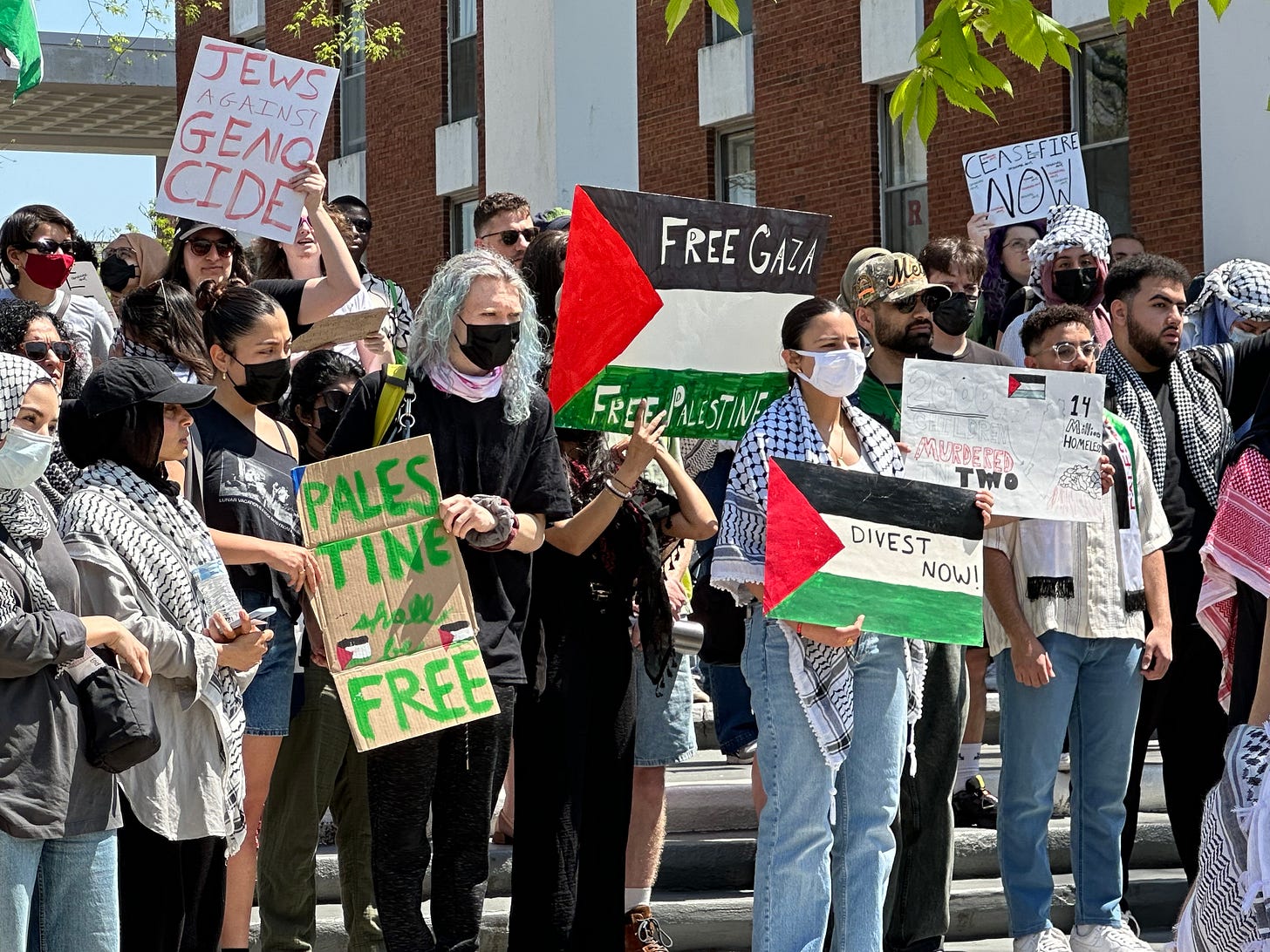
The order, as reported by The Washington Post, “is directed at universities where pro-Palestinian protests broke out last year,” and “threatens to revoke student visas of foreign students who participated in pro-Palestinian protests.”

Supporters of the order argue that these protests were antisemitic. They point to some uncomfortable speech — the equation of Israel with the Nazis, for instance — as proof, and then conflate sloganeering and assembly with physical harassment. Jewish students and faculty, the argument goes, were made uncomfortable by the protests and encampments and felt unsafe. That sense of fear, they say, proves that the protests were designed to harass, even if there was no direct harassment. It is a circular argument, but one endorsed by much of the American political establishment and leading Jewish organizations

Marc H. Ellis addresses the underlying issues with these arguments in his 2009 book Judaism Does Not Equal Israel.1 He describes what I’ll call a “triumphalist Judaism” that mixes Holocaust victimhood with Exodus (the novel) power, constructed in “the aftermath of the great Israeli triumph in the 1967 Arab-Israeli war” (6). That narrative posits several myths: that Palestine was empty and underutilized and had to be redeemed, that the “Arabs” were hostile to Jews as Jews, and that the state that was founded and that still exists remains a democratic outpost in a hostile world. This triumphalism, however, was also tied to our very real history as a persecuted minority. “Jews had once been weak and helpless,” he writes, but that was no longer the case. Yet, “our theology was telling us we were still. The fact was just the opposite. We had become empowered” and were acting as a regional power (59).

The current power dynamics in Israel/Palestine and the actual history — the forced removal of Palestinians from what is now the state and the continued usurpation of land — are treated as though they are benign acts. Israel — Jews — has become the victimizer in the region, acting as a colonial power, an occupying force.

What was “psychological,” he writes, has become “strategic.”

“If we owned up to our newfound power, we would have to be accountable for and to it. We would have to relinquish the Holocaust as the backdrop to everything Jewish.”

So Oct. 7 and the ensuing war play out as if they were new and shocking rather than as another battle — the deadliest and most traumatic, to be sure — in a decades-long rebellion by Palestinians against suppress and control by Israel.

The argument is based on an underlying anti-Muslim/anti-Arab bias that mirrors the hate and discrimination that Jews have faced across our history. It is evident in the language we (Americans and Jews) use consistently to refer to Arabs, Muslims, Palestine, and Israel. Arabs and Muslims continued to be seen as terrorists, even as the “not all” modifier is added.

Deena R. Hurwitz and Walther H. White Jr., in an article at the American Bar Association website, cite authors Sahar Aziz and John Esposito’s May 2024 book, Global Islamophobia and the Rise of Populism, to underscore a “disturbing rise of Islamophobia worldwide.”

Blaming Muslim minorities for economic, political, and social problems is an increasingly common rhetorical strategy for politicians in countries globally. A narrative of the “threatening Muslim invader” is prevalent, regardless of whether the targets of such rhetoric are born citizens or new arrivals.

Trump, for instance, mixes Islamophobic and xenophobic language as he calls for closing the borders. At the same time, he and his conservative allies rely on both anti- and philosemitic imagery when talking with and about Jews.

“In the United States, Europe, and India, Islamophobic rhetoric is essentially normalized,” Hurwitz and White write.

The use of this rhetoric reduces the history and diversity within the Muslim and Arab communities (and within the Jewish community) to “a set of stereotyped characteristics most often reducible to themes of violence, civilizational subversion, and fundamental otherness.”

Anti-Palestinian racism silences, excludes, erases, stereotypes, defames, and dehumanizes Palestinians. This is used to deny and justify violence against Palestinians and fails to acknowledge Palestinians as Indigenous people with a collective identity while erasing their human rights and equal dignity and worth.

Trump’s executive order builds on this structure of anti-Muslim/anti-Arab thought, while also endorsing stereotypes of Jews as a model minority in need of special protection — even as he dismantles what he calls the “DEI regime.” Pitting Jewish and Muslim communities against each other creates hierarchies among aggrieved groups, which the right can then use to abrogate our rights of speech, assembly, and petition. It’s also a solution that is out of proportion to the problem.

It creates a threat to international students (mostly Muslim) based purely on their protected speech and assembly, while doing nothing to improve the actual safety of Jewish students. Remember, we already have strong protections in most jurisdictions; prohibiting speech does nothing to address this.

Alex Morey of the Foundation for Individual Rights and Expression, a group that defends speech and academic freedom on campus and that has usually been allied with more conservative groups, describes what I’ll call an existential threat. She told the Forward that the order’s language might push universities to crack down on protest, because it functions as an implied threat — to funding and to visas.

Morey said that her organization was already fielding frantic queries from international students at American universities who are worried about being caught in a legal dragnet.

“These are not students that got arrested at a protest or vandalized a building, these are students who just went out and protested,” she said. “What we don’t want to see is schools saying, ‘Hey, Students for Justice in Palestine, I’m going to need a list of everyone in that club and we’re going to comb it for foreign students.’”

What we are talking about is the loss of immigration status and potential deportation as retribution for protest. It is a direct attack on the 14th Amendment’s equal rights clause, which provides “any person within (the United States) the equal protection of the laws,” including the First Amendment’s five basic freedoms.

The order brings together several of Trump’s favorite targets — higher education, Muslims, immigrants and protesters — and is part of a broader effort to undermine the academic freedom and speech rights of faculty and students in higher education. Trump is a wannabe autocrat. He sees these groups as a threat to his control. While fighting antisemitism is the ostensible reason for the order, the larger targets are our democratic institutions.

Channel Surfing is a reader-supported publication. To receive new posts and support my work, consider becoming a free or paid subscriber.

Thursday, October 3, 2024

“Repression on Grounds: A Virtual Town Hall on May 4 and Its Aftermath” (Faculty for Justice in Palestine)

(Charlottesville, VA)

In the aftermath of the violent repression of the encampment protests at UVa in May by police and administration, and with issues about first amendment rights at UVa still unresolved, faculty at the University of Virginia will host: “Repression on Grounds: A Virtual Town Hall on May 4 and Its Aftermath” on Sunday October 6 from 11 am -12:30 pm EDT. The town hall will be virtual.

Participants can register for the event here: https://tinyurl.com/56r54kus

The town hall will address violent break up of the pro-Palestinian encampment on May 4, 2024
by military-style police in riot gear and its aftermath. But rather than seeing this as a defeat,
organizers will share what they have learned since the summer and chart a path forward for
pro-Palestinian activism at UVA and nationally, including renewed calls for divestment from
Israel and genocide. The town hall will address:
- What happened on 5/4;
- What has happened since 5/4;
- Suggested steps moving forward;
- National framing;
- Disclosure, divestment & how to get involved
- Q&A

As Israel’s genocide in Gaza intensifies to include Lebanon, members of Faculty for Justice in
Palestine
and allies will highlight the moral urgency of the moment and discuss the role student,
faculty, staff, and community activism and pressure has to do in achieving an arms embargo
against Israel and charting a path towards Palestinian sovereignty. With free speech and
academic freedom under fire across the nation and in the Commonwealth, It’s time to hear from
faculty, staff and students what is really going on with regards to freedom of speech, academic
freedom and protest rights at Jefferson’s University. 

As we enter into another academic year, questions of politics, both domestic and international,
are central to the work we do at the university. It is critically important that faculty, staff, and
students maintain the right to speak freely on these issues without risking the kinds of retaliation
they've seen in the last several months.

Contact: Faculty for Justice in Palestine, UVA. fjp.uva@gmail.com


Related links:

Elite Universities on Lockdown. Protestors Regroup.

What caused 70 US universities to arrest protesting students while many more did not?

Campus Protests, Campus Safety, and the Student Imagination

Democratic Protests on Campus: Modeling the Better World We Seek (Annelise Orleck)

Methods of Student Nonviolent Resistance

Wikipedia Community Documents Pro-Palestinian Protests on University and College Campuses

One Fascism or Two?: The Reemergence of "Fascism(s)" in US Higher Education 

A People's History of Higher Education in the US

Sunday, April 20, 2025

Canary Mission: A Threat to Democracy on US Campuses

In recent years, the rise of organizations like Canary Mission has raised serious concerns about the state of free speech, academic freedom, and democracy on American college campuses. Operating under the guise of combating anti-Semitism and extremism, Canary Mission’s tactics and objectives have sparked widespread debate about its impact on campus life and the broader implications for democracy in the U.S.

Who is Canary Mission?

Founded in 2015, Canary Mission is a controversial online platform that compiles and publishes dossiers on students, professors, and organizations it deems to be associated with anti-Semitism or support for groups like Hamas or Hezbollah. While it claims to be an anti-extremist initiative, critics argue that Canary Mission’s activities are part of a broader, coordinated effort to silence pro-Palestinian voices, suppress critical discourse, and undermine academic freedom.

The organization's name derives from the "canary in the coal mine" metaphor, suggesting that it is warning the public about supposed dangers related to individuals and groups it monitors. But in practice, Canary Mission’s database often targets individuals solely for their political views on the Israeli-Palestinian conflict, with no proven ties to terrorism or violence. Students, particularly those involved in pro-Palestinian activism or who criticize Israel’s policies, have found themselves the subject of detailed and often misleading profiles that can haunt their careers.

The impact of Canary Mission is far-reaching: students who appear on the site have reported facing backlash in the form of social ostracism, job discrimination, and even legal action, all because their political activities or beliefs have been highlighted on this platform. Canary Mission’s website claims to provide a “public service” by exposing individuals “advocating for hate,” but its methods often conflate political activism with extremism, which can create an atmosphere of fear and self-censorship within academic circles.

Funding and Connections

Canary Mission’s funding sources remain somewhat opaque, which raises questions about its backing and potential influence. According to investigative reports and public disclosures, it is widely believed that the organization is funded by a network of right-wing pro-Israel groups, including wealthy donors, philanthropic organizations, and think tanks like the Simon Wiesenthal Center and the Foundation for Defense of Democracies. These connections underscore a broader ideological agenda that aligns with certain political interests, particularly those that aim to stifle critical discussions surrounding Israel’s policies and its occupation of Palestine.

The secrecy surrounding its financial backing and the lack of transparency in its operations have led many to draw parallels between Canary Mission and other shadowy entities designed to police speech and dissent. It appears to operate in the shadows, with little public oversight or accountability. This lack of transparency further erodes trust in its motivations and methods.

Undermining Democracy and Free Speech

At its core, Canary Mission's activities are a direct attack on the fundamental principles of democracy: free speech and the right to dissent. In a healthy democracy, universities serve as incubators for diverse ideas, where students are encouraged to debate and challenge ideas without fear of retribution. However, by tracking and blacklisting individuals who express views about Israel, Palestine, or other sensitive geopolitical issues, Canary Mission is chilling free expression on campuses across the country.

The organization’s efforts to publicly shame individuals who participate in peaceful political activism not only threatens their personal and professional futures but also discourages others from speaking out. In effect, it promotes an atmosphere of fear where students are reluctant to engage in legitimate political discourse out of concern for being targeted.

Moreover, Canary Mission’s activities can create a toxic, polarized environment on campuses. By labeling individuals as extremists based on their political positions rather than their actions or behaviors, the organization fuels division and resentment. This undermines the civil discourse that should thrive in academic settings, where ideas are meant to be debated and critically examined. Instead, it creates an echo chamber that only accepts one viewpoint, forcing out dissent and opposition.

The claim that Canary Mission is a controversial organization that undermines democracy on U.S. campuses can be supported by multiple sources from investigative journalists, academic scholars, and civil rights organizations who have analyzed the organization's activities. Here are a few sources that substantiate the concerns regarding Canary Mission:

  1. The New York Times (2016) – An article titled "A Shadowy Online Group Is Targeting American Students" highlights the growing concerns about Canary Mission's activities and its impact on free speech on campuses. The piece discusses how students, particularly those involved in pro-Palestinian activism, are being targeted and profiled on the platform, leading to career and personal repercussions.

  2. The Electronic Intifada (2016) – This online news platform dedicated to issues surrounding Palestine and Israel published several articles that discuss how Canary Mission disproportionately targets students and activists critical of Israeli policies. The site’s reports argue that the platform acts as an intimidation tool against those who challenge mainstream narratives regarding Israel.

  3. The Center for Constitutional Rights (CCR) – The CCR has expressed concern over the chilling effects Canary Mission has on academic freedom and free speech. They highlight how the organization often labels political activism as extremism, without proper evidence, and argues that it is a form of political repression aimed at silencing certain voices.

  4. The Forward (2018) – A Jewish publication, The Forward ran a story detailing how Canary Mission had led to the harassment and blacklisting of students, and how its methods were drawing criticism from many who saw it as an attack on academic freedom.

  5. Anti-Defamation League (ADL) Reports – While the ADL has supported efforts to combat anti-Semitism, they have also raised concerns about the unintended consequences of organizations like Canary Mission, suggesting that their approach to monitoring student activism can blur the line between legitimate political expression and hate speech.

  6. The Guardian (2017) – A Guardian article explored how Canary Mission's controversial practices affected student life, particularly those involved in the Boycott, Divestment, Sanctions (BDS) movement. The article discusses the potential damage to reputations and careers due to Canary Mission's online blacklist.

  7. The Southern Poverty Law Center (SPLC) – The SPLC has been vocal about the ways in which Canary Mission’s tactics align with other surveillance programs aimed at quelling dissent. The SPLC has voiced concern about its potential for misusing "extremism" labels to stifle legitimate political views, undermining democracy and the right to free speech.

Canary Mission's efforts to stifle free speech and intimidate those who hold opposing views on sensitive political issues like the Israeli-Palestinian conflict represent a dangerous erosion of democratic values in American higher education. By using fear, intimidation, and a lack of transparency to silence critical voices, it undermines the very foundation of academic freedom and democratic engagement.

Universities should be spaces where open dialogue and differing opinions are encouraged, not spaces where students are targeted for their political beliefs. As the influence of groups like Canary Mission continues to grow, it is imperative that the broader academic community pushes back against these efforts and defends the principles of free speech, democratic engagement, and intellectual diversity. Without these values, our campuses—and our democracy—will be all the poorer for it.

Tuesday, October 8, 2024

20-year UVA law school librarian forced to seek redress from President Jim Ryan; defending the right to protest in the face of illegal disciplinary action

Contact: Ben Doherty, 434-282-9009

Charlottesville - On Saturday, May 4th, Ben Doherty (they/them) joined hundreds of UVA co-workers, students and community-members protesting for university leadership to divest from Israel’s war-machine.

Not only do Ben and coworkers have a demonstrable right to protest under the law, it’s also the case that UVA as a public institution has legal restrictions that prevent it from infringing on such rights. However, in response to this May 4 protest, UVA law school leadership issued Ben a “Letter of Counseling.” Letter of Counseling refers to an optional first step in discipline by the VA Department of Human Resources Management’s Standards of Conduct which has jurisdiction over UVA.

On June 25th, Ben was joined by coworkers on a delegation where they asserted the need for UVA to accept its legal restrictions and honor Ben’s right to protest. In response to this delegation, the UVA law school’s Assoc. Dean sent an email to Ben indicating, “a letter of counseling is not a disciplinary action.” However the email also sent mixed messages that were out of step with DHRM requirements. The Asst. Dean would not categorically agree that the result of ruling it not discipline is by extension ruling it unable to be referenced in any future cumulative evaluation or attempts at termination. The Asst. Dean encouraged Ben to take a one-on-one with Dean Leslie Kendrick. However, that meeting on July 12th did not resolve anything.

The unwillingness to comply with Ben’s rights is a risk not only for Ben but for their coworkers as well. That’s why Ben and their team have decided that the issue must be brought to the attention of UVA President Jim Ryan. Ben will lead a delegation to President Jim Ryan’s office tomorrow Wednesday, Oct. 9th at 1pm.

***

What: Delegation to President Jim Ryan

When: Wednesday, Oct. 9th, 1pm.

Where: Launching from Gingko Tree (b/w Rotunda & Chapel), UVA Campus 145 McCormick Rd.

***
Please see below: Full statement from the UCW-UVA’s campaign committee to defeat retaliation.

On Wednesday, October 9 at 1:00pm, United Campus Workers-University of Virginia (UCW) will rally to “say no to retaliation” outside of Madison Hall at the University of Virginia. UCW has chosen that location to tell UVA President Jim Ryan that it will not accept retaliation against any workers for exercising their right to protest.

On May 4, 2024 the University of Virginia administrators sent in riot police to violently break up the encampment for Palestine. After attacking the protesters with shields and chemical weapons, the police arrested 27 people. One of the people arrested was Ben Doherty (they/them pronouns), a librarian who has worked at the law school for over 20 years. Like the other arrestees, Ben was charged with criminal trespass–a charge that was later dismissed; and given a No Trespass Order barring them from campus–which was also soon rescinded since Ben was not an actual threat to anyone at the university.

However–in addition to the police violence, dismissed criminal charges, and rescinded No Trespass Order–on May 21, 2024, the law school issued a “letter of counseling” to Ben. The letter mischaracterizes Ben’s lawful protest against genocide in Palestine as insubordination and explains that “future conduct of this kind, whether at the Law School or elsewhere at the University, will very likely result in disciplinary action up to and including termination.” That is now the second “letter of counseling” the law school has placed in Ben’s employment record, the first being in 2018 when Ben objected to the presence in the law library of one of the main organizers of the white nationalist Unite the Right rally who was harassing people in the law school, and whom the University had failed to issue a No Trespass Order.

Workers everywhere have a right to protest and the United Campus Workers will collectively oppose any retaliation against workers for exercising that right. The University cannot be allowed to illegally chill anyone’s right to protest against genocide. UCW has already raised its concerns about this illegal and chilling discipline twice earlier this summer, and now is asking Jim Ryan to stop this retaliation threatening Ben’s termination for engaging in their right to protest as a member of the world community.

Quote from Ben Doherty: “In 2017 and 2018, I was present when University administrators did nothing to protect UVA students, staff and community members from blatant white nationalist violence and harassment. In 2024, I was also present when University administrators sent violent riot police in to attack and arrest people protesting against genocide in Palestine. In both cases, University leadership failures fell on the backs of students, workers and community members. To cover these failures, the University wants to keep people quiet and we all must work collectively to push back against University retaliation designed to chill our right to protest injustice.”

Gary Broderick
UCW-VA Lead Organizer
804-347-4942


Sunday, December 7, 2025

Kleptocracy, Militarism, Colonialism: A Counterrecruiting Call for Students and Families

The United States has long framed itself as a beacon of democracy and upward mobility, yet students stepping onto college campuses in 2025 are inheriting a system that looks less like a healthy republic and more like a sophisticated kleptocracy entwined with militarism, colonial extraction, and digital exploitation. The entanglement of higher education with these forces has deep roots, but its modern shape is especially alarming for those considering military enlistment or ROTC programs as pathways to opportunity. 

The decision to publish on December 7th is deliberate. In 1941, Americans were engaged in a clearly defined struggle against fascism, a moral fight that demanded national sacrifice. The world in 2025 is far murkier. U.S. militarism now often serves corporate profit, global influence, and the security of allied autocracies rather than clear moral or defensive imperatives.

This is an article for students, future students, and the parents who want something better for their children. It is also a call to pause and critically examine the systems asking for young people’s allegiance and labor.

Higher education has become a lucrative extraction point for political and financial elites. Universities now operate as hybrid corporations, prioritizing endowment growth, real-estate expansion, donor influence, and federal cash flows over public service or student welfare. Tuition continues to rise as administrative bloat accelerates. Private equity quietly moves into student housing, online program management, education technology, and even institutional governance. The result is a funnel: taxpayers support institutions; institutions support billionaires; students carry the debt. Meanwhile, federal and state funds flow through universities with minimal oversight, especially through research partnerships with defense contractors and weapons manufacturers. What looks like innovation is often simply public money being laundered into private hands.

For decades, the U.S. military has relied on higher education to supply officers and legitimacy. ROTC programs sit comfortably on campuses while recruiters visit high schools and community colleges with promises of financial aid, job training, and escape from economic insecurity. But the military’s pitch obscures the broader structure. The United States spends more on its military than the next several nations combined, maintaining hundreds of foreign bases and intervening across the globe. American forces are involved, directly or indirectly, in conflicts ranging from Palestine to Venezuela to Ukraine, and through support of allies such as Saudi Arabia and the United Arab Emirates, often supplying weapons used in devastating campaigns. This is not national defense. It is a permanent war economy, one that treats young Americans as fuel.

At the same time, Russian cybercriminal networks have infiltrated U.S. institutions, targeting critical infrastructure, education networks, and private industry. Reports show that the U.S. government has frequently failed to hold these actors accountable and, in some cases, appears to prioritize intelligence or geopolitical advantage over domestic security, allowing cybercrime to flourish while ordinary Americans bear the consequences. This environment adds another layer of risk for students and families, showing how interconnected digital vulnerabilities are with global power games and domestic exploitation.

For those who enlist hoping to fund an education, the GI Bill frequently underdelivers. For-profit colleges disproportionately target veterans, consuming their benefits with low-quality, high-cost programs. Even public institutions have learned to treat veterans as revenue streams. U.S. universities have always been entwined with colonial projects, from land-grant colleges built on seized Indigenous land to research that supported Cold War interventions and overseas resource extraction. Today these legacies persist in subtler forms. Study-abroad programs and global campuses often mirror corporate imperialism. Research partnerships with authoritarian regimes proceed when profitable. University police departments are increasingly stocked with military-grade equipment, and curricula frequently erase Indigenous, Black, and Global South perspectives unless students actively seek them out. The university presents itself as a space of liberation while quietly reaffirming colonial hierarchies, militarized enforcement of U.S. interests worldwide, and even complicity in digital threats.

For many young people, enlistment is not a choice—it is an economic survival strategy in a country that refuses to guarantee healthcare, housing, or affordable education. Yet the military’s promise of stability is fragile and often deceptive. Students and parents should understand that young Americans are being recruited for geopolitics, not opportunity. Wars in Ukraine, Palestine, and Venezuela, along with arms support to Saudi Arabia and the United Arab Emirates, rarely protect ordinary citizens—they protect corporations, elites, and global influence. A person’s body and future become government property. ROTC contracts and enlistments are binding in ways that most eighteen-year-olds do not fully understand, and penalties for leaving are severe. Trauma is a predictable outcome, not an anomaly. The military’s mental health crisis, suicide rates, and disability system failures are well documented. Education benefits are conditional and often disappointing. The idea that enlistment is a reliable pathway to college has long been more marketing than truth, especially in a higher-education landscape dominated by predatory schools. Young people deserve more than being used as leverage in someone else’s empire.

A non-militarized route to opportunity requires acknowledging how much talent, energy, and potential is lost to endless war, endless debt, and the growing digital threats that go unaddressed at the highest levels. It requires demanding that federal and state governments invest in free or affordable public higher education, universal healthcare, and stronger civilian service programs rather than military pipelines. Students can resist by refusing enlistment and ROTC recruitment pitches, advocating for demilitarized campuses, supporting labor unions, student governments, and anti-war coalitions, and demanding transparency about university ties to weapons manufacturers, foreign governments, and cybersecurity vulnerabilities. Parents can resist by rejecting the false choice presented to their children between military service and crippling debt, and by supporting movements pushing for tuition reform, debt cancellation, and public investment in youth.

It is possible to build a higher-education system that serves learning rather than empire, but it will not happen unless students and families refuse to feed the machinery that exploits them. America’s kleptocracy, militarism, colonial legacies, and complicity in global digital crime are deeply embedded in universities and the workforce pipelines that flow through them. Yet young people—and the people who care about them—still hold power in their decisions. Choosing not to enlist, not to sign an ROTC contract, and not to hand over your future to systems that see you as expendable is one form of reclaiming that power. Hope is limited but not lost.

Sources

  1. U.S. Department of Defense. Defense Budget Overview Fiscal Year 2025. 2024.

  2. Amnesty International. “Saudi Arabia and UAE Arms Transfers and Human Rights Violations.” 2024.

  3. Human Rights Watch. “Conflicts in Ukraine, Venezuela, and Palestine.” 2024.

  4. FBI and CISA reports on Russian cybercrime and critical infrastructure infiltration. 2023–2025.

  5. Cybersecurity & Infrastructure Security Agency (CISA). National Cybersecurity Annual Review. 2024.

Monday, April 14, 2025

American Universities Complicit in Genocide, Again

As universities across the United States respond with increasing repression to student-led protests against the genocide in Palestine, historical parallels emerge that challenge the very principles of academic freedom and moral responsibility. The aggressive crackdowns—ranging from mass arrests to administrative threats—echo disturbing precedents from The Third Reich in the Ivory Tower by historian Stephen H. Norwood. The book exposes how many American universities, particularly in the 1930s, were complicit in Nazi ideology through appeasement, censorship, and the suppression of anti-fascist voices. The current treatment of pro-Palestinian student activists suggests that history is, once again, repeating itself.

The Suppression of Moral Dissent in Higher Education

Norwood’s research demonstrates how elite U.S. universities—including Harvard, Columbia, and Yale—maintained diplomatic and academic relationships with Nazi Germany, even as the regime persecuted Jews, socialists, and other marginalized groups. Student activists who sought to protest these ties were ignored, censored, or dismissed as “radicals.” The pattern is eerily similar today: pro-Palestinian students, many of whom are calling attention to potential war crimes in Gaza and the West Bank, are met with suspensions, arrests, and a media narrative that frames them as dangerous or disruptive.

This is not simply an issue of campus policy. It is an indication of how institutions of higher learning align themselves with power—whether it be the Nazi government in the 1930s or the Netanyahu government today—at the expense of justice and free expression.

The Influence of Financial and Political Interests

One of Norwood’s most damning revelations was how American universities welcomed Nazi officials on campus, accepted funding from German sources, and ignored early reports of persecution. Today, many of these same institutions maintain deep financial ties to Israel, including research partnerships, donor influence, and endowment investments in companies linked to the Israeli military-industrial complex.

This financial entanglement shapes institutional responses to protest. Instead of engaging with the moral and legal arguments posed by students—who cite documented reports from the UN, Human Rights Watch, and other credible organizations—university administrators call in police forces, disband student groups, and issue vague statements about maintaining "campus order." Just as in the 1930s, universities prioritize political and economic alliances over ethical accountability.

The Criminalization of Campus Activism

Norwood’s book describes how students protesting Nazi ties were accused of being “unruly” or “disruptive,” justifying administrative crackdowns. Today, students calling for an end to U.S. complicity in Israel’s actions face similar character assassinations, often being labeled as “terrorist sympathizers” or threats to campus safety.

Recent crackdowns have seen:

  • Mass arrests of peaceful demonstrators, including those engaging in sit-ins and teach-ins.

  • Surveillance and doxxing of students and faculty who express pro-Palestinian views.

  • Increased administrative pressure, including suspensions, expulsions, and threats to scholarships or visas for international students.

The use of state power—often in coordination with local police, federal agencies, and even private security firms—mirrors historical instances where universities acted as enforcers of political orthodoxy rather than defenders of intellectual freedom.

What This Means for US Higher Education

If universities continue down this path, they risk further eroding their credibility as spaces for critical inquiry and moral debate. Just as history judges those who remained silent—or complicit—during the rise of fascism, future generations will scrutinize how today’s institutions responded to calls for justice in Palestine.

The lesson from The Third Reich in the Ivory Tower is clear: universities have a choice. They can either stand on the side of truth and academic freedom or become enforcers of state violence and repression. The students protesting today, much like those who opposed fascism in the 1930s, are asking their institutions to make that choice. The question is whether universities will listen—or if history will once again record their failure.

Monday, August 11, 2025

The Assassination of Anas al-Sharif: A Stark Reminder of the Global Suppression of Dissident Voices

On August 10, 2025, Palestinian journalist Anas al-Sharif, a respected correspondent for Al Jazeera, was killed in an Israeli airstrike near Gaza City's Al-Shifa Hospital. Alongside four colleagues, al-Sharif was reporting from one of the most dangerous places on earth—an epicenter of a protracted conflict and humanitarian crisis. The Israeli military claimed al-Sharif was a leader in a Hamas cell, accusations that both Al Jazeera and the journalist himself had categorically denied.

This targeted killing is more than a tragic loss of life; it signals a concerted effort to silence independent journalism in one of the world’s most contested territories. Sharif’s assassination fits a pattern of repression that threatens the free flow of information in Palestine and reverberates globally—especially in democracies like the United States, where the space for dissenting voices is narrowing under pressure from political and corporate interests.


A Journalist Under Siege in Gaza

For years, Anas al-Sharif had been a fearless voice reporting on the devastating consequences of the Israeli blockade and military campaigns on Gaza’s civilian population. His reports brought international attention to the human cost of war: widespread destruction, scarcity of food and medicine, and the psychological toll on children and families.

Al-Sharif’s on-air appeals for humanitarian intervention were marked by raw emotion and urgency. His willingness to confront powerful narratives and highlight suffering made him a target. Israeli officials responded with an escalating campaign of vilification, accusing him of terrorism without evidence and intensifying military operations around his reporting sites.

The Committee to Protect Journalists (CPJ) had raised alarms about threats against Sharif and other journalists in Gaza, warning the international community that such intimidation could foreshadow violence. Tragically, those warnings came true.


The Deadliest Conflict for Journalists in Recent History

According to CPJ data, over 200 journalists have been killed in Gaza since the current conflict began 22 months ago, making it the deadliest period for the press in decades. The targeting of journalists in Gaza violates international humanitarian law, which protects reporters as civilians in conflict zones. Yet, the line between combatants and reporters is increasingly blurred by powerful actors seeking to control narratives.

The killing of al-Sharif and his colleagues has sent a chilling message to journalists across the globe: reporting on human rights abuses and war crimes carries lethal risk. This trend threatens to erode the fundamental democratic principle that the public has the right to know what is happening in their name.


Suppression of Dissent in the United States

While the context in Gaza is extreme, troubling parallels exist in the United States. Press freedom in the US has faced mounting challenges, especially for journalists exposing government wrongdoing, police abuses, and systemic inequalities.

Investigative reporters have been subjected to government surveillance, subpoenaed for their sources, and threatened with prosecution under broad national security laws. Whistleblowers face legal retaliation, and activists reporting on racial justice or labor issues often encounter police intimidation.

This creeping erosion of press freedoms limits the ability of journalists to hold power accountable. It also fosters a culture where dissenting voices—whether in mainstream media, academia, or grassroots activism—are marginalized or criminalized.


Higher Education as a Crucible for Free Expression

Universities and colleges should be bastions of critical thought, inquiry, and free expression. However, they increasingly reflect the pressures found in broader society. Political and financial influences shape what can be taught or researched, particularly around controversial subjects such as Palestine, US foreign policy, race, and inequality.

Faculty and students who challenge dominant narratives often face harassment, surveillance, or even administrative censure. Legislative efforts in several states seek to restrict discussions deemed “divisive,” chilling debate and critical scholarship.

The suppression of voices like Sharif’s in the media finds echoes in academic institutions, where control over narratives can be just as forceful—only less visible.


The Urgent Need for Solidarity and Defense of Press Freedom

The assassination of Anas al-Sharif is a devastating reminder of what is lost when journalism is silenced: truth, accountability, and the possibility for change. It is a call to action for universities, journalists, human rights advocates, and the global community to defend those who risk their lives to report uncomfortable realities.

Solidarity must transcend borders. Academic institutions should champion press freedom by protecting scholars and students who work on sensitive issues and by amplifying marginalized voices. Media organizations and advocacy groups must push for international mechanisms to protect journalists and hold accountable those who target them.

Sharif’s legacy is one of courage and commitment to the truth. To honor his life and sacrifice, we must resist efforts to normalize violence against journalists and dissenters everywhere.


Sources