Search This Blog

Showing posts sorted by date for query racism. Sort by relevance Show all posts

Friday, December 19, 2025

The Brown University Killing, the Educated Underclass, and the Politics of Control

When a killing becomes associated with an elite institution such as Brown University, the public narrative hardens quickly. The event is framed as an unforeseeable rupture—either the product of individual pathology or evidence that universities have failed to control dangerous people in their midst. Missing from both accounts is a deeper examination of how elite higher education produces an educated underclass, how mental illness is managed rather than treated, how international students are uniquely exposed to risk, and how mass surveillance and reporting regimes increasingly substitute for care.

Elite universities project an image of abundance: intellectual freedom, global opportunity, and moral seriousness. Yet beneath that image lies a population living with chronic insecurity. Graduate students, adjuncts, postdoctoral researchers, and international students occupy a paradoxical position—highly educated, institutionally dependent, and structurally disposable. They are central to the university’s labor model and global prestige, yet peripheral to its safety nets and decision-making structures.

Mental illness must be addressed directly, but not in the reductive way it is often invoked after violence occurs. Campus mental health systems are overwhelmed, under-resourced, and shaped by liability concerns rather than therapeutic commitments. Students in severe psychological distress frequently encounter long waitlists, fragmented care, or administrative responses that blur the line between support and discipline. Crisis is managed, not resolved.

For international students, these failures are magnified. Visa status is typically contingent on continuous enrollment and academic performance. A mental health crisis can threaten not only a student’s education but their legal right to remain in the country. Seeking help may carry perceived—or real—risks: loss of funding, forced leaves of absence, housing instability, or immigration consequences. Cultural stigma, racism, language barriers, and social isolation further discourage engagement with already inadequate systems.

Rather than expanding care, universities have increasingly expanded surveillance. Elite campuses now operate dense ecosystems of monitoring: security cameras, access controls, data analytics, behavioral intervention teams, and anonymous “concerned citizen” tip lines. These systems are justified as preventative safety measures, but they often function as tools of social control. “Concerning behavior” is deliberately undefined, allowing subjective judgments to trigger institutional scrutiny.

Such systems disproportionately affect those who already stand out—students who are foreign, mentally ill, socially isolated, or racially marginalized. For international students in particular, being flagged by a tip or threat assessment process can escalate rapidly, drawing in campus police, local law enforcement, or federal immigration authorities. Surveillance does not replace care; it displaces it.

In the aftermath of violence, political responses tend to reinforce this displacement. Donald Trump’s reactions to campus-related violence and crime have followed a consistent pattern: emphasis on “law and order,” denunciations of universities as irresponsible or ideologically corrupt, and calls for stronger policing, harsher penalties, and increased monitoring. Mental illness is often invoked rhetorically, but rarely accompanied by proposals for expanded treatment, housing stability, or protections for vulnerable students—especially non-citizens.

This framing matters. When elite campus violence is interpreted through a punitive lens, it legitimizes further surveillance, broader reporting mandates, and closer coordination between universities and law enforcement. It shifts responsibility away from institutional structures and onto individuals deemed dangerous or deviant. For foreign students and members of the educated underclass, this environment deepens fear and discourages help-seeking, even as pressure intensifies.

The concept of the educated underclass helps explain why these dynamics are so volatile. Contemporary higher education produces vast numbers of highly trained individuals for a shrinking set of secure positions. International students are recruited aggressively, charged high tuition, and celebrated as evidence of global prestige, yet offered limited pathways to stable employment or belonging. Universities benefit enormously from this arrangement while externalizing its human costs.

None of this excuses violence. Accountability is essential, and the suffering of victims must remain central. But focusing exclusively on individual blame—or on punitive political responses—allows institutions to preserve comforting myths about themselves. It obscures how structural precarity, untreated mental illness, immigration vulnerability, and surveillance-based governance interact in predictable ways.

What incidents connected to elite universities ultimately reveal is not merely individual failure, but institutional contradiction. Universities claim to value diversity while subjecting foreign students to heightened scrutiny. They speak the language of wellness while expanding systems of monitoring and reporting. Political leaders denounce campuses while endorsing the very control mechanisms that exacerbate isolation and distress.

Until universities invest seriously in mental health care, protect international students from cascading penalties, and confront the harms of surveillance-first approaches—and until political leaders move beyond carceral reflexes—elite campuses will remain places where suffering is managed rather than addressed. When that management fails, the consequences can be catastrophic.


Sources

American Psychiatric Association. Mental Health in College Students.
https://www.psychiatry.org/patients-families/college-students/mental-health-in-college

Eisenberg, D., et al. “Mental Health and Academic Success in College.” The B.E. Journal of Economic Analysis & Policy, 2009.

Foucault, Michel. Discipline and Punish: The Birth of the Prison. Vintage Books.

Institute of International Education. Open Doors Report on International Educational Exchange.
https://opendoorsdata.org

Lipson, S. K., & Eisenberg, D. “Mental Health and Academic Attitudes and Expectations in University Populations.” Journal of Adolescent Health, 2018.

Monahan, Torin. Surveillance in the Time of Insecurity. Rutgers University Press.

Newfield, Christopher. The Great Mistake: How We Wrecked Public Universities and How We Can Fix Them. Johns Hopkins University Press.

U.S. Department of Homeland Security. SEVP Guidance for International Students.
https://www.ice.gov/sevis

Trump, Donald J. Public statements and campaign remarks on crime, universities, and law enforcement, 2016–2024.

Zuboff, Shoshana. The Age of Surveillance Capitalism. PublicAffairs.

Wednesday, December 3, 2025

A Century of American Exploitation: Oil, Crypto, and the Struggle for Latin America’s Universities

Latin America—a region of thirty-three countries stretching from Mexico through Central and South America and across the Caribbean—has spent more than a century fighting against foreign exploitation. Its universities, which should anchor local prosperity, cultural autonomy, and democratic life, have instead been repeatedly reshaped by foreign corporations, U.S. government interests, global lenders, and now crypto speculators. Yet the region’s history is also defined by persistent, courageous resistance, led overwhelmingly by students, faculty, and Indigenous communities.

Understanding today’s educational crisis in Latin America requires tracing this long arc of exploitation—and the struggle to build systems rooted in equity rather than extraction.

1900s–1930s: Bananas, Oil, and the Rise of the “Banana Republics”

Early in the 20th century, American corporations established vast profit-making empires in Latin America. United Fruit Company—today’s Chiquita Banana—dominated land, labor, and politics across Guatemala, Honduras, and Costa Rica. Standard Oil and Texaco secured petroleum concessions in Venezuela and Ecuador, laying foundations for decades of foreign control that extracted immense wealth while leaving behind environmental devastation, as seen in Texaco’s toxic legacy in the Ecuadorian Amazon between 1964 and 1992.

Universities were bent toward these foreign interests. Agricultural programs were geared toward serving plantation economies, not local farmers. Engineering and geological research aligned with extractive industries, not community development.

Resistance did emerge. Student groups in Guatemala and Costa Rica formed part of early anti-oligarchic movements, linking national sovereignty to university reform. Their demands echoed global currents of democratization. Evidence of these early student-led struggles appears in archival materials and Latin American scholarship on university reform, and culminates in the influential 1918 Córdoba Manifesto in Argentina—a radical declaration that attacked oligarchic, colonial universities and demanded autonomy, co-governance, and public responsibility.

1940s–1980s: Coups, Cold War Interventions, and the Deepening of U.S. Oil Interests

During the Cold War, exploitation intensified. In Guatemala, the CIA-backed overthrow of democratically elected President Jacobo Árbenz in 1954 protected United Fruit’s land holdings. Universities were purged or militarized, and critical scholars were exiled or killed.

In Chile, the 1973 overthrow of Salvador Allende—supported by American corporate giants such as ITT and Anaconda Copper—ushered in a brutal dictatorship. Under Augusto Pinochet, thousands were murdered, tortured, or disappeared, while the Chicago Boys imported radical neoliberal reforms that privatized everything, including the higher education system.

Throughout the region, oil deals disproportionately favored American companies. Mexico and Venezuela saw petroleum wealth siphoned off through arrangements that benefited foreign investors while leaving universities underfunded and politically surveilled. Scholarship critical of foreign intervention was marginalized, while programs feeding engineers and economists to multinational firms were expanded.

Student resistance reached historic proportions. Chilean students and faculty formed the core of the anti-dictatorship movement. Mexico’s students rose in 1968, demanding democracy and university autonomy before being massacred in Tlatelolco. CIA declassified documents reveal that student uprisings across Latin America in the early 1970s were so widespread that U.S. intelligence considered them a regional threat.

1990s–2000s: Neoliberalism, Privatization, and the Americanization of Higher Education

In the 1990s, neoliberalism swept the region under pressure from Washington, the IMF, and the World Bank. After NAFTA, Mexico’s universities became increasingly aligned with corporate labor pipelines. In Brazil, Petrobras’ partnerships with American firms helped reshape engineering curricula. Private universities and for-profit models proliferated across the region, echoing U.S. higher ed corporatization.

Hugo Chávez captured the broader sentiment of resistance when he declared that public services—including education—cannot be privatized without violating fundamental rights.

Students fought back across Latin America. In Argentina and Brazil they contested tuition hikes and privatization. In Venezuela, the debate shifted toward whether oil revenue should fund tuition-free universities.

Indigenous Exclusion, Racism, and the Colonial Foundations of Inequality

One of the greatest challenges in understanding Latin American education is acknowledging the deep racial and ethnic stratification that predates U.S. exploitation but has been exacerbated by it. Countries like Ecuador, Bolivia, Peru, Mexico, Brazil, and Guatemala have large Indigenous populations that, to this day, receive the worst education—much like Native American communities relegated to underfunded reservation schools in the United States.

Racism remains powerful. Whiter populations enjoy greater economic and educational access. University admission is shaped by class and color. These divisions are not accidental; they are a machinery of control.

There have been important exceptions. Under President Rafael Correa, Ecuador built hundreds of new schools, including Siglo XXI and Millennium Schools, and expanded public education access. In Mexico, the 2019 constitutional reform strengthened Indigenous rights, including commitments to culturally relevant education. Bolivia—whose population is majority Indigenous—has promoted Indigenous languages, judicial systems, and education structures.

But progress is fragile. Austerity, IMF conditionalities, and elite resistance have led to cutbacks, school closures, and renewed privatization across the region. The study you provided on Ecuador documents Indigenous ambivalence, even hostility, toward Correa’s universal education plan—revealing how colonial wounds, cultural erasure, and distrust of state power complicate reform and provide openings for divide-and-conquer strategies long exploited by ruling classes.

These contradictions deepen when Indigenous movements—rightfully demanding no mining, no oil extraction, and protection of ancestral lands—collide with leftist governments reliant on resource extraction to fund public services. This tension is especially acute in Ecuador and Bolivia.

2010s–Present: Crypto Colonialism and a New Frontier of Exploitation

Cryptocurrency has opened a new chapter in Latin America’s long history of foreign-driven experimentation. El Salvador’s adoption of Bitcoin in 2021, promoted by President Nayib Bukele, transformed the country into a speculative test lab. Bukele has now spent more than $660 million in U.S. dollars on crypto, according to investigative reporting from InSight Crime. Universities rushed to create blockchain programs that primarily serve international investors rather than Salvadoran students.

In Venezuela, crypto became a survival tool amid hyperinflation and economic collapse. Yet foreign speculators profited while universities starved. Student groups warned that crypto research was being weaponized to normalize economic chaos and distract from public-sector deterioration.

Resistance has grown. Salvadoran students have protested the Bitcoin law, demanding that public resources focus on infrastructure, health, and education. Venezuelan students call for rebuilding social programs rather than chasing speculative financial technologies.

Contemporary Student Resistance: 2010s–2020s

Across the region, student movements remain powerful. The Chilean Winter of 2011–2013 demanded free, quality public education and challenged Pinochet’s neoliberal legacy. The movement culminated in the 2019 uprising, where education reform was central.

Mexico’s UNAM students continue to resist corruption, tuition hikes, gender violence, and the encroachment of corporate and foreign interests. The 1999–2000 UNAM strike remains one of the longest in modern higher education.

Colombian students have forced governments to negotiate and invest billions in public universities, framing their struggle as resistance to neoliberal austerity shaped by U.S. policy.

Argentina continues to face massive austerity-driven cuts, sparking protests in 2024–2025 reminiscent of earlier waves of resistance. Uruguay’s Tupamaros movement—largely student-led—remains a historical touchstone.

Every country in Latin America has experienced student uprisings. They reflect a truth that Paulo Freire, exiled from Brazil for teaching critical pedagogy, understood deeply: education can either liberate or oppress. Authoritarians, privatizers, and foreign capital prefer the latter, and they act accordingly.

Today’s Regional Education Crisis

The COVID-19 pandemic pushed the system into further crisis. Children in Latin America and the Caribbean lost one out of every two in-person school days between 2020 and 2022. Learning poverty now exceeds 50 percent. Entire generations risk permanent economic loss and civic disenfranchisement.

Infrastructure is collapsing. Rural and Indigenous communities suffer the worst conditions. Public investment is chronically insufficient because governments are trapped in cycles of debt repayment to international lenders. Ecuador has not seen a major public-investment program in a decade, as austerity and IMF repayments dominate national budgets.

The result is a system starved of resources and increasingly vulnerable to privatization schemes—including U.S.-style online coursework, ideological “instruction kits,” and for-profit degree mills.

Latin American Universities as Battlegrounds for Sovereignty

Latin America’s universities are shaped by the same forces that have dominated the region’s history: oil extraction, agribusiness, foreign capital, neoliberalism, structural racism, debt, and now crypto speculation. Yet universities have also been homes to transformation, rebellion, cultural resurgence, and hope.

Across more than a century, students—Indigenous, Afro-descendant, mestizo, working-class—have been the region’s fiercest defenders of public education and national sovereignty. Their resistance continues today, from Quito to Buenos Aires, from Mexico City to Santiago.

For readers of the Higher Education Inquirer, the lesson is clear: the struggle for higher education in Latin America is inseparable from the struggle for democracy, racial justice, Indigenous autonomy, and freedom from foreign domination. The region’s ruling elites and international lenders understand that an educated public is dangerous, which is why they starve, privatize, and discipline public schools. Students understand the opposite: that education is power, and that power must be reclaimed.

The next chapter—especially in countries like Ecuador—will depend on whether students, teachers, and communities can defend public education against the dual forces that have undermined it for more than a century: privatizers and fascists.


Sources (Selection)

National Security Archive, CIA Declassified Documents (1971)
InSight Crime reporting on El Salvador Bitcoin expenditures
Luciani, Laura. “Latin American Student Movements in the 1960s.” Historia y Memoria (2019)
The Córdoba Manifesto (1918)
UNESCO, World Bank data on learning poverty (2024)
Latin American studies on United Fruit, Standard Oil, Texaco/Chevron in Ecuador
LASA Forum: Analysis of Indigenous responses to Correa’s education reforms
Periodico UNAL: “The Student Rebellion: Córdoba and Latin America”
Multiple regional news sources on Argentina’s 2024–2025 education protests

Friday, November 28, 2025

The Hidden Costs of ROTC — and the Military Path: Why Prospective Enlistees and Supporters Should Think Twice

[Editor's note: This article was written before West Virginia National Guard troops were shot upon in the occupied District of Columbia. That horrific event makes our point even more salient. No matter how desperate someone may be, we implore folks to think twice before signing anything related to military service under the Trump Administration.] 

For many young Americans, the Reserve Officers’ Training Corps (ROTC) or other military‑linked opportunities can look like a ticket to education, steady income, and a chance to “see the world.” But the allure of scholarships, structure, and economic opportunity often hides a deeper reality — one that includes moral danger, personal risk, and long-term uncertainty.

Recent events underscore this. On November 24, 2025, the United States Department of Defense (DoD) announced it was opening a formal investigation into Mark Kelly — retired Navy captain, former astronaut, and current U.S. Senator — after he appeared in a video alongside other lawmakers urging U.S. troops to disobey “illegal orders.” The DoD’s justification: as a retired officer, Kelly remains subject to the Uniform Code of Military Justice (UCMJ), and the department said his statements may have “interfered with the loyalty, morale, or good order and discipline of the armed forces.”

This episode is striking not only because of Kelly’s prominence, but because it shows how even after leaving active service, a veteran’s speech and actions can be subject to military law — a stark reminder that joining the military (or training through ROTC) can carry obligations and consequences long after “service” ends.

Moral, Legal & Personal Risks Behind the Promise

When you consider military service — through ROTC or otherwise — it’s important to weigh the full scope of what you may be signing up for:

Potential involvement in illegal or immoral wars: ROTC graduates may eventually be deployed in foreign conflicts — possibly ones controversial or condemned internationally (for example, interventions in places like Venezuela). Participation in such wars raises real moral questions about complicity in human rights abuses, “regime-change,” or other interventions that may lack democratic or legal legitimacy.

Domestic deployment and policing: Military obligations are increasingly stretching beyond foreign wars. Service members — even reservists — can be called in to deal with domestic “disputes,” civil unrest, or internal security operations. This raises ethical concerns about policing one’s own communities, and potential coercion or suppression of civil and political rights.

Long-term oversight and limited freedom: The investigation of Senator Kelly shows that veterans and officers remain under DoD jurisdiction even after service ends. That oversight can restrict free speech, dissent, or political engagement. Those seeking to escape economic hardship or limited opportunities may overlook how binding and enduring those obligations can be — even decades later.

Psychological and bodily danger: Military service often involves exposure to combat, trauma, physical injury — not to mention risks such as sexual assault, racism, sexism, and institutional abuse. Mental health consequences like PTSD are common, and the support systems for dealing with them are widely criticized as inadequate.

Institutional racism, sexism, and inequality: The military is an institution with historic and ongoing patterns of discrimination — which can exacerbate systemic injustices rather than alleviate them. For individuals coming from marginalized communities, the promise of “a way out” can come with new forms of structural violence, exploitation, or marginalization.

Career precarity and institutional control: Even after completing education or training, the reality of “limited choices” looms large. Military obligations — contractual, legal, social — can bind individuals long-term, affecting not just their mobility but their agency, conscience, and ability to critique the system.

Why Economic Incentives Often Mask the Real Costs

For many, the draw of ROTC is economic: scholarships, stable income, a way out of challenging socioeconomic circumstances, or a ticket out of a hometown with limited opportunity. These incentives are real. But as the recent case with Mark Kelly makes clear, the costs — legal, moral, social — can be far greater and more enduring than advertised. What looks like an escape route can become a lifetime of obligations, constraints, and potential complicity in questionable policies.

A Call for Caution, Conscience, and Awareness

Prospective enlistees deserve full transparency. The decision to join ROTC or the military should not be sold merely as an educational contract or a job opportunity — it is an entrance into a deeply entrenched institution, one with power, obligations, and potential for harm. The new controversy around Mark Kelly ought to serve as a wake-up call: if even a decorated former officer and sitting U.S. senator can be threatened decades after service, young people should consider carefully what they may be signing up for.

If you — or someone you care about — is thinking of joining, ask: What kind of wars might I be asked to fight? What does “service” really cost — and who pays?

Sources:

Higher Education Inquirer. Trump Sends West Virginia National Guard to D.C. Without Consulting Mayor Bowser." August 16, 2025. Higher Education Inquirer : Trump Sends West Virginia National Guard to D.C. Without Consulting Mayor Bowser

AP News. “Pentagon says it's investigating Sen. Mark Kelly over video urging troops to defy 'illegal orders'.” November 24, 2025. https://apnews.com/article/4882f76b05dcdfa3060c284c2c84dd12

The Guardian. “Mark Kelly: call for troops to disobey illegal orders is 'non-controversial'.” November 25, 2025. https://www.theguardian.com/us-news/2025/nov/25/mark-kelly-troops-disobey-illegal-orders-comments

Reuters. “Pentagon threatens to prosecute Senator Mark Kelly by recalling him to Navy service.” November 24, 2025. https://www.reuters.com/world/us/pentagon-threatens-prosecute-senator-mark-kelly-by-recalling-him-navy-service-2025-11-24/

RAND Corporation. “Mental Health and Military Service.” 2022.

Amnesty International. Human Rights Violations in Venezuela. 2023.

U.S. Department of Defense. Reports on Sexual Assault in the Military. 2024.

Washington, H. Medical Apartheid: The Dark History of Human Experimentation in the United States.

Rosenthal, E. An American Sickness.

Thursday, November 27, 2025

National Day of Mourning: Higher Education’s Long Reckoning With Indigenous Oppression

[Editor's note: United American Indians of New England host the National Day of Mourning. Their website is at United American Indians of New England - UAINE.]

Each November, while much of the United States celebrates Thanksgiving, Indigenous communities and their allies gather in Plymouth, Massachusetts, and across the country for the National Day of Mourning. It is a day that confronts the mythology of national innocence and replaces it with historical clarity. For Higher Education Inquirer, the significance of this day extends directly into the heart of American higher education—a system built, in no small part, on the expropriation of Indigenous land, the exploitation of Native Peoples, and the continued structural racism that shapes their educational opportunities today.

From the earliest colonial colleges to the flagship research institutions of the twenty-first century, U.S. higher education has never been separate from the project of settler colonialism. It has been one of its instruments.

Land, Wealth, and the Origins of the University

America’s oldest colleges—Harvard, Yale, William & Mary, Dartmouth—were founded within the colonial order that dispossessed Indigenous communities. While missionary language framed some of these institutions’ early purposes, they operated through an extractive logic: the seizure of land, the conversion of cultural worlds, and, eventually, the accumulation of immense academic wealth.

The Morrill Land-Grant Acts of 1862 and 1890 expanded this pattern on a national scale. Recent research documented by the “Land-Grab Universities” project shows that nearly eleven million acres of Indigenous land—taken through coercive treaties, forced removal, or outright theft—were funneled into endowments for public universities. Students today walk across campuses financed by displacements their own institutions have yet to fully acknowledge, let alone remedy.

Higher Education as an Arm of Assimilation

The United States also used education as a tool for forced assimilation. The Indian boarding school system, with the Carlisle Industrial School as its model, operated in partnership with federal officials, church agencies, and academic institutions. Native children were taken from their families, stripped of their languages, and subjected to relentless cultural destruction.

Universities contributed research, training, and personnel to this system, embedding the logic of “civilizing” Indigenous Peoples into the academy’s structure. That legacy endures in curricula that minimize Indigenous knowledge systems and in institutional cultures that prize Eurocentric epistemologies as default.

Scientific Racism, Anthropology, and the Theft of Ancestors

American universities played a central role in producing scientific racism. Anthropologists and medical researchers collected Indigenous remains, objects, and sacred items without consent. Museums and university labs became repositories for thousands of ancestors—often obtained through grave robberies, military campaigns, or opportunistic scholarship.

The 1990 Native American Graves Protection and Repatriation Act (NAGPRA) was designed to force institutions to return ancestors and cultural patrimony. Yet decades later, many universities are still out of compliance, delaying repatriation while continuing to benefit from the research collections they amassed through violence.

Contemporary Structural Racism in Higher Education

The oppression is not confined to history. Structural racism continues to constrain Native Peoples in higher education today.

Native students remain among the most underrepresented and under-supported groups on American campuses. Chronic underfunding of Tribal Colleges and Universities (TCUs) reflects a broader political disregard for Indigenous sovereignty and self-determination. Meanwhile, elite institutions recruit Native students for marketing purposes while failing to invest in retention, community support, or Indigenous faculty hiring.

Some universities have begun implementing land acknowledgments, but these symbolic gestures have little impact when institutions refuse to confront their material obligations: returning land, committing long-term funding to Indigenous programs, or restructuring governance to include tribal representatives.

What a Real Reckoning Would Require

A genuine response to the National Day of Mourning would require far more than statements of solidarity. It would involve confronting the ways American higher education continues to profit from dispossession and the ways Native students continue to bear disproportionate burdens—from tuition to cultural isolation to the racist violence that still occurs on and around campuses.

Real accountability would include:

• Full compliance with NAGPRA and expedited repatriation.
• Transparent reporting of land-grant wealth and the return or shared governance of those lands.
• Stable, meaningful funding for TCUs.
• Hiring, tenure, and research policies that center Indigenous scholarship and sovereignty.
• Long-term institutional commitments—financial, curricular, and political—to Indigenous communities.

These steps require institutions to shift from performative recognition to structural transformation.

A Day of Mourning—And a Call to Action

The National Day of Mourning is not merely a counter-holiday. It is a reminder that the United States was founded on violence against Native Peoples—and that its colleges and universities were not passive beneficiaries but active participants in that violence.

For higher education leaders, faculty, and students, the question is no longer whether these histories are real or whether they matter. They are documented. They are ongoing. They matter profoundly.

The real question is what institutions are willing to give up—land, power, wealth, or narrative control—to support Indigenous liberation.

On this National Day of Mourning, HEI honors the truth that Indigenous survival is an act of resistance, and Indigenous sovereignty is not a symbolic aspiration but an overdue demand. The future of higher education must move through that truth, not around it.

Sources
Roxanne Dunbar-Ortiz, An Indigenous Peoples’ History of the United States.
The Land-Grab Universities Project (High Country News & Land-Grab Universities database).
David Treuer, The Heartbeat of Wounded Knee.
Margaret D. Jacobs, A Generation Removed: The Fostering and Adoption of Indigenous Children in the Postwar World.
NAGPRA regulations and compliance reports.

Wednesday, September 17, 2025

Pedagogies of Repression: Ford, Trump and the War on Education (Henry A. Giroux and William Paul)

Analyses of fascism too often fixate on its most spectacular expressions: staggering inequality, systemic racism, the militarization of daily life, unbridled corruption, monopolistic control of the media, and the concentration of power in financial and political elites. Fascism thrives on a culture of fear and racial cleansing and the normalization of cruelty, lies, and state violence. Yet what is often overlooked is how culture and education now function as decisive forces in legitimating these authoritarian passions and in eroding democratic commitments. As Hannah Arendt, Jason Stanley, Richard Evans, Chris Hedges, and others remind us, the protean origins of fascism are never fully buried; they return in altered and often disguised forms, seeping into everyday life and reshaping the common sense of a society.

Under US President Donald Trump, we face a terrifying new horizon of authoritarian politics: the erosion of due process, mass abductions, vicious attacks on higher education, and the steady construction of a police state. Canada has not yet descended into such full-fledged authoritarianism, but troubling echoes are undeniable. Public spaces and public goods are under assault, book bans have appeared in Alberta, languages of hate increasingly target those deemed disposable, the mass media bends to corporate interests, labour is suppressed, and democratic values are met with disdain. These may not replicate the worst horrors of the past, but they reveal how culture and education become the terrain upon which democracy is dismantled and authoritarianism gains legitimacy. These are warning signs of a gathering darkness that must be confronted before they harden into something far more sinister.

Culture and Pedagogy

Fascism thrives not only on brute police power, prisons, or economic violence but also on culture and pedagogy. Culture has increasingly become a site in the service of pedagogical tyranny. It works through erasure and repression, through memory stripped of its critical force, and through dissent silenced in the name of order. Fascism is never solely a political or economic system; it is a pedagogical project, a machinery of teaching and unlearning that narrows the horizon of what can be said, imagined, or remembered.

Today authoritarianism seeps insidiously into everyday life, embedded in seemingly obvious maneuvers that consolidate power under the guise of technical or bureaucratic necessity. Its mobilizing passions often emerge unobtrusively in maneuvers that hide in the shadows of the mundane, often at the level of everyday experience.

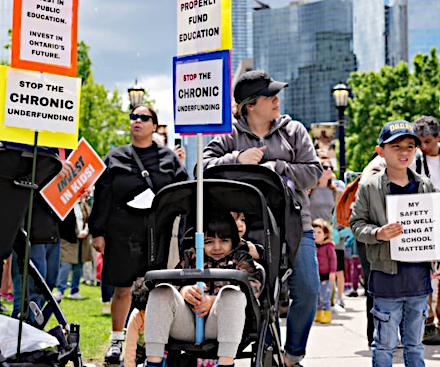
This creeping logic is starkly visible in Ontario, where Doug Ford’s Progressive Conservative (PC) government has moved to seize control of local school boards. What may look like routine administrative measures should be read as a warning: authoritarianism does not arrive only with grandiose spectacles or open attacks on democracy’s foundations; it gains ground quietly, through the erosion of the ordinary, the capture of the local, and above all, through the weaponization of education as a tool to dismantle democracy itself.

The Ford government’s seizure of the Toronto, Toronto Catholic, Ottawa-Carleton, and Dufferin-Peel Catholic district school boards is extraordinary, even for this democracy-averse regime. Education Minister Paul Calandra has even mused about eliminating trustees altogether before the 2026 local elections, declaring “Everything is on the table.” His justification that Ontario’s Ministry of Education (MOE) has allowed them to make too many decisions on their own is both unsupported and revealing. It exposes a deeper authoritarian project: the desire to centralize power and strip away democratic oversight from institutions closest to local communities. It curbs liberal instincts of trustees who see first-hand the vast diversity of lives and needs of the families who rely on their schools.

This is precisely how authoritarian control operates: by eroding intermediary structures that connect people to power. Just as Donald Trump sought to bend national cultural institutions like the Smithsonian Museum to his will, Ford dismantles the modest democratic functions of trusteeship. Both cases illustrate how authoritarianism works through the fine print of governance as much as through grandiose pronouncements.

Manufactured Deficits and Structural Starvation

The pretext for takeover was financial mismanagement. Yet none of the investigators found evidence of serious fiscal incompetence. The truth is that boards submitted balanced budgets year after year but only after slashing programs and services, closing outdoor education centres, selling property, cutting staff, and raising fees. What really drives their fiscal crises is a decades-old funding model – first imposed by the Mike Harris PC government in 1997 – that shifted resources from local taxes to provincial grants. This was not a move toward equitable funding; these were neoliberals of the first order who believed in central control of funding so they could squeeze school boards and education workers to contain costs.

This model, based on enrolment rather than actual need, starved boards of resources for special education, transportation, salaries, and infrastructure.1 For instance, school boards don’t get funding for actual children who need special education support but rather on the basis of a predictive model MOE devised. Boards pay for the kids MOE doesn’t fund. The Ford government hasn’t funded the full increase for statutory teacher benefits for years, leaving boards short by millions. The result is a structural deficit: chronic underfunding that leaves even well-managed boards teetering on insolvency. The Ford government, while claiming to increase spending, has in fact cut funding per student by $1,500 in real terms since 2018. This is the problem faced by with 40 percent of Ontario school boards.

It is this manufactured insolvency that led Minister Calandra to get the most out of a useful crisis and put the four school boards under supervision and maybe next eliminate all school boards in the province. Here we see neoliberal austerity converging with authoritarian ambition. Underfunding is not a policy mistake; it is a deliberate strategy to weaken public education, undermine trust in democratic institutions, and prepare the ground for privatization schemes such as vouchers and charter schools. In this instance, the policy of underfunding is a way of weakening public education and then blaming whatever problems occur on education itself. This is gangster capitalism at work, cloaked in the language of fiscal responsibility but fueled by a pedagogy of dispossession.

Eliminating Trustees, Silencing Communities

If board takeovers were simply about money, supervisors would have been told to just find savings. Instead, elected trustees were suspended, their offices shuttered, their tiny stipends cut off, and their ability to communicate with constituents forbidden. Calandra’s power grab has all the elements of Elon Musk’s DOGE assaults in the US: move fast, offer absurd excuses, and blame the victims. The supervisors replacing trustees – accountants, lawyers, and former politicians with no background in education – now wield greater power than the elected community representatives they displaced.

This substitution of technocrats for democratically accountable representatives is part of fascism’s pedagogy. It teaches the public to accept disenfranchisement as efficiency, to see obedience as order. Parents who ask why a program disappeared or why their child’s special education class has grown larger are now met with silence. In this vacuum, the lesson learned is that participation is futile and resistance meaningless – precisely the kind of civic numbing oligarchic fascism requires.

Command, Control, and the Policing of Education

Ford’s government frames these takeovers as a “broader rethink” of governance, but the real project is clear: the imposition of command and control over education. This move sends a strong message that it’s time to duck our heads and get back to basics: teaching “reading, writing, spelling, and arithmetic and the whole shebang…” as Doug Ford complained last fall after teachers and students attended a rally in support of the Grassy Narrows First Nation and its efforts to deal with generations of mercury contamination in their area. He proclaimed, with no evidence, that the field trip was “indoctrination” by teachers because activists protesting Israeli genocide were present. Community members who supported an Indigenous curriculum, modern sexual education, or even school-name changes honoring anti-colonial figures are dismissed or painted as obstacles. The message from Ford and Calandra is blunt: stick to the basics – reading, writing, arithmetic – and leave politics at the door.

Yet politics hangs over classrooms like a shroud. Despite his Captain Canada complaints about the Trump tariffs, Ford admires the President quick-marching America toward fascism. In an off-mic moment he commented recently: “Election day, was I happy this guy won? One hundred per cent I was.” It’s not the racism, the authoritarianism, the compulsive lying, the fraud, the sexual assaults that bothers the Premier; it’s that he got stiffed by his friend.

Usurping trustees according to University of Ottawa professor Sachin Maharaj is just another step toward the Progressive Conservatives’ goal to “squelch the pipeline of more progressive leaders”2 like those gaining notice and experience attending to the needs of local schools.

The banning of the Toronto Muslim Student Alliance’s screening of the film No Other Land, which documents Israeli settler violence, shows how censorship now masquerades as neutrality. This is the pedagogy of repression in action: narrowing what can be taught, remembered, or discussed until education is reduced to obedience training. What parades as a “broader rethink” is part of the authoritarian language of censorship and control. Like Trump’s attacks on “critical race theory” or his censorship of the Smithsonian, Ford’s moves are not about protecting students from politics but about protecting power from critique. The real issue here is constructing authoritarian policies that narrow critical thinking, teacher autonomy, essential funding, and knowledge that enable schools to both defend and facilitate democracy.

For Ford and his adherents, the real issue is not that schools are failing but that they are public and have a vital role to play in a democracy. The real threat to Ford is that a democracy can only exist with informed citizens. Yet that is precisely the role education should assume.

Bill 33: Codifying Authoritarianism

The perversely named Bill 33, the Supporting Children and Students Act extends this authoritarian logic. It allows the Minister to investigate boards or trustees on the mere suspicion they might act “inappropriately” or against the “public interest” – an elastic phrase that grants unchecked power. It checks much-maligned Diversity Equity and Inclusion efforts by refusing boards the right to name schools, forcing them to abandon diversity-affirming figures in favor of colonial or sanitized names. It mandates the reintroduction of police officers into schools, despite community opposition to surveillance and “unaccountable access to youth by cops.”3

At work here is the legacy of colonialism, a legacy that is terrified of diversity, of those deemed other, being able to narrate themselves. Viewed as threat, this anti-democratic language ultimately falls back on issues of control and security. This is one instance of how authoritarianism consolidates itself, not through tanks in the streets but through legislation that transforms education into an arm of the security state. Pedagogical spaces are militarized, memory is policed, and students are taught that surveillance is normal and dissent dangerous.

Trumpasitic Authoritarianism

Ford’s methods echo those of his southern counterpart. Just as Trump’s politics thrive on dispossession, erasure, and the weaponization of culture, Ford borrows from the same authoritarian playbook. The takeover of school boards not only tightens political control but also grants easy access to billions of dollars in public land, enriching developers tied to his government.4 Here, neoliberal profiteering fuses seamlessly with authoritarian centralization, an example of the merging of gangster capitalism with the pedagogy of repression.

What do you expect from a government that makes decisions reflecting the arrogance of power? The Ford government cut Toronto city council in half soon after took office in 2018 and threatened to use a constitutional override, the Notwithstanding Clause, Section 33 of Canada’s Charter of Rights and Freedoms, to overturn a Superior Court justice’s decision that the move was unconstitutional. Ford actually used the clause to push through a bill restricting election advertising in 2021 and again, pre-emptively, in 2022, buttressing back-to-work legislation against striking public workers, among the lowest paid in the province. He’s considering using it again after his decision to remove bike lanes from Toronto streets was overturned in court; power makes you petty.

Democracy in the Smallest Details

The takeover of Ontario school boards may appear less dramatic than Trump’s assaults on national institutions, but its implications are just as dire. Authoritarianism advances not only through spectacle but through the slow erosion of local democratic practices that once seemed secure.

If fascism is a pedagogy of fear, amnesia, and conformity, then resistance must be a pedagogy of memory, solidarity, and imagination. To defend education is to defend democracy itself, for schools are not simply sites of instruction but laboratories of citizenship, places where young people learn what it means to speak, to question, to remember, and to act. When trustees are silenced, when curricula are censored, when communities are stripped of their voice, what is lost is not only oversight but the very possibility of democratic life.

What is at stake, then, is far larger than budget shortfalls or bureaucratic reshuffling. It is whether the future will be governed by communities or dictated from above by those who mistake obedience for learning and silence for peace. Fascism thrives in these small erasures, in the details that seem technical until they harden into structures of domination.

The lesson could not be clearer: democracy dies in increments, but it can also be rebuilt in increments – through collective memory, through civic courage, through the refusal to allow education to become a weapon of obedience. To resist the Ford government’s authoritarian incursions is not only to protect local school boards; it is to reclaim the very ground on which democratic hope stands. •

Endnotes

  1. Dan Crow, The Consequences Of A Neoliberal Funding Formula, Canadian Centre for Policy Alternatives, Fall/Winter 2018.
  2. Sachin Maharaj, Interview August 26, 2025
  3. Andrea Vásquez Jiménez, Interview June 7, 2025.
  4. William Paul, “Riding the Gravy Train” in Against the People: How Ford Nation is Dismantling Ontario, eds: Brian Evans, Carlo Fanelli, Fernwood Publishing, 2024.

Henry A. Giroux currently is the McMaster University Professor for Scholarship in the Public Interest and The Paulo Freire Distinguished Scholar in Critical Pedagogy. His most recent books include The Violence of Organized Forgetting (City Lights, 2014), Dangerous Thinking in the Age of the New Authoritarianism (Routledge, 2015), coauthored with Brad Evans, Disposable Futures: The Seduction of Violence in the Age of Spectacle (City Lights, 2015), and America at War with Itself (City Lights, 2016). His website is henryagiroux.com.

William Paul is editor of School Magazine website.

This article first appeared at the Social Project Bullet