Search This Blog

Showing posts sorted by relevance for query first amendment. Sort by date Show all posts

Friday, January 24, 2025

U.S. Department of Education's Trump Appointees and America First Agenda

The U.S. Department of Education has announced a team of senior-level political appointees who will support the implementation of President Trump’s America First agenda.  

The Trump Administration, by Executive Order, has already required colleges and universities to eliminate diversity, equity and inclusion measures and schools are scrambling to be compliant with this new federal policy. New policies may also affect grants from the Department of Health and Human Services, which includes the Food and Drug Administration, the Centers for Disease Control and Prevention, and the National Institutes of Health.

Notable actions the Department of Education has already taken include: 

  • Dissolution of the Department’s Diversity & Inclusion Council, effective immediately;
  • Dissolution of the Employee Engagement Diversity Equity Inclusion Accessibility Council (EEDIAC) within the Office for Civil Rights (OCR), effective immediately and pursuant to President Trump’s Executive Order “Ending Radical and Wasteful Government DEI Programs and Preferencing”;
  • Cancellation of ongoing DEI training and service contracts which total over $2.6 million;
  • Withdrawal of the Department’s Equity Action Plan;
  • Placement of career Department staff tasked with implementing the previous administration’s DEI initiatives on paid administrative leave; and
  • Identification for removal of over 200 web pages from the Department’s website that housed DEI resources and encouraged schools and institutions of higher education to promote or endorse harmful ideological programs.

At least four appointees to the Department of Education, as well as including incoming Secretary of Education Linda McMahon, have worked at the America First Policy Institute (AFPI). AFPI's higher education proposals are posted here and noted at the bottom of this article. AFPI has been accused of using dark money to prevent student loan forgiveness and its rhetoric clearly advances this agenda.

Rachel Oglesby – Chief of Staff

Rachel Oglesby most recently served as America First Policy Institute's Chief State Action Officer & Director, Center for the American Worker. In this role, she worked to advance policies that promote worker freedom, create opportunities outside of a four-year college degree, and provide workers with the necessary skills to succeed in the modern economy, as well as leading all of AFPI’s state policy development and advocacy work. She previously worked as Chief of Policy and Deputy Chief of Staff for Governor Kristi Noem in South Dakota, overseeing the implementation of the Governor’s pro-freedom agenda across all policy areas and state government agencies. Oglesby holds a master’s degree in public policy from George Mason University and earned her bachelor’s degree in philosophy from Wake Forest University. 


Jonathan Pidluzny – Deputy Chief of Staff for Policy and Programs 

Jonathan Pidluzny most recently served as Director of the Higher Education Reform Initiative at the America First Policy Institute. Prior to that, he was Vice President of Academic Affairs at the American Council of Trustees and Alumni, where his work focused on academic freedom and general education. Jonathan began his career in higher education teaching political science at Morehead State University, where he was an associate professor, program coordinator, and faculty regent from 2017-2019. He received his Ph.D from Boston College and holds a bachelor’s degree and master’s degree from the University of Alberta. 

Chase Forrester – Deputy Chief of Staff for Operations 

Virginia “Chase” Forrester most recently served as the Chief Events Officer at America First Policy Institute, where she oversaw the planning and execution of 80+ high-profile events annually for AFPI’s 22 policy centers, featuring former Cabinet Officials and other distinguished speakers. Chase previously served as Operations Manager on the Trump-Pence 2020 presidential campaign, where she spearheaded all event operations for the Vice President of the United States and the Second Family. Chase worked for the National Republican Senatorial Committee during the Senate run-off races in Georgia and as a fundraiser for Members of Congress. Chase graduated from Clemson University with a bachelor’s degree in political science and a double-minor in Spanish and legal studies.

Steve Warzoha – White House Liaison

Steve Warzoha joins the U.S. Department of Education after most recently serving on the Trump-Vance Transition Team. A native of Greenwich, CT, he is a former local legislator who served on the Education Committee and as Vice Chairman of both the Budget Overview and Transportation Committees. He is also an elected leader of the Greenwich Republican Town Committee. Steve has run and served in senior positions on numerous local, state, and federal campaigns. Steve comes from a family of educators and public servants and is a proud product of Greenwich Public Schools and an Eagle Scout. 

Tom Wheeler – Principal Deputy General Counsel 

Tom Wheeler’s prior federal service includes as the Acting Assistant Attorney General for Civil Rights at the U.S. Department of Justice, a Senior Advisor to the White House Federal Commission on School Safety, and as a Senior Advisor/Counsel to the Secretary of Education. He has also been asked to serve on many Boards and Commissions, including as Chair of the Hate Crimes Sub-Committee for the Federal Violent Crime Reduction Task Force, a member of the Department of Justice’s Regulatory Reform Task Force, and as an advisor to the White House Coronavirus Task Force, where he worked with the CDC and HHS to develop guidelines for the safe reopening of schools and guidelines for law enforcement and jails/prisons. Prior to rejoining the U.S. Department of Education, Tom was a partner at an AM-100 law firm, where he represented federal, state, and local public entities including educational institutions and law enforcement agencies in regulatory, administrative, trial, and appellate matters in local, state and federal venues. He is a frequent author and speaker in the areas of civil rights, free speech, and Constitutional issues, improving law enforcement, and school safety. 

Craig Trainor – Deputy Assistant Secretary for Policy, Office for Civil Rights 

Craig Trainor most recently served as Senior Special Counsel with the U.S. House of Representatives Committee on the Judiciary under Chairman Jim Jordan (R-OH), where Mr. Trainor investigated and conducted oversight of the U.S. Department of Justice, including its Civil Rights Division, the FBI, the Biden-Harris White House, and the Intelligence Community for civil rights and liberties abuses. He also worked as primary counsel on the House Judiciary’s Subcommittee on the Constitution and Limited Government’s investigation into the suppression of free speech and antisemitic harassment on college and university campuses, resulting in the House passing the Antisemitism Awareness Act of 2023. Previously, he served as Senior Litigation Counsel with the America First Policy Institute under former Florida Attorney General Pam Bondi, Of Counsel with the Fairness Center, and had his own civil rights and criminal defense law practice in New York City for over a decade. Upon graduating from the Catholic University of America, Columbus School of Law, he clerked for Chief Judge Frederick J. Scullin, Jr., U.S. District Court for the Northern District of New York. Mr. Trainor is admitted to practice law in the state of New York, the U.S. District Court for the Southern and Eastern Districts of New York, and the U.S. Supreme Court. 

Madi Biedermann – Deputy Assistant Secretary, Office of Communications and Outreach 

Madi Biedermann is an experienced education policy and communications professional with experience spanning both federal and state government and policy advocacy organizations. She most recently worked as the Chief Operating Officer at P2 Public Affairs. Prior to that, she served as an Assistant Secretary of Education for Governor Glenn Youngkin and worked as a Special Assistant and Presidential Management Fellow at the Office of Management and Budget in the first Trump Administration. Madi received her bachelor’s degree and master of public administration from the University of Southern California. 

Candice Jackson – Deputy General Counsel 

Candice Jackson returns to the U.S. Department of Education to serve as Deputy General Counsel. Candice served in the first Trump Administration as Acting Assistant Secretary for Civil Rights, and Deputy General Counsel, from 2017-2021. For the last few years, Candice has practiced law in Washington State and California and consulted with groups and individuals challenging the harmful effects of the concept of "gender identity" in laws and policies in schools, employment, and public accommodations. Candice is mom to girl-boy twins Madelyn and Zachary, age 11. 

Joshua Kleinfeld – Deputy General Counsel 

Joshua Kleinfeld is the Allison & Dorothy Rouse Professor of Law and Director of the Boyden Gray Center for the Study of the Administrative State at George Mason University’s Scalia School of Law. He writes and teaches about constitutional law, criminal law, and statutory interpretation, focusing in all fields on whether democratic ideals are realized in governmental practice. As a scholar and public intellectual, he has published work in the Harvard, Stanford, and University of Chicago Law Reviews, among other venues. As a practicing lawyer, he has clerked on the D.C. Circuit, Fourth Circuit, and Supreme Court of Israel, represented major corporations accused of billion-dollar wrongdoing, and, on a pro bono basis, represented children accused of homicide. As an academic, he was a tenured full professor at Northwestern Law School before lateraling to Scalia Law School. He holds a J.D. in law from Yale Law School, a Ph.D. in philosophy from the Goethe University of Frankfurt, and a B.A. in philosophy from Yale College. 

Hannah Ruth Earl – Director, Center for Faith-Based and Neighborhood Partnerships

Hannah Ruth Earl is the former executive director of America’s Future, where she cultivated communities of freedom-minded young professionals and local leaders. She previously co-produced award-winning feature films as director of talent and creative development at the Moving Picture Institute. A native of Tennessee, she holds a master of arts in religion from Yale Divinity School.

AFPI Reform Priorities

AFPI's higher education priorities are to:

 Related links:

Trump's Education Department dismantles DEI measures, suspends staff (USA Today) 

Friday, November 21, 2025

America’s Creepiest College Presidents

Across the United States, a quiet but unmistakable chill has settled over many college campuses. It isn’t the weather. It’s the behavior of a particular class of leaders—the college presidents whose decisions, priorities, and public personas have begun to feel, for lack of a better word, creepy. Not criminal, necessarily. Not always abusive in the legal sense. Just profoundly unsettling in ways that undermine trust, erode shared governance, and push higher education further into the shadows of authoritarianism and corporate capture.

This piece introduces criteria for what makes a college president “creepy,” highlights examples of the types of leaders who fit the mold, and invites reader feedback to build a more accountable public record.


Criteria for a “Creepy” College President

“Creepy” here is not about personality quirks. It’s about behavior, power, and material consequences. Based on the reporting and analysis at HEI, we propose the following criteria:


1. First Amendment Hostility

Presidents who suppress speech, restrict student journalism, punish dissent, or hide behind overbroad “time, place, and manner” rules fall squarely into this category. The creepiness intensifies when universities hire outside PR firms or surveillance contractors to monitor campus critics, including students and faculty.

2. Student Rights Violations

Presidents who treat students as risks rather than people, who hide data on assaults, who enable over-policing by campus security, or who weaponize conduct codes to silence protest movements—from Palestine solidarity groups to climate activists—fit the profile.

3. Civil Rights Erosion

Administrators who undermine Title IX protections, retaliate against whistleblowers, protect abusive coaches, or ignore discrimination complaints are not just negligent—they’re institutionally creepy. Their public statements about “inclusion” often ring hollow when compared with their actions behind closed doors.

4. Worker Rights Suppression

Union busting. Outsourcing. Wage stagnation. Anti-transparency tactics. Presidents who preach community while crushing collective bargaining efforts, freezing staff pay, or firing outspoken employees through “restructuring” deserve a place on any such list.

5. Climate Denial or Delay

Presidents who sign glossy climate pledges yet continue fossil-fuel investments, partner with extractive corporations, or suppress environmental activism on campus epitomize a uniquely twenty-first-century creepiness: a willingness to sacrifice future generations to maintain donor relationships and boardroom comfort.


Examples: The Multi-Modal Creep Typology

Rather than name only individuals—something readers can help expand—we outline several recognizable types. These composites reflect the emerging patterns seen across U.S. higher education.

The Surveillance Chancellor

Obsessed with “campus safety,” this president quietly expands the university’s security apparatus: license plate readers at entrances, contracts with predictive-policing vendors, facial recognition “pilots,” and backdoor relationships with state or federal agencies. Their speeches emphasize “community,” but their emails say “monitoring.”

The Union-Busting Visionary

This leader talks the language of innovation and social mobility while hiring anti-union law firms to intimidate graduate workers and dining staff. Their glossy strategic plans promise “belonging,” but their HR memos rewrite job classifications to avoid paying benefits.

The Donor-Driven Speech Regulator

Terrified of upsetting trustees, corporate sponsors, or wealthy alumni, this president cracks down on student protests, bans certain speakers, or manipulates disciplinary procedures to neutralize campus activism. They invoke “civility” while undermining the First Amendment.

The DEI-Washing Chief Executive

This president loves diversity statements—for marketing. Meanwhile, they ignore racial harassment complaints, target outspoken faculty of color, or cut ethnic studies under the guise of “realignment.” Their commitment to equity is perfectly proportional to the next accreditation review.

The Climate Hypocrite

At Earth Day, they pose with solar panels. In the boardroom, they argue that divesting from fossil fuels is “unrealistic.” Student climate groups often face administrative smothering, and sustainability staffers are rotated out when they ask uncomfortable questions.


Why “Creepiness” Matters

Creepy leaders normalize:

  • an erosion of democratic rights on campus,

  • the quiet expansion of surveillance,

  • the targeting of vulnerable students and workers, and

  • a form of managerial governance that undermines the public purpose of higher education.

Higher education is supposed to be a refuge for inquiry, dissent, creativity, and collective imagination. Presidents who govern through fear—whether subtle or overt—pose a deeper threat than those who merely mismanage budgets. They hollow out the civic core of academic life.


A Call for Reader Feedback

HEI is building a more comprehensive and accountable registry of America’s Creepiest College Presidents, and we want your help.

  • Who on your campus fits these criteria?

  • Which presidents (past or present) deserve examination?

  • What specific stories, patterns, or documents should be highlighted?

  • What additional criteria should be added for future reporting?

Send your confidential tips, analyses, and suggestions. Together, we can shine light into administrative corners that have remained dark for far too long.

Higher Education Inquirer welcomes further input and encourages readers to share this article with colleagues, student groups, labor organizers, and university newspapers.

Thursday, September 4, 2025

Judge Rules on Harvard Case: When We Fight, WE WIN! (Todd Wolfson, AAUP)

Last night, we got great news: We WON our lawsuit challenging the Trump’s administration’s attempt to dismantle research and critical thought at Harvard University.  

Please join us in our fight for higher education and research.

A federal judge agreed with us and with the Harvard administration that the Trump administration violated the Constitution, the Civil Rights Act, and the Administrative Procedures Act by demanding that Harvard restrict speech and restructure core operations or else face the cancellation of billions in federal funding for the university and its affiliated hospital.

In her ruling, US District Judge Allison Burroughs found that the administration’s actions, which included freezing and canceling more than $2 billion in research grants, violated the First Amendment rights of Harvard and of Harvard’s faculty and amounted to “retaliation, unconstitutional conditions, and unconstitutional coercion.” Her ruling vacates the government’s funding freeze and permanently blocks it from using similar reasoning to deny grants to Harvard in the future.

In April, the national AAUP and our Harvard chapter, alongside the United Auto Workers, filed the lawsuit seeking to stop the Trump administration’s attack on Harvard. Pressured by our filing, the Harvard administration subsequently filed suit and the cases were linked.

Many of Judge Burroughs’s findings responded primarily to the claims of AAUP members, particularly about harms to research, First Amendment violations, and attacks on academic freedom.

This is a huge win not just for AAUP members at Harvard but for all of American higher education, for science, and for free and critical thought in this country. The Trump administration’s attempts to restrict speech and cripple lifesaving research are widespread, affecting every state and type of institution in the nation. As this victory shows, Trump’s war on higher education is unconstitutional. We will continue to stand up and fight back against these attempts to dismantle our universities, terrify students and faculty, and punish hospitals and scientific research for not bowing to authoritarianism. And we will win.

We could not have done it without the leadership, hard work, and testimony of AAUP members. We need you in this fight with us too. Please join now.

In solidarity,

Todd Wolfson, AAUP President

Thursday, February 6, 2025

Trump is Using Jews, Not Protecting Us (Hank Kalet, Channel Surfing)

His Executive Order on Antisemitism is a Threat to Muslims and Palestinians on Campuses and an Attack on the First Amendment

Antisemitism exists. It has a long and painful history that has embedded fear in our DNA as Jews, a fear that grows when incidents occur, like the one in Australia recently.

Police in New South Wales state, which includes Sydney, said on Wednesday they had found explosives in a caravan, or trailer, that could have created a blast wave of 40 metres (130 feet).

There was some indication the explosives might be used in an antisemitic attack that could have caused mass casualties, police said.

There also was an apparently coordinated set of “graffiti attacks” on Jewish sites that have caused the Australian Jewish community to increase security. Similar security efforts are being ramped up by Jewish groups in Europe as threats of antisemitic acts and the growth of the Far Right stoke fears.

Share

There have been reports of violent and deadly incidents throughout Europe, as well, with direct attacks on synagogues and other Jewish institutions. And there are leaders like Viktor Orhan in Hungary and political parties like Alternative for Germany who use antisemitic language and tropes, though often sanitized, amid their more targeted attacks on Muslim immigrants.

Syndicate or Reuse

Books by Hank Kalet

The United States is not immune to antisemitism, of course, but American Jews seem unable to focus on the real threats. Rather than keep our eyes trained on an ascendant right wing — including many of the people in President Donald Trump’s immediate circle, including the president himself — much of the Jewish community is focused on Israel and seems intent on conflating criticism of Israel, its war on Gaza, and the occupation with actual systemic anti-Jewish action.

This is the context for Wednesday’s executive order on “combatting antisemitism,” which targets campus protests and continues a Conservative/Republican push to peel Jews away from teh Democratic Party.

The order, as reported by The Washington Post, “is directed at universities where pro-Palestinian protests broke out last year,” and “threatens to revoke student visas of foreign students who participated in pro-Palestinian protests.”

Supporters of the order argue that these protests were antisemitic. They point to some uncomfortable speech — the equation of Israel with the Nazis, for instance — as proof, and then conflate sloganeering and assembly with physical harassment. Jewish students and faculty, the argument goes, were made uncomfortable by the protests and encampments and felt unsafe. That sense of fear, they say, proves that the protests were designed to harass, even if there was no direct harassment. It is a circular argument, but one endorsed by much of the American political establishment and leading Jewish organizations


Marc H. Ellis addresses the underlying issues with these arguments in his 2009 book Judaism Does Not Equal Israel.1 He describes what I’ll call a “triumphalist Judaism” that mixes Holocaust victimhood with Exodus (the novel) power, constructed in “the aftermath of the great Israeli triumph in the 1967 Arab-Israeli war” (6). That narrative posits several myths: that Palestine was empty and underutilized and had to be redeemed, that the “Arabs” were hostile to Jews as Jews, and that the state that was founded and that still exists remains a democratic outpost in a hostile world. This triumphalism, however, was also tied to our very real history as a persecuted minority. “Jews had once been weak and helpless,” he writes, but that was no longer the case. Yet, “our theology was telling us we were still. The fact was just the opposite. We had become empowered” and were acting as a regional power (59).

The current power dynamics in Israel/Palestine and the actual history — the forced removal of Palestinians from what is now the state and the continued usurpation of land — are treated as though they are benign acts. Israel — Jews — has become the victimizer in the region, acting as a colonial power, an occupying force.

What was “psychological,” he writes, has become “strategic.”

“If we owned up to our newfound power, we would have to be accountable for and to it. We would have to relinquish the Holocaust as the backdrop to everything Jewish.”

So Oct. 7 and the ensuing war play out as if they were new and shocking rather than as another battle — the deadliest and most traumatic, to be sure — in a decades-long rebellion by Palestinians against suppress and control by Israel.

The argument is based on an underlying anti-Muslim/anti-Arab bias that mirrors the hate and discrimination that Jews have faced across our history. It is evident in the language we (Americans and Jews) use consistently to refer to Arabs, Muslims, Palestine, and Israel. Arabs and Muslims continued to be seen as terrorists, even as the “not all” modifier is added.

Deena R. Hurwitz and Walther H. White Jr., in an article at the American Bar Association website, cite authors Sahar Aziz and John Esposito’s May 2024 book, Global Islamophobia and the Rise of Populism, to underscore a “disturbing rise of Islamophobia worldwide.”

Blaming Muslim minorities for economic, political, and social problems is an increasingly common rhetorical strategy for politicians in countries globally. A narrative of the “threatening Muslim invader” is prevalent, regardless of whether the targets of such rhetoric are born citizens or new arrivals.

Trump, for instance, mixes Islamophobic and xenophobic language as he calls for closing the borders. At the same time, he and his conservative allies rely on both anti- and philosemitic imagery when talking with and about Jews.

“In the United States, Europe, and India, Islamophobic rhetoric is essentially normalized,” Hurwitz and White write.

The use of this rhetoric reduces the history and diversity within the Muslim and Arab communities (and within the Jewish community) to “a set of stereotyped characteristics most often reducible to themes of violence, civilizational subversion, and fundamental otherness.”

Anti-Palestinian racism silences, excludes, erases, stereotypes, defames, and dehumanizes Palestinians. This is used to deny and justify violence against Palestinians and fails to acknowledge Palestinians as Indigenous people with a collective identity while erasing their human rights and equal dignity and worth.

Trump’s executive order builds on this structure of anti-Muslim/anti-Arab thought, while also endorsing stereotypes of Jews as a model minority in need of special protection — even as he dismantles what he calls the “DEI regime.” Pitting Jewish and Muslim communities against each other creates hierarchies among aggrieved groups, which the right can then use to abrogate our rights of speech, assembly, and petition. It’s also a solution that is out of proportion to the problem.

It creates a threat to international students (mostly Muslim) based purely on their protected speech and assembly, while doing nothing to improve the actual safety of Jewish students. Remember, we already have strong protections in most jurisdictions; prohibiting speech does nothing to address this.

Alex Morey of the Foundation for Individual Rights and Expression, a group that defends speech and academic freedom on campus and that has usually been allied with more conservative groups, describes what I’ll call an existential threat. She told the Forward that the order’s language might push universities to crack down on protest, because it functions as an implied threat — to funding and to visas.

Morey said that her organization was already fielding frantic queries from international students at American universities who are worried about being caught in a legal dragnet.

“These are not students that got arrested at a protest or vandalized a building, these are students who just went out and protested,” she said. “What we don’t want to see is schools saying, ‘Hey, Students for Justice in Palestine, I’m going to need a list of everyone in that club and we’re going to comb it for foreign students.’”

What we are talking about is the loss of immigration status and potential deportation as retribution for protest. It is a direct attack on the 14th Amendment’s equal rights clause, which provides “any person within (the United States) the equal protection of the laws,” including the First Amendment’s five basic freedoms.

The order brings together several of Trump’s favorite targets — higher education, Muslims, immigrants and protesters — and is part of a broader effort to undermine the academic freedom and speech rights of faculty and students in higher education. Trump is a wannabe autocrat. He sees these groups as a threat to his control. While fighting antisemitism is the ostensible reason for the order, the larger targets are our democratic institutions.

Channel Surfing is a reader-supported publication. To receive new posts and support my work, consider becoming a free or paid subscriber.

Tuesday, March 25, 2025

FACULTY UNIONS SUE TRUMP ADMIN: NO HALTING SCIENCE RESEARCH TO SUPPRESS SPEECH (American Federation of Teachers)

The faculty and national labor unions allege that the Trump administration improperly canceled Columbia University’s federal funding to compel speech restrictions on campus, damaging both vital scientific research and academic discourse

NEW YORK– The American Association of University Professors (AAUP) and the AFT today sued the Trump administration on behalf of their members for unlawfully cutting off $400 million in federal funding for crucial public health research to force Columbia University to surrender its academic independence. While the Trump administration has been slashing funding since its first days in office, this move represents a stunning new tactic: using cuts as a cudgel to coerce a private institution to adopt restrictive speech codes and allow government control over teaching and learning.

The plaintiffs, who represent members of Columbia University faculty in both the humanities and sciences, allege that this coercive tactic not only undermines academic independence, but stops vital scientific research that contributes to the health and prosperity of all Americans. The terminated grants supported research on urgent issues, including Alzheimer’s disease prevention, fetal health in pregnant women, and cancer research.

The Trump administration’s unprecedented demands, and threats of similar actions against 60 universities, have created instability and a deep chilling effect on college campuses across the country.  Although the administration claims to be acting to combat antisemitism under its authority to prevent discrimination, it has completely disregarded the requirements of Title VI, the statute that provides it with that authority–requirements that exist to prevent the government from exercising too much unfettered control over funding recipients. According to the complaint, the cancellation of federal funds also violates the First Amendment, the separation of powers, and other constitutional provisions.

“The Trump administration’s threats and coercion at Columbia are part of a clear authoritarian playbook meant to crush academic freedom and critical research in American higher education. Faculty, students, and the American public will not stand for it. The repercussions extend far beyond the walls of the academy. Our constitutional rights, and the opportunity for our children and grandchildren to live in a democracy are on the line,” said Todd Wolfson, president of the AAUP.

“President Trump has taken a hatchet to American ingenuity, imagination and invention at Columbia to attack academic freedom and force compliance with his political views,” said AFT President Randi Weingarten. “Let’s be clear: the administration should tackle legitimate issues of discrimination. But this modern-day McCarthyism is not just an illegal attack on our nation’s deeply held free speech and due process rights, it creates a chilling effect that hinders the pursuit of knowledge—the core purpose of our colleges and universities. Today, we reject this bullying and resolve to challenge the administration’s edicts until they are rescinded.”

“We’re seeing university leadership across the country failing to take any action to counter the Trump administration’s unlawful assault on academic freedom,” said Reinhold Martin, president of Columbia-AAUP and professor of architecture. “As faculty, we don’t have the luxury of inaction. The integrity of civic discourse and the freedoms that form the basis of a democratic society are under attack. We have to stand up.”

The complaint alleges that the Trump administration’s broad punitive tactics are indicative of an attempt to consolidate power over higher education broadly. According to the complaint, the administration is simultaneously threatening other universities with similar punishment in order to chill dissent on specific topics and speech with which the administration disagrees. Trump administration officials have spoken publicly about their plans to “bankrupt these universities” if they don’t “play ball.”

Universities have historically been engines of innovation in critical fields like technology, national security, and medical treatments. Cuts to that research will ultimately harm the health, prosperity and security of all Americans.

“Columbia is the testing ground for the Trump administration’s tactic to force universities to yield to its control,” said Orion Danjuma, counsel at Protect Democracy. “We are bringing this lawsuit to protect higher education from unlawful government censorship and political repression.”

The lawsuit was filed in the Southern District of New York and names as defendants the government agencies that cut Columbia’s funding on March 7 and signed the March 13 letter to Columbia laying out the government's demands required to restore the funding, including the Department of Justice, Department of Education, Health and Human Services and General Services Administration. The plaintiffs are represented by Protect Democracy and Altshuler Berzon LLP.

The full complaint can be read here.

Monday, September 9, 2024

Petition: UVA and Charlottesville community demand UVA administration drop UJC charges against student protesters arrested on May 4th

Contact: 

Laura Goldblatt (lgoldblatt@gmail.com)
609-915-6132

Walt Heinecke (Waltheinecke@hotmail.com)
(434) 825-1896

September 8, 2024

Charlottesville, VA 

UVA students have launched a petition that has garnered over 500 signatures and counting demanding that the UVA administration drop University Judiciary Committee (UJC) charges against the five remaining protesters still facing such charges following local and state police’s violent break up of the UVA and community pro-Palestinian encampment on May 4th, 2024. 

The petition notes that in addition to retraumatizing students attacked by police in riot gear, some wielding semi- and automatic weapons, the charges are unjust and arbitrary. Given that local authorities, including the Albemarle County Prosecutor Jim Hingeley, has determined that there is not enough evidence to proceed with criminal charges and all no trespass orders have been dropped, the administration seeks to use the UJC charges to further antagonize students who have otherwise been fully exonerated through due process. 

The students protesting at the encampment and on May 4th sought to realize UVA’s mission of being both “good and great” by demanding this ethos apply to the University’s operations and that they divest from Israeli companies and those profiting from the genocide in Gaza. In making an example of these students, administrators aim to deny UVA faculty, staff, students, and Charlottesville community members of their first amendment rights and protections and instill a culture of fear around free speech and the right to protests at UVA.

The UJC charges also cause material harm to those students who cannot obtain diplomas and secure employment, effectively locking them out of the job market despite their successful completion of their degrees. Current students facing charges remain in limbo. As they start the academic year, they are unsure of what will happen in their cases and whether they will be able to finish the semester with their peers.

A local civil rights attorney representing one of the students facing UJC charges recently stated “It’s over the top. ‘Let’s prosecute them. Let’s put them in judicial proceedings. Let’s take away their right to get a diploma.’ What else do you want to do to them?”...All for a small, entirely peaceful demonstration for which the university can give no adequate, truthful answer to why it happened, how it happened and who, in fact, ordered it happening.” (Daily Progress, August 25, 2024)

In a recent Statement the American Association of University Professors (“AAUP Condenms Wave of Administrative Policies Intended to Crackdown on Peaceful Campus Protests”) stated: “College and university students are both citizens and members of the academic community. As Citizens, students should enjoy the same freedom of speech, peaceful assembly, and right of petition that other citizens enjoy and, as members of the academic community, they are subject to the obligations that accrue to them by virtue of this membership. Faculty members and administration officials should ensure that institutional powers are not employed to inhibit such intellectual and personal development of students as is often promoted by their exercise of the rights of citizenship both on and off campus....Administrators who claim that “expressive activity” policies protect academic freedom and student learning, even as they severely restrict its exercise, risk destroying the very freedoms of speech and expression they claim to protect.”

In dropping the UJC charges, UVA administrators could join with peer institutions like the University of Chicago, which have dropped all charges against student protesters. Such actions would serve as the first step towards transparency and healing, actions that they refused to take over the summer in the immediate wake of their egregious decisions on May 4.

Monday, March 31, 2025

A LETTER TO HARVARD LAW SCHOOL STUDENTS (Harvard Law School Faculty)

From the Harvard Crimson:

Roughly 70 percent of Harvard Law School’s professors accused the federal government of exacting retribution on lawyers and law firms for representing clients and causes opposed by President Donald Trump in a Saturday night letter to the school’s student body.

The letter, which was signed by 82 of the school’s 118 active professors as of this article’s publication, described Trump’s threats as a danger to the rule of law. It condemned the government for intimidating individuals based on their past public statements and threatening international students with deportation over “lawful speech and political activism.”

Nine emeritus professors also joined the statement.

March 29, 2025 
To our students: 
We are privileged to teach and learn the law with you. We write to you today—in our 
individual capacities—because we believe that American legal precepts and the institutions 
designed to uphold them are being severely tested, and many of you have expressed to us your 
concerns and fears about the present moment. 
Each of us brings different, sometimes irreconcilable, perspectives to what the law is and should 
be. Diverse viewpoints are a credit to our school. But we share, and take seriously, a 
commitment to the rule of law: for people to be equal before it, and for its administration to 
be impartial. That commitment is foundational to the whole legal profession, and to the special 
role that lawyers play in our society. As the Model Rules of Professional Conduct provide: “A 
lawyer is … an officer of the legal system and a public citizen having special responsibility for 
the quality of justice.” 
The rule of law is imperiled when government leaders: 
• single out lawyers and law firms for retribution based on their lawful and ethical 
representation of clients disfavored by the government, undermining the Sixth 
Amendment; 
• threaten law firms and legal clinics for their lawyers’ pro bono work or prior 
government service; 
• relent on those arbitrary threats based on public acts of submission and outlays of funds 
for favored causes; and 
• punish people for lawfully speaking out on matters of public concern. 
While reasonable people can disagree about the characterization of particular incidents, we are 
all acutely concerned that severe challenges to the rule of law are taking place, and we strongly 
condemn any effort to undermine the basic norms we have described. 
On our own campus and at many other universities, international students have reported fear 
of imprisonment or deportation for lawful speech and political activism. Whatever we might 
each think about particular conduct under particular facts, we share a conviction that our 
Constitution, including its First Amendment, was designed to make dissent and debate 
possible without fear of government punishment. Neither a law school nor a society can 
properly function amidst such fear. 
We reaffirm our commitment to the rule of law and to our roles in teaching and upholding 
the precepts of a fair and impartial legal system. 

Tuesday, February 18, 2025

US Department of Education calls for an end to social justice and equity. What will universities do?

On February 14, the US Department of Education, Office of Civil Rights, called on universities to end efforts for social justice and equity.  

There was no mention in the letter about legacy admissions at elite and highly selective universities which systematically discriminate because of social class.  

According to the Dear Colleague letter:

The law is clear: treating students differently on the basis of race to achieve nebulous goals such as diversity, racial balancing, social justice, or equity is illegal under controlling Supreme Court precedent.

The Higher Education Inquirer will document those with power in higher education who fall in line and are complicit in these anti-democratic efforts. 

We hope there will be dissenters with power, university presidents, trustees, and donors, who are willing to come forward and organize others to do the same thing. But we know that struggles like this cannot depend on those with power to step forward. 

We pray that these people in power, at the very least, will not prohibit action from students who want to exercise their God-given civil rights, including First Amendment rights of speech and assembly.

Stay tuned for more articles. 

Wednesday, August 13, 2025

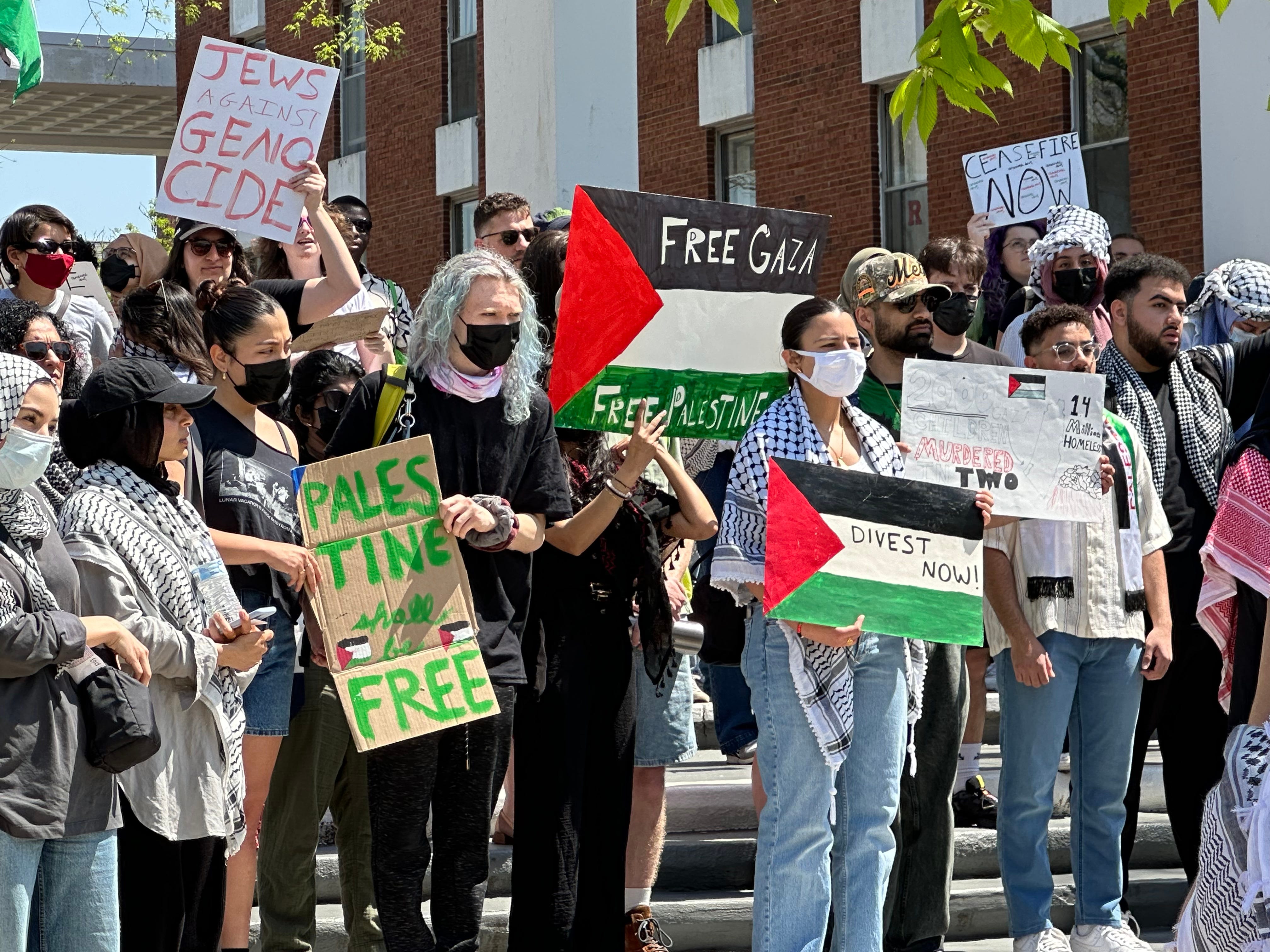
Silencing Higher Education: Trump’s War on Discourse About Genocide in Palestine

Academic institutions have long served as crucibles of free thought and protest. Yet under President Trump’s second term, universities have become battlegrounds in a sweeping campaign that conflates advocacy around the genocide in Gaza with antisemitism—and weaponizes Title VI and Title IX to stifle dissent. This article outlines the administration’s tactics, war crimes ramifications, and the universities ensnared so far.


War Crimes at Issue: Gaza Protests and U.S. Reaction

The conflict in Gaza has seen mounting allegations of genocide against Israel—claims underscored by protests on dozens of U.S. campuses. In response, the Trump administration has launched a social media “catch-and-revoke” system that uses AI to flag pro-Palestinian speech, leading to visa revocations and deportations—even targeting legal residents and green-card holders. Over 1,000 visa revocations were reported by mid-April 2025, rising to nearly 2,000 by mid-May—many later overturned by courts.

Activists such as Mahmoud Khalil, a Columbia University legal resident arrested during a protest, and Mohsen Mahdawi, detained during a citizenship interview, have been caught up in these actions—both cases widely criticized for infringing First Amendment rights. These responses reflect a concerted effort to equate peaceful protest with national-security threats under the guise of combating antisemitism.


Title VI Enforcement: Chilling Academic Freedom

Under a January 29, 2025 Executive Order, Trump directed federal agencies to squash antisemitism—including speech critical of Israel—by enforcing Title VI of the Civil Rights Act against universities.

In March 2025, the Department of Education’s Office for Civil Rights sent letters to 60 universities, warning of enforcement investigations over alleged antisemitism during pro-Gaza protests. This has had an unmistakable chilling effect on faculty, students, and campus activism.


Institutions Targeted and Financial Punishments

The administration’s pressure tactics have taken several forms.

Columbia University saw $400 million in federal grants and contracts canceled, tied to agencies including the Departments of Justice, Education, and Health and Human Services. The university received an ultimatum to change discipline policies, suspend or expel protestors, ban masks, empower security with arrest authority, and restructure certain academic departments by March 20—under threat of permanent funding loss. Columbia ultimately settled for $200 million and restored funding.

George Washington University was accused by the DOJ of being “deliberately indifferent” to antisemitic harassment during spring 2024 protests, especially affecting Jewish, American-Israeli, and Israeli students and faculty, and was given a deadline of August 22 to take corrective action.

UCLA recently had $584 million in federal funding suspended over similar antisemitism-related accusations and affirmative action concerns.

Harvard University is in settlement talks over nearly $500 million in frozen federal funding, negotiating compliance with federal guidelines in exchange for restoring money. Harvard also faces a separate Title VI/IX complaint over $49 million in DEI grants, with claims of race- and sex-based discrimination.

Other institutions under investigation include Johns Hopkins, NYU, Northwestern, UC Berkeley, University of Minnesota, and USC.


Legal Backlash and Academic Resistance

Universities and academic organizations have begun to push back.

The AAUP has filed suit against Trump’s executive orders on DEI, calling them vague, overreaching, and chilling to speech. Some institutions, including Harvard, have resisted enforcement efforts, defending academic freedom and constitutional rights—even as they weigh risks to federal funding.

Legal experts argue that Title VI enforcement in this context may be unconstitutional if motivated by ideological suppression rather than actual antisemitism.


The Battle for Free Speech and Human Rights

Trump’s strategy effectively conjoins criticism of genocide and advocacy for Palestinian rights with civil rights violations—casting a chilling effect across campuses nationwide. The consequences are profound.

Academic autonomy is undermined when universities must trade institutional integrity for compliance with politically driven mandates. Student activism, especially from international and Palestinian voices, faces existential threats via visa policies and deportation tactics. Human rights accountability is sidelined when federal power is used to muzzle discourse about atrocities abroad.


Sources:

Thursday, October 3, 2024

“Repression on Grounds: A Virtual Town Hall on May 4 and Its Aftermath” (Faculty for Justice in Palestine)

(Charlottesville, VA)

In the aftermath of the violent repression of the encampment protests at UVa in May by police and administration, and with issues about first amendment rights at UVa still unresolved, faculty at the University of Virginia will host: “Repression on Grounds: A Virtual Town Hall on May 4 and Its Aftermath” on Sunday October 6 from 11 am -12:30 pm EDT. The town hall will be virtual.

Participants can register for the event here: https://tinyurl.com/56r54kus

The town hall will address violent break up of the pro-Palestinian encampment on May 4, 2024
by military-style police in riot gear and its aftermath. But rather than seeing this as a defeat,
organizers will share what they have learned since the summer and chart a path forward for
pro-Palestinian activism at UVA and nationally, including renewed calls for divestment from
Israel and genocide. The town hall will address:
- What happened on 5/4;
- What has happened since 5/4;
- Suggested steps moving forward;
- National framing;
- Disclosure, divestment & how to get involved
- Q&A

As Israel’s genocide in Gaza intensifies to include Lebanon, members of Faculty for Justice in
Palestine
and allies will highlight the moral urgency of the moment and discuss the role student,
faculty, staff, and community activism and pressure has to do in achieving an arms embargo
against Israel and charting a path towards Palestinian sovereignty. With free speech and
academic freedom under fire across the nation and in the Commonwealth, It’s time to hear from
faculty, staff and students what is really going on with regards to freedom of speech, academic
freedom and protest rights at Jefferson’s University. 

As we enter into another academic year, questions of politics, both domestic and international,
are central to the work we do at the university. It is critically important that faculty, staff, and
students maintain the right to speak freely on these issues without risking the kinds of retaliation
they've seen in the last several months.

Contact: Faculty for Justice in Palestine, UVA. fjp.uva@gmail.com


Related links:

Elite Universities on Lockdown. Protestors Regroup.

What caused 70 US universities to arrest protesting students while many more did not?

Campus Protests, Campus Safety, and the Student Imagination

Democratic Protests on Campus: Modeling the Better World We Seek (Annelise Orleck)

Methods of Student Nonviolent Resistance

Wikipedia Community Documents Pro-Palestinian Protests on University and College Campuses

One Fascism or Two?: The Reemergence of "Fascism(s)" in US Higher Education 

A People's History of Higher Education in the US

Thursday, March 27, 2025

We’re taking it to the courts and the streets--and we need you (Todd Wolfson, AAUP)


The Trump administration’s assaults on education, science, campuses, and communities across the United States are unprecedented, and require an unprecedented response. We are fighting with you and for you in the streets, on campus, and in the courts.

While there are some exceptions, the truth is clear: We cannot count on college administrations to take a stand and take the lead in defending our campuses and communities. Instead, faculty and unions are leading the fight and we need you in it.

This week alone, the AAUP, working in partnership with our chapters, the AFT, and other allies, filed three lawsuits against the Trump administration.

—We sued the administration for its illegal revocation of $400 million in federal funding from Columbia University. We believe that the funding cuts and related demands, which undermine critical scientific and medical and suppress speech, are an unlawful attack on the First Amendment and academic freedom and must be stopped.

—We filed suit to protect free speech rights across colleges and universities against the chilling effect of the Trump administration’s immigration deportation policies.

—We filed a legal action to stop the dismantling of the Department of Education and mass firings that will decimate the crucial services that benefit every person residing in the US.

We cannot win these lawsuits, protect academic freedom, and defend higher education without you. AAUP members have stepped up to provide information and testimony, and they have put themselves on the line as public participants in these legal cases.

We need you with us—please join now. If you're not an active or retired teacher, researcher, graduate student, or similar, you can join as a supporter--just choose "associate member" as you go through the join process.

In solidarity,
Todd Wolfson, AAUP President

P.S.—We need you in the streets, too! On April 8, please join us in a National Day of Action to stand up for education and research.

Friday, March 28, 2025

Trump's Growing Crackdown of Dissenters on Campus

In recent weeks, a growing number of international students and green card holders at prestigious universities, including Cornell, Columbia, Georgetown, and Tufts, have been arrested and detained by federal immigration authorities. These actions appear to be part of a broader crackdown on pro-Palestinian activism within U.S. academic institutions and against dissent in general.  

Tufts University

On March 26, 2025, Rumeysa Ozturk, a Turkish doctoral student at Tufts University, was detained by federal agents who revoked her student visa. Ozturk had co-authored an op-ed in the Tufts student newspaper condemning investments in companies linked to Israel and referring to the "Palestinian genocide" in Gaza. Her detention occurred as she was heading to an iftar dinner during Ramadan.

Columbia University

Earlier this month, Mahmoud Khalil, a lawful permanent resident and recent graduate of Columbia University, was arrested in his university housing. Khalil's participation in pro-Palestinian protests led to allegations of supporting Hamas, resulting in the revocation of his green card. He is currently detained while challenging the deportation order.

Subsequently, Yunseo Chung, a 21-year-old Columbia junior from South Korea holding a green card, was targeted for deportation due to her involvement in similar protests. A federal judge issued a temporary restraining order preventing her detention while she contests the deportation order.

Georgetown University

Badar Khan Suri, a Georgetown University postdoctoral fellow on a student visa, was detained on March 17, 2025, under accusations of spreading Hamas propaganda and promoting antisemitism. His attorney disputes these claims, suggesting that Suri is being targeted because of his Palestinian wife's heritage and their perceived opposition to U.S. foreign policy.

Cornell University

Momodou Taal, a Cornell graduate student with dual British and Gambian citizenship, was instructed to surrender to ICE authorities on March 22, 2025. Taal's legal team preemptively filed a lawsuit challenging the deportation order, citing concerns over potential surveillance and targeting due to his activism.

These incidents have raised significant concerns among civil rights organizations, university officials, and international communities. Critics argue that the Trump administration's actions infringe upon First Amendment rights and target individuals based on their political views. In response, legal challenges are underway, with courts issuing orders to halt certain deportations and detentions.

As this situation develops, universities and advocacy groups continue to monitor and respond to the evolving landscape of immigration enforcement affecting international students and green card holders across the nation.

Tuesday, May 6, 2025

Santa Ono: Take the Money and Run

In a stunning development that has sent ripples through the world of higher education, University of Michigan President Santa J. Ono announced he will step down this summer to take the helm at the University of Florida. The announcement comes just seven months after he signed a lucrative contract extension at U-M—one that brought his salary to $1.3 million per year and was among the most generous in the nation.

Ono’s exit will mark the shortest presidential tenure in University of Michigan history—just two and a half years. And it’s happening at a moment of profound political and institutional tension, with many in Ann Arbor voicing frustration at what they perceive as the university's muted resistance to a suite of controversial measures emanating from the Trump administration.

From Rising Star to Abrupt Exit

When Santa Ono arrived in Ann Arbor in late 2022, he brought with him a sterling academic pedigree and a reputation as a charismatic, student-focused leader. His hiring was seen as a stabilizing move after years of controversy surrounding his predecessor.

But beneath the surface, Ono’s relationship with the university community frayed. Faculty members and students alike cite his increasing absence from public discourse in 2024, particularly as the federal government—under a resurgent Trump administration—moved to slash research funding, roll back diversity, equity and inclusion (DEI) programs, and scrutinize university partnerships, including U-M’s involvement with The PhD Project, which aims to diversify business faculty.

“He’s been more or less invisible particularly this year,” said Faculty Senate Chair Derek Peterson. “What we need is a fighter, not a conformer.”

The Florida Move

Ono’s move to the University of Florida has sparked speculation about his motivations. On paper, Michigan is more prestigious, enjoys greater autonomy thanks to a unique governance structure, and has a massive $19.2 billion endowment. Florida, by contrast, is under the thumb of a politically active governor and a centralized board that has exerted pressure on universities to conform to ideological mandates.

Yet the financial allure may have been too great to ignore: reports suggest Florida’s presidential compensation could total $3 million annually—more than double Ono’s current pay.

Brendan Cantwell, a professor of higher education policy at Michigan State University, noted the irony: “He’s leaving a more prestigious, more autonomous institution. That says a lot about the pressures he faced.”

A State Under Fire: The Regressive Politics of Higher Education in Florida

For those familiar with the political climate in Florida, Ono’s move to the University of Florida is far from surprising. Over the past few years, Florida has become a hotbed for right-wing political maneuvering in higher education, with Governor Ron DeSantis spearheading efforts to reshape universities in line with his conservative agenda.

From banning certain books to defunding DEI programs and trying to control academic curriculum, DeSantis has made it clear that higher education in Florida is now a battleground for ideological warfare. His administration has launched aggressive campaigns against what he describes as “woke” politics in academia, citing the need to root out “liberal indoctrination” and promote “freedom” from progressive influences.

Florida’s approach to higher education has included an unprecedented wave of budget cuts to diversity programs, particularly those aimed at supporting historically underrepresented students. The state’s universities are now grappling with the loss of funding for programs designed to increase access for Black, Latino, and Indigenous students. DeSantis has also pushed for "anti-woke" laws that bar universities from offering certain courses or diversity-related initiatives. This is not only affecting the curriculum, but also the very way in which faculty and staff are hired and evaluated.

In 2023, the University of Florida eliminated many of its DEI programs under pressure from the state. The state’s Board of Governors is now actively involved in scrutinizing university curriculums, and its influence extends even to hiring practices, where faculty members are increasingly expected to align with a more conservative view of American history and culture. These moves have drawn ire from academics nationwide, who argue that Florida’s political leadership is attempting to stifle intellectual freedom and academic independence.

Moreover, Florida’s universities face a severe erosion of academic freedom, as DeSantis has sought to impose strict guidelines on speech and research. This includes revising what can and cannot be taught in classrooms and restricting discussions around race, gender, and political identity. The state's newly imposed curriculum laws have made it more difficult for universities to engage in meaningful discourse about topics such as climate change, systemic racism, and gender equality.

For Ono, stepping into this highly charged, politicized environment will represent a dramatic shift from his more moderate, research-focused tenure at Michigan. His leadership will likely be tested not just by university-level challenges but also by the state's political apparatus, which has shown a willingness to intervene in nearly every facet of higher education.

Institutional Challenges Ahead

Ono’s departure leaves U-M with significant challenges. The Board of Regents announced that he will remain in Ann Arbor until an interim president is named—a process that may take weeks. But finding a long-term leader capable of navigating the rapidly shifting higher education landscape could take much longer.

The next president will have to address:

  • Federal Research Cuts: The loss of federal contracts—particularly from agencies like the National Institutes of Health—has cost Michigan and its peer institutions hundreds of millions of dollars. A $15 million Social Security study was among the casualties. U-M is using endowment funds to plug gaps, but that is not a sustainable strategy.

  • DEI Backlash and Retrenchment: The university recently shuttered two DEI offices and scaled back programming, citing political and legal risks. While Ono promised to bolster financial aid and mental health support, many faculty and students felt betrayed by the move.

  • Campus Unrest and Free Speech: Protests over the Gaza war led to harsh disciplinary action against student groups, including the suspension of Students Allied for Freedom and Equality (SAFE). Critics say the campus has become increasingly authoritarian, and several lawsuits have been filed by terminated employees alleging First Amendment violations.

  • Board Relations and Governance: U-M’s elected Board of Regents is ideologically divided. While five Democratic regents penned a passionate op-ed in defense of academic independence, the board’s stance on DEI and other political flashpoints appears fractured.

A Bigger Crisis in Public Higher Ed?

Beyond the immediate concerns, the university’s upheaval reflects deeper anxieties about the future of public higher education in America. Declining public trust, rising tuition, and the politicization of universities—especially around issues of race, gender, and free speech—have created an atmosphere of volatility.

While the University of Michigan continues to see strong application numbers, including from international students, enrollment of in-state high school graduates is dropping. The university’s Go Blue Guarantee, which offers free tuition to families earning under $125,000, is a step toward addressing affordability concerns. But will it be enough?

Sandy Baruah of the Detroit Regional Chamber sees a broader mission: “Our research universities all have a responsibility to make the case for higher education. The value of higher ed is critical to the state of Michigan.”

What’s Next?

The Faculty Senate has passed resolutions urging the university to join a “mutual defense pact” with other Big Ten schools to resist political interference and defend academic freedom. But U-M is not obligated to act on those resolutions.

Interim leadership will be announced soon, and the search for a permanent successor will follow. Whoever takes the reins next will need to be a deft political operator—someone capable of rebuilding trust internally while weathering mounting external threats.

In the words of Cantwell: “Whoever they hire has to be prepared to be under intense scrutiny—locally, federally, ideologically. The next leader of Michigan must have both a spine and a strategy.”

As the University of Michigan enters this uncertain chapter, one thing is clear: the battle over the soul of public higher education is far from over.

Wednesday, September 3, 2025

University of Kentucky Athlete Arrested After Infant Found Dead in Closet – Amid Kentucky’s Near-Total Abortion Ban

Lexington, KY (September 3, 2025) — A University of Kentucky student and athlete, 21-year-old Laken Ashlee Snelling—a senior member of the UK STUNT cheer team—has been arrested and charged in connection with the death of her newborn, authorities say.

Allegations and Legal Proceedings

Lexington police were called to a Park Avenue residence on August 27 after they discovered the unresponsive body of an infant hidden in a closet, wrapped in a towel inside a black trash bag. Snelling admitted to giving birth and attempting to conceal both the infant and evidence of the birth, according to arrest documents.

Snelling faces three Class D felony charges:

  • Concealing the birth of an infant

  • Tampering with physical evidence

  • Abuse of a corpse

Each charge carries potential penalties of 1 to 5 years in prison and fines up to $10,000.

At her first court appearance on September 2, Snelling pleaded not guilty and was released on a $100,000 bond, with the court ordering her to live under house arrest at her parents’ home in Tennessee. Her next hearing is scheduled for September 26.

A preliminary autopsy by the Fayette County Coroner’s Office revealed that the infant was a boy, but the cause of death remains inconclusive. Officials confirmed that a thorough death investigation is ongoing.

Context: Kentucky’s Near-Total Abortion Ban

Kentucky currently enforces one of the nation’s most restrictive abortion laws. Since August 1, 2022, the state’s trigger law has rendered abortion completely illegal, except when necessary to prevent the pregnant individual’s death or permanent impairment of a major, life-sustaining bodily function. No exceptions are made for rape, incest, or fetal abnormalities.

Attempts to challenge the ban have largely failed. A 2024 lawsuit disputing the near-total prohibition was voluntarily dismissed earlier this year, and the law remains firmly in place. Additionally, a constitutional amendment that would have explicitly declared that Kentucky's state constitution does not protect abortion rights was rejected by voters in November 2022.

Public Reaction and Additional Details

Snelling, originally from White Pine, Tennessee, had built a public persona that included cheerleading and pageant appearances. Months earlier, she had posted on TikTok expressing a desire for motherhood—listing “having babies” among her life goals. Viral maternity-style photos—later removed from her social media—have intensified public scrutiny.

A Broader National Context

Snelling’s case arises within a wider national conversation about the legal and societal implications of criminal investigations following pregnancy outcomes. Since the repeal of federal protections for abortion rights, concerns have grown that miscarriages, stillbirths, or even self-managed abortions may now be subject to legal scrutiny—raising fears about reproductive autonomy and medical privacy.


Sources

  • The Guardian: University of Kentucky athlete charged after dead infant found hidden in closet (Sept. 2, 2025)

  • People: Univ. of Kentucky STUNT Team Member Arrested After Allegedly Hiding Dead Newborn in Her Closet (Sept. 2, 2025)

  • TurnTo10: University of Kentucky athlete pleads not guilty to hiding newborn in closet (Sept. 2, 2025)

  • WWNYTV: College student pleads not guilty after dead infant found in closet (Sept. 3, 2025)

  • The Sun (UK): Laken Snelling cheerleader baby case (Sept. 2, 2025)

  • WKYT: Fayette County coroner releases autopsy results after infant found in closet (Sept. 3, 2025)

  • AP News: Kentucky abortion law lawsuit dismissed (2024)

  • Wikipedia: Abortion in Kentucky (updated 2025); 2022 Kentucky Amendment 2

  • New York Post: Kentucky cheerleader who hid newborn had listed “having babies” as life goal (Sept. 2, 2025)

  • Fox News: Kentucky athlete once posted about wanting babies (Sept. 2, 2025)

  • India Times: Viral maternity photos of Kentucky student after newborn death case (Sept. 2, 2025)

  • Vox: How abortion bans create confusion and surveillance risks (2025)