Search This Blog

Showing posts sorted by relevance for query Chegg. Sort by date Show all posts

Friday, July 11, 2025

Chegg: A Critical History of a Disruptor Turned Controversy Machine

Chegg, once hailed as a Silicon Valley disruptor democratizing access to education, has undergone a profound and troubling transformation since its founding in 2005. What began as a textbook rental company evolved into a billion-dollar homework help empire—an empire that, critics argue, has done more to undermine academic integrity than to foster genuine learning. Its business model capitalized on the structural weaknesses of American higher education and, in the process, normalized a shadow system of paid cheating.

Origins: Textbooks, Student Debt, and Disruption

Chegg was born at the intersection of inflated textbook costs and the neoliberal university. Founders Osman Rashid and Aayush Phumbhra sought to bring the efficiencies of the sharing economy to the campus bookstore. In its early years, Chegg attracted investor attention by promising cheaper textbook rentals—a modest but important service in an era of spiraling student debt.

But as textbook rentals became commodified, Chegg pivoted. By the early 2010s, it was building a suite of digital services: step-by-step solutions, tutoring, and subscription-based homework help under its Chegg Study brand. When Chegg went public in 2013, it promoted itself not just as a tech company, but as a partner in “student success.” In reality, it had found a way to turn student desperation into a profitable SaaS model.

Homework Help or Cheating-as-a-Service?

Chegg’s transformation into a homework help platform would eventually earn it a darker moniker: “Cheating-as-a-Service.”

Nowhere is this critique more powerfully detailed than in education journalist Derek Newton’s Cheat Sheet, a Substack project dedicated to exposing the industrial-scale cheating facilitated by platforms like Chegg, Course Hero, and Studypool. Newton, who has tracked the issue since 2019, documented case after case in which students used Chegg not to learn—but to submit answers for graded assignments and exams. Faculty across disciplines and institutions began reporting widespread cheating enabled by Chegg, especially during the remote learning surge triggered by COVID-19.

In one issue of Cheat Sheet, Newton wrote:

“Chegg isn’t an education company. It’s a cheating company. It monetizes academic dishonesty, obfuscates accountability, and deflects responsibility while raking in millions in subscription revenue.”

According to Newton, Chegg’s "ask an expert" function—where students submit specific questions and receive solutions within minutes—became a tool of choice for real-time cheating during online exams. Despite university honor codes, many students saw Chegg as a normalized part of academic life. Meanwhile, Chegg’s refusal to proactively block cheating or cooperate fully with universities left institutions scrambling.

Pandemic Profits and Ethical Collapse

During the COVID-19 pandemic, as universities shifted online, Chegg’s subscriber base soared. Students confined to Zoom classrooms flocked to digital platforms for support—or shortcuts. By 2021, Chegg had nearly 7 million subscribers and posted annual revenues of $776 million. Its stock price peaked above $100 in February 2021.

But that growth came with growing backlash. Professors and academic integrity officers called for investigations. Some universities demanded IP logs and timestamps from Chegg in academic misconduct cases. In response, Chegg adopted a policy of releasing user data only under subpoena—shifting the burden to faculty and administrators.

Chegg, for its part, insisted it was simply offering "study support" and denied facilitating cheating. But the evidence presented in Newton’s Cheat Sheet and other academic publications told a different story.

Collapse, AI Disruption, and Image Repair

In 2023, a new threat emerged: OpenAI’s ChatGPT. Free, flexible, and fast, ChatGPT began to supplant Chegg for the same user base. In a rare moment of corporate honesty, Chegg CEO Dan Rosensweig told investors that ChatGPT was impacting the company’s subscriber growth. Wall Street panicked. Chegg’s stock plummeted, its valuation shrank, and the company began rounds of layoffs—first 4% of its workforce, then 23% in 2024.

Desperate to stay relevant, Chegg pivoted again—this time toward “CheggMate,” its proprietary AI chatbot built in partnership with OpenAI. Yet the damage to its brand, and its future, was already apparent.

By 2025, Chegg was struggling to define its purpose in a rapidly changing education tech landscape. Its subscription model had been undermined by free AI. Its name remained tainted by years of academic dishonesty. And efforts to shift into AI tutoring raised further concerns about data privacy, surveillance, and automation in learning.

A Mirror of Higher Education’s Failures

Chegg’s rise and fall cannot be understood in isolation. It thrived in a system where students are overburdened, instructors are underpaid, and administrators look the other way as long as graduation rates and tuition dollars remain stable. Its gig-based backend—where underpaid "experts" supply answers for a global audience—mirrors the adjunctification of academic labor itself.

Derek Newton’s Cheat Sheet and other critical reporting have exposed how edtech platforms exploit the credibility crisis in higher education. The real scandal isn’t just that Chegg exists—it’s that the ecosystem made it necessary.

Conclusion

Chegg’s legacy may one day be viewed not as a revolution in learning, but as a symptom of higher education’s marketized decline. Like diploma mills and for-profit colleges before it, Chegg served the needs of students abandoned by the system—but did so at the cost of academic trust and intellectual growth.

As the AI era unfolds, and companies like Chegg scramble to reposition themselves, the Higher Education Inquirer will continue to ask: who profits, who pays, and who is left behind?


Sources

  • Derek Newton, Cheat Sheet newsletter: https://cheatsheet.substack.com

  • Chegg Inc. 10-K and Investor Calls (2015–2025)

  • The Chronicle of Higher Education, “Is Chegg Helping or Hurting?”

  • Inside Higher Ed, “Chegg, ChatGPT, and the New Arms Race in EdTech”

  • Bloomberg, “Chegg Warns of ChatGPT Threat”

  • Reddit threads: r/Professors, r/College, r/AcademicIntegrity

  • The Markup, “Chegg’s Gig-Economy Model and Academic Labor”

  • The Atlantic, “The Cheating Economy”

  • Higher Education Inquirer Archives on EdTech and Academic Integrity

Friday, May 5, 2023

Cheating Giant Chegg, Shrinks (Derek Newton)

[Editor's Note: This article first appeared in The Cheat Sheet, the free newsletter on academic integrity and cheating.]


Yesterday, academic cheating company Chegg took yet another major hit on its stock value after the market closed, a decline that continues.

Today, Chegg - which is shockingly listed on the New York Stock Exchange - tumbled below $10 a share. In February 2021, Chegg shares were worth more than $113. In just over two years, Chegg shares have lost more than $100 in value - an Alpine decline of more than 91%.

Yikes.

The panic retreat by investors was initiated by Chegg’s quarterly earnings (Q1 - 2023) which were, not good. The bullets, according to news coverage:

Total net revenue down 7% year over year

*Subscription services, which represent 90% of Chegg’s business, were down 3% year over year.

*Total subscribers were down 5.1 million year over year.

*Projected further, continued declines in revenue, subscribers, and profit.

The company and media blamed the decline on AI tools such as ChatGPT - the automated service that can answer academic questions faster than Chegg, and for free.

In the earnings announcement, Chegg’s CEO said:

"since March we saw a significant spike in student interest in ChatGPT. We now believe it’s having an impact on our new customer growth rate."

Two things.

To start, The Cheat Sheet could have saved Chegg’s investors some serious money. Or, made you some, had you shorted Chegg. Back in Issue 68, I wrote:

Bottom line: Chegg as a business is in trouble.

Yup.

This past February, in Issue 193, I wrote:

… Chegg thinks their earnings will be essentially unchanged for 2023 vs 2022. I think they’re dreaming.

They were.

I’d repeated the wisdom of some smart readers who said early, early on that the likes of ChatGPT was going to be a Chegg killer. I agreed and told EdSurge exactly that, also in February (see Issue 193):

Some instructors have opposed companies like Chegg and Course Hero, as trying to get content related to the courses they teach removed can cause a headache. The chatbots represent a new headache, for teachers and possibly also for homework-help companies.

That whole business could be threatened by free tools like ChatGPT, argues Derek Newton, who runs The Cheat Sheet, a newsletter that covers academic dishonesty.

For Newton, the primary motivation of a student using homework-help services is laziness or a lack of preparedness. And so having a free alternative that can give answers to questions — like ChatGPT — could shrink the number of students who are willing to pay

In that Issue I wrote:

It’s too early to tell if ChatGPT will dent Chegg and its irresponsible ilk - but I can’t really see how it won’t.

And so it came to pass.

It is clear now that Chegg’s recent announcement of a partnership with ChatGPT (see Issue 203) was a desperate Hail Mary. And there’s no reason to think it will work, no reason to think Chegg’s decline won’t continue.

It also answers a question I’d been wrestling with for years - whether Chegg’s investors (see Issue 142) knew its core business was academic misconduct or not. This most recent investment retreat proved to me that they did. They only left when a better, more efficient cheater started eating their profits.

But a wise confidant and reader texted to say my question was academic - Chegg’s investors know now. He’s right.

When a free answer site takes away your customers, it becomes very clear very quickly what you’re actually selling.

Finally, a reminder that a collapsing valuation is not Chegg’s only problem.

As it happens, I checked in last week on the legal challenge by Pearson, against Chegg (see Issue 55). The suit is still active. And if Pearson wins, it could decapitate Chegg’s entire value proposition - selling the answers to questions they do not own. Chegg also continues to face investor legal challenges (see Issue 163). Since this recent stock evaporation essentially confirms that Chegg was a cheating provider all along, it’s hard to see how this recent news hurts investors’ claims.

Related links: 


Sunday, November 2, 2025

When Educators Back the Cheating Platform: The Strange Case of Chegg (Glen McGhee)

Chegg — once a poster child for pandemic-era edtech growth — is now in free fall. In 2025 the company announced it would slash 45 % of its workforce, citing plunging web traffic, collapsing revenue, and the onslaught of AI tools that let students bypass paid homework help altogether.

It’s a dramatic reversal for a company that sold itself as a learning aid. But behind that collapse lies an even more troubling paradox: many teacher pension funds and public retirement systems — in whose names educators put decades of trust — hold millions in Chegg stock. Why would those funds invest in a company whose business model many of their own beneficiaries see as unethical, even corrosive?

We’ve seen this pattern before. In the early 2000s, retirement funds like these were major institutional investors in for-profit higher education companies such as EDMC, ITT Tech, and the University of Phoenix. Those institutions promised strong returns but ultimately collapsed under fraud allegations, predatory practices, and declining enrollments. Many public-sector workers indirectly suffered as the funds lost money. Chegg’s story looks eerily similar: high growth promises, an ethically contested business model, and exposure of public retirement funds to extreme financial risk. The repetition suggests a structural pattern: when education is financialized and commodified, the people meant to serve it — educators and students — are exposed to both moral and economic hazards.


The Downward Spiral: Why Chegg Is Crashing

Chegg’s decline didn’t begin yesterday. It was seeded by technological disruption and a fragile business model dependent on volume, content access, and student compliance. Generative AI tools such as ChatGPT and Bard have undercut Chegg’s core service: paid homework help and explanations. Students can often get free answers faster and more flexibly. Google’s “AI overviews,” which display answer snippets directly in search results, divert traffic away from Chegg’s site, reducing ad and subscription conversions. Chegg has even sued Google, alleging unfair competition.

Earlier in 2025, Chegg laid off 22 % of its staff and closed its U.S. and Canada offices to cut costs. That was supposed to be a stabilization move, but it foreshadowed deeper troubles. The more recent 45 % layoff is sweeping: 388 jobs are being cut, $15–19 million in severance charges are expected, and $100–110 million in cost savings are projected for 2026. Chegg’s stock has lost approximately 99 % of its value since its 2021 peak. Yet the company is still pursuing a pivot toward B2B “skilling” markets, though skeptics doubt whether this can make up for the erosion of its original model. In short, Chegg is facing structural obsolescence. The ecosystem that once made its growth plausible is collapsing around it.


Pension Funds and the Strange Attraction to Chegg

Several public pension and teachers’ retirement systems hold millions in Chegg: Kentucky Teachers’ Retirement System owns $4.5 million, California State Teachers’ Retirement System owns $4 million, New York State Common Retirement Fund owns $13 million, Colorado Public Employees’ Retirement Fund owns $9.3 million, California Public Employees’ Retirement Fund owns $5.3 million, a Florida retirement fund owns $3.3 million, Ohio Public Employees Retirement owns $1.5 million, and the Teacher Retirement System of Texas owns $630,000.

These investments raise hard questions. Do pension fund managers assume Chegg will survive its technological disruption? Are they prioritizing short-term returns over long-term reputational or ethical risk? Do they believe the stock is undervalued and thus a “contrarian bet”? Are they following passive index allocations rather than making deliberate choices? Some fund managers defend such investments as fulfilling fiduciary duty: to maximize returns for their beneficiaries within acceptable risk parameters. Ethical considerations, they argue, should not trump financial sustainability — especially in a system underfunded and under stress. But when the bet fails, the consequences fall hardest on retirees, educators, and the public who trusted those funds to safeguard their futures.


Do We Owe Them Sympathy?

It’s tempting to feel a bit sorry: pension funds losing money is a headline nobody wants. But sympathy is complicated. These funds store and grow the life savings of public-sector workers — teachers, librarians, and staff. A poorly timed speculative investment can damage retiree security and erode public trust. On the other hand, this is no innocent failure; it is a foreseeable risk in backing a business facing existential challenges. It reflects a broader pattern of financialization in education: turning learning into a profit-seeking venture, exposing it to wild swings, and treating educators and students as market participants. Losses are regrettable, especially at the human level, but they also demand accountability. Institutions must explain why they placed trust in Chegg when its vulnerabilities were visible.


What This Reveals: Institutional Contradiction

This episode exposes several deeper contradictions at the intersection of education, finance, and values. Many educators see Chegg as a threat to academic integrity, yet the institutions managing their retirement funds believed in its upside. Some investors are attracted to the “turnaround bet,” seeing potential in a company trading at a fraction of its former value, though the risk is very high. Some funds may hold Chegg because their portfolios track broad indices, ceding moral discretion to the market. Education has become infrastructure built on venture logic, and the Chegg collapse is a warning: when learning becomes a commodity, its institutions become as unstable as any tech startup. Finally, if pension funds backed a cheating-enabled platform, what else might their capital support, and how does that affect trust in those institutions?


A Moral and Institutional Reckoning 

Chegg’s collapse is not just a market drama; it’s a moral and institutional reckoning. A company built on a questionable model is now evaporating under AI pressure. Meanwhile, public pension funds — meant to safeguard the futures of educators — placed bets on that very evaporation.

We might feel a pang of sympathy for the financial losses. But our greater duty is to probe the judgment of those entrusted with public capital, and to demand coherence between values and investment. If the administrators of teacher retirement funds cannot align ethics with asset allocation, then their claims to serving the public good are weakened — and so is the trust on which the idea of public education depends.


Sources

Barron’s: “Chegg Is Suing Google. The Stock Is Sinking.”
Reuters: “Chegg to lay off 22% of workforce as AI tools shake up edtech industry.”
SF Chronicle: “Bay Area educational tech company slashes 248 jobs as students turn to AI tools for learning.”
The Cheatsheet Substack: “Meet Chegg’s Biggest Backers.”
The Chronicle of Higher Education: “Work in Public Education and Hate Chegg? You Might Be an Investor.”
Wikipedia: “Chegg”

Monday, April 10, 2023

EdTech Meltdown

The Silicon Valley tech downturn has been creating reverberations in other parts of the economy and in other areas of the US.

Edtech, a small subset of the tech industry that overlaps with higher education, is facing major headwinds as skepticism about higher education and the economy grows.  Even two industry insiders, Noodle CEO John Katzman and Kaplan executive Brandon Busteed have been critical of the short-term thinking and questionable outcomes of edtech. Katzman has called some companies in the space "more adtech than edtech," implying that some do little more than marketing and advertising for colleges and universities.     

Ultimately, it's US consumers who are feeling the greatest pain as participants in online education--a mode of instruction that for millions of people may have more risks than benefits--within an increasingly dysfunctional economy that produces expensive education and fewer good jobs.   

Significant problems that were observed in large subprime colleges like University of Phoenix, Corinthian Colleges, ITT Tech, DeVry University, Colorado Tech, and the Art Institutes more than a dozen years ago have resurfaced in edtech.  And other problems unique to edtech have emerged. 

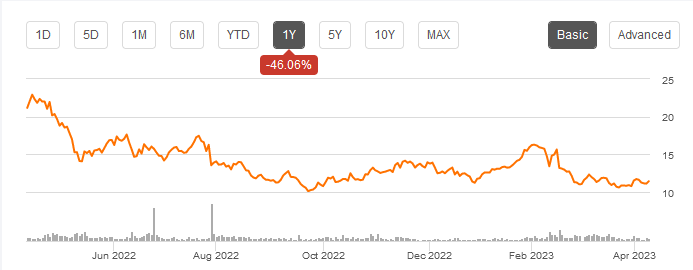
Chegg is an edtech company based in Santa Clara, California, and provides homework help, online tutoring, and other student services.  The company's value grew more than 300 percent in 2020, during the Covid pandemic, but has faced headwinds for the last two years. This includes allegations that  Chegg enables students to cheat on homework and other assignments. Derek Newton has chronicled this problem in the substack The Cheat Sheet.

[Chegg shares grew in 2020 during the Covid pandemic. Source: Seeking Alpha] 

 
Coursera is a publicly traded MOOC based in Mountain View California.  Shares started trading in April 2021.  The company has under-performed as a profit making enterprise. Massive Open Online Courses were once seen as a wave of the future in adult education but their popularity has waned. 

[Coursera has underperformed since its IPO in April 2021.  Source: Seeking Alpha]

2U (based in Lanham, MD) and Guild Education (based in Denver) and are two edtech companies based outside of Silicon Valley. 

2U is a publicly traded Online Program Manager (OPM).  The company services major universities such as the University of Southern California and University of North Carolina with support for some of their online degree programs. 2U has received an enormous amount of funding from Cathie Wood, a major Silicon Valley investor, and has continued to receive support despite a long record of financial losses.  

Some 2U investors have grown tired of persistent losses--and it has shown in the declining share price. The company also faces increased scrutiny in DC for recruiting consumers unable to recoup the cost of education for high-priced masters degrees in areas such as social work.  2U acquired edX, the Harvard-MIT MOOC in 2021 and its profitability remains to be seen.  

In 2023, 2U sued the US Department of Education for attempting to require more transparency between OPMs and their clients.  This strategy is similar to the defensive strategy that subprime colleges have used to stop gainful employment regulations, and more recently, borrower defense to repayment rules.  


 [2U shares have dropped more than 90 percent over the last 5 years. Source: Seeking Alpha]

Guild Education is a privately held corporation that grew to an estimated $4.4B evaluation in a few years. Guild serves businesses by administering online education benefits for large corporations such as Walmart, Target, and Macy's.  While its work may help companies with their bottom line, they appear to do little for their workers. 

At least ten of Guild's investors are based in Silicon Valley, including Silicon Valley Bank and venture capital firms in San Francisco, Palo Alto, and Menlo Park, California. Valuations.fyi reports Guild's estimated value at $1.3B, a 70 percent drop from its peak in June 2022. 

 
[Image above: Guild's valuation in Billions from valuations.fyi]
 
The Higher Education Inquirer will continue to observe changes in edtech as the College Meltdown advances.  


A ‘rigged’ economy and skepticism about college (Paul Fain, Open Campus)

How University of Phoenix Failed. It's a Long Story. But It's Important for the Future of Higher Education. 

The Cheat Sheet (Derek Newton)

2U Virus Expands College Meltdown to Elite Universities 

Erica Gallagher Speaks Out About 2U's Shady Practices at Department of Education Virtual Listening Meeting

Borrower Defense Claims Surpass 750,000. Consumers Empowered. Subprime Colleges and Programs Threatened.

Guild Education: Enablers of Anti-Union Corporations and Subprime College Programs 

College Meltdown 2.0 

The Growth of "RoboColleges" and "Robostudents"

The American Dream is Over (Gary Roth) 

Friday, September 29, 2023

2U-edX crash exposes the latest wave of edugrift

2U, a Lanham, Maryland-based edtech company and parent company edX, is facing layoffs of an estimated 200 to 400 workers--a significant number for a company that only employs a few thousand--amid more rumors that the company is for sale. While the pain of their firings may be consequential for those who are experiencing it, the pain of those the company has damaged, mostly striving middle-class consumers and their families, may be worse.  

2U's problems are not new. The Higher Education Inquirer first reported on the beginning of company's meltdown in October 2019.  In July 2022, 2U announced layoffs as it changed its business model (again) and the US Department of Education scrutinized the company's grad school offerings.

2U began in 2008 as an online program manager (OPM), one of a few companies offering edtech services that required large amounts of capital and labor costs. They expanded through the acquisition of other edtech firms, Trilogy Education Services (2019) and edX (2021).  edX is an education platform that was created by Harvard and MIT as a massive open online course (MOOC) platform, but as part of 2U now concentrates on selling a number of elite and brand name tech bootcamps.

In 2022 and 2023, the Wall Street Journal (Lisa Bannon), Chronicle of Higher Education (Mike Vasquez), and USA Today (Chris Quintana) investigated 2U after a few US senators sounded the alarm about consumers being fleeced by 2U and other OPMs. 

With 2U's reputation in shambles and layoffs ahead, the parent company wrapped itself around the more respectable edX brand. Bjju's, an Indian edtech firm, was said to be looking at 2U or Chegg as a possible acquisition (Byju's is now facing its own problems).  

Concentrating on growth for years, then acquisition, then consolidation and rebranding, 2U has never generated an annual profit--and that trend doesn't appear to be changing. 

Earlier this year we listed 2U, Chegg, Coursera, and Guild Education as part of the EdTech Meltdown. 

Unlike the prior wave of for-profit college failures of Corinthian Colleges, ITT Tech, Education Management Corporation, and others that hurt working-class student debtors, 2U has collaborated with elite universities, targeting mostly middle-class folks for advanced degrees and certificates with elite brand names such as USC and UC Berkeley. Credentials that frequently are not worth the debt. Credentials that often did not lead to better paying jobs. Credentials that burden (and sometimes crush) consumers financially with private loans from Sallie Mae and others.

edX's website advertises coding, data analytics, cybersecurity, and AI bootcamps from a number of name brands: Ohio State University, Columbia University, University of Texas, Harvard University, Michigan State University, University of Denver, Southern Methodist University, University of Minnesota, University of Central Florida, Arizona State University, Northwestern University, Rice University, the University of North Carolina, and UC-Irvine.   

  • Ohio State University AI Bootcamp $11,745
  • University of Texas Coding Bootcamp $12,495
  • Berkeley Extension Coding Bootcamp $13,495
  • University of Pennsylvania Cybersecurity Bootcamp $13,995
  • Columbia University Data Analytics Bootcamp $14,745 

It's not clear how well managed the programs are and how much these schools are involved in instruction and career guidance.  However, edX claims that with their bootcamp certificates, graduates will "gain  access to more than 260 employers--including half of the Fortune 100--seeking skilled bootcamp graduates." 

While the targets of for-profit colleges and 2U may have been different, their approaches were similar: sell a dream to consumers that often does not materialize. Spend tens of millions on targeted (and sometimes misleading) advertising and enrollment. Keep the confidence game going as long as it will last. But that may not be much longer.

In April 2023, 2U filed a lawsuit against the US Department of Education to avoid further government oversight. A familiar defensive strategy in the for-profit college business.

There is much we don't know about how significant the damage has been to those who bought the 2U story and spent tens of thousands on elite degrees and certificates, but it must be significant. Most US families do not have that kind of money to spend on something that doesn't result in financial gains.  

Recent reviews of edX on TrustPilot have been scathing. And social media have been brutal on 2U, Trilogy, and EdX. Reddit, for example, has posts like "The dirty truth about edX/Trilogy Boot Camps." In a more recent post about edX, there was a flurry of negative reviews.


In 2016, we wrote "When college choice is a fraud." At that time we were focusing on the tough choices that working-class people have deciding between their local community college or a for-profit career school. Little did we know that the education business was already moving its way up the food chain and that edtech companies like 2U would be engaging in the latest form of edugrift

Related link:

2U Virus Expands College Meltdown to Elite Universities (2019)

Buyer Beware: Servicemembers, Veterans, and Families Need to Be On Guard with College and Career Choices (2021)

College Meltdown 2.1 (2022)

EdTech Meltdown (2023)  

Erica Gallagher Speaks Out About 2U's Shady Practices at Department of Education Virtual Listening Meeting (2023)

"Edugrift" by J.D. Suenram (2020)

When college choice is a fraud (2016)

Thursday, July 1, 2021

The Growth of "RoboColleges" and "Robostudents"


In a previous Higher Education Inquirer article, I presented frightening full-time faculty numbers at some large online universities which I call "robocolleges."  Full-time faculty at these robocolleges, in fact, are nearly nonexistent. Bear in mind that all of them are regionally accredited, the highest level of institutional accreditation, and the list includes well-known public university systems as well as for-profit ones.  

Robocolleges have de-skilled instruction by paying teams of workers, some qualified and some not, to write content, while computer programs perform instructional and management tasks. Learning management systems with automated instruction programs are known by different names and their mechanisms are proprietary.  As professor jobs are deskilled, tasks can be farmed out at reduced costs.  

Besides the human content creators who may be given instructional titles, other staff members at robocolleges are paid to communicate with students regarding their progress. The assumption is that managing work this way significantly reduces costs, and it does, at least in the short and medium terms.  However, instructional costs are frequently replaced by marketing and advertising expenses to pitch the schools to prospective students and their families.  Companies like EducationDynamics and Guild Education have filled the niche of promoting robocolleges to workers at a reduced cost but their overall impact is minimal.  

Meanwhile,  companies like Chegg profit from this form of learning, helping students game the system in greater numbers, in essence creating robostudents.  

The business model in higher education for reducing labor power and faculty costs is not reserved to for-profit colleges.  Community colleges also rely on a small number of full-time faculty and armies of low-wage contingent labor.  

In some cases, colleges and universities, including many brand name schools, utilize outside companies, online program managers (OPMs), to run their online programs, with OPMs like 2U taking up as much as 60 percent of the revenues.  OPMs can perform a variety of jobs, but are best known for their work in enrollment and retention.  Prospective students may believe they are talking to representatives of a particular university when in fact they are talking to someone from an outside source.  Noodle has disrupted the OPM model by selling their services ala carte, but only time will tell whether it has an impact, or whether schools will merely find less costly outsourced servicers.  

Outsourcing higher education has been a reality in US higher education for decades. And automation is also part of education, as it should, when it performs menial tasks, such as taking roll and doing preliminary work to determine student cheating.  It's likely that more schools will become more robotic in nature to reduce organizational expenses.  But what are the long-term consequences with long-term student outcomes, when automation is used to perform higher level tasks, and when outsourced individuals act in the name of brand name colleges?  

To get a small glimpse of this robocollege phenomenon, these schools cumulatively have about 3000 full-time instructors for more than a half-million students.  

American Intercontinental University: 51 full-time instructors for about 8,700 students.
American Public University System has 345 F/T instructors for more than 50,000 students. 
Aspen University has 34 F/T instructors for about 9,500 students.  
Capella University: 216 F/T for about 38,000 students.
Colorado State University Global: 34 F/T instructors for 12,000 students.
Colorado Technical University: 59 F/T instructors for 26,000 students.
Devry University online: 53 F/T instructors for about 17,000 students.
Grand Canyon University has 461 F/T instructors for 103,000 students.*  
Liberty University: 1072 F/T for more than 85,000 students.*
Purdue University Global: 346 F/T instructors for 38,000 students.
South University: 0 F/T instructors for more than 6000 students.
Southern New Hampshire University: 164 F/T for 104,000 students.
University of Arizona Global Campus: 194 F/T instructors for about 35,000 students.
University of Maryland Global: 193 F/T instructors for 60,000 students.
University of Phoenix: 127 F/T instructors for 96,000 students.
Walden University: 206 F/T for more than 50,000 students.

*Most of these full-time instructors are faculty at the physical campuses.  

Sunday, January 30, 2022

How University of Phoenix Failed. It's a Long Story. But It's Important for the Future of Higher Education.

The failure of University of Phoenix (UoPX) is more than a dark moment in higher education history.  It should act as a lesson learned in the higher ed business. Executives at 2U, Guild Education, Coursera, Liberty University, Purdue University Global, University of Arizona Global, Chegg, Academic Partnerships, Pearson PLCNavientMaximus and other for-profit and non-profit entities must take heed of the mistakes and the hubris of Phoenix, the wisdom of its cofounder John D. Murphy, and the silencing of important worker voices.  

For several decades of the 20th century, hundreds of University of Phoenix campuses dotted the American landscape, conveniently located in cities and growing suburbs, off major highways. Founded in 1973, America's largest university became a for-profit darling of Wall Street in the 1980s and 1990s, and the provider of career education for mid-level managers in corporate America and public service. A Phoenix degree was the ticket to promotions and salary increases.  

During its zenith, the school was backed by dozens of lawyers and DC lobbyists and a number of politicians and celebrities--including Nancy Pelosi, John McCain, Shaquille O'Neil, Al Sharpton, and Suze Orman. UoPX bought the naming rights to the Arizona Cardinals' pro football stadium in 2006. And in 2010, enrollment at the University of Phoenix stood at nearly a half million students.  The school even had an enormous presence at US military installations across the globe. University of Phoenix's presence was everywhere.* 

Phoenix's stock rose for many reasons. It was a leader in educational innovation. It was convenient and affordable for upwardly social mobile workers.  Its profits were large, and its labor costs were relatively low because UoPX hired business leaders and experts in the field, not tenured scholars, to teach part-time.  

But something went horribly wrong along the way.

In the 2010s, University faced government and media scrutiny for its questionable business practices, its declining graduation rates, and its part in creating billions in student loan debt. And when workers voiced their concerns, they were silenced in a variety of ways, from threats and intimidation to firings. 

This enrollment collapse has now lasted a dozen years and counting.  

Today, as a miniscule portion of Apollo Global Management's portfolio, UoPX's enrollment numbers are less than 100,000--and few of its physical campuses remain open during the Covid pandemic. It's not known how many campuses, if any, are financially viable.  

University of Phoenix enrollment, 2009-2016 (Source: US Department of Education) 

There are a several reasons why University of Phoenix is just a shadow of what it was. Businesspeople and lobbyists blame government regulation and oversight; others blame the relentless pursuit of quarterly profits and corrupt Apollo Group CEOs, including Todd Nelson.

Having talked to co-founder John D. Murphy and read his book Mission Forsaken, what I found out was that University of Phoenix began failing three decades earlier, during the Ronald Reagan era, when US companies chose to invest less in their workforces.  When this post-Fordist shift happened, US companies reduced benefits for workers, and divested in the education and training of mid-level executives.

In order to keep the company growing in the face of this retrenchment, UoPX shifted its mission, from educating America's upwardly mobile workers to enrolling anyone--at any cost. The company could only decline as it preyed upon consumers and silenced its workers.   After 2010, enrollment counselors were signing up people who were woefully unprepared academically and financially for college work.  

By 2014, about 1 million University of Phoenix's alumni were saddled with more than $35 billion in student loan debt    

US Student Loan Debt by Institution (Source: Brookings, Looney and Yannelis, 2015)

In 2017, Apollo Group sold the company to Apollo Global Management, an investment behemoth, along with Vistria Group and the Najafi Companies.   As part of its holdings, the school was a tiny portion of its portfolio. Barak Obama's close friend, Anthony Miller, was paid to be Board president.  

Among national universities, UoPX is now ranked near the bottom in social mobility according to the Washington Monthly.

In January 2022, as a sign of its continued unraveling, Apollo Education appointed George Burnett, a former executive of three failed or predatory companies, including Alta College and Academic Partnerships, to be Phoenix's newest President. 

UoPX's problems are a symptom of an economic system that despite the hype cares little about workers: a system that today looks at labor costs as something to be reduced--rather than an investment. With few exceptions, America's most powerful corporations: Amazon, Walmart, Target, Yum Brands, McDonalds--rely on low-wage labor and automation to make a huge profit. Companies in medicine, finance, and tech have smaller labor numbers--and while work may be lucrative at the moment, it's becoming more precarious.

*In the early 2010s, Apollo Group, Phoenix's former parent company, spent between $376 million and $655 million a year on ads and marketing.  


Related link: Guild Education 

Tuesday, February 26, 2019

The Layoff.com: Observations of College Meltdown in Real Time (Updated September 29, 2024)

The Layoff.com is a "simple discussion board" for workers who would like to learn more about the rumors or possibility of job cuts in their organization. It's also been helpful for us to understand what has been happening behind the scenes in the US Higher Education business. 
 
We have been observing and participating on this website for more than a dozen years, watching the fall of Corinthian Colleges (Everest College, Wyotech, and Heald), ITT Tech, Education Management Corporation (the Art Institutes and South University), the partial collapse of Apollo Group (University of Phoenix), Perdoceo (formerly Career Education Corporation), and Laureate International, and the transformation of Kaplan University to Purdue University Global and Bridgepoint Education (Ashford University) to University of Arizona Global.   

As the College Meltdown has advanced, we have also observed a number of private schools collapse and public colleges and universities struggle. As enrollments continue to drop, we can expect more layoffs to occur and for education related businesses to struggle more.  
 
The contents of this article are updated periodically, to illustrate trends in the College Meltdown.  The most recent update was published September 29, 2024.  2U, the online program manager for elite university certificates has been the poster child in 2024, but there are many other companies and institutions in peril.  


Wednesday, December 24, 2025

The Expanding Crisis in U.S. Higher Education: OPMs, Student Loan Servicers, Deregulation, Robocolleges, AI, and the Collapse of Accountability

Across the United States, higher education is undergoing a dramatic and dangerous transformation. Corporate contractors, private equity firms, automated learning systems, and predatory loan servicers increasingly dictate how the system operates—while regulators remain absent and the media rarely reports the scale of the crisis. The result is a university system that serves investors and advertisers far more effectively than it serves students.


This evolution reflects a broader pattern documented by Harriet A. Washington, Alondra Nelson, Elisabeth Rosenthal, and Rebecca Skloot: institutions extracting value from vulnerable populations under the guise of public service. Today, many universities—especially those driven by online expansion—operate as financial instruments more than educational institutions.


The OPM Machine and Private Equity Consolidation

Online Program Managers (OPMs) remain central to this shift. Companies like 2U, Academic Partnerships—now Risepoint—and the restructured remnants of Wiley’s OPM division continue expanding into public universities hungry for tuition revenue. Revenue-sharing deals, often hidden from the public, let these companies keep up to 60% of tuition in exchange for aggressive online recruitment and mass-production of courses.

Much of this expansion is fueled by private equity, including Vistria Group, Apollo Global Management, and others that have poured billions into online contractors, publishing houses, test prep firms, and for-profit colleges. Their model prioritizes rapid enrollment growth, relentless marketing, and cost-cutting—regardless of educational quality.

Hyper-Deregulation and the Dismantling of ED

Under the Trump Administration, the federal government dismantled core student protections—Gainful Employment, Borrower Defense, incentive-compensation safeguards, and accreditation oversight. This “hyper-deregulation” created enormous loopholes that OPMs and for-profit companies exploited immediately.

Today, the Department of Education itself is being dismantled, leaving oversight fragmented, understaffed, and in some cases non-functional. With the cat away, the mice will play: predatory companies are accelerating recruitment and acquisition strategies faster than regulators can respond.

Servicers, Contractors, and Tech Platforms Feeding on Borrowers

A constellation of companies profit from the student loan system regardless of borrower outcomes:

  • Maximus (AidVantage), which manages huge portfolios of federal student loans under opaque contracts.

  • Navient, a longtime servicer repeatedly accused of steering borrowers into costly options.

  • Sallie Mae, the original student loan giant, still profiting from private loans to risky borrowers.

  • Chegg, which transitioned from textbook rental to an AI-driven homework-and-test assistance platform, driving new forms of academic dependency.

Each benefits from weak oversight and an increasingly automated, fragmented educational landscape.

Robocolleges, Robostudents, Roboworkers: The AI Cascade

Artificial Intelligence has magnified the crisis. Universities, under financial pressure, increasingly rely on automated instruction, chatbot advising, and algorithmic grading—what can be called robocolleges. Students, overwhelmed and unsupported, turn to AI tools for essays, homework, and exams—creating robostudents whose learning is outsourced to software rather than internalized.

Meanwhile, employers—especially those influenced by PE-backed workforce platforms—prioritize automation, making human workers interchangeable components in roboworker environments. This raises existential questions about whether higher education prepares people for stable futures or simply feeds them into unstable, algorithm-driven labor markets.

FAFSA Meltdowns, Fraud, and Academic Cheating

The collapse of the new FAFSA system, combined with widespread fraudulent applications, has destabilized enrollment nationwide. Colleges desperate for students have turned to risky recruitment pipelines that enable identity fraud, ghost students, and financial manipulation of aid systems.

Academic cheating, now industrialized through generative AI and contract-cheating platforms, further erodes the integrity of degrees while institutions look away to protect revenue.

Advertising and the Manufacture of “College Mania”

For decades, advertising has propped up the myth that a college degree—any degree, from any institution—guarantees social mobility. Universities, OPMs, lenders, test-prep companies, and ed-tech platforms spend billions on marketing annually. This relentless messaging drives families to take on debt and enroll in programs regardless of cost or quality.

College mania is not organic—it is manufactured. Advertising convinces the public to ignore warning signs that would be obvious in any other consumer market.

A Media Coverage Vacuum

Despite the scale of the crisis, mainstream media offers shockingly little coverage. Investigative journalism units have shrunk, education reporters are overstretched, and major outlets rely heavily on university advertising revenue. The result is a structural conflict of interest: the same companies responsible for predatory practices often fund the media organizations tasked with reporting on them.

When scandals surface—FAFSA failures, servicer misconduct, OPM exploitation—they often disappear within a day’s news cycle. The public remains unaware of how deeply corporate interests now shape higher education.

The Emerging Picture

The U.S. higher education system is no longer simply under strain—it is undergoing a corporate and technological takeover. Private equity owns the pipelines. OPMs run the online infrastructure. Tech companies moderate academic integrity. Servicers profit whether borrowers succeed or fail. Advertisers manufacture demand. Regulators are missing. The media is silent.

In contrast, many other countries maintain strong limits on privatization, enforce strict quality standards, and protect students as consumers. As Washington and Rosenthal argue, exploitation persists not because it is inevitable but because institutions allow—and profit from—it.

Unless the U.S. restores meaningful oversight, reins in private equity, ends predatory revenue-sharing models, rebuilds the Department of Education, and demands transparency across all contractors, the system will continue to deteriorate. And students, especially those already marginalized, will pay the price.


Sources (Selection)

Harriet A. Washington – Medical Apartheid; Carte Blanche
Rebecca Skloot – The Immortal Life of Henrietta Lacks
Elisabeth Rosenthal – An American Sickness
Alondra Nelson – Body and Soul
Stephanie Hall & The Century Foundation – work on OPMs and revenue sharing
Robert Shireman – analyses of for-profit colleges and PE ownership
GAO (Government Accountability Office) reports on OPMs and student loan servicing
ED OIG and FTC public reports on oversight failures (various years)
National Student Legal Defense Network investigations
Federal Student Aid servicer audits and public documentation

Sunday, September 29, 2024

Layoffs in Higher Education

The Layoff.com is a "simple discussion board" for workers who would like to learn more about the rumors or possibility of job cuts in their organization. It's also been helpful for us to understand what has been happening behind the scenes in the US Higher Education business. 

We have been observing and participating on this website for more than a dozen years, watching the fall of Corinthian Colleges (Everest College, Wyotech, and Heald), ITT Tech, Education Management Corporation (the Art Institutes and South University), the partial collapse of Apollo Group (University of Phoenix), Perdoceo (formerly Career Education Corporation), and Laureate International, and the transformation of Kaplan University to Purdue University Global and Bridgepoint Education (Ashford University) to University of Arizona Global.   


As the College Meltdown has advanced, we have also observed a number of private schools collapse and public colleges and universities struggle. As enrollments continue to drop, we can expect more layoffs to occur and for education related businesses to struggle more.  
 
The contents of this article are updated periodically, to illustrate trends in the College Meltdown.  The most recent update was published October 29, 2024.  2U, the online program manager for elite university certificates has been the poster child in 2024, but there are many other companies and institutions in peril.  


Wittenberg University 

Sunday, February 20, 2022

College Meltdown 2.0

College Meltdown 2.0 is distinctly different than the College Meltdown that started in 2010. 

The first wave of the College Meltdown (2010-2021) resulted in a slow and steady drop in overall US college enrollment, with dramatic losses among for-profit colleges and community colleges. Corinthian Colleges, ITT Educational Services, and Education Management Corporation were three large for-profit chains to close. Small private liberal arts schools and regional universities also experienced losses.  More folks were moving into the growing educated underclass.  


Elements of College Meltdown 2.0 include publicly held corporations.  Click on the image to see the chart (Source: Seeking Alpha) 

College Meltdown 2.0 comes as the Coronavirus becomes more manageable.  However US fascism continues to advance, student loan debt is slowly approaching $2 trillion, and the 2026 enrollment cliff is just a few years away.  This new wave includes remnants of for-profit colleges like National American University, Stratford University, South University, the Art InstitutesUniversity of Phoenix (owned by Apollo Global Management), Career Education Corporation (aka Perdoceo), and DeVry University (owned by Cogswell Education) as well as national accreditor ACICS. 

The largest element of College Meltdown 2.0 is federal student loan debt, which appears to be rising to an unsustainable level--as it hamstrings the lives of millions of families.  When mandatory student loan payments resume (scheduled for May 1), long-term default rates may range from 30 and 50 percent.  It also appears that at least $500 billion of the Federal Student Aid (FSA) student loan portfolio will be unrecoverable.  

College Meltdown 2.0 also involves online program managers (OPMs) that service elite schools (2U), regional universities (Academic Partnerships), and subprime robocolleges (Zovio-University of Arizona Global and Graham Holdings-Kaplan-Purdue University Global). 

Student loan servicers and private student loan companies (MaximusNavient, Sallie Mae, Nelnet), publishers and other edtech enterprises (EducationDynamics, Chegg, Barnes & Noble Education, Coursera, and Guild Education) are implicated or at least entangled in the mess.  Higher education accreditors and student loan asset-backed securities (SLABS) are also worth monitoring.  

Related link: 2U Virus Expands College Meltdown to Elite Universities


Wednesday, May 31, 2023

Robocolleges, Artificial Intelligence, and the Dehumanization of Higher Education

In 2019, the Higher Education Inquirer began writing about the ruthless automation of academic work. We were looking for information on how the ideas of Frederick Taylor and his intellectual progeny (e.g. Harvard Business School's Clayton Christensen) resulted in an academic assembly line for low-grade higher education.  A subprime education for the masses. 

It was obvious that large for-profit colleges had been divesting in academic labor for decades, replacing full-time instructors with adjunct faculty. And they eventually replaced thousands of physical learning sites with exclusively online learning. Over time, content creators and other ghost workers replaced adjuncts. And the remaining adjuncts worked as deskilled labor. Shareholder profits, and branding, advertising, and enrollment numbers were more important than student outcomes. 

Two years later we used the terms "robocollege" and "robostudent" to acknowledge the extent of dehumanization in higher education. We noted that this process was taking place not only at for-profit colleges, but shadow for-profits, mid-rung state-run schools--and even at more elite schools who were looking for increased profits. 

Community colleges continue to dehumanize significant portions of their adjunct workforces with low pay and precarity. Online education makes it more alienating but more convenient for working folks. 

Expensive public and private universities continue to use grad assistants, lecturers, and other adjunct instructors in high-tech lecture halls. Classes almost as alienating and unproductive as online instruction.     

Over the last four decades, thousands of satellite campuses have closed across the US, making local connections less possible. Night schools at the local high school are a thing of the past.

For-profit Online Program Managers (OPMs) like Academic Partnerships and 2U recruit students for regional and elite state universities and private schools--hoping to profit from the growth of online education. But learning outcomes, completion rates, and debt-to-earnings ratios may be riskier bets for consumers choosing to take the more convenient and seemingly cheaper online route.  

Studies indicate that medical school students in face-to-face programs fall short in empathy.  So what can we expect from online instruction in education, nursing, psychology, social work, and other professions where empathy is necessary?   

Where does the process of dehumanization stop in US higher education?  It's difficult to believe that an extension of all this automation, artificial intelligence, will make human existence more humane for the masses--not under our current political economy that values greed and excess.  

It doesn't appear that accreditors, government agencies, labor unions, the media, or higher ed institutions themselves are deeply interested in countering these technological trends--or even in understanding its consequences.  It could be argued that this new wave of education serves US elites well by delivering subprime outcomes: making the "educated underclass" easier to control and less able to compete. 

Academic labor has had a few recent wins at a few brand name public universities but this seems less likely to occur where the labor supply is less valued. 

The numbers of full-time faculty continue to drop at robocolleges.  And where there are already few full-time faculty, US workers at Southern New Hampshire University and Purdue Global are being replaced by cheap academic labor working remotely from India.  This itself may only be a stop gap as artificial intelligence replaces intellectual labor.  

How about other private and state run schools in decline?  Will they follow the same desperate path of dehumanization to stem the bleeding?

What lies ahead for online students?  If student-consumers are merely present to acquire or upgrade credentials, why won't they use AI and other methods to escalate levels of intellectual dishonesty?  For those who are unemployed or underemployed, is returning to online education worth the financial risk and the time away from work, friends, and family?  Will their educational work be obsolete before they can put it to good use?  

Related links: 

The Higher Education Assembly Line

The Growth of "RoboColleges" and "Robostudents"

College Meltdown 2.2: Who’s Minding the Store?

State Universities and the College Meltdown

Sharing a Dataset of Program-Level Debt and Earnings Outcomes (Robert Kelchen) 

OPM Market Landscape And Dynamics: Spring 2023 Updates (Phil Hill)

Cheating Giant Chegg, Shrinks (Derek Newton)