Search This Blog

Showing posts sorted by relevance for query establishment. Sort by date Show all posts

Tuesday, November 5, 2024

Questioning the Higher Education Establishment

"So that's how it is," sighed Yakov. "Behind the world lies another world." Bernard Malamud

The Higher Education Inquirer has published a number of articles about how US higher education works and the institutions, organizations, and individuals it serves. 

We have written about US higher education in a number of ways, discussing the history, economics, and underlying ideologies (e.g. neoliberalism, white supremacy) and theories making it what it is--an industry that reinforces a larger (and environmentally unsustainable) economic system and an industry that produces too many unneeded credentials--and soul crushing student loan debt. 

We have listed the myths that US higher education perpetuates and the methods it uses to disseminate them. We have examined a number of higher education institutions and their categories (including university hospitals, state universities, private colleges, community colleges, and online robocolleges). We have investigated several businesses associated with higher education, some nefarious, many profit driven, and a few (like TuitionFit and College Viability App) driven by integrity and values. And we have followed the struggle of labor and consumers. HEI has even created an outline for a People's History of US Higher Education.

But we haven't examined higher education as part of the establishment. Like the establishment that students of the 1960s talked about as something not to trust. The trustees, endowment managers, foundation presidents, accreditors, bankers, bond raters, CEOs and CFOs who make the decisions that affect how higher ed operates and who at the same time work to make consumers, workers, and activists invisible. 


To say we cannot trust US higher education administrators and business leaders may sound passe, or something that only extremists of the Left or Right might say, but it isn't, and more folks are seeing that

Examining US higher education needs to be assessed more deeply (like Craig Steven Wilder, Davarian Baldwin, and Gary Roth have done) and more comprehensively (like Marc Bousquet), and it needs to be explained to the People. It's something few have endeavored, because it isn't profitable, not even for tenure in some cases. 

Without our own sustainable business model, the Higher Education Inquirer will continue writing (and prompt others to write) stories significant to workers and consumers, the folks who deserve to be enlightened and who deserve to tell their stories. 

And as long as we can, the Higher Education Inquirer will ask the Establishment for answers that only they know, something few others are willing to do

Monday, November 24, 2025

“How to Survive, Not Thrive”: The Chronicle’s Misleading Advice to Adjuncts

The Chronicle of Higher Education recently published Erik Ofgang’s piece, “How to Thrive as an Adjunct Professor.” The article is framed as practical guidance from one contingent faculty member to others — a survival manual for the academe’s most disposable workers. But the framing itself is the problem. The Chronicle is not a neutral outlet dispensing helpful tips. It is an institution firmly embedded in the higher-ed Establishment, and its editorial choices reflect the interests of those who run that Establishment.

The suggestion that adjuncts can “thrive” is not merely optimistic; it is ideological. It normalizes a labor system built on underpayment, instability, and silent suffering. It helps institutions maintain a two-tier caste system in which tenure-line faculty enjoy stability, voice, and benefits, while adjuncts scramble semester-to-semester without a guarantee of renewed employment or even basic respect.

The Chronicle’s article treats precarity as a lifestyle challenge rather than a structural failure. That framing deflects attention away from institutional responsibility. The reason adjuncts have to piece together multiple jobs, endure last-minute course assignments, and live without healthcare is not that they lack good strategies. It is because universities — including the ones that proudly subscribe to the Chronicle — have chosen to replace stable academic jobs with contingent, low-paid labor.

Turning exploitation into a self-help genre is a subtle form of gaslighting. Instead of pressuring institutions to create full-time positions, support collective bargaining, or reduce administrative bloat, the Chronicle encourages adjuncts to “adapt” and “manage” their conditions. Resilience becomes a substitute for rights. Coping becomes a substitute for reform. The system remains untouched.

The omissions in the Chronicle’s piece are revealing. There is no mention of organizing, even as adjuncts across the country unionize in record numbers. There is no scrutiny of universities’ vast expenditures on athletics, luxury facilities, and administrative expansion. There is no questioning of the billion-dollar endowments that coexist with poverty-level adjunct wages. Instead, the Chronicle defaults to the safest possible narrative: individuals should adjust; institutions should not.

This is not accidental. The Chronicle’s core readership includes the provosts, deans, trustees, and HR architects who built the adjunct system. It is financially and culturally aligned with the sector’s leadership. Its survival depends on not alienating them. That alignment shapes what it chooses to publish — and what it chooses not to. Pieces that counsel adjuncts to quietly endure their exploitation are palatable to the Establishment. Pieces that call out structural injustice are not.

Adjunctification is not an unfortunate side effect of financial pressures. It is a deliberate strategy to reduce labor costs and weaken faculty power. It is part of a decades-long reorganization of higher education around managerial priorities and corporate values. Any article that ignores these realities in favor of “tips” is engaging in misdirection.

In truth, adjuncts don’t need advice on how to “thrive.” They need living wages, multiyear contracts, healthcare, respect, and a seat at the table. They need a labor system that recognizes teaching as the core mission of higher education rather than a cost center to be minimized. They need the kind of systemic change that the Chronicle rarely demands — because demanding it would mean criticizing the very institutions that sustain the Chronicle’s prestige and its business model.

The Chronicle’s soft-pedaled advice is not harmless. It is part of the ideological infrastructure that protects the higher-education status quo. If the sector is ever to become less exploitative, those who report on it must stop reassuring adjuncts that survival is a form of success and start holding institutions accountable for creating the conditions adjuncts are forced to endure.

HEI exists precisely because the mainstream higher-ed press will not.


Sources

Erik Ofgang, “How to Thrive as an Adjunct Professor,” Chronicle of Higher Education, Nov. 6, 2025.
American Association of University Professors (AAUP). Data Snapshot: Contingent Faculty in US Higher Ed.
Marc Bousquet, How the University Works: Higher Education and the Low-Wage Nation (NYU Press, 2008).
Tressie McMillan Cottom, Lower Ed: The Troubling Rise of For-Profit Colleges (2017).
Gary Rhoades, “Managed Professionals: Unionized Faculty and Restructuring Academic Labor” (SUNY Press, 1998).
Claire Goldstene, The Struggle for the Soul of Higher Education (2015).
Devarian Baldwin, In the Shadow of the Ivory Tower (2021).

Wednesday, April 23, 2025

Trump’s Higher Education Crackdown: Culture War in a Cap and Gown

In a recent flurry of executive orders, former President Donald Trump has escalated his administration’s long-running war on American higher education, targeting college accreditation processes, foreign donations to universities, and elite institutions like Harvard and Columbia. Framed as a campaign for accountability and meritocracy, these actions are in reality part of a broader effort to weaponize public distrust, reinforce ideological purity tests, and strong-arm colleges into political obedience.

But even if Trump's crusade were rooted in good faith—which it clearly is not—his chosen mechanism for “fixing” higher education, the accreditation system, is already deeply flawed. It’s not just that Trump is using a broken tool for political ends—it's that the tool itself has long been part of the problem.

Accreditation: Already a Low Bar

Accreditation in U.S. higher education is often mistaken by the public as a sign of quality. In reality, it’s often a rubber stamp—granted by private agencies funded by the very schools they evaluate. “Yet in practice,” write economists David Deming and David Figlio, “accreditors—who are paid by the institutions themselves—appear to be ineffectual at best, much like the role of credit rating agencies during the recent financial crisis.”

As a watchdog of America’s subprime colleges and a monitor of the ongoing College Meltdown, the Higher Education Inquirer has long reported that institutional accreditation is no sign of academic quality. Worse, it is frequently used by subprime colleges as a veneer of legitimacy to mask predatory practices, inflated tuition, and low academic standards.

The Higher Learning Commission (HLC), the nation’s largest accreditor, monitors nearly a thousand institutions—ranging from prestigious schools like the University of Chicago and University of Michigan to for-profit, scandal-plagued operations such as Colorado Technical University, DeVry University, University of Phoenix, and Walden University. These subprime colleges receive billions annually in federal student aid—money that flows through an accreditation pipeline that’s barely regulated and heavily compromised.

On the three pillars of accreditation—compliance, quality assurance, and quality improvement—the Higher Learning Commission often fails spectacularly when it comes to subprime institutions. That’s not just a bug in the system; it’s the system working as designed.

Who Watches the Watchers?

Accreditors like the HLC receive dues from member institutions, giving them a vested interest in keeping their customers viable, no matter how exploitative their practices may be. Despite objections from the American Association of University Professors, the HLC has accredited for-profit colleges since 1977 and ethically questionable operations for nearly two decades.

As Mary A. Burgan, then General Secretary of the AAUP, put it bluntly in 2000:

"I really worry about the intrusion of the profit motive in the accreditation system. Some of them, as I have said, will accredit a ham sandwich..."

[Image: From CHEA: Higher Learning Commission dues for member colleges. Over the last 30 years, HLC has received millions of dollars from subprime schools like the University of Phoenix.]

The Council for Higher Education Accreditation (CHEA), which oversees accreditors, acts more like a trade association than a watchdog. Meanwhile, the U.S. Department of Education—the only federal entity with oversight responsibility—has done little to ensure quality or accountability. Under the Trump-DeVos regime, the Department actively dismantled what little regulatory framework existed, rolling back Obama-era protections that aimed to curb predatory schools and improve transparency.

In 2023, an internal investigation revealed that the Department of Education was failing to properly monitor accreditors—yet Trump’s solution is to hand even more power to this broken apparatus while demanding it serve political ends.

Harvard: Not a Victim, But a Gatekeeper of the Elite

While Trump's attacks on Harvard are rooted in personal and political animus, it's important not to portray the university as a defenseless bastion of the common good. Harvard is already deeply entrenched in elite power structures—economically, socially, and politically.

The university’s admissions policies have long favored legacy applicants, children of donors, and the ultra-wealthy. It has one of the largest endowments in the world—over $50 billion—yet its efforts to serve working-class and marginalized students remain modest in proportion to its vast resources.

Harvard has produced more Wall Street bankers, U.S. presidents, and Supreme Court justices than any other institution. Its graduates populate the upper echelons of the corporate, political, and media elite. In many ways, Harvard is the establishment Trump claims to rail against—even if his own policies often reinforce that very establishment.

Harvard is not leading a revolution in equity or access. Rather, it polishes the credentials of those already destined to lead, reinforcing a hierarchy that leaves most Americans—including working-class and first-generation students—on the outside looking in.

The Silence on Legacy Admissions

While Trump rails against elite universities in the name of “meritocracy,” there is a glaring omission in the conversation: the entrenched unfairness of legacy admissions. These policies—where applicants with familial ties to alumni receive preferential treatment—are among the most blatant violations of meritocratic ideals. Yet neither Trump’s executive orders nor the broader political discourse dare to address them.

Legacy admissions are a quiet but powerful engine of privilege, disproportionately benefiting white, wealthy students and preserving generational inequality. At institutions like Harvard, Yale, and Princeton, legacy applicants are admitted at significantly higher rates than the general pool, even when controlling for academic credentials. This practice rewards lineage over talent and undermines the very idea of equal opportunity that higher education claims to uphold.

Despite bipartisan rhetoric about fairness and access, few politicians—Democratic or Republican—have challenged the legitimacy of legacy preferences. It’s a testament to how deeply intertwined elite institutions are with the political and economic establishment. And it’s a reminder that the war on higher education is not about fixing inequalities—it’s about reshaping the system to serve different masters.

A Hypocritical Power Grab

Trump’s newfound concern with educational “results” is laced with hypocrisy. The former president’s own venture into higher education—Trump University—was a grift that ended in legal disgrace and financial restitution to defrauded students. Now, Trump is posing as the savior of academic merit, while promoting an ideologically-driven overhaul of the very system that allowed scams like his to thrive.

By focusing on elite universities, Trump exploits populist resentment while ignoring the real scandal: that billions in public funds are siphoned off by institutions with poor student outcomes and high loan default rates—many of them protected by the very accrediting agencies he now claims to reform.

Conclusion: Political Theater, Not Policy

Trump's latest actions are not reforms—they're retribution. His executive orders target symbolic elites, not systemic rot. They turn accreditation into a partisan tool while leaving the worst actors untouched—or even empowered.

Meanwhile, elite institutions like Harvard remain complicit in maintaining a class hierarchy that benefits the powerful, even as they protest their innocence in today’s political battles.

Real accountability in higher education would mean cracking down on predatory schools, reforming or replacing failed accreditors, and restoring rigorous federal oversight. But this administration isn't interested in cleaning up the swamp—it’s repurposing the muck for its own ends.

The Higher Education Inquirer remains committed to pulling back the curtain on these abuses—no matter where they come from or how well they are disguised.

Wednesday, November 26, 2025

Extending Gainful Employment to All Institutions—Without Diluting Its Urgent Purpose

The debate over Gainful Employment (GE) regulations is once again heating up, and as usual, the loudest noise doesn’t come from the students who have been harmed, but from the institutions and lobbyists who fear accountability. The GE rule—originally crafted to curb abuses in the for-profit sector—evaluates whether programs leave their students with earnings high enough to reasonably repay the loans pushed onto them. It is, at its core, a consumer-protection regulation intended to protect the people higher education is supposed to serve.

A growing chorus now argues that Gainful Employment should apply to all types of schools, not just vocational programs and for-profit institutions. In principle, that argument is not wrong. Accountability should not be selective. Tuition-driven public universities, prestige-obsessed private nonprofits, elite medical centers with shadowy revenue streams, religious institutions, and wealthy flagships all participate in federal student aid programs. They all receive taxpayer money. They all should have to answer the question: Do your students earn enough to justify the debt you load onto them?

But here is where the trap lies. Expanding GE to all institutions should not become a tactic to delay, dilute, or derail Gainful Employment’s implementation. Too often, calls for “fairness” mask efforts by industry groups and establishment-aligned lobbyists to sidestep regulation altogether. The for-profit sector has used this move for more than a decade. When faced with sanctions after years of deceptive recruiting, falsified job-placement rates, and sky-high default rates, the response was always: “Why us? If GE is good policy, make everyone do it.” It is a clever pivot—not toward accountability, but away from it.

The Department of Education has long understood where the worst abuses lie. Corinthian Colleges, ITT Tech, Education Management Corporation, Career Education Corporation, and dozens more left hundreds of thousands of borrowers financially ruined. Many of these systems were sustained by federal aid despite evidence of fraud; many operated with political cover provided by well-paid lobbyists and deregulation-friendly lawmakers. GE was designed to stop the bleeding—to prevent an industry already steeped in predation from reinventing itself yet again.

Extending GE to all institutions is a worthy goal, but the immediate necessity is to enforce the rule where the risks are greatest. The fact that certain nonprofit and public institutions also produce poor outcomes does not negate the catastrophic harm of the for-profit sector. It simply means that any expansion of GE must follow, not precede, robust implementation.

Moreover, GE should be understood in the broader context of how the higher education finance system evolved. For decades, policymakers outsourced accountability to market forces—encouraging tuition hikes, aggressive lending through the FFEL program, and eventually the widespread securitization of student debt. When cracks began to show in the 1990s and 2000s, the establishment response was not structural reform but technical tinkering. GE was one of the first serious attempts to measure whether federally funded education delivered an actual public benefit. That is precisely why it has been so aggressively contested.

And the truth is, higher education’s accountability debate has always been a history of delay. Institutions insist they need “more data,” “more nuance,” “more consultation,” or “more time,” even as predatory practices continue to metastasize. Expanding GE is necessary. But using expansion as a pretext to stall action only reinforces a system where institutions externalize risk and students internalize debt.

What students and taxpayers deserve today is twofold:
First, a strong GE rule applied immediately to the programs with the highest risk of abuse.
Second, a parallel policy process—transparent, public, and insulated from institutional lobbying—to develop an expansion of GE-style metrics across all schools.

This is not an either-or choice. It is a matter of sequencing and political honesty.

If higher education leaders want GE applied to everyone, they should welcome its implementation in the sectors with the longest record of fraud. If lawmakers want accountability to be universal, they should commit to expanding the regulation—after the current version is enforced, not instead of it. And if critics want fairness, they should start by acknowledging the vast inequities that made GE necessary in the first place.

We cannot pretend that all institutions pose equal risk. But neither can we pretend that only one sector deserves scrutiny. The student debt crisis—forty years in the making—demands real enforcement today and a broader structural fix tomorrow.

Anything less is not reform. It is evasion.

Sources
U.S. Department of Education, Gainful Employment Rulemaking Documentation
Tressie McMillan Cottom, Lower Ed: The Troubling Rise of For-Profit Colleges
Ben Miller, “Asleep at the Switch: How the Department of Education Failed to Police the For-Profit College Industry,” Center for American Progress
Jordan Matsudaira, research on postsecondary accountability metrics
The Century Foundation, reports on proprietary higher education and oversight failures

Friday, July 11, 2025

“You Don’t Need a Tariff. You Need a Revolution”: A Viral Wake-Up Call—Or CCP Propaganda?


In a clip that’s rapidly gone viral among both left-leaning critics of neoliberalism and right-wing populists, a young Chinese TikTok influencer delivers a searing indictment of American economic decline. Fluent in English and confident in tone, the speaker lays bare what many struggling Americans already feel: that they’ve been conned by their own elites.

“They robbed you blind and you thank them for it. That’s a tragedy. That’s a scam,” the young man declares, addressing the American people directly.

The video, played and discussed on Judging Freedom with Judge Andrew Napolitano and Professor John Mearsheimer, has sparked praise—and suspicion. While the message resonates with a growing number of Americans disillusioned by the bipartisan political establishment, some are asking: Who is behind this message?
 
A Sharp Critique of American Oligarchy

In his 90-second monologue, the influencer claims U.S. oligarchs offshored manufacturing to China for profit—not diplomacy—gutting the middle class, crashing the working class, and leaving Americans with stagnating wages, unaffordable healthcare, mass addiction, and what he calls “flag-waving poverty made in China.” Meanwhile, he says, China reinvested its profits into its people, raising living standards and building infrastructure.

“What did your oligarchs do? They bought yachts, private jets, and mansions… You get stagnated wages, crippling healthcare costs, cheap dopamine, debt, and flag-waving poverty made in China.”

He ends with a provocative call: “You don’t need another tariff. You need to wake up… You need a revolution.”

It’s a blistering populist critique—and one that finds unexpected agreement from Mearsheimer, who said on the show, “I basically agree with him. I think he’s correct.”
A Message That Cuts Across Party Lines

The critique echoes themes found in Donald Trump’s early campaign rhetoric, as well as long-standing leftist arguments about neoliberal betrayal, corporate offshoring, and elite impunity. It’s the kind of message that unites the American underclass in its many forms—service workers, laid-off factory employees, disillusioned veterans, and student debtors alike.

Mearsheimer went on to argue that the U.S. national security establishment itself was compromised—that its consultants and former officials had deep financial ties to China, making them unwilling to confront the geopolitical risks of China’s rise. According to him, elites were more invested in their own gain than in the national interest.

But that raises an even more complicated question.
 
Is This an Authentic Voice—or a CCP Production?

The most provocative—and potentially overlooked—aspect of this story is the medium itself: TikTok, which is owned by ByteDance, a company under heavy scrutiny for its ties to the Chinese Communist Party (CCP). Could this slick, emotionally resonant video be part of a broader soft-power campaign?

The Chinese government has invested heavily in media operations that shape global narratives. While the content of the message may be factually accurate or emotionally true for many Americans, it’s not hard to imagine the CCP welcoming—if not engineering—videos that sow further division and distrust within the United States.

The video’s flawless production, powerful rhetoric, and clever framing—presenting China as the responsible partner and the U.S. as self-destructive—align closely with Beijing’s global messaging. Add to this the timing, with U.S.-China tensions running high over tariffs, Taiwan, and global power shifts, and the question becomes unavoidable:

Is this sincere grassroots criticism… or a polished psychological operation?

The answer may be both. It’s entirely possible that the young man believes everything he’s saying. But it’s also likely that content like this is algorithmically favored—or even quietly encouraged—by a platform closely tied to a government with every incentive to highlight American decline.
Weaponized Truth?

This is not a new tactic. During the Cold War, both the U.S. and the USSR employed truth-tellers and defectors to criticize their adversaries. But in today's digital landscape, the boundaries between propaganda, whistleblowing, and legitimate dissent are more porous than ever.

The Higher Education Inquirer has reported extensively on how American elites—across both political parties—have betrayed working people, including within the halls of higher education. That doesn’t mean we should ignore where a message comes from, or what strategic purpose it might serve.

The danger is not just foreign interference. The greater danger may be that such foreign-origin messages ring so true for so many Americans.
A Closing Thought: Listen Carefully, Then Ask Why

The influencer says:

“You let the oligarchs feed your lies while they made you fat, poor, and addicted… I don’t think you need another tariff. You need to wake up.”

He’s not wrong to say Americans have been exploited. But if the message is being boosted by a rival authoritarian state, it’s worth asking why.

America’s problems are real. Its discontent is justified. But as in all revolutions, the question is not only what we’re overthrowing—but what might take its place.

Sources:

Judging Freedom – Judge Andrew Napolitano and Professor John Mearsheimer

TikTok (ByteDance) ownership and CCP ties – Reuters, The New York Times, Wall Street Journal

The Higher Education Inquirer archives on student debt, adjunct labor, and corporate-academic complicity

Pew Research Center – Views of China, U.S. Public Opinion

Congressional hearings on TikTok and national security, 2023–2024

Wednesday, August 13, 2025

Trumpism, Neoliberalism, and the Abandoned Majority

In the ongoing battle between Trumpism and neoliberalism, much of the mainstream narrative paints these forces as diametrically opposed. In reality, while they clash on culture-war rhetoric and political branding, both camps operate in ways that protect entrenched wealth and power—especially within higher education.

Trumpism, with its populist veneer, frames itself as a rebellion against “the establishment.” Yet Donald Trump’s policies in office—including massive corporate tax cuts, deregulation favoring billionaires, and the rollback of labor protections—aligned closely with neoliberal orthodoxy. His administration stacked the Department of Education with for-profit college lobbyists and dismantled borrower protections, leaving indebted students vulnerable to predatory lending.

Neoliberalism, as embodied by centrist Democrats and much of the university establishment, champions “meritocracy” and global competitiveness, but often functions as a machine for upward wealth transfer. University leaders such as Princeton’s Christopher Eisgruber, Northwestern’s Michael Schill, Harvard’s Claudine Gay, Stanford’s Marc Tessier-Lavigne, Texas A&M’s M. Katherine Banks, and reformist chancellors Andrew Martin of Washington University in St. Louis and Daniel Diermeier of Vanderbilt oversee institutions that cut faculty jobs, outsource labor, and raise tuition, all while securing lucrative corporate and donor partnerships. These leaders, regardless of political branding, manage universities as if they were hedge funds with classrooms attached.

In both cases, the non-elite—students burdened by soaring debt, adjunct professors lacking job security, and underpaid university workers—remain locked in systems of extraction. Trumpist politicians rail against “liberal elites” while quietly protecting billionaire donors and for-profit education interests. Neoliberal university leaders publicly oppose Trumpism but maintain donor networks tied to Wall Street, Silicon Valley, and global finance, reinforcing the same structural inequality.

This false binary obscures the shared economic agenda of privatization, commodification, and concentration of wealth and power within elite institutions. For the working class and the educated underclass, there is no true champion—only differing marketing strategies for the same system of exploitation.


Sources

  • Henry A. Giroux, Neoliberalism’s War on Higher Education (Haymarket Books, 2014)

  • David Dayen, “Trump’s Fake Populism,” The American Prospect

  • Jon Marcus, “The New College Presidents and Their Corporate Mindset,” The Hechinger Report

  • U.S. Department of Education, Office of Federal Student Aid, “Borrower Defense to Repayment Reports”

  • New York Times coverage of Claudine Gay, Marc Tessier-Lavigne, Michael Schill, and M. Katherine Banks’ administrative records

Thursday, February 6, 2025

Trump is Using Jews, Not Protecting Us (Hank Kalet, Channel Surfing)

His Executive Order on Antisemitism is a Threat to Muslims and Palestinians on Campuses and an Attack on the First Amendment

Antisemitism exists. It has a long and painful history that has embedded fear in our DNA as Jews, a fear that grows when incidents occur, like the one in Australia recently.

Police in New South Wales state, which includes Sydney, said on Wednesday they had found explosives in a caravan, or trailer, that could have created a blast wave of 40 metres (130 feet).

There was some indication the explosives might be used in an antisemitic attack that could have caused mass casualties, police said.

There also was an apparently coordinated set of “graffiti attacks” on Jewish sites that have caused the Australian Jewish community to increase security. Similar security efforts are being ramped up by Jewish groups in Europe as threats of antisemitic acts and the growth of the Far Right stoke fears.

Share

There have been reports of violent and deadly incidents throughout Europe, as well, with direct attacks on synagogues and other Jewish institutions. And there are leaders like Viktor Orhan in Hungary and political parties like Alternative for Germany who use antisemitic language and tropes, though often sanitized, amid their more targeted attacks on Muslim immigrants.

Syndicate or Reuse

Books by Hank Kalet

The United States is not immune to antisemitism, of course, but American Jews seem unable to focus on the real threats. Rather than keep our eyes trained on an ascendant right wing — including many of the people in President Donald Trump’s immediate circle, including the president himself — much of the Jewish community is focused on Israel and seems intent on conflating criticism of Israel, its war on Gaza, and the occupation with actual systemic anti-Jewish action.

This is the context for Wednesday’s executive order on “combatting antisemitism,” which targets campus protests and continues a Conservative/Republican push to peel Jews away from teh Democratic Party.

The order, as reported by The Washington Post, “is directed at universities where pro-Palestinian protests broke out last year,” and “threatens to revoke student visas of foreign students who participated in pro-Palestinian protests.”

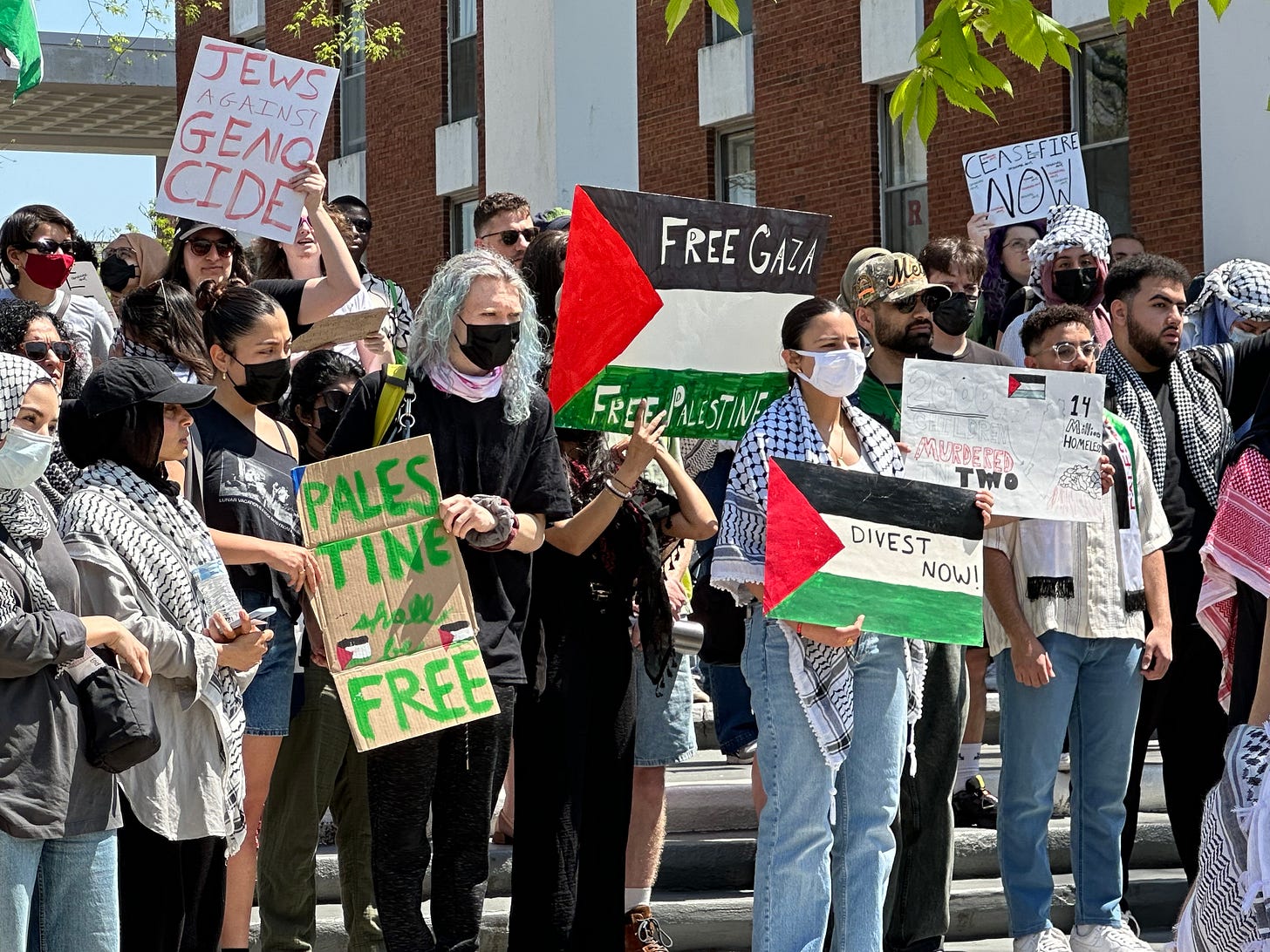
Supporters of the order argue that these protests were antisemitic. They point to some uncomfortable speech — the equation of Israel with the Nazis, for instance — as proof, and then conflate sloganeering and assembly with physical harassment. Jewish students and faculty, the argument goes, were made uncomfortable by the protests and encampments and felt unsafe. That sense of fear, they say, proves that the protests were designed to harass, even if there was no direct harassment. It is a circular argument, but one endorsed by much of the American political establishment and leading Jewish organizations

Marc H. Ellis addresses the underlying issues with these arguments in his 2009 book Judaism Does Not Equal Israel.1 He describes what I’ll call a “triumphalist Judaism” that mixes Holocaust victimhood with Exodus (the novel) power, constructed in “the aftermath of the great Israeli triumph in the 1967 Arab-Israeli war” (6). That narrative posits several myths: that Palestine was empty and underutilized and had to be redeemed, that the “Arabs” were hostile to Jews as Jews, and that the state that was founded and that still exists remains a democratic outpost in a hostile world. This triumphalism, however, was also tied to our very real history as a persecuted minority. “Jews had once been weak and helpless,” he writes, but that was no longer the case. Yet, “our theology was telling us we were still. The fact was just the opposite. We had become empowered” and were acting as a regional power (59).

The current power dynamics in Israel/Palestine and the actual history — the forced removal of Palestinians from what is now the state and the continued usurpation of land — are treated as though they are benign acts. Israel — Jews — has become the victimizer in the region, acting as a colonial power, an occupying force.

What was “psychological,” he writes, has become “strategic.”

“If we owned up to our newfound power, we would have to be accountable for and to it. We would have to relinquish the Holocaust as the backdrop to everything Jewish.”

So Oct. 7 and the ensuing war play out as if they were new and shocking rather than as another battle — the deadliest and most traumatic, to be sure — in a decades-long rebellion by Palestinians against suppress and control by Israel.

The argument is based on an underlying anti-Muslim/anti-Arab bias that mirrors the hate and discrimination that Jews have faced across our history. It is evident in the language we (Americans and Jews) use consistently to refer to Arabs, Muslims, Palestine, and Israel. Arabs and Muslims continued to be seen as terrorists, even as the “not all” modifier is added.

Deena R. Hurwitz and Walther H. White Jr., in an article at the American Bar Association website, cite authors Sahar Aziz and John Esposito’s May 2024 book, Global Islamophobia and the Rise of Populism, to underscore a “disturbing rise of Islamophobia worldwide.”

Blaming Muslim minorities for economic, political, and social problems is an increasingly common rhetorical strategy for politicians in countries globally. A narrative of the “threatening Muslim invader” is prevalent, regardless of whether the targets of such rhetoric are born citizens or new arrivals.

Trump, for instance, mixes Islamophobic and xenophobic language as he calls for closing the borders. At the same time, he and his conservative allies rely on both anti- and philosemitic imagery when talking with and about Jews.

“In the United States, Europe, and India, Islamophobic rhetoric is essentially normalized,” Hurwitz and White write.

The use of this rhetoric reduces the history and diversity within the Muslim and Arab communities (and within the Jewish community) to “a set of stereotyped characteristics most often reducible to themes of violence, civilizational subversion, and fundamental otherness.”

Anti-Palestinian racism silences, excludes, erases, stereotypes, defames, and dehumanizes Palestinians. This is used to deny and justify violence against Palestinians and fails to acknowledge Palestinians as Indigenous people with a collective identity while erasing their human rights and equal dignity and worth.

Trump’s executive order builds on this structure of anti-Muslim/anti-Arab thought, while also endorsing stereotypes of Jews as a model minority in need of special protection — even as he dismantles what he calls the “DEI regime.” Pitting Jewish and Muslim communities against each other creates hierarchies among aggrieved groups, which the right can then use to abrogate our rights of speech, assembly, and petition. It’s also a solution that is out of proportion to the problem.

It creates a threat to international students (mostly Muslim) based purely on their protected speech and assembly, while doing nothing to improve the actual safety of Jewish students. Remember, we already have strong protections in most jurisdictions; prohibiting speech does nothing to address this.

Alex Morey of the Foundation for Individual Rights and Expression, a group that defends speech and academic freedom on campus and that has usually been allied with more conservative groups, describes what I’ll call an existential threat. She told the Forward that the order’s language might push universities to crack down on protest, because it functions as an implied threat — to funding and to visas.

Morey said that her organization was already fielding frantic queries from international students at American universities who are worried about being caught in a legal dragnet.

“These are not students that got arrested at a protest or vandalized a building, these are students who just went out and protested,” she said. “What we don’t want to see is schools saying, ‘Hey, Students for Justice in Palestine, I’m going to need a list of everyone in that club and we’re going to comb it for foreign students.’”

What we are talking about is the loss of immigration status and potential deportation as retribution for protest. It is a direct attack on the 14th Amendment’s equal rights clause, which provides “any person within (the United States) the equal protection of the laws,” including the First Amendment’s five basic freedoms.

The order brings together several of Trump’s favorite targets — higher education, Muslims, immigrants and protesters — and is part of a broader effort to undermine the academic freedom and speech rights of faculty and students in higher education. Trump is a wannabe autocrat. He sees these groups as a threat to his control. While fighting antisemitism is the ostensible reason for the order, the larger targets are our democratic institutions.

Channel Surfing is a reader-supported publication. To receive new posts and support my work, consider becoming a free or paid subscriber.

Saturday, February 1, 2025

Higher Education Inquirer: Increasingly Relevant

The Higher Education Inquirer continues to grow.  Last month the number of views rose to more than 45,000.  And our total number of views has increased to more than 440,000. While we had added advertisements, we have not received any SEO help, and we do not pay Google for ads. 

We believe our growth stems largely from our increasing relevance and in our truth telling, which other higher education news outlets are unwilling to do in these times.

Our devotion to transparency, accountability, and value for our readers guides us. 

We invite a diverse group of guest authors who are willing to share their truths. The list includes academics from various disciplines, advocates, activists, journalists, consultants, and whistleblowers. We back up all of this work with data and critical analysis, irrespective of politics and social conventions. We are willing to challenge the higher education establishment, including trustees, donors, and university presidents.

Our articles covering student loan debt, academic labor, nonviolent methods of protest, and freedom of speech are unparalleled. And we are unafraid about including other issues that matter to our readers, including stories and videos about mental health, student safety, technology (such as artificial intelligence), academic cheating, and the nature of work.  And matters of war, peace, democracy, and climate change

Our focus, though mainly on US higher education, also has an international appeal

Some of our work takes years to produce, through careful documentation of primary and secondary sources, database analysis, and Freedom of Information Act (FOIA) requests. We share all of this information for everyone to see at no cost.  

Of course, we could not operate without all your voices. We welcome all your voices. Something few other sources are willing to do.    


Wednesday, July 9, 2025

Los Angeles Community College District Claims to Be Facing State Takeover Amid Allegations of Fraud and Censorship in LAVC Media Arts Department (LACCD Whistleblower)

The Los Angeles Community College District (LACCD) may be facing state takeover within two years due to overextended hiring and budget mismanagement, as discussed during a May 2025 meeting of the Los Angeles Valley College (LAVC) Academic Senate. Faculty warned that the looming financial crisis could result in mass layoffs—including tenured staff—and sweeping program cuts.

Start Minutes LAVC Academic Senate

“R. Christian-Brougham: other campuses have brand new presidents doing strange things. If we don’t do things differently as a district, from the mouth of the president in two years we’ll be bankrupt and go into negative.
 Chancellor has responsibility
C. Sustin  asks for confirmation that it is the Chancellor that can and should step in to curb campus budgets and hirings.
R. Christian-Brougham: the Chancellor bears responsibility, but in the takeover scenario, the Board of Trustees – all of them – would get fired
E. Perez: which happened in San Francisco
C. Sustin: hiring is in the purview of campuses, so they can’t directly determine job positions that move forward?
R. Christian-Brougham: Chancellor and BoT could step in and fire the Campus Presidents, though.
E. Perez: in next consultation with Chancellor, bringing this up.
C. Maddren: Gribbons is not sitting back; he’s acting laterally and going upward
E. Thornton: looping back to the example of City College of San Francisco: when the takeover happened there the reductions in force extended to multiple long-since-tenured members of a number of disciplines, including English. For this and so many other reasons, it was a reign of terror sort of situation. So we really need to push the Chancellor.”

End Minutes Academic Senate

https://go.boarddocs.com/ca/laccd/Board.nsf/vpublic?open#

The dire financial outlook comes as new scrutiny falls on LAVC’s Media Arts Department, already under fire for years of alleged fraud, resume fabrication, and manipulation of public perception. Central to these concerns is the department’s chair, Eric Swelstad, who also oversees a $40,000 Hollywood Foreign Press Association (Golden Globe) grant for LAVC students—a role now drawing sharp criticism in light of mounting questions about his credentials and conduct.

Over the past two months, a troubling wave of digital censorship has quietly erased years of documented allegations. In May 2025, nearly two years’ worth of investigative reporting—comprising emails, legal filings, and accreditation complaints—were scrubbed from the independent news site IndyBay. The removed content accused Swelstad of deceiving students and the public for over two decades about the quality and viability of the Media Arts program, as well as about his own professional qualifications.

In June 2025, a negative student review about Swelstad—posted by a disabled student—disappeared from Rate My Professor. These incidents form part of what appears to be a years-long campaign of online reputation management and public deception.


An AI-driven analysis of Rate My Professor entries for long-serving Media Arts faculty—including Swelstad, Arantxa Rodriguez, Chad Sustin, Dan Watanabe, and Jason Beaton—suggests that the majority of positive reviews were written by a single individual or a small group. The analysis cited "Identical Phrasing Across Profiles," "Unusually Consistent Tag Patterns," and a "Homogeneous Tone and Style" as evidence:

“It is very likely that many (possibly a majority) of the positive reviews across these faculty pages were written by one person or a small group using similar templates, tone, and strategy… The presence of clearly distinct voices, especially in the negative reviews, shows that not all content comes from the same source.”

A now-deleted IndyBay article also revealed emails dating back to 2016 between LAVC students and Los Angeles Daily News journalist Dana Bartholomew, who reportedly received detailed complaints from at least a dozen students—but failed to publish the story. Instead, Bartholomew later authored two glowing articles featuring Swelstad and celebrating the approval of LAVC’s $78.5 million Valley Academic and Cultural Center:

* *"L.A. Valley College’s new performing arts center may be put on hold as costs rise,"* Dana Bartholomew, August 28, 2017.

  [https://www.dailynews.com/2016/08/09/la-valley-colleges-new-performing-arts-center-may-be-put-on-hold-as-costs-rise/amp/](https://www.dailynews.com/2016/08/09/la-valley-colleges-new-performing-arts-center-may-be-put-on-hold-as-costs-rise/amp/)

* *"L.A. Valley College’s $78.5-million arts complex approved in dramatic downtown vote,"* Dana Bartholomew, August 11, 2016.
  [https://www.dailynews.com/2016/08/11/la-valley-colleges-785-million-arts-complex-approved-in-dramatic-downtown-vote/](https://www.dailynews.com/2016/08/11/la-valley-colleges-785-million-arts-complex-approved-in-dramatic-downtown-vote/)

Among the most explosive allegations is that Swelstad misrepresented himself as a member of the Writer’s Guild of America (WGA), a claim contradicted by official WGA-West membership records, according to another redacted IndyBay report.

This appears to be the tip of the iceberg according to other also scrubbed IndyBay articles

Other questionable appointments, payments, and student ‘success stories’ in the Los Angeles Valley College Media Arts Department include:

* **Jo Ann Rivas**, a YouTube personality and former Building Oversight Committee member, was paid as a trainer and presenter despite reportedly only working as a casting assistant on the LAVC student-produced film *Canaan Land*.

(https://transparentcalifornia.com/salaries/2018/los-angeles-district/jo-ann-rivas/)

* **Robert Reber**, a student filmmaker, was paid as a cinematography expert.

(https://transparentcalifornia.com/salaries/2017/los-angeles-district/robert-reber/)

* **Diana Deville**, a radio host and LAVC alumna with media credits, served as Unit Production Manager on *Canaan Land*, but her resume claims high-profile studio affiliations including DreamWorks, MGM, and OWN.

(https://www.tnentertainment.com/directory/view/diana-deville-13338)

The film *Canaan Land*, made by LAVC Media Arts students, has itself raised eyebrows. Filmmaker Richard Rossi claimed that both it and his earlier student film *Clemente* had received personal endorsements from the late Pope Francis. These assertions were echoed on *Canaan Land*'s GoFundMe page, prompting public denials and clarifications from the Vatican in *The Washington Post* and *New York Post*:

[https://www.washingtonpost.com/news/early-lead/wp/2017/08/17/after-july-miracle-pope-francis-reportedly-moves-roberto-clemente-closer-to-sainthood/]
* [https://nypost.com/2017/08/17/the-complicated-battle-over-roberto-clementes-sainthood/]

Censorship efforts appear to have intensified following the publication of a now-removed article advising students how to apply for student loan discharge based on misleading or fraudulent education at LAVC’s Media Arts Department. If successful, such filings could expose the department—and the district—to financial liability.

But the highest-profile financial concern is the 2020 establishment of the **Hollywood Foreign Press Association’s $40,000 grant** for LAVC Media Arts students, administered by Swelstad:

* [HFPA Endowed Scholarship Announcement (PDF)](https://www.lavc.edu/sites/lavc.edu/files/2022-08/lavc_press_release-hfpa-endowed-scholarship-for-lavc-film-tv-students.pdf)
* [LAVC Grant History Document](https://services.laccd.edu/districtsite/Accreditation/lavc/Standard%20IVA/IVA1-02_Grants_History.pdf)

As a disreputable academic administrator with a documented history of professional fraud spanning two decades and multiple student success stories that aren’t, future grant donors may reconsider supporting the Department programs – further pushing the Los Angeles Valley College and by extension the district as a whole towards financial insolvency. 

Saturday, August 19, 2023

Department of Education Fails (Again) to Modify Enrollment Projections (Dahn Shaulis and Glen McGhee)

For more than a decade, the US Department of Education (ED) has forecasted higher education enrollment numbers, projecting 10 years in advance. In 2013, the National Center for Education Statistics projected total enrollment to reach nearly 24 million students (23,834,000) a decade later.  But by 2021, the real numbers would already be five million fewer (18,659,851). 

 https://blogger.googleusercontent.com/img/b/R29vZ2xl/AVvXsEh0XDO-CWvziwZ0MOgEWNGsPk75fpqAEhcDU9fJ7AJOLSiRR5KOzmdAgL1DzwWX7LaJvOloeTgKzMrEn8oxit6d978xdU4rh-JdZMRvTyVC6jvzHl5uMWkocCHvdyd_3qBsZxbWI-nOEZWs0iSVqWsY9OaorqB-WWUlKrEWho-qgopGXdcMG_cN6z1sE8g/s895/2013%20NCES.PNG

We can only guess what happened to enrollment numbers between 2021 and today, but it's doubtful they have increased.  The National Student Clearinghouse has reported lower numbers between 2021 and 2022, but they use different methods and do not engage in forecasting. 

In 2013, few could have predicted such a significant enrollment decline. The lag in getting up-to-date numbers from ED made it even more difficult to envision. We relied on more up-to-date numbers, though less complete, from the National Student Clearinghouse to understand what was happening. 

In 2014, with limited data, futurist Bryan Alexander asked Inside Higher Education readers Has Higher Education Peaked?  In fact, undergraduate higher education had peaked and began its steady decline in 2011.  Little was said from the higher education establishment for years. The slow but consistent downward trend, though, became more obvious with each year as the numbers came in.  

By 2017, Nathan Grawe predicted a 2026 enrollment cliff, a by-product of reduced birth rates in the 2008-2009 Great Recession.  This revelation made more people conscious of already declining enrollment numbers that started falling six years earlier. But the Department of Education did little to change their predictive formula. For several years, growing enrollment in online courses and graduate degrees kept total enrollment declines from appearing more dramatic.

In January 2018 we contacted the US Department of Education about these failures. According to William Hussar, the agency had already begun work on developing an alternative methodology for producing college projections, but that this would take years to implement. In the meantime, the numbers continued to drop, and polls showed fewer people having confidence in higher education.  Student loan debt may have been of little interest to most Americans, but it did sour tens of millions of debtors and their families. We suggested that behavioral economists might be needed to provide an alternative formula.

Today, the US Department of Education, despite some revisions in their most recent modeling, continues to forecast higher education enrollment gains--up to 2031-- despite mounting evidence it will decrease significantly (i.e. the "enrollment cliff"). We cannot expect online education, grad school participation, or even a faltering economy to prop up higher ed enrollment. Faith in higher education is waning-and for good reason. Despite propaganda from the higher ed industry, it's become a riskier bet for a growing number of the working class and middle class.


Related links:

US Department of Education Fails to Recognize College Meltdown

US Department of Education Projects Increasing Higher Ed Enrollment From 2024-2030. Really? (Dahn Shaulis and Glen McGhee)

Enrollment cliff? What enrollment cliff? 

Projections of Education Statistics to 2028 (US Department of Education)

Saturday, November 15, 2025

Entangled Frontiers: Saudi Arabia, Yemen, the UAE, South Sudan, and the Israel-Palestine Arena — Implications for Higher Education, Censorship, and Global Governance

The global higher education landscape is increasingly shaped by conflicts, diplomacy, and shifting regional alliances. The relationships among Saudi Arabia, Yemen, the United Arab Emirates (UAE), South Sudan, and the Israel-Palestine conflict highlight the interconnections between geopolitics, humanitarian crises, and the responsibilities of universities as institutions of knowledge, ethics, and justice. These contexts influence not only student mobility and research collaboration but also institutional priorities, funding flows, and academic freedom. Understanding the intersection of geopolitics and higher education is essential for institutions seeking to engage globally with integrity, equity, and impact.

For scholars and administrators, these regions exemplify the challenge of balancing opportunity and risk. Research and student engagement opportunities abound in humanitarian crises, fragile states, and post-conflict zones, yet these are embedded in complex political and ethical landscapes. Additionally, the growing pressures on American universities to navigate internal censorship, legislative constraints, and donor-influenced agendas have profound implications for their global credibility and ability to engage abroad. This article explores each of these regions in depth, examines the cross-cutting implications for higher education, and discusses the domestic pressures in U.S. higher education that shape international engagement.


Saudi Arabia and Yemen

The war in Yemen has devastated the nation, creating one of the most severe humanitarian crises in recent history. Civilian infrastructure has been destroyed, millions of people have been displaced, and famine and disease threaten vast swathes of the population. Saudi Arabia, as the leading actor in the coalition intervening in Yemen, has faced both international criticism and pressure to negotiate. Recent diplomatic initiatives have suggested that Riyadh may be seeking to recalibrate its involvement, including attempts to engage Houthi representatives in peace talks. For higher education institutions, these shifts have important implications for student mobility, research opportunities, and refugee education programs. Yemen's crisis represents not only a humanitarian emergency but also a research frontier in global health, humanitarian logistics, and post-conflict educational reconstruction.

Saudi Arabia’s position on Israel adds another layer of complexity for global academic partnerships. The Kingdom continues to insist that it will not normalize relations with Israel without the establishment of a Palestinian state. This position affects regional alliances, funding priorities, and the willingness of other states to engage in collaborative academic initiatives. For universities, this reality translates into both opportunities and constraints. Scholarship programs, research funding, and institutional partnerships linked to Saudi Arabia may be influenced by the Kingdom’s foreign policy priorities. Institutions engaging with Yemen must navigate a humanitarian context that is deeply intertwined with the diplomatic posturing of a regional superpower.


The United Arab Emirates

The UAE has emerged as a significant regional actor, leveraging economic strength to expand its influence across Africa, the Red Sea corridor, and the Middle East. Its normalisation with Israel through the Abraham Accords marked a historic diplomatic shift in Arab-Israeli relations, yet the UAE has simultaneously articulated clear objections to unilateral Israeli annexation plans in the West Bank. In Africa, the UAE has deepened ties with South Sudan and other fragile states through financial agreements, including banking cooperation and long-term oil-backed loans. These interventions exemplify how foreign investment, diplomacy, and regional security concerns intersect in ways that directly affect higher education.

For universities, the UAE represents both opportunity and caution. Institutions can engage with new funding streams, branch campuses, and international partnerships facilitated by Gulf state investment. At the same time, ethical considerations are paramount. Funding sources tied to conflict zones, extractive economic deals, or contested geopolitical agendas require careful institutional scrutiny. Universities must develop frameworks that incorporate conflict sensitivity, ethical risk assessment, and transparency. The UAE’s dual role as a facilitator of academic mobility and a participant in contested geopolitical spaces underscores the complexity of engagement in regions influenced by external power.


South Sudan

South Sudan, the world’s youngest nation, has struggled to stabilize since its independence in 2011. Recurring conflict, economic dependence on oil, and weak governance structures have hindered the development of higher education infrastructure. Agreements with the UAE, including long-term oil-backed loans and financial cooperation, highlight the influence of foreign investment on the state’s trajectory and, by extension, its educational system.

For higher education, South Sudan presents both a critical research site and an urgent development need. Universities can contribute to capacity-building, curriculum development, and scholarship programs for displaced or return diaspora students. Research in post-conflict governance, peace studies, and resource management can inform broader academic understanding of fragile states. Yet these opportunities come with ethical and practical complexities. Partnerships with South Sudanese institutions must navigate the implications of resource-linked foreign investment, the risk of perpetuating inequality, and the fragility of governance structures. Universities engaging in South Sudan must balance their commitment to education with a nuanced understanding of political and economic realities.


Israel and Palestine

The Israel-Palestine conflict continues to shape the global higher education discourse, affecting student mobility, refugee education, research collaborations, and institutional partnerships. Saudi Arabia’s insistence that normalization with Israel is contingent upon Palestinian statehood and East Jerusalem as its capital remains a critical point of leverage in regional diplomacy. The UAE, despite having normalized with Israel, continues to assert that Israeli annexation of the West Bank represents a “red line” that could destabilize the region.

For universities, this context presents both opportunities and ethical challenges. Engaging with Palestinian students, hosting refugee scholars, and conducting research on human rights and humanitarian crises are vital areas of academic intervention. At the same time, institutions must navigate funding sources, regional political sensitivities, and reputational risks. Academic freedom in research on Israel and Palestine is often contested, both abroad and domestically in the United States, where political and donor pressures shape what research is feasible, safe, or fundable.


Censorship and Academic Freedom in U.S. Higher Education

Recent developments in American higher education highlight the fragility of academic freedom, which directly affects international engagement. Surveys indicate that over one-third of U.S. faculty perceive a decline in academic freedom, and approximately 70% report self-censorship on topics such as the Israel-Palestine conflict. Legislation in several states, framed under terms like “viewpoint diversity” or “campus neutrality,” imposes constraints on curriculum, speech, faculty tenure, and university governance. These pressures are compounded by donor influence, administrative oversight, and the politicization of higher education.

Censorship and self-censorship are not abstract concerns; they have tangible impacts on research agendas, global partnerships, and the capacity of universities to host refugee or international scholars. Institutions with programs in global health, humanitarian response, Middle East studies, or post-conflict development must contend with domestic pressures that may limit the scope of inquiry or public engagement. The erosion of academic freedom in the United States thus has a direct effect on the credibility and effectiveness of universities abroad, as it mirrors, in some respects, the constraints faced by institutions in fragile or authoritarian states.


Cross-Cutting Themes

Several themes cut across these regional and domestic contexts. First, conflict and displacement in Yemen, South Sudan, and Palestine create urgent educational needs for refugees and internally displaced scholars. Universities must develop programs that provide access, mentorship, and flexible pathways to education. Second, foreign investment and resource-linked funding—from the UAE in South Sudan to Saudi-backed initiatives in Yemen—underscore the ethical complexities of international partnerships. Transparency, due diligence, and conflict-sensitive frameworks are essential. Third, diplomatic realignments, including the Abraham Accords and evolving Saudi-Israel relations, create new corridors for collaboration but also introduce geopolitical risk. Fourth, domestic censorship and political pressures in the U.S. affect research capacity, ethical engagement, and the freedom to examine contentious topics, directly influencing global credibility.

Finally, structural inequality and systemic injustice are central concerns. Funding flows, research agendas, and student access are all mediated by power structures that can perpetuate inequities. Universities must be conscious of whose voices are amplified, whose perspectives are sidelined, and how partnerships with conflict-affected states influence the production of knowledge. Ethical global engagement requires institutions to address these imbalances proactively.


References & Sources

  1. PEN America, “New Report Unveils Alarming Tactics in Censorship of Higher Education,” pen.org

  2. Times of India, “Is Academic Freedom on the Decline? 35% of US College Professors Say Yes,” timesofindia.indiatimes.com

  3. Times of Israel, “Faculty Survey Reveals Fear, Self-Censorship at US Universities,” timesofisrael.com

  4. Associated Press, “Under Threat from Trump, Columbia University Agrees to Policy Changes,” apnews.com

  5. The Guardian, “US Universities’ Faculty Unite to Defend Academic Freedom After Trump’s Attacks,” theguardian.com

  6. Le Monde, “UC Berkeley, the US Capital of Free Speech, Stands Firm Against Trump,” lemonde.fr