Search This Blog

Showing posts sorted by relevance for query porn. Sort by date Show all posts

Monday, July 21, 2025

Digital Dope: How Internet Addiction Mirrors the Great Crises of Gin, Opium, Meth, and Fentanyl

In the 18th century, gin swept through the working-class neighborhoods of London, offering brief euphoria and long-term devastation. In the 19th century, opium dulled the pain of colonialism and industrial collapse. The 20th century brought methamphetamine and its promise of energy and escape, followed by fentanyl—cheap, potent, and deadly.

Now, in the 21st century, we face a new form of mass addiction: not chemical but digital. The most addictive substances of our time are not smoked, snorted, or injected—they are streamed, swiped, and scrolled.

The internet, once hailed as a revolution in knowledge and communication, has been weaponized into an empire of distraction and dependency. Social media, pornography, and online gambling—backed by surveillance capitalism and unchecked corporate power—are engineered for compulsive use. And like the addictive epidemics of the past, they are eroding individual agency, family life, and the very foundations of civic society.

The Gin Craze and the Algorithmic Binge

In 18th-century Britain, the Gin Craze turned city streets into open-air taverns. Cheap, potent alcohol flooded the market, leading to widespread addiction, crime, and social decay. The state profited from taxes while the poor drowned in despair.

Today’s equivalent is the infinite scroll. Social media platforms like TikTok, Instagram, and Facebook—like gin—are engineered to be consumed endlessly. The user is reduced to a set of engagement metrics. Like the gin drinker numbing pain, the social media user seeks validation, escape, or identity in a flood of curated images and outrage. Depression, anxiety, and loneliness have exploded, especially among teens and young adults. Suicides, particularly among girls, have surged in tandem with social media usage.

Opium Dens and the Porn Empire

The opium den offered oblivion. It soothed pain but eroded will. Victorian elites warned of its moral decay while quietly indulging themselves.

Today, online pornography is the new opium—widely available, hyper-stimulating, and often degrading. Once confined to private spaces, it is now accessible to children, monetized by multi-billion-dollar platforms, and normalized by mainstream culture. The effects—especially on young people—include desensitization, unrealistic expectations, isolation, and difficulty forming real-life relationships.

Research has shown that excessive porn consumption alters brain chemistry similarly to addictive drugs. It hijacks the reward system, rewires sexual expectations, and in many cases, contributes to erectile dysfunction, compulsive behavior, and emotional detachment.

Meth, Fentanyl, and the Speed of the Feed

Meth promised productivity; fentanyl promises relief. Both deliver destruction.

Digital addiction today mimics the frenetic highs of meth and the numbing power of fentanyl. The constant rush of notifications, likes, and headlines overstimulates the brain and crushes attention spans. Apps and games are engineered like slot machines, delivering intermittent reinforcement that keeps users hooked. The average smartphone user touches their phone over 2,500 times a day.

University students struggle to read long texts or concentrate for extended periods. Professors battle declining classroom attention and rising rates of anxiety and burnout. Like meth, the digital feed gives the illusion of efficiency while grinding the mind into dust.

Online Gambling: Casino in Your Pocket

The rise of online sports betting and casino apps has brought Vegas to every dorm room and bedroom. Targeted ads on Instagram and YouTube lure young people into betting with "free" money. Many students—especially young men—develop compulsive behaviors, losing thousands before they graduate. Some turn to credit cards, payday loans, or family bailouts.

States, like governments in the gin and opium eras, have embraced online gambling for its tax revenues. Universities, meanwhile, remain largely silent—even as students destroy their finances and futures through legalized digital addiction.

Higher Education: From Ivory Tower to Digital Trap

Colleges were once sanctuaries of thought and reflection. Today, they are nodes in the digital economy—where learning management systems monitor clicks, and students are nudged toward screens at every turn. Social interaction is filtered through group chats and Reddit threads. Pornography, gambling, and endless scrolling are a click away on the same device used to write term papers and attend virtual lectures.

Even counseling services are digitized. The solution to tech addiction, students are told, is often more tech—apps that monitor screen time, AI chatbots for mental health, or video therapy that feels detached and impersonal.

The Profiteers and the Pushers

In every addiction crisis, there are profiteers: distillers, opium traders, pharmaceutical companies, and cartels. Today, Big Tech plays the same role. Meta, TikTok, YouTube, Pornhub, DraftKings, FanDuel, and hundreds of smaller apps compete for attention with algorithms that exploit human weakness.

Their business model depends on addiction. They study neuroscience, behavioral psychology, and micro-targeted advertising with military-grade precision. Like the drug lords of the past, they deny responsibility while reaping billions.

And just as the poor suffered most in the gin and opioid crises, it is the working class, the unemployed, the chronically ill, and the disconnected who fall hardest into the digital pit.

The Need for Radical Intervention

Digital addiction is not a moral failing—it’s a public health emergency. Like past addiction epidemics, the solution requires:

  • Public awareness campaigns

  • Stricter age and content regulation

  • Taxation on digital vice industries

  • Digital literacy education at all levels

  • Offline spaces and activities that foster real connection and attention

Higher education must lead. Not by digitizing every service, but by teaching students to reclaim their minds, their time, and their agency. Faculty must model mindful engagement and challenge the corporatization of the university by tech companies. Administrators must reconsider their reliance on LMS systems, data harvesting, and digital surveillance.

Will We Wake Up in Time?

In the past, addiction crises forced society to reflect on what was lost: family cohesion, civic virtue, mental clarity, and freedom itself. We stand again at such a crossroads. The digital drug is in every hand, and the overdose is slow—but devastating.

Like gin, opium, meth, and fentanyl, the internet addiction crisis is about more than chemicals—it’s about despair, disconnection, and exploitation. And like those earlier epidemics, it is not an individual failing, but a systemic one. The good news? As with past crises, awareness is the first step toward recovery. The question is: Will we act before another generation is lost?


The Higher Education Inquirer continues to investigate the intersection of capitalism, addiction, and the commodification of human attention. Reach out if you have a story to share.

Tuesday, December 16, 2025

The Decline of “Happily Ever After”: Teen Girls, Marriage, and Social Inequality

A profound shift is taking place in the aspirations of American teenagers. In a Pew Research analysis of 2023 University of Michigan survey data, only 61 percent of 12th-grade girls expected to marry someday, down sharply from 83 percent in 1993. Boys, in contrast, reported a stable 74 percent, surpassing girls for the first time. Alongside this, fewer teens anticipated having children or staying married for life. Only 48 percent of 12th-graders said they were “very likely” to want children, and belief in lifelong marriage dropped from 59 percent to 51 percent over three decades.

These figures are more than statistical curiosities; they reflect structural changes in the lives of young women and reveal how cultural, economic, and social inequality shape personal expectations. Access to education and professional opportunity has expanded dramatically for women, allowing them to envision futures independent of traditional marriage and family structures. Yet these gains exist alongside persistent barriers: economic instability, student debt, and unequal labor markets make long-term commitments like marriage and homeownership fraught and uncertain. For many girls, the choice to delay or reject marriage is not merely personal—it is pragmatic.

Cultural shifts amplify this trend. For decades, mainstream media promoted the narrative of “happily ever after,” equating personal fulfillment with marriage and motherhood. Today, stories about self-discovery, financial independence, and flexibility dominate the imagination of young women. In this context, marriage is no longer the default marker of adulthood or success; it is one of many possible pathways, often weighed against educational ambitions, career goals, and economic realities.

This evolution of expectations is deeply intertwined with inequality. Historically, marriage has often reinforced gendered hierarchies, particularly among working-class and minority women, for whom early marriage frequently constrained educational and career opportunities. Delaying marriage, or choosing to forgo it altogether, can represent a form of empowerment—but it also exposes young women to the structural vulnerabilities of a society where social support and economic stability are unevenly distributed. For those without family wealth or safety nets, the decision to prioritize education or autonomy over marriage is often a negotiation with risk rather than pure choice.

The broader social implications are significant. Declining enthusiasm for marriage may influence fertility patterns, reshape household structures, and challenge institutions built around traditional family models. For policymakers, educators, and social institutions, the question becomes whether systems will adapt to support diverse life paths or continue to privilege outdated models that assume early marriage and childbearing. For young women navigating these choices, the cultural shift represents both liberation and uncertainty, an opportunity to define adulthood on their own terms amid economic and social pressures.

As these teenagers mature, their choices may redefine what adulthood looks like in the United States. The decline in the “happily ever after” fantasy signals not a rejection of commitment, but a recalibration of priorities under the weight of opportunity, constraint, and inequality. It is a moment that reveals how deeply personal aspirations—love, marriage, family—are shaped by the structures, inequities, and possibilities of the world they inherit.


Sources:
Ms. Magazine. “Actually It’s Good That Fewer High Schoolers Want to Get Married.” 2025. https://msmagazine.com/2025/11/20/high-school-girls-marriage

New York Post. “High school girls are shifting away from marriage and 'happily ever after,' expert says.” 2025. https://nypost.com/2025/11/25/media/high-school-girls-are-shifting-away-from-marriage-and-happily-ever-after-expert-says

The Times. “Jobs, porn and manfluencers: the real reasons girls don't want to get married.” 2025. https://www.thetimes.com/us/news-today/article/why-dont-girls-plan-to-get-married-f7hr8jgp0

Wednesday, October 2, 2024

What would a second Trump administration mean for higher education? Summing up Project 2025 (Bryan Alexander)

[Editor's Note: This article first appeared at BryanAlexander.org.]

What happens to higher education if Trump wins November’s election?

We’ve been exploring this question over the past year, including months of reading, analysis, reflection, and conversation about Project 2025 might mean for higher education. Today I’d like to sum up what we found.

The book, Mandate for Leadership, addresses academia directly on multiple levels. I’ll break them down here. The implications for the broader society within which colleges and universities exist – that’s a subject for another post.

I’ve organized the various ideas and threads into several headers: the Department of Education, higher education economics, international education and research, research supported and opposed, military connections, sex education, and anti-intellectualism.

Higher education and the Department of Education Many accounts of Project 2025’s educational impact draw attention to its attack on the Department of Education, which makes sense, since this is where the document focuses its academic attention. to begin with, Mandate for Leadership wants to break up the DoE and distribute its functions to other federal units. For example, the work the Office for Postsecondary Education (OPE) does would move to the Department of Labor, while “programs deemed important to our national security interests [shift] to the Department of State.” (327).

It would revise the student loan system to a degree. “Federal loans would be assigned directly to the Treasury Department, which would manage collections and defaults.” (327-330) Income-based repayment schemes would continue, but with restrictions. (337-8) Project 2025 would end the Biden team’s Public Service Loan Forgiveness program, along with “time-based and occupation-based student loan forgiveness” plans. (361) More ambitiously, the new government could just privatize loans. (353)

The chapter’s author also calls for “rejecting gender ideology and critical race theory” in the department or through its successor units. (322) This might also proceed via changes to one law, as a new secretary would “[w]ork with Congress to amend Title IX to include due process requirements; define “sex” under Title IX to mean only biological sex recognized at birth; and strengthen protections for faith-based educational institutions, programs, and activities.” (333) This culture war move could have another legal feature, given the call to amend FERPA in order to make it easier for college students to sue the government for privacy violations, in response to school support of transgender and nonbinary students. (344-346)

The obverse of these moves is having the new DoE or its replacements “promulgat[ing] a new regulation to require the Secretary of Education to allocate at least 40 percent of funding to international business programs that teach about free markets and economics.” Additionally, the government would “require institutions, faculty, and fellowship recipients to certify that they intend to further the stated statutory goals of serving American interests,” although it’s unclear what that would mean in practice. (356)

This section’s author, Lindsay Burke, also wants the next administration to change its relationship with post-secondary accreditors. She supports Florida’s new policy of requiring public universities to cycle through accrediting agencies. (332) Burke also wants to encourage new accreditors to start up. (355) Her chapter further calls for a new administration to prevent accreditation agencies from advocating for diversity, equity, and inclusion (DEI) work on campuses. (352)

The economics of higher education The Department of Education chapter would see a revamped Department of Education or its successors “[r]equir[ing]… ‘skin in the game’ from colleges to help hold them accountable for loan repayment.” (341) I can’t see how this would work in detail. Her new federal administration would also reduce funding to academic research by cutting reimbursement for indirect costs. (355)

That section also wants to reduce the labor market’s demand for post-secondary degrees. Under the header “Minimize bachelor’s degree requirements” we find: “The President should issue an executive order stating that a college degree shall not be required for any federal job unless the requirements of the job specifically demand it.” (357). Later on in the book, the Department of Labor section section also calls on Congress to end college degree requirements for federal positions. (597) That chapter wants to boost apprenticeships, mostly likely in competition with college and university study. (594-5)

International research and education. Cutting down immigration is a major Project 2025 theme, and the book does connect this to academia. It calls out international students like so:
ICE should end its current cozy deference to educational institutions and remove security risks from the program. This requires working with the Department of State to eliminate or significantly reduce the number of visas issued to foreign students from enemy nations. (141)

First, this would impact many would-be students’ careers. Second, implementing such a policy would likely depress international student interest.

Project 2025 consistently focuses on China as America’s enemy, and this means it wants United States higher education to decouple from that adversary or else face consequences. For example, the introduction warns that “[u]niversities taking money from the CCP should lose their accreditation, charters, and eligibility for federal funds.” Later in the text is some language about the government and universities supporting American but not Chinese research and development. (100) Another section sees “research institutions and academia” playing a role in Cold War 2.0:
Corporate America, technology companies, research institutions, and academia must be willing, educated partners in this generational fight to protect our national security interests, economic interests, national sovereignty, and intellectual property as well as the broader rules-based order—all while avoiding the tendency to cave to the left-wing activists and investors who ignore the China threat and increasingly dominate the corporate world. (emphases added; 218)

Later on, the Department of Justice discussion offers this recommendation:

key goals for the China Initiative that included development of an enforcement strategy concerning researchers in labs and universities who were being coopted into stealing critical U.S. technologies, identification of opportunities to address supply-chain threats more effectively, and education of colleges and universities about potential threats from Chinese influence efforts on campus. (556)

This seems to describe increased DoJ scrutiny over colleges and universities. I’m not sure what “education… about potential threats” means, although I suspect it might include pressure on academics.

The Department of Commerce section wants to “[t]ighten… the definition of ‘fundamental research’ to address exploitation of the open U.S. university system by authoritarian governments through funding, students and researchers, and recruitment” (673) More succinctly, that chapter calls for strategic decoupling from China (670, 674). We can imagine a new federal administration – along with, perhaps, state governments, businesses, nonprofits, and foundations – asking academia to play its role in that great separation. One of the trade policy chapters broods about how “more than 300,000 Communist Chinese nationals attend U.S. universities” and it’s hard not to see this as a call for reducing that number. (785)

That chapter’s author, Peter Navarro, condemns one leading American university for allegedly enabling Chinese power:

Huawei, well-known within the American intelligence community as an instrument of Chinese military espionage, has partnered with the University of California–Berkeley on research that focuses on artificial intelligence and related areas such as deep learning, reinforcement learning, machine learning, natural language processing, and computer vision, all of which have important future military applications.28 In this way, UC–Berkeley, whether unwittingly or wittingly, helps to boost Communist China’s capabilities and quest for military dominance. (785-6)

I can’t help but read this as a call for federal scrutiny of academic international partnerships, with sanctions in the wings.

Project 2025 looks at other regions of the globe and wants higher education to help. For example, the State Department chapter calls on American campuses to assist its African policy: “The U.S. should support capable African military and security operations through the State Department and other federal agencies responsible for granting foreign military education, training, and security assistance.” (187)

Other federal units come in for transformation which impacts colleges and universities. One chapter calls for “reinstituti[ng] the National Security Higher Education Advisory Board.” (Wikipedia; 218) The USAID chapter would cut some post-secondary support, based on the argument that “[w]e must admit that USAID’s investments in the education sector, for example, serve no other purpose than to subsidize corrupt, incompetent, and hostile regimes.” (275)

Support for and opposition to research Project 2025 consistently calls for research and development, at least in certain fields. The Department of Energy chapter enthusiastically promotes science. That chapter also tends to pair research with security, so we might infer increased security requirements for academic energy work. Alternative energy and decarbonization research would likely not receive federal support from McNamee’s departments, as he might see them as a “threat to the grid.” (373)

The document also calls for transparency many times, which might benefit academics as it could (should it occur) give greater access to more documentation. One passage actually uses the language of open source code: “True transparency will be a defining characteristic of a conservative EPA. This will be reflected in all agency work, including the establishment of opensource [sic] science, to build not only transparency and awareness among the public, but also trust.” (417)

On the flip side, Project 2025 opposes climate research throughout. For a sample of the intensity of this belief,

Mischaracterizing the state of our environment generally and the actual harms reasonably attributable to climate change specifically is a favored tool that the Left uses to scare the American public into accepting their ineffective, liberty-crushing regulations, diminished private property rights, and exorbitant costs. (419)

That passage exists in the Environmental Protection Agency chapter, and fits into its author’s desire to cut back the EPA in general, but particularly to end its support for academic research. There are specific examples, such as “[r]epeal[ing] Inflation Reduction Act programs providing grants for environmental science activities” (440). This is also where we see a sign of Project 2025’s desire to get more political appointees into federal positions. There would be “a Science Adviser reporting directly to the Administrator in addition to a substantial investment (no fewer than six senior political appointees) charged with overseeing and reforming EPA research and science activities.” (436) That would have further negative effects on academic work.

Later on, the Department of Transportation chapter calls for shutting down the National Oceanographic and Atmospheric Administration (NOAA). Why? NOAA is “one of the main drivers of the climate change alarm industry and, as such, is harmful to future U.S. prosperity.” (675) Faculty, staff, and students who rely on NOAA would lose out.

Military and civilian higher education There are many connections here, reflecting a view that all of academia can contribute in an instrumental way to American military and foreign policy goals, while also being reformed by a new administration. For example, the text calls for reforming post-secondary military education, asking a new government to “[a]udit the course offerings at military academies to remove Marxist indoctrination, eliminate tenure for academic professionals, and apply the same rules to instructors that are applied to other DOD contracting personnel.” (104)

There’s also an idea for creating a new military academy, a Space Force Academy:
to attract top aero–astro students, engineers, and scientists and develop astronauts. The academy could be attached initially to a large existing research university like the California Institute of Technology or MIT, share faculty and funding, and eventually be built separately to be on par with the other service academies. (119)

Related to this, a later discussion calls for the creation of a new academic institution dedicated to financial warfare:

Treasury should examine creating a school of financial warfare jointly with DOD. If the U.S. is to rely on financial weapons, tools, and strategies to prosecute international defensive and offensive objectives, it must create a specially trained group of experts dedicated to the study, training, testing, and preparedness of these deterrents. (704)

Earlier in the book there’s some discussion of reforming the Pentagon’s purchasing systems calls for spreading some Defense Acquisition University (DAU) functions to “include accreditation of non-DOD institutions” – i.e., potentially some civilian institutions. (98)

Project 2025 would reverse certain Biden- and Obama-era human rights provisions for military academies’ faculty, staff, and students. It calls for “individuals… with gender dysphoria [to] be expelled from military service…” (103)

Sex education, research, support for student life All of this appears under threat. Here’s the relevant passage from the introduction, a shocking response to pornography: “Educators and public librarians who purvey [pornography] should be classed as registered sex offenders. And telecommunications and technology firms that facilitate its spread should be shuttered.” (5) This seems aimed at K-12 schools, where so much culture war battling has occurred, but we shouldn’t assume higher education would escape. Remember that it’s a common strategy for critics to label sex education and research materials as porn.

Anti-intellectualism Project 2025 respects knowledge and skills insofar as they assist with making a new administration succeed, but is at the same time very skeptical of their role in broader society, when formally recognized. It wants universities to develop new technologies, but not to advance DEI. For a clear sense of what I’m talking about, here’s the introduction’s take on credentials:

Intellectual sophistication, advanced degrees, financial success, and all other markers of elite status have no bearing on a person’s knowledge of the one thing most necessary for governance: what it means to live well. That knowledge is available to each of us, no matter how humble our backgrounds or how unpretentious our attainments. It is open to us to read in the book of human nature, to which we are all offered the key just by merit of our shared humanity. (10)

One could respond that most of the book’s authors possess intellectual sophistication and/or advanced degrees and/or financial success, but that’s part of the conservative populist paradigm.

Summing up, Project 2025 presents multiple challenges, threats, and dangers to American higher education. Proposed policies strike at academic teaching, research, finances, autonomy, and some of the most vulnerable in our community. It outlines routes for expanded governmental surveillance of and action upon colleges and universities, not to mention other parts of the academic ecosystem, such as accreditors and public research entities.

Keep in mind that Project 2025 isn’t necessarily a total guide to a potential Trump administration. The candidate has denounced it and led the publication of another platform. I’d like to explore that document next. We should also track Trump’s various pronouncements, such as his consistent desire to deport millions of people. For that alone we should expect a major impact on higher education.

Yet Project 2025 draws deeply on Republican politicians and office holders, not to mention conservative thinking. It seems fair to expect a new administration to try realizing at least a chunk of it, if not more.

What do you think of this sketch of a potential Trump administration?

Tuesday, January 6, 2026

End of an Era

For now, we have suspended our three decade long run of citizen journalism and will let you know where we go from here.  Two of our other publications, American Injustice and street sociologist are also closed, but remain online for now on Blogger. 


Our Anti-SLAPP lawsuit (Chip Paucek and Pro Athlete Community v Dahn Shaulis) is pending. While the legal bill is enormous, we expect to win. In the meantime, please support independent voices like Richard Wolff, Robert A. PapeJulie K. BrownRoger Sollenberger, and Troy Barile
**********************************************
Use the search tools and click on these hashtags for more information from our archives.  
#1stAmendment #2U #accountability #addiction #adjunct #AI #AImeltdown #alcoholism #algo #algorithm #alienation #Ambow #anomie #anti-intellectual #anxiety #Apollo #austerity #BariWeiss 
#NCAA #NDA #neoliberal #nihilism #nokings #nonviolence #Palantir #Palestine #porn #Princeton #Pritzger #protest #PSLF #PXED #QOL #rehumanization #resistance #robocollege #robostudent #roboworker #Russia #solidarity #strikedebt #surveillance #tech #temperance #tiktok #TPUSA #transparency #Trump #UATX #umich #underemployment #USC #VA #value #veritas #virtue #Vistria #wikipedia #WWIII #Yale

*****************************************************

   Higher Education and Class Sorting. Image by Glen McGhee

On our last full day of operation, we extend our deepest gratitude to the many courageous voices who have contributed to the Higher Education Inquirer over the years. Through research, reporting, whistleblowing, analysis, and public service, you have exposed inequities, challenged powerful interests, and helped the public understand the realities of higher education. Together, you form a resilient network of knowledge, courage, and public service, showing that collective insight can illuminate even the most entrenched systems. Your dedication has been, and continues to be, invaluable.

Special thanks to:
Bryan Alexander (Future Trends Forum), J. J. Anselmi (author), Devarian Baldwin (Trinity College),  Lisa Bannon (Wall Street Journal), Joe Berry (Higher Education Labor United), Kate Bronfenbrenner (Cornell)Stephen Burd (New America), Ann Bowers (Debt Collective), James Michael Brodie (Black and Gold Project Foundation), Patrick Campbell (Vets Ed Brief), Richard Cannon (activist), Kirk Carapezza (WGBH), Kevin L. Clay (Rutgers)Randall Collins (UPenn), Marianne Dissard (activist), Cory Doctorow, William Domhoff (UC Santa Cruz), Ruxandra Dumitriu, Keil Dumsch, Garrett Fitzgerald (College Recon), Glen Ford (with the ancestors), Richard Fossey (Condemned to Debt), Erica Gallagher (2U Whistleblower), Cliff Gibson III (Gibson & Keith), Henry Giroux (McMaster University), Terri Givens (University of British Columbia), Aaron Glantz, Luke Goldstein (The Lever),  Nathan Grawe (Carleton College), Michael Green (UNLV), Michael Hainline (Restore the GI Bill for Veterans), Debra Hale Shelton (Arkansas Times), Stephanie M. Hall (Protect Borrowers),  David Halperin (Republic Report), Bill Harrington (Croatan Institute), Phil Hill (On EdTech), Investor X (business insider), Robert Jensen (UT Austin), Seth Kahn (WCUP), Hank Kalet (Rutgers), Ben Kaufman (Protect Borrowers), Robert Kelchen (University of Tennessee), Karen Kelsky (The Professor Is In)Neil Kraus (UWRF), LACCD Whistleblower, Michelle Lee (whistleblower), Wendy Lynne Lee (Bloomsburg University of PA), Emmanuel Legeard (whistleblower), Adam Looney (University of Utah), Alec MacGillis (ProPublica), Jon Marcus (Hechinger Report), Steven Mintz (University of Texas), John D. Murphy (Mission Forsaken)Annelise Orleck (Dartmouth)Margaret Kimberly (Black Agenda Report), Austin Longhorn (UT student loan debt whistleblower), Richard Pollock (journalist), Debbi Potts (whistleblower), Jack Metzger (Roosevelt University), Derek Newton (The Cheat Sheet), Jeff Pooley (Annenberg Center), Fahmi Quadir (Safkhet Capital)Chris Quintana (USA Today)Jennifer Reed (University of Akron), Kevin Richert (Idaho Education News), Gary Roth (Rutgers-Newark), Mark Salisbury (TuitionFit), Stephanie Saul (NY Times), Christopher Serbagi (Serbagi Law), Alex Shebanow  (Fail State), Bob Shireman (TCF)Bill Skimmyhorn (William & Mary), Peter Simi (Chapman University), Jeffrey Sonnenfeld (Yale)Gary Stocker (College Viability), Strelnikov (Wikipedia Sucks), Taylor Swaak (Chronicle of Higher Education)Theresa Sweet (Sweet v Cardona), Harry Targ (Purdue University), Moe Tkacik (American Prospect),  Kim Tran (activist), Mark Twain Jr. (business insider), Michael Vasquez (The Tributary), Marina Vujnovic (Monmouth)Richard Wolff (Economic Update), David WhitmanTodd Wolfson (Rutgers, AFT)Helena Worthen (Higher Ed Labor United), DW (South American Correspondent), Heidi Weber (Whistleblower Revolution), Michael Yates (Monthly Review), government officials who have supported transparency and accountability, and the countless other educators, researchers, whistleblowers, advocates, and public servants whose work strengthens our understanding of higher education.

Dahn Shaulis and Glen McGhee


Wednesday, July 23, 2025

Why are men so obsessed with pornography? (Robert Jensen)

[Editor's note: This article previously appeared at Julie Bindel's writing and podcasts.]


A young Andrea Dworkin, 1965

With a sense of both joy and grief, I offer as my text for today Andrea Dworkin’s “I Want a Twenty-Four-Hour Truce During Which There Is No Rape,” a speech she gave to the National Organization for Changing Men in 1983 in St. Paul, MN. The joy comes from remembering how her words helped me understand feminism, the first step in understanding myself. The grief comes from how relevant her analysis remains in today’s broken world.

So, let’s start with a story to remind us of the state of contemporary sexual politics.

In my last five years at the University of Texas at Austin, I taught a course that I designed called “Freedom: Philosophy, History, Law.” We reviewed philosophers’ conceptions of freedom and then studied how the term has been defined and deployed politically throughout U.S. history. The course concluded with the radical feminist critique of the contemporary pornography industry, set in the context of the feminist critique of men’s violence, as a case study in the complexity of conflicting claims about freedom.

In the fall of 2016, I delivered that lecture on men’s violence right after the election of Donald Trump. Despite the tense political environment, I thought it would have been irresponsible to avoid the obvious. Without commentary, I summed up the uncontested facts. The president-elect had bragged about being sexually aggressive and treating women like sexual objects, and several women had testified about behavior that—depending on one’s evaluation of the evidence—could constitute sexual assault. Does it seem fair, I asked the class, to describe him as a sexual predator? No one disagreed.

Trump sometimes responded by contending that Bill Clinton was even worse. Citing someone else’s bad behavior to avoid accountability is a weak defense, and of course Trump wasn’t running against Bill, but I suggested that we take that claim seriously. As president, Clinton took advantage of his powerful position by having sex with a much younger woman who was first an intern and then a junior employee. He settled a sexual harassment lawsuit out of court, and he had been accused of rape. Does it seem fair to describe him as a sexual predator? No one disagreed.

I asked students to reflect. A former president, a Democrat, had been outed as a sexual predator but continued to be treated as a respected statesman and philanthropist. The incoming president, a Republican, was elected with the widespread understanding that he was an unapologetic sexual predator.

That day has been on my mind since Clinton endorsed Andrew Cuomo, who was running for mayor of New York City after having resigned the governor’s office on the heels of multiple complaints of sexual harassment. More women have given accounts of Trump’s sexual misconduct, and a year before his reelection a jury had found that he had sexually assaulted a woman.

Between 2016 and today, the #MeToo movement emerged, forcing a cultural reckoning of sorts about men’s sexual exploitation of women. For a while. That movement can claim some gains, just as the decades of feminist work against rape, harassment, and violence changed the culture in many ways—rape shield and marital rape laws, sexual harassment lawsuits, domestic violence shelters and rape crisis centers.

But Donald Trump is president again, and Bill Clinton is still applauded in public. I am not suggesting that the two men and their political projects present the same threat—to women, democracy, or the larger living world. I am suggesting that we be honest about the sexual politics of the United States.

Andrea Dworkin died in 2005. I don’t know what she would say if she were alive today, but I know what she wrote in her first book, published in 1974:

The commitment to ending male dominance as the fundamental psychological, political, and cultural reality of earth-lived life is the fundamental revolutionary commitment. It is a commitment to transformation of the self and transformation of the social reality on every level. [Andrea Dworkin, Woman Hating (New York: E.P. Dutton, 1974), p. 17].

In my lifetime, the United States has never been a revolutionary society, even during the fabled 1960s. Change has come much slower. Three steps forward, four steps back? Or maybe three steps forward, a step to the side, then back a couple of steps? Only in hindsight can we see how much permanent progress was made. But whatever that future assessment may be, we can both be grateful to feminists for their work and recognize that attempts to make revolutionary change have failed. Sometimes, even attempts to make minor reforms have failed. And sometimes even holding the ground to protect small changes is difficult.

My topic today is the one project on which we clearly have lost ground since the initial feminist critique—the harms of pornography.

That brings me back to “I Want a Twenty-Four-Hour Truce During Which There Is No Rape.” My thesis can be stated simply: Andrea Dworkin was right, specifically about pornography and more generally about patriarchy, feminism, and men. And more than ever, we need that analysis.

But first, a bit more autobiography. In 1983, when Andrea delivered that speech, I was living about an hour north of the Twin Cities, working at a small Catholic college, where I got my first lessons in the sex/gender system and power. But as a professor of mine said when he realized he was sliding into a digression, “That’s another story for another course.”


I had no idea the men’s conference was taking place, but I wouldn’t have attended. At that point in my life, I was sure I knew everything I needed to know about feminism: Feminists were ugly women who were angry because they couldn’t get dates. I wasn’t a tough guy, but at that time I believed what I had been told by other men and had no idea of what feminism was or could mean to me. If I had been in the audience, I doubt I would have been able to understand what Andrea had to say.

But five years later, when I started graduate school at the University of Minnesota and began studying the feminist critique of pornography, I got a second chance. That year, Andrea published her book Letters from a War Zone, which included that speech, and this time I was paying attention.


One additional biographical note. That change in my assessment of feminism was due in part to the influence of a friend, Jim Koplin, who had been a volunteer in the antipornography movement in Minneapolis that Andrea had helped lead. The power of Andrea’s writing opened a door, and Jim helped me get past my fear and walk through it. It’s a reminder of how important we men can be in helping each other understand and embrace feminism. After Jim died in 2012, I wrote a book about my life with him, Plain Radical: Living, Loving, and Learning to Leave the Planet Gracefully, in which I described how his quiet commitment to radical politics changed me. That book was my attempt to describe how love between men changed me.

A few years later I met Gail Dines, who had been working to understand pornography in her UK graduate program. As we were getting established in our faculty jobs in the early 1990s, pro-porn ideology was becoming dominant in academic feminism and I’ll never forget the day I met Gail, watching her stand up at a conference and challenge that ideology. That’s also another story for another course. As the so-called “sex positive” approach become dogma in women’s studies, Gail’s fierce commitment, along with Jim’s ongoing support, helped keep me going.

Now, finally, back to my thesis, point #1.

Andrea was right about pornography. When I say “Andrea,” I really mean all the feminists who developed the critique of pornography and the other sexual-exploitation industries, including street prostitution, escorts, stripping, massage parlors, and now the online sex industry. Andrea was one of the most prominent of those critics but she was not alone. I focus on her writing because it influenced me the most dramatically.

In 1979, Andrea published the book Pornography: Men Possessing Women, which helped expand the political conversation about obscenity law from a liberal-versus-conservative framing about moral judgment to include a feminist critique of harm to women, which led to a civil-rights ordinance that was the basis for the Minneapolis organizing. Think back to the most common pornography of the 1970s, when she was developing her analysis: Playboy, Penthouse, and Hustler magazines, and the movies “Deep Throat,” “Behind the Green Door,” and “The Devil in Miss Jones.” All were sexually explicit, sometimes depicting coercion and force, but remarkably tame compared with the sexual degradation and violence that is readily available on the internet today. Yet even then, Andrea saw that pornography was not just sex on the page and screen but sex presented in a domination/subordination dynamic, sex that eroticized power. Male domination/female subordination was the core pornographic power dynamic, but any social hierarchy—race, ethnicity, class, nationality, disability—could be eroticized for the primarily male viewers.

Fast-forward a half century, and the images that anyone of any age with a smartphone or computer today can access easily in seconds illustrate the accuracy of that analysis. Pornography has become more intensely cruel and degrading to women. Pornography is without question the most openly racist mass media genre. Scenes of rough sex that pornographers once considered too dangerous to market are now considered unremarkable. Girls report that the boys they date want to replicate those scenes during sex, including strangulation. Young women report abandoning the hope of a male partner who doesn’t use pornography. Women in relationships with men report a sense of betrayal when partners refuse to give up pornographic pleasures.

And then there are the women used in the production of pornography, the women Andrea demanded that we never forget. I don’t mean the “porn stars” who explain how they are empowered by the pornography industry. I’m not mocking those women but simply pointing out that they are not representative of an industry that, as one pornography producer told me, “chews up and spits out women.”

Andrea was right, but I doubt that she could have predicted the intensity of the misogyny in today’s pornography. Multiple penetrations, gang bangs, ass-to-mouth are standard practices. I won’t bother making an argument that these sexual practices are degrading, because even pornography producers acknowledge that. When I asked producers back in the early 2000s what trends to expect in the coming years, they said that couldn’t predict. During the filming of the documentary “The Price of Pleasure,” one producer responded rhetorically: “How many dicks can you stick in a girl at one time?” Producers told me that they didn’t know how to devise sexual scenes more extreme than what was already being filmed. That’s what we call “mainstream pornography,” which is presumed to be legal. Beyond the mainstream is more disturbing. The industry long denied it profited from filmed rape until a journalist documented the practice, and of course far more brutal material exists in the darker corners of the internet.


If a political movement offered an insightful analysis of a destructive social phenomenon and, decades later, that analysis proved to be more accurate than anyone could have predicted, it would make sense for the culture to pay attention. It would make sense for politicians to devise public policies to respond to the harm being done. It would make sense for scholars to pursue research to deepen our understanding of the power dynamics. It would make sense for journalists to report on the crisis. It would make sense for educators to include this analysis in health curricula. Indeed, a few people in those positions have done those things, but rarely do they even mention the foundational feminist critique. For the most part, the dominant culture has not paid attention. Why?

Let’s move to point #2.

Andrea was right in challenging men to care more about the well-being of women than about their own sexual pleasure. She was right to point out that in societies characterized by institutionalized male dominance—that is, patriarchal societies—men would find ways to avert their eyes, not only from the harms of pornography and the other sexual-exploitation industries, but also from rape, battery, sexual harassment. It was no surprise that the backlash to the #MeToo movement was almost immediate.

But why has such a compelling feminist critique of pornography been so ignored? The seemingly endless expansion of the pornography industry is partly a story about economics forces and technological developments. The profit motive in capitalism drives pornographers just as in any other business. VCRs, DVDs, computers, smartphones, and the internet have made distribution much easier. But behind those factors, pornography and the sexual-exploitation industries are fueled by men’s demand for sexual access to women. Liberal-left/secular men call it “sexual freedom,” by which they mean the freedom to pursue sexual pleasure without constraints from other men and without concern for the consequences for women. Conservative-right/religious men reject that libertarian ideology, preferring “traditional family values” that give them control over “their” women at home, but right-wing men are patrons of the industry all the same.

When I began speaking and writing in support of this critique, men constantly asked me, “Why are radical feminists are so obsessed with pornography?” My question in response has always been, “Why are men so obsessed with pornography?” The simple answer, of course, is that pornography works—it provides quick and easy sexual stimulation without any emotional investment in another person.

Share

But after lots of self-reflection about my years of using pornography as a young man and conversations with many men, I think it’s about more than just the demand for sexual access. Men use pornography to shore up a sense of power over women—women who never talk back, never challenge men or men’s desires. That illusion of control helps men evade our fears. Real men are not supposed to be afraid, of course, but I have never met a man who wasn’t at some point in his life afraid of at least one thing: The fear that he is not “man enough.” In patriarchy, men are trained not only to control women but to fear being controlled by other men if we aren’t strong enough to dominate. Men routinely fear that we are not capable of living up to the pathological profile of a “real man.” Pornography shores up illusions about male power.

Before I conclude, an important clarification. I realize I have been talking about heterosexual practices, but this is not solely a question for straight men. Gay men are targets in patriarchy, but they are implicated in patriarchy as well. Chris Kendall's book Gay Male Pornography: An Issue of Sex Discrimination is a good place to start to understand the complexity in the context of pornography. And, I should make it clear that when I talk about gay men, I include myself. Most of my intimate relationships have been heterosexual, but some have been with men. That’s also another story for another course, but it’s important to mark that many straight men have some gay experience and our often fumbling attempts to make sense of that is another example of how patriarchy constrains men.

Andrea asked men to embrace feminism for women’s sake, but she also knew that feminism was men’s only hope of escaping what some call “the man box.” She challenged us to renounce our sexual prerogatives, let go of our fears, and help women and ourselves. I’ll conclude with her words from that speech, starting with evidence that, in spite of the stereotypes, feminists indeed have a sense of humor and do not hate men.

I came here today because I don’t believe that rape is inevitable or natural. If I did, I would have no reason to be here. If I did, my political practice would be different than it is. Have you ever wondered why we are not just in armed combat against you? It’s not because there’s a shortage of kitchen knives in this country. It is because we believe in your humanity, against all the evidence.

Next are the words of Andrea that I have quoted most often. When I first read them, I felt their power in my body. Every time I re-read them, I feel that same power.

We do not want to do the work of helping you to believe in your humanity. We cannot do it anymore. We have always tried. We have been repaid with systematic exploitation and systematic abuse. You are going to have to do this yourselves from now on and you know it. [Andrea Dworkin, Letters from a War Zone: Writings 1976-1987 (London: Secker & Warburg, 1988/Chicago: Lawrence Hill Books 1993), pp. 169-170.]

Many of us have tried to meet that challenge, with varying degrees of success, but as a movement we have failed. We are living through another “crisis of masculinity,” which periodically appear when social movements threaten change. In this period of male panic, the conservative case for a benevolent sexism has been pushed aside by the hostile sexism of the manosphere. Liberals concerned with the problems of boys and men reject a radical feminist analysis, or often any feminist analysis. Instead of looking to feminism, men too often blame women and feminism, explicitly or implicitly.
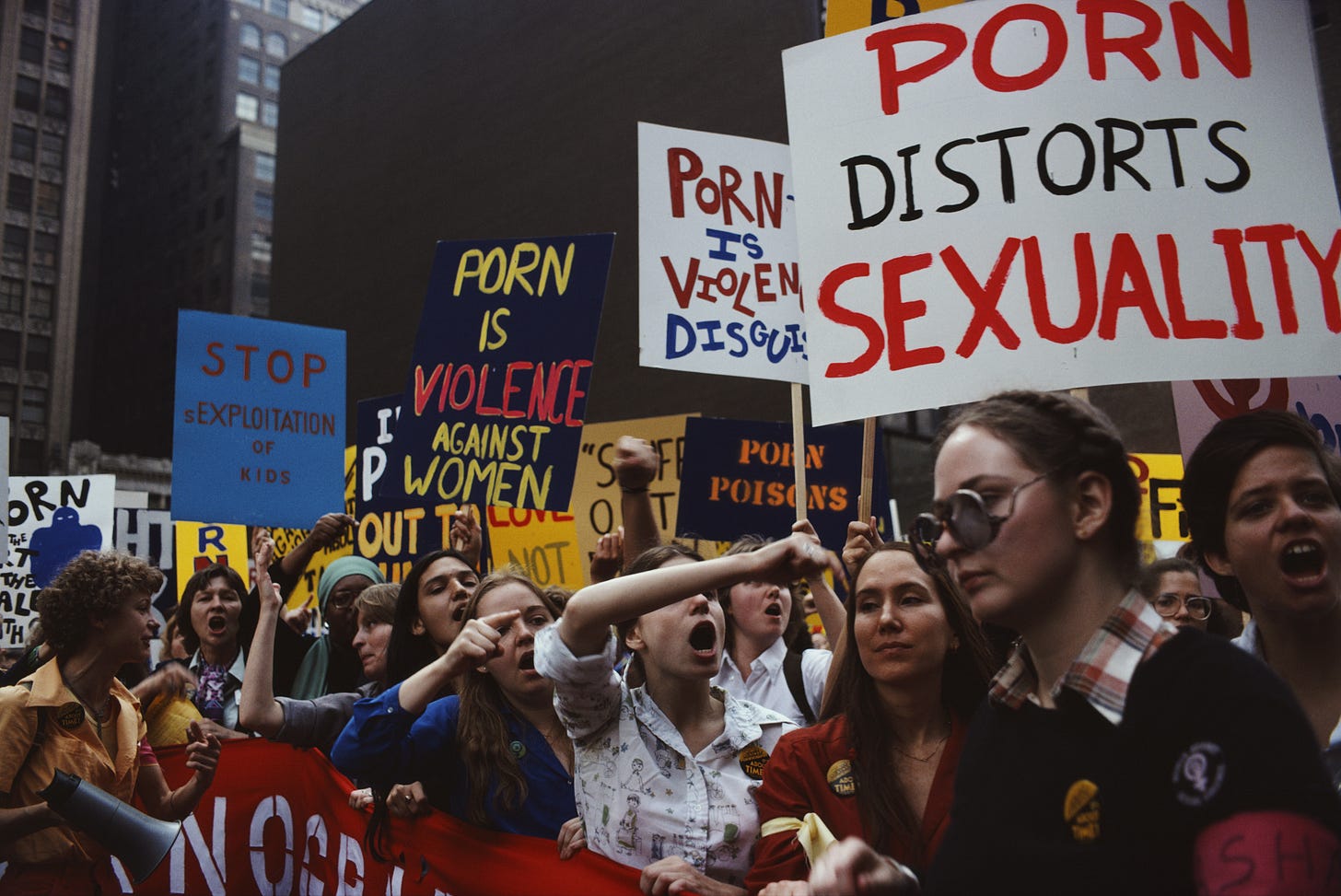

That’s why I keep saying, over and over, as often as possible—that radical feminism is not a threat to men but a gift to us. If we take feminism seriously, it offers us a way to let go of that fear of inadequacy, which creates the possibility that we can let go of our obsession with being real men and instead try to be fully human.

This is where most speakers offer the upbeat ending, the reminder that social change takes time, that others before us kept struggling after defeats, that we have no right to give up. I agree we have no right to give up, but I don’t think that platitudes help. My assessment is that things are going to get worse before they get better and that there is no guarantee they will get better. In addition to the many failures of human beings to treat each other with respect and compassion, we face unprecedented ecological collapse for which there are no simple solutions, and perhaps no solutions at all. Progressive social change is likely to be more difficult against that background.

Fifteen years ago when I wrote “pornography is what the end of the world looks like,” I meant that in pornography we can see what a world without empathy looks like, and societies devoid of empathy couldn’t continue indefinitely. Today, the high-energy/high-technology systems we take for granted are closer to the end than I could have imagined. Fear often keeps us from confronting both social hierarchies and ecological collapse, but failing to confront crises does not resolve crises.

I’ll end with one more personal experience, not exactly upbeat but honest. I now live in rural New Mexico, and one of my new friends is a young man who shares many of my concerns. Because I didn’t want to be the old guy who annoys young people with unwanted advice, I was at first hesitant to offer too many stories from my life. But I finally realized that he wanted those conversations, that he feels cut off from most men in his own generation as he and his partner try to craft a life that is humane and ecologically sane. That got me thinking about my late friend Koplin, and how more important to me than his analysis were his stories about his life choices, which had given me a sense that I could let go of trying to be a real man and find a way to be a decent person. His example of how to face harsh realities and yet live a fulfilling life was crucial to my embrace of radical feminism.

That’s a reminder that while it is good for men to practice humility—to talk less and listen more, to remember we don’t have all the answers—we have to open up to each other, both to hold each other accountable and to help each other deal with our lives. We have to talk more about ourselves, not out of self-indulgence but out of a commitment to challenge and care for each other.

Andrea was right: We have to do it ourselves.

-------------------------

Robert Jensen, an Emeritus Professor in the School of Journalism and Media at the University of Texas at Austin, is the author of It’s Debatable: Talking Authentically about Tricky Topics from Olive Branch Press. His previous book, co-written with Wes Jackson, was An Inconvenient Apocalypse: Environmental Collapse, Climate Crisis, and the Fate of Humanity. To subscribe to his mailing list, go to http://www.thirdcoastactivist.org/jensenupdates-info.html or visit

https://robertwjensen.org/


Email him at rjensen@austin.utexas.edu.

*A version of this essay was presented to the National Organization for Men Against Sexism’s 50th anniversary conference on July 17, 2025.*