Search This Blog

Showing posts sorted by date for query genocide. Sort by relevance Show all posts

Tuesday, January 6, 2026

End of an Era


[Editor's note: We have suspended our three decade long run of independent (muckraking) journalism and analysis and will let you know where we go from here. The 2024 lawsuit against founder/editor Dahn Shaulis (Chip Paucek and Pro Athlete Community v Dahn Shaulis) is pending. While the legal bill is enormous, we expect to win. In the meantime, please support independent voices like Richard WolffRoger SollenbergerJulie K. Brown, and Troy Barile.  #veritas]

******************************************************
#accountability #adjunct #AI #AImeltdown #alienation #Ambow #anomie #anxiety #austerity #BDR #bot #boycott #BRICS #charliekirk #China #civilwar #climate #collegemania #collegemeltdown #crypto #CTE #democracy #divest #doomloop #edtech #edugrift #enshittification #epstein #epsteinfiles #FAFSA #fascism #genocide #greed #IDR #incel #India #jobless #kleptocracy #labor #medugrift #moralcapital #NCAA #neoliberal #nokings #nonviolence #Palantir #protest #PSLF #PXED #QOL #rehumanization #resistance #robocollege #robostudent #roboworker #Russia #solidarity #strikedebt #surveillance #temperance #TPUSA #transparency #Trump #value #veritas #virtue #WWIII

*********************************************************

On our last full day of operation, we extend our deepest gratitude to the many courageous voices who have contributed to the Higher Education Inquirer over the years. Through research, reporting, whistleblowing, analysis, and public service, you have exposed inequities, challenged powerful interests, and helped the public understand the realities of higher education.

Special thanks to:
Bryan Alexander (Future Trends Forum), J. J. Anselmi (author), Devarian Baldwin (Trinity College),  Lisa Bannon (Wall Street Journal), Joe Berry (Higher Education Labor United), Kate Bronfenbrenner (Cornell)Stephen Burd (New America), Ann Bowers (Debt Collective), James Michael Brodie (Black and Gold Project Foundation), Patrick Campbell (Vets Ed Brief), Richard Cannon (activist), Kirk Carapezza (WGBH), Kevin L. Clay (Rutgers)Randall Collins (UPenn), Marianne Dissard (activist), Cory Doctorow, William Domhoff (UC Santa Cruz), Ruxandra Dumitriu, Keil Dumsch, Garrett Fitzgerald (College Recon), Glen Ford (with the ancestors), Richard Fossey (Condemned to Debt), Erica Gallagher (2U Whistleblower), Cliff Gibson III (Gibson & Keith), Henry Giroux (McMaster University), Terri Givens (University of British Columbia), Luke Goldstein (The Lever),  Nathan Grawe (Carleton College), Michael Green (UNLV), Michael Hainline (Restore the GI Bill for Veterans), Debra Hale Shelton (Arkansas Times), Stephanie M. Hall (Protect Borrowers),  David Halperin (Republic Report), Bill Harrington (Croatan Institute), Phil Hill (On EdTech), Robert Jensen (UT Austin), Seth Kahn (WCUP), Hank Kalet (Rutgers), Ben Kaufman (Protect Borrowers), Robert Kelchen (University of Tennessee), Karen Kelsky (The Professor Is In)Neil Kraus (UWRF), LACCD Whistleblower, Michelle Lee (whistleblower), Wendy Lynne Lee (Bloomsburg University of PA), Emmanuel Legeard (whistleblower), Adam Looney (University of Utah), Alec MacGillis (ProPublica), Jon Marcus (Hechinger Report), Steven Mintz (University of Texas), John D. Murphy (Mission Forsaken)Annelise Orleck (Dartmouth)Margaret Kimberly (Black Agenda Report), Austin Longhorn (UT student loan debt whistleblower), Richard Pollock (journalist), Debbi Potts (whistleblower), Jack Metzger (Roosevelt University), Derek Newton (The Cheat Sheet), Jeff Pooley (Annenberg Center), Fahmi Quadir (Safkhet Capital)Chris Quintana (USA Today)Jennifer Reed (University of Akron), Kevin Richert (Idaho Education News), Gary Roth (Rutgers-Newark), Mark Salisbury (TuitionFit), Stephanie Saul (NY Times), Christopher Serbagi (Serbagi Law), Alex Shebanow  (Fail State), Bob Shireman (TCF)Bill Skimmyhorn (William & Mary), Peter Simi (Chapman University), Jeffrey Sonnenfeld (Yale)Gary Stocker (College Viability), Strelnikov (Wikipedia Sucks), Taylor Swaak (Chronicle of Higher Education)Theresa Sweet (Sweet v Cardona), Harry Targ (Purdue University), Moe Tkacik (American Prospect),  Kim Tran (activist), Mark Twain Jr. (business insider), Michael Vasquez (The Tributary), Marina Vujnovic (Monmouth)Richard Wolff (Economic Update), Todd Wolfson (Rutgers, AFT)Helena Worthen (Higher Ed Labor United), DW (South American Correspondent), Heidi Weber (Whistleblower Revolution), Michael Yates (Monthly Review), government officials who have supported transparency and accountability, and the countless other educators, researchers, whistleblowers, advocates, and public servants whose work strengthens our understanding of higher education.

Together, you form a resilient network of knowledge, courage, and public service, showing that collective insight can illuminate even the most entrenched systems. Your dedication has been, and continues to be, invaluable.

Dahn Shaulis and Glen McGhee

From Lie to Myth: How January 6, 2021, Is Being Rewritten

Five years after the violent breach of the U.S. Capitol, January 6, 2021, is already being reframed. Once documented as an unprecedented attack on American democracy—captured in real-time video, congressional testimony, and thousands of contemporaneous reports—it is increasingly portrayed not as a factual event but as a malleable symbol in the service of ideology. Through selective memory, amplification of distortions, and the cultivation of doubt, some narratives depict the day as a “patriotic protest” or a “routine political demonstration gone awry,” erasing violence, shootings, and clear attempts to overturn a certified election.

This phenomenon mirrors a long-standing pattern in U.S. history education. Scholars such as James Loewen have documented how American history textbooks frequently sanitize or mythologize the past. In works like Lies My Teacher Told Me and Lies Across America, Loewen demonstrated that slavery, genocide, systemic oppression, and the struggles of marginalized peoples are often minimized, distorted, or omitted entirely. Textbooks present events in palatable, ideologically convenient ways, softening uncomfortable truths and creating myths that can shape generations’ understanding of history.

The parallels are striking. Episodes of slavery, genocide, and the oppression of indigenous peoples have long faced pressures to be simplified, sanitized, or celebrated as part of a “progressive” or patriotic narrative. These distortions often appear in children’s textbooks, turning lived suffering into background context or moral lessons rather than acknowledging systemic cruelty and resistance. The pattern establishes a precedent for reframing contemporary events, like January 6, in ways that normalize myth over fact.

This process is already visible in Texas and Florida. In Texas, the TEKS (Texas Essential Knowledge and Skills) standards were revised for 2024–2025, requiring students to study slavery and sectionalism. Critics, however, note that Texas textbooks historically minimized slavery as a cause of the Civil War and that initiatives like the 1836 Project promote celebratory narratives of state history, often downplaying oppression and Indigenous dispossession. In Florida, recent social-studies standards have described enslaved people as developing “skills which, in some instances, could be applied for their personal benefit,” a characterization widely criticized for sanitizing the brutality and systemic oppression of slavery. Florida has also rejected textbooks containing material deemed inconsistent with state standards on “social justice” or critical race theory. As a result, textbooks may present sanitized, recontextualized versions of history that obscure systemic injustice and human suffering.

The consequences are profound. When textbooks mythologize slavery, genocide, or oppression, they normalize the selective telling of history. Students may internalize incomplete or sanitized narratives, making it easier for future events to be reframed or mythologized. Once historical facts are treated as optional or negotiable, myth replaces reality; ideology displaces context; collective memory becomes selective. The rewriting of January 6 is only the latest iteration of a long-standing educational trend documented by Loewen and others: the molding of history to comfort, persuade, or conceal rather than to illuminate.

For educators, historians, journalists, and concerned citizens, the challenge is urgent. Preserving factual records, teaching critical thinking, and highlighting the mechanics of mythmaking are essential to resisting the erasure and distortion of history. January 6, like slavery, genocide, and other atrocities, demonstrates that when truth is optional, democracy itself is at risk. Recognizing the difference between lie, myth, and historical reality is not merely academic—it is central to defending memory, civic understanding, and the integrity of public discourse.


Sources

  1. Loewen, James. Lies My Teacher Told Me: Everything Your American History Textbook Got Wrong. New York: The New Press, 1995.

  2. Loewen, James. Lies Across America: What Our Historic Sites Get Wrong. New York: The New Press, 1999.

  3. Texas State Board of Education. 2024–2025 TEKS Social Studies Crosswalk (Kindergarten–Grade 8).

  4. “How some Texas parents and historians say a new state curriculum glosses over slavery and racism,” Texas Tribune, Nov. 18, 2024.

  5. Thomas B. Fordham Institute critique of 2010–2014 Texas history standards.

  6. “Florida’s new social‑studies standards on Black history stir outrage over embrace of ‘benefits,’” TIME, July 2023.

  7. Reporting on textbook rejections and curriculum restrictions in Florida under Governor Ron DeSantis.

  8. Wikipedia: The 1836 Project — background and aims.

  9. Studies and critiques of bias in curricula and textbooks — how history can be whitewashed, sanitized, or mythologized in official education materials.

Saturday, November 29, 2025

How Can Unions Defend Worker Power Under Trump 2.0? (Labor Notes)


Graphic featuring the photos of three speakers at the roundtable webinar.

WATCH: How Can Unions Defend Worker Power Under Trump 2.0?

With an emboldened Trump in the White House for a second term, the ground has shifted dramatically for unions. The labor movement, like many institutions, is scrambling to devise strategies to build power—or even just survive—during these challenging times.

This authoritarian consolidation of power is testing unions. What can unions do to survive in the second Trump presidency? What tactics and strategies can help unions organize larger numbers of new members and survive an all-out assault on labor and other rights?

Here's how Jackson Potter, Vice President of the Chicago Teachers Union, put it at our Roundtable Series webinar this month with Haymarket Books and The American Prospect:

"The labor movement is not even close to being extinguished. It just takes some spark, effort, initiative, and some vision and imagination to revive what seems to be dormant. We did that with CTU—in 2012, we engaged structures that had been moribund and petrified in bad practice, and revived them to a point where we were able to take on one of the most powerful politicians and beat him in Chicago. And that lent itself to a whole set of teachers taking action—even in red states, with the Red for Ed movement—and people were able to win big things that way."


Read the articles so far in our Roundtable Series

WATCH THE FULL WEBINAR HERE (Program starts at the 11:25 mark)
Subscribe to the Labor Notes Magazine!
Labor Notes December issues fanned out on top of each other.

In the December issue: 

New York's Working Class Elects a Movement Mayor, by Luis Feliz Leon
Zohran Kwame Mamdani, a Democratic Socialist and the Democratic nominee, will be New York City’s next mayor, after trouncing former Governor Andrew Cuomo in a primary and general election double whammy. Volunteers were galvanized by Mamdani’s relentless focus on the affordability crisis and principled stand against Israel’s unfolding genocide in Gaza.

Canadian Postal Workers Strike Again, by Danielle Smith
Canadian postal workers are back on strike—again—as they fight to save a vital public service. “By staying on the job and continuing to wait for demoralizing offers, we show that we accept this, we’re not going to fight. So we decided we’re going out,” said Nova Scotia letter carrier Basia Sokal. 

Indiana Casino Dealers Are Bringing Back the Recognition Strike, by Alexandra Bradbury
There are no clocks in a casino, so the dealers all set their phone alarms for noon. Everyone was a bundle of nerves. Before work, a couple of people threw up.

But when the cacophony of alarms sounded, everyone lifted their hands in the air, slammed down the lids on their games of baccarat, blackjack, craps, and roulette, and announced they were on strike. “It was more powerful than anything I’ve ever felt in my life,” said dealer Tera Arnold. “I had goosebumps head to toe.”

PLUS: Articles published so far in our Roundtable Series: How Can Unions Defend Worker Power Under Trump 2.0?, a Stewards' Corner on welcoming immigrant members into the union, and more! 

Get the Labor Notes Magazine — $30 a year for 11 issues. 


If you'd like a bunch of copies to share with co-workers and members of your community, order a bundle, which starts at $50 a year to receive 5 copies a month!

Subscribe by Tuesday, December 9, to receive our January issue! 
Get Your Copy of the Labor Notes Magazine!
In solidarity,
Labor Notes Staff

Thursday, November 27, 2025

America Under Fire: Political Violence, Systemic Oppression, and the Role of Higher Education

The ambush shooting of two National Guardsmen near the White House on November 27, 2025, by Rahmanullah Lakanwal, a 29-year-old Afghan national, is the latest in a growing wave of politically motivated violence that has engulfed the United States since 2024. Lakanwal opened fire on uniformed service members stationed for heightened security, wounding both. Federal authorities are investigating whether ideological motives drove the attack, which comes against a backdrop of escalating domestic and international tensions. This ambush cannot be understood in isolation. It is part of a larger pattern of domestic political violence that has claimed lives across ideological lines. 

Conservative activist Charlie Kirk was assassinated at Utah Valley University during a campus event in September 2025. Minnesota state representative Mary Carlson and her husband were murdered in their home by a man impersonating law enforcement, while a state senator and spouse were injured in the same spree. Governor Josh Shapiro survived an arson attack on his residence earlier this year. Even Donald Trump was the target of an assassination attempt in July 2024. Added to this grim tally are incidents such as the 2025 Manhattan mass shooting, in which young professionals, including two Jewish women, Julia Hyman and Wesley LePatner, were killed, and the Luigi Mangione case, in which a former student allegedly killed a corporate executive in New York. Together, these incidents reveal a nation in which lethal violence increasingly intersects with politics, identity, and ideology.

The domestic escalation of violence cannot be separated from broader structures of oppression. Migrants and asylum seekers face detention, family separation, and deportation under the authority of ICE, often in conditions described as inhumane, creating fear and vulnerability among refugee communities. Routine encounters with law enforcement disproportionately harm Black, Indigenous, Latinx, and other marginalized communities. Excessive force and lethal policing add to communal distrust, reinforcing perceptions that violence is a sanctioned tool of the state. Political rhetoric compounds the problem. President Trump and other political leaders have repeatedly framed immigrants, political opponents, and even students as threats to national security, implicitly legitimizing aggressive responses and providing fodder for extremist actors.

The domestic situation is further complicated by U.S. foreign policy, which has often contributed to global instability while modeling the use of violence as an instrument of governance. In Palestine, military aid to Israel coincides with attacks on civilians and infrastructure that human-rights organizations describe as ethnic cleansing or genocide. In Venezuela, U.S. sanctions, threats, and proxy operations have intensified humanitarian crises and political instability. Complicity with the governments of the UAE, Saudi Arabia, and Russia enables human-rights abuses abroad while emboldening domestic actors who mimic state-sanctioned violence. These global policies reverberate at home, influencing public discourse, shaping extremist narratives, and creating a climate in which political and ideological violence is increasingly normalized.

Higher education sits at the nexus of these domestic and global pressures. Universities and colleges are not merely observers; they are active participants and, in some cases, victims. The assassination of Charlie Kirk on a campus underscores that institutions of learning are no longer insulated from lethal political conflict. Alumni, recent graduates, and professionals—such as the victims of the Manhattan shooting—are affected even after leaving school, revealing how closely academic networks intersect with broader societal risks. International and refugee students, particularly from Afghan and Middle Eastern communities, face heightened anxiety due to restrictive immigration policies, anti-immigrant rhetoric, and the real threat of violence. Faculty teaching topics related to immigration, race, U.S. foreign policy, or genocide are increasingly targeted by harassment, threats, and institutional pressures that suppress academic freedom. The cumulative stress of political violence, systemic oppression, and global conflicts creates trauma that universities must address comprehensively, both for students and faculty.

Higher education cannot prevent every act of violence, nor can it resolve the nation’s deep political fractures. But it can model ethical and civic engagement, defending inquiry and speech without succumbing to fear or political pressure. It can extend support to vulnerable communities, promote critical thinking about the domestic roots of political violence and the consequences of U.S. foreign policy, and foster ethical reflection that counters the normalization of aggression. Silence or passivity risks complicity. Universities must recognize that the threats affecting campuses, alumni, and students are interconnected with broader systems of power and oppression, both domestic and global.

From the White House ambush to Charlie Kirk’s assassination, from the Minnesota legislators’ murders to the Manhattan mass shooting, from Luigi Mangione’s high-profile killing to systemic violence enforced through ICE and police overreach, and amid the influence of incendiary political rhetoric and U.S. complicity in violence abroad, the United States is experiencing an unprecedented convergence of domestic and international pressures. Higher education sits at the center of these converging forces, and how it responds will shape not only campus safety and academic freedom but also the broader civic health of the nation. The challenge is immense: to uphold democratic values, protect communities, and educate students in a society increasingly defined by fear, extremism, and violence.


Sources

Reuters. “FBI probes gunman’s motives in ambush shooting of Guardsmen near White House.” The Guardian. Coverage on suspect identification and political reaction. AP News. Statements by national leaders following attacks. Washington Post. Analysis of domestic violent extremism and political violence trends. People Magazine. Reporting on Minnesota legislator assassination. NBC/AP. Statements by Gov. Josh Shapiro after Charlie Kirk’s killing. Utah Valley University and local ABC/Fox affiliates on the Kirk shooting. Jewish Journal, ABC7NY. Coverage of Manhattan mass shooting and Jewish victims. Reuters. Luigi Mangione case and court proceedings. Human Rights Watch / Amnesty International reports on Palestine, Venezuela, UAE, Saudi Arabia, and Russia. Brookings Institute. Analysis of political violence and domestic extremism. CSIS. “Domestic Extremism and Political Violence in the United States.”

Friday, October 31, 2025

The US Government Shutdown: "Let Them Eat Cheese"

The stock market is up. Politicians beam on cable news about “economic resilience.” But on the ground, the picture looks very different. Jobs are scarce or unstable, rents keep rising, and food insecurity is back to 1980s levels. The government shutdown has hit federal workers, SNAP recipients, and service programs for the poor and disabled. And what does Washington offer the hungry? Cheese—literally and metaphorically.

Government cheese once symbolized a broken welfare system—a processed product handed out to the desperate while politicians preached self-reliance. Today’s version is digital and disembodied: food banks filled with castoffs, online portals for benefits that don’t come, “relief” programs that require a master’s degree to navigate. People are told to be grateful while they wait in line for what little is left.

Meanwhile, the headlines celebrate record-breaking stock prices and defense contracts. Billions flow abroad to Argentina, Ukraine, and Israel—especially Israel, where U.S. aid underwrites weapons used in what many describe as genocide in Palestine. Corporate media downplay it, politicians justify it, and dissenters are told they’re unpatriotic.

In the U.S., the old cry of “personal responsibility” masks the reality of neoliberal economics—a system that privatizes profit and socializes pain. When the government shuts down, it’s the poor who feel it first. The “educated underclass”—graduates burdened by debt, adjuncts working without benefits, laid-off professionals—are just a few missed paychecks away from standing in the same line for government cheese.

Yet many Americans don’t see who the real enemy is. They turn on one another—Democrats versus Republicans, urban versus rural, native-born versus immigrant—while the architects of austerity watch from gated communities. The spectacle distracts from the structural theft: trillions transferred upward, democracy traded for debt, justice sold to the highest bidder.

“Let them eat cheese” is no longer a historical joke. It’s the bipartisan message of a political class that rewards Wall Street while abandoning Main Street. And as long as the public stays divided, hungry, and distracted, the pantry of power remains locked.


Sources

  • U.S. Department of Agriculture (USDA). “Household Food Insecurity in the United States in 2024.”

  • Gary Roth. "The Educated Underclass." 

  • Congressional Budget Office (CBO). “Economic Effects of a Government Shutdown.”

  • Federal Reserve Bank of St. Louis. “Wealth Inequality and Stock Market Concentration.”

  • The Intercept. “How U.S. Weapons and Aid Fuel the Assault on Gaza.”

  • Associated Press. “Food Banks Report Record Demand Amid Inflation.”

  • Jacobin Magazine. “Neoliberalism and the Return of American Austerity.”

  • Reuters. “U.S. Sends Billions in Loans and Aid to Argentina.”

  • Economic Policy Institute (EPI). “Wage Stagnation and the Cost of Living Crisis.”

Wednesday, September 17, 2025

Pedagogies of Repression: Ford, Trump and the War on Education (Henry A. Giroux and William Paul)

Analyses of fascism too often fixate on its most spectacular expressions: staggering inequality, systemic racism, the militarization of daily life, unbridled corruption, monopolistic control of the media, and the concentration of power in financial and political elites. Fascism thrives on a culture of fear and racial cleansing and the normalization of cruelty, lies, and state violence. Yet what is often overlooked is how culture and education now function as decisive forces in legitimating these authoritarian passions and in eroding democratic commitments. As Hannah Arendt, Jason Stanley, Richard Evans, Chris Hedges, and others remind us, the protean origins of fascism are never fully buried; they return in altered and often disguised forms, seeping into everyday life and reshaping the common sense of a society.

Under US President Donald Trump, we face a terrifying new horizon of authoritarian politics: the erosion of due process, mass abductions, vicious attacks on higher education, and the steady construction of a police state. Canada has not yet descended into such full-fledged authoritarianism, but troubling echoes are undeniable. Public spaces and public goods are under assault, book bans have appeared in Alberta, languages of hate increasingly target those deemed disposable, the mass media bends to corporate interests, labour is suppressed, and democratic values are met with disdain. These may not replicate the worst horrors of the past, but they reveal how culture and education become the terrain upon which democracy is dismantled and authoritarianism gains legitimacy. These are warning signs of a gathering darkness that must be confronted before they harden into something far more sinister.

Culture and Pedagogy

Fascism thrives not only on brute police power, prisons, or economic violence but also on culture and pedagogy. Culture has increasingly become a site in the service of pedagogical tyranny. It works through erasure and repression, through memory stripped of its critical force, and through dissent silenced in the name of order. Fascism is never solely a political or economic system; it is a pedagogical project, a machinery of teaching and unlearning that narrows the horizon of what can be said, imagined, or remembered.

Today authoritarianism seeps insidiously into everyday life, embedded in seemingly obvious maneuvers that consolidate power under the guise of technical or bureaucratic necessity. Its mobilizing passions often emerge unobtrusively in maneuvers that hide in the shadows of the mundane, often at the level of everyday experience.

This creeping logic is starkly visible in Ontario, where Doug Ford’s Progressive Conservative (PC) government has moved to seize control of local school boards. What may look like routine administrative measures should be read as a warning: authoritarianism does not arrive only with grandiose spectacles or open attacks on democracy’s foundations; it gains ground quietly, through the erosion of the ordinary, the capture of the local, and above all, through the weaponization of education as a tool to dismantle democracy itself.

The Ford government’s seizure of the Toronto, Toronto Catholic, Ottawa-Carleton, and Dufferin-Peel Catholic district school boards is extraordinary, even for this democracy-averse regime. Education Minister Paul Calandra has even mused about eliminating trustees altogether before the 2026 local elections, declaring “Everything is on the table.” His justification that Ontario’s Ministry of Education (MOE) has allowed them to make too many decisions on their own is both unsupported and revealing. It exposes a deeper authoritarian project: the desire to centralize power and strip away democratic oversight from institutions closest to local communities. It curbs liberal instincts of trustees who see first-hand the vast diversity of lives and needs of the families who rely on their schools.

This is precisely how authoritarian control operates: by eroding intermediary structures that connect people to power. Just as Donald Trump sought to bend national cultural institutions like the Smithsonian Museum to his will, Ford dismantles the modest democratic functions of trusteeship. Both cases illustrate how authoritarianism works through the fine print of governance as much as through grandiose pronouncements.

Manufactured Deficits and Structural Starvation

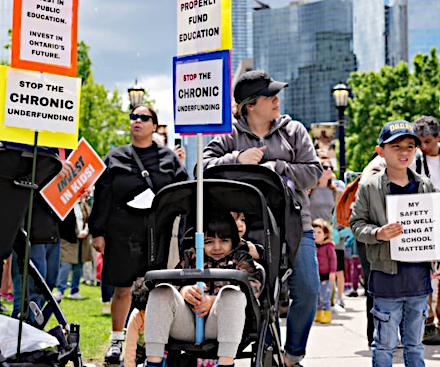
The pretext for takeover was financial mismanagement. Yet none of the investigators found evidence of serious fiscal incompetence. The truth is that boards submitted balanced budgets year after year but only after slashing programs and services, closing outdoor education centres, selling property, cutting staff, and raising fees. What really drives their fiscal crises is a decades-old funding model – first imposed by the Mike Harris PC government in 1997 – that shifted resources from local taxes to provincial grants. This was not a move toward equitable funding; these were neoliberals of the first order who believed in central control of funding so they could squeeze school boards and education workers to contain costs.

This model, based on enrolment rather than actual need, starved boards of resources for special education, transportation, salaries, and infrastructure.1 For instance, school boards don’t get funding for actual children who need special education support but rather on the basis of a predictive model MOE devised. Boards pay for the kids MOE doesn’t fund. The Ford government hasn’t funded the full increase for statutory teacher benefits for years, leaving boards short by millions. The result is a structural deficit: chronic underfunding that leaves even well-managed boards teetering on insolvency. The Ford government, while claiming to increase spending, has in fact cut funding per student by $1,500 in real terms since 2018. This is the problem faced by with 40 percent of Ontario school boards.

It is this manufactured insolvency that led Minister Calandra to get the most out of a useful crisis and put the four school boards under supervision and maybe next eliminate all school boards in the province. Here we see neoliberal austerity converging with authoritarian ambition. Underfunding is not a policy mistake; it is a deliberate strategy to weaken public education, undermine trust in democratic institutions, and prepare the ground for privatization schemes such as vouchers and charter schools. In this instance, the policy of underfunding is a way of weakening public education and then blaming whatever problems occur on education itself. This is gangster capitalism at work, cloaked in the language of fiscal responsibility but fueled by a pedagogy of dispossession.

Eliminating Trustees, Silencing Communities

If board takeovers were simply about money, supervisors would have been told to just find savings. Instead, elected trustees were suspended, their offices shuttered, their tiny stipends cut off, and their ability to communicate with constituents forbidden. Calandra’s power grab has all the elements of Elon Musk’s DOGE assaults in the US: move fast, offer absurd excuses, and blame the victims. The supervisors replacing trustees – accountants, lawyers, and former politicians with no background in education – now wield greater power than the elected community representatives they displaced.

This substitution of technocrats for democratically accountable representatives is part of fascism’s pedagogy. It teaches the public to accept disenfranchisement as efficiency, to see obedience as order. Parents who ask why a program disappeared or why their child’s special education class has grown larger are now met with silence. In this vacuum, the lesson learned is that participation is futile and resistance meaningless – precisely the kind of civic numbing oligarchic fascism requires.

Command, Control, and the Policing of Education

Ford’s government frames these takeovers as a “broader rethink” of governance, but the real project is clear: the imposition of command and control over education. This move sends a strong message that it’s time to duck our heads and get back to basics: teaching “reading, writing, spelling, and arithmetic and the whole shebang…” as Doug Ford complained last fall after teachers and students attended a rally in support of the Grassy Narrows First Nation and its efforts to deal with generations of mercury contamination in their area. He proclaimed, with no evidence, that the field trip was “indoctrination” by teachers because activists protesting Israeli genocide were present. Community members who supported an Indigenous curriculum, modern sexual education, or even school-name changes honoring anti-colonial figures are dismissed or painted as obstacles. The message from Ford and Calandra is blunt: stick to the basics – reading, writing, arithmetic – and leave politics at the door.

Yet politics hangs over classrooms like a shroud. Despite his Captain Canada complaints about the Trump tariffs, Ford admires the President quick-marching America toward fascism. In an off-mic moment he commented recently: “Election day, was I happy this guy won? One hundred per cent I was.” It’s not the racism, the authoritarianism, the compulsive lying, the fraud, the sexual assaults that bothers the Premier; it’s that he got stiffed by his friend.

Usurping trustees according to University of Ottawa professor Sachin Maharaj is just another step toward the Progressive Conservatives’ goal to “squelch the pipeline of more progressive leaders”2 like those gaining notice and experience attending to the needs of local schools.

The banning of the Toronto Muslim Student Alliance’s screening of the film No Other Land, which documents Israeli settler violence, shows how censorship now masquerades as neutrality. This is the pedagogy of repression in action: narrowing what can be taught, remembered, or discussed until education is reduced to obedience training. What parades as a “broader rethink” is part of the authoritarian language of censorship and control. Like Trump’s attacks on “critical race theory” or his censorship of the Smithsonian, Ford’s moves are not about protecting students from politics but about protecting power from critique. The real issue here is constructing authoritarian policies that narrow critical thinking, teacher autonomy, essential funding, and knowledge that enable schools to both defend and facilitate democracy.

For Ford and his adherents, the real issue is not that schools are failing but that they are public and have a vital role to play in a democracy. The real threat to Ford is that a democracy can only exist with informed citizens. Yet that is precisely the role education should assume.

Bill 33: Codifying Authoritarianism

The perversely named Bill 33, the Supporting Children and Students Act extends this authoritarian logic. It allows the Minister to investigate boards or trustees on the mere suspicion they might act “inappropriately” or against the “public interest” – an elastic phrase that grants unchecked power. It checks much-maligned Diversity Equity and Inclusion efforts by refusing boards the right to name schools, forcing them to abandon diversity-affirming figures in favor of colonial or sanitized names. It mandates the reintroduction of police officers into schools, despite community opposition to surveillance and “unaccountable access to youth by cops.”3

At work here is the legacy of colonialism, a legacy that is terrified of diversity, of those deemed other, being able to narrate themselves. Viewed as threat, this anti-democratic language ultimately falls back on issues of control and security. This is one instance of how authoritarianism consolidates itself, not through tanks in the streets but through legislation that transforms education into an arm of the security state. Pedagogical spaces are militarized, memory is policed, and students are taught that surveillance is normal and dissent dangerous.

Trumpasitic Authoritarianism

Ford’s methods echo those of his southern counterpart. Just as Trump’s politics thrive on dispossession, erasure, and the weaponization of culture, Ford borrows from the same authoritarian playbook. The takeover of school boards not only tightens political control but also grants easy access to billions of dollars in public land, enriching developers tied to his government.4 Here, neoliberal profiteering fuses seamlessly with authoritarian centralization, an example of the merging of gangster capitalism with the pedagogy of repression.

What do you expect from a government that makes decisions reflecting the arrogance of power? The Ford government cut Toronto city council in half soon after took office in 2018 and threatened to use a constitutional override, the Notwithstanding Clause, Section 33 of Canada’s Charter of Rights and Freedoms, to overturn a Superior Court justice’s decision that the move was unconstitutional. Ford actually used the clause to push through a bill restricting election advertising in 2021 and again, pre-emptively, in 2022, buttressing back-to-work legislation against striking public workers, among the lowest paid in the province. He’s considering using it again after his decision to remove bike lanes from Toronto streets was overturned in court; power makes you petty.

Democracy in the Smallest Details

The takeover of Ontario school boards may appear less dramatic than Trump’s assaults on national institutions, but its implications are just as dire. Authoritarianism advances not only through spectacle but through the slow erosion of local democratic practices that once seemed secure.

If fascism is a pedagogy of fear, amnesia, and conformity, then resistance must be a pedagogy of memory, solidarity, and imagination. To defend education is to defend democracy itself, for schools are not simply sites of instruction but laboratories of citizenship, places where young people learn what it means to speak, to question, to remember, and to act. When trustees are silenced, when curricula are censored, when communities are stripped of their voice, what is lost is not only oversight but the very possibility of democratic life.

What is at stake, then, is far larger than budget shortfalls or bureaucratic reshuffling. It is whether the future will be governed by communities or dictated from above by those who mistake obedience for learning and silence for peace. Fascism thrives in these small erasures, in the details that seem technical until they harden into structures of domination.

The lesson could not be clearer: democracy dies in increments, but it can also be rebuilt in increments – through collective memory, through civic courage, through the refusal to allow education to become a weapon of obedience. To resist the Ford government’s authoritarian incursions is not only to protect local school boards; it is to reclaim the very ground on which democratic hope stands. •

Endnotes

  1. Dan Crow, The Consequences Of A Neoliberal Funding Formula, Canadian Centre for Policy Alternatives, Fall/Winter 2018.
  2. Sachin Maharaj, Interview August 26, 2025
  3. Andrea Vásquez Jiménez, Interview June 7, 2025.
  4. William Paul, “Riding the Gravy Train” in Against the People: How Ford Nation is Dismantling Ontario, eds: Brian Evans, Carlo Fanelli, Fernwood Publishing, 2024.

Henry A. Giroux currently is the McMaster University Professor for Scholarship in the Public Interest and The Paulo Freire Distinguished Scholar in Critical Pedagogy. His most recent books include The Violence of Organized Forgetting (City Lights, 2014), Dangerous Thinking in the Age of the New Authoritarianism (Routledge, 2015), coauthored with Brad Evans, Disposable Futures: The Seduction of Violence in the Age of Spectacle (City Lights, 2015), and America at War with Itself (City Lights, 2016). His website is henryagiroux.com.

William Paul is editor of School Magazine website.

This article first appeared at the Social Project Bullet